Our readers keep the lights on and my smoothie glass nicely filled. As an Amazon Associate, I earn from qualifying purchases.
A domestic paint sprayer can either turn a weekend project into a triumph of smooth, even coverage or an afternoon of frustration with clogs, spits, and drips. The difference comes down to matching the tool’s motor power, nozzle range, and viscosity tolerance to the actual paint you plan to spray, from thick latex on a fence to thin lacquer on a cabinet door.
I’m Mohammad Maruf — the founder and writer behind WellFizz. I’ve spent dozens of hours analyzing motor wattage, brass versus plastic nozzle construction, cleaning protocols, and real-world customer experiences across seven HVLP and airless sprayers to pin down which models actually deliver on their promises for home projects.
Whether you are painting a fence, refinishing furniture, or rolling out fresh color on interior walls, the best domestic paint sprayer must balance atomization quality, cleanup speed, and material compatibility to make your job faster without sacrificing the final finish.
How To Choose The Best Domestic Paint Sprayer
Picking the wrong sprayer can turn a simple painting project into a cleanup nightmare. Focus on three areas that define real-world performance: the spray technology, the nozzle setup, and the motor’s ability to handle the paint you actually use at home.
HVLP vs. Airless for home use
HVLP (High Volume, Low Pressure) sprayers use a turbine to push a large volume of air at low pressure, giving you more control and less overspray. These are ideal for furniture, cabinets, trim, and lighter stains. Airless sprayers use a piston pump to pressurize paint directly, allowing them to spray unthinned latex and cover large areas like exterior walls and fences much faster, but with more overspray and a bigger learning curve.
Nozzle selection and material compatibility
The tip size determines what you can spray without thinning. A 1.0 mm to 1.5 mm nozzle works for stains, varnishes, and lacquers. A 2.0 mm tip suits chalk paint and latex, while 3.0 mm to 4.0 mm tips handle thick primers and heavy latex. Brass nozzles resist wear better than plastic options and produce a more consistent fan pattern over time.
Motor power and cleanup design
Motor wattage in HVLP units ranges from 450W to 800W; higher wattage typically means better atomization of thicker paints and less need for thinning. For airless models, PSI (pressure) and GPM (flow rate) tell you how fast the machine can push paint. Cleanup design matters equally — quick-detach nozzles, flush valves, and accessible fluid paths separate sprayers you’ll actually use again from those you’ll leave in the garage.
Quick Comparison
On smaller screens, swipe sideways to see the full table.
| Model | Category | Best For | Key Spec | Amazon |
|---|---|---|---|---|
| Wagner FLEXiO 595 | HVLP | Versatile indoor/outdoor finishing | Dual iSpray & Detail Finish nozzles | Amazon |
| InoKraft MaXpray M1 Airless | Airless | Large walls, fences, and exteriors | 3000 PSI / 0.29 GPM | Amazon |
| Tilswall Shark 800 HVLP | HVLP | Furniture, cabinets, and fences | 800W motor / 4 brass nozzles | Amazon |
| Batavia 700W Split-Design HVLP | HVLP | Reduced fatigue for long projects | 700W motor / detachable gun (1 lb) | Amazon |
| HomeRight Super Finish Max | HVLP | DIY trim, doors, and small furniture | 450W / 3 brass tips (1.5-4.0 mm) | Amazon |
| Tilswall Shark 700 Cordless | HVLP | Portable jobs without power outlets | 90,000 RPM brushless motor | Amazon |
| Wagner Control Spray QX2 | HVLP | Stains and light-bodied liquids | 3 spray patterns / adjustable flow | Amazon |
In‑Depth Reviews
1. Wagner Spraytech FLEXiO 595
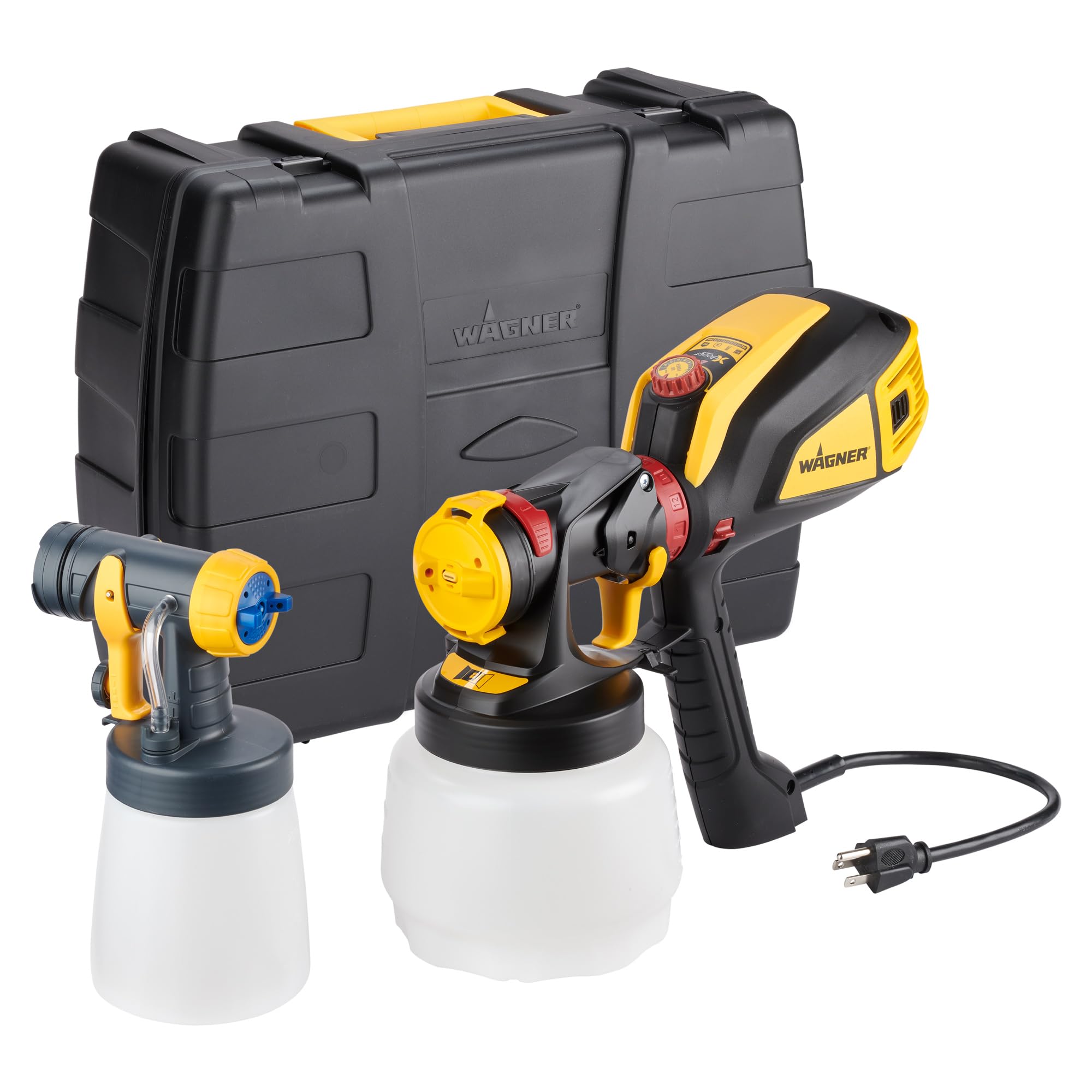
The Wagner FLEXiO 595 is the most versatile single-unit sprayer for homeowners who paint everything from cabinets to exterior siding. It ships with two distinct nozzle systems: the iSpray nozzle handles unthinned latex and thick stains on broad surfaces, while the Detail Finish nozzle delivers a tight fan for trim and furniture. The X-Boost turbine produces enough air volume to atomize heavy-bodied paints without a separate thinning step, which eliminates the biggest friction point with lower-power HVLP units.
Nine speed settings let you dial in the air output from a whisper-light mist for fine lacquer to full power for latex on a fence. The spray width is adjustable in both direction and pattern, so you can narrow the fan for a chair spindle or widen it for a wall section. The unit is 10 percent lighter than earlier FLEXiO models, which noticeably reduces forearm fatigue during a full-day project. The bonus cup liner simplifies cleanup — peel it out and rinse instead of scrubbing the cup interior after every color change.
Real users report that thick deck stains spray beautifully without dilution, completing jobs in a quarter of the time rolling would take. The trade-off is that the nozzle can clog during long sessions with thick paint, so keeping a container of soapy water nearby for quick tip cleaning is recommended. The weight is still noticeable when the cup is full, and the transformer requirement for 220V regions adds a step for international buyers.
Why it’s great
- Sprays unthinned latex and thick stains without issues
- Two interchangeable nozzle systems cover broad surfaces and detail work
- Nine power settings give precise control over air volume and finish
Good to know
- Nozzle tip can clog during extended use with heavy paint
- Requires a step-down transformer for 220V power regions
- Full cup adds noticeable weight during prolonged overhead work
2. InoKraft MaXpray M1 Airless

The InoKraft MaXpray M1 is a corded airless sprayer that brings pro-grade pressure to domestic projects without the pro-grade price tag. Its 550W motor generates 3000 PSI at 0.29 GPM, which is enough power to spray unthinned latex and acrylic straight from a five-gallon bucket. The AtoMax 515 carbide reversible tip handles clog clearing with a simple flip — no disassembly required — and the 360-degree swivel joint on the gun makes maneuvering around corners and eaves noticeably easier than a rigid connection.
Setup takes about 15 minutes with the laminated Quick Start Guide, and the Flush-Ease valve connects directly to a garden hose for flushing the system without full pump disassembly. The 25-foot hose provides good reach for one-story exterior work, and the included 12-inch tip extension helps access ceilings and tall eaves. The pump draws from a five-gallon bucket directly, which means fewer refills and less downtime compared to cup-fed HVLP units when painting large wall areas.
Customers consistently report painting entire interiors — living rooms, hallways, and kitchens — in under three hours with consistent coverage. The plastic hose has some memory that causes coiling, which can be annoying during setup. A few users experienced stray spray from the nozzle nut area, which was resolved by fully seating the tip. The pump is significantly heavier than handheld HVLP units at over 22 pounds, and the learning curve for controlling overspray requires practice on scrap material first.
Why it’s great
- Sprays unthinned latex and acrylic from a five-gallon bucket
- Reversible carbide tip clears clogs with a quick flip
- Flush-Ease valve enables fast garden-hose cleanup
Good to know
- Heavy unit at over 22 pounds; not ideal for portable use
- Plastic hose retains coil memory straight from the package
- Steep learning curve for controlling overspray on large surfaces
3. Tilswall Shark 800 HVLP

The Tilswall Shark 800 delivers 800 watts of motor power in a split-body HVLP design, putting it among the most powerful consumer-class handheld sprayers on the market. The 800W motor atomizes paints up to 120 Din-S viscosity, which means it handles thicker latex and chalk-type paints with less thinning than typical 450W units. The side-feed paint container is a genuinely useful innovation — you can add paint without unscrewing the lid, which reduces mess and refill time during a project.
The kit includes four brass nozzles spanning 1.0 mm to 3.0 mm, giving you fine control from thin stains up to heavy primers. The three spray patterns (horizontal oval, vertical oval, and round) cover the standard positioning needs for furniture, fences, and walls. An 8.2-foot air hose and 9.8-foot power cord provide a decent working radius, and the shoulder strap offloads the motor weight from your hand during extended sessions.
Real buyers praise the smooth, glass-like coverage achievable when the paint is properly thinned and the smallest nozzle is used with minimal trigger pull. Some users report more overspray than expected, particularly at higher flow settings, so masking and drop cloths are essential. The learning curve is real — first-time users benefit from practicing on cardboard to dial in the flow control knob before hitting the project surface.
Why it’s great
- 800W motor handles thick paints with minimal thinning
- Side-feed container allows quick, mess-free refills
- Four brass nozzles cover stain-to-primer viscosity range
Good to know
- Overspray can be heavy at higher flow settings
- Requires paint thinning and viscosity cup use for best results
- Learning curve for precise flow control and pattern shaping
4. Batavia 700W Split-Design HVLP

The Batavia 700W HVLP sprayer uses a split-body design that separates the heavy motor unit from the spray gun, connected by a 6.5-foot flexible air hose. The handheld gun weighs only one pound, which dramatically reduces arm fatigue during jobs that require prolonged spraying — a real advantage over integrated handheld units that put the full motor weight in your hand. The 700W motor delivers double the PSI of standard models, according to the manufacturer, with a 50 percent reduction in atomized particle size that contributes to a smoother final coat.
Four nozzle sizes from 1.0 mm to 3.0 mm cover the range from lacquer and sealer up to latex and chalk-type paints. The 360-degree anti-backflow design is intended to prevent the clogging that plagues many budget sprayers, and the visible fluid path lets you spot blockages during operation. ETL certification provides reassurance on electrical safety, and the 24-month warranty is above average for this price tier.
Customer reports indicate the unit lays down Behr exterior stain flawlessly and uses less paint than a previous Graco airless. The nozzle can clog after refills — a quick wipe clears it. The stationary motor unit must be placed on a flat surface, which limits mobility compared to a fully integrated handheld. The gun body feels solid, but the cleaning needle and brush are small and require patience to fully clear dried paint from the tip.
Why it’s great
- Detachable one-pound gun reduces hand fatigue significantly
- 700W motor atomizes paint into fine particles for smooth results
- Anti-backflow design and visible fluid path reduce clog frequency
Good to know
- Motor unit must sit on a flat surface; limits on-the-go mobility
- Nozzle can clog after refills; quick cleaning required
- Cleaning tools are small and require thorough manual effort
5. HomeRight Super Finish Max

The HomeRight Super Finish Max has been a staple in the DIY community for years, and its 450W motor paired with three brass spray tips gives it a durability edge over units relying on plastic nozzles. The included tips span 1.5 mm (stains and sealers), 2.0 mm (latex and chalk paint), and 4.0 mm (primer and thick latex), so you can switch between material types without buying additional accessories. The material flow control knob and adjustable air cap provide horizontal, vertical, and round patterns, which covers the basics for furniture, cabinets, and trim.
Experienced DIYers report that the sprayer produces factory-quality finishes on doors and trim when used with quality paint like Benjamin Moore. The key is thinning the paint slightly and straining it before filling the cup — a step that prevents the occasional spitting that some reviewers note. The two-year warranty and U.S.-based customer service are meaningful advantages if you need a replacement part down the line.
The 450W motor is adequate for stains and thinner latex, but it struggles with heavy-bodied paints without significant thinning, and the cup size at 40 fluid ounces requires frequent refills on larger projects. Some users find the strong airflow dislodges lightweight drop cloths, so weighing them down with tape is recommended. Cleanup is straightforward but requires diligence — leaving paint in the nozzle overnight risks hardened clogs that are difficult to clear.
Why it’s great
- Three brass spray tips outlast plastic competitors and cover stain to primer
- Two-year warranty with U.S.-based customer service
- Consistent finish on trim, doors, and cabinets when paint is properly thinned
Good to know
- 450W motor needs thinning for thick latex paints
- Strong airflow can blow away lightweight drop cloths without tape
- Small cup requires frequent refills on larger furniture or wall projects
6. Tilswall Shark 700 Cordless
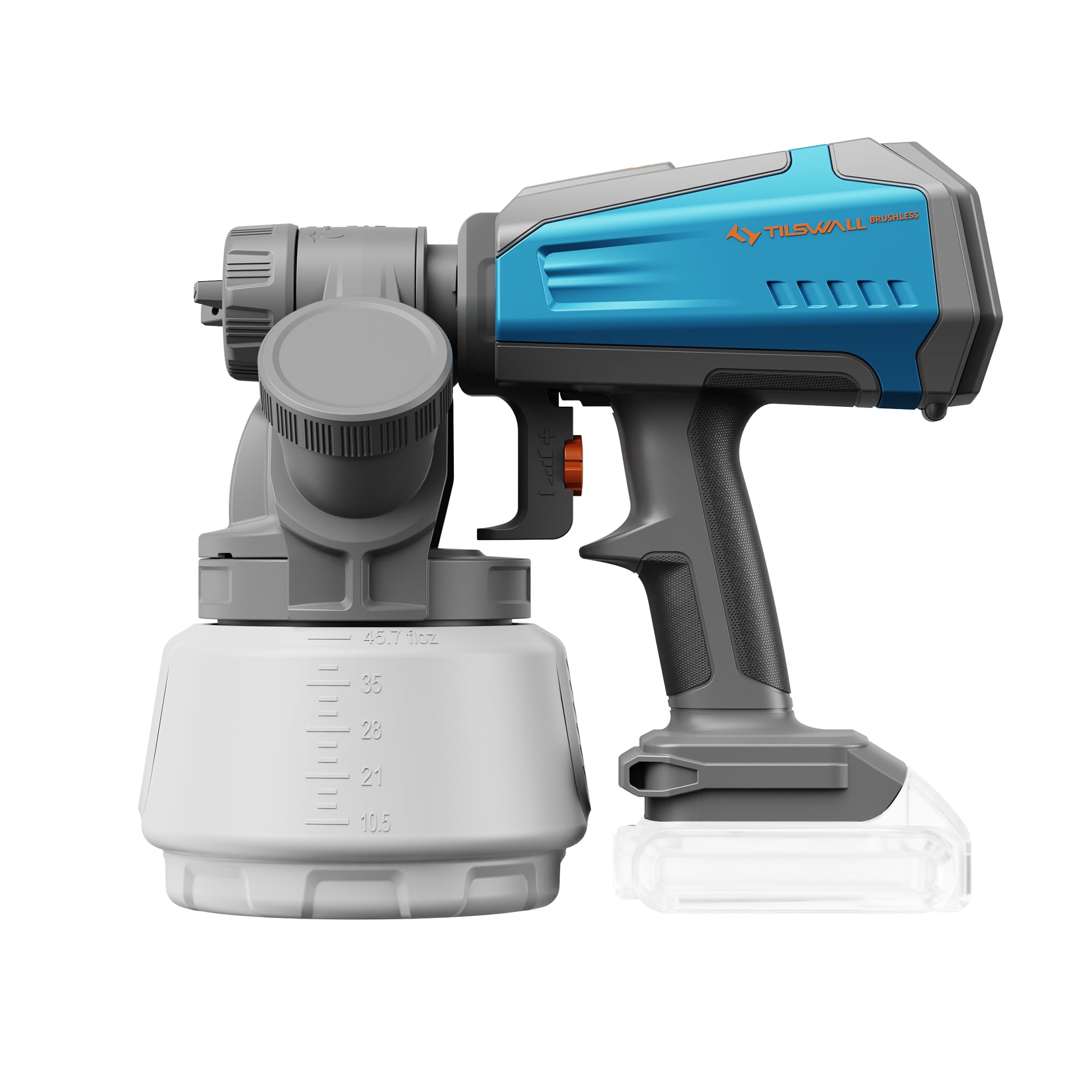
The Tilswall Shark 700 brings true cordless freedom to the domestic paint sprayer category, running on any compatible DeW 20V battery (battery not included). Its brushless motor spins at up to 90,000 RPM, which produces a finer atomization than brushed alternatives while generating less vibration and noise during operation. The protective start-up delay means the motor needs a two-second trigger press before it begins spraying — this prevents the spatter burst that happens when a cold motor suddenly engages at full speed.
The side-feed container is the same clever design as the Shark 800, allowing refills without unscrewing the lid. Three spray patterns (horizontal, vertical, circular) and a variable flow control from 0 to 900 ml/min give you substantial control over material output. The gun feels balanced when paired with a standard 20V battery, and the absence of a cord makes it ideal for fence lines, sheds, and other locations where extension cords become a tripping hazard or simply can’t reach.
Buyers appreciate the brass nozzle and stainless steel flow needle construction, which feels more durable than the all-plastic competitors at the same price tier. The unit works best for furniture, shelves, and outdoor touch-ups rather than whole-house work, as battery life limits runtime to roughly one to two hours of intermittent spraying depending on paint viscosity. The protective delay can confuse first-time users — if the nozzle is pointed at the target during the spatter burst, it leaves a visible blotch that requires sanding to remove.
Why it’s great
- Brushless motor runs quieter and atomizes finer than brushed units
- Cordless operation eliminates tripping hazards and extension cord limitations
- Side-feed container allows clean, fast refills without removing the lid
Good to know
- Battery not included; requires compatible DeW 20V pack
- Protective start-up delay causes spatter if not aimed away during activation
- Battery life limits use to small- to medium-sized projects
7. Wagner Control Spray QX2

The Wagner Control Spray QX2 is an entry-level HVLP sprayer designed specifically for light-bodied materials like transparent, semi-transparent, and solid stains plus water-based lacquers. It is not intended for thick latex or heavy primers — within its narrow material range it performs reliably, applying stain roughly twice as fast as a brush on fences, decks, and lattice. The three spray patterns (horizontal, vertical, round) and adjustable material flow give you enough control to match the project surface without needing a complex tool.
Real users report running four continuous hours with thick black paint without clogging or overheating, which is surprising for such a compact unit at this price tier. The spray width of roughly five to six inches works well for lattice edges and narrow boards, and cleanup requires only rinsing the few removable parts under a tap. The small canister is the main practical limitation — it requires frequent refills on medium-sized projects.
Some units appear to have quality-control issues: a minority of buyers report that the motor runs but no paint leaves the nozzle in any useful quantity, even after thinning. This suggests the internal air path or pump may be inconsistent across production batches. The plastic construction feels light, and the 1.54-kilogram weight makes it easy to handle, but the overall build is not as robust as mid-range options. For stain-only projects where budget is the primary constraint, this sprayer delivers acceptable results if you get a functional unit.
Why it’s great
- Excellent stain-only sprayer for fences, decks, and lattice on a budget
- Remarkable runtime without clogging reported by many users
- Easy water cleanup with very few removable parts
Good to know
- Not suitable for latex, chalk paint, or heavy-bodied materials
- Small canister requires frequent refills on medium or large projects
- Reported quality-control inconsistencies with pump output on some units
FAQ
Do I need to thin latex paint before using an HVLP sprayer?
How long does it take to clean a domestic paint sprayer after use?
Can I use an airless paint sprayer for small furniture projects?
Final Thoughts: The Verdict
For most users, the best domestic paint sprayer winner is the Wagner FLEXiO 595 because its dual-nozzle system and nine speed settings cover the widest range of home projects from furniture to siding without needing a separate machine. If you need to spray large wall areas and exteriors fast, grab the InoKraft MaXpray M1 for its airless speed and direct bucket feed. And for cordless convenience on smaller jobs like fence touch-ups and shed painting, nothing beats the Tilswall Shark 700 with its brushless motor and side-fill container.

Mo Maruf
I created WellFizz to bridge the gap between vague wellness advice and actionable solutions. My mission is simple: to decode the research and give you practical tools you can actually use.
Beyond the data, I am a passionate traveler. I believe that stepping away from the screen to explore new environments is essential for mental clarity and physical vitality.