Our readers keep the lights on and my smoothie glass nicely filled. As an Amazon Associate, I earn from qualifying purchases.
A chronic kidney disease diagnosis for your dog changes everything. Suddenly, every ingredient you trusted is scrutinized for phosphorus, sodium, and protein load. Finding a food that supports renal function without triggering appetite rejection or gastrointestinal upset is the single most stressful part of managing this condition. The right therapeutic diet can meaningfully extend your dog’s quality time with you, but the market is flooded with prescription labels and marketing claims that blur the line between kidney support and empty promises.
I’m Mohammad Maruf — the founder and writer behind WellFizz. I have spent hundreds of hours analyzing the specific nutritional profiles, veterinary guidelines, and customer feedback for kidney-friendly canine diets to separate genuine renal support from generic marketing fluff.
This guide breaks down the top prescription and veterinary-recommended formulas specifically designed for canine kidney disease. You will learn exactly what phosphorus and sodium levels mean, why protein restriction matters, and how to match a diet to your dog’s stage of renal decline. Here is my honest, spec-by-spec breakdown of the best dog food kidney disease options on the market right now.
How To Choose The Best Dog Food For Kidney Disease
Selecting a renal diet goes beyond grabbing the bag with a kidney on the label. You need to match the food’s nutrient profile to your dog’s specific IRIS stage (International Renal Interest Society) and their individual tolerance. The wrong choice can accelerate disease progression or cause your dog to refuse meals entirely.
Phosphorus Restriction — The Primary Target
Elevated phosphorus in the bloodstream directly worsens kidney damage in dogs with renal disease. A quality renal diet keeps phosphorus levels between 0.2% to 0.6% on a dry matter basis. Compare this to standard adult maintenance diets that often sit above 0.8% or even 1.2%. Lower phosphorus means less stress on compromised nephrons, slowing the disease’s progression and delaying the need for more aggressive interventions like subcutaneous fluids.
Sodium Control For Blood Pressure Management
Damaged kidneys cannot efficiently excrete excess sodium, leading to hypertension and increased proteinuria (protein leaking into urine). Renal diets restrict sodium to around 0.1% to 0.3% to manage blood pressure and reduce the workload on the cardiovascular system. This is especially critical for dogs with concurrent heart conditions, which frequently accompany advanced kidney disease in senior dogs.
Protein Quantity and Quality Balancing Act
Too much protein generates nitrogenous waste that damaged kidneys struggle to filter. Too little protein leads to muscle wasting, hypoalbuminemia, and poor immune function. Renal diets use highly digestible, bioavailable animal proteins at moderate levels (14% to 25% on a dry matter basis) to minimize waste production while preserving lean body mass. Avoid extremely high-protein “grain-free” formulas for dogs with diagnosed kidney disease.
Quick Comparison
On smaller screens, swipe sideways to see the full table.
| Model | Category | Best For | Key Spec | Amazon |
|---|---|---|---|---|
| Hill’s Prescription Diet k/d Stew | Wet Food | Advanced renal stages & hydration | 0.24% phosphorus (dry matter) | Amazon |
| Royal Canin Renal Support S | Dry Kibble | Appetite stimulation & small kibble | 0.3% phosphorus (dry matter) | Amazon |
| Pro Plan NF Kidney Function | Dry Kibble | Long-term maintenance & energy density | 0.2% phosphorus (dry matter) | Amazon |
| Blue Buffalo KS Kidney Support | Dry Kibble | Transition from commercial to prescription | 0.3% phosphorus (dry matter) | Amazon |
| Dave’s Restricted Sodium Pate | Wet Food | Low sodium priority & multi-dog households | 0.45% phosphorus (dry matter) | Amazon |
In‑Depth Reviews
1. Hill’s Prescription Diet k/d Kidney Care Chicken & Vegetable Stew

Hill’s k/d stands as the most clinically researched renal diet on the market, backed by decades of feeding trials in dogs with naturally occurring chronic kidney disease. The Chicken & Vegetable Stew form delivers a phosphorus content of approximately 0.24% on a dry matter basis, which is among the lowest available in any commercial renal food. The stew format provides substantial moisture content — a critical tool for managing hydration in dogs whose kidneys can no longer concentrate urine efficiently.
The formulation employs ActivBiome+ Kidney Defense, a proprietary prebiotic blend designed to shift the gut microbiome toward producing fewer uremic toxins. Real customer feedback consistently reports extended survival times well beyond initial veterinary prognoses — one owner documented 19 months of quality life for a border collie that was given a 6-12 month window. The bite-sized chunks in gravy texture helps maintain appetite even as nausea from uremia sets in, and the recipe provides essential amino acids above AAFCO minimums to protect lean muscle mass.
This is a veterinary-exclusive diet requiring a prescription, ensuring that your veterinarian has cleared it for your dog’s specific IRIS stage. The 12-pack of 12.5 oz cans offers better value than single can purchases, though the daily volume needed for a mid-size dog (50-60 lbs) means one can per day is typical. Some dogs show strong flavor preferences within the k/d line — if your dog rejects chicken stew, the beef variety often works as an alternative without compromising the renal profile.
Why it’s great
- Lowest phosphorus content at 0.24%, slows disease progression measurably
- High moisture stew format supports hydration in chronic kidney disease
- Clinically proven to extend quality of life in multiple feeding trials
Good to know
- Requires veterinary prescription; not available over the counter
- Expensive at full retail — check for Amazon subscribe & save discounts
- Some dogs prefer beef version; flavor trial may be needed
2. Royal Canin Veterinary Diet Canine Renal Support S Dry Dog Food
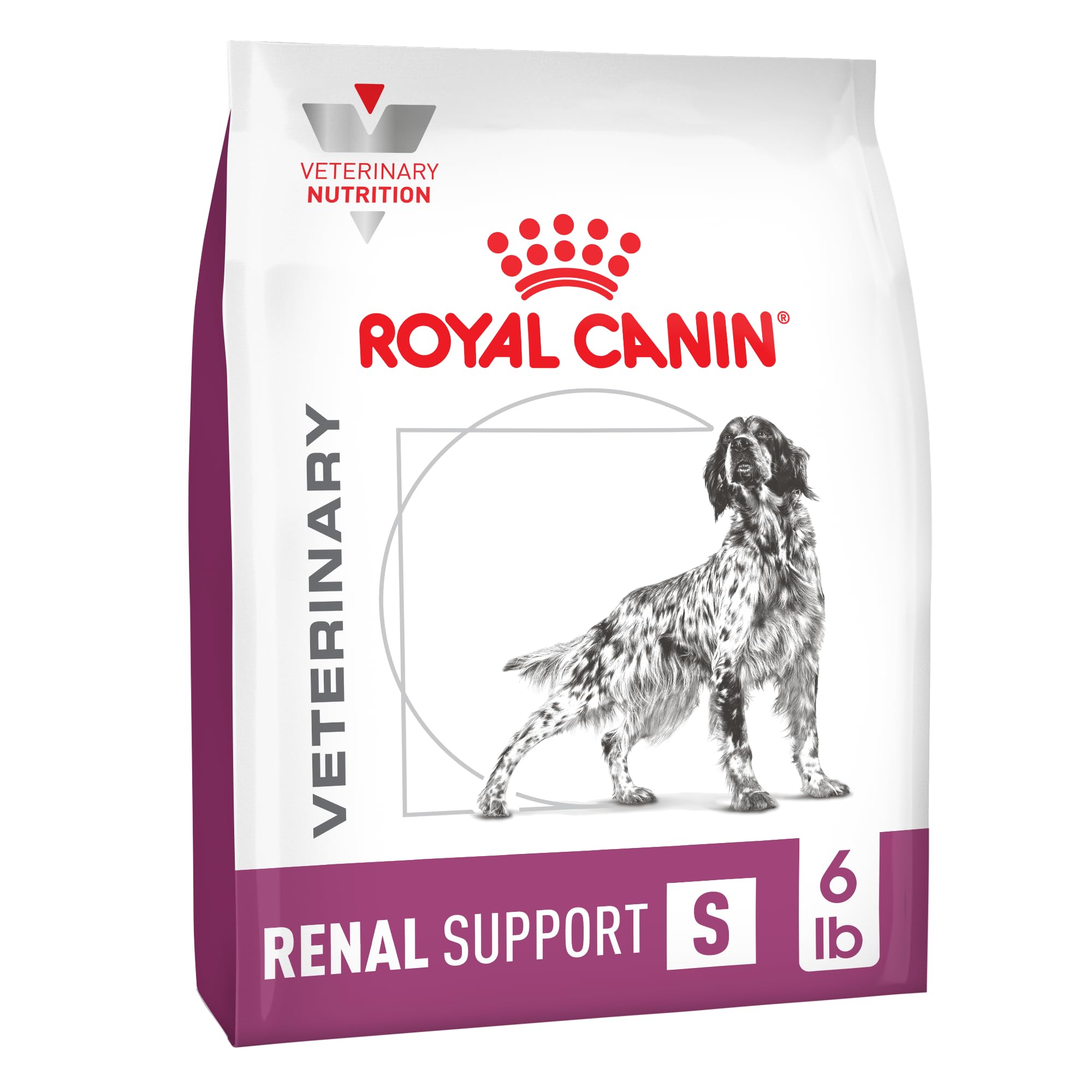
Royal Canin Renal Support S (the ‘S’ stands for Savory) specifically tackles the anorexia that plagues dogs in later-stage kidney disease. The crescent-shaped kibble is engineered for an enhanced texture and aroma profile that stimulates eating even when uremic nausea is present. The phosphorus content sits at approximately 0.3% on a dry matter basis, which is well within the therapeutic range for IRIS stages 2-3 kidney disease.
The formulation uses a precise antioxidant complex (including vitamin E and beta-carotene) combined with EPA and DHA from fish oil to manage oxidative stress on remaining kidney tissue. Controlled protein levels target 14-16% on a dry matter basis — lower than maintenance diets but sufficient to maintain lean body mass when fed at the recommended calorie density. The 27 cups per 6 lb bag provides a clear feeding roadmap, though larger dogs will go through a bag quickly.
Customer feedback reveals a consistent pattern: dogs that refused other renal diets (particularly Hill’s k/d) will accept Royal Canin. One owner with two Chihuahuas having liver shunts reported excellent acceptance, while another noted that mixing the kibble with warm water creates a gravy that further entices picky eaters. The key drawback is the larger kibble size for very small breeds — dogs with missing teeth or jaw issues may need the pieces crushed or softened. This is also a prescription-only diet, so a current vet authorization is required.
Why it’s great
- Highly palatable formula designed to overcome uremic appetite suppression
- Low phosphorus at 0.3% effective for stages 2-3 kidney disease
- Omega-3 fatty acids from fish oil support renal blood flow
Good to know
- Kibble is large for small-breed dogs or those with missing teeth
- Strictly veterinary-exclusive; prescription check is mandatory
- Lower protein may not suit dogs with early-stage disease needing muscle maintenance
3. Pro Plan Veterinary Diets Purina NF Kidney Function Canine Dry Formula

Purina Pro Plan NF (Nutritional Function) delivers the tightest phosphorus restriction among the dry kibble options at approximately 0.2% on a dry matter basis, matching the phosphorus ceiling of the most aggressive wet renal foods. This makes it a particularly strong choice for dogs in IRIS stage 3 or early stage 4 where every milligram of phosphorus reduction counts. The formula is energy-dense, meaning your dog gets sufficient calories from a smaller volume of food — beneficial when kidney disease causes early satiety and reduced intake.
The kibble size is medium, but customer reports consistently describe it as too large for toy breeds and small seniors with dental issues. One Maltese owner documented cutting each piece by hand to accommodate a 15-year-old dog with missing teeth. The good news is that the dry formula softens well when soaked in water for 30-60 minutes, transforming into a porridge-like consistency that many dogs accept eagerly. The low sodium profile (approximately 0.1-0.15%) makes it suitable for dogs with concurrent heart failure, a common comorbidity.
Long-term compliance data from owners shows that dogs on Pro Plan NF can maintain near-normal kidney bloodwork values for extended periods — one owner reported a 15-year-old Chihuahua thriving for five months on this diet after diagnosis. The bag size (6 lbs) is manageable for small dogs but may require subscription ordering for larger breeds. Like all veterinary therapeutic diets, a prescription is required, and customers report that the vet approval process through Amazon is straightforward when you have an existing relationship with your veterinarian.
Why it’s great
- Aggressive phosphorus restriction at 0.2% — lowest among dry renal options
- Energy-dense formula compensates for reduced appetite in kidney disease
- Very low sodium suitable for dogs with concurrent heart conditions
Good to know
- Large kibble size is problematic for toy breeds and senior dogs with dental loss
- Dry formula requires soaking for softer texture; adds prep time
- Some dogs reject the vegetable flavor profile; picky eaters may refuse
4. Blue Buffalo Natural Veterinary Diet KS Kidney Support Dry Dog Food

Blue Buffalo KS Kidney Support occupies a useful middle ground between strict prescription formulas and over-the-counter “kidney friendly” foods. With a phosphorus content around 0.3% on a dry matter basis and controlled sodium levels, it provides genuine renal support while offering a more familiar ingredient list for owners who prefer “natural” formulations without chicken by-product meals, corn, wheat, or soy. The first ingredient is real deboned chicken, which appeals to dogs and owners accustomed to Blue Buffalo’s non-prescription lines.
The protein level is moderate — approximately 18-20% on a dry matter basis — which is higher than some competing renal diets but still below standard adult maintenance foods. This makes it a reasonable transition option for dogs newly diagnosed with stage 2 kidney disease who have been eating high-protein foods and need a gradual step down. However, the same moderate protein level makes it less suitable for advanced-stage disease (IRIS stage 3-4) where stricter restriction is necessary. The kibble size, as noted by owners of small dogs, is notably large — a 16-year-old dog with one tooth required the pieces to be crushed.
Customer satisfaction is mixed but informative: some owners report their aging dogs with renal failure rejected Hill’s and Royal Canin but happily accepted Blue Buffalo KS, attributing it to the chicken-first ingredient list. Others note that the 6 lb bag price point is competitive among prescription diets, making it an accessible entry point for owners who want to try a renal diet without the highest premium. The veterinary prescription requirement is enforced, though the online approval process through partnered pharmacies is typically smooth.
Why it’s great
- Clean ingredient profile — no by-products, corn, wheat, or soy
- Real deboned chicken as first ingredient improves acceptance
- Transition-friendly for dogs moving from high-protein commercial diets
Good to know
- Kibble size is large for small-breed dogs with dental problems
- Moderate protein level not ideal for advanced-stage (stage 3-4) disease
- Requires veterinary prescription like other therapeutic renal diets
5. Dave’s Pet Food Restricted Sodium Diet for Dogs, Chicken Pate
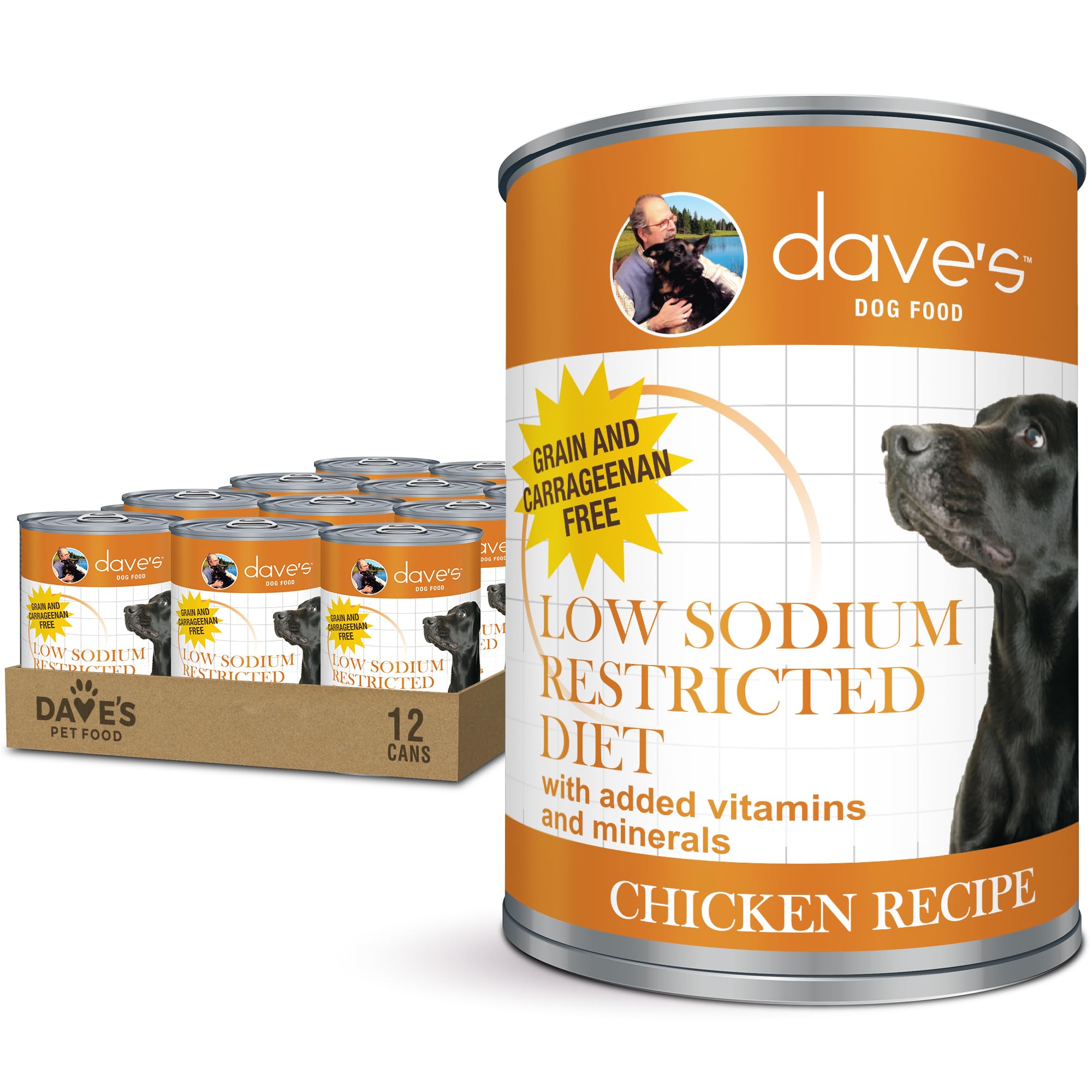
Dave’s Restricted Sodium Chicken Pate is the only option on this list that does not require a veterinary prescription, making it a critical tool for owners whose dogs need low-sodium and moderate phosphorus support without the overhead of a vet authorization process. The phosphorus content is approximately 0.45% on a dry matter basis — higher than the therapeutic prescription diets but still significantly lower than standard commercial canned foods (which often exceed 1.0%). The sodium level is the star feature here, formulated specifically for dogs on cardiac medications like Vetmedin and furosemide who also have compromised kidney function.
The ingredient list is refreshingly short: chicken, chicken broth, chicken liver, and a minimal vitamin-mineral premix. No corn, wheat, soy, artificial preservatives, or carrageenan. The pate texture is described by owners as smelling similar to chicken baby food, a sensory cue that most dogs find highly palatable. One owner with a heart failure dog on multiple diuretics reported that their dog licked the bowl clean and maintained stable electrolyte levels without needing increased medication doses. Another owner noted a 5-pound weight gain in a dog with chronic renal disease who had lost significant muscle mass.
The can-to-can packaging consistency is a known issue with Amazon fulfillment — multiple verified buyers report receiving cases with 7 or more severely dented cans, some of which had to be discarded. This appears to be a supply chain problem rather than a product defect, but it is a real logistical headache if you rely on monthly subscriptions. The 13.2 oz can size is generous; a single can can cover a full day’s feeding for a 30-40 lb dog, making the per-can cost competitive even among non-prescription foods.
Why it’s great
- No veterinary prescription required — accessible immediately after diagnosis
- Extremely low sodium perfect for concurrent heart/kidney conditions
- Short, clean ingredient list with chicken as single protein source
Good to know
- Phosphorus at 0.45% is higher than prescription renal diets
- Chronic can-denting problem with Amazon shipments; inspect each can
- Pate includes thickening agents some holistic vets question for digestion
FAQ
Does my dog need a prescription for kidney disease dog food?
What is the safest phosphorus level for a dog with stage 3 kidney disease?
Can I mix wet renal food with dry kibble for kidney disease?
Final Thoughts: The Verdict
For most dogs with chronic kidney disease, the best dog food kidney disease winner is the Hill’s Prescription Diet k/d Chicken & Vegetable Stew because its sub-0.25% phosphorus content, high moisture stew format, and decades of clinical feeding trial data provide the most rigorous renal support available. If your dog has appetite refusal and needs smaller kibble with enhanced palatability, grab the Royal Canin Renal Support S. And for owners who need immediate low-sodium support without a prescription delay, nothing beats the Dave’s Restricted Sodium Pate for accessibility and ingredient simplicity.

Mo Maruf
I created WellFizz to bridge the gap between vague wellness advice and actionable solutions. My mission is simple: to decode the research and give you practical tools you can actually use.
Beyond the data, I am a passionate traveler. I believe that stepping away from the screen to explore new environments is essential for mental clarity and physical vitality.