Our readers keep the lights on and my smoothie glass nicely filled. As an Amazon Associate, I earn from qualifying purchases.
That stiff neck or nagging lower back ache after a long drawing session isn’t just part of the job—it’s a sign your seating setup is failing you. A proper drafting stool puts your hips, knees, and spine in a neutral alignment, letting you focus on the work instead of shifting positions every twenty minutes to find relief.
I’m Mohammad Maruf — the founder and writer behind WellFizz. After analyzing hundreds of customer reports and spec sheets, I’ve zeroed in on the precise engineering details that separate a stool you’ll tolerate from one that actually supports your body through hours of precision work.
From pneumatic lift quality to foot ring adjustability, this guide breaks down the top contenders to help you find the best drafting stool for your studio, home office, or workshop.
How To Choose The Best Drafting Stool
Buying a drafting stool isn’t like picking a standard office chair. The seat height range must match your drafting table or standing desk, the foot ring must reach your natural leg position, and the backrest must engage your lumbar curve at an elevated posture. Here are the key factors to weigh.
Seat Height Range & Gas Lift Quality
A drafting stool typically offers a seat height range between 19 and 33 inches. Measure your table’s surface height and subtract 10 to 12 inches to find the ideal seat height. Look for stools that meet ANSI/BIFMA X5.1 standards—this certification ensures the gas cylinder can handle repeated adjustments without failing.
Foot Ring Adjustability
Fixed foot rings force your legs into one position, which can cut off circulation over time. A vertically adjustable foot ring lets you set the height so your knees stay at a 90-degree angle with your feet resting flat. Adjustments of 7 to 8 inches of vertical travel give you the most flexibility for different body heights.
Backrest Type & Lumbar Support
Drafting stools come with no backrest, a low back, or a high back with lumbar support. For sessions longer than two hours, a supportive backrest that targets the lumbar curve is essential. Adjustable lumbar support lets you dial in the exact pressure point needed to prevent slouching.
Quick Comparison
On smaller screens, swipe sideways to see the full table.
| Model | Category | Best For | Key Spec | Amazon |
|---|---|---|---|---|
| Kaleurrier Adjustable Stool | Premium | All‑day comfort & stability | Aluminum base, 350 lb capacity | Amazon |
| ORRSAKER Drafting Chair | Mid‑Range | Breathable mesh & lumbar support | 2‑inch adjustable lumbar, 300 lb cap | Amazon |
| HYLONE Armless Chair | Mid‑Range | Small spaces & breathability | Breathable mesh back, BIFMA lift | Amazon |
| Amseatec Drafting Chair | Mid‑Range | Premium look & padded armrests | Flip‑up arms, PU leather, 300 lb cap | Amazon |
| Brick Attic Drafting Chair | Budget | Entry‑level value & comfort | Memory foam cushion, 300 lb cap | Amazon |
In‑Depth Reviews
1. Kaleurrier Adjustable Stool

The Kaleurrier stands apart with its aluminum base and 25.2-inch footprint—a wider stance than any other stool in this roundup. That extra stability, combined with a gas cylinder certified to ANSI/BIFMA X5.1 and EN 1335 standards, means the stool handles the 350-pound weight capacity without wobble, even when you lean back or shift side to side.
The seat cushion uses high-density soft sponge with a boxed edge profile that supports the full thigh without digging into the backs of your knees. Height adjustment covers 19.7 to 27.6 inches, making it suitable for drafting tables and standing desks on the lower end of the height spectrum. The adjustable foot ring lets you fine-tune leg position, and the 360-degree swivel keeps you mobile without forcing you to twist your spine.
Customer feedback consistently praises the thick cushion and the stable gliding base. A few users note that the low backrest offers limited adjustment range, and the minimum height of 19.7 inches may sit too high for standard 30-inch desks. But for dedicated drafting or bar-height workstations, this stool delivers a premium foundation that justifies its position at the top of the list.
Why it’s great
- Wide aluminum base provides exceptional stability
- 350 lb weight capacity—highest in the group
- High-density cushion supports long sessions without flattening
Good to know
- Lowest seat height may be too tall for standard desks
- Backrest adjustment range is limited
2. ORRSAKER Drafting Chair

ORRSAKER built this chair around ventilation. The dual-layer mesh backrest combined with 3 inches of high-resilience foam creates airflow that keeps you cool during warm studio sessions. The X-shaped backrest houses a 2-inch height-adjustable lumbar support that hits the natural curve of your spine—critical for preventing the mid-afternoon slump that sets in after hours at a tall desk.
The 7.9-inch flexible height adjustment covers 33 to 41 inches of seat height, with a reinforced foot ring that uses an anti-slip locking mechanism. The 90-degree flip-up armrests let you convert the chair to an armless stool, giving you clearance for tasks like guitar practice or sitting cross-legged. Upgraded PU casters roll silently over hardwood and tile without leaving scuffs.
Buyers at the 265-pound mark report the 300-pound capacity feels solid and stable, and the 15-minute assembly time is a recurring theme in reviews. The main trade-off is the seat depth—some users with longer femurs find the cushion a bit short for full thigh support. For those who prioritize breathability and lumbar contact, this is a strong performer.
Why it’s great
- Dual-layer mesh promotes all-day airflow
- Adjustable lumbar support with 2-inch range
- Anti-slip locking foot ring stays put
Good to know
- Seat depth may feel short for taller users
- Mesh back leans slightly back from vertical
3. HYLONE Armless Drafting Chair

HYLONE targets the small-studio or home-office buyer who needs to slide the stool under the desk when not in use. The armless design and slat-back mesh profile let you push the chair flush against the table, reclaiming floor space. The mesh back promotes air circulation and is paired with an FSC-certified wood seat board topped with natural sponge foam for a medium-firm feel that doesn’t sag.
The BIFMA-tested gas lift provides height adjustment compatible with bar-height tables and standing desks, and the seat tension adjustment lets you customize the recline resistance. The adjustable foot ring helps position your legs to reduce pressure, and the durable nylon wheels roll smoothly across hard floors. Assembly takes about 15 minutes with the included tool.
Reviews note that the lowest seat setting may still feel too high for a 30-inch desk, so measure your table height carefully. The chair also lacks armrests, which some users miss during breaks. For cramped spaces where every inch counts, this is a smart, no-fuss choice that keeps you cool while you work.
Why it’s great
- Armless profile slides fully under the desk
- Breathable mesh back prevents heat buildup
- BIFMA-certified gas lift for safe height changes
Good to know
- Lowest setting may be too tall for standard desks
- No armrests for occasional resting
4. Amseatec Drafting Chair
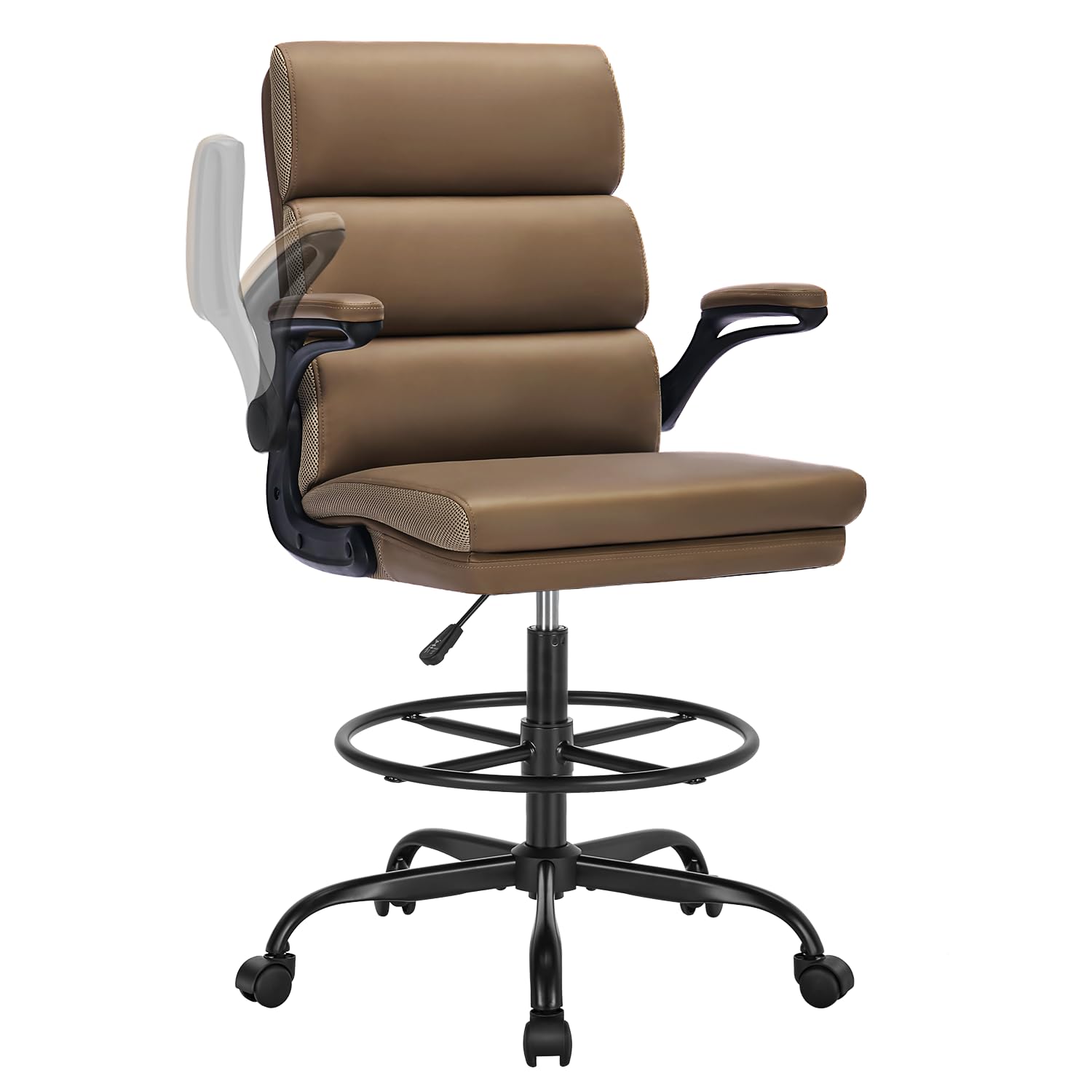
The Amseatec brings a premium aesthetic to the mid-range category. The tan PU leather finish resists scratches and repels spills, making it a practical option for studios where paint, ink, or coffee is always nearby. The bonded leather pairs with high-density foam padding to deliver firm support without bottoming out over time.
Beyond the looks, the chair offers 90-degree flip-up padded armrests that let you switch between arm support and open sitting positions. The 3-stage back support—with separate zones for the lumbar, mid-back, and upper back—helps maintain spine alignment during 8-hour days. The foot ring adjusts vertically to accommodate different leg lengths, and the carbon steel frame with a Class-3 gas lift supports 300 pounds.
Customer feedback highlights the easy assembly and comfortable cushion, though some reviewers mention that screws can loosen over time, causing squeaks that require tightening. The wide, deep seat with slight bounce works well for users who prefer a plush feel. If you want a drafting stool that looks as good as it functions, this tan PU option stands out.
Why it’s great
- PU leather resists stains and wipes clean
- Three-stage back support for full spine alignment
- Flip-up armrests adapt to different tasks
Good to know
- Screws may loosen and cause squeaks over time
- Firm cushion may not suit every preference
5. Brick Attic Drafting Chair

The Brick Attic offers solid build quality at an accessible price point. The 15.8-inch cushion is designed to fit a broad range of body types, and the 2mm thick steel base provides stability with a 300-pound weight limit. The height adjusts from 33.86 to 41.75 inches, and the foot ring travels 7.87 inches vertically to accommodate different leg positions.
The memory foam cushion is firmer than standard sponge padding, which helps maintain support over longer periods without flattening. The detachable backrest with a curved profile and a thickened steel plate lets you remove the back altogether if you need a pure stool configuration. The PU leather upholstery cleans easily, and the silent casters roll smoothly over concrete and tile without noise.
Buyers report assembly takes about 15 minutes, and many note that the chair resolved their lower back pain compared to a standard stool. The main trade-off is the foot ring which can occasionally slide down, requiring a moment to re-lock. For a first-time drafting stool buyer or for secondary use in a garage or workshop, this provides strong value without cutting corners on essential adjustability.
Why it’s great
- Memory foam cushion resists flattening
- 7.87-inch foot ring travel for leg positioning
- Detachable backrest converts to stool
Good to know
- Foot ring may slide down without regular tightening
- PU leather may not breathe as well as mesh
FAQ
What seat height range do I need for a drafting table?
Should I get a drafting stool with or without armrests?
How much weight can a typical drafting stool support?
Final Thoughts: The Verdict
For most users, the best drafting stool winner is the Kaleurrier Adjustable Stool because its aluminum base, 350-pound capacity, and thick cushion provide unmatched stability and all-day comfort for dedicated drafting workstations. If you want breathable mesh and adjustable lumbar support, grab the ORRSAKER Drafting Chair. And for a budget-friendly entry point that still offers memory foam and a detachable backrest, nothing beats the Brick Attic Drafting Chair.

Mo Maruf
I created WellFizz to bridge the gap between vague wellness advice and actionable solutions. My mission is simple: to decode the research and give you practical tools you can actually use.
Beyond the data, I am a passionate traveler. I believe that stepping away from the screen to explore new environments is essential for mental clarity and physical vitality.