Our readers keep the lights on and my smoothie glass nicely filled. As an Amazon Associate, I earn from qualifying purchases.
Choosing the heart of your next rig means navigating a landscape of core counts, boost clocks, and socket types. Whether you are building a high-refresh-rate gaming machine, a video editing workstation, or a silent home office PC, the processor dictates every ounce of performance your system can deliver. Making the wrong pick here can bottleneck your graphics card or leave you wanting more grunt for multi-threaded tasks.
I’m Mohammad Maruf — the founder and writer behind WellFizz. I’ve spent countless hours analyzing the latest benchmark data, thermal performance reports, and platform compatibility specifications to separate the true performers from the hype.
This guide breaks down the top contenders across performance tiers so you can confidently select your new best central processing unit for a build that stays fast for years.
How To Choose The Best Central Processing Unit
Selecting the right CPU is a balancing act between core count, clock speed, thermal output, and platform cost. The wrong choice can mean an expensive motherboard swap or a chip that runs too hot for your cooler. Here are the three most critical factors to get right.
Core Count vs. Clock Speed: Matching Your Workload
Gamers often benefit from higher clock speeds on fewer cores, while content creators and streamers need more cores for rendering and encoding. A 12-core processor with a high boost clock, like the Ryzen 9 series, handles both gaming and productivity with ease. For pure gaming, a 6-core or 8-core chip with a 5.0 GHz or higher boost is often sufficient, freeing budget for a stronger GPU.
Socket Compatibility and Chipset Features
The physical socket (LGA1700, LGA1851, or AM5) dictates which motherboard you must buy. AM5 supports DDR5 memory and PCIe 5.0, future-proofing your build but requiring a more expensive board. Intel’s LGA1700 platform allows backward compatibility with DDR4 memory on certain boards, offering a more budget-friendly upgrade path for the 12th, 13th, and 14th Gen Core processors.
Thermal Design Power and Cooling Requirements
Higher TDP ratings mean more heat output. A 125W chip like the Intel Core i7-12700KF can be tamed by a mid-range air cooler, while a 170W chip like the Ryzen 9 7900X or a 250W turboing Core Ultra 9 285K demands a high-performance dual-tower air cooler or a 360mm liquid cooler for sustained workloads. Check your case clearance and cooler compatibility before buying.
Quick Comparison
On smaller screens, swipe sideways to see the full table.
| Model | Category | Best For | Key Spec | Amazon |
|---|---|---|---|---|
| Intel Core i7-12700KF | Mid-Range | Gaming & Multi-Tasking | 12 Cores (8P+4E) up to 5.0 GHz | Amazon |
| Dell OptiPlex 5060 (i5-8500) | Entry Desktop | Office & Basic Productivity | 6 Cores up to 4.3 GHz | Amazon |
| AMD Ryzen 9 7900X | Premium Desktop | Content Creation & Streaming | 12 Cores / 24 Threads up to 5.6 GHz | Amazon |
| HP ProDesk 600G4 (i7-8700) | Renewed Tower | Home & Office Workstation | 6 Cores up to 4.6 GHz | Amazon |
| Dell OptiPlex 7070 SFF (i7-9700) | Renewed SFF | Compact Business Desktop | 8 Cores up to 4.7 GHz | Amazon |
| AMD Ryzen 9 9900X3D | High-End Desktop | Gaming & Heavy Workloads | 12 Cores / 24 Threads, 140MB Cache | Amazon |
| Intel Core Ultra 9 285K | Flagship Desktop | Professional CAD & Rendering | 24 Cores (8P+16E) up to 5.7 GHz | Amazon |
| Intel Core i9-14900 | High-End Desktop | Adobe Creative Suite & Encoding | 24 Cores (8P+16E) up to 5.8 GHz | Amazon |
| Dell All-in-One ec24250 (Intel Core 3) | All-in-One PC | Family & Education Use | Intel Core 3 up to 1.2 GHz | Amazon |
In‑Depth Reviews
1. AMD Ryzen 9 9900X3D

The Ryzen 9 9900X3D represents the sweet spot in AMD’s Zen 5 X3D lineup, packing 12 high-performance cores with an immense 140MB of total cache. This design massively reduces memory latency, providing a palpable lift in gaming frame rates and snappier responsiveness for heavy multi-tasking. Reviewers consistently note it runs cool with a decent AIO cooler, with no stutter or thermal throttling ruining the experience.
For content creators who also game, this processor offers a compelling compromise — it does not quite match the raw multi-core throughput of the 16-core 9950X in rendering, but it crushes gaming workloads where cache-sensitive titles benefit. The AM5 platform ensures DDR5 and PCIe 5.0 support, future-proofing your investment. The included cooler is a Wraith Prism, but a better aftermarket solution is strongly recommended for sustained loads.
The main trade-off is the price premium over non-X3D chips, but for users who want top-tier gaming performance without sacrificing productivity, the 9900X3D is an easy recommendation. Builders focused purely on gaming at the highest possible FPS might still prefer the 9800X3D for its better single-core boost, but the 9900X3D brings more versatility to the table.
Why it’s great
- Massive 140MB cache for excellent gaming performance
- 12 cores handle heavy multi-threaded workloads with ease
- Runs cool with standard AIO cooling solutions
Good to know
- Premium pricing compared to non-X3D Ryzen 9 chips
- Requires a strong aftermarket cooler for peak performance
- Not the fastest single-core option for pure gaming
2. Intel Core Ultra 9 285K

Intel’s Core Ultra 9 285K marks a major architectural shift with its hybrid Performance + Efficient core design totaling 24 cores. This chip is a monster for professional applications like SolidWorks, CAD modeling, and video encoding, where the 16 E-cores handle background tasks while the 8 P-cores tackle the heavy lifting. Users report Cinebench scores pushing past 40,000 points with a high-quality 360mm AIO cooler.
The chip operates on the new LGA1851 socket, which requires an Intel 800-series motherboard and supports only DDR5 memory. This platform upgrade cost is a consideration, but the CPU’s stability is markedly improved over previous generations — reviewers explicitly note no overheating or voltage issues compared to 13th and 14th Gen chips. Under a sustained rendering load, it draws roughly 205W and stays under 80°C with a good cooler.
The included box does not have a thermal solution, so factor a premium cooler into your budget. For creative professionals who need raw multi-core grunt and system stability, the Core Ultra 9 285K is the clear flagship choice. Gamers will see excellent performance too, but the premium over a Core i7 or Ryzen 7 is harder to justify unless you also do heavy productivity work.
Why it’s great
- 24-core hybrid architecture delivers top-tier multi-threaded performance
- Excellent stability for professional CAD and rendering work
- Efficient power draw under load with proper cooling
Good to know
- Requires a new LGA1851 motherboard and DDR5 RAM
- Does not include any CPU cooler in the box
- Overkill for pure gaming builds
3. Intel Core i7-12700KF

The i7-12700KF continues to be a smart pick for mid-range builds that need strong gaming chops and respectable multi-core performance without breaking the bank. Its hybrid architecture with 8 Performance-cores and 4 Efficient-cores hits a solid balance, and the unlocked multiplier allows for easy overclocking on Z690 or Z790 boards. The 125W base TDP means a decent air cooler like a Thermalright Peerless Assassin can handle it just fine.
This chip supports both DDR4 and DDR5 memory, giving you flexibility to reuse older RAM or invest in a faster platform. The 12MB L2 + 25MB L3 cache is generous for the price point and provides snappy load times in games and applications. Since it is a KF variant, there is no integrated graphics — you will need a discrete GPU for any display output, which is not a problem for gamers but matters for diagnostic scenarios.
For real-world gaming at 1440p, this chip will not bottleneck even an RTX 4070 in most titles. It performs close to the i9-12900K in gaming but at a significantly lower cost. The main downside is the platform being mature — the LGA1700 socket does not offer a future CPU upgrade beyond 14th Gen, so consider this a build-and-forget option.
Why it’s great
- Excellent gaming performance for the price point
- Unlocked multiplier for easy overclocking
- DDR4 and DDR5 memory compatibility options
Good to know
- No integrated graphics — requires a discrete GPU
- LGA1700 platform is a dead-end for future CPU upgrades
- Runs warm under heavy multi-threaded load
4. AMD Ryzen 9 7900X

The Ryzen 9 7900X is a 12-core Zen 4 powerhouse that excels in multi-threaded productivity tasks like photo and video editing. With a boost clock reaching 5.6 GHz and a massive 76MB total cache, it handles complex renders and simultaneous encoding with ease. Cinebench multi-core scores around 28,700 points are common, putting it well ahead of comparably priced Intel alternatives in straight rendering throughput.
One of the key selling points is the inclusion of integrated RDNA 2 graphics, which allows for basic display output and video decoding without a dedicated GPU — handy for temporary troubleshooting or a basic office setup. The AM5 platform gives you access to PCIe 5.0 and DDR5 memory, future-proofing your motherboard for later upgrades. The 5nm process node helps keep power efficiency respectable for the performance level.
However, this chip runs quite hot under load — reviewers report 82°C peak temperatures even with a 360mm AIO. Proper cooling is non-negotiable, and some users choose to undervolt or enable Eco Mode to reduce thermals for non-intensive daily use. It is not the strongest gaming CPU compared to the X3D variants, but for a mixed-use content creator build, the 7900X offers fantastic price-to-performance.
Why it’s great
- Top-tier multi-core performance for rendering and encoding
- Integrated RDNA 2 graphics for basic display output
- AM5 platform with PCIe 5.0 and DDR5 support
Good to know
- Runs very hot — requires high-end AIO cooling
- Gaming performance lags behind X3D variants
- AM5 motherboards and DDR5 RAM are pricier than DDR4 alternatives
5. Intel Core i9-14900

The i9-14900 is the final crown jewel of the LGA1700 platform, offering 24 cores (8 P + 16 E) and 32 threads with a blistering 5.8 GHz boost clock. It includes the Intel Laminar RH1 cooler in the box, making it a rare high-end chip that works out of the box for basic builds. This processor is especially well-suited for Adobe Creative Suite users because the integrated UHD Graphics 770 provides Quick Sync hardware acceleration, which reviewers report significantly speeds up H.264 and H.265 encodes and live preview rendering.
With a 36MB L3 cache and support for both DDR4 and DDR5 memory, this chip offers great flexibility. It works with affordable Z690 or Z790 motherboards, and a BIOS update is usually all that is needed. The low 125W base TDP means it does not require extreme cooling for normal use, though heavy rendering will push power draw up and demand a decent cooler.
The main caveat is that the LGA1700 platform is now a dead end — you cannot upgrade to a future generation without a new motherboard. Also, some users report receiving units that appear lightly used or returned, so purchasing from a trusted seller with good return policy is wise. For a high-core-count build on a budget LGA1700 platform, the i9-14900 is hard to beat.
Why it’s great
- Quick Sync acceleration dramatically speeds up Adobe video encoding
- Compatible with affordable DDR4 and LGA1700 motherboards
- Includes a functional stock cooler for basic use
Good to know
- LGA1700 platform has no future CPU upgrade path
- Some units may arrive used or returned from other customers
- Requires good cooling for sustained rendering loads
6. Dell OptiPlex 7070 SFF (i7-9700)

This renewed Dell OptiPlex 7070 Small Form Factor packs an Intel Core i7-9700, 32GB of DDR4 RAM, and a 1TB NVMe M.2 SSD into a compact chassis that fits neatly on a desk. It offers strong office productivity performance with its 8-core processor that can turbo up to 4.7 GHz, handling spreadsheets, web browsing, and even light photo editing without breaking a sweat. The built-in AX210 Wi-Fi 6E provides a modern wireless connection.
As a business-class refurbished desktop, the build quality is excellent and the system arrives with Windows 11 Pro pre-installed. The 1TB NVMe drive delivers snappy boot times — reviewers report system start-up in roughly 15 seconds. Port selection is generous with five USB 3.1 ports, four USB 2.0 ports, and two DisplayPorts for dual-monitor setups. A wireless keyboard and mouse are included in the box.
Because it is a Small Form Factor design, expansion options are limited — you cannot fit a full-size GPU or additional drives without adapters. The integrated UHD Graphics 630 can handle basic video output but is not suitable for modern gaming beyond very light titles. This is a fantastic budget option for a home office or student productivity machine, but not a rig for serious gaming or content creation.
Why it’s great
- Powerful 8-core i7-9700 with 32GB RAM for smooth multitasking
- Compact SFF chassis saves desk space
- Includes Wi-Fi 6E, wireless keyboard, and mouse
Good to know
- Limited expansion for GPU or storage upgrades
- Integrated graphics cannot handle modern gaming
- Refurbished unit may have quirks like missing power cord or USB Wi-Fi dongle
7. HP ProDesk 600G4 (i7-8700)
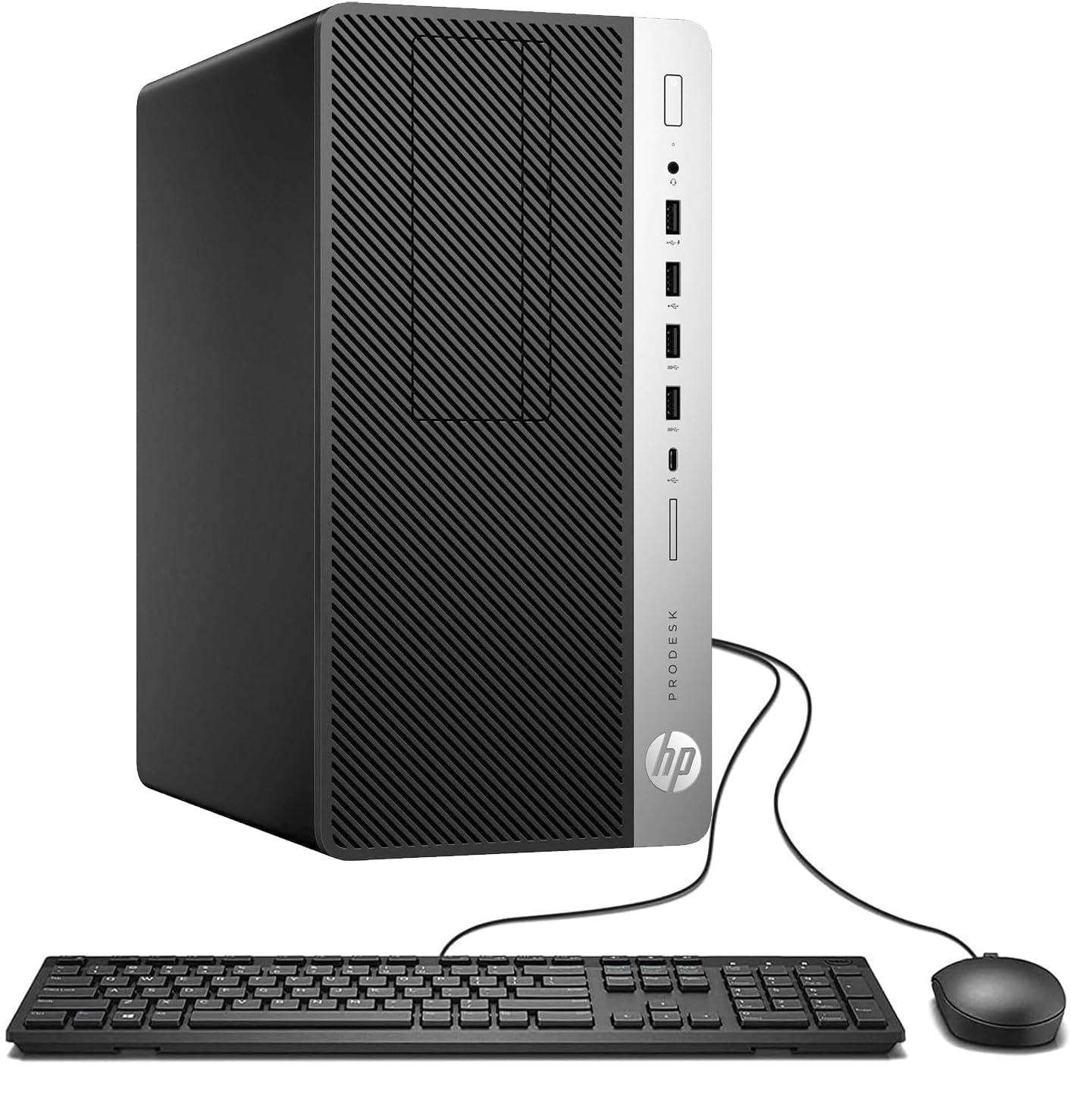
The HP ProDesk 600G4 Tower is a robust, renewed business desktop that combines a 6-core Intel i7-8700 with a generous 32GB of DDR4 RAM. This configuration is ideal for executive multitasking, media streaming, and high-performance web browsing. The 1TB SSD provides lightning-fast boot times and plenty of storage for documents and media files. The tower form factor offers more internal space than SFF designs, with four internal SATA slots for additional drives.
Port connectivity is excellent with six USB 3.0 ports, four USB 2.0 ports, and a USB Type-C port, along with two DisplayPorts. The integrated Intel HD Graphics 630 can drive dual 4K monitors for a productive workspace. HP is a Microsoft Authorized Refurbisher, so you get a quality guarantee and free tech support with your purchase.
The i7-8700 is an 8th Gen processor, which means it lacks the performance hybrid architecture of newer chips. It is perfectly capable for office applications and basic content creation, but it will show its age in CPU-intensive tasks like video rendering or modern gaming. The integrated graphics also limit gaming potential. This is a solid, affordable choice for a home office or business workstation where raw CPU power is not the top priority.
Why it’s great
- High 32GB DDR4 RAM capacity for smooth multitasking
- Ample storage with 1TB SSD and extra SATA slots
- Excellent port selection including USB Type-C
Good to know
- 8th Gen CPU is aging for demanding tasks
- Integrated graphics cannot handle modern games
- Renewed product with standard warranty
8. Dell OptiPlex 5060 (i5-8500)

The Dell OptiPlex 5060 Desktop is a renewed business machine that offers great value for basic home and office use. Powered by a 6-core Intel i5-8500 that boosts to 4.3 GHz, it provides enough power for everyday tasks like web browsing, document editing, and streaming. The dual-drive setup with a 500GB SSD for fast boot times and a 1TB HDD for mass storage gives you the best of both worlds.
With 16GB of DDR4 RAM, you can keep many browser tabs and applications open without slowdowns. Integrated Intel UHD Graphics 630 handles 1080p video playback smoothly. Connectivity includes built-in Wi-Fi, Bluetooth, and LAN, making it easy to connect to your network and peripherals. The sleek black tower is compact enough for most desks.
Some users report the fan noise can be noticeable under load, and the Wi-Fi may occasionally drop after sleep — a common issue with some Dell BIOS configurations that can be fixed with a wired ethernet connection. The lack of HDMI means you will need a DisplayPort adapter for most monitors. This is a no-frills, dependable machine for budget-conscious users who need a functional office PC.
Why it’s great
- Dual-drive setup offers speed and storage capacity
- 16GB RAM handles multitasking well for office work
- Low power consumption at about 30W idle
Good to know
- Fan can be noisy under load
- Wi-Fi may drop after sleep mode
- No HDMI port — requires DisplayPort adapter for most monitors
9. Dell All-in-One ec24250 (Intel Core 3)

The Dell ec24250 All-in-One is designed for simplicity — a single-cable machine that integrates a 23.8-inch FHD IPS display, Intel Core 3 processor, 8GB of DDR5 RAM, and a 512GB SSD into a sleek white chassis. The display offers 99% sRGB coverage and ComfortView Plus for reduced blue light emissions, making it ideal for long work or study sessions. The 5MP IR webcam with HDR ensures you look good on video calls.
Integrated Intel Graphics and Dolby Atmos spatial sound deliver pleasant media consumption, while the all-in-one design eliminates cable clutter. The 1.2 GHz base clock is modest, but the processor is sufficient for web browsing, email, office applications, and streaming video. The 1-year onsite service provides peace of mind for less tech-savvy users who want support at their location.
This is not a machine for gaming, video editing, or any heavy processing tasks — the Core 3 processor is a low-power chip that will struggle with multi-threaded workloads. The 8GB of RAM is also the bare minimum for Windows 11, so you may hit memory limits with many applications open. This is a perfect choice for a family member, student, or a secondary office computer where ease of use and clean aesthetics are the priorities.
Why it’s great
- Clean all-in-one design minimizes cable clutter
- FHD IPS display with blue light reduction for eye comfort
- Includes 1-year onsite service for support at home
Good to know
- Low-power processor not suitable for gaming or heavy workloads
- 8GB RAM is minimal for Windows 11 multitasking
- Only one USB port makes wired keyboard and mouse tricky
FAQ
Does a higher core count always mean better gaming performance?
Should I choose an Intel or AMD processor for my build?
What does an unlocked multiplier mean for a CPU?
Final Thoughts: The Verdict
For most users building a new system, the best central processing unit winner is the AMD Ryzen 9 9900X3D because it combines 12 powerful cores with an immense 140MB cache for top-tier gaming and productivity in one socket. If you need raw multi-core power for professional CAD and rendering, grab the Intel Core Ultra 9 285K. And for a budget-conscious gaming build with great flexibility, nothing beats the value of the Intel Core i7-12700KF.

Mo Maruf
I created WellFizz to bridge the gap between vague wellness advice and actionable solutions. My mission is simple: to decode the research and give you practical tools you can actually use.
Beyond the data, I am a passionate traveler. I believe that stepping away from the screen to explore new environments is essential for mental clarity and physical vitality.