Our readers keep the lights on and my smoothie glass nicely filled. As an Amazon Associate, I earn from qualifying purchases.
A down imaging fish finder is the difference between drifting over a submerged brush pile and knowing exactly where it sits. Standard 2D sonar shows you a blob; down imaging paints a photorealistic picture of the bottom, timber, rock piles, and bridge pilings beneath your hull. For the angler who wants to stop marking fish and start seeing the cover they relate to, dedicated down imaging technology is the single most effective tool you can add to your console.
I’m Mohammad Maruf — the founder and writer behind WellFizz. Across dozens of hours analyzing transducer cone angles, CHIRP frequencies, display resolutions, and real-world customer reports, I’ve narrowed down the specific models that deliver the sharpest underwater photographs without demanding a second mortgage.
Whether you fish shallow reservoirs, deep clear lakes, or tidal rivers, the right unit transforms how you read structure. This guide covers the best down imaging fish finder models for every boat size, budget tier, and angling style.
How To Choose The Best Down Imaging Fish Finder
Down imaging works by sending a thin, high-frequency sonar beam straight down, then processing the return echoes into a picture that shows fish-holding structure, bottom hardness changes, and individual fish suspended above cover. The quality of that picture depends on three interrelated factors: the transducer’s frequency bandwidth, the display’s pixel count, and the processing power inside the unit. Here is what to prioritize when comparing models.
Transducer Technology and CHIRP Capability
The transducer is the sensor doing all the work. A dedicated down imaging transducer should use a high-frequency CHIRP bandwidth — typically 455 kHz or 800 kHz — to paint the most detailed picture. Wider CHIRP ranges (such as 150–240 kHz) give better target separation for 2D sonar, but for pure down imaging you want a transducer that fires a narrow, concentrated beam at the higher frequencies. Models that combine both CHIRP and down imaging in one element save space and simplify wiring.
Screen Size, Resolution, and Sunlight Readability
Seeing individual branches on a submerged tree requires pixel density. A 5-inch display with 480 x 480 resolution shows the same data as a 9-inch display with 1024 x 600, but the larger screen spreads the pixels over more surface area. For down imaging, look for units with at least 480 vertical pixels and a minimum screen diagonal of 5 inches. SolarMAX or IPS-treated displays beat standard LCD panels in direct sun, which is where most of us fish.
Mapping and GPS Integration
A stand-alone down imaging unit works fine, but pairing it with built-in GPS and chart plotting adds serious utility. Models that overlay down imaging scans onto contour maps let you mark productive waypoints, return to specific stumps or ledges trip after trip, and create custom depth maps of your local lake. If you fish multiple bodies of water, preloaded inland maps with 1-foot contour resolution save hours of manual mapping.
Quick Comparison
On smaller screens, swipe sideways to see the full table.
| Model | Category | Best For | Key Spec | Amazon |
|---|---|---|---|---|
| Humminbird Helix 5 Chirp GPS G3 | Mid-Range | All-around console unit with GPS mapping | Dual Spectrum CHIRP, 5-inch display | Amazon |
| Lowrance Elite FS 10 | Premium | Touchscreen performance with live sonar ready | 10-inch touchscreen, Active Imaging 3-in-1 | Amazon |
| Garmin ECHOMAP UHD 93sv | Premium | Large-screen mapping with Ultra HD scanning | 9-inch touchscreen, GT56UHD transducer | Amazon |
| Humminbird XPLORE 10 | Premium | MEGA imaging with One-Boat networking | 10.1-inch touchscreen, MEGA Side Imaging+ | Amazon |
| Lowrance HOOK Reveal 5 | Mid-Range | Best entry-level with FishReveal technology | 5-inch SolarMAX, SplitShot transducer | Amazon |
| Lowrance Eagle 5 | Mid-Range | IPS screen for extreme viewing angles | 5-inch IPS display, SplitShot HD | Amazon |
| Garmin Striker 7SV | Mid-Range | Larger 7-inch screen for clear imaging | 7-inch display, CHIRP ClearVu/SideVu | Amazon |
| Garmin Striker Vivid 7cv | Mid-Range | Vivid color palettes for target distinction | 7-inch display, CHIRP ClearVu | Amazon |
| Humminbird PiranhaMAX 4 DI | Entry-Level | Budget-friendly down imaging starter | 4.3-inch display, XNT 9 DI T transducer | Amazon |
In‑Depth Reviews
1. Humminbird Helix 5 Chirp GPS G3

The Helix 5 Chirp GPS G3 packs Dual Spectrum CHIRP sonar into a compact 5-inch TFT display with a Low-Q transducer that delivers precise 2D target separation. In Wide Mode, the beam covers a larger area for scanning open water, while Narrow Mode tightens the focus to reveal individual fish arches and the exact shape of submerged timber. The preloaded Basemap covers over 10,000 lakes, giving you a chart plotter alongside your down imaging feed.
AutoChart Live records eight hours of bottom data in real time, creating custom contour maps of depth, hardness, and vegetation. The keypad control system is glove-friendly and reliable in rain, and the screen brightness holds up well in direct sun with an optional visor. At just over 2 pounds, the head unit mounts easily on a kayak, jon boat, or small console without adding clutter.
Customers consistently report that the Helix G3 series provides an economical upgrade path — the included XNT 9 HW T transducer handles both 2D chirp and broad coverage, while the unit’s NMEA compatibility leaves room for network expansion. For anglers who want GPS mapping and Dual Spectrum CHIRP in a single mid-range package, this remains the standard.
Why it’s great
- Dual Spectrum CHIRP provides both wide coverage and narrow detail modes
- AutoChart Live creates custom 1-foot contour maps in real time
- Keypad controls work reliably in wet, cold conditions
Good to know
- Screen is 5-inch diagonal, which can feel small for split-screen sonar and GPS views
- Transducer cable may be short for larger boats, requiring an extension
2. Lowrance Elite FS 10 with Active Imaging 3-in-1 Transducer

The Elite FS 10 is built for the angler who wants a large, responsive touchscreen without stepping up to the HDS Pro line. Its 10-inch LCD panel shows down imaging scans with enough real estate to run a split view of CHIRP sonar, DownScan, and a C-MAP chart simultaneously. The included Active Imaging 3-in-1 transducer handles CHIRP, SideScan, and DownScan through a single element, reducing cable clutter at the transom.
FishReveal software overlays down imaging structure on top of CHIRP fish arches, so you see exactly where fish sit in relation to cover. The unit is also live sonar compatible with ActiveTarget 2 XL, giving you a future upgrade path to forward-facing sonar. Preloaded C-MAP inland charts cover thousands of US lakes, and Genesis Live creates ½-foot contour maps on the fly.
Customer feedback highlights the learning curve of the touchscreen menu, but once configured, the interface responds quickly even in cold weather. The 3.66-pound head unit is heavier than smaller models, so a sturdy RAM mount is recommended for rough water. For serious anglers who split their time between structure fishing and open-water trolling, the Elite FS 10 delivers flagship features at a mid-premium price.
Why it’s great
- 10-inch touchscreen offers excellent split-view flexibility
- Active Imaging 3-in-1 transducer provides CHIRP, SideScan and DownScan from one element
- FishReveal overlays fish arches onto down imaging structure
Good to know
- Touchscreen interface has a moderate learning curve during initial setup
- Heavier than smaller units, requiring a sturdy mounting solution
3. Garmin ECHOMAP UHD 93sv with GT56UHD-TM Transducer

The ECHOMAP UHD 93sv pairs a 9-inch keyed-assist touchscreen with the GT56UHD-TM transducer, which delivers Ultra High-Definition ClearVü and SideVü scanning sonar. The down imaging performance from ClearVü at 800 kHz is among the sharpest in this class — individual rocks, stumps, and brush piles appear with photographic clarity. The 20 percent range increase over the previous GT52 transducer means you cover more water at speed without losing detail.
Preloaded LakeVü g3 maps shine with integrated Navionics data covering over 18,000 lakes with 1-foot contours. The unit supports Panoptix LiveScope sonar and NMEA 2000 networking for autopilot and engine data. The quick-release bail mount makes it easy to move the unit between boats or stow it when not in use. Wi-Fi connectivity pairs with the ActiveCaptain app for software updates and waypoint transfer.
Owners mention that the transducer is sensitive to electrical interference from non-brushless trolling motors, and careful routing of the power cable is required to eliminate noise. The touchscreen works well with gloves, and the keyed-assist buttons provide a backup when conditions get rough. For anglers who prioritize mapping detail and Ultra HD scanning sonar, this is the benchmark in the premium mid-range.
Why it’s great
- GT56UHD transducer delivers Ultra HD ClearVü with 20% more range
- LakeVü g3 maps include 1-foot contours on over 18,000 lakes
- Quick-release bail mount allows easy transfer between boats
Good to know
- Transducer can pick up interference from non-brushless trolling motors
- Sun cover sold separately and recommended for prolonged bright conditions
4. Humminbird XPLORE Series 10
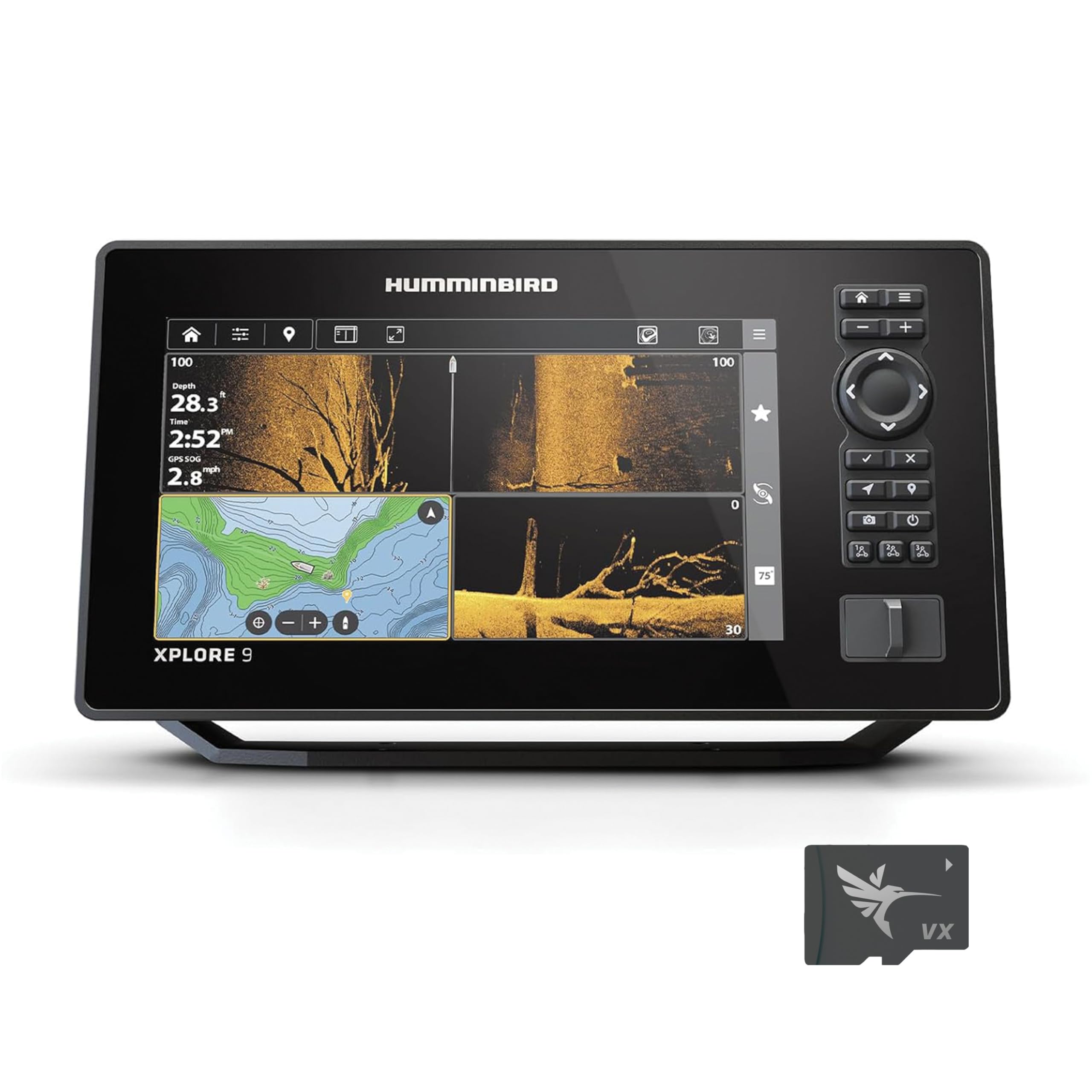
The XPLORE series represents Humminbird’s latest touchscreen platform, built around MEGA Side Imaging+ and MEGA Down Imaging+ technology. The down imaging coverage reaches 200 feet of depth with exceptional contrast between soft bottom, hard structure, and fish. The 10.1-inch color TFT display responds to touch input and physical keypad controls, giving you redundancy in wet conditions.
Built-in GPS uses the enhanced Basemap covering over 10,000 lakes with terrain markers, hazards, and marina locations. The included LakeMaster and CoastMaster VX map card covers US and Canadian waters, making this a true turnkey navigation unit. Bluetooth connectivity enables wireless anchor control with compatible Minn Kota trolling motors and smartphone notifications. AutoChart Live records eight hours of real-time bottom data for custom contour mapping.
Customers upgrading from older Helix models describe the interface as noticeably faster and more intuitive, with the touchscreen reducing menu diving. The 4.75-pound head is substantial, and the control-head-only model means you supply your own transducer if you want a specific mounting style. For the angler who wants one unit to handle down imaging, side imaging, GPS, and trolling motor integration, the XPLORE is a complete command center.
Why it’s great
- MEGA Down Imaging+ provides 200 feet of crisp structure detail
- Touchscreen and keypad dual control for flexibility in any weather
- One-Boat Network integrates Minn Kota trolling motors and Cannon downriggers
Good to know
- Control head only — transducer purchased separately
- Heavy unit requires a robust mounting bracket and appropriate dash space
5. Lowrance HOOK Reveal 5 SplitShot

The HOOK Reveal 5 is the gateway to FishReveal technology, which overlays CHIRP fish arches onto the high-resolution DownScan Imaging view. Instead of guessing which echo might be a fish, you see suspended targets clearly separated from branches and bottom clutter. The 5-inch SolarMAX display is readable in direct sunlight, and the autotuning sonar adjusts sensitivity automatically as depth and water clarity change.
The SplitShot transducer combines wide-angle high CHIRP sonar with a dedicated DownScan element, so you get solid 2D bottom tracking alongside detailed down imaging. Preloaded C-MAP US inland maps cover nearly 4,000 lakes, and Genesis Live lets you create custom contour maps of uncharted water. The flush-mount design fits neatly into most console cutouts without extensive modification.
Owners report that the split-screen view of CHIRP and DownScan is intuitive, and the autotuning feature significantly reduces button-pushing while on the water. The unit is lightweight at 14.4 ounces, making it a strong contender for kayak anglers who want down imaging without the weight penalty. For the price, the HOOK Reveal 5 gives you the best balance of modern sonar processing and a user-friendly interface.
Why it’s great
- FishReveal blends CHIRP arches with DownScan structure images
- Autotuning sonar adjusts settings as conditions change
- Lightweight design ideal for kayaks and small boats
Good to know
- 5-inch screen limits split-view detail when GPS and sonar are shown together
- Some users report sonar may be set to off from the factory, requiring a settings check
6. Lowrance Eagle 5 Fish Finder with IPS Screen
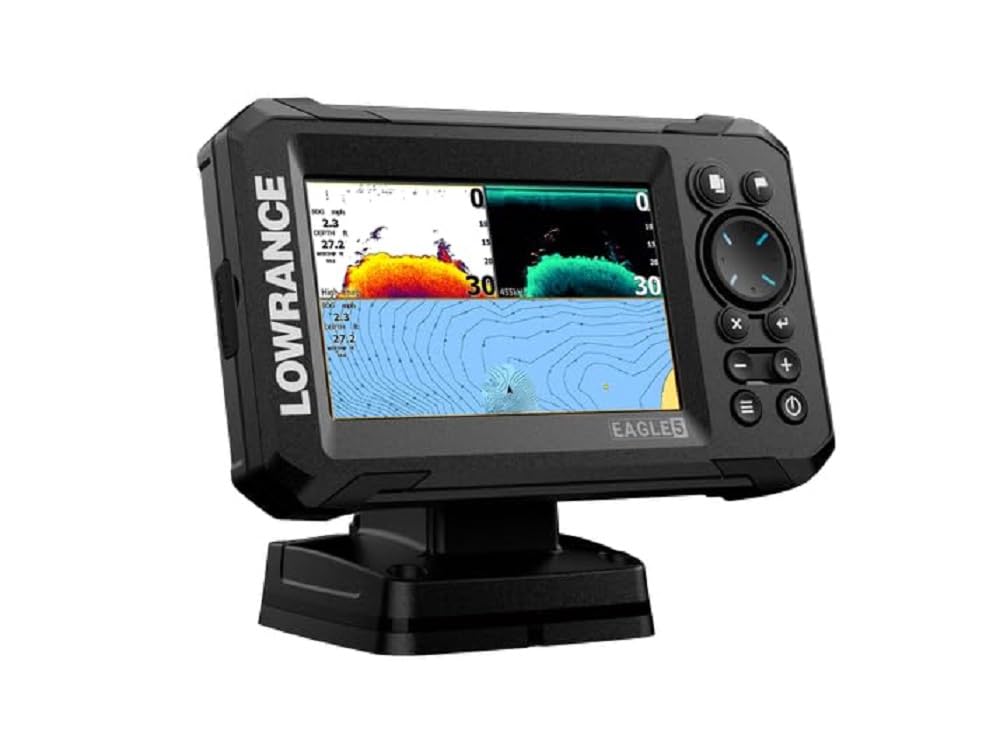
Lowrance resurrected the Eagle name with a focus on high-visibility IPS screen technology. The IPS panel maintains color accuracy and contrast at extreme viewing angles, so the person sitting next to you at the console sees the same down imaging detail as the captain. The 5-inch display is small, but the improved viewing cone compensates for its size when you are not sitting directly in front of it.
The newly designed SplitShot HD transducer offers improved clarity and range over the previous generation. FishReveal on DownScan overlays fish icons onto the structure image, and chirp sonar runs simultaneously on a separate frequency. Preloaded C-MAP charts cover over 17,000 US lakes, and Genesis Live creates ½-foot contour maps in real time. The twist-lock connector system simplifies wiring and reduces the chance of a loose connection.
Customer reviews consistently mention that the Eagle 5 is easy to set up and delivers excellent image quality for its price tier. Some users note that the sun cover is sold separately and that the menu navigation takes a few trips to master. For anglers who wear polarized sunglasses and fish from a center-console layout where viewing angle matters, the IPS screen gives the Eagle 5 a real edge over standard LCD units.
Why it’s great
- IPS screen maintains contrast at extreme viewing angles
- SplitShot HD transducer provides improved clarity and range
- Twist-lock connectors ensure secure and easy installation
Good to know
- Sun cover not included in the box
- Small screen may feel cramped for split-screen GPS and sonar views
7. Garmin Striker 7SV with ClearVu and SideVu

The Striker 7SV is the largest model in Garmin’s Striker Plus line, offering a 7-inch sunlight-readable display with built-in CHIRP traditional sonar and CHIRP ClearVu scanning sonar. ClearVu is Garmin’s implementation of down imaging, and at 7 inches the screen real estate lets you see individual limbs of submerged trees, the exact profile of a rock pile, and the transition from sand to muck.
The included CV52HW-TM transducer fires both traditional chirp and ClearVu through a single housing. Built-in Quickdraw Contours software creates and stores 1-foot contour maps for up to 2 million acres. The built-in GPS handles waypoints and routes, though the Striker line does not include a chart plotter — you get GPS positioning for navigation and mapping without preloaded cartography. Wi-Fi connectivity pairs with the ActiveCaptain app for smart notifications and community map sharing.
Owners point out that the down imaging is particularly strong in water under 60 feet, where the high-frequency ClearVu beam provides exceptional target detail. The side-scan feature adds extra coverage but requires careful transducer alignment to eliminate blind spots. For anglers who want a large display with dedicated down imaging and don’t need preloaded maps, the Striker 7SV offers the biggest screen per dollar in the mid-range category.
Why it’s great
- 7-inch display provides excellent real estate for ClearVu down imaging
- Quickdraw Contours creates 1-foot maps for up to 2 million acres
- Wi-Fi connectivity for ActiveCaptain app and software updates
Good to know
- No preloaded charts — GPS is for waypoints and mapping only
- Transducer alignment is critical for side-scan to work correctly
8. Garmin Striker Vivid 7cv

The Striker Vivid 7cv takes the ClearVu down imaging performance of the standard Striker lineup and adds seven vivid sonar color palettes that make it easier to distinguish fish targets from structure at a glance. The high-contrast palettes reduce eye strain during long days on the water, especially when scanning for subtle bottom changes or fish holding tight to cover.
The 7-inch QSVGA display delivers the same ClearVu resolution as the 7SV in a slightly more polished package. The unit includes a protective cover, power data cable, and all necessary mounting hardware. Like the 7SV, this model uses GPS for waypoints and mapping without preloaded charts, but the Quickdraw Contours software remains for creating your own 1-foot maps. The 1-year warranty gives peace of mind for a unit that will live on the water.
Users report that the vivid palettes genuinely help in spotting fish that are tight to the bottom, with one owner noting they found a submerged metal drum with catfish inside thanks to the improved contrast. The downside is the same as the standard Striker: no chart plotter means you cannot load LakeMaster or Navionics cards. For the angler who already knows their lake and just wants the sharpest down imaging with better visual differentiation, the Vivid 7cv is the smart pick.
Why it’s great
- Seven vivid color palettes improve target recognition
- 7-inch QSVGA display provides strong ClearVu down imaging
- Protective cover included for storage and transport
Good to know
- No preloaded maps or chart plotter functionality
- Requires a 12V battery and separate transducer mount for installation
9. Humminbird PiranhaMAX 4 DI

The PiranhaMAX 4 DI is the budget-entry point for down imaging, and it delivers exactly what the name promises: a 4.3-inch color TFT display with dedicated down imaging sonar from the XNT 9 DI T transducer. You get a clear photographic view of timber, brush, bridge pilings, and rocks directly below the boat. The dual-beam sonar gives you a choice between a narrow 20-degree beam for detail and a wide 60-degree beam for coverage.
The interface is streamlined with Fish ID+, fish alarms, depth alarms, and zoom. The tilt-and-swivel mount makes positioning flexible on small consoles or kayak rails. At 3.9 by 3.6 by 6.8 inches and weighing very little, this unit disappears on a small craft. The down imaging performance is basic compared to CHIRP-based systems but still a massive upgrade over standard 2D sonar alone.
Owner feedback highlights that the transducer cable is only about 10 feet, which forces most bass boat and pontoon owners to buy a separate extension cable. The screen is small and the resolution is modest, but for the price it delivers genuinely useful down imaging. For a first-time buyer on a tight budget or a secondary unit for a kayak, the PiranhaMAX 4 DI is the definition of function over flash.
Why it’s great
- Entry-level price point for dedicated down imaging sonar
- Dual-beam transducer offers choice between detail and coverage
- Compact and lightweight for kayaks and small boats
Good to know
- Transducer cable is short, typically requiring an extension for larger boats
- Screen resolution is lower than premium models, limiting fine detail
FAQ
Can I use a down imaging fish finder without GPS?
What is the effective depth range for down imaging in fresh water?
Do I need a separate transducer for down imaging and 2D sonar?
Final Thoughts: The Verdict
For most users, the best down imaging fish finder winner is the Humminbird Helix 5 Chirp GPS G3 because it combines Dual Spectrum CHIRP with built-in GPS mapping and AutoChart Live at a mid-range price that works for kayaks, jon boats, and bass boats alike. If you want a large touchscreen with live sonar upgrade potential, grab the Lowrance Elite FS 10. And for the budget-conscious angler who just wants to see structure below the boat, nothing beats the value of the Humminbird PiranhaMAX 4 DI.

Mo Maruf
I created WellFizz to bridge the gap between vague wellness advice and actionable solutions. My mission is simple: to decode the research and give you practical tools you can actually use.
Beyond the data, I am a passionate traveler. I believe that stepping away from the screen to explore new environments is essential for mental clarity and physical vitality.