Our readers keep the lights on and my smoothie glass nicely filled. As an Amazon Associate, I earn from qualifying purchases.
Cutting a perfect row of dovetails by hand demands years of practice, but a well-designed jig for your router delivers repeatable, tight-fitting joints on the first attempt. The difference between a drawer that pulls apart and one that lasts for decades often comes down to how consistently the template guides the bit — and how securely the workpiece stays in place.
I’m Mohammad Maruf — the founder and writer behind WellFizz. For this guide, I analyzed seven popular jigs across mid-range and premium price tiers, comparing template materials, clamping systems, and the precision of their indexing mechanisms to find the options that deliver real workshop value.
Whether you’re building a set of kitchen drawers or a jewelry box, choosing the right tool matters. This guide breaks down the key features and trade-offs to help you find the best dovetail jig for router based on your specific project needs and budget.
How To Choose The Best Dovetail Jig For Router
Selecting the right jig means matching its capabilities to the specific joinery you plan to produce. Three factors separate a frustration-free setup from a tool that collects dust.
Template Material and Construction
The template guides the router bit, so its material is everything. Machined aluminum templates resist wear and maintain their edge over years of use. Phenolic and glass-reinforced resin are lighter and more affordable, but can chip if nicked by the bit. For high-volume work, aluminum is the clear choice; for occasional home projects, a quality resin template works well.
Clamping and Workpiece Stability
A jig is only as good as its grip on the wood. Cam-type clamps with rubber or sandpaper backing offer the most secure hold. Look for designs that apply even pressure across the full width of the board. A jig that allows the workpiece to shift mid-cut will ruin the joint every time, regardless of template accuracy.
Indexing and Repeatability
The mechanism that positions your workpiece between cuts determines joint consistency. Brass indexing keys machined to exact widths produce uniform pins and tails. Rack-and-pinion adjustments, like those using 1/32-inch teeth, offer fine control over fence position. For through dovetails, your indexing system must lock in place without any slop.
Quick Comparison
On smaller screens, swipe sideways to see the full table.
| Model | Category | Best For | Key Spec | Amazon |
|---|---|---|---|---|
| PORTER-CABLE 4210 | Premium | Half-blind dovetails up to 12″ wide | Machined aluminum template | Amazon |
| Rockler Dovetail Jig Kit | Premium | Versatile kit with bits & collet | Phenolic templates (half-blind & through) | Amazon |
| Woodpeckers Spline Jig | Premium | Spline cutting on table saw & router | Aluminum Super Track with UHMW glide strip | Amazon |
| CMT300 Universal | Mid-Range | Half-blind joints with 7/16″ to 1″ stock | Steel body with factory-set stops | Amazon |
| Peachtree Master System | Mid-Range | Complete kit with bits & tracks | Anodized aluminum template (7° dovetail) | Amazon |
| Rockler Box Joint Jig | Mid-Range | Box joints with brass indexing keys | ¼”, ⅜”, ½” brass keys | Amazon |
| INCRA Jig | Value | Accurate fence positioning | 1/32″ rack teeth | Amazon |
In‑Depth Reviews
1. PORTER-CABLE 4210 Dovetail Jig

The PORTER-CABLE 4210 is the reference standard for half-blind dovetails in many professional shops. Its machined aluminum template resists wear far longer than phenolic or resin alternatives, and the template alignment lines cut setup time considerably. Heavy-duty cam-type clamps with sandpaper-backed locking bars hold stock firmly through multiple passes without shifting.
Router bit depth gauges built into the template let you set cutting depth without reaching for calipers. The jig accommodates stock up to 1-1/8 inches thick and 12 inches wide, covering most drawer and case work. On-board instructions are printed directly on the jig, which helps when you haven’t used it in a few months.
One consistent owner note is that the included guide bushing can be slightly oval from the factory; a simple 45-degree rotation of the router during setup remedies this. The jig ships with only one template (for half-blind, rabbeted half-blind, and sliding dovetails), so you’ll need to purchase additional templates for through dovetails.
Why it’s great
- Machined aluminum template delivers long-term accuracy
- Depth gauges eliminate guesswork during bit setup
- Cam clamps with sandpaper grip keep workpieces secure
Good to know
- Only includes one template (half-blind)
- Guide bushing may require minor tweaking
- Premium price point
2. Rockler Dovetail Jig Kit
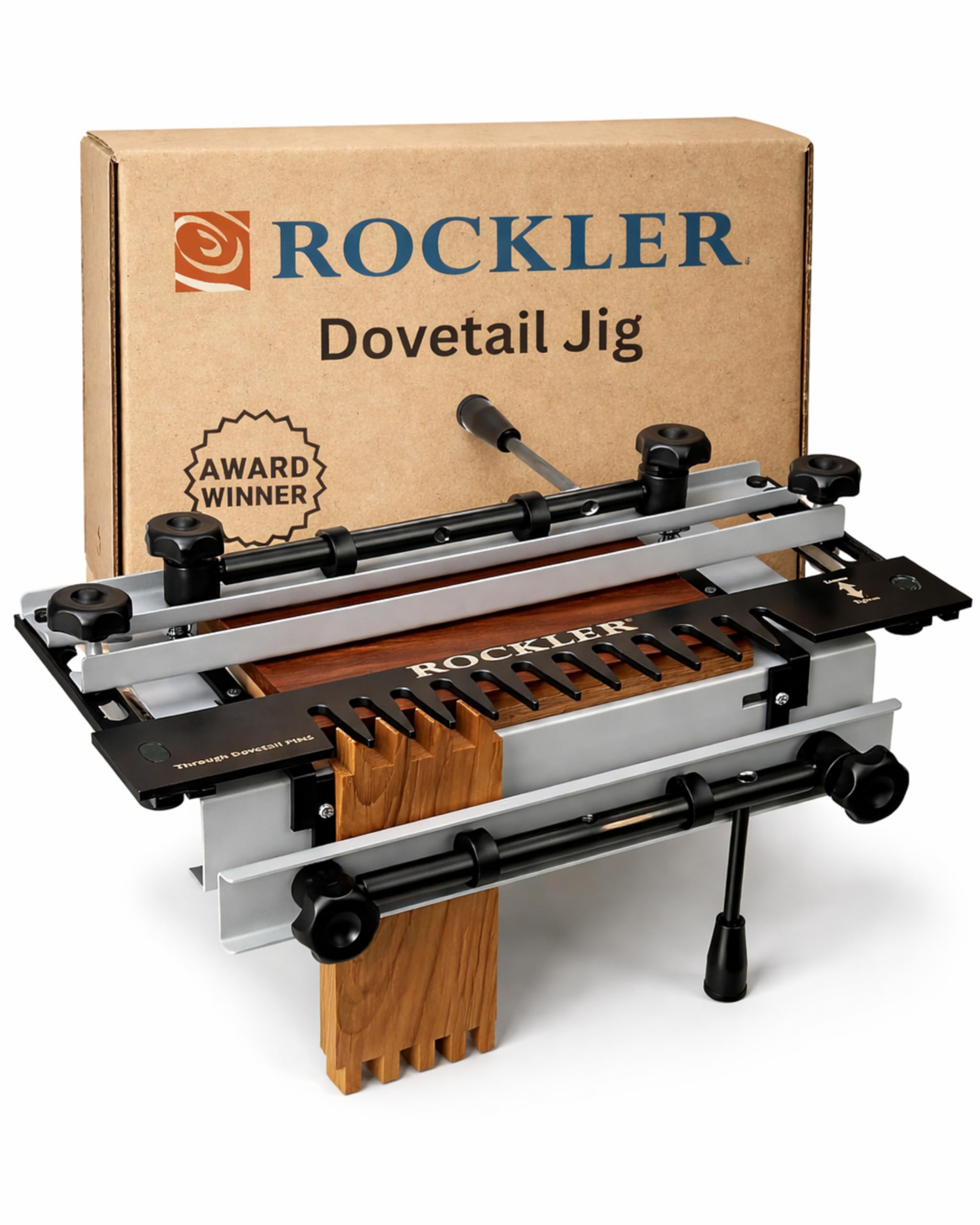
Rockler’s kit approach bundles everything you need to start cutting dovetails immediately: two phenolic templates (half-blind and through), three carbide-tipped router bits, a 7/16-inch guide bushing, and a collet adapter. The compact, portable design makes it a strong choice for workshops with limited bench space or for taking to job sites.
The one-piece stop system on this jig automatically sets the correct offset for half-blind joints. It accepts stock from 1/2 inch to 1-1/8 inches thick for half-blind dovetails and 3/8 inch to 3/4 inch for through dovetails. The template guide allows quick initial setup for 1/2-inch to 3/4-inch material, which covers common drawer stock.
Some users note that the included 8mm collet reducer is a weak point — it can bind inside the router collet. Replacing it with a higher-quality USA-made unit is a simple fix. The phenolic templates are durable but will chip if contacted by the bit, so careful router handling is essential.
Why it’s great
- All-in-one kit with bits, bushing, and collet adapter
- One-piece stop ensures consistent half-blind offset
- Compact footprint for small shops
Good to know
- Collet reducer is low quality; plan to replace it
- Phenolic templates can chip if bit contacts them
- Setup requires careful study of instructions
3. Woodpeckers Spline Jig

Woodpeckers built this jig for a specific job: cutting splines across miter joints to add strength and visual detail. The design works on both the table saw (for narrow splines) and the router table (for wider splines or dovetail key slots), giving it dual-platform utility that most dedicated dovetail jigs lack.
Two sections of aluminum Super Track attach to powder-coated steel legs lined with UHMW glide strips for smooth motion. Four molded flip stops keep workpiece alignment consistent across multiple cuts. The jig handles narrow projects from 1/2 inch to 16 inches wide, and by moving the tracks inward it can accommodate workpieces up to 3 feet wide.
Owner feedback highlights excellent build quality and straightforward setup, though some note that the plastic sliders on the base don’t hold their position as well as expected. The included stop blocks work fine for small frames but feel undersized for larger picture frames. Missing parts on delivery have been reported, but Woodpeckers customer service resolves those quickly.
Why it’s great
- Dual-platform: table saw and router table
- Handles projects up to 3 feet wide
- Precision-built with aluminum Super Track
Good to know
- Primarily a spline jig, not a full dovetail system
- Plastic sliders could be more secure
- Stop blocks feel small for large frames
4. CMT300 Universal Dovetail Jig
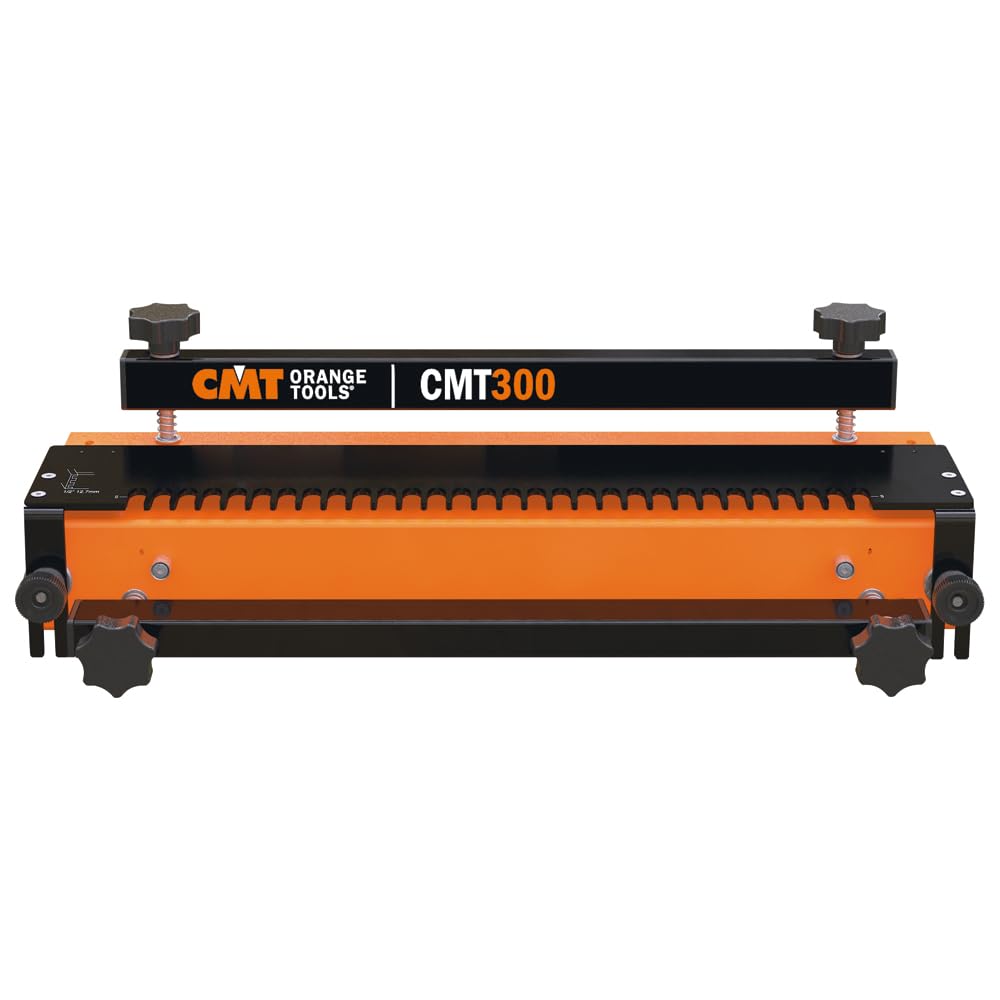
CMT Orange Tools takes a different approach with the CMT300, using a steel body and adjustable stops pre-set at the factory. The design is straightforward: clamp the workpiece with edges against the stops, set your bit depth, and begin routing. It accepts stock from 7/16 inch to 1 inch thick, covering a wide range of common lumber.
The standard jig includes a template for 1/2-inch half-blind joints along with a template guide. Additional templates are available for different joint styles, but the base unit gives you one well-executed joint type out of the box. The steel construction adds notable weight, which helps damp vibration during routing.
Reviews are mixed on ease of setup. Some users report achieving good results after working through the learning curve, while others struggle to dial in perfect joint fit. The jig works best when paired with CMT’s recommended router bits, as third-party bits sometimes create fit issues with the included guide bushing.
Why it’s great
- Steel construction dampens vibration
- Factory-set stops reduce setup steps
- Handles stock from 7/16″ to 1″ thick
Good to know
- Learning curve for achieving perfect fit
- Only includes one template for half-blind joints
- Works best with CMT recommended bits
5. Peachtree Dovetail Jig Master System

Peachtree’s Master System bundles two 17-inch anodized aluminum tracks, two track clamps, a 7-degree dovetail router bit, and a flush trim bit alongside the main jig template. The aluminum template features permanently scribed alignment lines that stay readable through years of use. It’s designed for stock from approximately 5/8 inch to 3/4 inch thickness.
Setup requires patience — the first trial often produces a tight fit that improves with minor adjustments. Using two routers (one with the dovetail bit, one with the flush trim bit) eliminates bit changes and speeds up the workflow significantly. The compact components store easily in a small toolbox or drawer.
Some users note that the instructions contain minor errors and lack a close-up photo for pin positioning, which adds to the initial learning curve. Experienced woodworkers tend to get good results quickly, while beginners should plan for a few practice cuts before tackling the actual project.
Why it’s great
- Anodized aluminum template with permanent alignment marks
- Includes two router bits and two track clamps
- Compact storage footprint
Good to know
- Instructions have minor errors and missing details
- Limited to 5/8″ to 3/4″ stock thickness
- Setup requires patience and practice cuts
6. Rockler Router Table Box Joint Jig

This Rockler jig is designed specifically for box joints (finger joints), using precision-machined solid brass indexing keys in three widths: 1/4 inch, 3/8 inch, and 1/2 inch. The keys store directly in the glass-filled nylon sled, so they’re hard to misplace. An MDF platform with melamine coating provides a low-friction surface for the workpiece.
The brass keys produce uniform finger spacing, but the critical setup detail involves using a larger key as a setup block before swapping to the correct one. The left side of the key is the reference surface for measuring, a detail missing from the included instructions. The jig works best for small- to medium-sized box projects rather than high-volume production runs.
Sawdust buildup under the sled requires cleaning between cuts, especially when routing multiple sides. The jig locks into a standard 3/4-inch miter slot with ergonomic knobs. Some users needed to drill new slots for their specific router table, so plan for potential minor modifications.
Why it’s great
- Three precision brass indexing keys included
- Melamine-coated MDF platform for smooth sliding
- Keys store in the sled to prevent loss
Good to know
- Setup trick (using larger key as block) not in manual
- Waste buildup under sled needs frequent cleaning
- May require minor modifications for some router tables
7. Original INCRA Jig (IJ32)

The INCRA Jig operates on a simple but effective principle: 1/32-inch rack teeth provide precise, repeatable fence positioning without complicated measurements. Made from 1/4-inch thick glass-reinforced resin, the jig clamps securely without flexing. It’s designed primarily as a fence positioning tool for router tables, enabling accurate dadoes, mortise-and-tenon work, and box joints.
An instructional DVD and joint-making templates come included, which helps flatten the learning curve. The jig was originally designed for the INCRA Fence System, but it works independently on a standard router table. The rack mechanism feels sturdy and the teeth engage cleanly, producing dead-on results once dialed in.
This is not a traditional dovetail template — it’s a fence positioner that enables accurate joint work when combined with the right bits and technique. Users report it saves significant setup time and keeps the fence perfectly parallel to the miter slot. The main caution is that you can lock the mechanism crooked if you rush the clamping process.
Why it’s great
- Precise 1/32″ rack positioning for repeatable cuts
- Sturdy glass-reinforced resin construction
- Includes DVD and templates for various joints
Good to know
- Not a traditional dovetail template jig
- Rush clamping can cause misalignment
- Requires reading manual and watching video
FAQ
What is the difference between a half-blind and a through dovetail jig?
Can I use a box joint jig to cut dovetails?
How important is the guide bushing size for a dovetail jig?
Can a dovetail jig work with a handheld router instead of a router table?
Final Thoughts: The Verdict
For most users, the best dovetail jig for router winner is the PORTER-CABLE 4210 because its machined aluminum template and depth gauges deliver professional-grade half-blind dovetails with minimal setup time. If you want an all-in-one kit that includes bits and collet adapter, grab the Rockler Dovetail Jig Kit. And for spline cutting across miter joints on both table saw and router table, nothing beats the Woodpeckers Spline Jig.

Mo Maruf
I created WellFizz to bridge the gap between vague wellness advice and actionable solutions. My mission is simple: to decode the research and give you practical tools you can actually use.
Beyond the data, I am a passionate traveler. I believe that stepping away from the screen to explore new environments is essential for mental clarity and physical vitality.