Our readers keep the lights on and my smoothie glass nicely filled. As an Amazon Associate, I earn from qualifying purchases.
The promise of Dolby Atmos is a sound bubble that places a helicopter exactly overhead and rain on a tin roof above your head, not just around it. Achieving that vertical soundstage requires speakers designed to reflect audio off your ceiling or dedicated height drivers, and the market is split between soundbars with up-firing channels, standalone satellite modules, and complete home theater systems. The wrong choice leaves your overhead effects sounding flat.
I’m Mohammad Maruf — the founder and writer behind WellFizz. My research for this guide involved cross-referencing hundreds of verified owner experiences against the specific driver configurations, amplifier wattages, and channel counts that define real Atmos separation versus marketing hype.
Whether you are upgrading from a basic 2.1 soundbar or building a dedicated home cinema from scratch, this guide to the best dolby atmos speakers breaks down the key specs that determine if a system delivers true overhead immersion or just adds volume.
How To Choose The Best Dolby Atmos Speakers
Selecting an Atmos system starts with your room geometry and the type of content you watch. A system with four up-firing channels in a room with 8-foot ceilings will create a very different effect than the same system in a room with vaulted ceilings. The three factors below determine whether you feel sound coming from above or just hear it bouncing around the walls.
Up-Firing vs. Dedicated Height Speakers
Up-firing drivers bounce sound off the ceiling to create the illusion of height, making them convenient for soundbars and satellite modules that sit on front towers. Dedicated in-ceiling or on-wall height speakers deliver a more precise overhead image but require wiring and structural installation. For renters or those who avoid tools, up-firing systems from brands like Klipsch and ULTIMEA offer a solid entry point, while the Samsung Q990D uses up-firing rears to fill the gap without permanent mounting.
Channel Configuration and Scaling
The numbers in a system like 5.1.2 or 11.1.4 refer to ear-level channels, subwoofer, and height channels respectively. A 5.1.2 system provides two overhead channels, which is sufficient for subtle effects like rain. An 11.1.4 system with four height channels and wide front array creates a much more precise bubble where you can pinpoint a jet flying from front left to rear right. For medium rooms, 5.1.2 is the entry point; for dedicated theaters, 7.1.4 or higher ensures no gap in the sound field.
HDMI eARC and Lossless Audio
Dolby Atmos metadata can be delivered via compressed Dolby Digital Plus (streaming) or lossless Dolby TrueHD (Blu-ray, high-bitrate streaming). HDMI eARC supports the higher bandwidth needed for TrueHD, while standard ARC compresses the signal. If you watch discs or use a high-end streaming device, ensure the soundbar or receiver has HDMI eARC input. The ULTIMEA F40, for example, highlights its 37Mbps eARC bandwidth for uncompressed 5.1.2 channel audio.
Quick Comparison
On smaller screens, swipe sideways to see the full table.
| Model | Category | Best For | Key Spec | Amazon |
|---|---|---|---|---|
| Samsung Q990D | Soundbar System | Premium all-in-one Atmos | 11.1.4 channels, 4 up-firing | Amazon |
| JBL Bar 1300X | Soundbar System | Detachable rear surrounds | 11.1.4 channels, 6 up-firing | Amazon |
| Sonos Arc Ultra | Soundbar | Ecosystem & multi-room | 9.1.4 channels, Sound Motion | Amazon |
| Sony HT-S60 | Soundbar System | BRAVIA TV pairing | 5.1 channels, DTS:X | Amazon |
| Klipsch Cinema 5.1.4 | Satellite System | Entry-level discrete Atmos | 5.1.4, 4 up-firing satellites | Amazon |
| Klipsch RP-500SA | Height Module | Adding Atmos to existing setup | 5.25″ woofer, switchable crossover | Amazon |
| Polk ES10 | Bookshelf Surround | Versatile surround placement | Hi-Res Audio, Power Port | Amazon |
| Fire TV Soundbar Plus | Soundbar System | Fire TV integration | 3.1 channels, dedicated center | Amazon |
| ULTIMEA F40 | Soundbar System | Budget 5.1.2 with app EQ | 5.1.2, neodymium up-firing | Amazon |
In‑Depth Reviews
1. Samsung Q990D 11.1.4ch Soundbar

The Samsung Q990D is the benchmark for all-in-one Atmos soundbars. Its 11.1.4 channel layout includes four up-firing drivers — two in the main bar and two in the rear satellites — creating a dense overhead bubble that rivals dedicated speaker setups. The 22 total speakers (front, side, up-firing) deliver wide soundstage width and precise object placement you can follow across the room.
Wireless Dolby Atmos support means you do not need an HDMI cable from the subwoofer to the bar, reducing clutter. Q-Symphony integration with compatible Samsung TVs lets the TV speakers and soundbar work together, adding extra height dimension. SpaceFit Sound Pro automatically calibrates the audio based on room acoustics, adjusting EQ and delay for your specific space without manual microphone placement.
Owners report that dialogue clarity is a massive step up from TV speakers — many turned off closed captions after the first use. The only recurring complaint is random audio dropouts over eARC with certain LG OLED models, though using standard ARC as a workaround solves the issue at the cost of bandwidth.
Why it’s great
- True 11.1.4 channel count with four discrete height drivers
- Wireless Dolby Atmos eliminates HDMI cable clutter
- SpaceFit Sound Pro auto-calibrates for your room dimensions
Good to know
- eARC dropouts reported with some LG OLED models
- At its best with Samsung TV for Q-Symphony
- Bulky satellites require shelf or stand space
2. JBL Bar 1300X 11.1.4-Channel Soundbar

The JBL Bar 1300X solves a common Atmos pain point: rear speaker wiring. The two satellite speakers detach from the main bar and run on built-in batteries, so you can place them behind your seating area without running cables. Each satellite has its own up-firing driver, bringing the total height channel count to four when combined with the bar’s two up-firing drivers, enabling true 11.1.4 channel separation.
The 12-inch wireless subwoofer produces deep, tactile bass that moves more air than most 10-inch competitors, creating subsonic pressure that anchors the low end during action sequences. The 1170W total system power ensures headroom for large rooms without distortion. Built-in Wi-Fi supports AirPlay 2, Alexa Multi-Room, and Chromecast for streaming music across the house.
Some owners note a dynamic volume swing between quiet dialogue and loud effects that requires manual adjustment. The “Smart Mode” resets every power cycle, and the night mode mutes the bar and subwoofer while sending sound only to the satellites — not ideal for everyone. The main bar is long, so measure your TV stand width before purchase.
Why it’s great
- Battery-powered detachable surrounds eliminate rear speaker wires
- 12-inch subwoofer delivers cinema-grade low-end pressure
- Four up-firing drivers for complete overhead coverage
Good to know
- Volume swings between dialogue and action scenes require attention
- Night mode mutes bar and sub, not ideal for all users
- Main bar length may exceed standard TV stand width
3. Sonos Arc Ultra Soundbar

The Sonos Arc Ultra uses a new Sound Motion acoustic architecture that packs more drivers into a single bar than previous generations. With 9.1.4 channel processing and dedicated up-firing drivers, it creates a wide soundstage with precise overhead effects without requiring a separate subwoofer — though adding the Sonos Sub and Era 300 rears dramatically expands the bubble to full 7.1.4 or higher.
AI-powered Speech Enhancement detects human voice frequencies in real time and clarifies dialogue without making everything sound artificially boosted. Trueplay tuning uses the microphone on your iPhone or iPad to measure room reflections and adjust EQ, delay, and height channel levels for your specific ceiling height and wall materials. The bar supports HDMI eARC for lossless Dolby TrueHD from Blu-ray sources.
The downside is price: you pay a premium for the Sonos ecosystem, and the Arc Ultra sounds good standalone but really shines with the + Sub and -per-pair Era 300s. Owners report the setup experience is the smoothest in the category, with the app guiding every step. Multi-room audio integration is seamless if you have other Sonos speakers.
Why it’s great
- Sound Motion architecture packs more drivers into compact bar
- AI Speech Enhancement clarifies dialogue without artifacts
- Trueplay auto-calibrates for room acoustics and ceiling height
Good to know
- Premium price escalates quickly with Sub and surrounds
- Standalone performance good but not best-in-class without rears
- Limited to HDMI eARC digital connection; no analog inputs
4. Sony BRAVIA Theater System 6 (HT-S60)

Sony’s HT-S60 is built for owners of BRAVIA TVs, unlocking features like Voice Zoom 3 that enhances dialogue by analyzing scene content and adjusting center channel levels in real time. The 5.1 channel system includes a dedicated center channel for clear vocal reproduction, rear speakers for surround depth, and a subwoofer for bass extension — all in a compact package that does not dominate the room.
Dolby Atmos and DTS:X support means it decodes both major object-based formats, and the Multi Stereo mode sends the same audio to all speakers for room-filling music playback. The BRAVIA Connect app offers granular control over sound profiles and channel levels. The system is fully wireless between the soundbar and rear speakers except for the subwoofer, which requires a wired connection to the TV.
Owners note that setup with Samsung TVs is straightforward despite the Sony branding, but the HDMI connection can cause intermittent audio drops on YouTube and other streaming apps — switching to optical cable solves this. The glossy soundbar finish reflects TV content under ambient light, which some find distracting.
Why it’s great
- Voice Zoom 3 enhances dialogue intelligently with BRAVIA TVs
- Dedicated center channel for vocal clarity
- Compact rear speakers deliver immersive surround
Good to know
- Subwoofer must be wired directly to TV
- HDMI audio drops reported on some streaming services
- Glossy soundbar finish reflects screen light
5. Klipsch Reference Cinema Dolby Atmos 5.1.4 System

The Klipsch Reference Cinema 5.1.4 system is one of the most accessible ways to get four up-firing Atmos channels without jumping to a premium soundbar. All four satellite speakers feature upward-firing drivers, giving you front and rear height effects that create a convincing 360-degree dome of sound. The 300W all-digital subwoofer provides enough low-end punch for movies and games.
The satellites use Tractrix horn technology with aluminum tweeters for efficient high-frequency extension — a Klipsch signature that makes dialogue and effects cut through without harshness at high volumes. The system works as a 5.1.4 setup with a 9-channel receiver or as a 7.1 system using the satellites as surrounds, giving flexibility depending on your AVR capabilities. Magnetic grilles and copper-colored woofer cones give them a premium look.
Owners note that the system does not include speaker wire, and the push-locking terminals require specific banana plugs for a secure fit. The subwoofer lacks the punch of larger Klipsch models, and some users set the crossover for the up-firing satellites higher (around 120Hz) to avoid distortion. The plastic cabinet material feels lighter than the premium Reference Premiere line.
Why it’s great
- Four up-firing satellites for front and rear height effects
- Tractrix horn technology delivers efficient, clear highs
- Versatile setup works as 5.1.4 or 7.1 depending on receiver
Good to know
- Speaker wire not included; terminals require careful plug selection
- Subwoofer punch is limited compared to larger Klipsch models
- Plastic cabinet construction lacks premium weight feel
6. Klipsch RP-500SA Reference Premiere Dolby Atmos Speakers

The RP-500SA is a dedicated height-effects module that can be placed on top of front towers as an up-firing Atmos speaker or wall-mounted as an elevation surround. The switchable crossover setting lets you choose between Atmos mode (full-range with height EQ) or surround mode (standard crossover for rear channel duty), giving you flexibility as your system evolves.
The 1-inch titanium LTS vented tweeter with Hybrid Tractrix horn delivers crisp, detailed highs that reveal subtle Atmos metadata like rustling leaves overhead. The 5.25-inch spun copper Cerametallic woofer provides mid-bass warmth that prevents the height channels from sounding thin — a common complaint with smaller Atmos modules. The scratch-resistant ebony finish matches the Reference Premiere series for seamless visual integration.
Owners report that mounting on towers produces subtle but convincing height effects, while wall-mounting at ear-to-ceiling height dramatically improves overhead separation. Some note that the sealed design limits deep bass extension, so crossing over at 100-120Hz is recommended. The price per pair places them in premium territory, but the build quality and sound accuracy justify the investment for serious home theater builders.
Why it’s great
- Switchable crossover for Atmos or surround duty
- 5.25-inch Cerametallic woofer adds mid-bass weight to height channels
- Titanium tweeter with Tractrix horn for detailed high-frequency effects
Good to know
- Sealed design limits bass; requires crossover management
- Premium pricing compared to bookshelf alternatives
- Atmos effect depth depends on ceiling height and placement
7. Polk Signature Elite ES10 Surround Speakers

The Polk ES10 is a compact bookshelf speaker designed for surround and height-channel duty in a timbre-matched system. The 1-inch Terylene tweeter and 4-inch Dynamic Balance woofer deliver clear, neutral sound that blends seamlessly with other Signature Elite series speakers for a cohesive front-to-back soundstage. The Power Port technology extends bass response by 3dB over conventional ports, reducing turbulence and distortion.
Hi-Res Audio certification (up to 40kHz) ensures the ES10 can reproduce the full frequency range of high-resolution audio sources and the extended highs of Dolby Atmos soundtracks. The 4-ohm and 8-ohm compatibility means they work with most AV receivers without impedance matching issues. Keyhole slots and threaded inserts give you both flush wall-mount and stand-mount options for satellite placement.
Owners praise the clarity for music and movies, noting the ES10 gets loud with clean power. The sealed cabinet limits deep bass extension — below 80Hz the roll-off is steep, so a subwoofer is mandatory for full-range performance. Some users note the wood-grain vinyl finish can look cheap under direct light, but the overall build quality of the MDF cabinet is solid.
Why it’s great
- Hi-Res Audio certified for 40kHz frequency extension
- Power Port technology reduces distortion for cleaner bass
- Timbre-matched design integrates with full Signature Elite series
Good to know
- Requires subwoofer for full range; bass rolls off below 80Hz
- Wood-grain vinyl finish is budget-feel under direct light
- Small cabinet limits maximum SPL for large rooms
8. Amazon Fire TV Soundbar Plus with Subwoofer
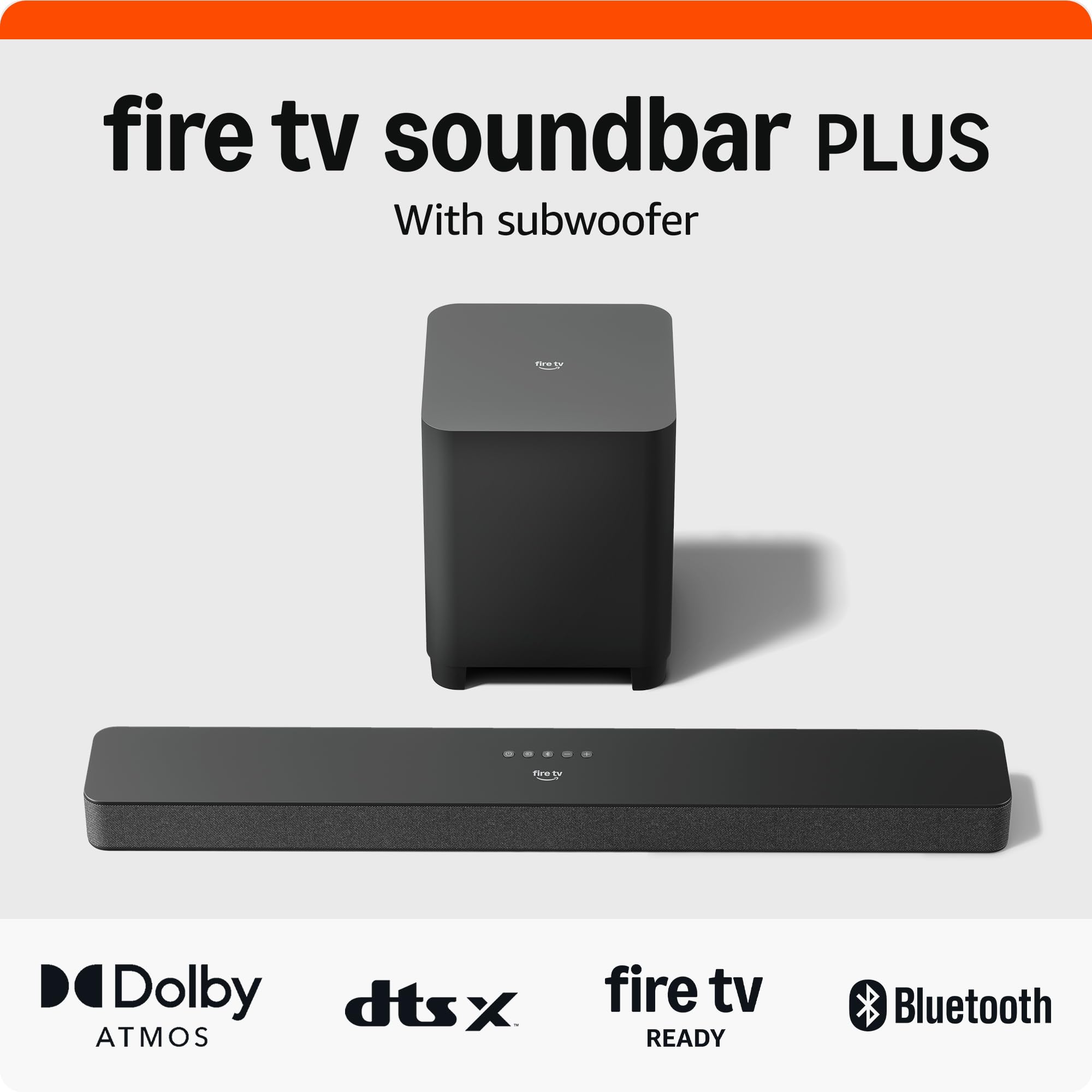
Amazon’s Fire TV Soundbar Plus packs Dolby Atmos and DTS:X decoding into a 3.1 channel soundbar with a dedicated center channel — a feature often missing at this price point. The separate subwoofer connects wirelessly to the soundbar and provides bass extension that anchors the soundstage, while the center channel ensures dialogue cuts through action sequences without the tinny artifacts common in virtualized center channels.
The soundbar integrates directly with Fire TV devices, allowing one remote to control power, volume, and input. Movie, Music, Sports, and Night modes optimize EQ curves based on content type, and the Bluetooth streaming lets you play music from your phone without turning on the TV. The teardown reveals honest engineering: real 2-way L/C/R channels with oval midrange drivers and silk dome tweeters, plus rear-firing drivers for virtual surround that can be toggled off.
Owners emphasize the value proposition — many chose this over more expensive brands because it delivers clear dialogue and solid bass without complicated setup. The soundbar is wide enough that it may not fit between the legs of some TVs, requiring a shelf or top-bezel placement. The subwoofer lacks fine-tuning options, so the bass level is set via a single knob or the Fire TV audio settings.
Why it’s great
- Dedicated center channel for dialogue clarity at a value price
- Seamless Fire TV integration with single-remote control
- Real 2-way L/C/R drivers instead of single full-range channels
Good to know
- Soundbar width may not fit between TV legs on smaller stands
- Subwoofer lacks granular fine-tuning beyond single knob
- Virtual surround from rear-firing drivers is subtle, not full Atmos height
9. ULTIMEA 5.1.2ch Sound Bar Skywave F40
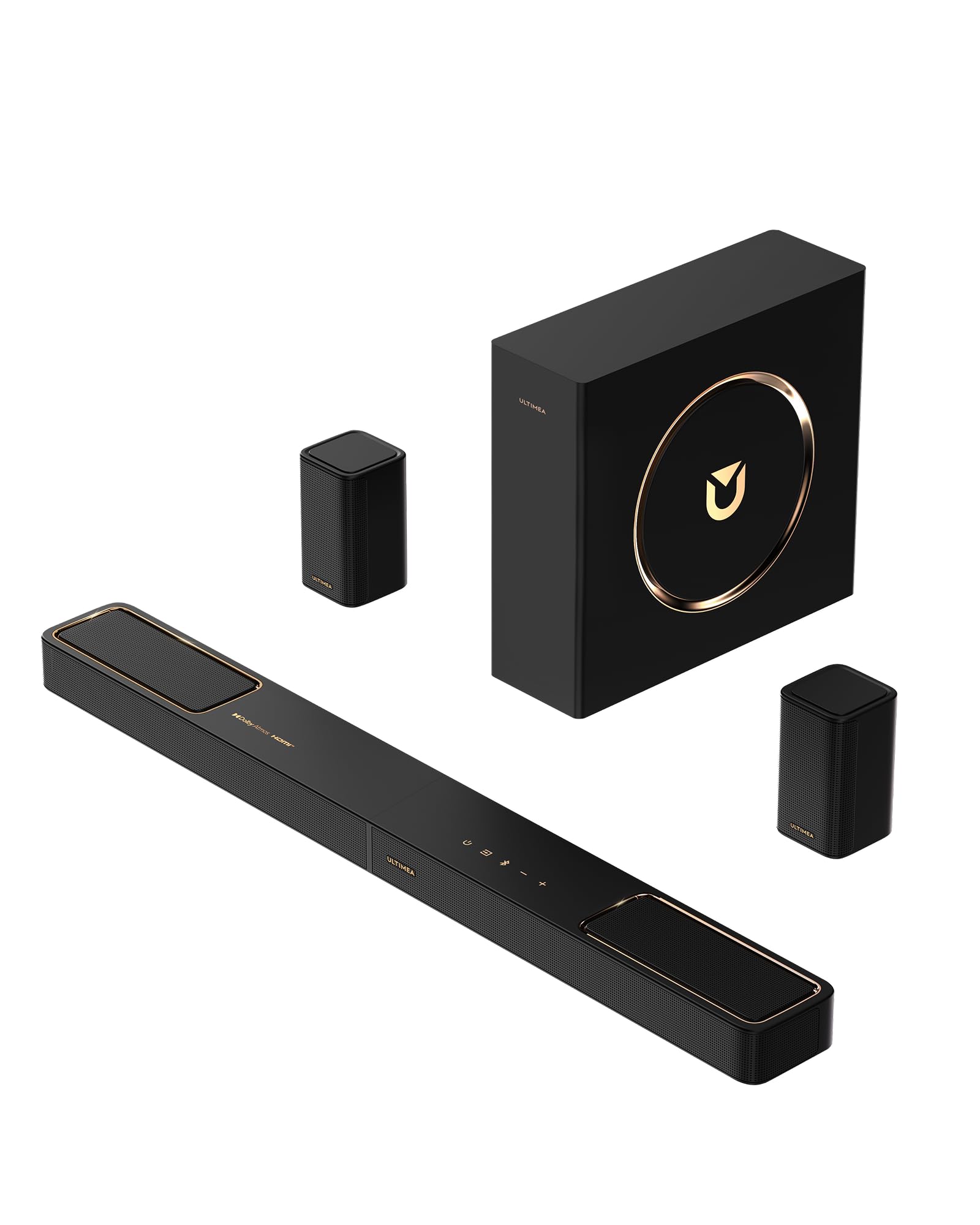
The ULTIMEA Skywave F40 brings Dolby Atmos to a budget-friendly 5.1.2 package with up-firing drivers using neodymium internal magnets and 18-core voice coils — aerospace-grade materials that improve height-channel precision and high-frequency dynamics. The two wired rear surround speakers connect to each other and create a 360-degree sound field when paired with the dual up-firing Atmos drivers and subwoofer.
HDMI eARC support up to 37Mbps bandwidth ensures lossless 5.1.2 Dolby TrueHD transmission from Blu-ray sources, while the bundled HDMI eARC cable and optical cable give you connection flexibility. The Ultimea App offers a 10-band graphic EQ, 13-step level adjustment per channel, and 121 preset sound settings — an uncommon depth of customization at this price tier. OTA updates keep the DSP firmware current.
Owners report the system is easy to set up with wireless rears (requiring only power), clear dialogue, and immersive surround effects that are impressive for the price. The bass is solid but not chest-thumping — the 5.25-inch wired subwoofer works well for small to medium rooms. Some users note the system is not compatible with DTS formats, and the rear speakers require a cable between them that must be hidden.
Why it’s great
- Neodymium up-firing drivers improve height channel precision
- HDMI eARC supports lossless Dolby TrueHD up to 37Mbps
- App-based 10-band EQ and 121 preset sound profiles
Good to know
- Not compatible with DTS formats
- Rear speakers require a connecting cable between them
- Wired subwoofer limits placement flexibility
FAQ
Do Dolby Atmos speakers require a special receiver?
What is the ideal ceiling height for up-firing Atmos speakers?
Can I add Atmos to my existing 5.1 surround sound system?
Is Dolby Atmos worth it for music listening?
Final Thoughts: The Verdict
For most users, the best dolby atmos speakers winner is the Samsung Q990D because its 11.1.4 channel configuration, wireless rear speakers, and SpaceFit Sound Pro calibration deliver a complete, uncompromised Atmos experience without requiring a separate receiver or in-ceiling wiring. If you want detachable rear surrounds that eliminate all speaker cables, grab the JBL Bar 1300X. And for a budget-friendly 5.1.2 setup with app-based EQ control, nothing beats the ULTIMEA Skywave F40.

Mo Maruf
I created WellFizz to bridge the gap between vague wellness advice and actionable solutions. My mission is simple: to decode the research and give you practical tools you can actually use.
Beyond the data, I am a passionate traveler. I believe that stepping away from the screen to explore new environments is essential for mental clarity and physical vitality.