Our readers keep the lights on and my smoothie glass nicely filled. As an Amazon Associate, I earn from qualifying purchases.
When your dog bolts into fifty acres of thick timber, a cell-tethered pet locator becomes a brick. Rural coverage means navigating valleys that block cellular repeaters, dense canopy that scatters Wi-Fi, and property lines measured in miles rather than feet. A dedicated dog tracker for these environments must rely on satellite networks or direct radio frequency rather than the nearest tower.
I’m Mohammad Maruf — the founder and writer behind WellFizz. I have spent hundreds of hours analyzing GPS modules, radio strength specifications, and real-world rural range claims to determine which devices actually hold a signal when you leave the pavement behind.
This guide evaluates nine units built to handle properties exceeding one acre, wooded terrain, and zero cellular dependency. Whether you need a containment fence or a search-and-recovery beacon, the best dog tracker for rural areas must prioritize satellite lock speed, battery endurance, and raw signal penetration above all else.
How To Choose The Best Dog Tracker For Rural Areas
Rural tracking introduces obstacles that suburban systems never face. Before selecting a device, you must weigh four factors that determine whether a collar will hold a lock when your dog crests a ridge two miles from the house.
Cellular Dependence vs. Radio Frequency Independence
Most consumer pet trackers rely on LTE-M or NB-IoT cellular chips. In rural zones with spotty carrier coverage, these collars fail silently. True rural trackers use UHF radio waves or satellite-to-handheld links that operate without any cellular infrastructure. Devices like the Marco Polo system use a proprietary radio frequency that works in canyons where GPS alone may drift.
Satellite Frequency Bands and Canopy Penetration
Dual-frequency GPS collars that access both L1 and L5 bands lock faster under heavy foliage because L5 signals resist multipath interference from tree branches. The Halo Collar 5 and PetSafe Guardian GPS 2.0 use this technology. Single-frequency units struggle in tall pines or dense deciduous forests, where the GPS fix may jump twenty feet during a single walk.
Battery Life Under Continuous Tracking
A tracker that lasts twelve hours is useless for an overnight search. Collars with dynamic tracking — where update frequency slows during rest and accelerates during movement — extend usable life significantly. Garmin’s Alpha TT 25 achieves up to 68 hours on a standard battery pack by adjusting polling intervals based on the dog’s velocity.
Boundary Containment vs. Open-Range Recovery
Some rural owners need a virtual fence that corrects the dog before it leaves the property. Others need a recovery tool that shows direction and distance after the dog has already run. Aorkuler’s handheld controller offers the latter without any phone app, while systems like the GF02 Plus combine fence creation with Bluetooth-based verification that works best when the owner is near the collar’s range.
Quick Comparison
On smaller screens, swipe sideways to see the full table.
| Model | Category | Best For | Key Spec | Amazon |
|---|---|---|---|---|
| Garmin Alpha TT 25 | Collar (Handheld Required) | Extended hunts with training | 68-hour battery, 9-mile range | Amazon |
| Marco Polo Advanced | Radio Direction Finder | No-cell, deep-forest recovery | 6-week receiver battery | Amazon |
| Dogtra Pathfinder 2 | GPS + Training Collar | App-based map tracking | 9-mile range, 2-sec updates | Amazon |
| PetSafe Guardian GPS 2.0 | GPS Fence + Tracker | Virtual fencing on ½+ acre | 70-hour battery, dual-frequency | Amazon |
| Halo Collar 5 | GPS Fence + Tracker | Precision boundaries with subscription | L1+L5 GPS, AI drift filter | Amazon |
| Garmin TT 15 Mini | Collar (Handheld Required) | Small breeds in rugged terrain | 30-hour battery, 7.5 oz | Amazon |
| Aorkuler GPS Tracker | Handheld + Collar | No-phone, no-subscription hiking | 3.5-mile LoS range | Amazon |
| LUCKSKY GPS Fence | Wireless Fence | Entry-level containment | 3,000-ft circular boundary | Amazon |
| yhpet GF02 Plus | App-Based Fence | Customizable Bluetooth geo-fence | 168-hour standby battery | Amazon |
In‑Depth Reviews
1. Garmin Alpha TT 25

The Alpha TT 25 operates as a receiver-only collar that requires a compatible Garmin handheld — the Pro 550 Plus or any Alpha series remote. That upfront investment buys a 2.5-second position refresh rate and a range that reaches nine miles in open terrain. The collar itself weighs almost nothing at 1.3 ounces, which makes it suitable for breeds as small as twenty pounds while still offering eighteen levels of continuous or momentary stimulation, plus tone and vibration.
Battery life benefits from dynamic tracking: the collar polls aggressively when the dog is moving and stretches intervals during rest, yielding up to 68 hours on a standard pack or 136 hours with the expanded battery. The user-replaceable flex band eliminates the need to buy a whole new collar when the strap wears out. A multicolor LED with seven color options helps identify multiple dogs after dark.
Owners report sub-foot GPS accuracy even in heavy rain, and the ability to monitor distance plus speed on the handheld screen. The trade-off is the lack of a built-in screen on the collar itself — you must carry the handheld unit, which adds bulk to your kit.
Why it’s great
- Sub-foot GPS accuracy verified in wet, wooded conditions
- User-replaceable battery pack extends service life indefinitely
- Multicolor LED makes nighttime identification effortless
Good to know
- Requires separate Garmin handheld purchase
- Standard battery under 30 hours without dynamic tracking mode
2. Marco Polo Advanced Pet Monitoring

The Marco Polo Advanced eschews GPS and cellular networks entirely, instead using UHF radio direction finding. A base unit placed at home emits a signal that the handheld receiver hunts; the collar tag transmits back, allowing the user to walk in the direction of the strongest signal. In practice, owners have tracked cats and dogs nearly a mile away in dense Pacific Northwest forest and mountainous terrain where GPS units lose lock entirely.
Battery life is extraordinary: the receiver carried by the owner lasts up to six weeks of continuous monitoring, and the pet tag charges monthly. The system supports up to three pets with the purchase of additional tags. The tag is light enough for cats as small as five pounds and fully submersible for swimming dogs.
The interface is deliberately simple — a single button initiates the search, and an LED array indicates signal strength. There is no app, no map, no subscription. The trade-off is that the user must learn to interpret relative signal strength rather than glance at a map pin. Collar mounting hardware has been described as flimsy by a few owners, though third-party harness attachments solve this.
Why it’s great
- Works in canyons and valleys where GPS drift is severe
- Receiver battery measured in weeks, not hours
- Zero monthly fees or data plans
Good to know
- Requires practice to interpret signal strength accurately
- Collar mounting hardware reported as fragile by some users
3. Dogtra Pathfinder 2

The Pathfinder 2 combines a handheld remote with a smartphone app that displays terrain, satellite, and standard maps powered by Mapbox. GPS updates occur every two seconds, and the system supports up to twenty-one dogs in a single hunt group. The collar receiver delivers 100 levels of nick and constant stimulation, plus tone and vibration, making it one of the most granular training tools available.
Offline mode stores maps locally so tracking continues even when the phone loses cellular connection. E-Fence and Mobile-Fence features allow the user to draw containment zones directly on the app map. The collar is waterproof and built for dogs 35 pounds and above, with a neck size range of 12 to 22 inches.
Some users note that the app drains phone battery quickly, and the boundary accuracy can be off by 50 to 80 feet on large rural properties. The e-fence must be manually activated each session rather than persisting automatically. Customer service from Dogtra’s USA-based team is responsive, with a two-year warranty and a 30-day satisfaction guarantee.
Why it’s great
- Offline map storage for tracking without cell signal
- 100-level stimulation allows precise correction calibration
- Supports 21 dogs on one system for multi-dog hunts
Good to know
- App operation drains smartphone battery rapidly
- Boundary accuracy may drift 50-80 feet on larger properties
4. PetSafe Guardian GPS 2.0

The Guardian GPS 2.0 is PetSafe’s second-generation wireless fence, now 50 percent smaller than the original. The collar fits necks as small as eight inches, covering breeds down to ten pounds. Dual-frequency GPS antennas improve location reliability under tree canopy compared to the single-frequency predecessor. AccuGuard technology combines GPS data with motion detection to filter out false boundary crossings caused by GPS drift.
Up to 50 custom virtual fences can be stored in the MyPetSafe app. The rechargeable battery lasts up to 70 hours between charges. The system requires a Wi-Fi connection for initial setup and a subscription plan (monthly or annual) for ongoing GPS and cellular connectivity. The first month is free, and each additional pet collar requires its own subscription.
Real-world performance shows fast boundary alerts, though some owners report a delay of five to twenty feet before the collar triggers correction if the dog runs at speed. Re-entry into the yard can trigger a full correction sequence if the GPS location jumps inside the boundary after crossing. The collar tends to loosen slightly during active use, requiring periodic tightening.
Why it’s great
- Compact collar fits breeds down to ten pounds
- Dual-frequency GPS improves reliability under foliage
- AccuGuard AI filters GPS drift for fewer false alerts
Good to know
- Subscription required per collar for GPS data access
- Correction delay of 5-20 feet when dog runs at speed
5. Halo Collar 5
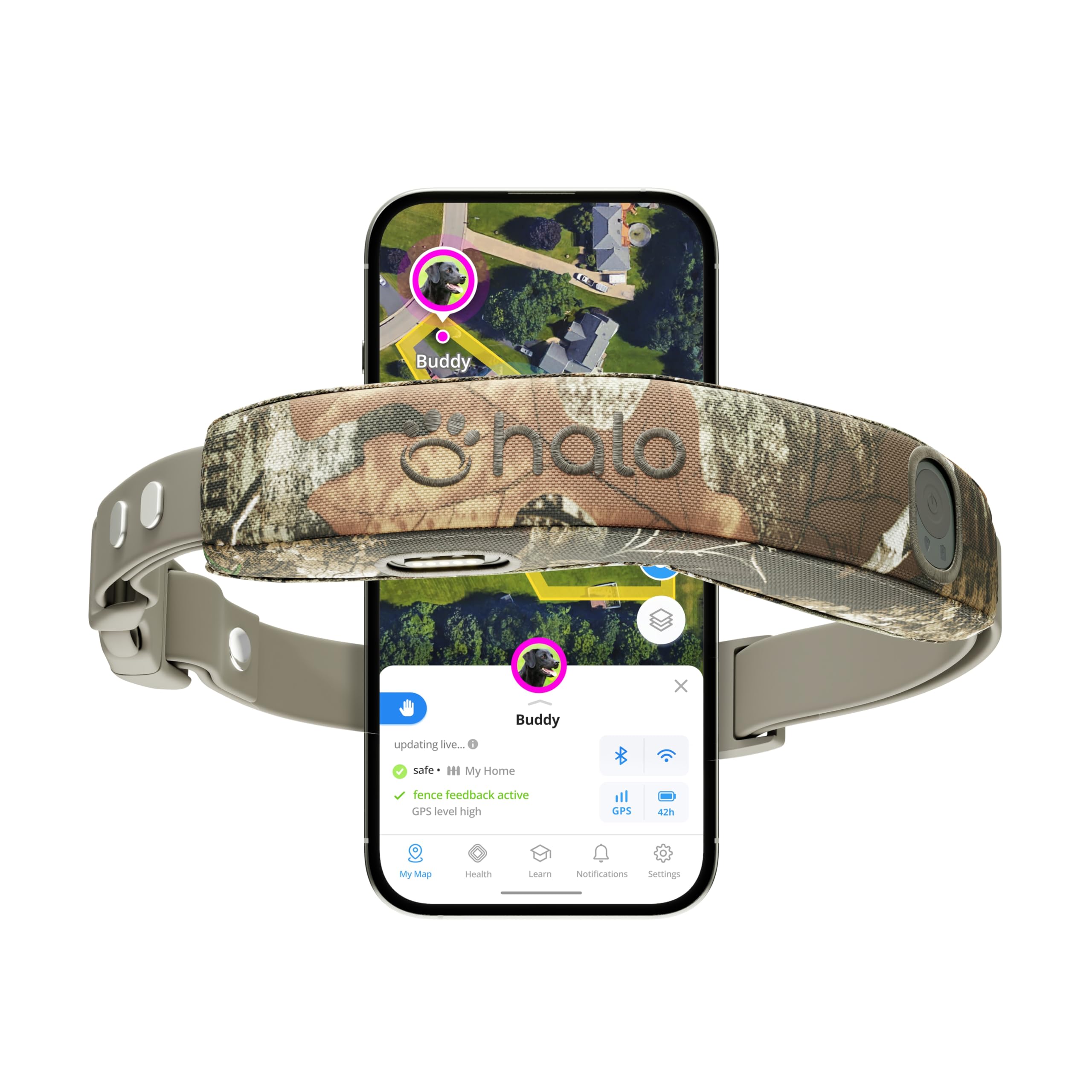
Halo Collar 5 uses dual-frequency L1 and L5 satellite reception plus real-time ground-station corrections to achieve accuracy within two feet of the dog’s actual location. The system updates twenty times per second and includes AI-based obstacle filtering that prevents trees and buildings from causing drift. It is built for rural properties where other GPS collars lose reliability.
The collar ships with a training program developed by Cesar Millan, teaching the dog to respond to escalating warnings: sound, then vibration, then optional static. The app allows creation and storage of multiple fences, which is useful for owners who travel between properties. AlwaysOn GPS tracks the dog continuously even when no fence is active, providing real-time location through the phone.
A subscription is required to activate GPS tracking, cellular data, and fence features. The collar charges magnetically and weighs 4.16 ounces. Some early firmware updates caused boundary drift and false corrections, though subsequent patches resolved many of those issues. Customer support wait times have been reported at over three hours during peak periods.
Why it’s great
- Sub-two-foot GPS accuracy with L1+L5 and ground-station correction
- AI obstacle filtering prevents drift near trees and buildings
- Built-in Cesar Millan training program guides correction
Good to know
- Subscription required for all GPS and fence features
- Firmware updates have introduced temporary boundary drift issues
6. Garmin TT 15 Mini

The TT 15 Mini is a scaled-down version of Garmin’s standard TT 15 dog device, weighing 7.5 ounces versus the original 10 ounces. It is designed for dogs with neck circumferences as small as 9.5 inches, making it the best option for small herding breeds, terriers, and puppies who need tracking in rugged terrain. The collar uses top-mounted GPS and GLONASS receivers for faster satellite acquisition under canopy.
Battery life runs 16 to 30 hours depending on polling frequency, and a sleep mode activated from the handheld saves charge when the dog is resting in the truck or kennel. The collar strap is 3/4-inch polyurethane-coated nylon and is user-replaceable in multiple colors. Contact points come in two lengths for short and long-haired breeds, with stainless steel insulation for reliable wet-condition performance.
Range is slightly reduced compared to the full-size TT 15 — owners report about 1,000 yards in brush and up to 6 miles in open fields. The mini antenna provides good range but can cause GPS position jumps of about twenty feet in dense tree cover, producing a noisy track line on the handheld display. Some users report the collar beep stopped working on one occasion, though a reboot restored function.
Why it’s great
- Lightweight 7.5-ounce form factor for small breeds
- GPS/GLONASS dual-constellation for faster satellite lock
- Collar sleep mode extends battery between hunting sessions
Good to know
- GPS position may jump ~20 feet in heavy tree cover
- Battery life at 16 hours with aggressive polling intervals
7. Aorkuler GPS Dog Tracker
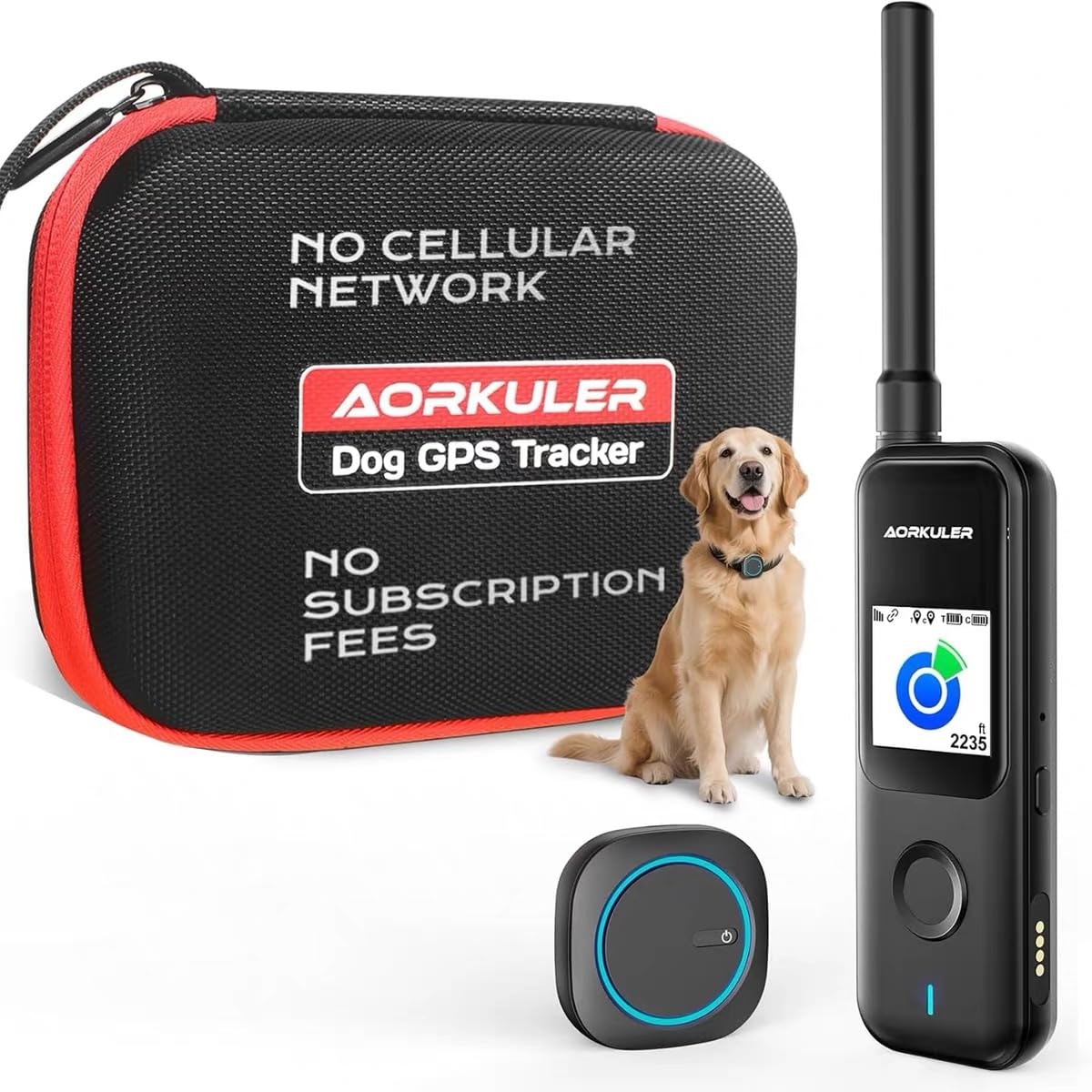
The Aorkuler tracker operates entirely without a phone or cellular connection. A handheld controller shows a green arrow pointing toward the dog’s direction and a distance reading updated every three seconds. The listed range is 3.5 miles line-of-sight, though real-world tests in semi-wooded areas reduced effective range to roughly 800 feet under moderate canopy and up to a quarter mile in open fields.
Battery life reaches 24 hours of continuous tracking on a 2-3 hour charge, or over ten days if used for daily short walks. The collar tag weighs 1.08 ounces and is waterproof. There is no account setup, no data collection, and no monthly fee — the system is a closed-loop radio link between collar and handheld.
The beeper is quiet, described by owners as difficult to hear beyond a few feet, which limits its usefulness as a recall aid. Satellite acquisition can take several minutes after power-on, especially in areas with heavy tree cover. The controller fits in a pocket and has an LED for nighttime identification.
Why it’s great
- Completely independent of cellular networks and Wi-Fi
- Intuitive arrow-and-distance interface requires no app
- Ultra-light collar tag at only 1.08 ounces
Good to know
- Real-world range in woods drops to 800 feet or less
- Beeper volume too low for audible recall at distance
8. LUCKSKY Wireless GPS Fence
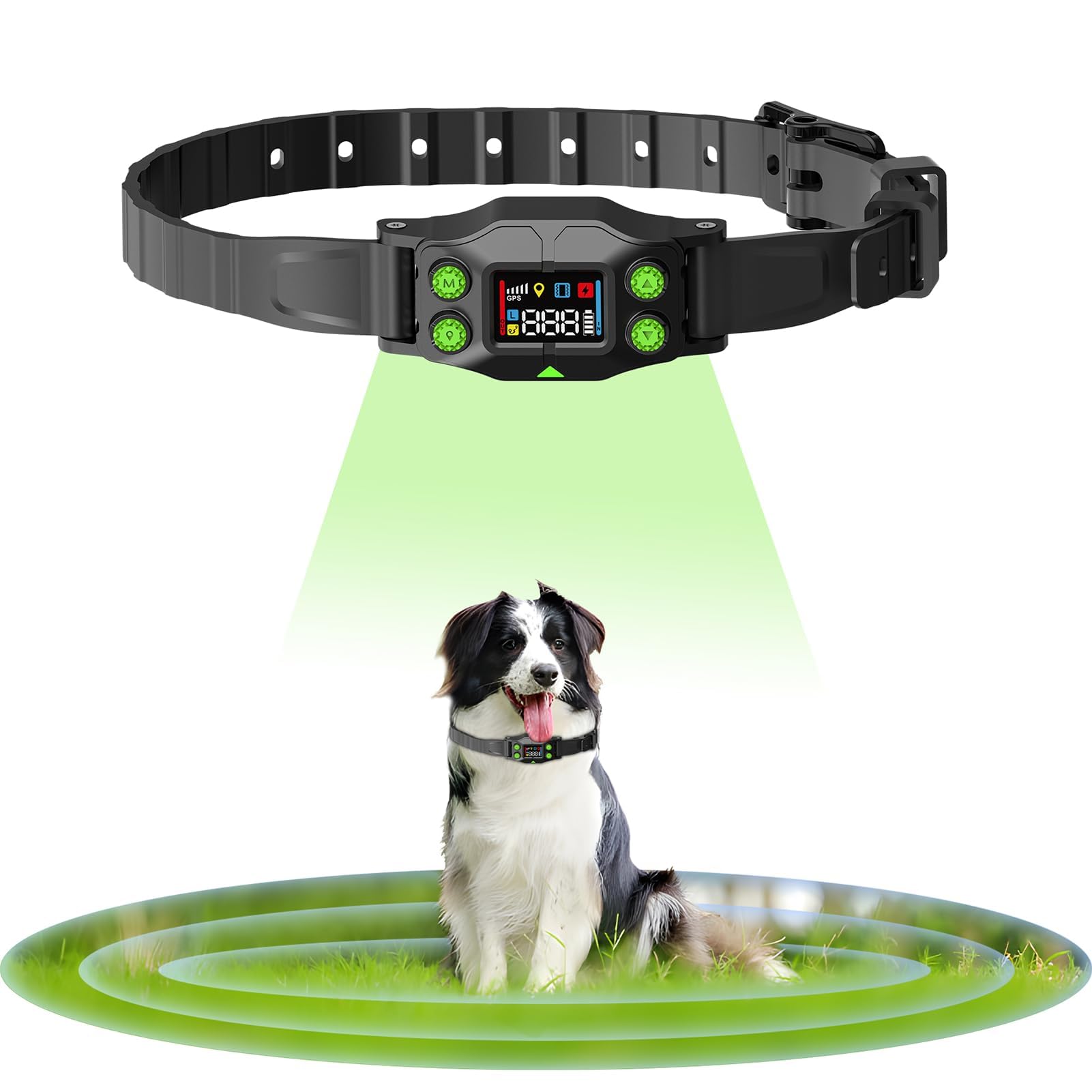
The LUCKSKY system creates a wireless boundary up to 3,000 feet in diameter without buried wires. Setup takes minutes: power on the base, wait for GPS lock, set the center point and radius, then choose vibration or static correction across five intensity levels. The collar fits neck sizes from 9 to 26 inches and includes two probe lengths for long and short-haired dogs.
Unlike subscription-based systems, this unit has no recurring fees. The collar is waterproof and the base station operates on standard household power. The static correction avoids high-voltage electric shock, instead using a graduated response intended as a training aid to build boundary memory.
Some customer reviews for this listing appear to be mismatched with incorrect product descriptions — a few reference alarm clocks rather than dog fences, suggesting listing contamination. The product is suitable for owners with small properties who want a simple, eco-friendly alternative to in-ground fencing, but reliability data for larger rural spreads is limited by the 3,000-foot maximum diameter.
Why it’s great
- Fast setup without trenching or wire burial
- Two probe lengths accommodate varied coat types
- Graduated vibration and static correction levels
Good to know
- Maximum 3,000-ft diameter limits use on larger rural properties
- Product listing may contain mixed customer reviews from unrelated items
9. yhpet GF02 Plus
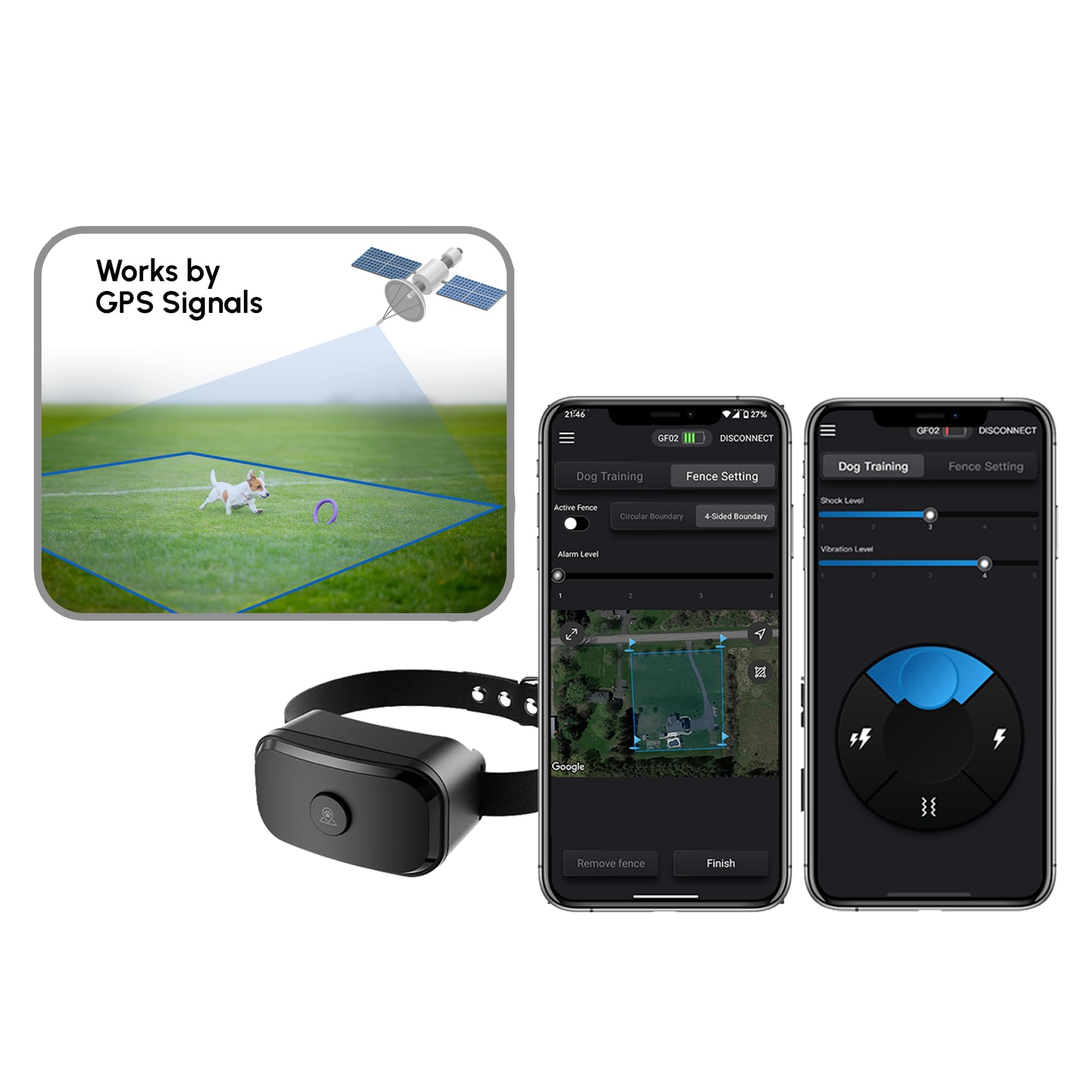
The GF02 Plus uses Google Maps through a smartphone app to define rectangular or circular boundary zones. The collar displays a paw print icon on the map once it connects via Bluetooth, confirming the dog’s location relative to the fence. The system offers three alert types — beep, vibration, or static correction — selected per the dog’s temperament and training level.
Battery life is rated at 168 hours in standby mode. The collar is built from ABS plastic and is waterproof. No subscription is required for operation: the app and GPS fence function without a monthly fee. The unit also includes a remote training mode for close-range obedience work, though this operates only within Bluetooth range.
Reliability is the primary concern. Multiple owners report inconsistent GPS signal that allows the dog to cross the boundary without triggering the correction. The static correction is reportedly too weak to deter large, thick-coated breeds above 100 pounds. The collar buckle loosened within two weeks for one reviewer, and the waterproof seal failed. Setup instructions are sparse, requiring users to discover a hidden finish button.
Why it’s great
- Google Maps-based boundary creation is intuitive for first-time users
- No subscription fees for GPS fence operation
- Long standby battery life at 168 hours
Good to know
- GPS signal inconsistent — dog may cross boundary without alert
- Static correction too weak for large breeds over 100 pounds
- Waterproof seal has failed on some units
FAQ
Will a GPS dog collar work on a 20-acre property with heavy tree cover?
How does a no-subscription tracker update location without cellular data?
What battery life should I expect when tracking a dog that runs all day?
Can I use a virtual fence on a property with steep ravines or creek beds?
Final Thoughts: The Verdict
For most users, the best dog tracker for rural areas winner is the Garmin Alpha TT 25 because it combines sub-foot GPS accuracy, 68-hour dynamic battery life, and 9-mile range in a collar light enough for most breeds. If you want a system that requires no phone and no subscription, grab the Marco Polo Advanced for its radio-direction reliability in zero-cell environments. And for a precision fence that fights GPS drift under heavy canopy, the Halo Collar 5 delivers dual-frequency accuracy unmatched by other subscription-based units.

Mo Maruf
I created WellFizz to bridge the gap between vague wellness advice and actionable solutions. My mission is simple: to decode the research and give you practical tools you can actually use.
Beyond the data, I am a passionate traveler. I believe that stepping away from the screen to explore new environments is essential for mental clarity and physical vitality.