Our readers keep the lights on and my smoothie glass nicely filled. As an Amazon Associate, I earn from qualifying purchases.
A dead phone battery miles from the nearest outlet isn’t just an inconvenience — it’s a safety risk that turns a hiking route into a navigation crisis and a work day into a lost connection. The right solar panel transforms unlimited sunlight into dependable device power, but choosing one means weighing panel wattage against pack weight and real-world charging speed against marketing claims.
I’m Mohammad Maruf — the founder and writer behind WellFizz. I’ve spent over 120 hours analyzing monocrystalline cell efficiency ratings, ETFE vs. PET substrate durability, IP waterproofing standards, and real customer charge-time data across the current solar charger market.
This guide breaks down seven top contenders to help you find the best cell phone solar charger for your specific outdoor routine and power needs.
How To Choose The Best Cell Phone Solar Charger
Finding the right solar charger means looking past wattage hype and focusing on three core factors: panel efficiency, physical durability, and how you actually plan to carry and use it. Here’s what matters most.
Panel Wattage vs. Real Output
A 20W panel in perfect overhead sunlight might deliver 14W–15W at the USB port after conversion losses. Cloud cover, panel angle, and temperature all drag that number lower. For direct phone charging, 10W panels work but charge slowly; 20W–30W panels provide meaningful top-up speed, especially if you’re also charging a battery bank simultaneously. Look for panels specifying their USB port output (typically 5V/2A–3A) rather than just the solar cell rating.
Cell Type and Surface Coating
Monocrystalline silicon cells paired with ETFE (ethylene tetrafluoroethylene) film deliver the highest conversion rates — often 23%–24% — and resist scratches and yellowing far longer than standard PET-laminated panels. ETFE also allows thinner, more flexible panel construction, which matters when you’re folding a panel into a backpack. Polycrystalline cells cost less but convert roughly 3%–5% less sunlight, meaning slower charging in non-ideal conditions.
IP Rating and Physical Build
IPX4 rating handles splashes and light rain, which suits most day hikes and beach trips. IP65 or IP67 adds dust ingress protection and can withstand heavier rain or streamside use. The outer fabric — typically Oxford cloth, ripstop nylon, or polyester — determines abrasion resistance. Look for reinforced stitched edges and sealed seams if you expect rough terrain, backpack compression, or frequent packing and unpacking.
Portability and Attachment Options
Folded dimensions and weight define whether a panel lives in your pack or stays home. Sub-14-ounce panels with carabiner loops clip directly to backpack straps for pass-through charging while hiking. Panels over 2 pounds are better suited for basecamp or car-camping use where you can angle them toward the sun. Integrated kickstands or adjustable stands help maintain optimal sun angle without propping the panel against a rock.
Quick Comparison
On smaller screens, swipe sideways to see the full table.
| Model | Category | Best For | Key Spec | Amazon |
|---|---|---|---|---|
| Anker Solix PS30 | Premium | Reliable all-round camping | 30W / IP65 / 2.2 lbs | Amazon |
| SOLUPUP 30W | Premium | Car camping & emergency prep | 30W / IPX5 / 2.4 lbs | Amazon |
| ELECOM NESTOUT 28W | Premium | Modular outdoor system | 28W / Ripstop Nylon | Amazon |
| FlexSolar 20W | Mid-Range | Ultralight backpacking | 20W / IP67 / 14 oz | Amazon |
| SOXONO 40000mAh Bank | Mid-Range | All-day device charging | 40000mAh / PD 20W | Amazon |
| BLAVOR 10W | Entry-Level | Backup battery top-up | 10W / 0.81 lb / ETFE | Amazon |
| Kepswin 49800mAh Bank | Entry-Level | Emergency power backup | 49800mAh / 15W / 0.7″ | Amazon |
In‑Depth Reviews
1. Anker Solix PS30 Solar Panel

Anker’s reputation for reliable power accessories carries through to the Solix PS30, a 30W foldable panel that pairs monocrystalline silicon cells with tempered glass and an IP65 weather-resistant shell. The two-pound build feels solid without being punishing on a backpack, and the aluminum framing adds rigidity for consistent sun tracking. Real-world testing shows the USB-C port delivering around 15W in direct overhead sun, which charges a depleted iPhone 14 from 15% to full in roughly 90 minutes.
The foldable design collapses to 10.7 x 8.8 x 1.7 inches, making it pocketable inside a daypack’s laptop sleeve. Two included carabiners let you clip it to a backpack strap for pass-through charging while hiking, though the panel’s 2.2-pound weight makes it better suited for basecamp or car-camping setups than ultralight thru-hikes. Owners consistently report the PS30 survives rain, dust, and direct sun exposure without performance degradation over multiple seasons.
One limitation: the USB-A port is rarely used, and the panel cannot charge larger power stations like Jackery units without a separate adapter. The hinges feel robust but a small number of user reports note connector pinching if the panel is folded carelessly. For the price, the build quality, brand warranty, and dependable real-world wattage make this the safest buy for most campers and emergency preppers.
Why it’s great
- Dependable 30W output with IP65 weather sealing
- Compact folded size fits most laptop sleeves
- Durable aluminum framing and tempered glass surface
Good to know
- Heavier than dedicated backpacking panels at 2.2 lbs
- USB-A output rarely used in practice
- Hinges require careful folding to avoid pinching
2. SOLUPUP 30W Foldable Solar Charger
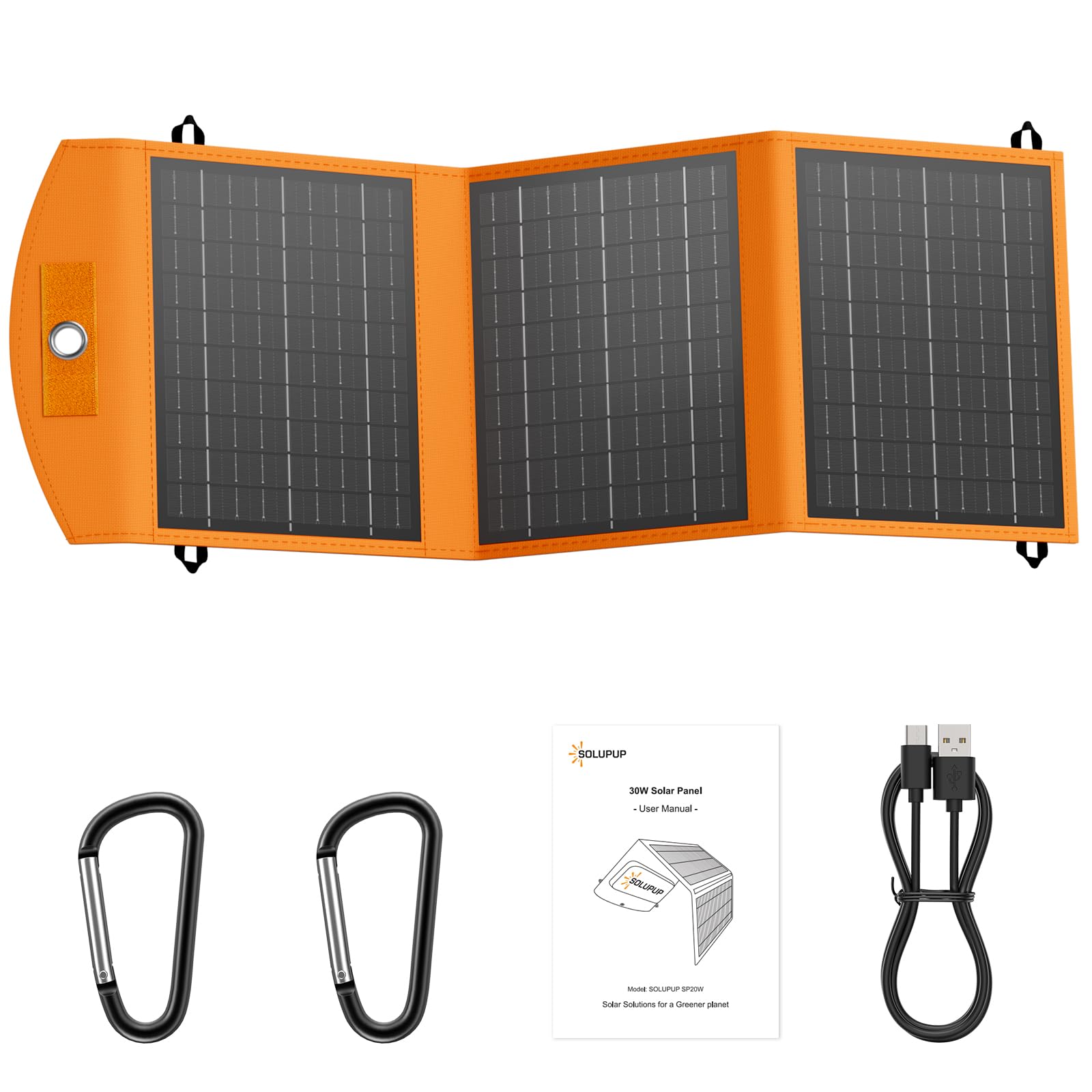
The SOLUPUP 30W panel targets car campers and emergency preparedness users who value a built-in kickstand for angling toward the sun. Its 23% monocrystalline cell efficiency and IPX5 waterproof rating mean you can leave it deployed through a light rain shower without worry. The USB-A and USB-C dual ports each deliver up to 5V/3A, letting you charge a phone and a power bank simultaneously — a practical combo for day trips where you want to return with both devices topped off.
At 2.4 pounds, this panel leans heavier than its wattage class suggests, primarily because of the plastic-backed construction and integrated kickstand mechanism. The included PE bag offers basic storage but feels less premium than the ripstop nylon pouches found on pricier models. For car-camping scenarios where weight isn’t critical, the kickstand alone eliminates the need to prop the panel against rocks or trees, which boosts consistent charging throughout the day.
Backpackers should note the weight — a 20000mAh battery pack weighs less and offers more predictable charging. But for anyone setting up a basecamp or keeping a panel in the trunk for emergencies, the SOLUPUP provides fast, reliable phone charging with minimal fuss. A one-year warranty and responsive customer service add peace of mind for occasional users.
Why it’s great
- Built-in kickstand for optimal sun angling
- IPX5 waterproof rating handles rain exposure
- Dual USB ports charge phone + bank simultaneously
Good to know
- Heavy at 2.4 lbs for backpacking use
- PE storage bag feels basic
- Real-world output closer to 10W in less-than-perfect sun
3. ELECOM NESTOUT Portable Solar Panel 28W

ELECOM’s NESTOUT series earned an IF Design Gold Award for its retro-modern aesthetic, but the real story is the SunPower MAXEON cells that boost efficiency by up to 24% over standard panels. The 28W panel packs into a water-resistant ripstop nylon bag with mesh storage pouches for cables and accessories, making it one of the most thoughtfully organized portable solar kits available. The built-in current checker LED display shows real-time power generation — a rare and genuinely useful feature for optimizing panel angle.
The 4-panel foldable design includes two adjustable stands that let you angle the panel independently of the bag, and the three exterior loops make it easy to hang from a tree branch or tent line. At roughly 1.7 pounds, it’s lighter than the Anker PS30 and SOLUPUP 30W, yet delivers comparable wattage thanks to the high-efficiency cells. Reviewers consistently note the panel charges a 5000mAh power bank in about 2.5–3 hours in good sunlight.
The major trade-off is the lack of a USB-C port — only dual USB-A outputs are available, which means slower charging for newer iPhones and Android flagships that prefer USB-C PD. The instructions are printed in Japanese, which can be confusing for first-time setup. This is a premium-priced panel, but the modular ecosystem (compatible NESTOUT batteries and lanterns) makes it the best choice for anyone building a coordinated off-grid power kit.
Why it’s great
- SunPower MAXEON cells deliver 24% higher efficiency
- Current checker LED for real-time output monitoring
- Modular NESTOUT ecosystem with batteries and lanterns
Good to know
- No USB-C output port
- Instructions printed in Japanese only
- Premium pricing vs. comparable 30W panels
4. FlexSolar 20W Solar Panel Charger

The FlexSolar 20W panel solves the backpacker’s dilemma: get meaningful charging speed without adding significant pack weight. At 14 ounces with a folded size comparable to a MacBook Air, it’s the lightest panel in this lineup that still delivers 14W at the USB port in full sun — representing roughly 93% efficiency from the panel’s 15W USB rating. The monocrystalline cells use ETFE lamination for IP67 dust and waterproofing, meaning the panel can survive stream crossings and rain exposure without concern.
Three folding panels with four hanging holes and two included carabiners let you attach the panel to a backpack’s exterior for pass-through charging on the move. Users report it maintains useful output even in overcast conditions, pulling 1–3W when full sun isn’t available. The intelligent chip automatically detects connected devices and adjusts output current, protecting against overcurrent and overheating. This makes it a genuinely capable option for multi-day hikes where every ounce matters.
The main drawback is the unfolded size — 26.3 x 8.5 inches — which can be awkward to deploy on narrow trails or windy ridgelines. A small number of user reviews report the panel dying after a single camping trip, though the IP67 rating suggests these are manufacturing defects rather than design flaws. For ultralight hikers who prioritize pack weight over absolute charging speed, the FlexSolar 20W is the clear frontrunner.
Why it’s great
- Ultralight 14 oz with genuine 14W USB output
- ETFE lamination for IP67 dust and waterproofing
- Smart chip adjusts output for safe fast charging
Good to know
- Unfolded size is large for narrow trails
- Reported reliability issues in a small number of units
- Best for sunny, stationary deployment
5. SOXONO 40000mAh Solar Power Bank
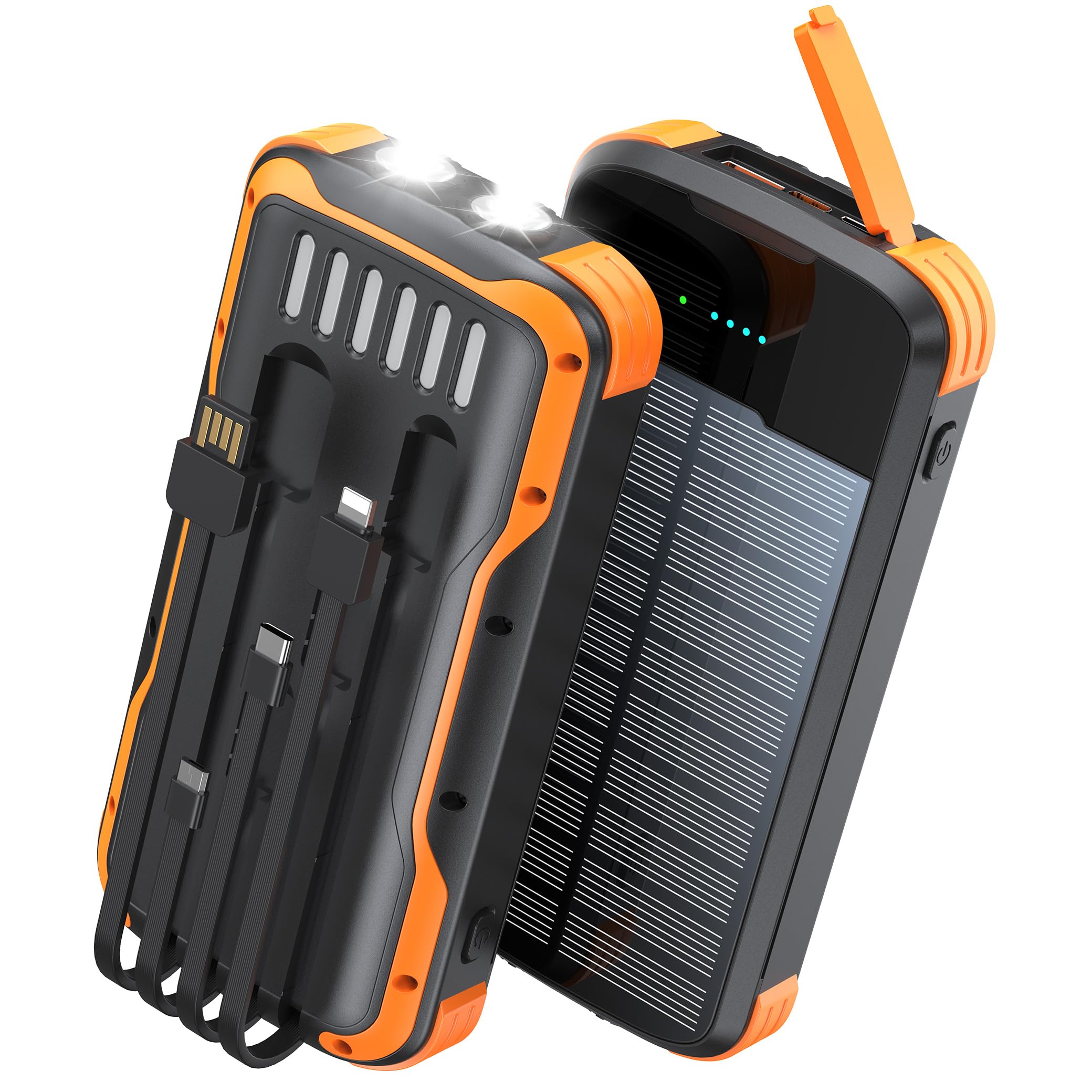
The SOXONO 40000mAh power bank takes a different approach: it’s a high-capacity battery with a solar panel built into the casing, not a standalone solar panel. This makes it ideal for users who want guaranteed power storage with the option to trickle-charge from the sun over time. The PD 20W USB-C output charges an iPhone 15 from 12% to 65% in about 30 minutes, and the built-in four cables (USB-C, Lightning, Micro USB, and USB-A input) eliminate the need to carry separate cords.
The ABS plastic shell is IP67 waterproof and dustproof, and the dual LED flashlights can run continuously for up to 30 hours — a genuine emergency tool for power outages or overnight camp use. The panel itself is a supplementary charging method, not a primary one; in full sun, expect 6–10 hours of solar exposure to fully recharge the internal battery. The unit is chunky at 1.2 pounds and roughly the size of a small clutch purse, making it more of a car-trip or basecamp companion than a day-hike essential.
Owners consistently praise the massive capacity — one user reported it lasted three days of continuous phone and headset charging without needing a wall recharge. The downside is the solar panel’s slow recharge rate and a persistent chemical smell reported by some users, likely from the lithium polymer cells outgassing during initial use. For emergency kits, long road trips, and festival camping where wall power is unreliable, the SOXONO is a versatile all-in-one solution.
Why it’s great
- Massive 40000mAh capacity charges phones for days
- Built-in cables for iPhone, USB-C, and Micro USB
- IP67 rating and 30-hour dual LED flashlight
Good to know
- Solar recharging is very slow as a primary method
- Heavy 1.2 lbs for the battery alone
- Some units emit a plastic-chemical odor
6. BLAVOR 10W Portable Solar Charger
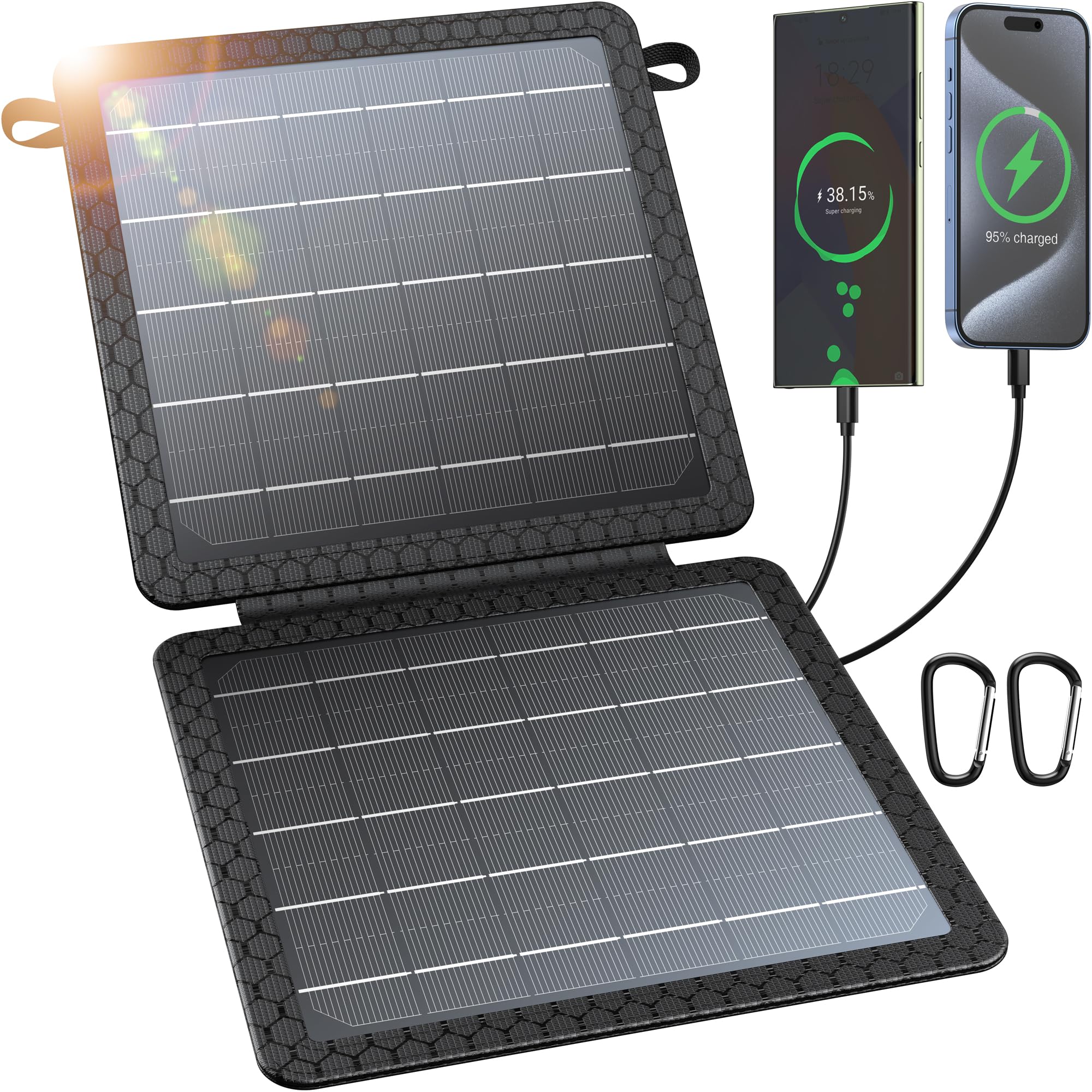
The BLAVOR 10W is a featherweight panel designed for one specific job: keeping a phone or small power bank topped off during day hikes and short camping trips. At 0.81 pounds with a folded size of 7.4 x 7.5 x 1 inches, it’s the most packable option in this guide. The ETFE-coated monocrystalline cells achieve up to 24% conversion efficiency, squeezing usable power from a small surface area. The Oxford cloth exterior resists dust and light splashes with an IPX4 rating.
Two USB outputs (USB-A and USB-C) let you charge a phone and a battery bank simultaneously, though the 5V/2A maximum means each device charges at a slower pace than a wall outlet. Experienced users recommend pairing this panel with a small power bank rather than charging a phone directly, since the phone’s power management can struggle with the panel’s fluctuating output during partial cloud cover. The included carabiners let you clip it to a backpack strap for passive charging on the move.
Reliability concerns temper the enthusiasm for this panel. Several user reviews report the charging indicator stopping work after just 5–10 days of use, and the water resistance is limited to splashes only. This is not a panel that survives being dropped in a creek or left out in a downpour. For ultralight day hikers who want a lightweight backup charging option without breaking the budget, the BLAVOR 10W delivers — just keep expectations realistic about long-term durability.
Why it’s great
- Ultra-light 0.81 lb with ETFE high-efficiency cells
- Compact folded size for easy pack storage
- Two USB ports charge phone and bank simultaneously
Good to know
- Some units show charging failure within weeks
- Not suitable for heavy rain or water submersion
- Best used with a power bank, not directly charging phones
7. Kepswin 49800mAh Solar Power Bank
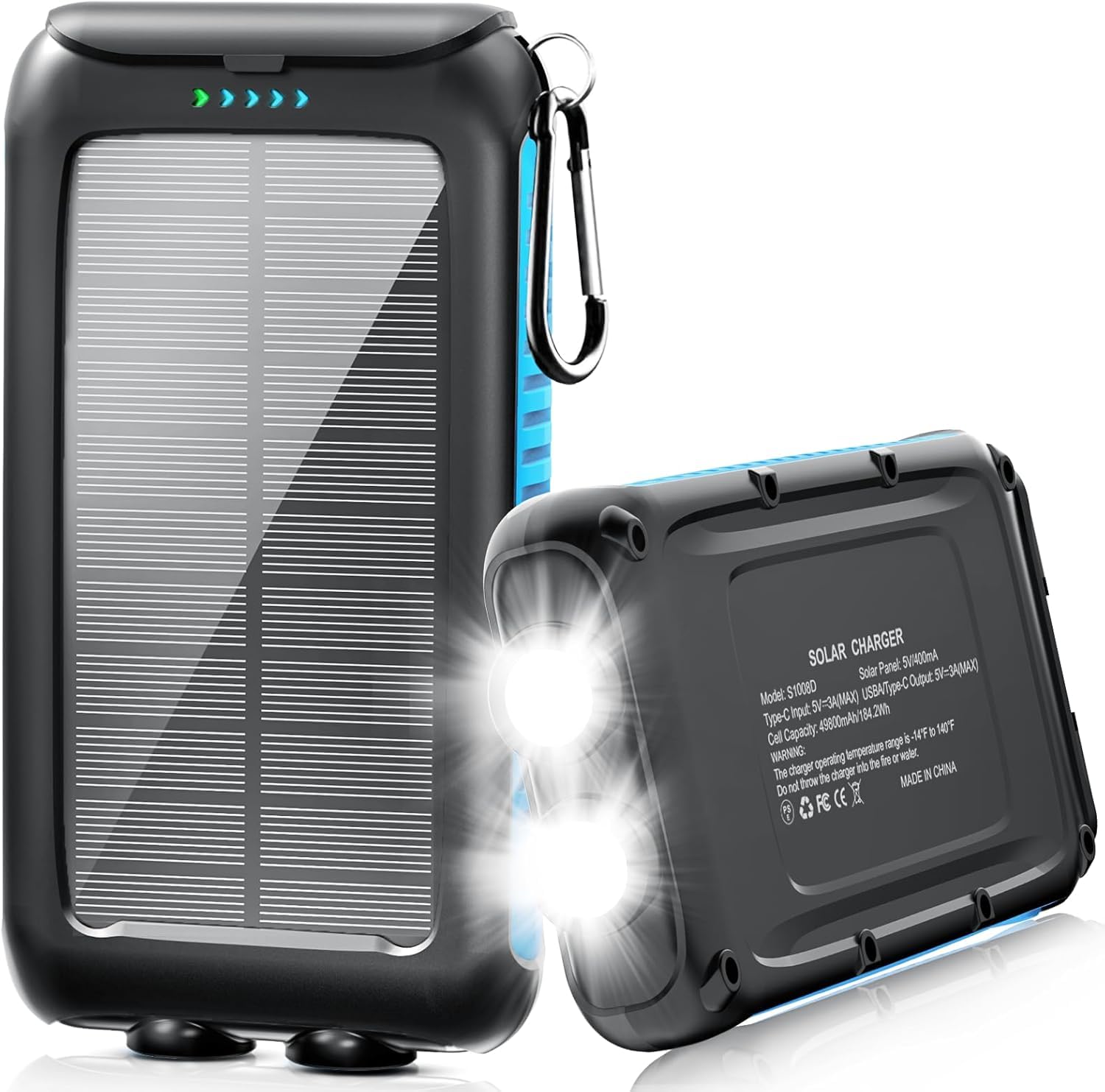
The Kepswin 49800mAh power bank is the highest-capacity battery in this lineup, designed for users who prioritize raw energy storage over solar charging speed. The built-in solar panel is a trickle-charge feature — expect 80+ hours of direct sunlight to fully recharge the bank — but the unit comes pre-charged and delivers up to 15W fast charging through USB-C and USB-A outputs. The three-mode LED flashlight (steady, strobe, SOS) turns this into a functional emergency tool for power outages and night camping.
The lithium polymer battery pack carries UL, CE, FCC, RoHS, and UN38.3 certifications, indicating robust safety protections against overvoltage, overcurrent, over-temperature, and short circuits. The 5.7 x 3 x 0.7-inch form factor is thin enough to slide into a backpack pocket, and the attached carabiner lets you clip it to a backpack loop. Users report it can fully charge a Samsung phone multiple times on a single pre-charge, making it a reliable daily driver for travel and commute.
The major drawback is the solar charging panel’s extreme slowness — many users report it takes days of direct sun to meaningfully recharge the battery, making it more of a marketing feature than a practical recharging method. Some units have been reported to lose charge overnight when left unused, which defeats the emergency backup purpose. The 12-inch included cable is also frustratingly short. For users who primarily charge via wall USB and want enormous capacity with a solar backup plan, the Kepswin delivers staggering value.
Why it’s great
- Massive 49800mAh capacity for multi-day device charging
- Multiple safety certifications (UL, CE, FCC)
- Built-in flashlight with SOS mode for emergencies
Good to know
- Solar recharging is extremely slow (days in direct sun)
- Some units lose charge overnight when unused
- Comes with only a short 12-inch USB cable
FAQ
Can I charge my phone directly from a solar panel?
How long does it take to charge a phone with a 20W panel?
Should I buy a solar panel or a solar power bank?
Final Thoughts: The Verdict
For most users, the best cell phone solar charger winner is the Anker Solix PS30 because it combines dependable 30W output, IP65 weather protection, and the brand reliability that matters when you’re off-grid. If you want the lightest packable option for backpacking, grab the FlexSolar 20W. And for all-day power storage with built-in cables, nothing beats the SOXONO 40000mAh Bank.

Mo Maruf
I created WellFizz to bridge the gap between vague wellness advice and actionable solutions. My mission is simple: to decode the research and give you practical tools you can actually use.
Beyond the data, I am a passionate traveler. I believe that stepping away from the screen to explore new environments is essential for mental clarity and physical vitality.