Our readers keep the lights on and my smoothie glass nicely filled. As an Amazon Associate, I earn from qualifying purchases.
Adding overhead channels to a home theater transforms the soundstage from a flat plane into a full three-dimensional bubble. The difference between hearing a helicopter fly across the front of the room and hearing it pass directly overhead comes down to the quality and placement of your height speakers. This guide focuses exclusively on the options that deliver that vertical lift for immersive audio formats.
I’m Mohammad Maruf — the founder and writer behind WellFizz. My approach to this guide involved hundreds of hours of cross-referencing technical specs, analyzing user feedback, and comparing driver materials to separate marketing claims from real-world performance for these specific audio components.
The goal is to help you navigate the many options and find the best ceiling speakers for atmos that match your room, receiver, and budget without relying on hype.
How To Choose The Best Ceiling Speakers For Atmos
Selecting the right overhead speakers for an Atmos setup requires a shift in thinking. Unlike standard surround channels, height channels need to produce precise, localized effects that sound like they originate from a specific point above you. This section covers the most important factors to get right.
Pivoting or Angle-Adjustable Drivers
Static drivers fire straight down, which is fine for background music but creates a narrow sweet spot for Atmos object-based audio. Speakers with pivoting woofers or swiveling tweeters allow you to aim the sound toward the listening position, creating a more convincing overhead image even if the speaker isn’t perfectly centered above the couch. Look for at least 15 degrees of swivel in the tweeter and an aimable woofer for the best results.
Driver Size and Material
For overhead effects like rain, debris, or aircraft flyovers, a 6.5-inch woofer is considered the baseline for producing enough output without straining. Eight-inch drivers offer more cone area for lower frequency extension, which helps blend with a subwoofer. The material matters too: polypropylene cones resist humidity in bathrooms or kitchens, while Cerametallic or mica-filled cones offer higher rigidity for cleaner mid-bass reproduction at higher volumes.
Frequency Response and Sensitivity
Atmos channels typically handle a limited frequency range starting around 80 Hz and going up to 20 kHz. A speaker with a sensitivity rating of 88 dB or higher will produce adequate volume with less power, which is beneficial because many receivers allocate less wattage to height channels. Avoid speakers with a frequency response that drops off sharply below 100 Hz, as that forces the receiver to send more low-end information to the subwoofer, potentially thinning out the sound.
Quick Comparison
On smaller screens, swipe sideways to see the full table.
| Model | Category | Best For | Key Spec | Amazon |
|---|---|---|---|---|
| Klipsch CDT-5800-C II | Premium In-Ceiling | Dedicated Atmos with aimable drivers | 8″ pivoting Cerametallic woofer | Amazon |
| Sonos by Sonance | Premium Wireless Ecosystem | Sonos Amp integration and Trueplay tuning | 6.5″ woofer w/ 25mm tweeter | Amazon |
| Yamaha NS-IC800 | Mid-Range In-Ceiling | High-efficiency 8-inch drivers | 8″ 2-way, 140W max input | Amazon |
| Yamaha NS-IW280CWH | Mid-Range 3-Way | Wide dispersion with dual tweeters | 6.5″ 3-way, dual 0.75″ tweeters | Amazon |
| Klipsch R-1650-C | Mid-Range In-Ceiling | 6.5-inch coax with polymer tweeter | 6.5″ polymer woofer, 1″ tweeter | Amazon |
| Polk Monitor XT90 | On-Speaker Up-Firing | Atmos without cutting holes | 4″ Dynamically Balanced Woofer | Amazon |
| Herdio 5.25″ Bluetooth | Value Bluetooth Pair | Wireless streaming to flush-mount speakers | 5.25″ 2-way, Bluetooth 5.0 receiver | Amazon |
| Pyle 8″ Bluetooth Pair | Value Bluetooth Pair | Large 8-inch driver with Bluetooth | 8″ woofer, 0.5″ tweeter, 250W | Amazon |
| ULTIMEA Skywave F40 | Soundbar System | All-in-one Atmos soundbar solution | 5.1.2ch, up-firing drivers, 400W | Amazon |
In‑Depth Reviews
1. Klipsch CDT-5800-C II

The CDT-5800-C II represents Klipsch’s serious entry into in-ceiling Atmos. The 8-inch Cerametallic woofer pivots so you can aim it directly at the listening position, which is crucial for creating a convincing overhead image. The Controlled Dispersion Technology helps localize effects more accurately than a standard coaxial design, making rain and aircraft sounds feel like they have a fixed point in space rather than washing over the whole ceiling.
Users consistently report a dramatic improvement when upgrading from budget in-ceiling speakers, especially in dedicated Atmos setups. The horn-loaded titanium tweeter provides the crisp high-frequency detail needed for object-based codecs. At this price point, the build quality and magnetic grille design also justify the investment for a permanent installation.
One caveat: like any in-ceiling speaker, the CDT-5800-C II benefits from a proper enclosure or backer box. Installing it in an open plenum will reduce bass response noticeably. Pair it with a competent subwoofer and a receiver capable of assigning these to height channels for the best effect.
Why it’s great
- Pivoting 8-inch Cerametallic woofer aims sound directly at listener
- Controlled Dispersion Technology sharpens localized overhead effects
- Titanium tweeter and horn-loaded design deliver clean highs
Good to know
- Requires a backer box for optimal bass response
- Best used with a subwoofer to handle deep low-end
2. Sonos in-Ceiling by Sonance

These speakers are purpose-built for the Sonos ecosystem. The 6.5-inch woofer and 25mm tweeter are tuned specifically to work with the Sonos Amp, and the magic happens when you run Trueplay. That calibration accounts for the ceiling height, furniture placement, and room construction to optimize the frequency response for Atmos content. The result is a seamless, immersive sound bubble that doesn’t require manual receiver calibration.
Installation is straightforward with the included cutout template, and the paintable grille lets it vanish into the ceiling. The nominal coverage angle of 90 degrees provides a wide sweet spot, making it forgiving for rooms where seating isn’t perfectly centered. The max SPL of 110 dB at 1 meter ensures there’s enough headroom for dramatic action sequences without pushing the speakers into distortion.
If you are not already invested in the Sonos Amp ecosystem, you are paying for software and calibration features that won’t function with a standard AV receiver. This is a brilliant choice for a Sonos household, but a less efficient option for a traditional receiver-based Atmos setup.
Why it’s great
- Trueplay calibration tailors sound to your specific ceiling and room
- 90-degree coverage angle provides a wide sweet spot
- Paintable grilles disappear into the ceiling visually
Good to know
- Requires a Sonos Amp to unlock full potential
- High entry cost compared to passive in-ceiling pairs
3. Yamaha NS-IC800

The Yamaha NS-IC800 delivers an 8-inch driver in a mid-range package that punches well above its price. The two-way design with a swiveling tweeter allows you to aim the high frequencies toward the listening area, while the large cone moves enough air to reproduce overhead effects with surprising weight. Users frequently report that these speakers play louder and cleaner than floorstanding models from a few years ago, which speaks to their high sensitivity and efficient design.
Build quality is a strong point here. The magnetic grille covers the entire bezel for a flush, clean look that is easy to paint. The gold-plated spring terminals and enclosed back help reduce sound bleed into adjacent rooms, which matters when you are running dedicated overhead channels. The cutout template is sturdy enough to use with a jigsaw or Rotozip without bending.
Where the NS-IC800 falls slightly short is in the very top end of the frequency spectrum for critical Atmos effects. Some listeners note that high-frequency reproduction is not as airy as higher-end models. For a mid-range option focused on impact and efficiency, though, this is a very capable performer for height channels.
Why it’s great
- 8-inch woofer provides strong low-end for overhead channels
- Swiveling tweeter improves localization of height effects
- Magnetic grille and enclosed design for clean installation
Good to know
- High-frequency extension is not the most detailed in its class
- Does not have a pivoting woofer, only a swiveling tweeter
4. Yamaha NS-IW280CWH

This 3-way in-ceiling design is a rare find in the speaker world. The NS-IW280CWH uses a 6.5-inch polypropylene mica cone woofer paired with two 0.75-inch dome tweeters arranged to spread high frequencies across a wide area. The result is a soundstage that remains cohesive even when you are not sitting directly under the speaker, making it a strong candidate for open-concept rooms or multi-row seating.
The angled baffle is another standout feature. The woofer and tweeters are mounted on a slight tilt so the sound naturally projects toward the listening area rather than firing straight down. Users who have installed these for Atmos consistently mention how clear and localized the overhead effects sound, especially when paired with a subwoofer to handle the low end. The water-resistant plastic housing also allows installation in bathrooms or covered patios.
The main limitation is the maximum input of 100 watts, which is lower than some competitors with 8-inch drivers. In a large room or with a powerful receiver, you may hit the ceiling on output before you reach reference levels. This is a great choice for medium-sized rooms where wide coverage matters more than sheer SPL.
Why it’s great
- 3-way design with dual tweeters for wide sound dispersion
- Angled baffle projects sound toward the listening position
- Water-resistant housing suitable for damp locations
Good to know
- 100W max input limits output in large rooms
- Subwoofer recommended to handle low frequencies
5. Klipsch R-1650-C

The Klipsch R-1650-C is a coaxial in-ceiling speaker that brings the brand’s signature dynamic sound to a 6.5-inch form factor. The polymer-cone woofer and coaxially mounted 1-inch polymer-dome tweeter work together to deliver clear, articulate sound with the efficiency Klipsch is known for. The aluminum grille is paintable and rust-resistant, making it suitable for high-humidity rooms.
For Atmos duty, these speakers perform best when installed in a proper enclosure. Users report that the sound is crisp and clean, particularly for subtle overhead effects like footsteps or rain. The flanged mounting system simplifies installation, and the magnetic grille seats flush against the ceiling for a polished look. The 5-inch depth is manageable for most ceiling cavities.
The trade-off for the compact size is output capability. The 6.5-inch driver cannot move as much air as an 8-inch woofer, so deep overhead rumble may sound a bit thin compared to larger models. In a small to medium-sized room paired with a capable subwoofer, however, the R-1650-C performs admirably for its price tier.
Why it’s great
- Crisp, efficient sound with good sensitivity for lower-powered receivers
- Paintable aluminum grille resists rust in humid areas
- Simple installation with magnetic grille for flush fit
Good to know
- 6.5-inch driver limits low-end output compared to 8-inch models
- Requires enclosure to avoid thin sound for overhead effects
6. Polk Monitor XT90

The Polk XT90 is an on-speaker up-firing module, not an in-ceiling speaker. It sits on top of compatible Polk floor-standing or bookshelf speakers and bounces sound off the ceiling to create the illusion of overhead channels. This is the best option for renters or anyone who cannot cut into their ceiling. The 4-inch Dynamically Balanced Woofer is designed to reproduce the frequencies needed for Atmos height information.
When placed on Polk XT70 towers or XT20 bookshelf speakers, the timbre matching ensures the sound blends seamlessly with the main channels. The effect relies heavily on ceiling height and material — standard flat stucco or drywall ceilings between 8 and 10 feet work best. Users report that with proper setup and receiver calibration, the XT90 produces a convincing sense of height for movie effects.
The main limitation is that up-firing modules are never as precise as dedicated in-ceiling speakers. The sound must bounce off the ceiling, which diffuses the localization. In a room with a textured or angled ceiling, the effect becomes noticeably less effective. The XT90 is a solid compromise when installation constraints prevent cutting holes, not a true replacement for overhead speakers.
Why it’s great
- Requires no ceiling modifications or drywall work
- Timbre-matched to Polk Monitor XT series for seamless blending
- Easy placement on bookshelf or floor-standing speakers
Good to know
- Less precise than true in-ceiling speakers for object-based audio
- Best performance requires flat ceilings between 8 and 10 feet
7. Herdio 5.25″ Bluetooth Ceiling Speaker Pair

The Herdio pair offers an entry point into ceiling speakers with a built-in Bluetooth 5.0 receiver. The 5.25-inch two-way drivers and included amplifier box let you stream audio wirelessly without needing a full AV receiver. This makes it a practical choice for non-critical listening areas like kitchens, bedrooms, or covered patios where you want background music without the complexity of a wired setup.
Users report that the sound is decent for the price, with clear mids and highs and acceptable bass when using the included Spotify bass booster equalizer. The flush mount design and cutout template make installation manageable for a DIY project. The Bluetooth range is strong, with some users reporting stable connections from 35 feet away through walls.
These speakers are not designed for Atmos or any surround sound application. They are a self-contained stereo pair that fills a room with music. For those looking to simply add ceiling audio without running speaker wire to an amplifier, this is a functional budget-friendly solution, but it does not belong in a dedicated home theater Atmos channel.
Why it’s great
- Built-in Bluetooth amplifier eliminates the need for a separate receiver
- Easy DIY installation with included cutout template
- Good sound quality for the price with clear mids and highs
Good to know
- Not compatible with Dolby Atmos or surround receivers
- Bass is limited due to small driver and included amplifier
8. Pyle 8″ Bluetooth Ceiling Speaker Pair

The Pyle PDICBT852RD stands out for its unusually large 8-inch woofer in a budget-friendly pair. The polypropylene cone can move a substantial amount of air, which translates to noticeably better bass response than smaller ceiling speakers at this price point. The built-in Bluetooth 5.0 receiver with amplifier box streams wirelessly from any device, and the 250-watt peak power rating provides enough headroom for casual listening at moderate volumes.
Users consistently praise the sound quality for the price, noting that the speakers produce clear audio with no distortion at reasonable volume levels. The directional tweeter is a useful feature that helps aim the high frequencies. The included cutout template and spring-loaded terminals make the install process straightforward even for beginners. The stain-resistant grilles also help maintain a clean appearance in high-traffic areas.
The caveat is that the included Bluetooth receiver is not particularly powerful or refined. Several users report improved performance by replacing it with a Fosi Audio Bluetooth receiver. Like the Herdio pair, this is a stereo music solution, not a component for a Dolby Atmos height channel setup. The large driver size makes it better for general music playback than most budget pairs, but it lacks the connectivity for integration with an AV receiver.
Why it’s great
- 8-inch woofer provides powerful bass for a ceiling speaker
- Bluetooth streaming eliminates the need for long wire runs
- Easy install with spring-loaded terminals and cutout template
Good to know
- Included Bluetooth amplifier is underpowered and limits performance
- Not designed for integration with AV receivers or Atmos systems
9. ULTIMEA Skywave F40
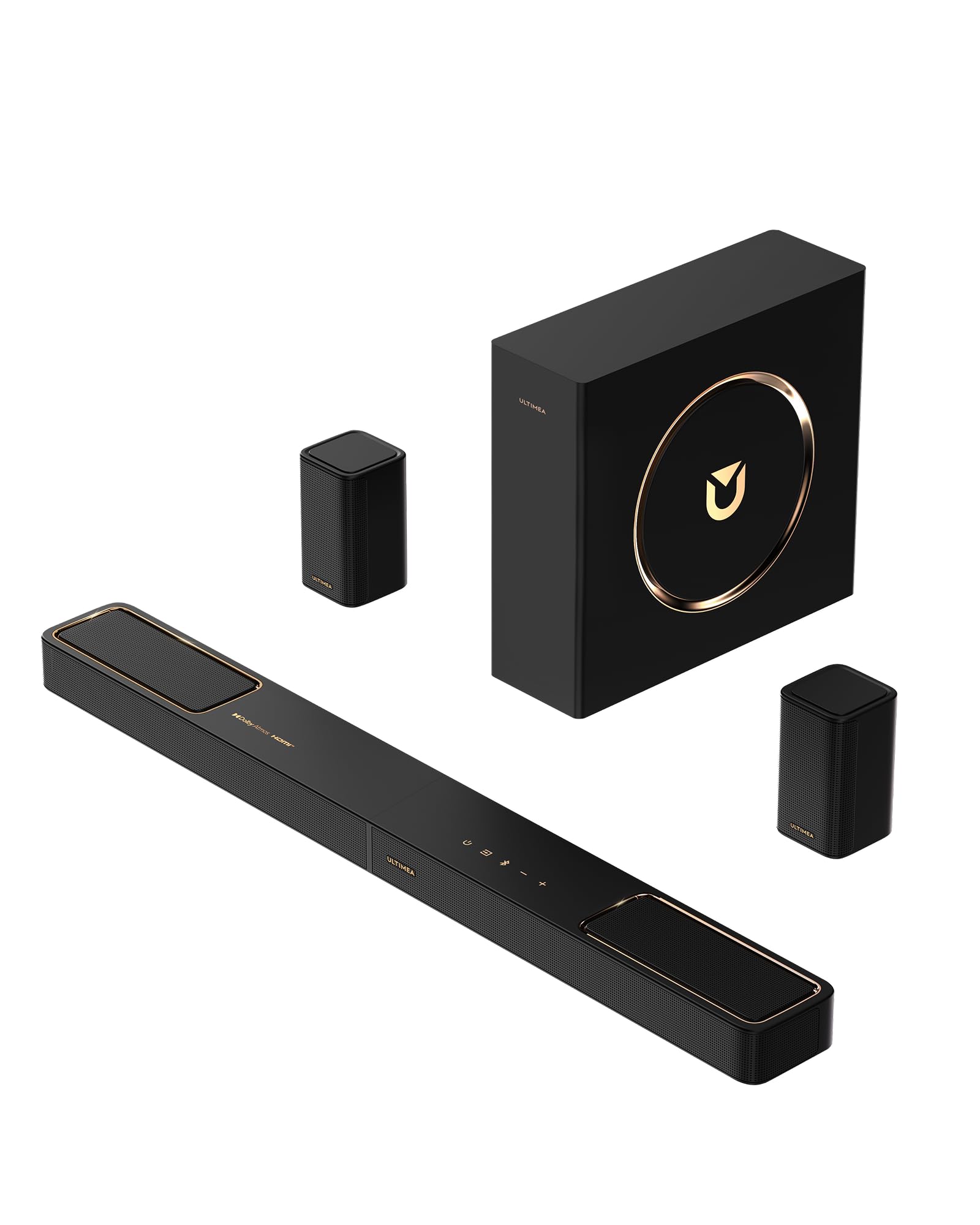
The ULTIMEA Skywave F40 is a 5.1.2-channel soundbar system that uses up-firing drivers with neodymium internal magnets to project sound toward the ceiling for a virtual overhead effect. It includes two wireless rear surround speakers and a wired 5.25-inch subwoofer to complete the surround bubble. This is a complete all-in-one solution for those who want Atmos-like effects without installing in-ceiling speakers or buying separate components.
The system supports HDMI eARC for lossless 5.1.2-channel audio transmission up to 37 Mbps, which preserves the detail in Atmos encodes. The app control provides 13-step level adjustment for each channel, a 10-band graphic EQ, and 121 preset sound settings. Users mention that the setup is plug-and-play, with instant HDMI CEC sync and auto on/off with the TV. The sound is described as immersive, with clear dialogue and decent bass for a compact subwoofer.
The physical limitations of up-firing drivers remain: the overhead effect depends entirely on ceiling reflection. The F40 does a respectable job for a soundbar, but the height channel separation is not as distinct as what discrete in-ceiling speakers provide. Also, DTS compatibility is not supported. This is an excellent choice for apartment dwellers or those who prioritize simplicity over absolute audio precision.
Why it’s great
- Complete all-in-one system with wireless rear speakers and subwoofer
- HDMI eARC support for lossless Atmos audio transmission
- Extensive app controls with 121 preset sound settings and 10-band EQ
Good to know
- Up-firing design cannot match the precision of in-ceiling speakers
- Not compatible with DTS audio formats
FAQ
Can I use any in-ceiling speaker for Dolby Atmos?
What is the ideal ceiling height for Atmos ceiling speakers?
Do I need a backer box for in-ceiling Atmos speakers?
How many ceiling speakers do I need for a 5.1.2 setup?
Final Thoughts: The Verdict
For most users, the best ceiling speakers for atmos winner is the Klipsch CDT-5800-C II because its pivoting Cerametallic woofer and Controlled Dispersion Technology provide the most convincing overhead localization for object-based audio. If you want a wireless ecosystem with automatic room calibration, grab the Sonos in-Ceiling by Sonance. And for a high-efficiency mid-range option that delivers eight-inch driver punch, nothing beats the Yamaha NS-IC800.

Mo Maruf
I created WellFizz to bridge the gap between vague wellness advice and actionable solutions. My mission is simple: to decode the research and give you practical tools you can actually use.
Beyond the data, I am a passionate traveler. I believe that stepping away from the screen to explore new environments is essential for mental clarity and physical vitality.