Our readers keep the lights on and my smoothie glass nicely filled. As an Amazon Associate, I earn from qualifying purchases.
Selecting the right drives for your NAS is the single most consequential decision for your home or small business server. A poor choice means lost data, degraded RAID performance, and constant drive failure anxiety — the right drive delivers years of silent, reliable 24/7 service. The market is flooded with desktop drives not designed for continuous operation, making it critical to distinguish between consumer hardware and purpose-built NAS storage.
I’m Mohammad Maruf — the founder and writer behind WellFizz. I specialize in analyzing enterprise storage benchmarks and real-world endurance data to help buyers match hardware to their actual workload, not marketing claims.
This guide breaks down the best options across capacity tiers and price points, focusing on CMR versus SMR, workload ratings, and vibration tolerance so you can confidently choose the right drives for nas.
How To Choose The Best Drives For NAS
Choosing a NAS drive involves more than just picking a capacity and a brand. The core decision points revolve around recording technology, rotational speed, vibration handling, and the workload the drive is certified to handle. Ignoring these factors can lead to RAID rebuild failures or premature drive death in a 24/7 environment.
CMR vs SMR — The Recording Technology Divide
Conventional Magnetic Recording (CMR) drives write data directly to tracks without overlapping, making them predictable and fast for RAID rebuilds. Shingled Magnetic Recording (SMR) drives overlap tracks, requiring the drive to rewrite large zones — causing severe write performance drops during RAID recovery. For any NAS using RAID 5 or RAID 6, CMR is non-negotiable. All drives in this guide are CMR-based.
Workload Rate and MTBF — Endurance Under Load
Workload rate, measured in TB per year, indicates how much data the drive can reliably transfer annually. Consumer drives top out around 55 TB/year, while NAS-specific models like the WD Red Plus handle 180 TB/year, and enterprise drives exceed 550 TB/year. MTBF (Mean Time Between Failures) for NAS drives typically ranges from 1 million to 2.5 million hours — higher numbers reflect better engineering for continuous operation.
Vibration Tolerance and TLER
Multi-bay NAS enclosures generate vibration that can misalign read/write heads if the drive lacks compensation. Enterprise and NAS drives include rotational vibration (RV) sensors to counter this. Time-Limited Error Recovery (TLER) prevents the drive from spending too long trying to read a bad sector — an extended recovery attempt can cause the NAS to drop the drive from the array, triggering a rebuild on a healthy drive. NAS-specific firmware includes TLER by default.
Quick Comparison
On smaller screens, swipe sideways to see the full table.
| Model | Category | Best For | Key Spec | Amazon |
|---|---|---|---|---|
| Seagate IronWolf Pro 16TB | Enterprise NAS | High-capacity RAID arrays with heavy workloads | 550 TB/year workload, 2.5M hr MTBF | Amazon |
| Seagate IronWolf 16TB | NAS Consumer | Up to 8-bay home NAS with data recovery service | 180 TB/year workload, 1M hr MTBF | Amazon |
| WD Red Plus 10TB | NAS Consumer | Small business NAS with high compatibility | 512 MB cache, 180 TB/yr workload | Amazon |
| WD Red Plus 8TB | NAS Consumer | Reliable 8-bay RAID with proven longevity | 256 MB cache, 7200 RPM CMR | Amazon |
| Toshiba MG06ACA10TE 10TB | Enterprise | 24/7 enterprise operation with stable platter tech | 550 TB/year workload, 256 MB cache | Amazon |
| HGST He10 10TB (Renewed) | Enterprise Refurb | Budget high-capacity bulk storage with redundancy | 2.5M hour MTBF, Helium sealed | Amazon |
| HGST Ultrastar 6TB (Renewed) | Enterprise Refurb | Low-cost bulk storage with RAID-Z2 backup | 128 MB cache, 7200 RPM | Amazon |
| White Label WL 4TB | Budget Enterprise | Entry-level RAID with low price per gigabyte | 1.2M hour MTBF, 64 MB cache | Amazon |
| WL 3TB 7200RPM | Budget Desktop | Lowest-cost storage for non-critical archives | 64 MB cache, SATA 6Gb/s | Amazon |
In‑Depth Reviews
1. Seagate IronWolf Pro 16TB
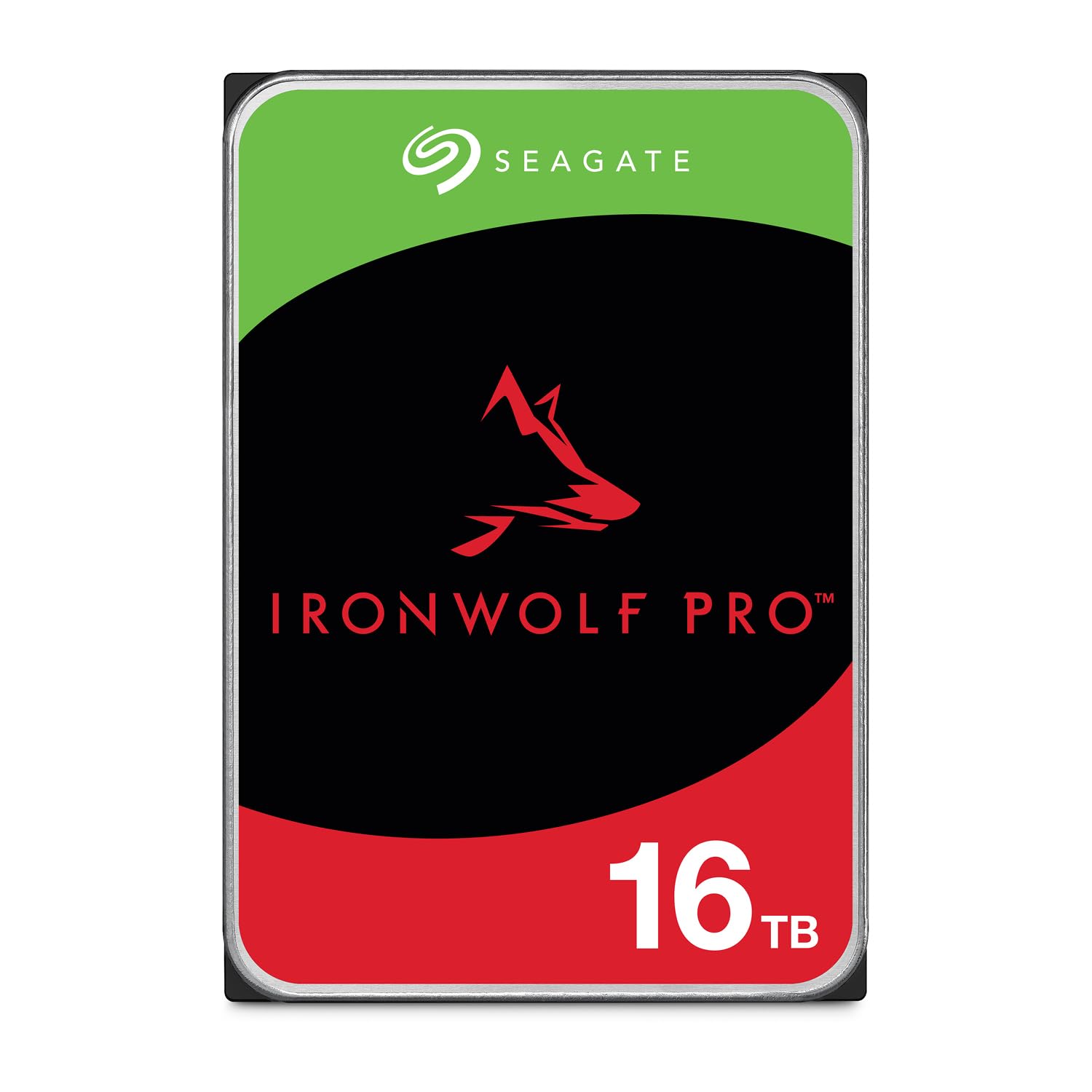
The Seagate IronWolf Pro 16TB is engineered for the most demanding NAS environments, with a workload rating of 550 TB per year and a 2.5 million hour MTBF. This drive is built to handle continuous read/write cycles in multi-bay RAID arrays without the vibration-induced errors that plague lesser drives. The inclusion of rotational vibration sensors and dual-plane balancing keeps performance consistent even when every bay is filled.
All-CMR recording means no RAID rebuild surprises — every sector is written conventionally for predictable recovery speeds. The 256 MB cache and 7200 RPM spindle deliver sequential read speeds over 250 MB/s, making it suitable for 4K video editing directly off the NAS. The 5-year limited warranty is complemented by 3 years of Rescue Data Recovery Services, a tangible safety net for critical data.
Noise levels are moderate — the drive is audible under heavy seek loads but remains quieter than equivalent enterprise drives from previous generations. Heat output is manageable in a well-ventilated NAS case. For users running large RAID 5 or RAID 6 arrays with multiple simultaneous users, this drive represents the current sweet spot between capacity, endurance, and data protection.
Why it’s great
- 550 TB/year workload rating handles heavy multi-user access
- RV sensors and dual-plane balancing prevent RAID drops
- 3-year Rescue Data Recovery included at no extra cost
- CMR recording ensures fast, predictable RAID rebuilds
Good to know
- Premium pricing compared to standard IronWolf line
- Audible under heavy seek load in quiet rooms
2. Seagate IronWolf 16TB

The standard Seagate IronWolf 16TB delivers many of the same core features as the Pro variant at a significantly lower cost, making it the optimal choice for home NAS users with up to 8 bays. It still uses CMR technology and includes IronWolf Health Management for monitoring drive health through the NAS operating system. The 180 TB/year workload rating is ample for media streaming, file backups, and personal cloud storage.
This drive runs cooler than its Pro sibling due to a slightly lower power ceiling, and noise levels are genuinely low — even during RAID rebuilds, the seek chatter remains subdued. The 256 MB cache and 7200 RPM spindle provide sequential reads north of 210 MB/s, sufficient for 4K streaming and simultaneous file access from multiple clients. The 3-year Rescue Data Recovery Services add peace of mind without the price hike.
Some buyers have reported DOA units, though Seagate and Amazon replacement service is generally responsive. For a 16TB drive at this price point, the trade-off in workload rating versus the Pro is reasonable for single-user or small-family NAS deployments where the drive isn’t under constant heavy transactional load.
Why it’s great
- Excellent $/TB ratio for high-capacity CMR storage
- Low noise and heat output suitable for living spaces
- IronWolf Health Management integrated with major NAS brands
- 3-year Rescue Data Recovery included
Good to know
- 180 TB/year workload limit under heavy business use
- Some reports of DOA units requiring exchange
3. WD Red Plus 10TB (WD100EFGX)

The Western Digital Red Plus 10TB is a purpose-built NAS drive with 512 MB of cache, the largest buffer in its class, which significantly reduces write latency during random I/O operations typical of RAID arrays. The drive is certified for up to 8 bays and supports a 180 TB/year workload rate, aligning with small to medium business usage patterns. The NASware firmware ensures deep compatibility with Synology, QNAP, and TrueNAS systems.
This is a CMR drive — WD has moved all Red Plus models away from SMR, so RAID rebuilds proceed without the fragmentation penalties that plagued older models. The 5.56 ms average latency and 260 MB/s data transfer rate make it competitive with enterprise drives in sequential workloads. Operating temperature stays within 30–40°C in a ventilated enclosure, contributing to long service life.
The 3-year warranty is shorter than the IronWolf Pro’s 5-year term, which is a consideration for buyers planning decade-long deployments. Noise levels are low at idle, with mild seek tones under load. For users who prioritize cache size and brand compatibility testing, this WD drive is a solid choice for mid-capacity NAS builds.
Why it’s great
- 512 MB cache improves random write performance
- NASware firmware guarantees compatibility with major NAS OS
- CMR technology with no SMR surprises
- Low operating temperatures extend drive life
Good to know
- 3-year warranty shorter than enterprise options
- Premium price per TB compared to standard models
4. WD Red Plus 8TB (WD80EFBX)

The WD Red Plus 8TB has become a reference point for reliability in the NAS community, with users reporting drives running continuously since 2012 without failure. This 7200 RPM CMR drive includes 256 MB of cache and supports up to 8 bays with a 180 TB/year workload rating. It is particularly well-suited for users who want a proven track record over maximum capacity.
Noise levels are low enough for deployment in a living room or office environment — the 7200 RPM spindle generates a mild hum but no distracting chatter. Temperature management is excellent, with idle readings around 90°F and maxing at 110°F under sustained write loads, even without direct airflow. This makes it a strong candidate for HTPC enclosures where cooling is limited.
The drive uses NASware firmware with TLER support, ensuring compatibility with Synology and QNAP RAID configurations. Some buyers have noted that used or Warehouse Deals units may have higher power-on hours, so checking the serial number warranty status before installation is recommended. For a mid-capacity NAS with a focus on long-term reliability, this is a benchmark choice.
Why it’s great
- Proven long-term reliability with decade-plus user reports
- Quiet operation suitable for home office environments
- Excellent thermal performance without active cooling
- CMR with TLER for seamless RAID integration
Good to know
- 8TB capacity may feel limiting for media hoarders
- Check warranty status on older stock before purchase
5. Toshiba MG06ACA10TE 10TB

The Toshiba MG06ACA10TE is an enterprise-grade drive designed for 24/7 operation in data center environments, with a workload rating of 550 TB per year — matching the Seagate IronWolf Pro at a lower capacity point. Toshiba’s Stable Platter Technology reduces vibration-induced read/write errors by aerodynamically stabilizing the platters, a feature particularly valuable in dense multi-bay NAS enclosures.
The drive includes Persistent Write Cache technology for improved write performance under sustained load, and Native Command Queuing for efficient I/O scheduling in RAID configurations. Sequential read speeds exceed 250 MB/s, and the 256 MB cache handles burst writes effectively. The unrecoverable error rate is rated at 1 per 10^15 bits read, ensuring data integrity during long backup sessions.
Some users have experienced DOA units or early failures, though the majority report drives arriving sealed with minimal power-on hours. The 5-year manufacturer warranty provides adequate protection. Operating noise is moderate — audible but not intrusive in a dedicated server room. For buyers who prioritize enterprise-grade specs at a 10TB capacity, this Toshiba drive is a compelling option.
Why it’s great
- 550 TB/year enterprise workload rating for heavy use
- Stable Platter Technology reduces vibration errors
- Persistent Write Cache for sustained write performance
- 5-year manufacturer warranty
Good to know
- Some reports of early failures in a small percentage of units
- Not as widely tested in consumer NAS as WD or Seagate
6. HGST He10 10TB (Renewed)

The HGST He10 10TB (renewed) offers the best price-per-terabyte for buyers willing to use enterprise surplus drives in their NAS. These helium-sealed drives were pulled from data center servers after approximately 5 years of operation and are fully tested and wiped to DoD standards. The 2.5 million hour MTBF rating reflects the original enterprise engineering, and the helium fill reduces drag, lowering power consumption and operating temperature.
Sequential read speeds around 250 MB/s are on par with new enterprise drives, and the 128 MB cache handles typical NAS workloads well. However, these drives use the newer SATA power standard with 3.3v PWDIS (Power Disable) pins, requiring either a compatible power supply or the included adapter cable to isolate the reset signal. Without it, the drive may not spin up in standard desktop or NAS power supplies.
Noise is the most common complaint — the helium-sealed design produces a distinct, muted seek chuckle that is louder than consumer drives. Heat output is low due to the helium environment. The seller warranty varies (some offer 5 years), but the manufacturer warranty is expired. These drives are best suited for RAID 5/6 arrays with redundancy and regular backup schedules, not for single-drive critical storage.
Why it’s great
- Best $/TB for high-capacity NAS builds
- Helium sealed for lower power and heat
- Enterprise-grade 2.5M hour MTBF design
- Sequential reads comparable to new drives
Good to know
- Requires 3.3v PWDIS adapter or compatible PSU
- Noisier than consumer NAS drives
- No manufacturer warranty — seller warranty only
7. HGST Ultrastar 6TB (Renewed)

The HGST Ultrastar 7K6000 6TB is a refurbished enterprise drive that delivers excellent value for bulk storage in NAS environments where redundancy is already in place. With a 2 million hour MTBF and 128 MB cache, this 7200 RPM drive was originally designed for data center RAID arrays. Refurbished units typically pass full sector-by-sector testing and come with zero bad sectors, making them viable for SnapRAID or RAID-Z2 pools.
Sequential read speeds measure around 215 MB/s in Ubuntu testing, with write speeds slightly lower at 209 MB/s. Power-on hours vary significantly — some units arrive with 300 hours while others show 80,000 hours of prior use. Checking SMART data immediately upon installation is essential to assess remaining life. The drives produce a noticeable hum and seek chatter, typical of enterprise hardware.
Voltage drop issues have been reported when four or more drives share a single SATA power cable — the motor startup draw can stall the drive. Splitting power across multiple cables resolves this. For users building a budget NAS with ZFS redundancy and a high tolerance for used hardware, these HGST drives offer compelling capacity at a fraction of the cost of new drives.
Why it’s great
- Very low cost per gigabyte for bulk storage
- Enterprise-grade 2M hour MTBF engineering
- Good sequential read/write speeds for RAID pools
- Zero bad sectors guaranteed by refurbishing process
Good to know
- Power-on hours vary widely — check SMART immediately
- Loud operation compared to consumer drives
- May require split power cables for multi-drive setups
8. White Label WL 4TB Enterprise

The White Label WL 4TB Enterprise drive is a budget-friendly option that uses enterprise-grade components with a 1.2 million hour MTBF rating and a dual-processor design for improved performance. Sustained sequential data rates reach 171 MB/s, and the enhanced RAFF (Rotary Acceleration Feed Forward) technology corrects both linear and rotational vibration in real time — a feature typically found in much more expensive drives.
Many units arrive as rebranded HGST or Toshiba drives, which means the underlying hardware is proven. The 64 MB cache is modest by today’s standards but sufficient for 4TB of storage in a RAID configuration. Installation is straightforward, and the drive is recognized immediately by Synology and QNAP systems. The 1-year warranty adds a basic safety net.
Some buyers have reported receiving dead drives in plain envelopes with no protective packaging, highlighting the importance of vendor choice. Additionally, missing SMART attributes (187 and 188) in some units make health monitoring less reliable — users should budget for potential replacement within 2–3 years. For cost-conscious buyers building a RAID with redundancy, this remains a viable entry point.
Why it’s great
- Enterprise RAFF vibration correction at budget price
- Often ships as rebranded HGST hardware
- Dual-processor design improves random I/O
- Good compatibility with major NAS systems
Good to know
- Missing critical SMART attributes in some units
- Packaging may be inadequate — risk of DOA
- Short 1-year warranty compared to premium drives
9. WL 3TB 7200RPM Desktop Hard Drive

The WL 3TB 7200RPM drive is the most affordable entry point in this guide, designed primarily as a desktop hard drive but frequently repurposed for entry-level NAS and DVR use. At 3TB with 64 MB cache, it offers the lowest capacity and smallest cache of any drive reviewed here. The aluminum enclosure provides adequate heat dissipation, and the SATA 6Gb/s interface is compatible with any modern NAS.
User reports describe this drive as surprisingly quiet in operation, with read/write speeds sufficient for security camera recording and basic file storage. The 7200 RPM spindle ensures better performance than the 5400 RPM drives commonly found at this price point. Many units ship as rebranded Hitachi or Toshiba drives, which adds some hardware credibility.
The main risk is longevity — some users have reported startup noise and failures after short periods, reflecting the desktop-grade design not optimized for 24/7 NAS operation. The 1-year warranty provides limited coverage. This drive should only be considered for non-critical archives or surveillance systems where data loss is acceptable, not for primary NAS storage with important data.
Why it’s great
- Lowest cost option for expanding NAS capacity
- Quiet operation despite 7200 RPM spindle
- Compatible with DVR and surveillance systems
- Aluminum enclosure aids heat dissipation
Good to know
- Desktop-grade design not rated for 24/7 NAS use
- Small cache and capacity limits performance
- Limited warranty and uncertain longevity
FAQ
Can I use a desktop hard drive in my NAS?
What is the difference between IronWolf and IronWolf Pro?
Final Thoughts: The Verdict
For most users, the drives for nas winner is the Seagate IronWolf Pro 16TB because it balances the highest workload rating, longest warranty, and comprehensive data recovery support in a single drive. If you want the best capacity-to-value ratio for a home NAS with up to 8 bays, grab the Seagate IronWolf 16TB. And for budget-conscious builders building RAID-Z2 arrays with redundancy, the HGST He10 10TB delivers unbeatable cost per terabyte.

Mo Maruf
I created WellFizz to bridge the gap between vague wellness advice and actionable solutions. My mission is simple: to decode the research and give you practical tools you can actually use.
Beyond the data, I am a passionate traveler. I believe that stepping away from the screen to explore new environments is essential for mental clarity and physical vitality.