Our readers keep the lights on and my smoothie glass nicely filled. As an Amazon Associate, I earn from qualifying purchases.
Living with spotty cellular coverage means stepping onto the porch, holding your phone toward the sky, or keeping calls short before they drop. A booster that requires drilling through walls and mounting gear on the roof only adds labor to the frustration. The category of indoor-only cell boosters, which use a compact internal antenna or a simple plug-and-play design, changes that equation entirely.
I’m Mohammad Maruf — the founder and writer behind WellFizz. I’ve spent hundreds of hours analyzing the gain, frequency band compatibility, and coverage-area claims of cellular amplifiers that forgo the traditional external mast, deciphering which units actually deliver bars without the installation headache.
Whether you live in a metal-roofed home, work from a basement, or simply want reliable calls without rooftop work, finding the right cell phone booster without outside antenna means choosing a device that prioritizes indoor placement and carrier-specific bands over complex hardware.
How To Choose The Best Cell Phone Booster Without Outside Antenna
The appeal of an indoor-only booster is clear: no ladder, no drilling, no coax cable routing through walls. But removing the outdoor antenna changes the rules of signal physics. The unit must pull a weak signal through a window, wall, or roof and rebroadcast it on the other side — all within the same room. Understanding the few specs that actually matter in this context prevents wasted money on a box that merely looks useful.
Carrier Bands vs. Carrier Names
A common trap is buying a booster labeled “for Verizon” or “for T-Mobile” without checking which specific frequency bands it supports. Verizon uses Band 13 (700 MHz) for primary LTE coverage, AT&T and T-Mobile rely heavily on Band 12/17 (also 700 MHz), and newer 5G deployments often use Band 71 (600 MHz) or Band 66 (1700/2100 MHz). If the booster covers your carrier’s specific band — and you verify that band is active in your area — the device will amplify that signal. A general “Multi-Carrier” label means nothing if it skips the band your tower broadcasts on.
Gain (dB) and Real Coverage Area
Gain is measured in decibels (dB), and every manufacturer advertises a number between 60 and 72 dB for indoor boosters. Higher gain does not automatically equal more coverage inside a home. The range claim — 1,500 sq ft vs. 5,000 sq ft — assumes an ideal outdoor signal of at least three bars. In a window-mounted scenario with a weaker outdoor signal (one bar), that coverage shrinks dramatically. Look for a booster with Automatic Gain Control (AGC) that prevents the unit from oscillating when the indoor and outdoor antennas are too close together.
Form Factor and Antenna Separation
Without an outdoor antenna, the booster’s internal or whip antenna must be physically separated from the rebroadcasting antenna by at least 15 to 30 feet to avoid feedback loops. Some compact “all-in-one” boosters integrate both antennas into the same chassis, which limits their effectiveness to very small rooms or extremely strong outdoor signals. A better option for medium homes is a unit that places the donor antenna near a window and the rebroadcast antenna on the opposite side of the room, even if both remain inside the structure.
Quick Comparison
On smaller screens, swipe sideways to see the full table.
| Model | Category | Best For | Key Spec | Amazon |
|---|---|---|---|---|
| SureCall Flare | All-in-One Stylish | Small to medium homes wanting aesthetic integration | 72 dB gain, integrated indoor antenna | Amazon |
| HiBoost 8000 | Multi-Room Power | Larger homes needing two indoor antennas | 70 dB gain, 2x indoor antennas | Amazon |
| ZORIDA ACE 5S | App-Assisted Setup | Users wanting guided installation via smartphone | 72 dB max gain, app support | Amazon |
| YLXONE Multi-Band | Broad Carrier Compatibility | Homes needing coverage across many bands | 70 dB gain, 10 frequency bands | Amazon |
| JACOOL Verizon Focus | Verizon Primary | Verizon/Straight Talk users with moderate space | Single-band (Band 13), 3000-5000 sq ft | Amazon |
| AT&T/T-Mobile Booster (F FREEQUEEN) | AT&T/T-Mobile Specialty | AT&T and T-Mobile Band 12/17 users | 65 dB gain, 4500 sq ft claim | Amazon |
| GAGBK AT&T Booster (2025) | AT&T Refresh | AT&T/Cricket users on Band 12/17 | 65 dB gain, self-oscillation elimination | Amazon |
| GAGBK Verizon Booster | Verizon Refresh | Verizon users needing Band 13 amplification | 65 dB gain, 5000 sq ft coverage | Amazon |
| CEL-FI GO G41 | Commercial-Grade Power | Entire large homes with extremely weak signal | 100 dB gain, 15000 sq ft | Amazon |
In‑Depth Reviews
1. SureCall Flare Cell Signal Booster

The SureCall Flare solves the biggest aesthetic problem of indoor boosters: it looks like a compact speaker, not a piece of telecom hardware. Its integrated dome antenna means zero visible cables on the indoor side, and the 72 dB gain is among the highest in the plug-and-play category. Users report boosting from one bar to four bars in 1,000 to 1,500 sq ft spaces when the outdoor signal is at least two bars.
This unit covers all major North American carriers operating on 700, 800, 1900, and 1700/2100 MHz bands, making it viable for AT&T, Verizon, T-Mobile, and regional carriers. The 50 ft RG-6 cable for the outdoor antenna is included, but the real draw is that the indoor antenna is built directly into the amplifier housing — no separate whip to place across the room.
The Flare requires careful antenna separation of at least 25 feet between the outdoor donor antenna and the indoor unit to prevent oscillation. Some users in metal-roofed homes report needing additional height on the outdoor side, but for standard wood-frame construction, the setup is straightforward. The max coverage claim of 2,500 sq ft holds only when the outside signal is strong.
Why it’s great
- 72 dB gain provides strong indoor boost for medium spaces
- Integrated interior antenna eliminates second cable run
- Stylish design blends into living room or office
- Supports all major carriers and 5G-ready phones
Good to know
- Requires at least 25 ft antenna separation to avoid feedback
- Coverage drops significantly with weak outside signal
- Outdoor antenna still needs mounting (not truly “no outside antenna”)
2. HiBoost Cell Phone Signal Booster (8000 Sq Ft)

The HiBoost is the only indoor-focused booster in this lineup that ships with two indoor antennas — one whip and one built into the main unit — allowing coverage to reach 5,000 to 8,000 sq ft when properly placed. Its 70 dB gain and Automatic Gain Control (AGC) make it one of the most stable options for homes with multiple rooms, metal roofs, or basement layouts. The included LCD display shows real-time gain and signal strength, which takes the guesswork out of positioning.
Band coverage spans 700-750 MHz (Bands 12, 13, 17), 800-850 MHz (Band 5), 1900 MHz (Band 2/25), and 1700-2100 MHz (Band 4). That makes it compatible with Verizon, AT&T, T-Mobile, and US Cellular simultaneously — one of the few units that handles multiple carriers without sacrificing performance on any of them. The HiBoost App offers step-by-step installation guidance, including outdoor antenna alignment.
Buyers in heavy forest or valley terrain report jumping from one bar to three or four bars, with data speeds improving from under 1 Mbps to over 25 Mbps. The 3-year warranty and US-based support are meaningful for the price, though the unit still requires an outdoor antenna (included) to pull in signal. For a true no-outdoor-antenna setup, the outdoor piece must be placed in a window rather than mounted.
Why it’s great
- Two indoor antennas cover up to 8,000 sq ft effectively
- AGC prevents oscillation in tricky indoor layouts
- LCD display and app for real-time tuning
- Simultaneously boosts multiple carriers
Good to know
- Outdoor antenna still required for donor signal
- Large homes with multiple floors may need stronger model
- Installation can be time-consuming for non-tech users
3. ZORIDA ACE 5S Cell Phone Signal Booster

The ZORIDA ACE 5S stands out for its companion app, which walks users through outdoor antenna placement, shows signal strength before and after installation, and provides one-on-one tech support chat. The 72 dB gain is matched only by the SureCall Flare, but the ACE 5S supports a wider frequency range, covering Bands 12/17, 13, 5, 4, and 2/25. This makes it genuinely compatible with all US carriers without sacrificing performance on any single band.
Multiple users in hilly terrain and rural cabins report going from two bars of 4G LTE to a full five bars of 5G after positioning the outdoor antenna 18 ft above ground level. The indoor whip antenna connects directly to the booster unit, so there is no second cable to route inside. The compact dimensions (5.5 x 3 x 1 inches) mean the booster sits discreetly on a desk or shelf.
The ACE 5S is FCC and IC certified, and ZORIDA backs it with a 3-year warranty and lifetime US-based support through the app. The one catch is that the app is essential for the best placement — skipping the guided setup may result in suboptimal performance. The 2000 sq ft coverage claim is realistic for small to medium homes, but drops fast if the outdoor signal is below one bar.
Why it’s great
- App provides real-time signal data and placement guidance
- 72 dB gain across a wide band range
- Compact, desk-friendly design
- Excellent customer support with live chat
Good to know
- App is nearly mandatory for optimal placement
- Coverage limited to 2000 sq ft in real conditions
- Outdoor antenna still needs to be positioned
4. YLXONE Multi-Band Cell Phone Booster
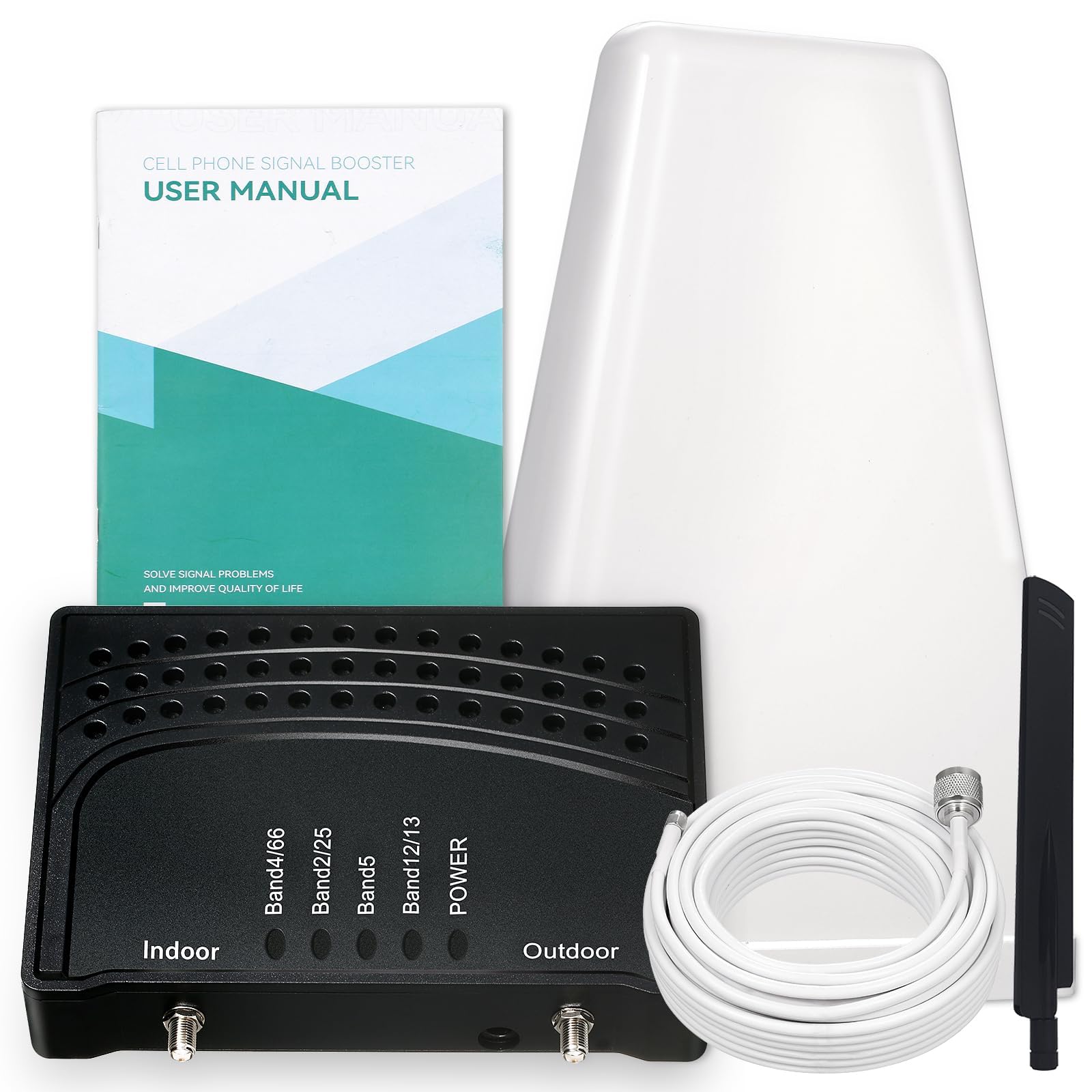
The YLXONE booster claims support for ten separate frequency bands spanning 700 MHz through 5.8 GHz, making it one of the broadest compatibility options in this mid-range tier. It ships with a 49 ft outdoor Log-periodic antenna and a 70 dB amplifier. Users in houses with aluminum siding and metal roofs report turning “no signal” into full bars within minutes of setup, which is impressive for a unit that costs less than premium options.
Band coverage includes 5/12/13/17, plus higher frequencies like 1800, 1900, 2100, 2300, and 2500 MHz. This means it can handle older 3G bands alongside modern LTE and 5G DSS deployments. The outdoor antenna is directional, so aiming it precisely at the nearest tower is critical. The included whip antenna for indoor use is omnidirectional, providing 360-degree coverage in a single room.
One reviewer with a metal roof saw signal jump from nothing to full bars in under two minutes. However, another reported that while the signal strength indicator improved, actual data throughput did not change, and the unit ran hot after 30 minutes. The 2000 sq ft max coverage is optimistic — real-world performance is closer to 800-1200 sq ft unless the outdoor signal is very strong.
Why it’s great
- Broad frequency support covers legacy and modern bands
- Works in metal-roof and difficult construction homes
- Very easy installation according to most users
- Competitive price for the band range offered
Good to know
- Inconsistent data throughput reported by some users
- Unit may run hot during extended use
- Coverage area smaller than advertised in weak signal zones
5. JACOOL Cell Phone Signal Booster for Verizon
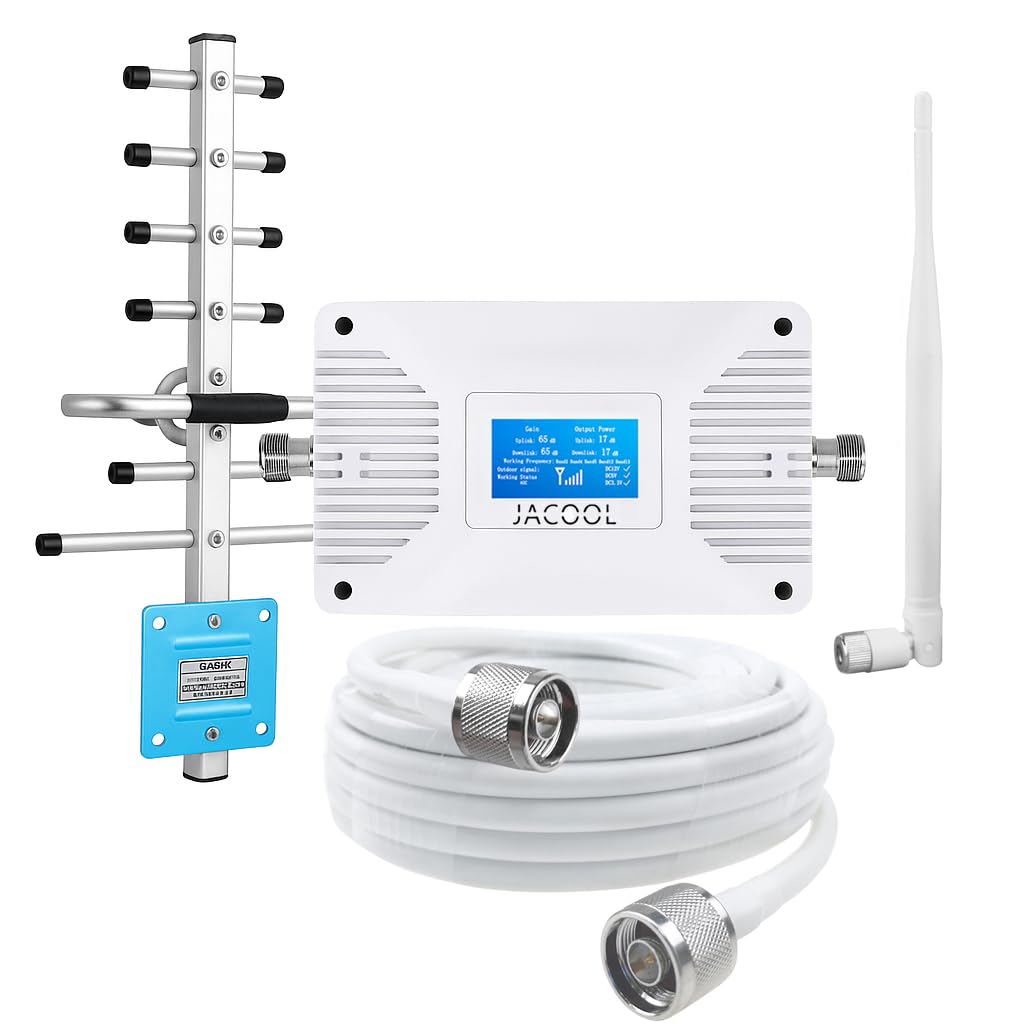
The JACOOL booster is a single-band amplifier tuned specifically for Verizon’s Band 13 (700 MHz) and also supports the 1700/2100 MHz AWS band. This laser focus on Verizon’s primary LTE frequencies means it can deliver strong results for users who only need Verizon-compatible boosting and do not want to pay for multi-band hardware they will not use. The kit includes a high-gain Yagi outdoor antenna, AGC, and automatic oscillation protection.
Coverage claims reach 3,000 to 5,000 sq ft, which is realistic for a single-band unit because it does not split power across multiple frequencies. Users with Straight Talk and Verizon service report 1-2 bars turning into 4-5 stable bars, with noticeably clearer voice calls and faster data. The AGC system intelligently adjusts gain to prevent the feedback loop that plagues many cheaper boosters.
The downside is that this unit will not help AT&T, T-Mobile, or US Cellular users unless those carriers also happen to use Band 13 in your area (rare). It is also a single-band design, meaning if Verizon deploys a secondary band for capacity in your region, the booster will not amplify it. The 3.5 lb weight and included mounting hardware are straightforward, but placement of the outdoor antenna still requires some care.
Why it’s great
- Optimized for Verizon Band 13 for efficient signal boost
- AGC prevents oscillation in tricky placements
- Coverage up to 5000 sq ft is achievable with strong outdoor signal
- Includes everything needed for a clean install
Good to know
- Only works with Verizon and Straight Talk Band 13
- No multi-carrier support for mixed-use homes
- Yagi antenna must be aimed precisely at the tower
6. AT&T/T-Mobile Booster (F FREEQUEEN)
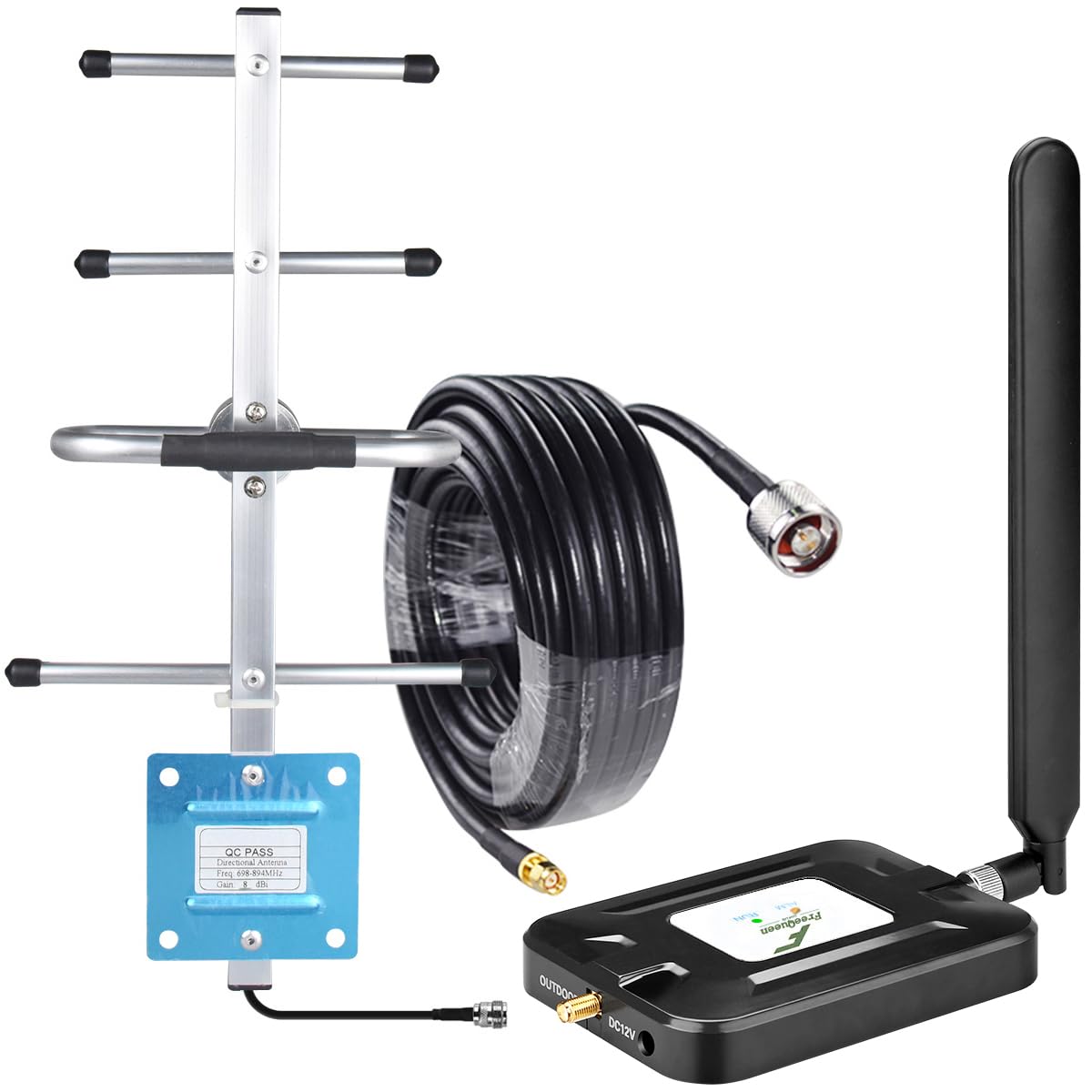
This booster is built for AT&T and T-Mobile users who rely on Band 12 and Band 17 at 700 MHz. It delivers 65 dB of gain and claims coverage up to 4,500 sq ft with a 50 ft outdoor coax cable included in the box. The package includes a directional Yagi antenna, an indoor whip antenna, and mounting hardware, making it a complete kit for a straightforward install. Users in rural areas with weak AT&T service report going from one bar to four bars, with noticeably fewer dropped calls.
The unit features AGC and a sleep/inactivity mode that reduces power consumption when no devices are actively connected. It is FCC approved and backed by a 3-year manufacturer warranty. The lightweight design (3.16 lbs) and small form factor mean it can be placed on a shelf or attached to a wall without drawing attention.
This booster is strictly single-band (700 MHz), so it will not help if your carrier uses Band 2, 4, 5, 13, or 66 for primary coverage. Users on Cricket, Straight Talk, and US Cellular may find compatibility as long as those MVNOs use the same 700 MHz band in their area. The main trade-off is that the indoor whip antenna needs to be placed at least 30-50 ft from the outdoor Yagi to avoid feedback, which can be challenging in smaller homes or apartments.
Why it’s great
- Targeted Band 12/17 boost for AT&T and T-Mobile users
- AGC ensures stable performance without manual tuning
- 50 ft coax cable provides flexible outdoor placement
- Sleep mode saves power when not in use
Good to know
- Only works on 700 MHz bands — no higher band support
- Indoor/outdoor antenna separation is critical
- Not effective if carrier uses different primary band in your area
7. GAGBK AT&T Booster (2025)

The GAGBK booster for AT&T and T-Mobile is a nearly identical sibling to the F FREEQUEEN unit, using the same 700 MHz Band 12/17 focus and 65 dB gain. The differentiating feature is the “Self-oscillation Elimination” system, which automatically detects interference between the indoor and outdoor antennas and adjusts gain to prevent whistling or feedback. This makes it slightly more forgiving in tight layouts where antenna separation is hard to achieve.
The kit includes a directional Yagi outdoor antenna, a 50 ft N-SMA coax cable, and an indoor whip antenna. Users report that installation takes about 30 minutes, and the booster works with AT&T, T-Mobile, Cricket, Straight Talk, and US Cellular on the 700 MHz band. One reviewer in a rural area with AT&T saw a jump from 1 bar to 4 bars, which eliminated dropped calls entirely.
The primary limitation is the single-band design — it does not support Band 13, 5, 4, 2, or 25. If your carrier requires any band outside 700 MHz for data or voice, this booster will not help. Another user reported the unit stopped working after three months, though the 3-year warranty covers replacement. For users who know their carrier relies solely on 700 MHz, this is a budget-friendly option.
Why it’s great
- Self-oscillation elimination reduces feedback issues
- Works with AT&T, T-Mobile, and compatible MVNOs
- Installs in under 30 minutes
- 3-year warranty for peace of mind
Good to know
- Only amplifies 700 MHz Band 12/17
- Some users report failure within months
- Antenna separation still important for best results
8. GAGBK Verizon Booster (2026)

This GAGBK booster is tuned exclusively for Verizon and Straight Talk on Band 13 (700 MHz). It provides 65 dB of gain and claims coverage up to 5,000 sq ft, making it a direct competitor to the JACOOL Verizon unit. The package includes a high-gain directional LDPA antenna (similar to a Yagi), a 50 ft coax cable, an indoor whip antenna, and a 12V power supply. Users in metal-roofed homes and rural areas report jumping from 1-2 bars to 4-5 bars, with significant improvements in call clarity and data speed.
The AGC function intelligently detects signal strength and adjusts gain to prevent oscillation. The booster also features an inactivity mode that puts the unit on standby when no devices are using the network, reducing power consumption. One reviewer noted that placing the outdoor antenna on the same side of the house as the nearest Verizon tower was critical for achieving the full 5,000 sq ft coverage.
Like all single-band boosters, this unit will not help if Verizon uses Band 5, 4, or 66 as your primary carrier frequency. The 3-year warranty is solid, but some users reported that the unit got warm during extended use. For Verizon subscribers in areas where Band 13 is the primary LTE band, this is a cost-effective solution, but it is not a universal fix for every weak-signal scenario.
Why it’s great
- Optimized for Verizon Band 13 for maximum efficiency
- AGC and sleep mode for stable, low-power operation
- 100X signal boost claim holds in many real-world scenarios
- 50 ft cable allows flexible outdoor antenna placement
Good to know
- Only works on Verizon Band 13
- Unit may run warm during heavy use
- Outdoor antenna alignment is critical for performance
9. CEL-FI GO G41 Cell Phone Booster
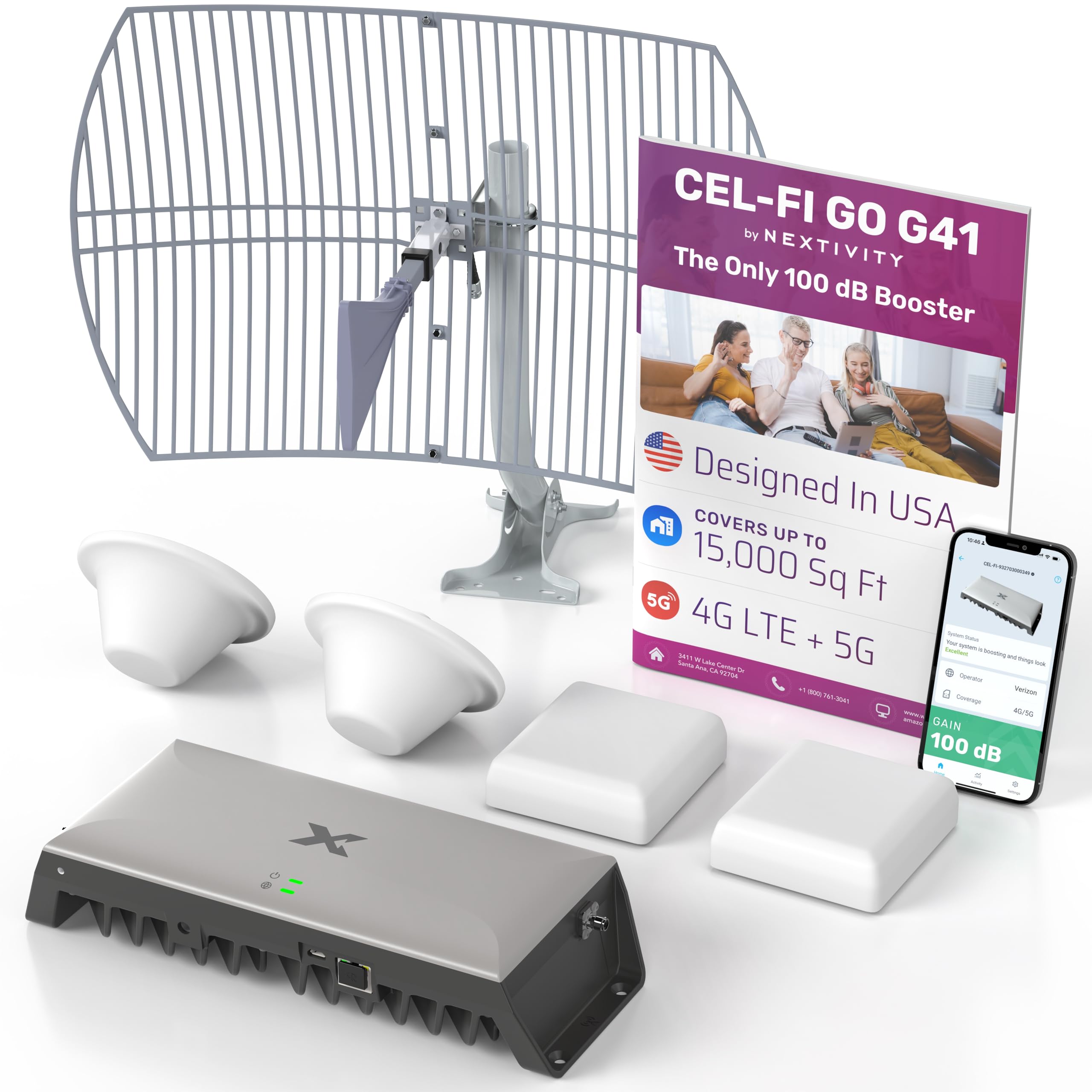
The CEL-FI GO G41 is in a different league entirely. With 100 dB of gain — 30 dB more than any other consumer booster on this list — it can cover up to 15,000 sq ft and is the only unit here with a 4th-generation IntelliBoost chipset that supports 5G NR, 5G DSS, and 4G LTE simultaneously. This is the booster you buy when you have zero signal in a remote valley or a metal-roofed commercial building and nothing else has worked.
The kit includes two indoor dome antennas and two panel antennas, plus an outdoor antenna and pole mount. Users in completely dead zones (no service at all) report going from -108 dBm to -75 dBm, which translates to multiple bars of usable 4G LTE and 5G throughout the house. One reviewer with a metal roof who could not even make calls before installation now has full bars across all three floors. The unit supports AT&T, Verizon, and T-Mobile on 700, 850, 1700/2100, and 1900 MHz bands.
The G41 requires a full day of installation and careful antenna placement. It is FCC certified and designed in California. The price is the highest here, but for users who have tried everything else and still have no usable signal, the G41 is the only true solution. The unit only amplifies two bands at a time (Band 12 and Band 2 in some configurations), which can cause issues if your phone prefers a different band that is not boosted.
Why it’s great
- 100 dB gain covers up to 15,000 sq ft — unmatched in consumer category
- 5G NR and 5G DSS support future-proofs the investment
- Two indoor antenna options for flexible placement
- Works in completely dead zones where other boosters fail
Good to know
- Significant upfront investment
- Only amplifies two bands at a time
- Installation requires a full day and careful planning
- Large kit with multiple components
FAQ
Can any indoor booster work without any outdoor antenna at all?
Will a single-band booster work if my carrier uses multiple bands in my area?
Why does my booster show full bars but data still feels slow?
How far apart do the indoor and outdoor antennas need to be?
Final Thoughts: The Verdict
For most users, the cell phone booster without outside antenna winner is the SureCall Flare because it combines 72 dB gain with an integrated indoor antenna that eliminates the need for a second cable run, making it the simplest path to reliable indoor signal. If you need multi-room coverage that still avoids rooftop work, grab the HiBoost 8000 with its dual indoor antennas and app-based tuning. And for dead-zone scenarios where nothing else works, the CEL-FI GO G41 delivers commercial-grade power that covers an entire house.

Mo Maruf
I created WellFizz to bridge the gap between vague wellness advice and actionable solutions. My mission is simple: to decode the research and give you practical tools you can actually use.
Beyond the data, I am a passionate traveler. I believe that stepping away from the screen to explore new environments is essential for mental clarity and physical vitality.