Our readers keep the lights on and my smoothie glass nicely filled. As an Amazon Associate, I earn from qualifying purchases.
Choosing a first-person-view drone means deciding between a toy-grade camera strapped to a quadcopter and a true immersive flight system. The difference isn’t just video quality — it’s the latency that determines whether you feel like a pilot or just a spectator watching a choppy slideshow. A proper FPV drone wirelessly transmits a live feed from the camera directly to your goggles or screen with minimal delay, letting you fly through gaps, race gates, or tree branches with real-time hand-eye coordination.
I’m Mohammad Maruf — the founder and writer behind WellFizz. I’ve spent hundreds of hours analyzing drone specifications, comparing transmission protocols, and studying customer flight logs across dozens of models to separate true FPV hardware from marketing claims.
Whether you want to learn acro mode, capture cinematic POV footage, or simply cruise with immersive clarity, the best drone with fpv depends entirely on your skill level, budget tier, and tolerance for DIY tuning.
How To Choose The Best Drone With FPV
Buying an FPV drone means evaluating three interconnected systems: the camera and transmission link, the flight controller and motors, and the goggles or display. A weak link in any one system ruins the immersive experience.
Transmission Type: Wi-Fi vs. True FPV
Wi-Fi FPV drones stream video over your phone via a 2.4GHz or 5GHz network. This works for casual overhead shots but introduces 100-300ms of latency — enough to make tight maneuvers feel disconnected. True FPV systems (analog or digital) use dedicated radio frequencies and separate video transmitters, delivering sub-30ms latency. If you plan to fly through obstacles or learn acro maneuvers, skip Wi-Fi and look for kits labeled “real FPV” with bundled goggles and an onboard VTX.
Flight Modes and Control Authority
Beginner FPV drones typically offer three flight modes: Normal (stabilized with altitude hold), Sport (more aggressive response), and Manual or Acro (no stabilization — full pilot control). A drone that locks you into beginner mode without a path to manual mode limits skill progression. The best entry-level kits let you toggle between modes as you gain confidence, with turtle mode (self-righting when flipped) as a valuable safety net.
Battery Life and Charging Ecosystem
True FPV micro drones often have 3-5 minute flight times per battery. That’s not a defect — it’s the trade-off for high thrust-to-weight ratios. The total flight experience depends on how many batteries come in the box and whether the charger can handle multiple packs. Look for kits with at least two batteries and a dedicated balance charger or voltage tester to avoid over-discharging LiPo cells.
Durability and Repairability
FPV flying involves crashes. Drones with full-coverage propeller guards, ducted frames, or impact-resistant plastics survive impacts far better than open-propeller camera drones. Also check whether replacement propellers, frames, and motors are sold separately. A whoop-style quadcopter with a durable plastic frame and easily replaceable parts is ideal for beginners learning acro mode.
Quick Comparison
On smaller screens, swipe sideways to see the full table.
| Model | Category | Best For | Key Spec | Amazon |
|---|---|---|---|---|
| DJI Avata 2 Fly More Combo | Premium FPV | Immersive POV / Acro | 155° FOV, 4K/60fps, 23-min flight | Amazon |
| DJI Neo 2 Motion Fly More Combo | Premium FPV | Beginner FPV with motion control | 151g, palm takeoff, 4K, Goggles N3 | Amazon |
| Ruko U11MINI 4K | Premium Camera | No-phone-needed aerial photography | 5.5″ touchscreen, 3-axis gimbal, 249g | Amazon |
| Bwine F7GIM | Premium Camera | Wind-resistant cinematic flight | 3-axis gimbal, 6K photo, 10000ft range | Amazon |
| Punieayi ZY90 PRO | Mid-Range All-in-One | Long flight with built-in screen | 5.7″ LCD controller, 100-min flight | Amazon |
| BETAFPV Cetus Pro | Mid-Range FPV Kit | Acro learning with turtle mode | N/S/M modes, altitude hold, 450mAh | Amazon |
| EMAX Tiny Hawk RTF | Mid-Range FPV Kit | Indoor racing / micro FPV | 35mph, 200ft analog range, durable | Amazon |
| karuisrc GPS Drone with EIS | Mid-Range All-in-One | Beginner GPS with controller screen | 4.5″ LCD, EIS camera, Follow Me | Amazon |
| PLEGBLE PL-715 GPS | Budget All-in-One | Entry-level GPS 4K camera drone | 2x 2700mAh, 46-min total, under 249g | Amazon |
In‑Depth Reviews
1. DJI Avata 2 Fly More Combo

The DJI Avata 2 is the gold standard for immersive FPV flight straight out of the box. It pairs a 1/1.3-inch sensor capable of 4K/60fps ultra-wide footage with a 155° field of view, delivering a POV experience that makes you feel like you’re inside the cockpit. The integrated propeller guard adds meaningful durability — reviewers report surviving crashes that would destroy an open-prop quad, and the turtle-mode self-righting lets you flip back without walking over.
The bundle includes DJI Goggles 3 and the RC Motion 3 controller, which translates wrist movements into flight direction without complex stick inputs. The Fly More Combo ships with one intelligent battery rated for up to 23 minutes, but aggressive acro maneuvers reduce that to about 17 minutes. The low-latency digital transmission stays clear even behind trees and structures, making tight proximity flying feel safe and responsive.
Experienced pilots appreciate the manual acro mode for flips and rolls, while beginners can ease in with the motion controller’s limited-angle mode. The downside is the ecosystem lock — you need DJI goggles and remotes to unlock full capability. If you want a premium, turnkey FPV system that prioritizes flight feel over modularity, this is the definitive pick.
Why it’s great
- True sub-30ms digital FPV with wide 155° FOV
- Durable integrated propeller guard survives crashes
- Intuitive motion control lowers the learning curve
Good to know
- Goggles and controller are DJI-specific; no third-party alternatives
- Aggressive flying drains battery well below rated 23 minutes
2. DJI Neo 2 Motion Fly More Combo
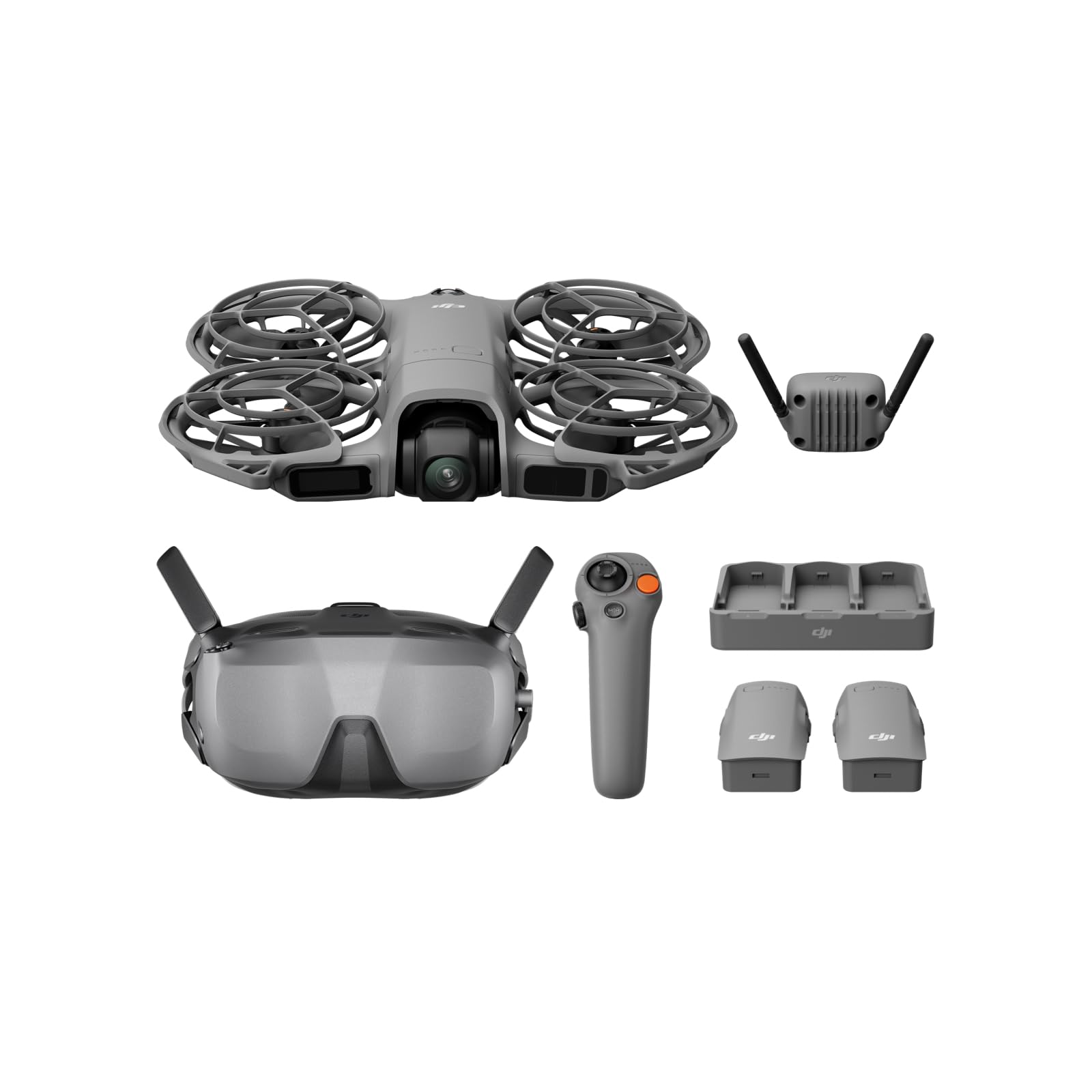
The DJI Neo 2 shrinks the FPV experience into a 151-gram package that requires no FAA registration. It supports palm takeoff and landing, gesture control, and ActiveTrack subject tracking — features that make it approachable for absolute beginners who have never flown an acro drone. The bundle includes the RC Motion 3 controller and Goggles N3, giving you a complete low-latency FPV system without Wi-Fi lag.
The camera captures 4K video at up to 60fps with electronic stabilization, and the onboard 49GB storage means you don’t need a microSD card to start filming. Three batteries in the Fly More Combo deliver roughly 15-20 minutes of total flight time, though individual flights average 10-15 minutes under normal use. The Goggles N3 provide a clear, low-latency view that makes flying through gaps feel natural.
Beginners will appreciate the motion controller’s point-and-fly simplicity — tilting the remote controls direction while speed is set by a thumb wheel. The trade-off is that manual acro mode isn’t as fully featured as the Avata 2’s. For someone who wants to experience true FPV without building a quad or learning Betaflight, the Neo 2 is the most painless entry point at this tier.
Why it’s great
- Ultra-light 151g design avoids FAA registration
- Motion controller makes FPV intuitive for total beginners
- Three batteries extend total flying session
Good to know
- Individual flight time around 10-15 minutes per battery
- Less manual acro control than dedicated FPV quads
3. Ruko U11MINI 4K
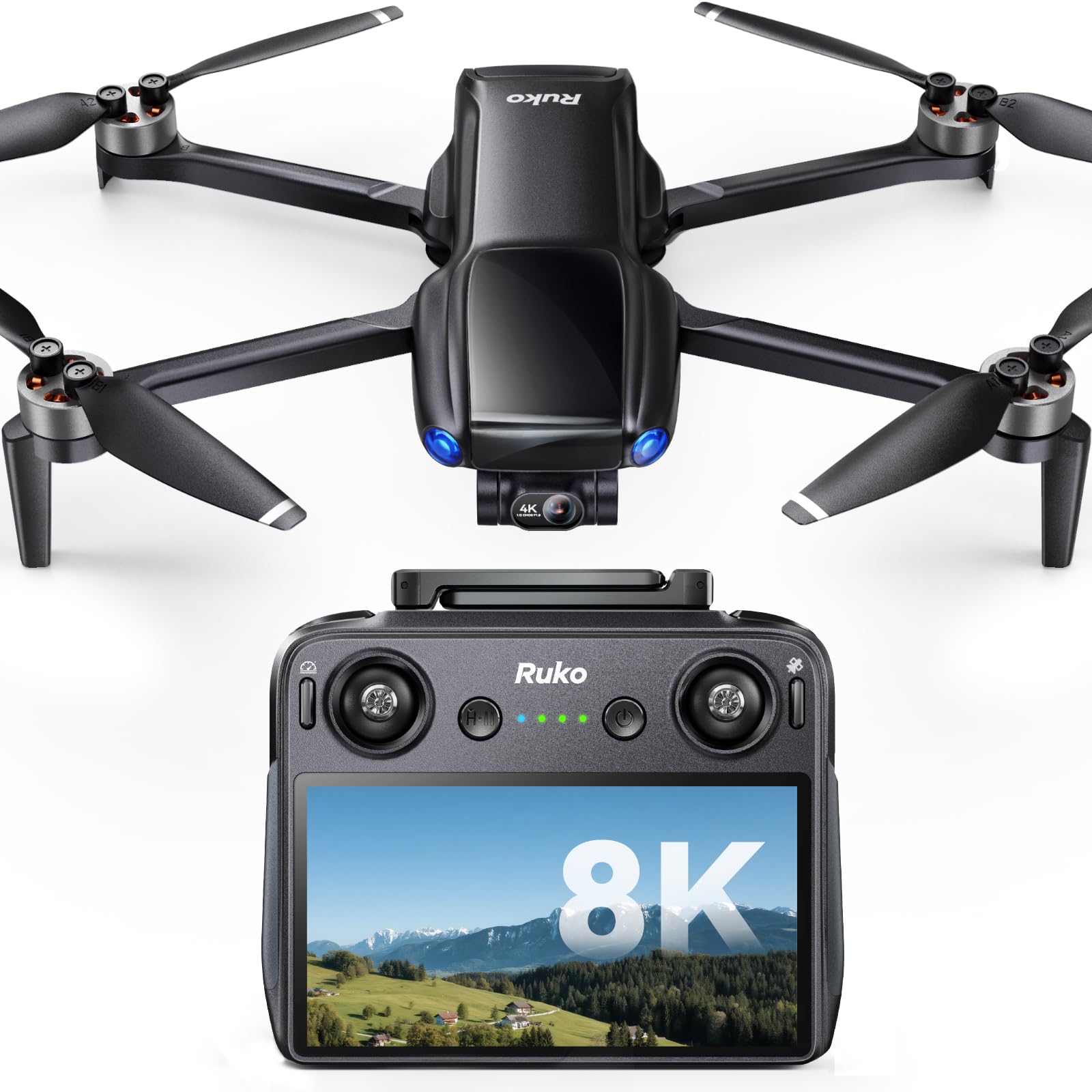
The Ruko U11MINI 4K takes a different approach to FPV: instead of goggles, it uses a built-in 5.5-inch 1080p touchscreen controller that eliminates the need for a phone. This is a camera-focused drone with a 3-axis mechanical gimbal, not a racing or acro quad. The 1/2-inch CMOS sensor captures 8K stills and 4K/30fps video with smooth stabilization that filters out vibration even in moderate wind.
Weighing under 249 grams, it’s FAA-exempt and folds down to a compact travel size. The bundle includes two intelligent batteries rated for 64 minutes total, with PD 3.0 fast charging support. The quadruple positioning system (GPS, barometer, TOF, optical flow) keeps the drone locked in place during hover, making it ideal for beginners who want to frame shots without fighting drift.
The R2 digital transmission system claims up to 20,000 feet of range on open ground. While real-world performance depends on interference, reviewers consistently note the feed stays clear and lag-free. The trade-off is that this is not a true FPV acro drone — there’s no manual mode, and the flight envelope prioritizes stability over agility. If your goal is cinematic aerial video without phone tethering, the U11MINI excels.
Why it’s great
- Integrated touchscreen removes phone dependency
- 3-axis gimbal delivers shake-free cinematic footage
- Under 249g with FAA-exempt compliance
Good to know
- No manual acro mode — stabilized flight only
- Goggles not included or supported for true FPV immersion
4. Bwine F7GIM
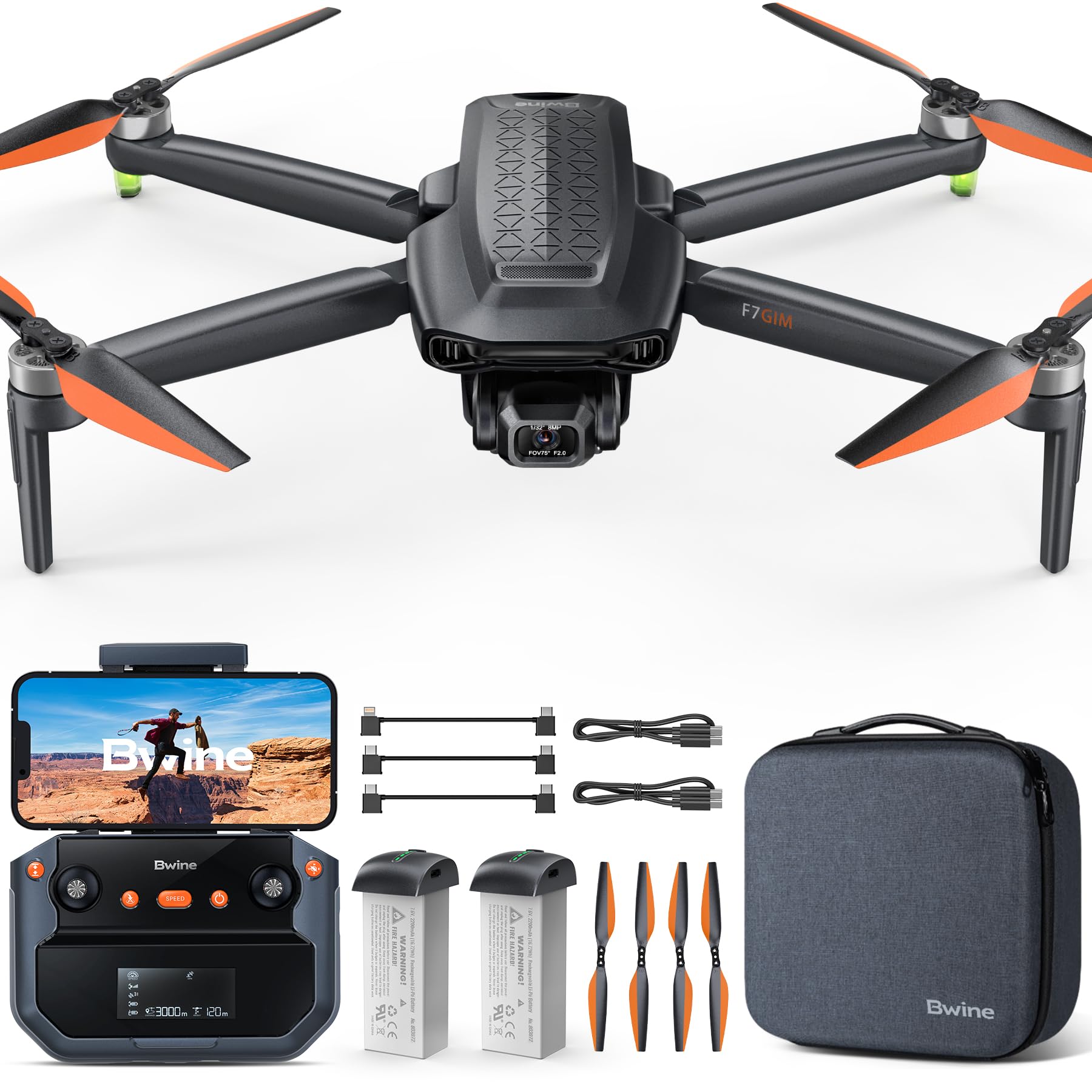
The Bwine F7GIM bridges the gap between camera drone and FPV system with a 3-axis brushless gimbal that claims 300 percent better stability accuracy over standard 2-axis designs. Its 18-megapixel sensor captures 6K photos and 4K/30fps video with 5x digital zoom. The wired digital transmission (not Wi-Fi) pushes real-time 4K video up to 10,000 feet with noticeably lower latency than typical phone-streaming drones.
The bundle includes two batteries delivering up to 70 minutes total flight time (35 minutes each), a military-grade shockproof carrying case, and a full set of spare propellers. Reviewers report stable flight in 10mph winds and reliable GPS-based auto-return that kicks in when signal drops below 2900 feet. The TOF sensors improve low-altitude stability by 200 percent, helping beginners hover close to the ground without bouncing.
Night Mode 2.0 reduces image noise for low-light footage, and the smart flight modes include Follow Me, Orbit, Waypoint, and Cruise Control. The remote controller uses a data cable connected to your phone, which can feel less elegant than an integrated screen but keeps the video feed uncompressed. For outdoor shooters who need wind resistance and professional gimbal stability without paying DJI prices, the F7GIM delivers impressive value at this tier.
Why it’s great
- 3-axis gimbal provides excellent wind stabilization
- Wired digital transmission avoids Wi-Fi interference
- 70-minute total flight with two included batteries
Good to know
- Phone required as display; no built-in screen
- Digital zoom reduces quality at 5x
5. Punieayi ZY90 PRO
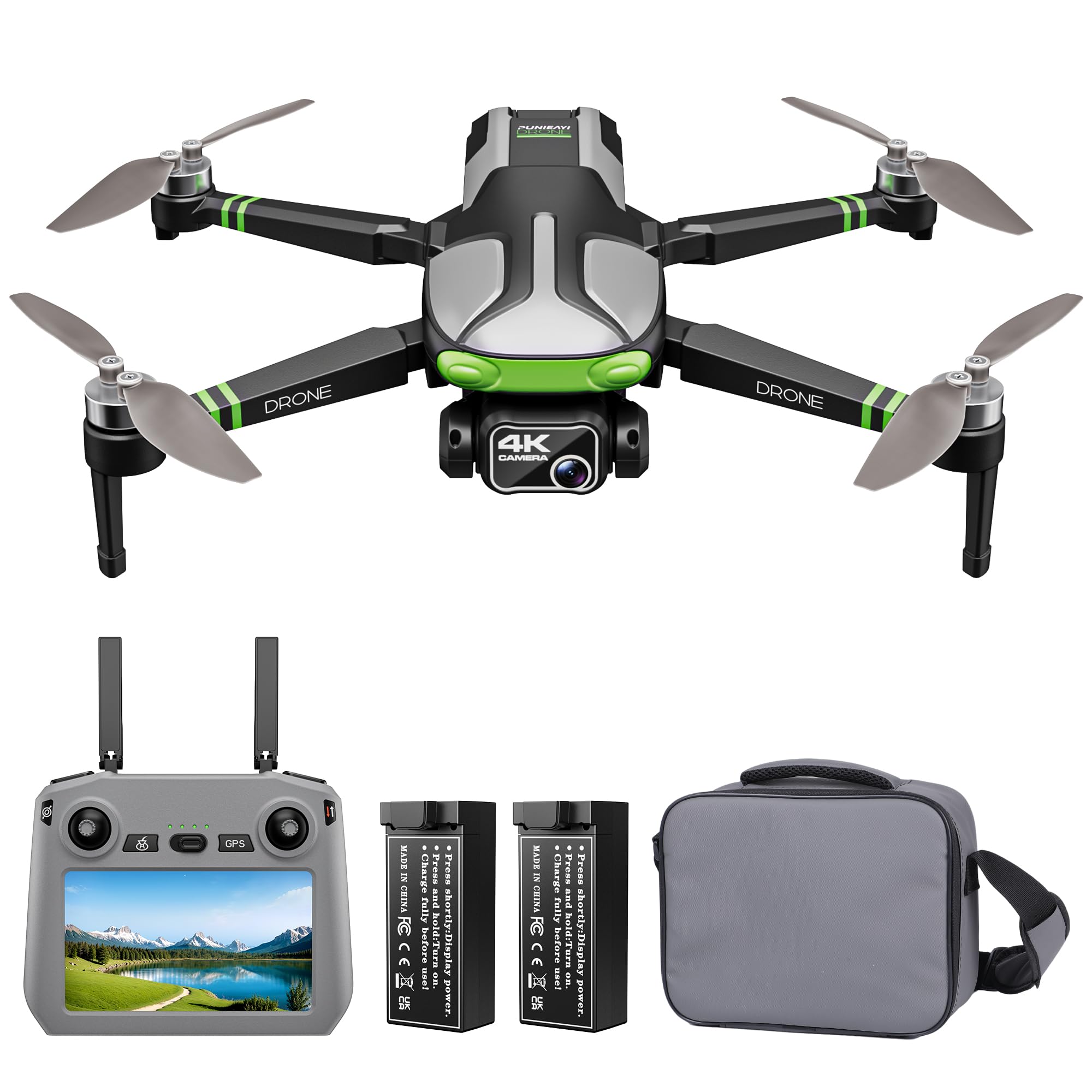
The Punieayi ZY90 PRO differentiates itself with a 5.7-inch LCD display built directly into the remote controller, giving you a large FPV view without needing goggles or a phone. The 4K camera with a 90-degree adjustable lens captures 2K/30fps video and 3840×2160 photos, while Level 4 wind resistance and brushless motors keep footage stable in breezy conditions. The intelligent flight modes include Rocket, Helix, Follow Me, and Circle Fly for automated cinematic shots.
The two 3800mAh batteries with visible power indicators deliver a claimed 100 minutes of total flight time, and USB-C fast charging reduces downtime between sessions. The controller supports transmission up to 6,500 feet, and the on-screen composition guides (diagonal lines, center dot, 3×3 grid) help beginners frame professional-looking shots without guessing. Beginner mode limits altitude and distance for safe practice.
Reviewers highlight the convenience of the integrated screen for outdoor use where phone brightness is an issue. The drone’s foldable design and included carrying case make it travel-ready. The downsides center on the manual organization — some users found the printed documentation confusing — and a few reported controller connectivity issues, though these appear isolated. For pilots who want a self-contained screen-based FPV experience with generous flight time, this is a strong mid-range contender.
Why it’s great
- Large built-in screen eliminates phone tethering
- 100-minute total flight time with two batteries
- On-screen composition guides for better framing
Good to know
- No manual acro mode available
- Some users report poorly organized manual
6. BETAFPV Cetus Pro

The BETAFPV Cetus Pro is purpose-built for beginners transitioning from stable flight to actual acro mode. It offers three flight modes — Normal (with altitude hold), Sport (more aggressive response), and Manual (full acro without stabilization) — plus three speed levels within each mode. The brushless motors provide more power and durability than the coreless motors found in cheaper toy quads, and the turtle mode lets you self-right the drone after a crash by flipping over via the transmitter.
The kit includes the LiteRadio 2 SE transmitter and VR02 goggles, both of which are functional for FPV but not premium. The barometer and laser sensors keep the Cetus locked to altitude in Normal mode. Two 450mAh BT2.0 batteries provide about 5 minutes of flight each, which is typical for micro FPV whoops. The self-protection feature automatically disarms the motors on strong impact and initiates emergency landing if the signal is lost.
Reviewers praise its durability — it survived full-speed crashes into walls and even a dog water bowl submersion. The main complaints are the short flight time per battery (recommended to buy extra 4-packs) and the lack of an orientation light, making direction hard to judge at distance. For someone determined to learn manual acro mode without risking a more expensive quad, this kit is the most direct training tool in this lineup.
Why it’s great
- Turtle mode and self-protection reduce crash damage
- Three flight modes including true manual acro
- Brushless motors improve performance and lifespan
Good to know
- Only 5 minutes per battery; extra packs needed
- No orientation light for directional awareness
7. EMAX Tiny Hawk RTF

The EMAX Tiny Hawk is a ready-to-fly micro racing drone that delivers real analog FPV at a claimed 35mph top speed. It includes goggles, a controller, and the drone itself — no assembly, no soldering, no external video receiver. The video transmission uses dedicated analog frequencies (not Wi-Fi), so latency stays low enough to fly through doorways and under tables. Range is rated at 200 feet through obstacles, which is competitive for indoor FPV.
The lightweight ducted frame is surprisingly tough — reviewers report surviving hundreds of crashes, water submersion, and full-speed impacts with only occasional prop replacement. Three difficulty modes (beginner, intermediate, expert) let you gradually unlock full manual control. The battery life averages around 4 minutes, which is short but standard for this class. The included charger works with the included 1S LiPo battery and includes a voltage tester.
Some users found the goggles slightly uncomfortable for extended sessions and the camera angle fixed too high for stable forward flight at low speeds. Durability claims vary — a minority report frame breakage after minor impacts. The Tiny Hawk connects to Betaflight for tuning, and the community support via YouTube tutorials is extensive. For anyone who wants to practice indoor race lines or fly FPV in tight spaces without a big investment, this kit delivers genuine FPV feel at a micro scale.
Why it’s great
- Real analog FPV with minimal latency for indoor flying
- Highly durable ducted frame survives repeated crashes
- Three flight modes scale difficulty for learning
Good to know
- Only 4 minutes flight per battery
- Goggles can feel heavy during longer sessions
8. karuisrc GPS Drone with EIS
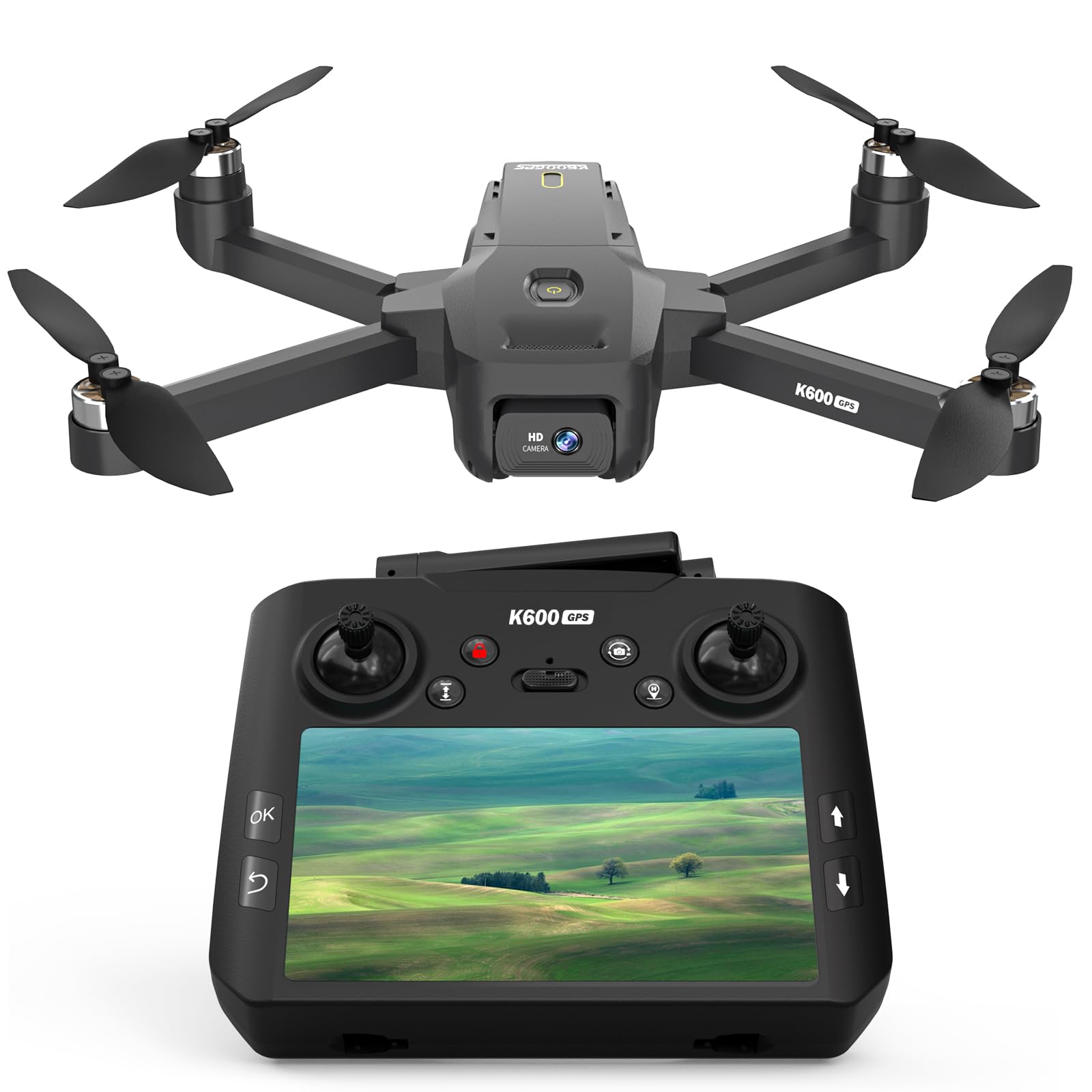
The karuisrc GPS Drone combines a 4.5-inch HD display on the remote controller with an electronic image stabilization (EIS) camera, offering a self-contained viewing experience at a mid-range price. The GPS module enables smooth auto-return, Follow Me, Waypoint Navigation, and Orbit Mode — features that reduce pilot workload and make cinematic tracking shots easier. The brushless motors provide stable flight in light wind, and the under-249g weight avoids FAA registration requirements.
Transmission range is rated at 400 meters control distance with 250 meters of mapping capability. The EIS camera smooths out minor vibrations but doesn’t match the clarity of a mechanical gimbal. The 2200mAh battery provides moderate flight time, though reviewers appreciated the quick GPS lock and responsive controls. The remote feels solid in hand, and the included batteries come ready to fly with simple calibration steps.
This drone is best for beginners who want GPS-assisted features and an integrated screen without spending on a premium tier. It lacks manual acro mode and the stabilization won’t satisfy serious cinematographers, but the Follow Me and Orbit modes work reliably. If your priority is having a controller that shows live video without phone clips or extra cables, this is a practical entry point with helpful safety features.
Why it’s great
- Built-in 4.5″ screen removes phone dependency
- GPS auto-return and Follow Me work reliably
- Under 249g with FAA-exempt weight
Good to know
- Electronic stabilization, no physical gimbal
- Limited to stabilized modes — no acro
9. PLEGBLE PL-715 GPS
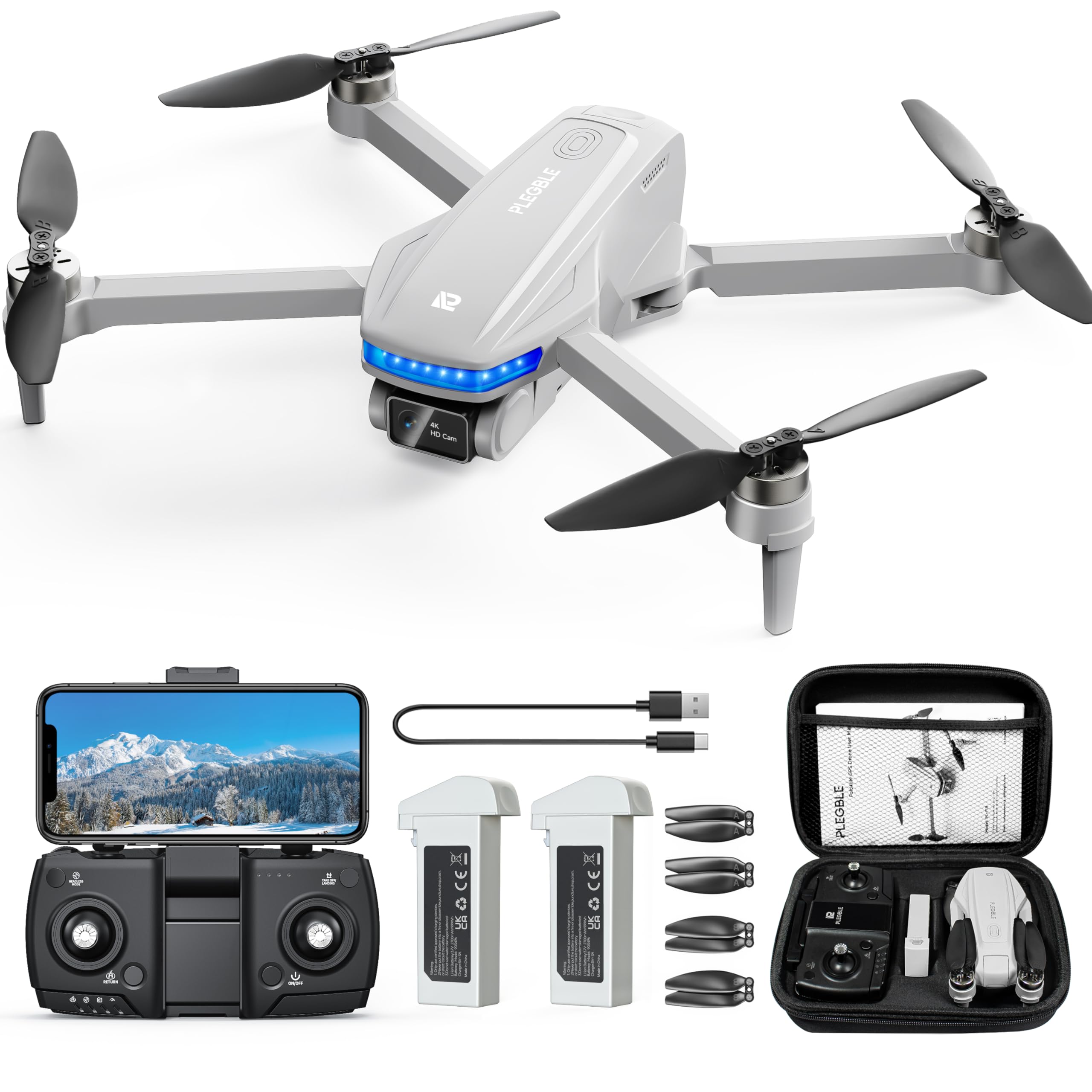
The PLEGBLE PL-715 is a budget-friendly GPS camera drone that delivers 4K photo capture and 5GHz FPV video streaming to your phone. It includes two 2700mAh batteries for a total flight time of 46 minutes (23 minutes each), which is generous for this price tier. The brushless motors improve efficiency and reduce noise compared to cheaper brushed alternatives. The 120° wide-angle lens with 90° adjustable angle captures a broad field of view for landscape shots.
GPS functions include auto-return, Follow Me, Waypoint Flight, and Circle Fly — features typically found on more expensive models. The beginner mode restricts flight to a 30-meter radius, helping novices practice within visual range. Weighing under 250 grams, it requires no FAA or Remote ID registration. The foldable design and included carrying case make it easy to transport.
Reviewers consistently call it a great starter drone for adults and kids alike, praising the responsive controls and stable hover. The camera quality is described as “surprisingly good for casual use” but won’t match gimbal-stabilized drones. Some users noted that the included USB-C charger needs a surge protector to reliably charge the batteries. For the budget tier, this is a well-rounded package that gives beginners access to GPS flight features and enough battery life for extended practice sessions.
Why it’s great
- 46-minute total flight with two included batteries
- GPS auto-return and Follow Me at entry-level price
- Under 249g with no FAA registration needed
Good to know
- FPV feed streams over Wi-Fi with higher latency
- Charging may require a USB-C surge protector
FAQ
Can I use a normal DJI camera drone for FPV flying?
Why do FPV drones have such short battery life compared to camera drones?
Do I need FAA registration for an FPV drone?
Final Thoughts: The Verdict
For most users, the drone with fpv winner is the DJI Neo 2 Motion Fly More Combo because it combines true digital FPV with beginner-friendly palm takeoff and motion controls at a weight that avoids FAA registration and regulatory overhead. If you want the full immersion of goggles plus acro flips and rolls, grab the DJI Avata 2 Fly More Combo. And for learning manual acro mode on a budget that can survive endless crashes, nothing beats the BETAFPV Cetus Pro with its turtle mode and three flight modes.

Mo Maruf
I created WellFizz to bridge the gap between vague wellness advice and actionable solutions. My mission is simple: to decode the research and give you practical tools you can actually use.
Beyond the data, I am a passionate traveler. I believe that stepping away from the screen to explore new environments is essential for mental clarity and physical vitality.