Our readers keep the lights on and my smoothie glass nicely filled. As an Amazon Associate, I earn from qualifying purchases.
The CFexpress Type B market now spans budget-friendly entry cards and pro-grade 4.0 units, but read speeds on the box often mask the sustained write numbers that actually keep your camera rolling through 8K RAW or high-speed continuous shutter.
I’m Mohammad Maruf — the founder and writer behind WellFizz. I’ve spent dozens of hours digging through sustained write benchmarks, real user endurance reports, and camera-specific compatibility notes to separate cards that actually deliver under heavy load from those that choke when it matters.
Whether you are upgrading from XQD or looking for the fastest 4.0 interface option, this guide breaks down which cfexpress type b card truly matches your camera, budget, and shooting demands.
How To Choose The Best CFexpress Type B Card
All CFexpress Type B cards look identical from the outside, but their internal controllers and NAND flash dictate whether your camera locks onto a buffer or clears it instantly. Picking the right one means matching the card’s sustained write performance to your camera’s maximum data rate at the resolution and frame rate you actually shoot.
Sustained Write Speed vs. Burst Speed
A card that advertises 3400 MB/s read may drop to 600 MB/s sustained write after a few seconds of 8K RAW recording. For video shooters using cameras like the Nikon Z9 or Canon R5C, the sustained write speed is the only number that prevents dropped frames. Cards listed with a specific sustained write figure (e.g., 820 MB/s or 850 MB/s) provide predictable performance in long takes.
CFexpress 4.0 Backward Compatibility
CFexpress 4.0 cards run PCIe 4.0 internally but are fully compatible with CFexpress 2.0 and XQD slots after a firmware update. On a 2.0 host, the card operates at 2.0 speeds, meaning you pay extra for future-proofing today. If you plan to upgrade your camera within two years, a 4.0 card makes sense. If you run a late-model Nikon or Canon mirrorless, 4.0 gives immediate buffer-clearing benefits.
Capacity vs. Thermal Throttling
Higher-density cards (1TB and above) pack more NAND die into the same form factor, which can generate more heat during sustained writes. Several premium cards in the 512GB range run cooler than their 2TB siblings. For long 8K recording sessions, a 512GB card with higher sustained write may outperform a larger card that throttles midway through a clip.
Quick Comparison
On smaller screens, swipe sideways to see the full table.
| Model | Category | Best For | Key Spec | Amazon |
|---|---|---|---|---|
| Nextorage NX-B3SE512G | CFexpress 4.0 | High-speed continuous shooting | 850 MB/s sustained write | Amazon |
| Delkin POWER 4.0 | CFexpress 4.0 | Pro video & 8K RAW | 820 MB/s sustained write | Amazon |
| OWC Atlas Pro 4.0 | CFexpress 4.0 | 6K high bitrate video | 800 MB/s sustained write | Amazon |
| PERGEAR Master Series | CFexpress 4.0 | Value 1TB capacity | 3500 MB/s read | Amazon |
| ProGrade Gold 4.0 | CFexpress 4.0 | Reliable pro workflow | 850 MB/s sustained write | Amazon |
| CHIPFANCIER 4.0 | CFexpress 4.0 | Nikon Z9 RAW | 3550 MB/s read | Amazon |
| SABRENT Rocket CFX PRO | CFexpress 2.0 | Large capacity 2TB | 1300 MB/s sustained write | Amazon |
| Lexar Professional Gold | CFexpress 2.0 | Trusted brand reliability | 1000 MB/s sustained write | Amazon |
| INDMEM 256GB | CFexpress 2.0 | Budget entry-level | 1700 MB/s read | Amazon |
In‑Depth Reviews
1. Nextorage NX-B3SE512G

Nextorage, founded by former Sony engineers, packs the B3SE series with high-quality TLC NAND that delivers a sustained write speed of 850 MB/s — the critical metric for 8K 60fps RAW recording. The 3900 MB/s read speed drastically cuts transfer times when paired with a CFexpress 4.0 reader, making post-production noticeably faster.
Real-world tests show this card clears the buffer on a Nikon Z8 during high-speed burst shooting without a single stall. The 512GB variant includes a dedicated protective case, 5-year warranty, and free data recovery software. It passed six durability tests including shock, temperature extremes, and X-ray exposure.
Users report flawless performance with the Fuji X-H2S at 30 fps RAW burst and zero overheating issues across long recording sessions. The only caveat is that the 1TB version offers higher sustained write than the 512GB variant, so heavy videographers should consider stepping up in capacity.
Why it’s great
- Excellent sustained write performance for 8K 60fps RAW
- Rugged build with 6-layer durability testing
- 5-year warranty with included data recovery software
Good to know
- 512GB variant has lower sustained write than the 1TB option
- Requires CFexpress 4.0 reader for full read speed benefit
2. Delkin Devices POWER 4.0

Delkin’s POWER 4.0 line targets professional videographers with a sustained write speed of 820 MB/s, well above the minimum required for 8K RAW recording on most cinema cameras and high-end mirrorless bodies. Burst read speeds hit 3650 MB/s, while burst write peaks at 3240 MB/s, giving a generous headroom for continuous RAW stills.
The card includes a shockproof and waterproof construction that holds up in rugged field conditions, and it ships with a small protective storage case. Delkin backs the card with a 48-hour replacement guarantee — they ship a new card before you return the defective one — plus a lifetime warranty that few competitors match.
Users running the Lumix GH6 and Nikon Z8 report flawless performance with oversampled 4K60 and high-bitrate video. Some early units showed defects, but Delkin’s no-hassle replacement process resolved them quickly. For shooters who prioritize warranty support and sustained write guarantees, this is a top contender.
Why it’s great
- Strong 820 MB/s sustained write for 8K video
- 48-hour replacement guarantee with lifetime warranty
- Rugged shockproof and waterproof build
Good to know
- Occasional defective units reported, though replacement is fast
- No bundled data recovery software
3. OWC Atlas Pro 4.0

OWC’s Atlas Pro 4.0 delivers a real-world write speed of 3000 MB/s and a sustained write floor of 800 MB/s, making it a strong option for 6K high-bitrate video and fast burst RAW sequences. It fully meets CFexpress 1.0, 2.0, and 4.0 specifications, ensuring compatibility with both legacy XQD cameras (with firmware updates) and the latest mirrorless bodies.
The card is impact, bend, shock, ESD, UV-ray, and X-ray resistant, and carries a 3-year OWC limited warranty. Users shooting thousands of 48 MP images on a Canon R5 Mark II report zero lag during continuous shutter and fast Lightroom transfers over Thunderbolt 4. No corruption or slowdowns were noted across day-long shoots.
OWC does not specify a minimum sustained write in their marketing as clearly as some competitors, but third-party benchmarks confirm the 800 MB/s floor. The 512GB capacity hits a sweet spot for most shooting sessions without pushing into thermal throttle territory that affects larger 2TB cards.
Why it’s great
- Proven real-world write speeds up to 3000 MB/s
- Fully compliant with all CFexpress Type B generations
- Strong thermal performance — no overheating during extended use
Good to know
- Sustained write not prominently advertised in product copy
- 3-year warranty is shorter than some competitors’ lifetime offers
4. PERGEAR Master Series
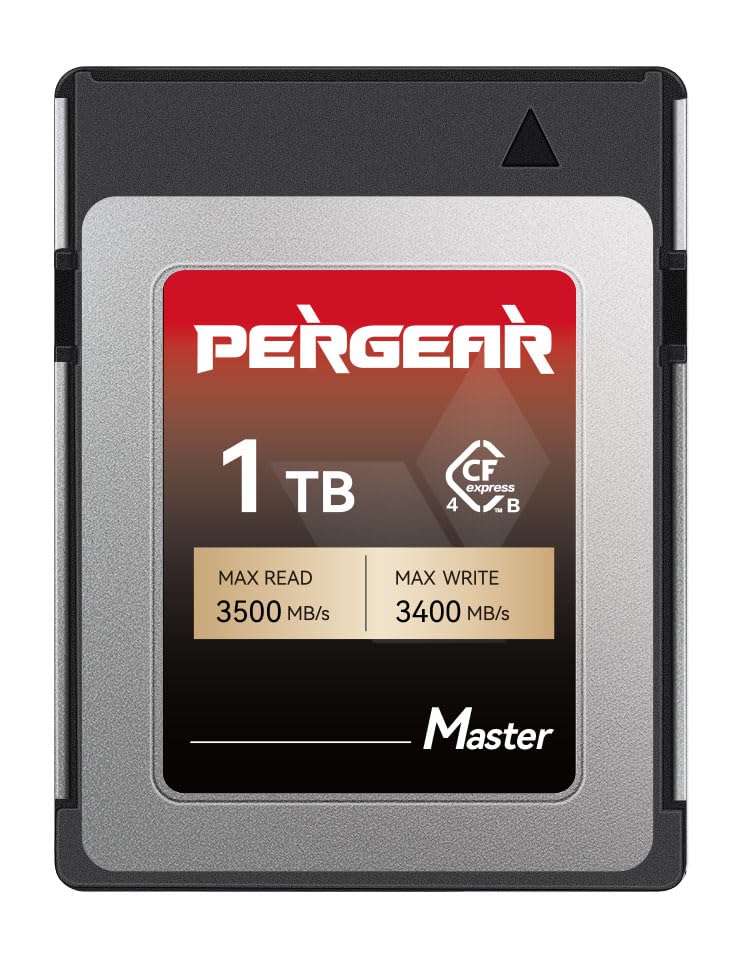
PERGEAR’s Master Series offers 1TB of CFexpress 4.0 storage at a price typically found on 512GB cards from bigger brands. Read speeds of 3500 MB/s and write speeds of 3400 MB/s provide ample bandwidth for 8K and 10K continuous recording. The card is shock, temperature, and X-ray resistant for field durability.
Users report excellent performance in the Nikon Z6III and Lumix S1 RII, with accurate capacity, no overheating, and fast transfer speeds. The card includes a 10-year warranty after registration, which is among the longest coverage periods in this category. Some shooters noted the card runs warm during extended R3D RAW recording on the Nikon ZR, though no failures were reported.
Value-conscious buyers who need high capacity without sacrificing 4.0 speed will find this a compelling option. The lack of sustained write marketing figures means real-world testing with your specific camera is recommended, but early adopters report smooth 8K RAW performance across multiple host bodies.
Why it’s great
- Massive 1TB capacity at a competitive price point
- 10-year warranty after registration
- Consistent read/write speeds across multiple camera platforms
Good to know
- Card can run warm during extended 8K RAW recording
- Sustained write speed not listed in official specs
5. ProGrade Digital Gold 4.0

ProGrade’s Gold 4.0 series is engineered with an 850 MB/s sustained write speed, optimized for 4K, 6K, and 8K video without dropped frames. The read speed reaches 3400 MB/s, and the card is backward compatible with XQD devices after a firmware update. ProGrade also offers the Refresh Pro software to maintain card speed and restore corrupted files.
The card features a laser-etched serial number to prevent counterfeiting, plus a 3-year warranty. Users highlight the card’s cool running temperature even during sustained recording sessions — a benefit of ProGrade’s thermal management. The Gold series balances price and performance well, coming in below ProGrade’s own Cobalt series while delivering professional-grade reliability.
Photographers and videographers who have switched to ProGrade for all their memory needs report zero corruption, fast buffer clearing, and confidence in the brand’s quality control. The Gold 512GB is ideal for 4K RAW workflows and burst shooting on cameras like the Sony Burano or Canon R5C.
Why it’s great
- Clear 850 MB/s sustained write specification for predictable performance
- Laser-etched serial number prevents counterfeits
- Runs cool under heavy load
Good to know
- 3-year warranty is shorter than some competitors’ lifetime coverage
- Refresh Pro software sold separately
6. CHIPFANCIER CFexpress 4.0
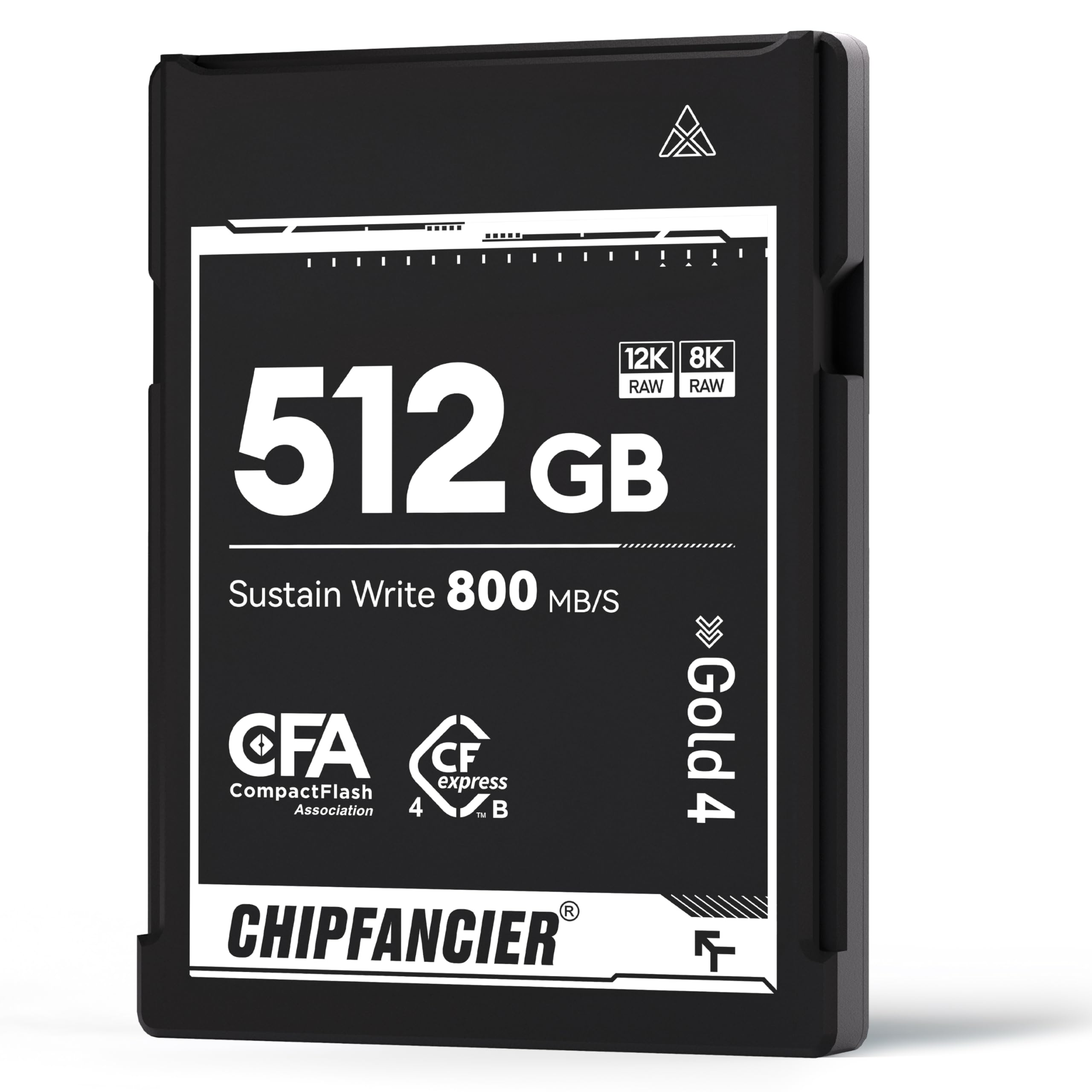
CHIPFANCIER enters the CFexpress 4.0 space with a 512GB card offering 3550 MB/s read and 1550 MB/s write speeds. While the company does not explicitly advertise sustained write figures, independent users report real-world read speeds around 1780 MB/s and write speeds around 1420 MB/s on standard benchmarks, which is competitive for the 4.0 entry tier.
The card is waterproof and built with high-quality components tested for reliability. Users running Nikon Z9, Canon R5, and Panasonic GH6 confirm stable performance with RAW 8K video at most frame rates, though the highest bitrate modes may push the card’s limits. The 512GB capacity is a good fit for day-long shoots without needing to swap cards.
Some users reported the card works flawlessly for months of heavy use, with no overheating or data corruption. CHIPFANCIER also offers a dedicated reader, which helps achieve the rated speeds. For budget-minded shooters wanting a taste of CFexpress 4.0 without paying flagship prices, this is a solid entry point.
Why it’s great
- Affordable CFexpress 4.0 performance for Nikon Z9 and Canon R5
- Waterproof construction for field durability
- Stable performance across months of heavy use
Good to know
- Sustained write speed not officially specified
- May struggle with highest bitrate 8K60 modes
7. SABRENT Rocket CFX PRO

Sabrent’s Rocket CFX PRO stands out with 2TB of capacity and a sustained write speed of 1300 MB/s — the highest sustained write in this lineup. It uses dual PCIe 3.0 lanes to reach 1800 MB/s read and 1700 MB/s write, and the SSD-grade controller supports LDPC, ECC RAID, and wear-leveling for long-term endurance.
Users report this card handles 8K60p N-RAW on the Nikon Z8 and 8K60p RAW on the Canon R5C without any dropped frames or buffer stalls. The large capacity lets shooters capture 400+ images at 120 fps continuously without swapping cards. The card is backward compatible with certain XQD cameras and works with standard CFexpress readers.
The packaging is oversized, and at 2TB the card can run warm during extended writes, but the thermal management is sufficient to prevent throttling in most use cases. For photographers who need massive on-card storage for long shoots without a laptop to offload, the Rocket CFX PRO is unmatched in this list.
Why it’s great
- Massive 2TB capacity eliminates card swaps
- 1300 MB/s sustained write handles demanding RAW workloads
- SSD-grade controller with advanced data protection features
Good to know
- Large size box with wasteful packaging
- Runs warmer during extended 8K recording sessions
8. Lexar Professional Gold
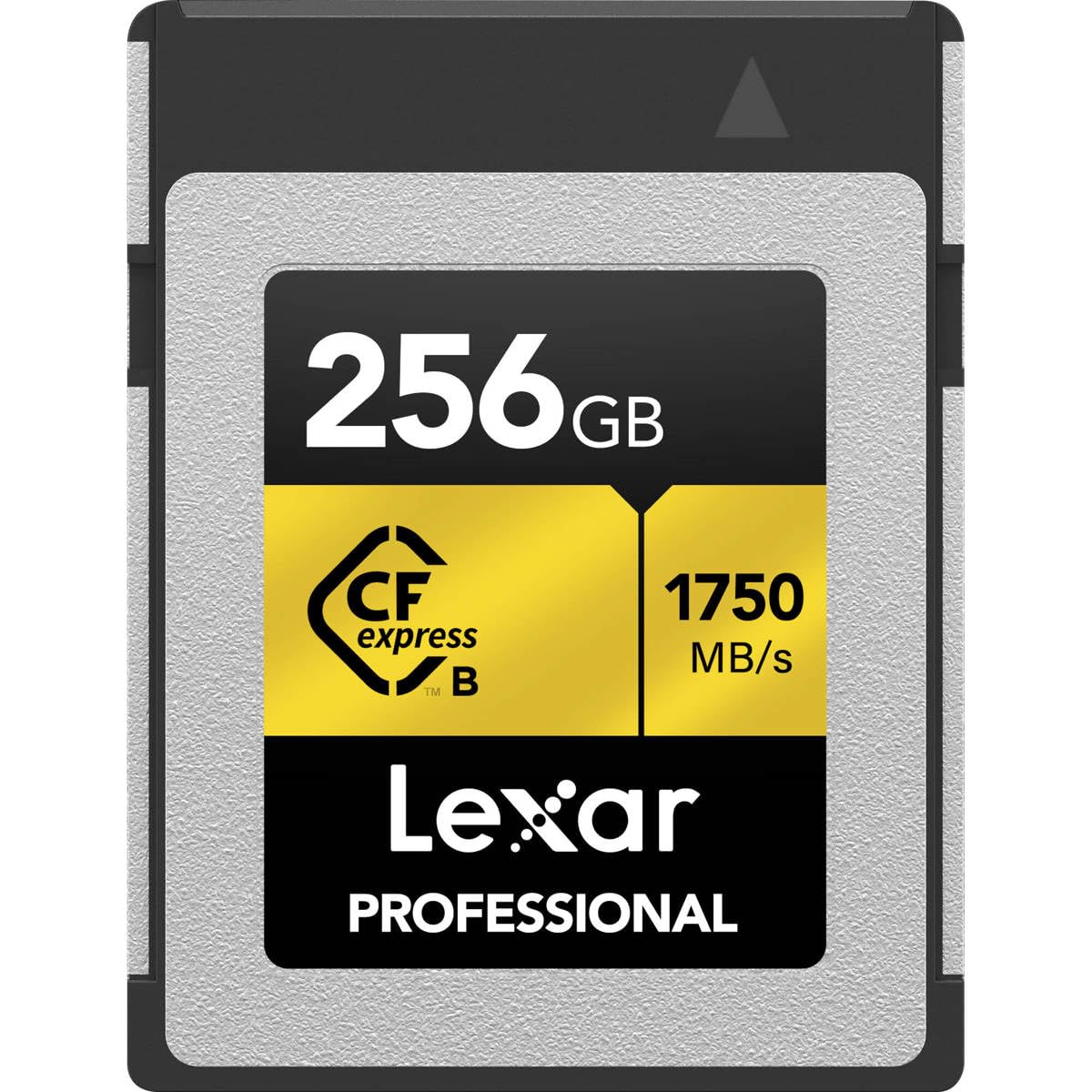
Lexar’s Professional Gold series has been a staple in the memory card market for years. This CFexpress Type B card delivers 1750 MB/s read and 1500 MB/s write with a minimum sustained write speed of 1000 MB/s, making it capable of smooth 8K RAW video. The card uses PCIe 3.0 and NVMe protocols and carries a limited lifetime warranty.
Users running Nikon Z8 and Canon R5 bodies report the card handles RAW burst shooting and 8K video without buffer delays. The 256GB capacity is on the smaller side, but it’s enough for a day of mixed photo and video work. Lexar’s brand recognition and widespread retail availability make it an easy recommendation for shooters who prefer established names.
One notable downside is the lack of software tools for card maintenance — competitors like ProGrade offer dedicated utilities for restoring performance over time. If you shoot heavily and want to refresh your card periodically, you’ll need third-party tools. Still, for raw speed and reliability, the Lexar Gold remains a benchmark.
Why it’s great
- Trusted brand with consistent performance across cameras
- 1000 MB/s sustained write is clearly specified
- Limited lifetime warranty provides long-term coverage
Good to know
- No official software for card maintenance or reset
- 256GB capacity feels limited for 8K video work
9. INDMEM 256GB

INDMEM’s 256GB CFexpress Type B card offers the lowest entry price in this roundup while still delivering 1700 MB/s read and 1600 MB/s write speeds. It supports PCIe 3.0 and NVMe, and is backward compatible with select XQD cameras after a firmware update. The card is waterproof and carries a one-year warranty.
Budget-conscious shooters report great value — one user noted that no other brand sells 1TB at the same price-to-capacity ratio. However, reliability is a concern: several users reported card corruption after one use, causing camera malfunction and file loss. The quality control appears inconsistent, with some units failing and others running perfectly for months.
The 256GB capacity limits your shooting window for 8K RAW, but it works well for 4K video and standard photo bursts at a fraction of the cost of premium cards. If you need a spare card for less demanding work or are testing the CFexpress waters on a tight budget, the INDMEM is worth considering — but have a backup plan for critical shoots.
Why it’s great
- Most affordable entry point into CFexpress Type B
- Waterproof construction
- Decent burst speeds for 4K video and photo work
Good to know
- Inconsistent quality control with reports of early card failure
- One-year warranty is short; no data recovery tools included
FAQ
What sustained write speed do I need for 8K60 RAW on a Nikon Z9?
Will a CFexpress 4.0 card work in my older XQD camera?
Do larger capacity cards run hotter than smaller ones?
How important is the card reader for achieving advertised speeds?
Can I use a CFexpress Type B card in a Type A slot?
Final Thoughts: The Verdict
For most users, the cfexpress type b card winner is the Nextorage NX-B3SE512G because it combines a clearly specified 850 MB/s sustained write with excellent durability and a 5-year warranty. If you prioritize replacement speed and lifetime coverage, grab the Delkin POWER 4.0. And for massive 2TB capacity with top sustained write performance, nothing beats the Sabrent Rocket CFX PRO.

Mo Maruf
I created WellFizz to bridge the gap between vague wellness advice and actionable solutions. My mission is simple: to decode the research and give you practical tools you can actually use.
Beyond the data, I am a passionate traveler. I believe that stepping away from the screen to explore new environments is essential for mental clarity and physical vitality.