Our readers keep the lights on and my smoothie glass nicely filled. As an Amazon Associate, I earn from qualifying purchases.
That moment when you lose service on a remote highway or a backcountry camping trip can be more than frustrating—it can feel isolated. A capable vehicle booster pulls in the faintest whisper of a signal from a distant tower and amplifies it inside your car, truck, or SUV, so you can make calls, stream routes, and stay in touch from places you never thought possible.
I’m Mohammad Maruf — the founder and writer behind WellFizz. I’ve spent dozens of hours dissecting the technical specs, customer feedback, and real-world performance data of the most popular mobile signal amplifiers on the market today to create a guide that cuts through the marketing noise.
If you’re tired of watching your bars disappear as soon as you leave city limits, the right cell signal booster for car will restore your connection across band 12/13/17 and keep everyone in the vehicle online during your next road trip.
How To Choose The Best Cell Signal Booster For Car
Selecting the right vehicle booster means matching its gain, frequency coverage, and antenna design to your specific driving habits and carrier. Below are the four specs that separate a worthwhile purchase from a wasted install.
Gain (dB) — How Much Muscle It Has
Gain is measured in decibels (dB). A higher gain number means the booster can amplify a weaker incoming signal more aggressively. Most car boosters fall between 50 dB and 72 dB. For general highway and suburban driving, 50–65 dB is sufficient. If you regularly travel through deep mountain passes or remote forests where the phone barely registers a signal, look for 65 dB or higher. Keep in mind that gain alone doesn’t guarantee performance—antenna placement and separation matter just as much.
Frequency Band Support — The Carrier Match Game
Every carrier in the U.S. uses a specific mix of frequency bands. Verizon relies heavily on Band 13 (700 MHz) and Band 4 (1700/2100 MHz). AT&T uses Band 12 (700 MHz) and Band 2 (1900 MHz). T-Mobile leans on Band 12 for coverage and Band 4 for capacity. A booster that covers Band 12/13 and Band 4/2/5 will serve most users. Some newer units also support Band 66 and Band 71 for extended range with 5G service. Check your phone’s band compatibility before buying—a booster can only amplify the bands it was designed to receive.
Antenna Type — Omnidirectional vs. Directional
Omnidirectional antennas, sometimes called whip or magnetic-mount antennas, pick up signals from 360 degrees. They are ideal for vehicles because you don’t need to aim them at a tower while driving. Directional antennas, by contrast, must be pointed and are better suited for stationary setups like an RV at a campsite. For a true car, truck, or SUV, a rugged omnidirectional antenna with a strong magnetic base is the standard choice. It stays attached through car washes and highway speeds, and it keeps working as the vehicle changes direction relative to the nearest tower.
Installation and Separation — The Hidden Performance Killer
The outside antenna and the inside antenna must be separated by enough distance (typically 15–20 feet of horizontal or vertical space) to prevent the booster from amplifying its own signal into a feedback loop. Many car kits include cables that force you to place the inside antenna near the rear of the vehicle and the outside antenna on the roof, creating a natural separation. If the cables are too short, you may struggle to achieve enough distance, which can cause the booster to shut down or oscillate. Measure your vehicle’s interior and roof space before committing to a kit.
Quick Comparison
On smaller screens, swipe sideways to see the full table.
| Model | Category | Best For | Key Spec | Amazon |
|---|---|---|---|---|
| weBoost Drive 4G-X OTR | Premium Truck | Semi-trucks and big rigs needing the longest range | 50 dB gain; 17-inch weather-resistant antenna | Amazon |
| HiBoost C30G-5S-BTW | Premium SUV | Large SUVs and pickups with precision 50Ω connectors | High power booster; 13 ft outside cable | Amazon |
| Atcall SF-Truck | Premium Truck | Professional truckers who want a smart LCD display | 50 dB gain; omnidirectional antenna | Amazon |
| Metarepeater MB1 | Mid-Range | Family vehicles with multiple passengers and devices | Smart LCD display; 360° omnidirectional reception | Amazon |
| GAGBK 6-Band Vehicle Booster | Mid-Range | RV and overland setups that need broader band support | 65 dB gain; supports band 2/4/5/12/13/17/25/66 | Amazon |
| ZORIDA Ace 5S | Mid-Range | Small vehicles where a compact indoor antenna helps | 72 dB max gain; 2000 sq ft coverage claim | Amazon |
| GAGBK Band 12/17 Car Booster | Budget | Drivers on a tight budget who need basic band 12/17/13 | 65 dB automatic gain control; sleep mode | Amazon |
In‑Depth Reviews
1. weBoost Drive 4G-X OTR (470210)

The weBoost Drive 4G-X OTR is the gold standard for big rigs and serious overlanders. Its 17-inch weather-resistant omnidirectional antenna captures signals from cell towers that standard magnetic antennas don’t even know exist, and the 50 dB gain provides a clean, stable amplification across band 12/17, 13, 5, 4, and 2/25. Real-world tests show download speeds jumping from under 1 Mbps to over 4 Mbps, and upload speeds becoming usable for VOIP and streaming.
Installation is more involved than a quick magnet mount—the kit includes a 3-way CB antenna mount, mast extension, and side exit adapter—but the result is a permanent, rugged setup that withstands highway speeds, rain, and road grime. The booster supports multiple users simultaneously, so everyone in the cab enjoys clearer calls and faster data. The included slim low-profile indoor antenna requires careful placement to avoid feedback, but customers report excellent results after a bit of trial and error.
The one catch is the price point, which puts it at the top of the market. That said, the weBoost name carries decades of RF engineering credibility, and the warranty support is well-documented in user feedback. For professional truckers or anyone who depends on connectivity while driving through remote stretches of interstate, this is the most reliable option available.
Why it’s great
- Industry-leading 17-inch OTR antenna pulls in signal where smaller antennas fail
- Multi-user support means the whole cab stays connected
- Rugged, weather-resistant build designed for constant road exposure
Good to know
- Installation is more involved and requires a CB antenna mount
- Higher price limits it to pro or serious overland use
2. HiBoost C30G-5S-BTW Car Booster
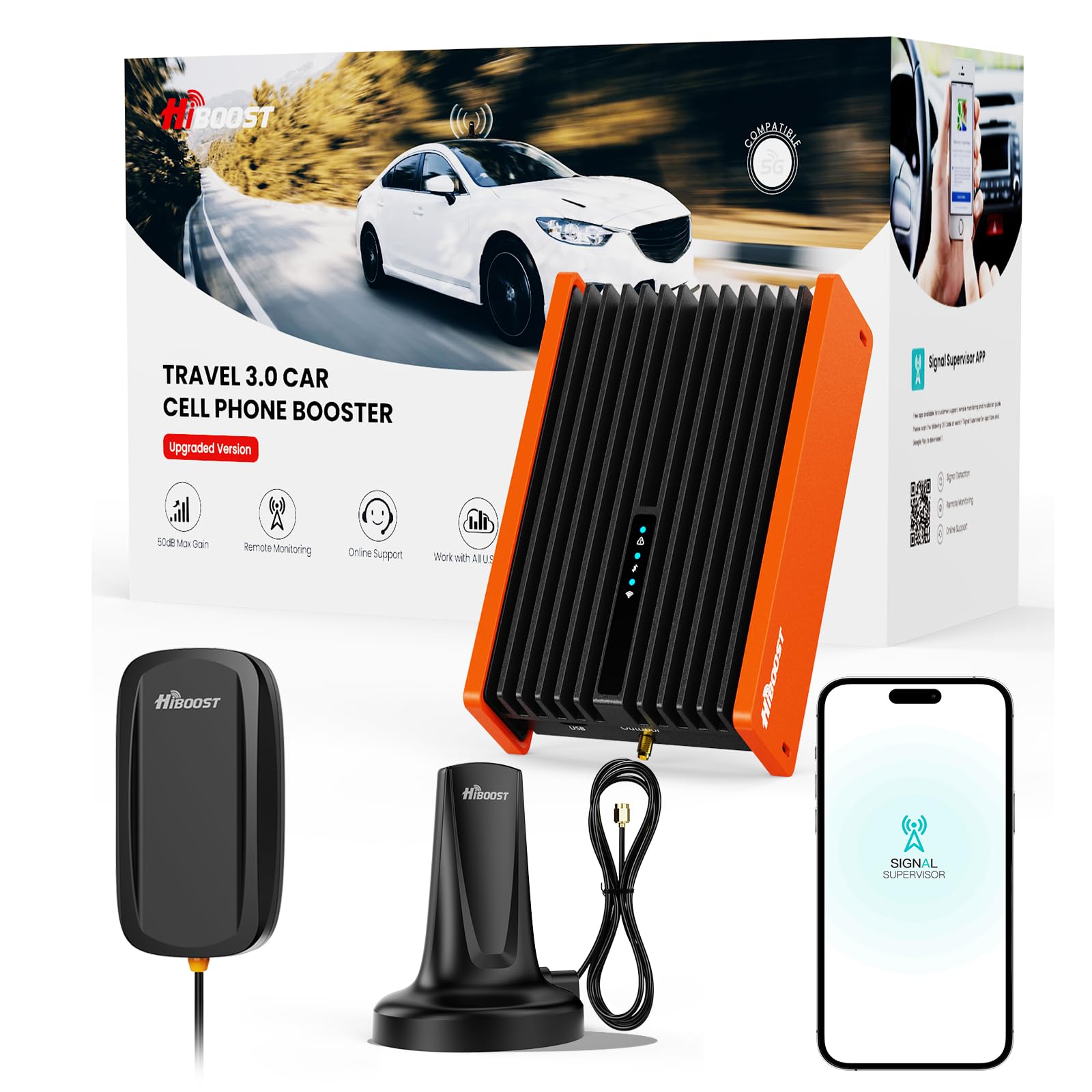
HiBoost takes a precision-first approach with the C30G-5S-BTW. The entire system uses 50-ohm RF connectors, which reduce signal transmission loss compared to cheaper connectors—a detail that matters when you’re working with a very weak incoming signal. The honeycomb-briquette heat sink design improves heat dissipation by about 30 percent, allowing the booster to maintain consistent output during long summer drives without thermal throttling.
The magnetic roof antenna is dustproof, oilproof, and waterproof, with a strong magnet that holds securely through potholes and high-speed corners. The indoor antenna cable runs 9.84 feet, while the outside cable is 13.12 feet—long enough for most SUVs and pickup trucks to achieve the necessary antenna separation. The companion app “Signal Supervisor” helps you find the optimal placement for both antennas in real time, which is a huge time saver. Users report boosting weak signals (2 bars or less) to 4 or more bars, even with 5G ultra capacity on T-Mobile.
On the downside, the power cord is slightly short for full-size trucks with wide dashboards, and the premium build quality comes with a matching premium price. But for SUV owners who want maximum performance and the reassurance of a 3-year warranty backed by responsive customer support, this booster delivers. It works with all major U.S. carriers and handles bands 12/17, 13, 5, 4, and 2/25.
Why it’s great
- 50-ohm precision connectors reduce signal loss before amplification
- Honeycomb heat dissipation keeps performance stable in heat
- App-guided installation simplifies antenna placement
Good to know
- Power cord could be longer for full-size truck cabins
- Premium pricing places it at the high end of the market
3. Atcall SF-Truck Cell Booster
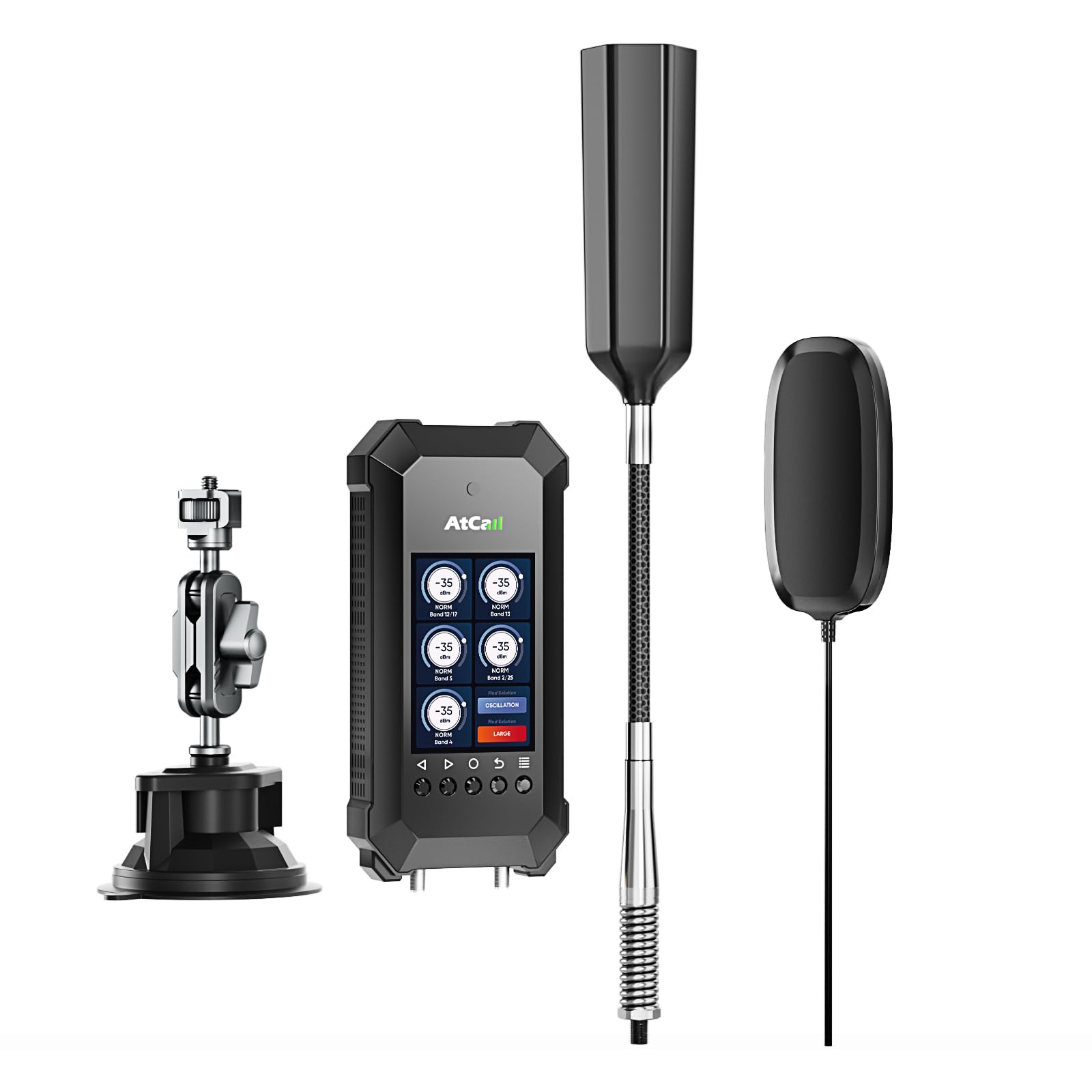
The Atcall SF-Truck was designed specifically for semi-truck cabins. The smart LCD monitor displays real-time signal strength and working status across five frequency bands (12/17, 13, 5, 2/25, and 4), which helps you troubleshoot installation and confirm the booster is pulling in usable signal. The included mounting brackets allow you to attach the main unit directly to the center console—no more shoving the booster under a seat where it overheats or gets kicked.
At 50 dB max gain, this booster is calibrated for the metal-rich environment of a truck cab, where signal penetration is naturally worse. The upgraded omnidirectional antenna is weather-resistant, shockproof, and rustproof, with a streamlined profile that reduces wind noise. Installation is DIY-friendly, with all accessories included, and most users complete the setup in under an hour. Customer feedback from remote areas like Alaska confirms that the SF-Truck boosts intermittent signals—those that flicker between 0 and 1 bars—into usable service.
The unit does require at least a whisper of signal to work; it cannot create service in a true dead zone. Some users noted that hills and mountains still block the signal, which is a physical limitation of all mobile boosters. The 3-year warranty and responsive customer support give peace of mind. For truckers who want a dedicated, console-mount solution with live status feedback, the Atcall SF-Truck is a smart professional tool.
Why it’s great
- LCD display shows real-time gain per band for easy troubleshooting
- Two mounting brackets designed for center-console installation
- Weather-resistant antenna built for long-haul exposure
Good to know
- Cannot create signal where none exists—requires at least a faint signal
- Mountains and hills can still block the amplified signal
4. Metarepeater MB1 Car Booster
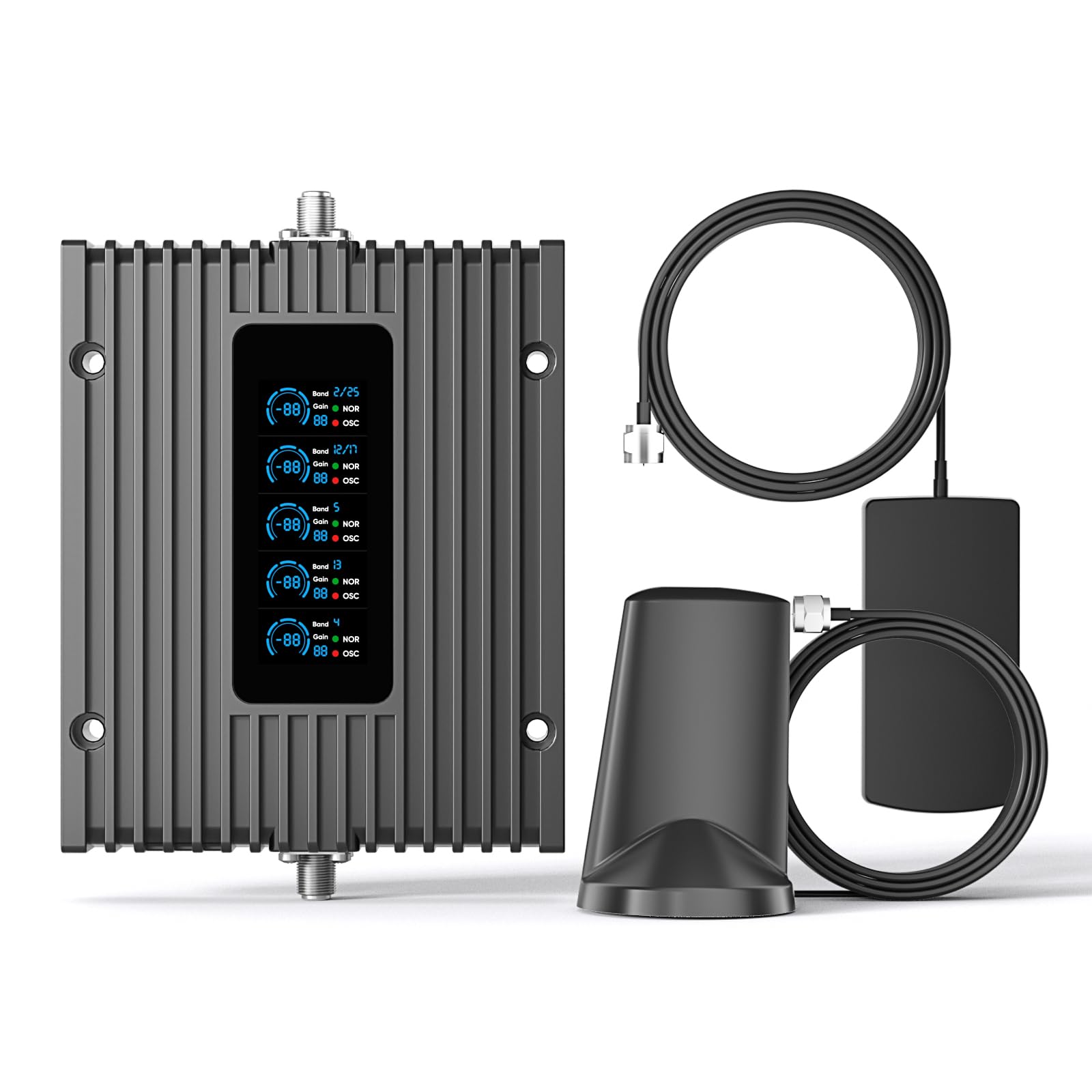
The Metarepeater MB1 brings a large color LCD display to the car booster category, showing the gain of each of the five supported frequency bands in real time. That visibility makes it easier to assess signal conditions as you drive through different terrain. The 360-degree omnidirectional outdoor antenna picks up signals from all directions, so you never have to aim or adjust it when you change direction on a winding road.
The set supports Band 12/17, 13, 5, 2/25, and 4, covering the dominant frequencies for Verizon, AT&T, and T-Mobile. The kit requires no drilling—the magnetic antenna mounts on the roof, and the indoor antenna (a compact patch unit with 10 feet of cable) can be tucked into a rear cubbyhole or under a seat. Users report gaining 1–2 bars in areas that previously had half a bar or no detectable signal, and the automatic gain control prevents oscillation as signal conditions change.
Several customers noted that the cables for the external antenna, internal antenna, and 12-volt power adapter are on the shorter side, which can limit mounting options in larger vehicles like full-size SUVs. The outdoor antenna’s paint protection could also be more durable. Even so, for family trips where multiple passengers need stable connectivity for navigation and entertainment, the MB1 offers a solid mid-range solution with a helpful display.
Why it’s great
- Color LCD shows gain per band for real-time signal monitoring
- 360° omni antenna works without aiming, ideal for driving
- No-drill magnetic installation keeps the vehicle intact
Good to know
- Cables are shorter than ideal, limiting placement flexibility
- Outdoor antenna paint protection could be more durable
5. GAGBK 6-Band Vehicle Booster
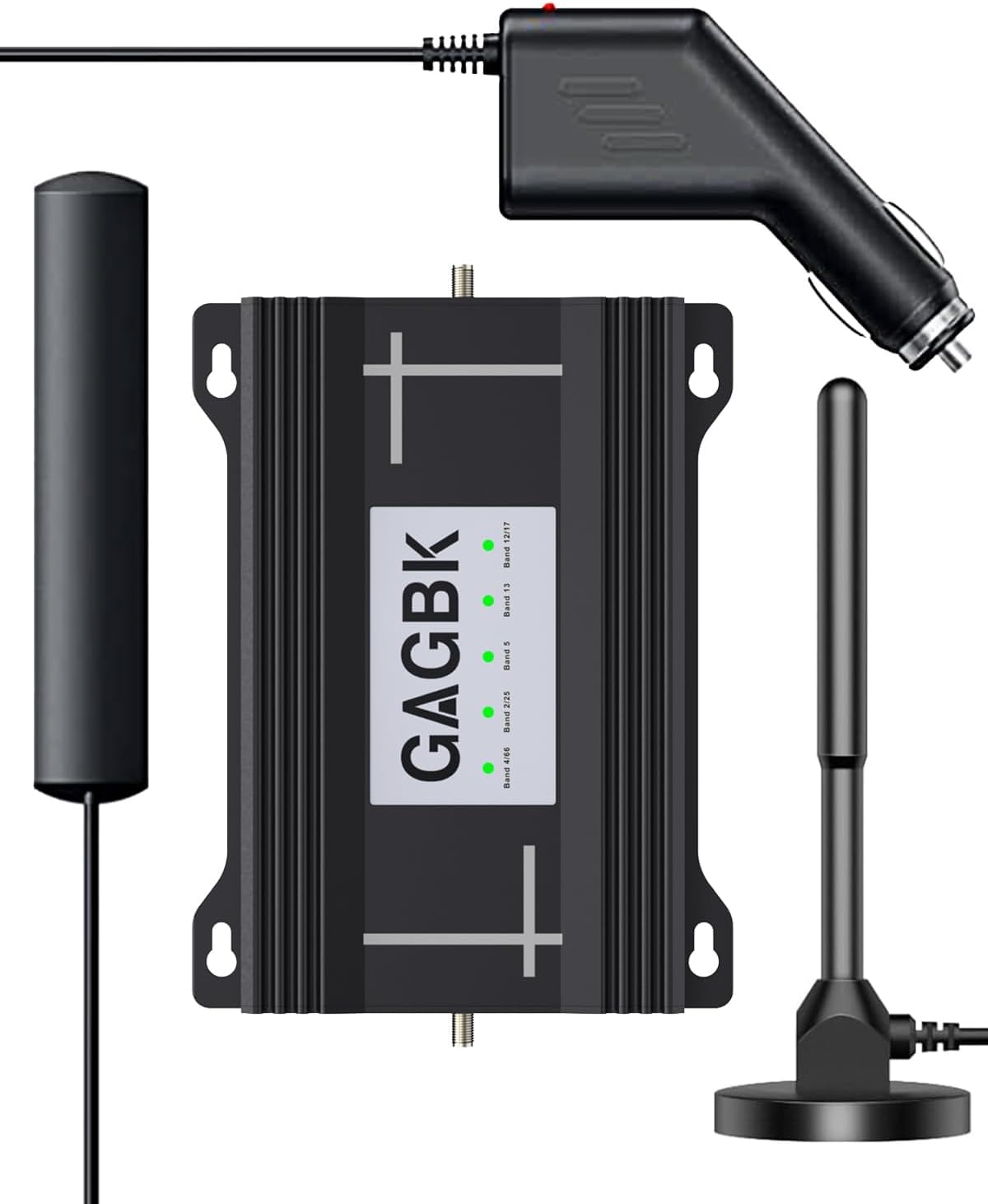
The GAGBK 6-Band Vehicle Booster stands out for its extended band support, covering 2, 4, 5, 12, 13, 17, 25, and 66. That broad frequency range makes it an excellent match for RV and overland travelers who may roam across multiple carrier territories and need a booster that works with whatever tower they encounter. The 65 dB gain is right in the sweet spot for vehicle use—strong enough to amplify a faint signal without creating oscillation issues.
The kit includes a 12V 3A power adapter, an indoor patch antenna with a 10-foot cable, and an outdoor magnetic whip antenna with a 16-foot cable. The extra cable length on the outdoor antenna helps achieve the separation needed to avoid feedback in larger vehicles like RVs or camper vans. The aluminum alloy housing provides better heat dissipation than plastic-bodied competitors. Users report boosting signals from 0–1 bars to a stable 3–4 bars, enabling clear calls and usable data for streaming and navigation.
Some customer feedback indicated that the antenna must be positioned close to the phone for maximum effect, and a few users returned the unit because it didn’t create signal in areas with absolutely zero carrier coverage—a limitation of all signal boosters, not just this model. The 30-day money-back guarantee and 3-year manufacturer warranty provide safety. This is a strong mid-range pick for travelers who want broad carrier compatibility without jumping to a premium price bracket.
Why it’s great
- Broad band support (2/4/5/12/13/17/25/66) fits most carriers
- 16-foot outdoor cable helps achieve proper antenna separation
- Aluminum housing improves heat dissipation for sustained use
Good to know
- Requires some signal to amplify; won’t work in absolute dead zones
- Maximum benefit may require phone close to indoor antenna
6. ZORIDA Ace 5S

The ZORIDA Ace 5S packs a 72 dB max gain in a compact package, making it one of the highest gain options in the mid-range tier. That extra amplification can make the difference in marginal areas where a lower-gain booster barely registers. It supports band 12/17, 13, 5, 4, and 2/25, covering all major U.S. carriers including Verizon, AT&T, and T-Mobile, and it works with 5G signals delivered on those existing 4G bands.
The indoor antenna is a compact whip that can be attached directly to the booster or placed on a wall, which is ideal for smaller vehicles where space is tight. The outdoor directional antenna includes a long 49.2-foot cable—far more than needed for most cars, but useful if you need to run the cable around an RV or large van. The ZORIDA app provides 1-on-1 technical support and guides you through placement with step-by-step videos and signal data feedback. Customer reviews highlight exceptional support from a representative named Noah who helped troubleshoot and optimize installations.
Coverage is rated up to 2000 square feet, though in a vehicle the effective area is limited to the cabin itself. Some users reported that the initial hardware revision shipped was incorrect, requiring a replacement. The directional antenna also means you may need to aim it carefully at the nearest tower for best results, which is less convenient for a moving vehicle. Despite these quirks, the combination of high gain and responsive app-based support makes this a compelling value for the price-conscious driver.
Why it’s great
- 72 dB max gain for excellent weak-signal amplification
- App-assisted setup with live signal data and video guides
- 49.2-foot outdoor cable provides flexible installation routing
Good to know
- Directional antenna requires aiming at the cell tower for best results
- Some users received wrong hardware revision initially
7. GAGBK Band 12/17 Car Booster

The GAGBK Band 12/17 Car Booster is the most accessible entry point into vehicle signal boosting. It focuses specifically on bands 12, 13, and 17 (700 MHz), which are the primary coverage bands for Verizon, AT&T, and T-Mobile. If your phone uses those frequencies—and most modern smartphones do—this unit can lift a weak 1-bar signal into a functional connection. The 65 dB automatic gain control adjusts amplification in real time to prevent self-oscillation.
The kit includes a magnetic whip antenna for the roof, an inside patch antenna with a 10-foot cable, and a 12-volt power adapter. Installation takes about 10–20 minutes and requires no drilling. The aluminum alloy body handles heat well, and the sleep mode feature reduces power draw when the booster isn’t actively amplifying—helpful for preserving the car battery during long stops. A single LED indicator shows connection status at a glance.
The band-limited design means it won’t help with Band 4 (1700/2100 MHz) or Band 2 (1900 MHz), which are used for capacity and 5G in many areas. Some customers reported the unit failing after a few months, and the limited band support can be a dealbreaker in regions where carriers rely more heavily on higher-frequency bands. Still, for the budget-minded driver who mostly travels through areas with decent 700 MHz coverage and just needs a boost on key road trips, this is a functional, low-risk starter.
Why it’s great
- Very accessible entry price for first-time booster buyers
- Simple 10-20 minute no-drill installation
- Sleep mode protects car battery when not in use
Good to know
- Only covers band 12/13/17—no Band 4 or Band 2 support
- Some reports of unit failure after 3 months
FAQ
Will a car signal booster work if there is absolutely no signal outside?
How critical is antenna separation for a car booster?
Does a car booster work with 5G?
Can I use a home signal booster in my car?
Final Thoughts: The Verdict
For most users, the cell signal booster for car winner is the weBoost Drive 4G-X OTR because its oversized antenna and proven multi-user support deliver the most reliable performance in the widest range of driving conditions. If you want the easiest installation with precision-grade connectors and app-guided placement, grab the HiBoost C30G-5S-BTW. And for truckers who need a dedicated console-mounted solution with a live LCD status display, nothing beats the Atcall SF-Truck.

Mo Maruf
I created WellFizz to bridge the gap between vague wellness advice and actionable solutions. My mission is simple: to decode the research and give you practical tools you can actually use.
Beyond the data, I am a passionate traveler. I believe that stepping away from the screen to explore new environments is essential for mental clarity and physical vitality.