Our readers keep the lights on and my smoothie glass nicely filled. As an Amazon Associate, I earn from qualifying purchases.
Buying a drone under a hundred bucks walks a tight line between pure novelty and real flight capability. The market is flooded with mini quadcopters that promise impressive range and high-definition footage, but most leave you fighting constant drift, short battery windows, and shaky video feeds. Knowing which compromises actually matter — and which features deliver a genuinely fun flying experience for kids or adults — makes the difference between a shelf decoration and a toy you actually want to recharge.
I’m Mohammad Maruf — the founder and writer behind WellFizz. I spent extensive hours combing through tech sheets, consumer feedback threads, and real flight footage analysis to isolate what separates a frustrating launch from a satisfying hover in the entry-level drone space.
This guide distills the essential specs and real-world performance data to help you confidently pick the right drone below $100 for your skill level and expectations.
How To Choose The Best Drone Below $100
The budget drone market is a minefield of inflated marketing claims. Core components like the motor type, stabilisation method, and camera sensor quality are the real deciding factors — not vague promises about 4K footage or extreme flight range. Knowing what each spec actually means in practice prevents a disappointing first flight.
Motor Type: Brushed vs. Brushless
Brushed motors are the default in toy-grade drones. They wear out after roughly 40-60 total flight hours and offer less torque, meaning they struggle against even a light breeze. Brushless motors, typically found in the upper tier of budget models, run cooler, last significantly longer, and provide consistent thrust for stable hovering. If your flying environment includes any outdoor space, prioritize a brushless chassis.
Flight Stabilisation: Altitude Hold and Optical Flow
Altitude hold uses a barometric sensor to maintain a fixed height, freeing the pilot from constant throttle adjustment. Optical flow adds a downward-facing camera that tracks surface movement, locking the drone’s horizontal position. Without both features, a budget drone will drift continuously, requiring micro-corrections every second — frustrating for beginners and kids.
Quick Comparison
On smaller screens, swipe sideways to see the full table.
| Model | Category | Best For | Key Spec | Amazon |
|---|---|---|---|---|
| PLEGBLE PL515 | Brushless | Outdoor stable flight | 32 min flight time (2× 1500mAh) | Amazon |
| RELIDOL PK01 | Screen Controller | Controller screen + brushless | 25 min flight time (2 batteries) | Amazon |
| FLYVISTA Shark | Toy-Grade | Kids beginners indoors | 2× 1800mAh batteries / 20 min | Amazon |
| Pallton X80 | Foldable | Crash-resilient indoor/outdoor | 24 min flight time (2 batteries) | Amazon |
| SYMA X100 | Obstacle Avoidance | Indoor kid-safe play | 20 min flight time (2× 700mAh) | Amazon |
In‑Depth Reviews
1. PLEGBLE PL515

The PL515 is the rare budget drone that actually earns its 4K camera claim. It uses a brushless motor system paired with a shock-absorbing mount to deliver genuinely stable aerial footage at 3840 x 2160. The 130-degree adjustable lens captures a wide field that most toy drones crop out, and the image stabilisation smooths the micro-vibrations that typically ruin underwater or soft footage at this price tier.
Flight endurance sits at an impressive 32 minutes across two 1500mAh LiPo batteries, which in real terms translates to roughly 14-15 minutes of active flying per battery — enough for a full park session. The child-lock safety start requires pulling down the outer eight-shaped stick, preventing accidental mid-air starts. Weighing under 250 grams, it needs no FAA or Remote ID registration, so you can launch immediately without paperwork.
Voice and gesture control add a layer of fun for casual users, and the foldable body fits into the included handbag for portability. Some users report the battery indicator can be inconsistent, and the WiFi range drops noticeably beyond 40 meters, but for structured indoor or low-wind outdoor flying, this drone delivers far above its price bracket.
Why it’s great
- Brushless motors provide stable flight and longer motor life
- True 4K footage with shock-absorbing camera mount
- Ultra-light design avoids FAA registration requirements
Good to know
- WiFi transmission becomes jittery beyond 40 meters
- Battery indicator can be inconsistent during flight
2. RELIDOL PK01
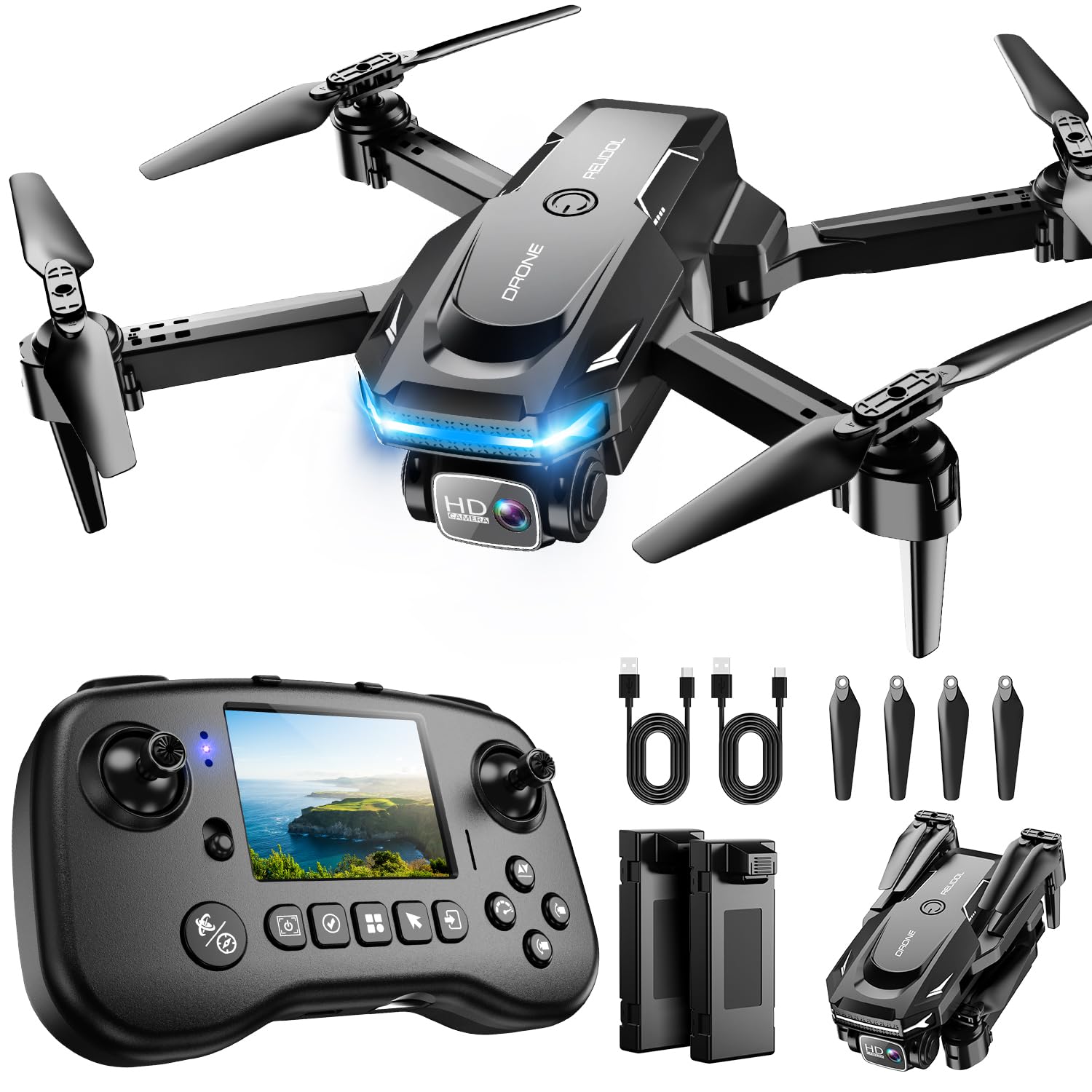
The PK01 solves the biggest frustration with entry-level FPV drones: needing a phone. Its controller features a built-in screen that displays live HD footage and flight telemetry, removing the hassle of app connections and phone mounts. An SD card slot records directly, though the memory card is sold separately.
Power comes from brushless motors, giving this drone noticeably better wind resistance than brushed alternatives at similar prices. The two included batteries deliver a combined 25 minutes of flight time, and USB-C charging is a welcome convenience upgrade over the micro-USB found on cheaper models. Features like one-key takeoff, 360° flips, headless mode, and gesture photography make it approachable for complete beginners without feeling kiddy.
The app is optional for advanced functions like waypoint flight and gravity control, but most users will stick entirely to the remote screen. The maximum recommended distance of 30 meters keeps flights close, and the low-power alarm adds a safety net. Build quality feels more substantial than the plastic shell suggests, though the propeller guards are a must for indoor flying.
Why it’s great
- Built-in remote screen eliminates phone dependency
- Brushless motor provides smooth, stable thrust
- USB-C charging for both batteries and controller
Good to know
- Requires separate SD card for photo/video storage
- Flight range limited to 30 meters for reliable transmission
3. Pallton X80

The Pallton X80 earns its reputation through sheer durability. Multiple verified purchasers report crashing into trees and hard ground without functional damage, thanks to the high-toughness plastic chassis and full propeller guard set. For absolute beginners and kids aged 8-12 who treat flying as a contact sport, this resilience is the most important spec in the listing.
The 1080P HD camera with FPV live feed to your phone is serviceable for casual backyard recordings, though it lacks the stabilisation found on the brushless models. Gesture selfie and gravity control are fun bonuses, and the 3-speed adjustment lets pilots graduate from slow indoor cruising to faster outdoor passes. Two modular batteries deliver a combined 24 minutes of flight time, which in practical terms means about 10-11 minutes per charge.
Altitude hold works reliably indoors, reducing the constant adjustments needed on simpler models. The foldable arms and included carrying case make it genuinely portable — fitting easily into a daypack. The main trade-off is the brushed motor system, which will degrade over time, but at this entry price point, the durability and easy replacements make it a logical choice for high-impact learning.
Why it’s great
- Exceptionally durable frame survives repeated crashes
- Full propeller guards protect blades and surroundings
- Gravity control and 3D flips add variety to each flight
Good to know
- Brushed motors limit lifespan and wind performance
- Camera video stabilization is minimal
4. SYMA X100

The SYMA X100 is purpose-built for indoor use with young pilots. Its standout feature is the 4-way infrared obstacle detection system that auto-avoids walls and furniture within about 12 inches. This doesn’t make the drone invincible — fast charging into a corner still results in contact — but it dramatically reduces the panic of a first-time flyer steering straight into a lamp.
The fully enclosed propeller guard leaves no spinning blade exposed, meeting the highest safety standard for toy drones. The ABS body is crack-resistant, and the 180-degree flip-to-stop mechanism cuts power instantly on impact. Two 700mAh batteries provide around 20 minutes of total flight time, though each individual flight lasts closer to 8-9 minutes depending on stunt usage. One-key takeoff, altitude hold, and two speed modes make the learning curve extremely gentle.
Headless mode eliminates orientation confusion, meaning whichever direction the drone faces, pushing forward always moves it away from the pilot. The 360° flips are fun for mini competitions but do drain battery faster. This drone does not have a camera, so it’s purely about flight skill rather than footage. Outdoor use is possible only in dead calm; any breeze blows the lightweight frame off course.
Why it’s great
- Infrared obstacle avoidance reduces indoor crashes
- Full protective cage prevents blade contact with skin
- Altitude hold makes hovering effortless for kids
Good to know
- No camera — flight skills only, no footage capture
- Very sensitive to outdoor wind despite stability features
5. FLYVISTA Cool Mini Drone
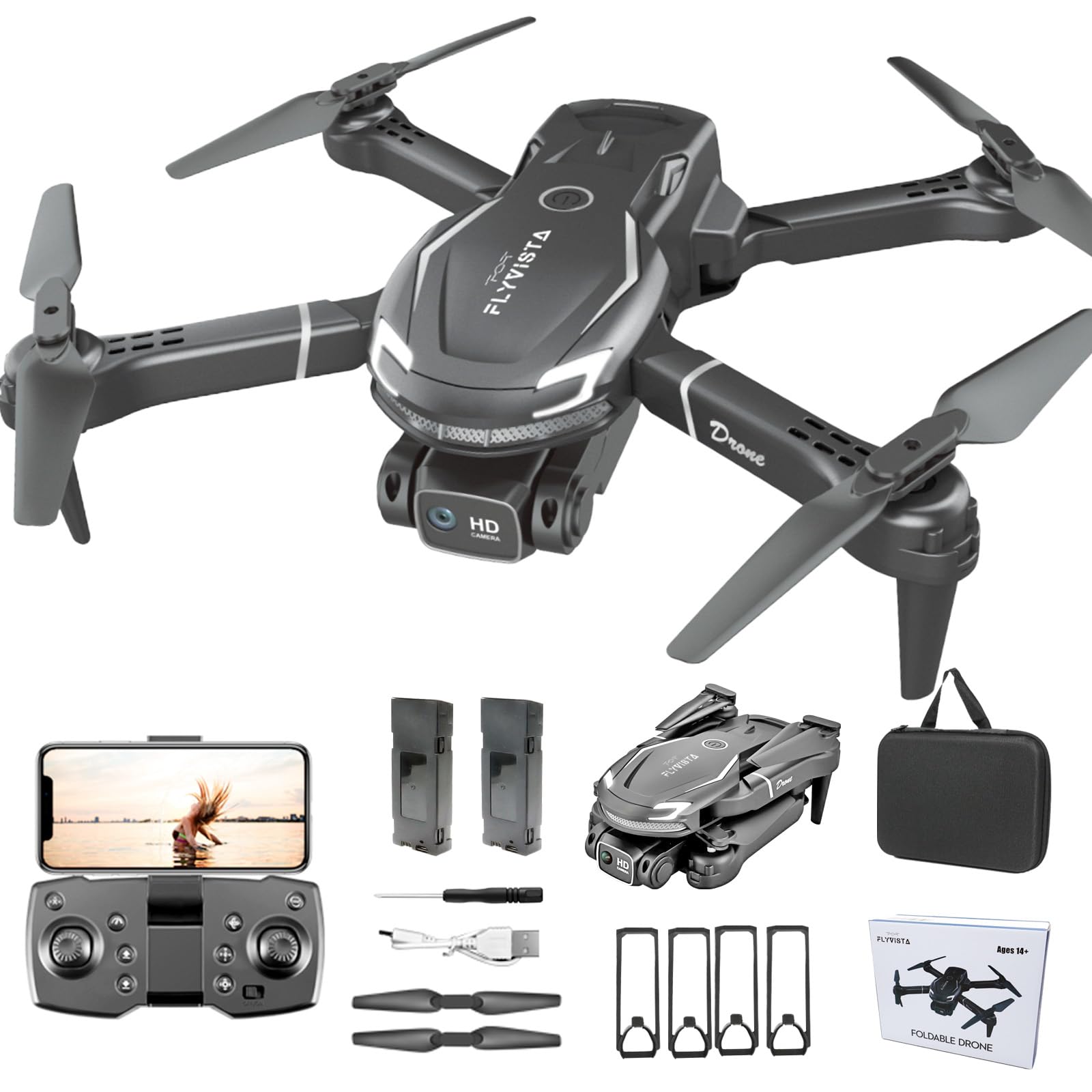
The FLYVISTA shark-shaped drone is the most affordable option here, and it packs a surprising amount of tech for the price. The optical flow positioning — a downward-facing camera that tracks ground movement — provides a stable hover that usually costs more to implement. Combined with altitude hold, this drone stays put in a way most competitors at this price point cannot match.
The 1080P camera is manually adjustable 90 degrees and supports FPV feed to your phone. The image quality is ordinary — soft and prone to motion blur — but adequate for social media clips of low-altitude park flights. Two 1800mAh batteries deliver a total of 20 minutes in the air, though aggressive flips and altitude changes cut into that window. The 360° flips, headless mode, and emergency stop cover all the basic safety and fun bases.
Build quality is where budget shows. Several users report drifting issues even indoors with no wind, and the brushed motors lack the torque to push back against any breeze. The controller connection can drop at moderate distances, and battery life per individual flight sits closer to 8 minutes. For a first drone for a young child flying exclusively inside a large room, the low risk and low price make sense. Outdoor flight expectations should be managed carefully.
Why it’s great
- Optical flow positioning for stable indoor hovering
- Aggressive price point for a camera-equipped drone
- Two high-capacity 1800mAh batteries included
Good to know
- Inconsistent drift reported even in indoor conditions
- Camera quality is soft and prone to motion blur
FAQ
Do drones under $100 need FAA registration?
Why does my budget drone drift even with altitude hold on?
Can I use a drone below $100 reliably outdoors?
Final Thoughts: The Verdict
For most users, the drone below $100 winner is the PLEGBLE PL515 because its brushless motor system and genuine 4K stabilised camera deliver performance that surpasses its price tier in wind resistance and footage quality. If you want a remote with a built-in screen and brushless power, grab the RELIDOL PK01. And for the most durable crash-resilient option that survives aggressive learning, nothing beats the Pallton X80.

Mo Maruf
I created WellFizz to bridge the gap between vague wellness advice and actionable solutions. My mission is simple: to decode the research and give you practical tools you can actually use.
Beyond the data, I am a passionate traveler. I believe that stepping away from the screen to explore new environments is essential for mental clarity and physical vitality.