Our readers keep the lights on and my smoothie glass nicely filled. As an Amazon Associate, I earn from qualifying purchases.
The gap between a good aerial still and a billboard-worthy commercial asset is defined by sensor size, dynamic range, and the gimbal’s ability to hold a horizon steady through a banking turn. For professional photographers, a drone is not a toy—it is a mobile camera platform that must deliver raw files with enough latitude to survive a heavy color grade. Choosing the wrong platform means baked-in noise, clipped highlights, or hours of wasted post-production trying to stabilize footage that should have been locked from the start.
I’m Mohammad Maruf — the founder and writer behind WellFizz. I’ve spent hundreds of hours dissecting sensor specs, flight controller algorithms, and gimbal mechanics across mid-range and flagship drones to identify the platforms that earn their place in a pro kit bag.
Whether you need a sub-250g waiver-friendly backup or a full-frame beast for cinema-level work, this guide cuts through the marketing noise to find the best drone for commercial photography that matches your actual shooting conditions and post-production pipeline.
How To Choose The Best Drone For Commercial Photography
Commercial aerial photography demands more than just a high megapixel count. You are shooting for clients who need images that print large, grade well, and deliver consistent color accuracy across a set. The drone is the foundation of that pipeline, so the decision rests on a few non-negotiable factors that separate a pro-grade tool from a consumer gadget.
Sensor and Lens Quality
The sensor is the heart of the camera. A 1-inch CMOS sensor (like the one in the DJI Air 3 or Autel EVO 2 Pro V3) offers a real step up in dynamic range and noise control compared to the smaller sensors found in entry-level models. For the absolute best latitude in post-production, look for a 4/3 CMOS sensor—such as the Hasselblad unit in the DJI Mavic 3 Pro and Mavic 4 Pro—which captures roughly four times the light area of a 1-inch sensor. Adjustable aperture also matters: being able to stop down to f/11 on a bright day without ND filters saves setup time on location.
Gimbal and Stabilization
A three-axis mechanical gimbal is not optional for commercial work. It isolates the camera from the drone’s motor vibrations and wind buffeting, producing footage that does not need warp stabilizer in post. Pay attention to gimbal rotation range—some models like the DJI Mini 5 Pro offer 225 degrees of roll rotation, which enables vertical and horizon-level shots without cropping the sensor. Electronic image stabilization (EIS) alone is insufficient for client work because it introduces a crop factor and can warp edges during fast panning.
Flight Time and Battery Ecosystem
On a commercial shoot, every battery swap costs time and risks missing the golden-hour light. Look for a platform that offers at least 35 minutes of real-world flight time per battery—not the hover-in-a-lab number. The best setups come with a multi-battery charging hub that can charge three packs sequentially or in parallel. For example, the DJI Mini 5 Pro Fly More Combo includes three Intelligent Flight Batteries that deliver up to 52 minutes each in ideal conditions, and the hub charges all three in about 193 minutes.
Obstacle Avoidance and Flight Safety
Professional photography often involves flying near buildings, bridges, or dense tree lines. Omnidirectional obstacle sensing—using a combination of forward, backward, downward, and lateral sensors—is a must. The best systems (like DJI’s Nightscape LiDAR on the Mini 5 Pro and Mavic 4 Pro) can detect obstacles in low light, which is critical for dawn and dusk shoots. Without reliable obstacle avoidance, a single collision can destroy the gimbal and sensor, putting the drone out of commission for weeks.
Video Transmission and Remote Control
For framing shots precisely, you need a low-latency, high-resolution video feed to your controller. Look for OcuSync or SkyLink systems that support 1080p/60fps live feeds and a range of at least 15 kilometers. A built-in screen on the remote (like the DJI RC 2 or the Autel Smart Controller SE) eliminates the need to connect your phone and saves setup time, especially in bright sunlight where phone screens become unreadable.
Quick Comparison
On smaller screens, swipe sideways to see the full table.
| Model | Category | Best For | Key Spec | Amazon |
|---|---|---|---|---|
| DJI Mavic 4 Pro | Flagship | High-end cinema & print | 100MP 4/3 CMOS Hasselblad | Amazon |
| DJI Mavic 3 Pro | Flagship | Triple-camera versatility | 4/3 CMOS Hasselblad, 20 MP | Amazon |
| Autel EVO 2 Pro V3 | Professional | Low-light & night photography | 1-inch CMOS, 6K HDR, ISO 44000 | Amazon |
| DJI Air 3 | Mid-Range | Travel & dual-camera work | Dual 48MP cameras, 46-min flight | Amazon |
| DJI Mavic 2 Pro | Premium | Hasselblad color science | 20MP 1-inch CMOS, adjustable aperture | Amazon |
| Antigravity A1-360 | Immersive | 360° VR capture & FPV | 8K 360° capture, 249g | Amazon |
| DJI Mini 5 Pro | Compact | Sub-250g pro-quality backup | 1-inch CMOS, 52-min flight | Amazon |
| DJI Mini 4 Pro (Kit) | Compact | Lightweight travel & vertical video | 4K/60fps HDR, under 249g | Amazon |
| DJI Mavic 2 Zoom | Legacy | Optical zoom inspection | 12MP, 2x optical zoom | Amazon |
| DJI Mini 4 Pro Fly More | Compact | All-around travel vlogging | 4K/60fps, omnidirectional sensing | Amazon |
| HOVERAir X1 PROMAX | Action | Active sports & FPV-like tracking | 8K@30fps, hands-free operation | Amazon |
| Bingchat Tablet Drone | Budget | Entry-level professional features | 4K HD, 84-min total flight | Amazon |
In‑Depth Reviews
1. DJI Mavic 4 Pro Fly More Combo

The Mavic 4 Pro sets a new benchmark for commercial aerial photography with its 100MP 4/3 CMOS Hasselblad main camera. That sensor size, combined with the 6K/60fps HDR video capability, provides enough resolution and dynamic range to crop into a 100MP still for billboard-level prints without losing detail. The 360-degree Infinity Gimbal allows for dynamic camera movement that was previously only possible with a separate gimbal operator on a rig.
The Nightscape Omnidirectional Obstacle Sensing system uses LiDAR and vision sensors that can detect obstacles down to 0.1 Lux, making pre-dawn and post-sunset shoots significantly safer. The 51-minute maximum flight time per battery means you can cover a large property or landscape without constant landings to swap packs, and the included parallel charging hub keeps three batteries cycling efficiently between flights.
The 30-kilometer O4+ video transmission system delivers a 10-bit HDR feed to the full-featured DJI RC 2 controller, so you can frame and expose shots with confidence even when the drone is a mile away. For commercial photographers who charge by the project, the Mavic 4 Pro reduces shoot time and increases usable frame count per flight.
Why it’s great
- 100MP files that print large with minimal interpolation
- Exceptional low-light obstacle avoidance for dawn/dusk work
- 51-minute flight time extends window for golden-hour coverage
Good to know
- Premium price reflects flagship component quality
- Requires FAA Remote ID compliance registration
- Charging hub needs a high-output USB-C power supply
2. DJI Mavic 3 Pro with RC

The Mavic 3 Pro brings a triple-camera system to the commercial pilot: a 4/3 CMOS Hasselblad main camera, a 1/1.3-inch Medium Tele camera (70mm equivalent), and a 1/2-inch Tele camera (166mm equivalent). This focal-length flexibility is invaluable for real estate and architectural photography, where you need both a wide establishing shot and a compressed perspective of a structure from a safe distance without moving the drone.
The 4/3 CMOS sensor captures RAW images with 12.8 stops of dynamic range, which handles the extreme contrast of a sunlit building against a shaded foreground. The adjustable aperture (f/2.8 to f/11) reduces the need for graduated ND filters in post. Omnidirectional obstacle sensing with APAS 5.0 lets you fly confidently through complex environments like construction sites or tree-lined properties.
Pro users will appreciate the 43-minute maximum flight time and O3+ video transmission that stays solid out to 15 kilometers. The three-camera system means you can deliver both wide panoramas and tight architectural details from a single flight pass, reducing overall project time and increasing the variety of usable frames per battery.
Why it’s great
- Triple focal lengths cover wide to tele in one flight
- 12.8-stop dynamic range handles high-contrast scenes
- Reliable 15km video transmission for large properties
Good to know
- Single battery included in base package; Fly More Combo recommended
- 70mm tele camera lacks adjustable aperture
- Controller screen brightness may struggle in direct sunlight
3. Autel EVO 2 Pro V3 Rugged Bundle
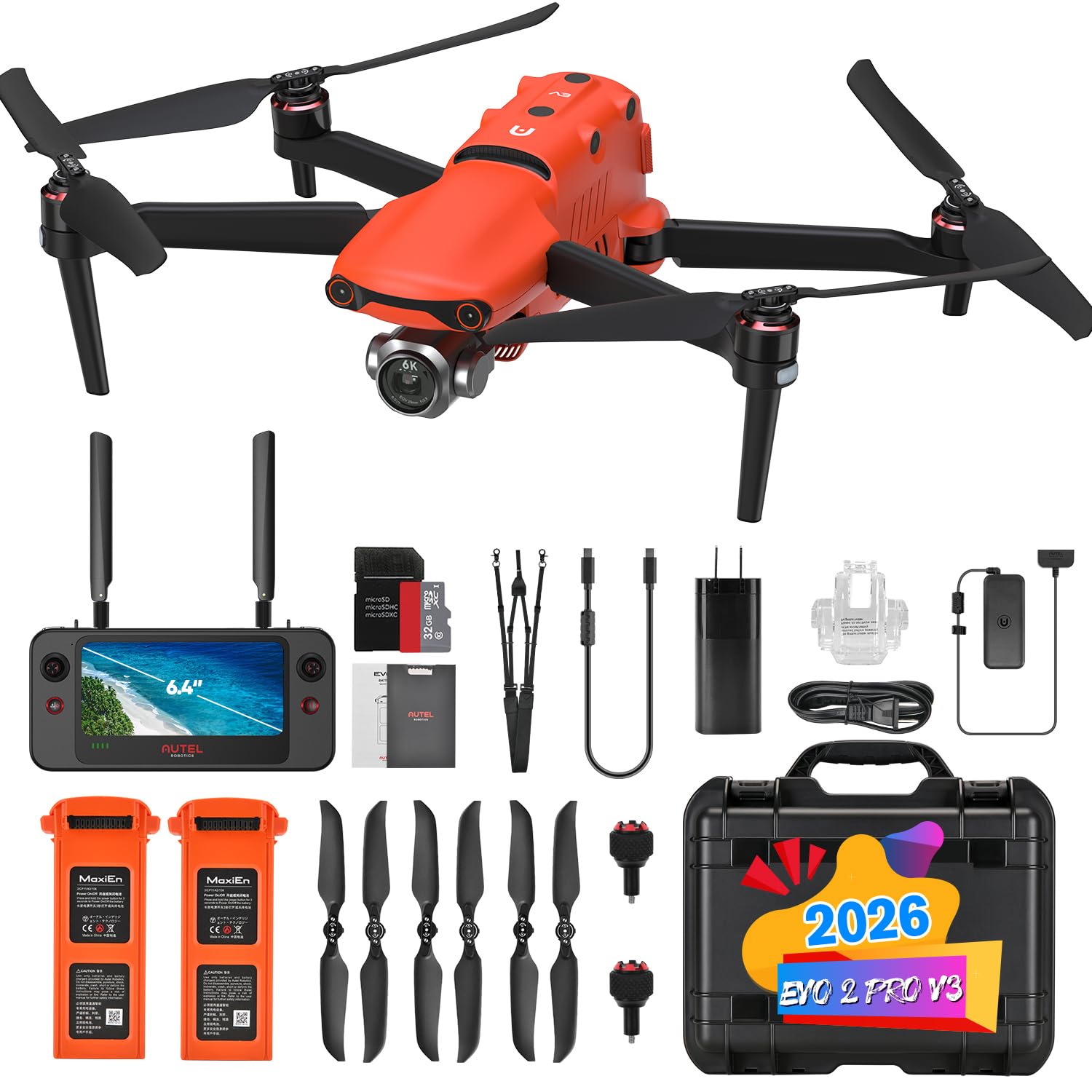
The Autel EVO 2 Pro V3 is engineered for challenging light conditions. Its 1-inch CMOS sensor, combined with the Moonlight Algorithm 2.0, pushes the ISO ceiling to 44000—an extreme range that allows you to shoot dawn cityscapes and dimly lit construction sites without the noise floor ruining the frame. The 12-bit DNG RAW capability captures 68.6 billion colors, giving a colorist or retoucher far more latitude than standard 10-bit files.
SkyLink 2.0 video transmission operates on three bands (2.4GHz, 5.8GHz, and 900MHz) and automatically frequency-hops to avoid interference in urban environments where Wi-Fi saturation can kill a feed. The Smart Controller SE features a 6.4-inch OLED display that remains readable in bright sun, and the IP43 rating means you can keep shooting through light rain or mist without sheltering the controller.
The rugged bundle includes three batteries (40 minutes each), a hard protective case, and the full Autel USA warranty. Commercial operators who need 6K resolution for cropping flexibility and who work in variable weather will find the V3 platform a reliable, geofence-free alternative to the DJI ecosystem.
Why it’s great
- ISO 44000 enables usable night photography
- Tri-band transmission resists urban interference
- IP43-rated controller works in light rain
Good to know
- Obstacle sensors do not detect thin wires
- Charging may require power-cycling to initiate
- Firmware updates less frequent than DJI’s schedule
4. DJI Air 3 Fly More Combo
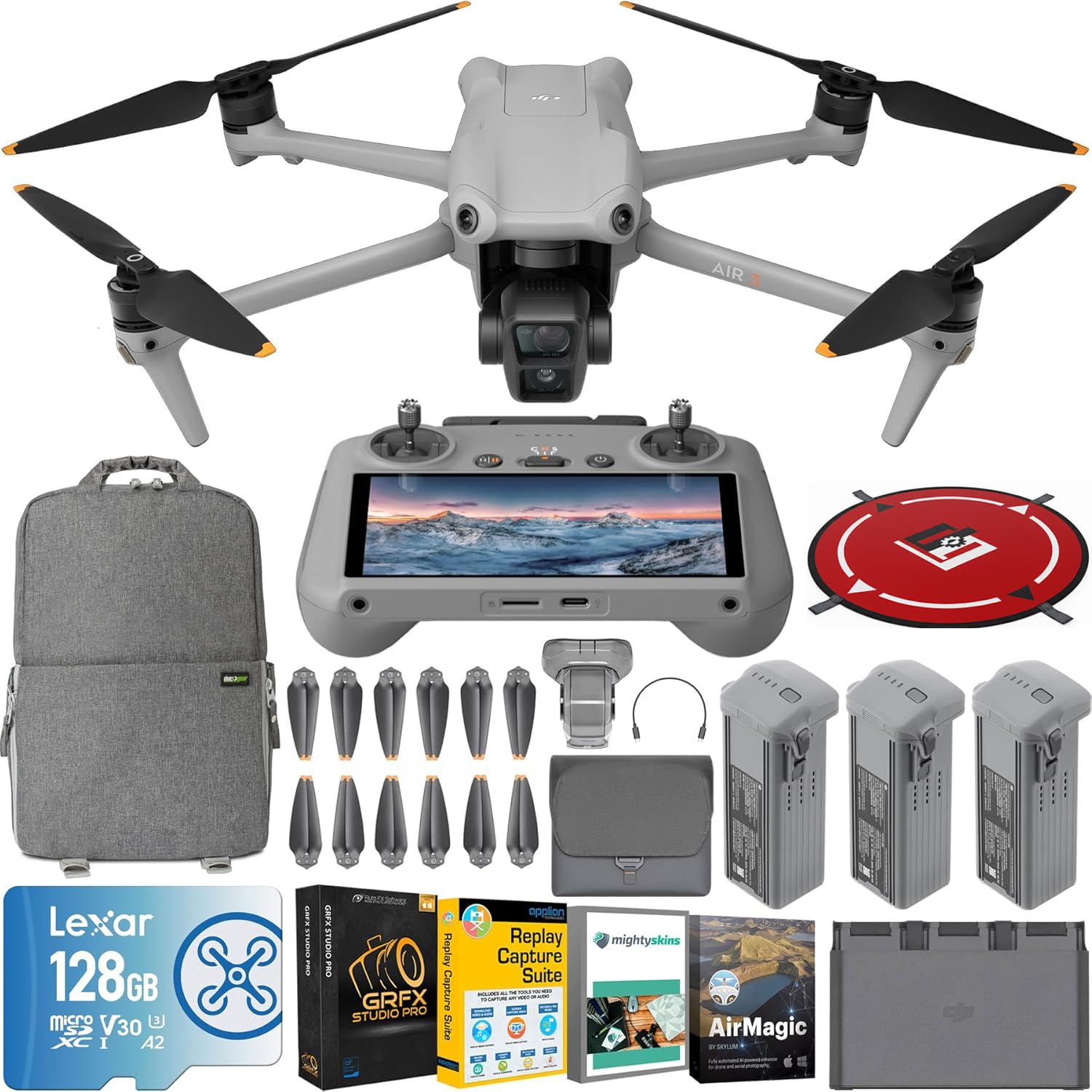
The DJI Air 3 delivers a dual-primary-camera system—a 24mm wide-angle and a 70mm medium telephoto—both capturing 48MP stills and 4K/60fps HDR video. This is a compact, mid-weight platform that balances portability with professional-grade output. The 70mm lens provides natural compression for isolating architectural details or compressing a landscape, while the 24mm lens captures the full scene.
With 46 minutes of maximum flight time and omnidirectional obstacle sensing, the Air 3 can handle a full multi-location real estate shoot on a single set of three batteries from the Fly More Combo. The O4 HD video transmission delivers a stable 1080p/60fps live feed up to 20 kilometers, which is more than sufficient for most commercial applications within line-of-sight regulations.
The included Deco Gear accessories (backpack, landing pad, 128GB SD card, and software bundle) add value for a traveling professional who needs a ready-to-go kit. The dual-camera setup allows you to shoot both establishing wide shots and compressed detail frames without swapping aircraft or lenses mid-session.
Why it’s great
- Dual 48MP cameras cover wide and tele perspectives
- 46-minute flight time per battery is best-in-class for this weight
- Omnidirectional sensing adds confidence near structures
Good to know
- Software bundle activation codes may need follow-up with seller
- No internal charger included; requires a 100W USB-C PD supply
- Backpack is generic rather than drone-molded
5. DJI Mavic 2 Pro

The Mavic 2 Pro remains a relevant tool for commercial photographers who prioritize color science above all else. Its Hasselblad L1D-20c camera uses a 20MP 1-inch CMOS sensor, and the Hasselblad Natural Color Solution (HNCS) produces straight-out-of-camera JPEGs and DNG RAW files with consistent, filmic tones that require minimal post-adjustment. The adjustable aperture (f/2.8 to f/11) offers creative control over depth of field and exposure without relying entirely on ND filters.
The three-axis gimbal holds steady even in moderate wind, and the ActiveTrack 2.0 system can track subjects while maintaining the composition—useful for cinematic reveals of a property or tracking a vehicle through a landscape. Omnidirectional obstacle sensing provides a safety net when flying through tight spaces like a construction site or a forest clearing.
While the flight time of 31 minutes is shorter than newer models, the Mavic 2 Pro’s build quality and proven reliability make it a strong candidate for a backup rig or a budget-friendly entry into Hasselblad-grade aerial imaging. The 8GB internal storage plus SD card support up to 128GB is adequate for a day of shooting RAW+JPEG pairs.
Why it’s great
- Hasselblad HNCS delivers natural, consistent color
- Adjustable aperture for exposure control in bright conditions
- Proven reliability and extensive third-party accessory ecosystem
Good to know
- 31-minute flight time is shorter than mid-range current models
- Software compatibility may require older DJI GO 4 app versions
- No internal fan; risk of overheating if used intensively in direct sun
6. Antigravity A1-360
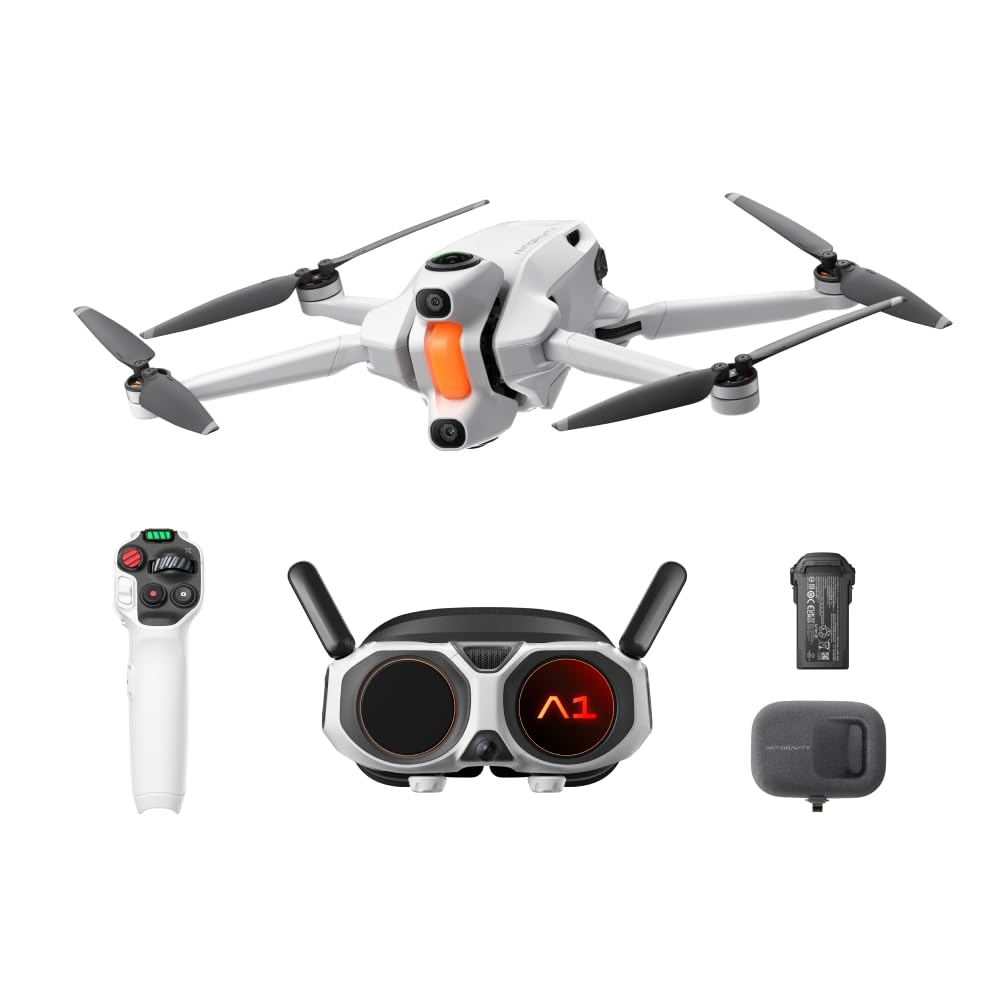
The Antigravity A1-360 is the world’s first drone to combine 8K 360-degree spherical capture with an immersive FPV goggle system. For commercial photographers who produce virtual tours, event coverage, or creative brand content, the ability to capture every angle in a single pass and then reframe in post is a workflow revolution. The dual 1-inch Micro-OLED goggles offer a 90-degree field of view, which is 66 percent wider than typical FPV goggles, providing a true first-person perspective.
The drone weighs under 249 grams with the standard battery, which means it avoids many FAA registration requirements in the United States. The High-Capacity Battery extends flight time to 39 minutes for longer shoots. The FreeMotion Mode lets beginners operate by pointing where they want the drone to go, while FPV Mode gives experienced pilots full directional control.
The Auto Editing 2.0 feature automatically reframes the 360-degree footage with cinematic maneuvers and dynamic angles—useful for clients who want a ready-to-share highlight reel without spending hours in Premiere Pro. For commercial work, the ability to deliver both a traditional flat edit and a full 360 VR experience from the same flight is a differentiator.
Why it’s great
- 8K 360 spherical capture reframes in post, no second flight needed
- Sub-250g with standard battery simplifies regulations
- Immersive goggles and motion controller offer intuitive operation
Good to know
- Premium price reflects unique 360 + goggle system
- Standard battery limits flight time to ~25 minutes
- 360 workflow requires post-processing software investment
7. DJI Mini 5 Pro Fly More Combo Plus
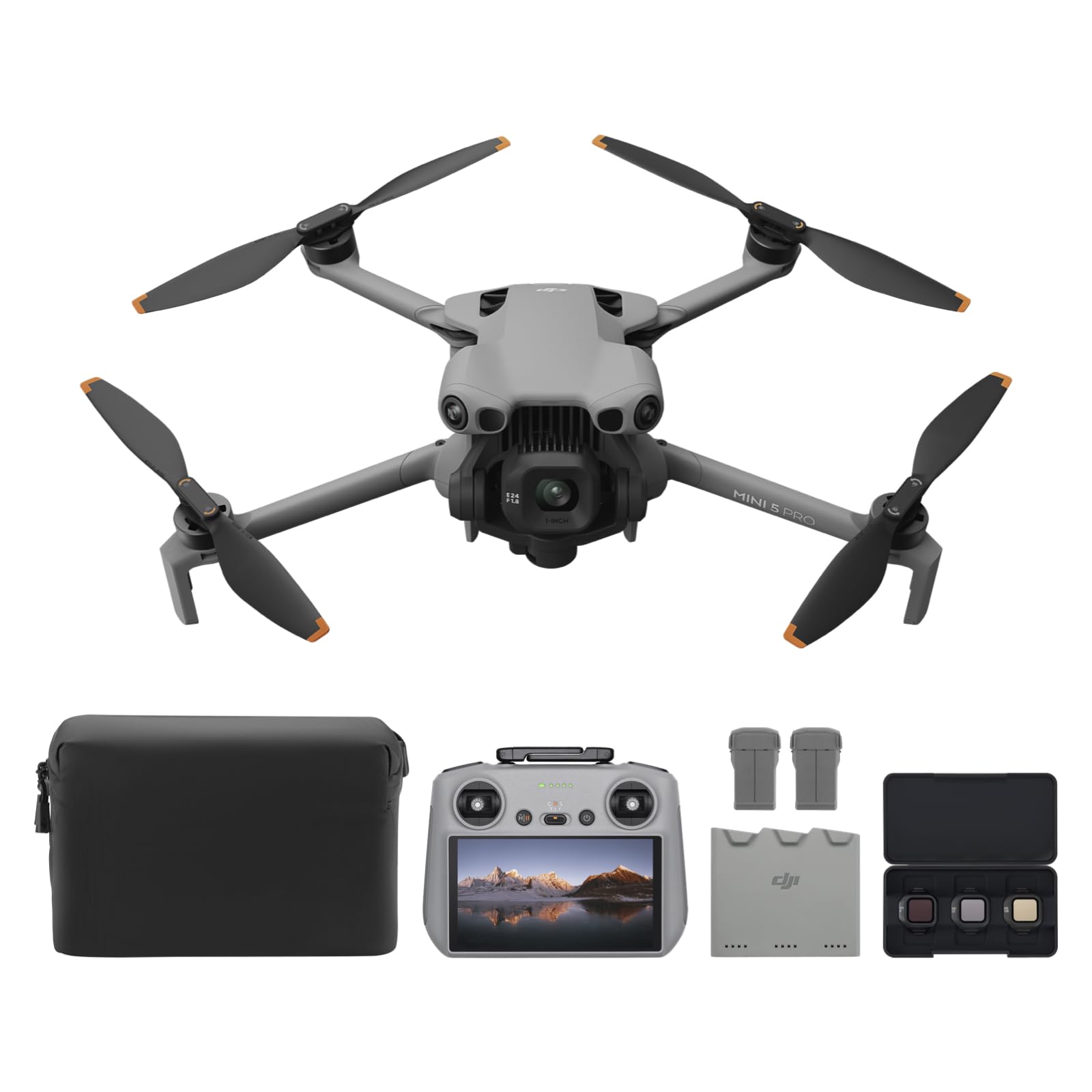
The DJI Mini 5 Pro packs a 1-inch CMOS sensor capable of 50MP stills and 4K/60fps HDR video into a frame that weighs just 249 grams. With the Intelligent Flight Battery Plus, flight time extends to 52 minutes, which is the longest in the sub-250g category and matches many larger drones. The 225-degree gimbal rotation enables true vertical filming without cropping, which is essential for social-media-first content workflows.
The Nightscape Omnidirectional Obstacle Sensing system uses forward-facing LiDAR and vision sensors to detect obstacles even in low light, a feature that was previously exclusive to DJI’s flagship Mavic series. The upgraded ActiveTrack 360 offers customizable tracking modes that keep a subject centered—useful for real estate walkthroughs or tracking a vehicle from a high angle without manual piloting.
The Fly More Combo Plus includes three batteries, a charging hub, ND filters, and the DJI RC 2 controller with a built-in screen. For a commercial photographer who needs a lightweight travel drone that can still produce editorial-quality stills and 4K footage, the Mini 5 Pro is the best balance of portability and sensor performance in its weight class.
Why it’s great
- 50MP 1-inch sensor delivers pro-grade stills in a 249g body
- True vertical filming without crop saves editing time
- Nightscape LiDAR adds safety margin in low-light flights
Good to know
- Plus battery pushes weight over 250g, requiring FAA registration
- DJI Care Refresh not available for US customers at launch
- Internal storage is 42GB; external SD card slot included
8. DJI Mini 4 Pro Drone Bundle Kit

The Mini 4 Pro bundle combines DJI’s excellent sub-250g platform with a range of accessories designed to get a new professional pilot airborne quickly. The drone itself captures 4K/60fps HDR vertical video natively—no cropping required—and the omnidirectional obstacle sensing (forward, backward, and downward) provides confidence when flying in complex environments like a residential neighborhood with power lines and trees.
Under 249 grams, the Mini 4 Pro does not require FAA registration for recreational flights, though any commercial operation (Part 107) still requires registration regardless of weight. The 34-minute maximum flight time per battery is adequate for a single property shoot, and the bundle includes a charging hub, landing pad, 128GB SD card, and strobe lights for night visibility.
The RC 2 controller with built-in screen eliminates the need for a smartphone, which is a significant convenience in bright outdoor conditions where phone screens are hard to read. For a professional who wants a lightweight, regulation-friendly secondary drone or a primary drone for social-media-first work, the Mini 4 Pro bundle delivers strong value.
Why it’s great
- FAA registration not required for non-commercial use under 250g
- Omnidirectional obstacle sensing protects in tight spaces
- Bundle includes all essential accessories for immediate flying
Good to know
- Bundle accessories (strobe lights, backpack) are entry-level quality
- 34-minute battery life is shorter than newer Mini 5 Pro
- No side sensors; lateral movement requires caution near obstacles
9. DJI Mavic 2 Zoom

The Mavic 2 Zoom is a specialized tool for commercial photographers who need optical zoom capability—a feature that remains rare in the consumer drone market. The 2x optical zoom (24-48mm equivalent) allows you to tighten a frame without losing resolution, which is useful for architectural detail shots where you cannot physically move the drone closer due to obstructions or safety regulations.
The 12MP 1/2.3-inch sensor is smaller than the 1-inch sensors found in most pro-grade drones, but the zoom versatility compensates for the resolution trade-off when the shot requires a specific compression perspective. The three-axis gimbal keeps the camera stable even at full zoom, and the Hyperlapse mode allows for dynamic time-lapse sequences from a single flight.
For photographers who specialize in inspection, roof surveys, or capturing hard-to-reach structural details, the Mavic 2 Zoom is a dedicated solution. Keep in mind that the optical zoom is limited to 2x, and digital zoom beyond that point introduces quality degradation. The drone remains a capable platform but faces stiff competition from newer triple-camera models.
Why it’s great
- True optical zoom captures details without resolution loss
- Compact foldable design for easy transport to job sites
- Proven reliability and extensive third-party accessory support
Good to know
- 12MP 1/2.3-inch sensor yields lower dynamic range than 1-inch sensors
- Software updates for Android have been problematic for some users
- Older model; no longer receives active firmware feature updates
10. DJI Mini 4 Pro Fly More Vlogger Combo

The Mini 4 Pro Vlogger Combo is built for content creators who need a compact, regulation-friendly drone that can deliver both 4K100 slow-motion video and 48MP RAW stills. The rotating gimbal enables true vertical shooting, which eliminates the need to crop a 16:9 frame for Instagram Reels or TikTok. The OcuSync 4 video transmission system provides a stable feed up to 12.4 miles, which is generous for a drone in this weight class.
The three included Intelligent Flight Batteries (34 minutes each) give you just over 100 minutes of total flight time, which is enough for a half-day location shoot. The FocusTrack subject tracking system works well for following a person walking through a property or a vehicle moving along a road, and the omnidirectional obstacle avoidance adds a safety net when flying near walls or tree branches.
The bundle includes a landing pad, 128GB SD card, drone sleeve, and a three-battery charging hub, making it a turnkey solution for a solo vlogger or a small creative team that needs a lightweight aerial platform. The under-250g design means you can travel internationally with fewer regulatory headaches.
Why it’s great
- 4K100 slow-motion adds cinematic flexibility to B-roll
- True vertical shooting saves social-media cropping time
- Sub-250g weight simplifies international travel compliance
Good to know
- Accessories may show signs of use on some units
- Battery life closer to 30 minutes in windy conditions
- No internal charger included; requires USB-C PD supply
11. HOVERAir X1 PROMAX

The HOVERAir X1 PROMAX is not a traditional camera drone—it is a flying action camera that prioritizes hands-free, self-flying operation for active commercial shoots. With 8K@30fps recording, a two-axis gimbal with EIS and horizon leveling, and a 107-degree FOV lens, this drone is built to capture fast-moving subjects without a manual pilot. The follow speed reaches 42 km/h, which is sufficient for cycling, skiing, or tracking a vehicle on a closed course.
The OmniTerrain system allows flight over snow, water, and cliffs, which reduces the anxiety of flying near reflective or featureless surfaces where standard sensor-based drones lose tracking. The HOVERAir launches from your hand via a simple click or voice command, and the rear ToF proximity sensor brakes before collisions at speeds up to 3 m/s, making it a relatively safe choice for dynamic environments.
For commercial photographers who shoot outdoor sports, adventure tourism, or brand content featuring moving subjects, the X1 PROMAX eliminates the need for a dedicated pilot and allows the photographer to be in the frame. The 64GB internal storage plus external SD card support up to 1TB provides ample space for 8K footage throughout a full shoot day.
Why it’s great
- Hands-free launch and tracking keeps photographer in the shot
- 8K resolution allows heavy cropping for multi-aspect delivery
- OmniTerrain flies over water, snow, and sand without drifting
Good to know
- Two-axis gimbal lacks roll stabilization of three-axis systems
- Limited to 12MP stills; not a primary photography platform
- Requires good light for optimal tracking performance
12. Bingchat Tablet Remote Drone
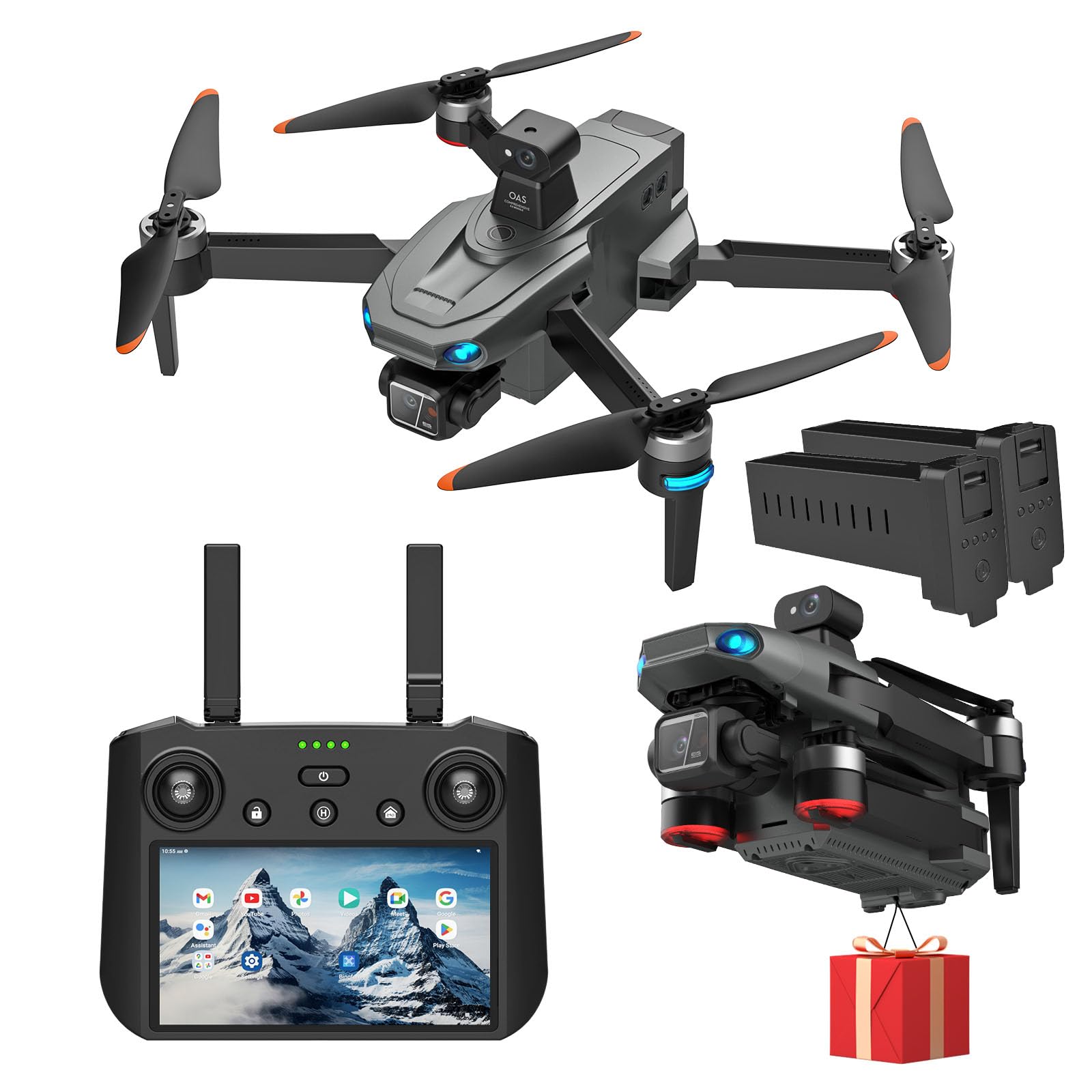
The Bingchat tablet remote drone aims to bridge the gap between entry-level toys and professional platforms. It features a 4K HD camera mounted on a three-axis gimbal with EIS anti-shake, a 130-degree FOV lens, and 48MP effective still resolution. The most notable feature is the tablet-style touch-screen controller that runs Android with Google Play support, allowing you to use any app without connecting a phone.
The drone claims 84 minutes of total flight time with two 11.1V batteries (42 minutes each), which is competitive at this price level. The 360-degree laser obstacle avoidance and payload release function add novelty, but the obstacle avoidance is less reliable than the omnidirectional vision systems on DJI or Autel drones. The claimed 5-mile range and 2624-foot height are best-case figures under ideal conditions.
For a commercial photographer on a tight budget who needs a drone with a three-axis gimbal and 4K recording, the Bingchat provides a functional entry point. However, you should invest in a DJI or Autel platform for critical client work where video quality, obstacle avoidance reliability, and firmware support are non-negotiable.
Why it’s great
- Three-axis gimbal with EIS provides smoother footage than budget alternatives
- Android tablet controller works without a smartphone
- Long total flight time with two batteries covers extended shoots
Good to know
- Obstacle avoidance is inconsistent; avoid flying near trees and wires
- 48MP still resolution is interpolated; real detail is lower
- Customer support is less responsive than tier-one brands
FAQ
Do I need an FAA Part 107 license to use a drone for commercial photography?
What does dynamic range mean for a real estate aerial shot?
Is a 1-inch sensor drone good enough for client work, or do I need a 4/3 sensor?
How many batteries do I need for a half-day commercial shoot?
Can I use the Antigravity A1-360 for standard flat video delivery?
Final Thoughts: The Verdict
For most users, the best drone for commercial photography winner is the DJI Mavic 4 Pro Fly More Combo because its 100MP 4/3 CMOS Hasselblad sensor, 51-minute flight time, and nighttime obstacle avoidance deliver uncompromised image quality and safety for high-end client work. If you need triple-camera versatility and a more accessible price point, grab the DJI Mavic 3 Pro. And for low-light and night photography with geofence-free operation, nothing beats the Autel EVO 2 Pro V3.

Mo Maruf
I created WellFizz to bridge the gap between vague wellness advice and actionable solutions. My mission is simple: to decode the research and give you practical tools you can actually use.
Beyond the data, I am a passionate traveler. I believe that stepping away from the screen to explore new environments is essential for mental clarity and physical vitality.