Our readers keep the lights on and my smoothie glass nicely filled. As an Amazon Associate, I earn from qualifying purchases.
Real estate videography demands a drone that can capture a property’s full character in a single, smooth, high-resolution pass — not a toy that shakes in the wind or forces you to land before the walkthrough is complete. The sub-250g weight class has opened up regulation-friendly flying, but for commercial listings you need a camera with a large sensor, a gimbal that doesn’t introduce micro-jitters, and a transmission system that keeps your framing locked at 400 feet.
I’m Mohammad Maruf — the founder and writer behind WellFizz. I’ve spent months poring over spec sheets, flight logs, and customer break-down reports to separate the listing-worthy machines from the warehouse rejects.
Whether you are a Realtor shooting twilight estates or a production house delivering cinematic walkthroughs, this guide analyzes every gimbal system, sensor size, and obstacle-avoidance array to help you identify the best drone for real estate videography that fits your workflow and budget.
How To Choose The Best Drone For Real Estate Videography
Selecting a drone for property shoots is different from picking a general-purpose flyer. The shot list for a single listing typically requires a wide establishing orbit, a smooth push-in over the driveway, and stable low-altitude passes across landscaping — all while maintaining consistent horizon lines and avoiding obstruction from trees or power lines. You need a machine that prioritizes camera fidelity, flight stability, and obstacle awareness above raw speed or acrobatics.
Sensor Size and Gimbal Quality
For real estate, the sensor is everything. A 1-inch CMOS sensor (or larger) captures the dynamic range needed to keep shadow detail in a foyer while retaining highlight texture in sun-lit windows. Pair that with a 3-axis mechanical gimbal, and you eliminate the horizon wobble that ruins a fly-through. Drones with only a 2-axis gimbal will produce tilted horizons during yaw maneuvers — a dead giveaway of amateur footage.
Obstacle Avoidance and Safety Systems
Real estate environments are obstacle-dense: porch columns, second-story eaves, mature trees, and fence lines. Omnidirectional obstacle sensing (forward, backward, upward, downward, and sideward) gives you the confidence to fly low and close without constant pilot anxiety. Systems that use binocular vision and infrared sensors, like those on the DJI Mini 4 Pro and Autel EVO II V3 series, provide real-time 3D mapping even in moderate light. Avoid drones that only offer downward sensing for property work.
Flight Time and Redundancy
A single listing shoot might require 20–30 minutes of actual airborne recording time. Look for a drone that offers at least 30 minutes of real-world flight per battery (not just hover time). Having a “Fly More” set with three batteries ensures you can cover an entire estate without rushing. Also prioritize drones with hot-swappable batteries and multi-battery charging hubs — time wasted waiting for a charge costs you billable hours.
Transmission Range and Video Feed Quality
For large properties, you may need to position the drone a quarter-mile away while maintaining a live 1080p or higher video feed on your controller. DJI’s O3+ and Autel’s SkyLink 2.0 systems provide reliable 1080p feeds at over 7 miles in clear airspace. Avoid drones that rely solely on Wi-Fi streaming; they will drop frames when you need them most. A built-in screen on the remote also eliminates the hassle of a phone dimming in sunlight.
Quick Comparison
On smaller screens, swipe sideways to see the full table.
| Model | Category | Best For | Key Spec | Amazon |
|---|---|---|---|---|
| DJI Mavic 3 Pro | Premium | Cinematic Walkthroughs | 4/3 CMOS, Triple Camera | Amazon |
| DJI Mavic 4 Pro Fly More Combo | Flagship | Low-Light & Large Estates | 100MP, 51-Min Flight Time | Amazon |
| Autel Robotics EVO 2 PRO V3 | Premium | Professional HDR & Twilight | 1″ CMOS, 6K HDR | Amazon |
| DJI Mavic 2 Pro | Mid-Range | Hasselblad Color Science | 1″ CMOS, Adjustable Aperture | Amazon |
| Antigravity A1-360 | Mid-Range | 360° Reframe Workflow | 8K 360 Video, 249g | Amazon |
| DJI Mini 4 Pro (RC 2) | Mid-Range | Lightweight, No Registration | 1/1.3″ CMOS, Omnidirectional | Amazon |
| DJI Mini 3 (DJI RC Bundle) | Mid-Range | True Vertical Social Clips | 1/1.3″ CMOS, 34-Min Flight | Amazon |
| K600PRO GPS Drone | Mid-Range | Beginner Professional Kit | 3-Axis Gimbal, 55-Min Flight | Amazon |
| HOVERAir X1 PRO | Entry-Level | Hands-Free Quick Shots | 192g, 2-Axis Gimbal + EIS | Amazon |
| Bingchat Tablet Remote Pro | Entry-Level | Extra Flight Time & Payload | 3-Axis Gimbal, 84-Min (2 Batt) | Amazon |
| DJI Flip With RC 2 | Entry-Level | Compact Property Scouting | 4K/60fps, Propeller Guards | Amazon |
| Autel EVO II Dual 640T V3 | Specialty | Thermal + Visible Inspection | 640×512 Thermal, 50MP | Amazon |
In‑Depth Reviews
1. DJI Mavic 3 Pro with RC

The Mavic 3 Pro’s 4/3 CMOS Hasselblad main camera is the largest sensor in this guide, delivering 12.8 stops of dynamic range — essential for keeping window highlights from blowing out during a sunlit front-of-house shot. The triple-camera array (24mm wide, 70mm medium tele, and 166mm tele) lets you punch in on architectural details like soffits and gutters without losing resolution. The 43-minute max flight time gives you enough hover buffer to re-shoot a scene two or three times on a single battery.
For real estate, the 24mm wide-angle Hasselblad lens is your primary tool. Its f/2.8–f/11 adjustable aperture means you can stop down at midday to sharpen the entire scene edge-to-edge, then open up at twilight for maximum light gathering. ActiveTrack 5.0 and APAS 5.0 eight-direction obstacle sensing keep the drone clear of tree branches even when you are focused on framing. The O3+ transmission pushes a stable 1080p feed out to 15 km, so you can stay far enough back to include the whole property line in a single orbit.
Some buyers note the standard RC does not have the ultra-bright screen of the more expensive RC Pro, and the Fly More combo (extra batteries and charger) is an additional investment. But for agents delivering 4K walkthroughs for luxury listings, the sensor fidelity and lens versatility make this the most capable, future-proof choice.
Why it’s great
- Largest sensor in class captures window detail and shadows simultaneously
- Triple-camera system allows detail zooms without sacrificing 4K quality
- 8-direction sensing enables safe close-quarters flying near structures
Good to know
- Standard RC screen brightness is 700 nits — fine in overcast but can struggle in direct sun
- Batteries are proprietary and moderately expensive to replace
2. DJI Mavic 4 Pro Fly More Combo
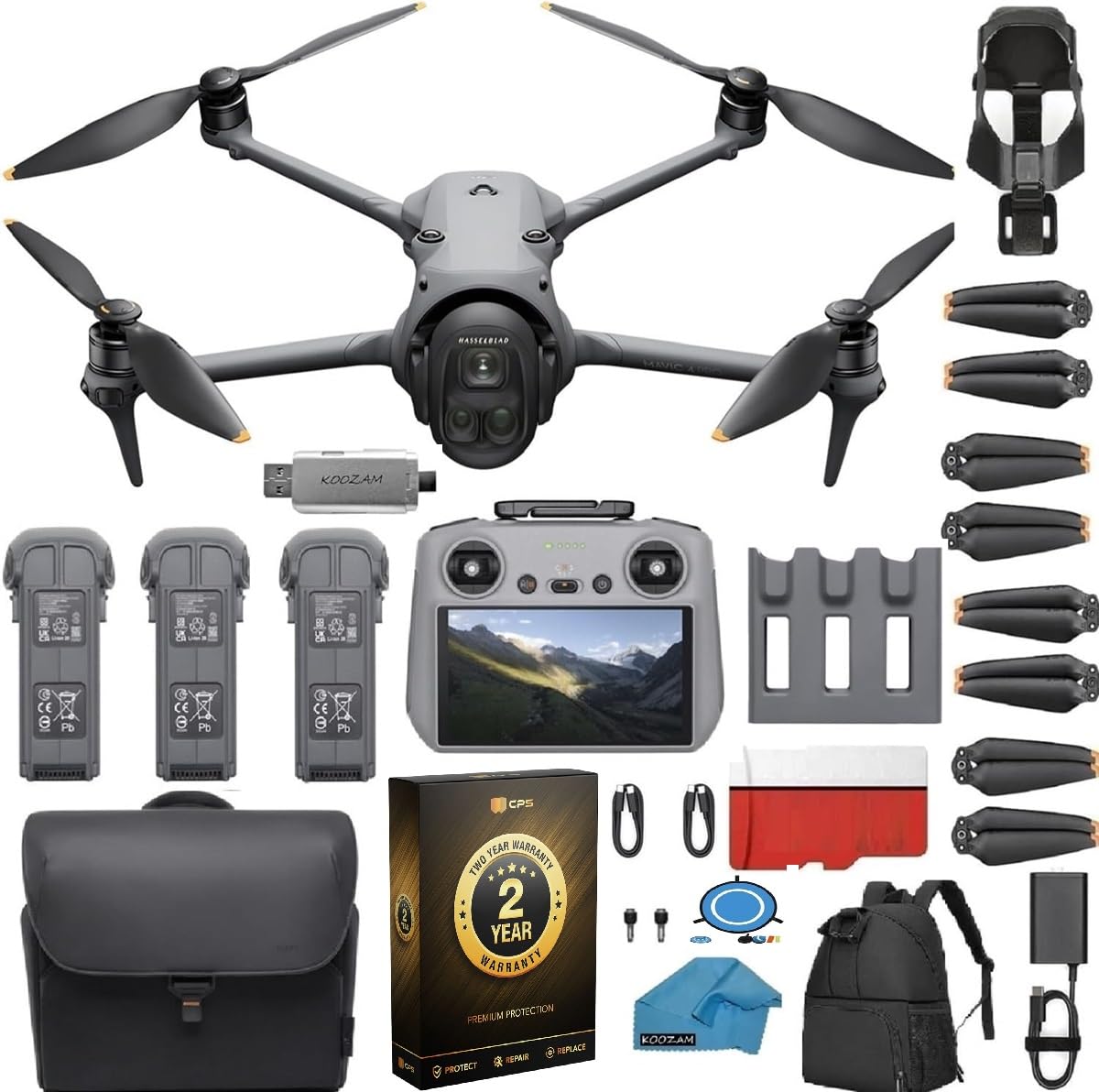
The Mavic 4 Pro’s Infinity Gimbal carries a triple 100MP Hasselblad wide, 48MP medium tele, and 50MP tele camera set that shoots 6K60 HDR on the main lens. The sensor’s dual native ISO fusion means twilight shots of a lit mansion retain both the glow of the windows and the tree line texture without noise artifacts. The 51-minute advertised flight time translates to roughly 38–42 minutes in windy real-world conditions — enough to cover a 5-acre estate in one go without swapping batteries.
ActiveTrack 360 on this model is a leap forward: the drone makes autonomous navigation decisions, allowing it to track a real estate agent walking the property line from front to back while keeping the agent centered. The low-light obstacle avoidance (six 0.1-lux fisheye sensors plus forward LiDAR) lets you work confidently during the golden hour and even into civil twilight when most listings look their best. The Fly More Combo bundle includes a backpack, landing pad, and multiple batteries, so you are ready to shoot immediately.
A handful of reviews note that the included backpack is basic and the tablet holder feels flimsy; serious operators will want a third-party hard case. The price sits at the top end of the market, but for production companies that bill per listing, the 51-minute window and cinematic frame rates justify the entry cost.
Why it’s great
- Hybrid 100MP stills provide enormous crop margin for brochure-quality photos
- Low-light tracking and obstacle avoidance extend usable shooting hours
- Triple-battery bundle covers entire estate shoots without recharging
Good to know
- High price point puts it beyond casual realtor budgets
- Stock backpack offers minimal protection for the gimbal system
3. Autel Robotics EVO 2 PRO V3
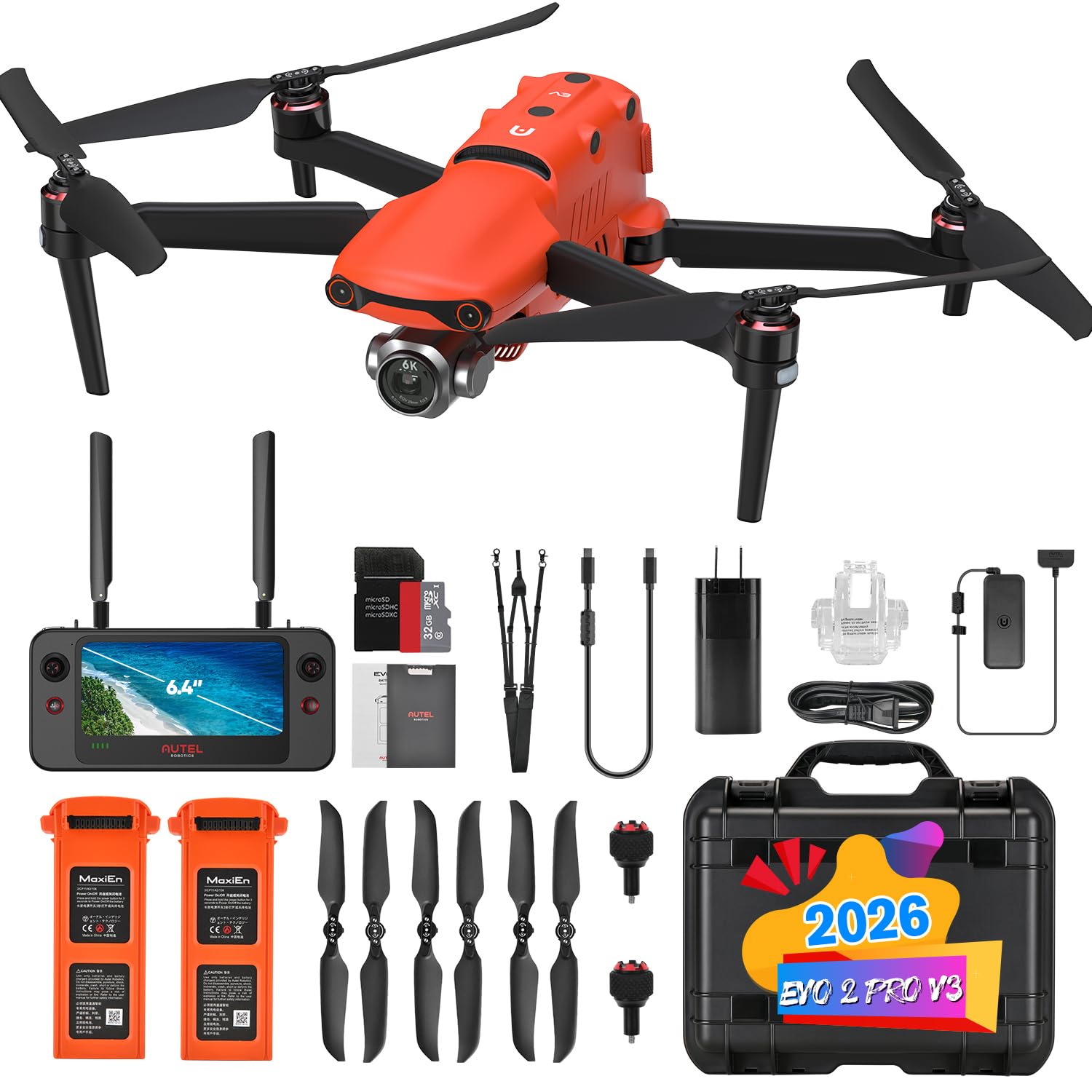
The Autel EVO 2 Pro V3 is built for 6K HDR capture with a 1-inch CMOS sensor that supports 12-bit DNG photos (68.6 billion colors). Its adjustable aperture ranges from f/2.8 to f/11, giving you precise exposure control when the sun drops and the property lights flick on — the Moonlight Algorithm 2.0 pushes ISO up to 44,000 for night photography without heavy grain. Real estate users in the Pacific Northwest report that the Autel handles low-light noise better than most 1-inch sensor drones in the price bracket.
The 19-group sensor suite provides 360° obstacle avoidance via 12 visual sensors, meaning you can navigate tight backyards with tree branches and power lines on all sides. SkyLink 2.0 delivers a 2.7K live feed at up to 15 km, which is handy for shooting sprawling rural properties from a single high vantage point. The rugged bundle includes three batteries, a multi-charger, and a protective case — everything you need for a full day of shooting.
One downside mentioned by professional users is the lack of geofencing restrictions compared to DJI, which means it will fly anywhere but also lacks some of the airspace safeguards you get with DJI firmware. The controller is excellent, with a 6.4-inch OLED screen, but the interface can feel less polished than DJI’s Fly app. For the image quality and build resilience, it remains a top choice for serious videographers who prioritize raw color depth over ecosystem polish.
Why it’s great
- Moonlight Algorithm 2.0 delivers exceptional low-light sensitivity for dusk twilight shoots
- No geofencing restrictions allow unrestricted flight over rural acreage
- Rugged bundle includes three batteries and a hard case for field readiness
Good to know
- App ecosystem and firmware tutorials are less developed than DJI’s platform
- Obstacle avoidance may miss thin wires, requiring pilot vigilance
4. DJI Mavic 2 Pro

The Mavic 2 Pro remains a relevant choice for real estate because of its Hasselblad L1D-20c camera with a 1-inch 20MP CMOS sensor and adjustable aperture (f/2.8–f/11). That aperture control is rare in mid-range drones and lets you dial in the exact depth of field for an establishing shot — sharp from the pool deck to the horizon. The 3-axis gimbal handles the 360° orbits that sell curb appeal, and the 31-minute flight time is enough for most single-property shoots, provided you carry a spare battery.
The omnidirectional obstacle sensing and ActiveTrack 2.0 are adequate for suburban residential lots, though the sensing array is less capable than the Mavic 3 generation. It still tracks moving subjects and avoids trees, but you must be more cautious near complex rooflines. The standard remote connects to your phone via USB-C, Lightning, or Micro-USB, and the DJI Go 4 app remains solid, albeit older than the Fly app.
Some units have been on shelves for years, so check the firmware version and make sure you are getting a fresh battery. The Mavic 2 Pro does not have the vertical shooting mode found on Mini 3 or Mini 4 Pro, meaning you will need to crop for portrait-orientation social media clips. For a realtor who shoots still-heavy listings and values Hasselblad color science, it is still a capable, time-tested tool.
Why it’s great
- Adjustable aperture provides precise exposure control for midday and dusk scenes
- Hasselblad natural color rendering reduces grading time in post
- Omnidirectional sensing gives safe operation around typical suburban obstacles
Good to know
- No native vertical shooting — must crop 4K down to portrait frame
- Battery life is adequate but lags behind newer 40+ minute offerings
5. Antigravity A1-360
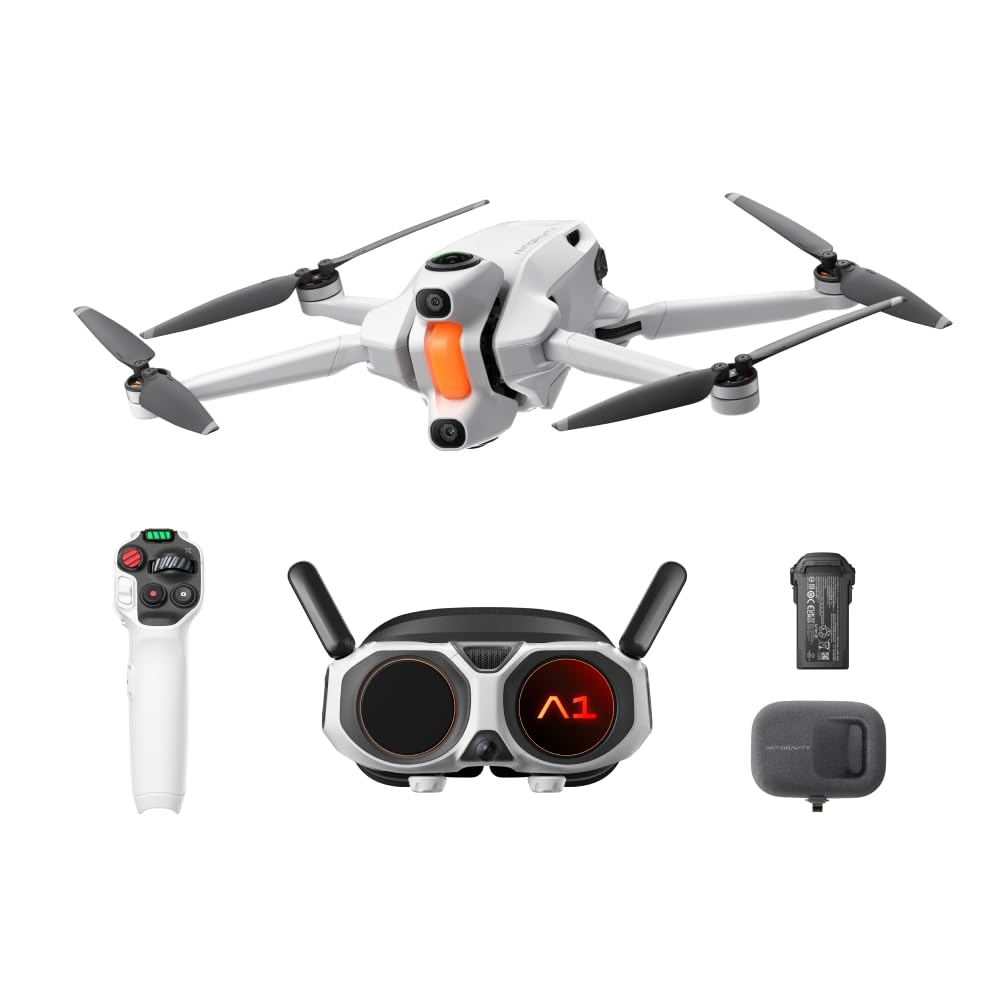
The A1-360 completely rethinks real estate capture by recording 8K 360° video and letting you reframe the shot in post. Instead of flying multiple orbits around the house, you fly one pass and later select the best angle — slow pans, push-ins, and pull-outs can all be pulled from a single take. The Insta360-powered stitching is near-seamless, so you won’t see seams across the backyard lawn. The Vision Goggles provide a 90° FOV for an FPV-like immersion that helps you feel the property layout before you edit.
Standard battery keeps the drone at 249g, waiving FAA registration, while the high-capacity battery extends flight to 39 minutes. The 360 obstacle-avoidance system fuses forward and downward binocular vision with 360 sensing, making it safe to fly through narrow gaps. Auto Edit 2.0 software automatically detects the best frames and paces them to music, which can cut your editing time for a standard listing from two hours to twenty minutes.
The catch is that the 8K 360 resolution, when reframed, yields roughly 4K equivalent — fine for web, but if you need 8K final delivery of a specific angle, you lose some resolution. The goggles and motion controller have a learning curve for pilots used to traditional sticks. For a videographer who shoots multiple listings per week, the time savings from one-shot capture and auto-editing can offset the learning investment.
Why it’s great
- Single flight captures every angle — reframe in post without re-flying
- Auto Edit 2.0 drastically reduces turnaround time for listing videos
- Sub-249g standard battery avoids registration requirements
Good to know
- Reframed 8K footage outputs roughly 4K — not ideal for broadcast 8K delivery
- Goggle and motion controller require dedicated practice to master
6. DJI Mini 4 Pro with DJI RC 2

The Mini 4 Pro packs the same omnidirectional obstacle sensing found on much larger DJI drones into a 249g frame. For real estate, this means you can get tight to a house’s eaves and around backyard sheds without the phantom stick reactions that plague budget drones. The 1/1.3-inch CMOS sensor shoots 4K/60fps HDR vertical video directly — no cropping needed for Instagram or TikTok listing clips — and the dual native ISO keeps the shot clean when the sun is low behind the house.
The bundle includes the DJI RC 2 with a built-in 5.5-inch screen that hits 700 nits, which is bright enough to frame your shot even on cloudless afternoons. The 34-minute flight time is realistic for a two-battery cycle covering most 2,000–4,000 sq ft homes. ActiveTrack 360 and waypoint flight mode let you program a repeatable orbit around a property so every listing gets the same reveal shot.
Where the Mini 4 Pro falls short for luxury real estate is the sensor size. The 1/1.3-inch sensor cannot match the dynamic range of a 1-inch or 4/3 CMOS, so you may see noise in deep shadows and less detail in bright windows. Also, the controller and drone rely on a Wi-Fi-based O4 transmission system — good for a mile or two in suburbia but less reliable in dense, signal-congested neighborhoods.
Why it’s great
- Omnidirectional sensing in a sub-250g airframe allows confident close-quarters flight
- Native vertical 4K/60fps HDR is perfect for social media listing previews
- Waypoint flight modes enable repeatable property orbits for consistent b-roll
Good to know
- 1/1.3-inch sensor struggles with dynamic range in high-contrast window scenes
- Transmission range is shorter than O3+ or SkyLink 2.0 in congested areas
7. DJI Mini 3 (DJI RC Bundle)
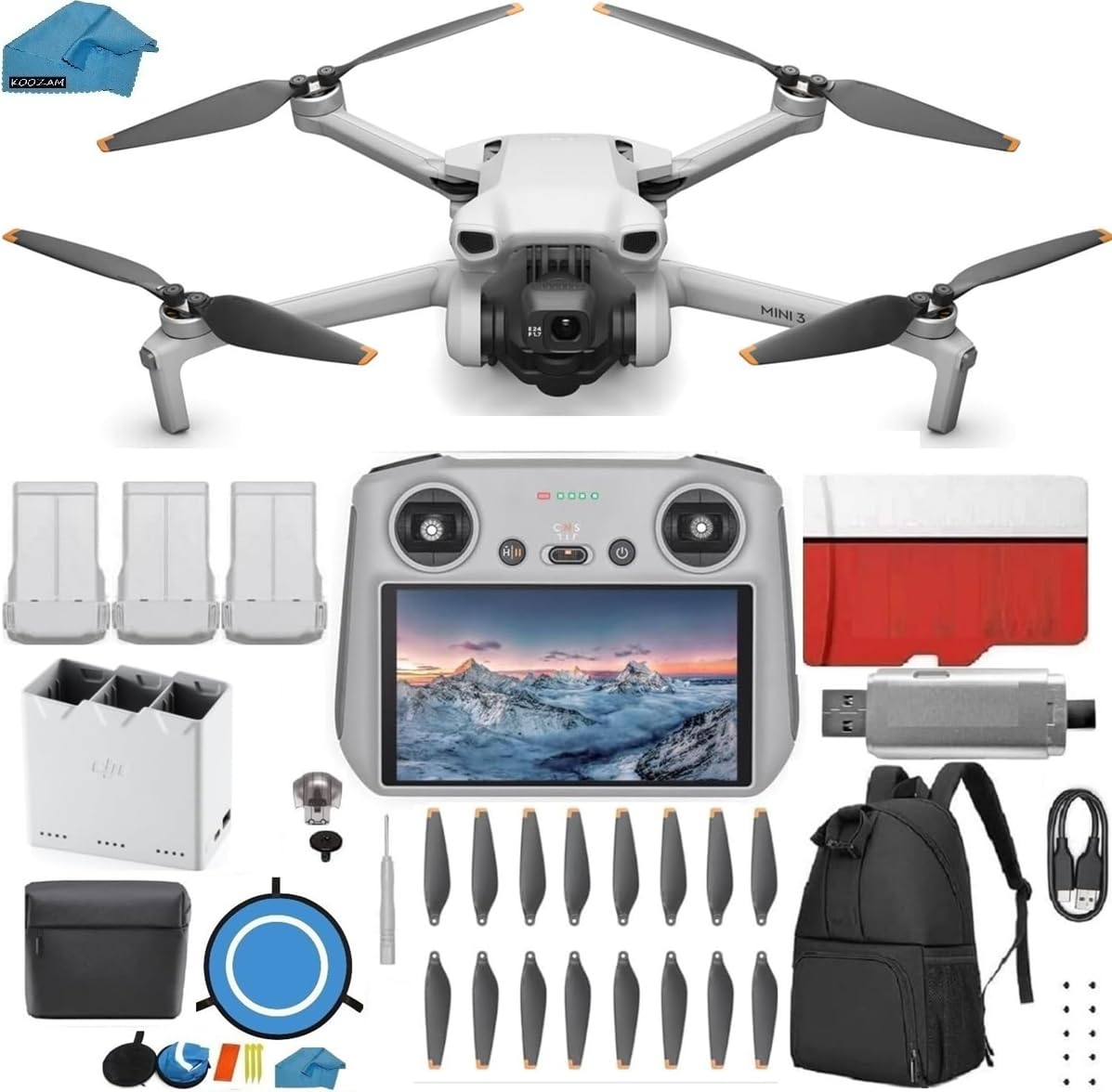
The DJI Mini 3’s defining feature for real estate is the True Vertical Shooting mode where the gimbal physically rotates 90° so you record 4K/60fps footage in portrait without cropping. For agents who lead with Instagram or TikTok listing teasers, this is a direct workflow accelerator — you no longer waste time re-framing a 16:9 clip to 9:16 in post. The 1/1.3-inch CMOS sensor captures 48MP stills that look crisp on MLS listings, and the f/1.7 aperture helps when you are shooting the interior of an open garage or under a covered patio.
The bundle includes the DJI RC with the Fly app pre-installed on a 5.5-inch HD display, which eliminates the frustration of your phone losing brightness halfway through a shoot. The 34-minute battery life is realistic for hovering and panning, and the sub-249g weight means you can carry two drones for redundancy without triggering FAA registration. For a solo realtor just getting into aerial marketing, this combo is the least intimidating path to professional-looking vertical video.
What it lacks is the obstacle-avoidance array of the Mini 4 Pro. You only get downward sensing, so you must manually avoid trees, roof peaks, and power lines. The lack of ActiveTrack also means you cannot autonomously track a walking path around a property. If you shoot simple overhead shots and front-facing flyovers, it is a bargain — but for complex staging, you will want the sensor suite of the Mini 4 Pro or Mavic 3.
Why it’s great
- True Vertical shooting saves hours of reframing for social-first listing campaigns
- Built-in screen remote avoids phone brightness issues in sunlight
- Sub-250g weight sidesteps FAA registration and travel restrictions
Good to know
- No forward, backward, or upward obstacle sensing requires constant pilot attention
- Lacks ActiveTrack and waypoint flight for automated property orbits
8. K600PRO GPS Drone
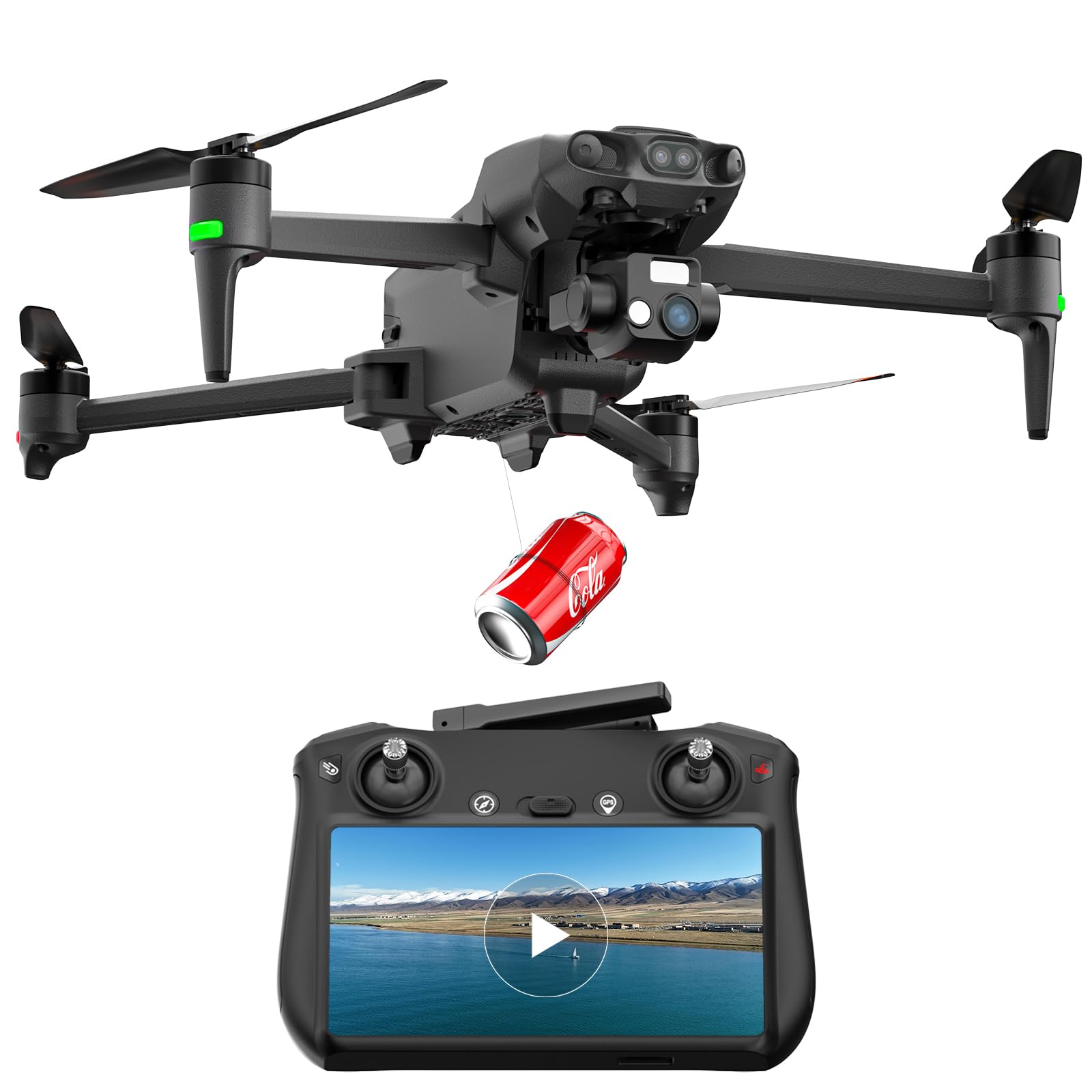
The K600PRO wraps a 3-axis gimbal 4K camera into a complete package with a 5.5-inch touchscreen controller, eliminating the phone-clip hassles of typical mid-range drones. For a real estate agent who wants a single-box solution without pairing devices, this is a practical entry point. The 55-minute advertised flight time (derived from an 11.1V 3500mAh battery) gives you headroom to fly a large property on one charge — though real-world flight in wind will land closer to 40 minutes. The EIS (Electronic Image Stabilization) works with the 3-axis gimbal to smooth out the pitch and yaw micro-jitters that ruin a walkthrough.
The GPS auto-return and follow-me modes are reliable for basic operations, and the 15 km FPV transmission range is more than enough for any residential or commercial property. The brushless motors provide enough thrust to handle light wind, and the 50x digital zoom (though mostly digital, not optical) can help you inspect roof sections or gutter lines. The included 16GB SD card is a small perk — you will want a faster card for 4K recording.
Multiple early reviews mention the controller screen and app are not as polished as DJI’s software; occasional lag in the video feed and a steeper learning curve for flight mode settings are common complaints. The obstacle-avoidance system is based on ToF sensors, not vision cameras, so it is effective only at slower speeds and close range. For an agent new to drones, the K600PRO is a capable starter kit, but experienced operators may quickly outgrow its sensor capabilities.
Why it’s great
- Integrated 5.5-inch touchscreen controller removes phone tethering issues
- Long 55-minute rated battery covers entire estate shoots in one flight
- GPS auto-return provides a safety net for beginner pilots
Good to know
- App and controller interface feel less polished than mainstream DJI/ Autel software
- ToF obstacle system cannot match the precision of binocular vision sensing
9. HOVERAir X1 PRO

The HOVERAir X1 PRO is not a traditional radio controller drone — it launches from your palm and operates via voice commands or on-body button presses, which makes it appealing for a real estate agent who wants a quick fly-over of a neighborhood lot without a 10-minute setup. The 4K@60fps camera with a 2-axis gimbal plus EIS delivers solid footage for curb-appeal shots, but the 2-axis limitation means the horizon will tilt during rapid yaw turns — a problem for smooth walkthroughs. Rear ToF collision detection provides basic rear safety, but the lack of forward or side sensors requires you to pick open launch spots carefully.
The OmniTerrain mode lets it fly over snow, water, and uneven ground, which can be useful for lakefront or hillside listings. The follow speed of 42 km/h is more than enough to track a car driving up a long driveway. At 192g, it is the lightest drone on this list, making it completely exempt from FAA registration and ideal for quick, permit-free flights. The 32GB internal storage is enough for several 4K clips, and the automatic flight modes handle the basic orbit and dolly track moves that sell a property’s scale.
If you require manual control for precise framing — for example, holding a window-level hover while an agent walks the yard — the HOVERAir will frustrate you. The lack of a 3-axis gimbal and the blade-like sports car aerodynamics make it more of a novelty for quick social clips than a primary real estate drone. It is best as a secondary pocket camera for producing one-minute preview videos posted during open house promotions.
Why it’s great
- Voice and palm-launch operation gets airborne in under 15 seconds
- Extremely light (192g) and foldable — fits in a jacket pocket for instant access
- OmniTerrain mode works over water and uneven ground for unique property angles
Good to know
- 2-axis gimbal cannot maintain level horizon during yaw maneuvers
- No traditional remote control limits precise framing for walkthrough shots
10. Bingchat Tablet Remote Professional Drone
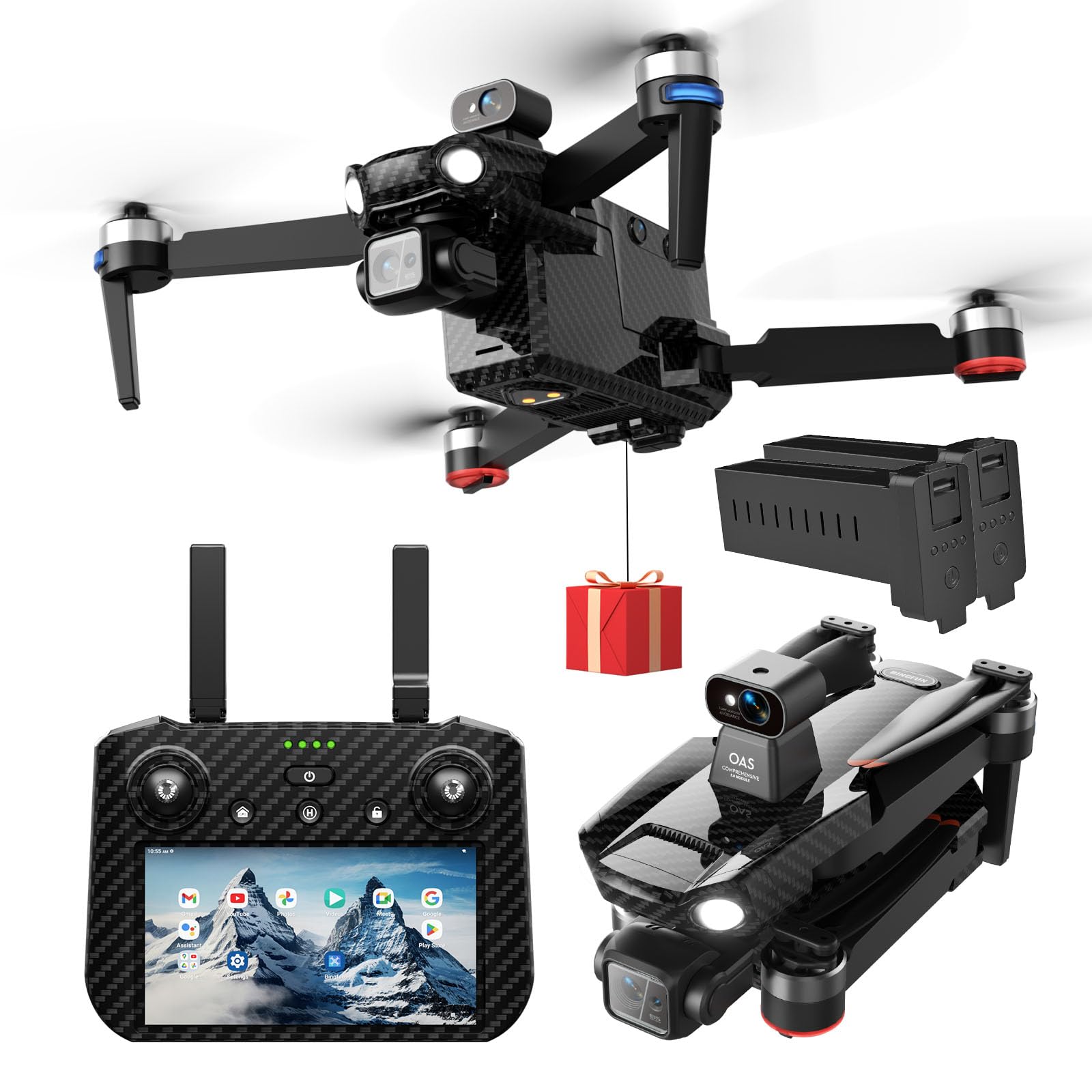
Bingchat’s 2026-upgraded tablet remote drone offers 84 minutes of total flight time across two 11.1V batteries — a major advantage for covering multiple small-to-medium listings in a single outing without rotating packs. The 3-axis gimbal and EIS stabilize the 4K HD camera through tight orbits around townhomes and property perimeters. The touchscreen controller runs Android with Google Play, so you can download third-party apps for flight planning or live streaming during open houses. The payload release is a unique extra for staging — you can drop a small marker or sign from the drone.
The 360° laser obstacle avoidance works well in open suburban areas, though the system is less nuanced than DJI’s vision-based approach and may struggle with thin branches or power lines. The 5-mile range is ample for large lots, and the Level 7 wind resistance keeps the drone steady in gusty conditions that would ground lighter models. The included 32GB SD card saves the 4K clips directly, and the follow-me mode helps frame an agent walking the property line.
Where this drone falls short is reliability consistency. Two separate critical reviews describe mid-air failures — one battery disconnect and one spiraling crash — though the majority of buyers praise the build and support. The app receives regular updates, but the interface is not as intuitive as the DJI Fly or Autel Explorer apps. For a cautious buyer, the Bingchat offers impressive battery endurance and a tablet controller, but the safety record warrants careful testing before trusting it with a client’s listing shoot.
Why it’s great
- Dual-battery flight time covers multiple residential listings in one session
- Touchscreen Android controller with Google Play supports third-party apps
- Payload release adds staging and marketing gimmick capabilities
Good to know
- Reported mid-air failure incidents raise reliability concerns for client work
- Obstacle avoidance may miss thin or fast-moving obstacles
11. DJI Flip With RC 2

The DJI Flip is an ultra-light (under 249g) drone designed for portability and safety, featuring built-in full-coverage propeller guards made from lightweight carbon fiber. For real estate, the propeller guards are a significant advantage when filming inside a model home or flying under a covered patio — the risk of clipping a wall or window is drastically reduced. The 1/1.3-inch CMOS sensor captures 4K/60fps HDR video and 48MP stills, providing respectable clarity for online MLS listings. The 31-minute flight time is realistic when the guards are attached, though adding the guards reduces wind resistance slightly.
The O4 video transmission system reaches up to 8 miles in ideal conditions, but in suburban neighborhoods with heavy Wi-Fi congestion, the feed remains stable for at least one mile. The palm takeoff feature lets you start filming quickly without needing a flat launch pad — useful if you are hopping between multiple open houses in a day. Subject tracking keeps a walking agent centered in the frame, which helps with quick walk-and-talk style property tours.
The trade-off for the propeller guards is reduced top speed and agility. You will not be making dynamic races around the property, and in higher winds, the extra drag from the guards can drain the battery faster. The RC 2 screen controller is excellent, but this is not a drone for slow, cinematic camera movements — it is best for realtors who need a quick, safe, and low-profile aerial shot for a single-family listing and want absolute piece of mind against crashes.
Why it’s great
- Full-coverage propeller guards eliminate collision anxiety in tight spaces
- Palm launch and subject tracking enable quick one-person filming sessions
- Sub-249g weight keeps FAA registration off the checklist
Good to know
- Propeller guards reduce flight performance and wind resistance
- Not designed for the slow, deliberate gimbal moves of walkthrough cinematography
12. Autel EVO II Dual 640T V3

The EVO II Dual 640T V3 is not a standard real estate video drone — it is a thermal/visible hybrid designed for property inspections, energy audits, and roof surveys. The 640×512 thermal sensor operating at 30 fps allows you to map heat loss around a house’s envelope, detect moisture intrusion behind walls, and identify faulty insulation — all critical data points for a commercial listing or a building inspection report. The 50MP 0.8-inch CMOS visible camera handles the traditional 4K property video, so you can pair thermal analysis with a standard walkthrough in a single flight. The 19-group sensor suite (12 visual sensors, ultrasound, IMUs) builds a 3D path for stable autonomous inspection routes.
SkyLink 2.0 provides a 15 km 2.7K live feed, which is valuable for inspecting large multi-building commercial complexes. The bundle includes three batteries, a multi-charger, and a hard case — everything for a full day of inspection flights. The 10+ temperature measurement modes (spot, center, region, isotherm) give you the data overlay needed for a professional energy audit report. The D-RI ranges (Detection, Recognition, Identification) help you qualify anomalies from 100 meters out.
The learning curve for blending thermal and visible workflows is steep. The smart controller is large and heavy (IP43-rated for weather), and integrating thermal data into your standard real estate video pipeline requires additional software. Unless you are a commercial inspector or use thermal data as a premium listing add-on, the EVO II Dual 640T is overkill for vanilla residential curb-appeal shoots.
Why it’s great
- Thermal 640×512 sensor at 30 fps enables comprehensive building envelope surveys
- 50MP visible camera concurrently captures 4K video and high-res stills
- Three-battery bundle and hard case support full-day inspection missions
Good to know
- Thermal data workflow requires additional post-processing software investment
- Heavy, large controller is less portable than consumer-grade setups
FAQ
Do I need a Part 107 license to fly a drone for real estate videography?
Which drone camera sensor size is best for twilight real estate shoots?
Can I use a thermal drone for standard real estate listing videos?
Final Thoughts: The Verdict
For most users, the best drone for real estate videography winner is the DJI Mavic 3 Pro because its 4/3 CMOS Hasselblad sensor and triple-camera array deliver the dynamic range and focal length flexibility needed for both wide establishing shots and architectural detail zooms. If you need the longest single-charge endurance and the most advanced low-light tracking for shooting dusk-to-night mansions, grab the DJI Mavic 4 Pro Fly More Combo. And for a lightweight, regulation-friendly drone that still offers omnidirectional obstacle sensing, nothing beats the DJI Mini 4 Pro for quick daily listing shoots.

Mo Maruf
I created WellFizz to bridge the gap between vague wellness advice and actionable solutions. My mission is simple: to decode the research and give you practical tools you can actually use.
Beyond the data, I am a passionate traveler. I believe that stepping away from the screen to explore new environments is essential for mental clarity and physical vitality.