Our readers keep the lights on and my smoothie glass nicely filled. As an Amazon Associate, I earn from qualifying purchases.
Turning your daily bike ride into a shared adventure with your dog requires more than just a standard leash and a hopeful attitude. A setup that keeps your pet a safe distance from spinning spokes, absorbs sudden lunges, and leaves your hands free to brake and steer is the difference between a great workout and a dangerous tangle. Choosing the right gear for this specific activity—one that accounts for your dog’s size, pulling style, and your bike’s frame geometry—is the only way to make the experience safe and genuinely fun for both of you.
I’m Mohammad Maruf — the founder and writer behind WellFizz. I’ve spent countless hours analyzing the engineering of bike-specific dog attachments and harnesses, decoding the differences between shock-absorbing mechanisms, mounting hardware, and material strengths to find the setups that actually hold up under real-world pulling conditions.
Whether you have a high-energy retriever that needs miles of pavement or a smaller dog that just wants to trot alongside, this guide evaluates the leading options to help you confidently choose the best dog harness for bike riding for your specific needs.
How To Choose The Best Dog Harness For Bike Riding
Biking with your dog is a high-speed activity that introduces unique forces and risks not found in a casual walk. Your selection process must prioritize mechanical safety and physical comfort for the dog over convenience features. Focus on the attachment system, the harness design, and the shock-absorbing mechanism.
Mounting System: Seat Post vs. Chain Stay
The point where the leash connects to the bike dictates the dog’s running path. A seat-post mount attaches high on the bike and is common with rigid-arm designs like the WalkyDog. It keeps the cord aloft but can pull the seat sideways if your dog lunges. A chain-stay or rear-axle mount, as used by the Bike Tow Leash, attaches lower and closer to the bike’s center of gravity. This reduces leverage and minimizes the risk of tipping, making it ideal for larger dogs that pull hard.
Harness Type: Pulling vs. Standard Walking
Never attach a bike leash to a neck collar. A proper pulling harness, like the Non-stop dogwear Freemotion, has a Y-shaped neck that avoids the trachea and a rear or side attachment ring at the dog’s center of mass. This allows the dog to use its full body weight to pull without choking or straining its neck. Standard walking harnesses with a top handle or front-clip attachment can cause the dog to twist sideways when pulling, creating an unstable and uncomfortable run.
Shock Absorption: Rigid Spring Arm vs. Bungee Cord
Your dog will always encounter a distraction that makes it bolt sideways. How the leash absorbs that shock is critical. Rigid spring arms, like those on the Springer, use a coiled steel mechanism that folds under significant force, absorbing the majority of the energy and preventing the dog from entering the wheel path. Bungee-cord systems, like the Neewa Tug Line, are lighter and simpler but offer less lateral control and can recoil if the lead breaks. For unpredictable or powerful dogs, a spring arm is the safer choice.
Quick Comparison
On smaller screens, swipe sideways to see the full table.
| Model | Category | Best For | Key Spec | Amazon |
|---|---|---|---|---|
| WalkyDog Plus | Premium | Stability & German Safety | 550 lb paracord, internal spring | Amazon |
| Non-stop dogwear Freemotion 5.0 | Premium | Performance Pulling Harness | Y-shaped neck, side attachment | Amazon |
| Bike Tow Leash | Premium | Anti-Tip Design | Fits 10–185 lb dogs | Amazon |
| Springer Hands Free Leash | Mid-Range | Strong Tug Absorption | Low-mounted steel spring | Amazon |
| Neewa Tug Line with Bungee | Mid-Range | Bikejoring & Skijoring | 2.0–2.5 m bungee length | Amazon |
| BIKE AND DOG Leash & Harness | Budget-Friendly | Entry-Level Kit | 3-ring harness, quick release | Amazon |
| NEWURBAN Hands Free Bike Leash | Budget-Friendly | Small Dogs on a Budget | Shock-absorbing bungee rope | Amazon |
In‑Depth Reviews
1. WalkyDog Plus Dog Bicycle Leash

The WalkyDog Plus has earned a reputation among serious cyclists and pet sitters who need a durable, repeatable mounting solution. Its high-carbon stainless steel wand mounts to the seat post in under five minutes and includes an internal shock-absorbing spring that lets you adjust the effective leash length by removing two springs inside the wand. The leash is military-grade paracord rated for 550 pounds of pull strength, giving you confidence when running a large breed that likes to surge.
Where this system shines is its clamping stability. The quick-release mechanism allows you to detach the wand from the bike in seconds, making it easy to switch between bikes or stow the setup when not in use. It keeps the dog running at a consistent safe distance from the rear wheel, and the integrated shock absorption handles sudden lunges without transferring excessive force to your bike frame.
The biggest maintenance point is the screw-on cap at the bottom of the wand—owners report it loosens over a week of rides and should be checked before each outing. The bungee cord inside the wand can also fray against the metal edge after several months of intense use, requiring replacement. For medium to large dogs that need structured exercise, this is the most refined all-around bike leash on the market.
Why it’s great
- TUV SUD safety certified for German quality standards
- Internal shock spring reduces jolts without a bulky external bungee
- Adjustable leash length via removable springs inside the wand
Good to know
- The cap screw on the wand loosens and needs weekly tightening
- The bungee cord edge frays over extended use
- Mounting clamp can swivel on seat post over time
2. Non-stop dogwear Freemotion Harness 5.0

The Non-stop dogwear Freemotion Harness is not a bike leash attachment—it is the harness you pair with any bike leash for optimal performance. Designed by world-leading athletes in dog-powered sports, its Y-shaped neck design allows the dog’s shoulder to move freely without restriction, while the padded neck opening provides stability without compressing the trachea. The pull force is distributed through a side attachment ring, which keeps the dog’s weight centered and prevents the harness from twisting during a sprint.
This harness is highly adjustable, with multiple points to customize both chest and length to fit dogs with unusual proportions, such as lean, deep-chested breeds like the Australian Shepherd or Boxer. The inner lining is soft against the coat to prevent chafing, and the outer fabric is abrasion-resistant for long miles on pavement or trail. Reflective piping and a dedicated loop for a safety light provide visibility in low-light conditions.
The trade-off is that the neck measurement is non-adjustable and must be snug with room for two fingers—any looser and the harness slides sideways during a pull. It is also not designed for casual walking; the design prioritizes the pulling motion, which makes attaching a standard walking leash feel awkward. For owners committed to bikejoring or regular bike runs, this harness is an investment that prevents injury and maximizes the dog’s natural gait.
Why it’s great
- Y-shaped neck frees shoulder movement and protects the trachea
- Side attachment ring evenly distributes pulling force
- Reflective piping and light loop for low-light visibility
Good to know
- Neck circumference is non-adjustable and sizing is critical to get right
- Hard to put on; requires bending the dog’s front legs into position
- Not ideal for dogs that do not naturally pull into the harness
3. Bike Tow Leash

The Bike Tow Leash takes a fundamentally different approach to physics. Instead of mounting high on the seat post, it attaches to the left side of the bike’s chain stay, low and near the rear axle. This lowers the point of force, drastically reducing the leverage your dog can exert to tip the bike sideways. The design is American Pet Association 5-star safety approved and accommodates dogs from 10 to 185 pounds, making it one of the most versatile options for multi-dog households.
The leash itself is a simple but durable nylon strap with a flexible insert that allows some lateral movement. It does not use a bungee or spring arm—the safety comes entirely from the low mounting point. When your dog pulls sideways, the bike slows or turns gently rather than tipping. Owners of powerful dogs like Labradors and pit bulls report that after months of daily use, the system remains stable and does not damage the bike frame.
The main limitation is that it is designed exclusively for the left side of the bike. If you ride in areas where left-side traffic is a concern or prefer to have your dog on the right, this leash will not accommodate that. The attachment screws also require manual tightening and can be cumbersome if you switch bikes frequently. For riders who prioritize stability and want a system that works with even the strongest pullers, the Bike Tow Leash delivers unmatched tipping protection.
Why it’s great
- Low chain-stay mount prevents tipping even with strong dogs
- Supports dogs from 10 to 185 pounds
- American Pet Association 5-star safety approved
Good to know
- Only mounts on the left side of the bike
- Attachment screws are not quick-release and can be fiddly to adjust
- The nylon arm can push down on tall dogs if not fitted correctly
4. Springer Hands Free Dog Leash Bike Attachment Kit

The Springer is a classic design that uses a low-mounted, heavy-duty steel spring to absorb up to 90 percent of the force from a dog’s sudden tug. Unlike a bungee cord that stretches, the spring arm folds at a hinge, creating a mechanical buffer that gives your dog a gentle resistance while keeping it out of the wheel path. The kit includes an 18-inch leash, three safety releases, and a universal clamp that fits most standard and mountain bike seat posts.
Safety releases are a standout feature—plastic breakaway rings that snap open if the dog wraps the leash around a tree or fire hydrant, instantly freeing your pet. The entire assembly can be removed from the bike in seconds by pulling a cotter pin, making it easy to revert to a standard bike setup when riding solo. Owners of high-energy breeds like pit bulls and sled dogs report that the spring action gives the dog just enough feedback to know it’s pulling, without jerking the rider off balance.
Weaknesses are centered around the plastic components. The breakaway rings are designed to fail under extreme force, but some users find them too fragile, occasionally snapping during normal pulling. The clamp also requires additional plastic inserts for a tight fit on thinner frames, and the straight section of the clamp can separate from the corkscrew section if the fit is not exact. For dogs that pull hard and predictably, the Springer offers a proven mechanical advantage over simple bungee leashes.
Why it’s great
- Steel spring arm absorbs up to 90% of tug force
- Safety release rings free the dog in an entanglement
- Quick-release cotter pin for easy removal
Good to know
- Plastic safety releases can break during normal use
- Clamp fit may require extra inserts for non-standard frames
- The straight clamp section can separate from the spring housing
5. Neewa Tug Line with Bungee

The Neewa Tug Line is a purpose-built bungee leash for bikejoring, the sport where a dog pulls a bicycle. It is designed to work with a waist belt or a dedicated bike mount, and its 2.0 to 2.5-meter length gives the dog room to stretch out and pull at full stride without coming too close to the rear wheel. The integrated bungee section absorbs shock from speed changes, allowing a smooth transition when the dog accelerates or decelerates.
Construction is straightforward and robust—nylon webbing with heavy-duty snap hooks at both ends. The bungee portion is stitched into the line, creating a single unbroken tow line that reduces the number of failure points. This leash is also compatible with Neewa’s canicross belts and harnesses, making it easy to build a cohesive joring kit for runners and cyclists alike.
One limitation is that this is a leash only—it does not include a bike mounting bracket or a harness. You need to purchase those separately or use a waist belt method. The 2.5-meter length can also feel excessive in tight urban settings where you want the dog running closer to the bike. For riders who want a dedicated pulling leash that handles the specific stress of bikejoring and skijoring, the Neewa Tug Line delivers the right combination of length and stretch.
Why it’s great
- Integrated bungee provides smooth shock absorption for pulling dogs
- 2.0–2.5 m length allows full stride for running
- Robust nylon construction with heavy-duty snap hooks
Good to know
- Leash only—no bike bracket or harness included
- Longer length may be cumbersome for tight turns
- Bungee section can degrade over time with heavy use
6. BIKE AND DOG Dog Leash and Harness for Bicycle
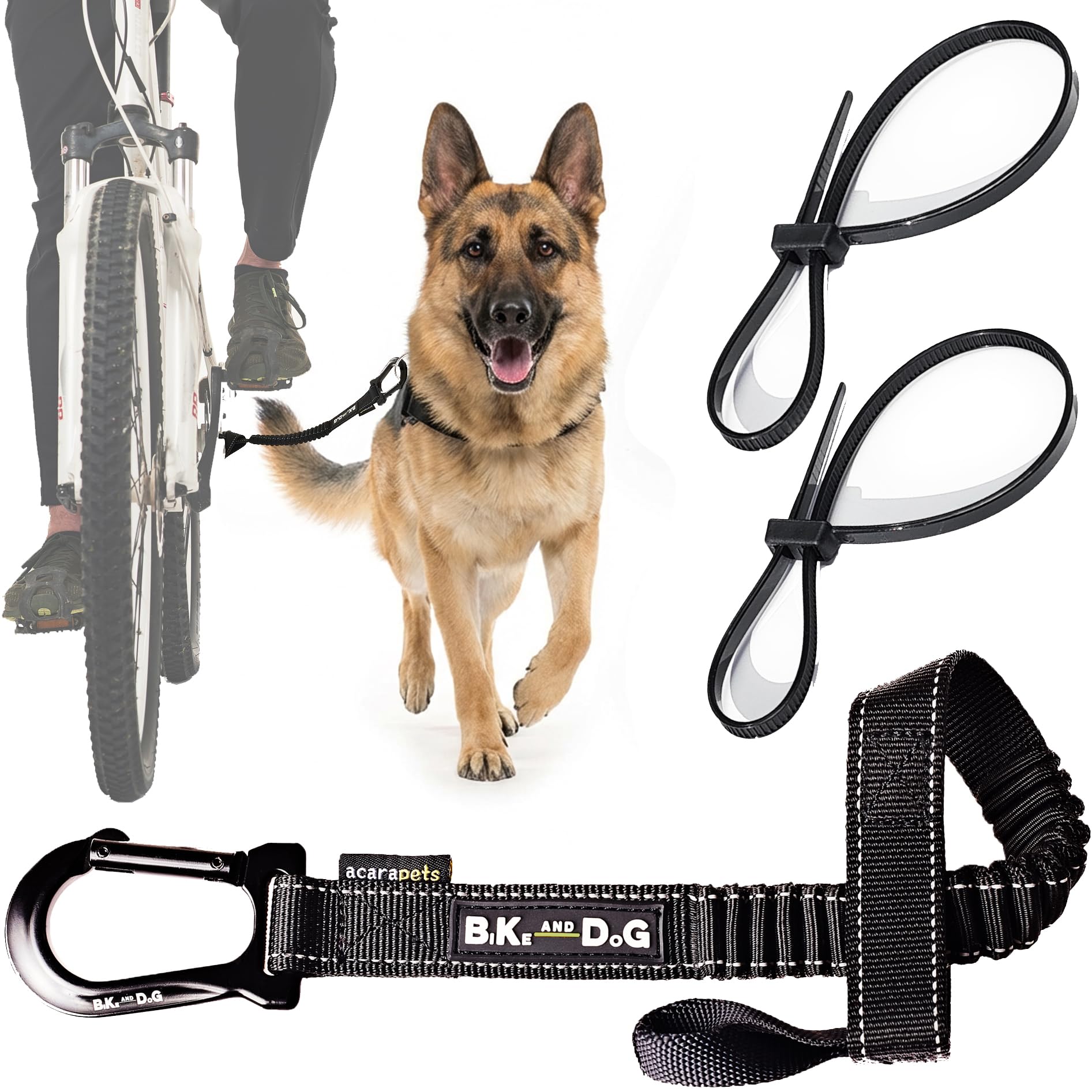
This all-in-one kit includes a harness with three metal rings and a leash designed to attach directly to your bike using two specialized cable ties. The harness has two side rings that allow the leash to connect at the dog’s flank rather than the back of the neck, keeping the pull force low and reducing the risk of the bike tipping. The no-tools installation claims are genuine—you can fasten the strap to the bike frame in about 10 seconds using the included cable ties.
The harness is best suited for smaller breeds and dogs that are already leash-trained and understand basic commands like “left” and “right.” The side-ring design works well to discourage side-switching, but it also limits the dog’s range of motion compared to a dedicated pulling harness. The kit’s value lies in its simplicity and low barrier to entry for owners who want to try biking with their dog without making a significant investment.
The main drawback is the risk of wheel entanglement if your dog is not trained to run on one side. Some reports indicate that a dog switching sides mid-ride can cause the leash to catch in the rear fender or spokes, which can be dangerous. Additionally, the harness is not padded and may cause chafing on longer rides. This kit is a solid starting point for small, well-mannered dogs, but owners of larger or less predictable dogs should consider a more robust mounting system.
Why it’s great
- Complete kit includes harness and bike leash
- Side attachment rings keep the pull force low
- No-tools installation with included cable ties
Good to know
- Not suitable for untrained dogs that may switch sides
- Harness lacks padding for long-distance comfort
- Cable ties may not hold up to large dogs over time
7. NEWURBAN Hands Free Dog Bike Leash

The NEWURBAN Hands Free Leash offers a budget-friendly entry point with a stainless steel wand that bolts to the bike frame and a flexible bungee rope that keeps the dog at a 15-inch distance from the wheels. The patented design includes a shock-absorbing system built into the rope, which is meant to soften sudden jerks without passing the full force to your arms or bike. The wand can be unscrewed from the mount in seconds, converting the rope into a walking leash for post-ride cool-downs.
This system works best for small to medium dogs that have already been trained to run alongside a bike. The bungee rope provides a gentle buffer, and the 15-inch guide pole gives the dog enough clearance to avoid the pedals and wheels. The rubber insert protects your bike frame from scratching, and the stainless steel construction resists rust when riding in wet conditions.
The biggest concern is build quality consistency. Some users report that the bracket loosens on frames larger than 35mm, and the bungee rope can break if a dog crosses behind the wheel and creates a sharp angle against the rope. The attachment pin has also been known to pull out under sudden tension. This is a functional starter leash for casual rides with a compliant dog, but it lacks the durability and safety redundancy needed for high-energy breeds or daily use.
Why it’s great
- Stainless steel wand resists rust and corrosion
- Quick-unscrew design converts to walking leash
- Rubber insert protects bike frame from scratches
Good to know
- Bracket may not fit frames larger than 35mm
- Bungee rope can break if dog crosses behind the wheel
- Attachment pin may pull out under sudden tension
FAQ
What is the safest type of harness for bike riding with my dog?
How do I prevent my dog from running into the bike wheels?
Can I use a retractable leash for bike riding?
Is a seat post mount or a chain stay mount better for my bike?
How long should the leash be for bikejoring?
Final Thoughts: The Verdict
For most users, the dog harness for bike riding winner is the WalkyDog Plus because it combines a TUV-certified safety rating, a robust internal shock spring, and a military-grade paracord leash in one easy-mount system. If you want the best pulling harness designed specifically for active dogs, grab the Non-stop dogwear Freemotion Harness 5.0. And for riders who prioritize absolute stability and tipping prevention with strong dogs, nothing beats the Bike Tow Leash.

Mo Maruf
I created WellFizz to bridge the gap between vague wellness advice and actionable solutions. My mission is simple: to decode the research and give you practical tools you can actually use.
Beyond the data, I am a passionate traveler. I believe that stepping away from the screen to explore new environments is essential for mental clarity and physical vitality.