Our readers keep the lights on and my smoothie glass nicely filled. As an Amazon Associate, I earn from qualifying purchases.
Driving through a remote canyon or parking at a scenic overlook only to watch your phone signal disappear is a familiar RV pain. A serious cell booster is the only way to turn that dead spot into a usable connection for calls, navigation, and streaming while on the road.
I’m Mohammad Maruf — the founder and writer behind WellFizz. I’ve spent hundreds of hours researching and comparing cellular amplifiers, analyzing technical specifications like antenna gain, uplink power, and band support to identify the systems that actually deliver a reliable connection in mobile environments.
This guide breaks down the top kits available to help you find the right cell phone booster for rv based on your vehicle setup, budget, and how far off the grid you plan to go.
How To Choose The Best Cell Phone Booster For RV
An RV cell booster is not a magic wand that creates signal from nothing. It amplifies an existing weak signal, so understanding your typical camping environment, your RV’s construction, and the technical specs of the booster kit is the only way to make a smart purchase.
Antenna Type: Omni-Directional vs. Directional
The outdoor antenna is the most critical component. An omni-directional antenna receives signals from all directions and is the best choice for driving and parked setups where you don’t want to aim the antenna manually. A directional antenna (a Yagi or log-periodic) must be pointed at a specific cell tower, but it offers much higher gain and is ideal for stationary camping in a fringe coverage area where every decibel matters.
Gain and Uplink Power
The maximum gain of a booster is measured in decibels (dB), and most top-tier kits offer around 50 dB of gain. However, uplink power is the spec that determines whether your phone can successfully transmit back to the tower. Low uplink power leads to dropped calls even if you see more bars on the screen. Look for a booster with strong uplink performance if you frequently talk on the phone while driving.
Band Support and Carrier Compatibility
Not all boosters support every cellular band, and band support determines which carriers will see improvement. All major US carriers rely on bands 12, 13, 5, 4, and 25/66. A good booster should cover at least these bands. If you are on a smaller regional carrier or a Canadian provider, double-check that the booster supports those frequencies.
Installation Complexity and Space
A booster is only as good as its installation. The outdoor antenna needs to be placed high enough to have a clear view of the sky, and the indoor antenna must be separated from it by at least 15-20 feet of physical distance to prevent the system from oscillating and shutting down. RVs with metal roofs often require a ground plane for the antenna, and fiberglass or wood roofs can cause issues with some kits. Plan your mounting location and cable routing before buying.
Quick Comparison
On smaller screens, swipe sideways to see the full table.
| Model | Category | Best For | Key Spec | Amazon |
|---|---|---|---|---|
| weBoost Destination RV | Stationary | Parked Campsite Use | 50 dB Gain, Directional Antenna | Amazon |
| SureCall Fusion2Go OTR | Drive & Park | Heavy-Duty Large RVs | 2XP Uplink, Omni Antenna | Amazon |
| HiBoost Travel 2.0 RV | Versatile | Real-Time Signal Monitoring | 50 dB Max Gain, 13ft Inside Cable | Amazon |
| weBoost Drive 4G-X OTR | Truck/Drive | Driving & Multi-User Calls | 50 dB Gain, 17″ Antenna | Amazon |
| Solid Signal Rover Duo RV | 2-in-1 | Car & RV Switching | 2-in-1 Vehicle Application | Amazon |
| HiBoost Car/SUV Pickup | Precision | Max Heat Dissipation | Precision 50Ω RF Connectors | Amazon |
| SignalBrick Truck RV Booster | Rugged | Extreme Environment Resistance | Spring Omni Antenna | Amazon |
| Confixpand 50dB Booster | Slim Design | Neat, Clutter-Free Cabins | Integrated 2-in-1 Antenna | Amazon |
| PRACOA Vehicle Booster | Entry-Level | Budget-Friendly Upgrade | 65dB High Gain | Amazon |
In‑Depth Reviews
1. weBoost Destination RV (470159)

The weBoost Destination RV is built specifically for stationary campsite use, and its directional antenna makes it the most powerful option when you are parked. The kit includes a 25-foot collapsible pole to get the antenna high above trees and terrain, providing a massive advantage in fringe coverage areas. Real-world speed tests show it boosting Verizon data from under 1 Mbps to 10-15 Mbps.
This system is heavy, weighing 24 pounds, and requires some time to set up and aim the antenna at the nearest tower using a compass or signal-finding app. The directional design is not suited for driving, so you will need to take it down before moving. It supports all major US carriers and provides strong multi-user performance inside the RV.
Owners consistently report that following the separation rules and aiming the antenna correctly is the difference between a dramatic improvement and a frustrating red-light situation. The build quality is robust, and weBoost’s US-based support team is responsive. For stationary boondocking where you need real internet speed, this is the gold standard.
Why it’s great
- Highest real-world data speed gains of any RV booster
- 25-foot pole provides unmatched antenna height
- Supports 5G and all major US/Canadian carriers
Good to know
- Not suitable for use while driving
- Heavy and requires setup time at each camp
- May struggle on RVs with non-metal roofs
2. SureCall Fusion2Go OTR

The Fusion2Go OTR is a heavy-duty system designed for large RVs, work vans, and fleet vehicles. Its standout feature is patented 2XP technology, which delivers twice the uplink power of a standard booster. This directly helps your phone transmit back to the tower, resulting in clearer calls and more stable data in deep fringe areas. The omni-directional antenna includes a built-in ground plane, making it effective on fiberglass, wood, or metal roofs.
The included antenna is a 16-inch rugged unit with a 3/8 x 24 thread mount, and an optional 32-inch extension is available. The cable run is 10 feet, which is shorter than some competitors, so you need to place the booster near the antenna mount. It boasts a strong 5G/4G LTE connection for multiple simultaneous users inside the vehicle.
User experiences show real-world improvements from -119 dBm to -95 dBm in a canyon, enabling YouTube streaming in what was previously a dead zone. The build quality is excellent, and SureCall backs it with a 3-year warranty and lifetime US-based support. This is a premium choice for a permanent install on a large RV or trailer used for both driving and camping.
Why it’s great
- 2XP uplink power improves talk and data stability
- Rugged outdoor antenna with built-in ground plane
- Excellent for large, multiple-user vehicles
Good to know
- Shorter cable run limits placement flexibility
- Premium price point
- Setup requires careful separation planning
3. HiBoost Travel 2.0 RV Kit

The HiBoost Travel 2.0 is a well-rounded kit that balances performance with user-friendly design. The 13-foot indoor antenna cable allows you to place the coverage antenna exactly where you need it—by the desk, the bed, or near a hotspot device. This flexibility is a real advantage over kits with shorter cables. It supports bands 12, 13, 5, 4, and 25, covering Verizon, AT&T, and T-Mobile.
A notable feature is the Signal Supervisor app, which provides live signal strength monitoring and installation help. The omni-directional outdoor antenna is weatherproof and designed for both driving and stationary use. The 50 dB gain is standard for this tier, and the system is FCC approved.
Customer reviews highlight the ease of installation and the effectiveness of the boost in weak signal areas, often going from 1 to 4 bars. Some users reported initial app pairing issues with specific Android phones, but overall the customer service and warranty (3 years) are strong. For RVers who want a straightforward kit with modern monitoring tools, this is a top pick.
Why it’s great
- Long 13ft indoor cable for flexible placement
- Signal Supervisor app for real-time monitoring
- Compact and easy to install
Good to know
- App connectivity can be buggy on some phones
- Omni antenna not as powerful as directional in fringe areas
- Coverage limited to 1-2 miles
4. weBoost Drive 4G-X OTR (470210)

The weBoost Drive 4G-X OTR is a classic workhorse designed specifically for large trucks and RVs that are on the move. It uses a large 17-inch weather-resistant omni antenna and a powerful amplifier with 50 dB of gain to cover the entire cabin. The included 3-way CB antenna mount and mast extension let you attach the antenna to a mirror bracket, which is a major plus for truckers and Class C motorhome owners who lack a suitable roof mount.
This system supports all major US carriers and works with multiple devices simultaneously. Real-world testing shows speed improvements from under 1 Mbps to over 4 Mbps downstream, and it adds two hours of battery life by reducing the phone’s transmit power. The single-user version is also available, but the multi-user OTR version is far better for a family or crew.
The installation requires attention to detail, particularly to prevent the indoor antenna from having line-of-sight to the outdoor antenna. Users who follow the setup guide report significant improvements in call stability and data speeds on long highway stretches. This is a durable, proven unit for those who need a boost while driving, not just when parked.
Why it’s great
- Large 17-inch antenna for maximum signal capture
- Includes mirror mount for easy truck installation
- Extends battery life by reducing phone power draw
Good to know
- 4G only, not 5G compatible
- Setup requires careful separation of antennas
- Premium price point
5. Solid Signal Rover Duo RV (78048)

The Solid Signal Rover Duo RV is a unique 2-in-1 system that comes with separate antennas for your car and your RV. The kit includes a powerful booster, an outside RV antenna, an outside vehicle antenna, an inside vehicle antenna, and a desktop inside antenna for the RV. This allows you to transfer the same amplifier between your tow vehicle and your trailer without buying two separate boosters.
Based on the same core platform as the weBoost Drive Reach (Solid Signal is a weBoost partner), the Rover Duo delivers 50 dB of gain and supports bands 2, 4, 5, 12/17, and 13 for 4G LTE and 5G. It is designed and assembled in the USA, which is a strong selling point for those who prefer domestic manufacturing. The customer support is also US-based.
Owners appreciate the flexibility of having one booster for two vehicles. Setup is fairly straightforward if you have basic mechanical skills. Some users noted that the lack of signal improvement in very deep fringe areas is a limitation of any booster, but for normal weak signal areas, it adds 1-2 bars and stabilizes calls. It is a smart, space-saving solution for serious RVers.
Why it’s great
- Includes antennas for both car and RV
- Assembled in the USA with US-based support
- Easy to transfer booster between vehicles
Good to know
- Not a miracle solution for zero-signal areas
- Some customers reported damaged packaging
- 2-year warranty is shorter than some competitors
6. HiBoost Car/SUV Pickup (C30G-5S-BTW)
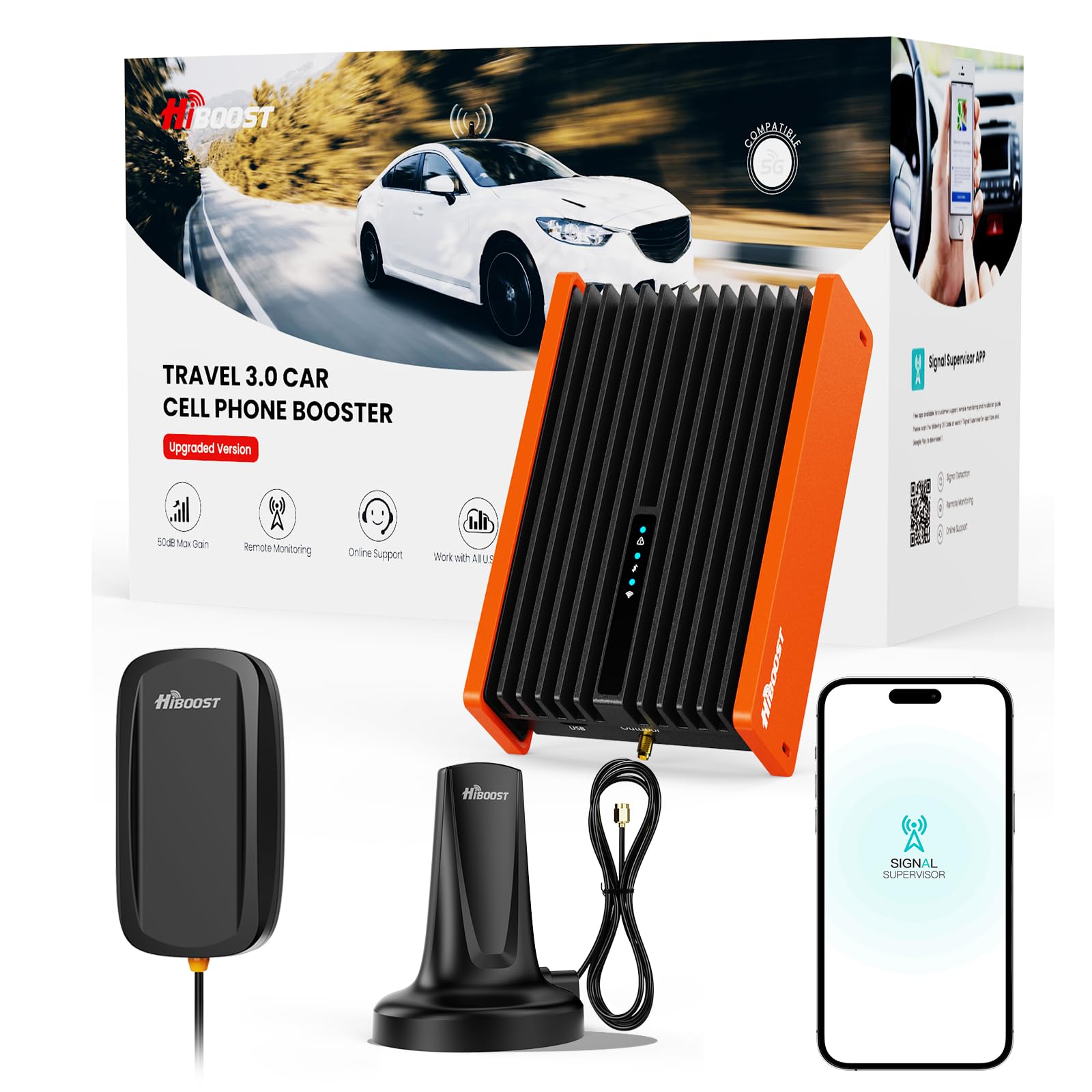
While marketed for cars and SUVs, this HiBoost kit works exceptionally well in smaller RVs and overlanding rigs. The honeycomb briquette design improves heat dissipation by 30%, which helps the booster maintain peak performance during long days of driving. It uses precision-grade 50-ohm RF connectors throughout to minimize signal loss.
The outdoor magnetic antenna is heavy-duty, dustproof, oilproof, and waterproof, and it stays firmly attached to the roof at highway speeds. The Signal Supervisor app provides live status monitoring and guides you through installation. It supports all major US carriers and the latest 5G bands.
Users report noticeable improvements, often going from 2 bars to 4 bars inside their vehicle. The only real limitation is that the antenna separation distance in a smaller vehicle can be tight, and some owners had to route the cables creatively to avoid feedback. For compact RV owners who want a powerful, modern booster with great thermal management, this is a solid mid-range choice.
Why it’s great
- Excellent heat dissipation for sustained performance
- Strong magnetic roof antenna stays secure
- Precision RF connectors for low signal loss
Good to know
- Smaller vehicle design may limit cable routing
- Power cord could be longer for some setups
- Feedback issues reported in compact cabs
7. SignalBrick Truck RV Booster
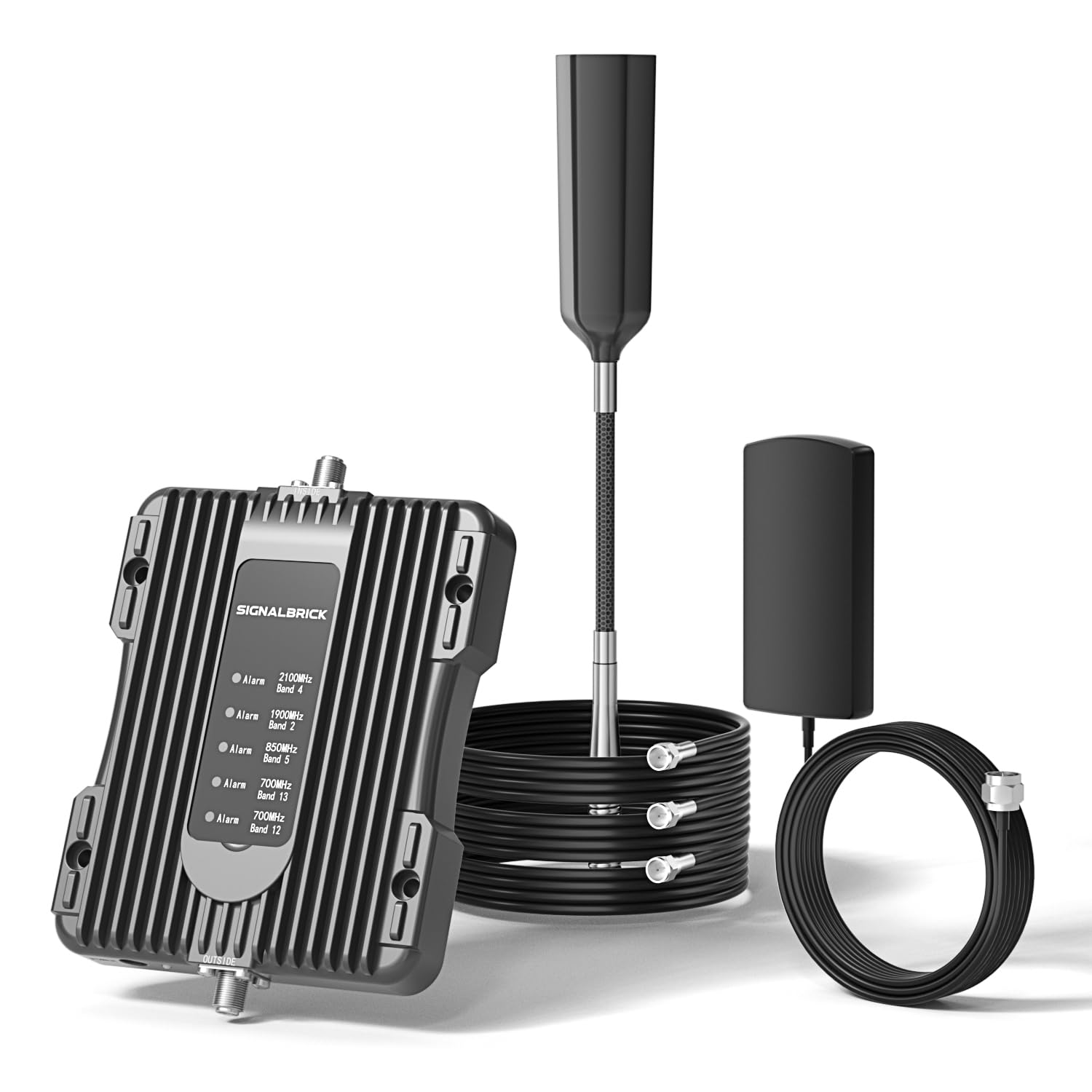
The SignalBrick booster is built like a tank, with a spring-loaded omni-directional antenna designed to resist harsh environments and extreme shaking from rough roads. The outdoor antenna is weather-resistant and built to handle dust, oil, and water. The booster comes in a custom hard case for portable use, which is a nice touch for those who move it between vehicles.
It delivers 5-8 miles of communication distance under ideal conditions, and users report boosting from 1 bar to 3-4 bars on LTE and 5G networks. It supports bands 4, 5, 12, 13, 17, 25, and 66, covering all major US carriers and Canadian providers. The kit includes a 12V DC power cord and all necessary mounting hardware.
Reviews from Canadian users are particularly strong, with many noting that it works well with Koodo, Rogers, Bell, and Telus. The build quality is often compared to boosters costing twice as much. The main drawback is that the cables could be longer for some RV setups, and the lack of an app-based monitoring tool may feel dated to tech-savvy users. It is an excellent value for those who need a tough, reliable booster.
Why it’s great
- Spring antenna withstands rough terrain
- Weather-resistant and dustproof design
- Excellent performance with Canadian carriers
Good to know
- Cables are somewhat short for large RVs
- No app-based signal monitoring
- Warranty details less transparent than competitors
8. Confixpand 50dB Booster (LPDA+Panel)

The Confixpand booster is notable for its integrated 2-in-1 design, where the indoor antenna is built into the main unit. This eliminates the need for a separate indoor panel antenna and reduces cable clutter inside the cabin. The slim chassis (170x110x25mm) can be mounted discreetly on the dashboard or center console.
It provides 50 dB of downlink gain and supports bands 12, 13, 5, 25, and 66 for 5G and 4G LTE. The outdoor antenna is a heavy-duty fiberglass omni unit designed to survive scrapes from tree branches. The built-in Automatic Gain Control (AGC) and LED indicator provide real-time feedback on signal quality.
User reviews are a mixed bag. Some users in urban fringe areas saw a 30% speed improvement, while others in deep rural areas found the improvement marginal. The all-in-one design is clever, but the fixed placement means you cannot move the indoor antenna to the optimal spot. It is a solid entry-level-to-mid-range option for those who prioritize a clean, simple installation above maximum performance.
Why it’s great
- Slim, integrated design reduces cable clutter
- AGC prevents oscillation automatically
- Heavy-duty fiberglass outdoor antenna
Good to know
- Integrated antenna limits placement flexibility
- Performance gain is lower in deep fringe areas
- Some users found improvement marginal
9. PRACOA Vehicle Booster (B0GXRDYX3Y)
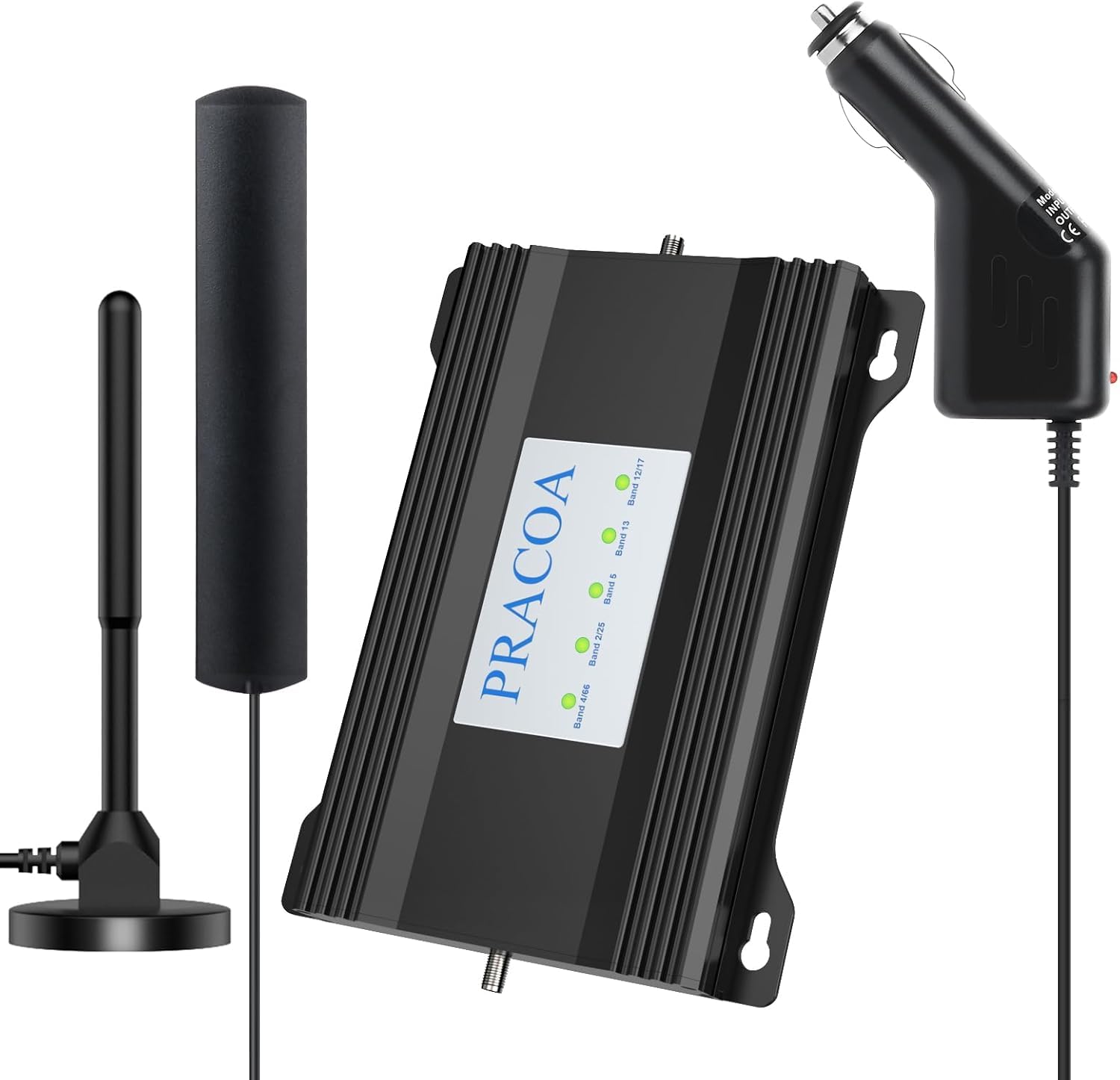
The PRACOA booster is an entry-level kit that offers a claimed 65 dB gain at a very attractive price point. It supports a wide range of bands, including 2, 4, 5, 12, 13, 17, 25, and 66, covering all major US carriers. The system includes an outdoor magnetic antenna, an indoor patch antenna, and all necessary cables.
It features Automatic Gain Control, Inactivity Mode, and Oscillation Elimination to self-adjust performance. The maximum communication distance is listed at 5-8 miles. The kit is designed for cars, trucks, SUVs, and RVs, and it supports multiple users and devices.
Customer feedback is quite positive for the price point, with an RF engineer noting an improvement from -112 dBm to -98 dBm RSRP on T-Mobile n25 after precise tower aiming. However, setup requires some technical know-how as the directional indoor antenna is only effective over a 180-degree arc. For RVers on a tight budget who are willing to tinker with placement, this is a surprisingly capable option. The included warranty (90-day replacement, 3-year limited) adds a layer of confidence.
Why it’s great
- Very cost-effective entry into cell boosting
- Wide band support for all major carriers
- AGC and oscillation elimination built in
Good to know
- Setup can be tricky and requires exact tower alignment
- Indoor antenna has a limited 180-degree coverage arc
- Cheaper cables and connectors may degrade over time
FAQ
Does a cell booster work if there is no signal at all at my campsite?
Should I get an omni-directional or directional antenna for my RV?
Will a cell booster work through a fiberglass or wood RV roof?
How important is the FCC registration requirement?
Can I use a home booster in my RV?
Final Thoughts: The Verdict
For most users, the best Cell Phone Booster For RV is the weBoost Destination RV because its directional antenna and 25-foot pole provide the highest data speeds and most reliable connection for stationary camping. If you want a rugged system that works both while driving and when parked, grab the SureCall Fusion2Go OTR for its superior uplink power and weather-tested design. And for budget-conscious RVers who still want a dependable boost, the SignalBrick Truck RV Booster offers surprising performance at an entry-level price point.

Mo Maruf
I created WellFizz to bridge the gap between vague wellness advice and actionable solutions. My mission is simple: to decode the research and give you practical tools you can actually use.
Beyond the data, I am a passionate traveler. I believe that stepping away from the screen to explore new environments is essential for mental clarity and physical vitality.