Our readers keep the lights on and my smoothie glass nicely filled. As an Amazon Associate, I earn from qualifying purchases.
Choosing the wrong solar charge controller means watching your battery bank drain faster than it should, wasting the very energy your panels worked so hard to collect. Whether you’re managing an off-grid cabin, a weekend RV trip, or a critical remote setup, the controller is the brain of your solar system, making split-second decisions about voltage and current. A mismatch in amp rating or charging algorithm can silently sabotage your entire power investment, leaving you with dead batteries and a frustrating troubleshooting session.
I’m Mohammad Maruf — the founder and writer behind WellFizz. My buying guides are built on deep market research, cross-referencing hundreds of real-world user reports and technical specifications to separate marketing hype from genuinely reliable hardware.
This guide distills the essential differences between PWM and MPPT technology and ranks five controllers by real-world charging capability. Ready to find the best solar charge controller for your off-grid or mobile power setup.
How To Choose The Best Solar Charge Controller
Selecting a solar charge controller starts with understanding your battery chemistry and solar array voltage. A controller that works beautifully for a 12V lead-acid system may fail completely with a 48V lithium bank, so matching the technology to your specific hardware is non-negotiable.
MPPT vs. PWM: The Core Technology Decision
Maximum Power Point Tracking (MPPT) controllers convert excess voltage into additional current, making them ideal for higher-voltage panels or cold climates where panel voltage rises. Pulse Width Modulation (PWM) controllers act like a simple switch, dragging panel voltage down to battery voltage — they work reliably on small systems where panel and battery voltages are closely matched, but they waste any voltage surplus. MPPT units typically cost more but recover the difference in higher harvest within a few months on systems above 200W.
Amp Rating and Array Sizing
A controller’s amp rating sets the maximum current it can handle from your solar array. For a 12V system, the rule of thumb is to divide total panel wattage by 12 to get the amp requirement — a 400W array, for example, needs at least a 33A controller, making 40A the safe choice. Oversizing a controller is perfectly fine and allows for future panel expansion; undersizing leads to overheating, derating, or shutdown on sunny days.
Battery Compatibility Profiles
Modern controllers offer selectable presets for Gel, AGM, Flooded, and Lithium batteries. The critical detail with Lithium is the absorption voltage: many budget PWM controllers lack a user-adjustable setting for LiFePO4, forcing you into a preset voltage that may not fully charge or may overcharge the battery. If you own a lithium battery, verify the controller has a dedicated Lithium mode or a user-programmable voltage range.
Quick Comparison
On smaller screens, swipe sideways to see the full table.
| Model | Category | Best For | Key Spec | Amazon |
|---|---|---|---|---|
| Renogy Rover 40A MPPT | MPPT | Full off-grid performance with Bluetooth | 99% Tracking Efficiency | Amazon |
| Renogy Voyager 20A PWM | PWM | Outdoor marine and RV wet environments | IP67 Waterproof Rating | Amazon |
| BougeRV Li 30A PWM | PWM | Multi-battery compatibility on a budget | 30A / 55V Max Input | Amazon |
| 80A PWM YKYWTRWL | PWM | High-amperage lead-acid banks | 80A / 1920W Capacity | Amazon |
| Bateria Power 10A MPPT | MPPT | Compact portable and motorcycle systems | 10A / 30 Voc Limit | Amazon |
In‑Depth Reviews
1. Renogy Rover 40A MPPT Solar Charge Controller with Bluetooth

This is the benchmark for serious off-grid systems. The Renogy Rover 40A uses genuine MPPT technology with a tracking efficiency that reaches 99%, converting high-voltage panel input into usable charging current far more effectively than any PWM unit in this lineup. The 4-stage charging profile (Bulk, Absorption, Float, Equalization) paired with a user-customizable Lithium mode means you can dial in the exact absorption voltage for your LiFePO4 bank without guessing. Build quality is reinforced by an insulated plastic housing and a fanless heat sink that keeps operation silent — no whirring fans to fail after a dusty season.
The bundled BT-2 Bluetooth module transforms the unit into a fully monitored station. The Renogy DC Home App provides real-time datalogging of PV input, battery voltage, and historical energy harvest, which eliminates the need for a separate battery monitor. The controller also includes a 0-volt battery activation feature, letting it wake deeply discharged lithium batteries that other controllers would reject as dead. For a 400W to 520W array at 12V, the 40A rating offers comfortable headroom without pushing the unit to its thermal limit.
User reports consistently highlight the 20-30% gain over previous PWM controllers, especially on overcast days where panel voltage rises. The integrated load terminals with 5 programmable modes allow direct DC appliance control, making this a true system hub. The only practical catch is the premium price, but for anyone building a permanent off-grid or RV power system, the Rover pays for itself within a season through higher harvest alone.
Why it’s great
- Industry-leading MPPT tracking efficiency delivers noticeably more daily watt-hours than PWM
- Bluetooth app monitoring removes the guesswork from battery state of charge
- User-adjustable voltage parameters for custom lithium profiles
Good to know
- Premium price point puts it out of reach for small portable budgets
- Bluetooth range is limited to about 30-40 feet through walls
2. Renogy Voyager 20A PWM Solar Charge Controller

When your controller has to live outside, exposed to rain, spray, or even accidental submersion, the Voyager 20A is the right tool. Its IP67 rating means the electronics are completely sealed against dust and water ingress, a feature nearly impossible to find in PWM controllers at this price tier. The 4-stage PWM charging (Bulk, Absorption, Float, Equalization) is well-tuned for lead-acid chemistry, and it automatically detects 12V or 24V system voltage. The backlit LCD cycles through PV current, battery voltage, and cumulative energy generated — useful data without needing a phone app.
Multiple real-world reports confirm the Voyager survived being submerged in mud and water during a flood and kept running afterward, a testament to the sealing quality. For RVs and boats where condensation and humidity are constant, the waterproof housing eliminates the corrosion failures common in open-terminal controllers. The Lithium activation feature handles LiFePO4 batteries, though the PWM architecture means you lose the voltage conversion advantage of MPPT — this unit is about ruggedness, not maximum harvest efficiency.
A known nuance: the battery voltage reading can drift when the external temperature sensor is connected, particularly on lead-acid banks, so pairing with an external battery monitor gives you more accurate state-of-charge data. The lack of status LEDs means you rely entirely on the LCD, which has a long auto-scroll interval that some users find slow. For a simple, reliable, weatherproof controller on a small to medium RV or boat, this is the most resilient option in its class.
Why it’s great
- Fully sealed IP67 enclosure survives rain, spray and accidental submersion
- 4-stage PWM charging protects battery health with proper float maintenance
- Accurate PV input and battery data shown on the LCD display
Good to know
- Battery voltage reading shows error when temp sensor is attached to lead-acid batteries
- PWM architecture sacrifices up to 20% harvest compared to MPPT in cool climates
3. BougeRV Li 30A PWM Solar Charge Controller
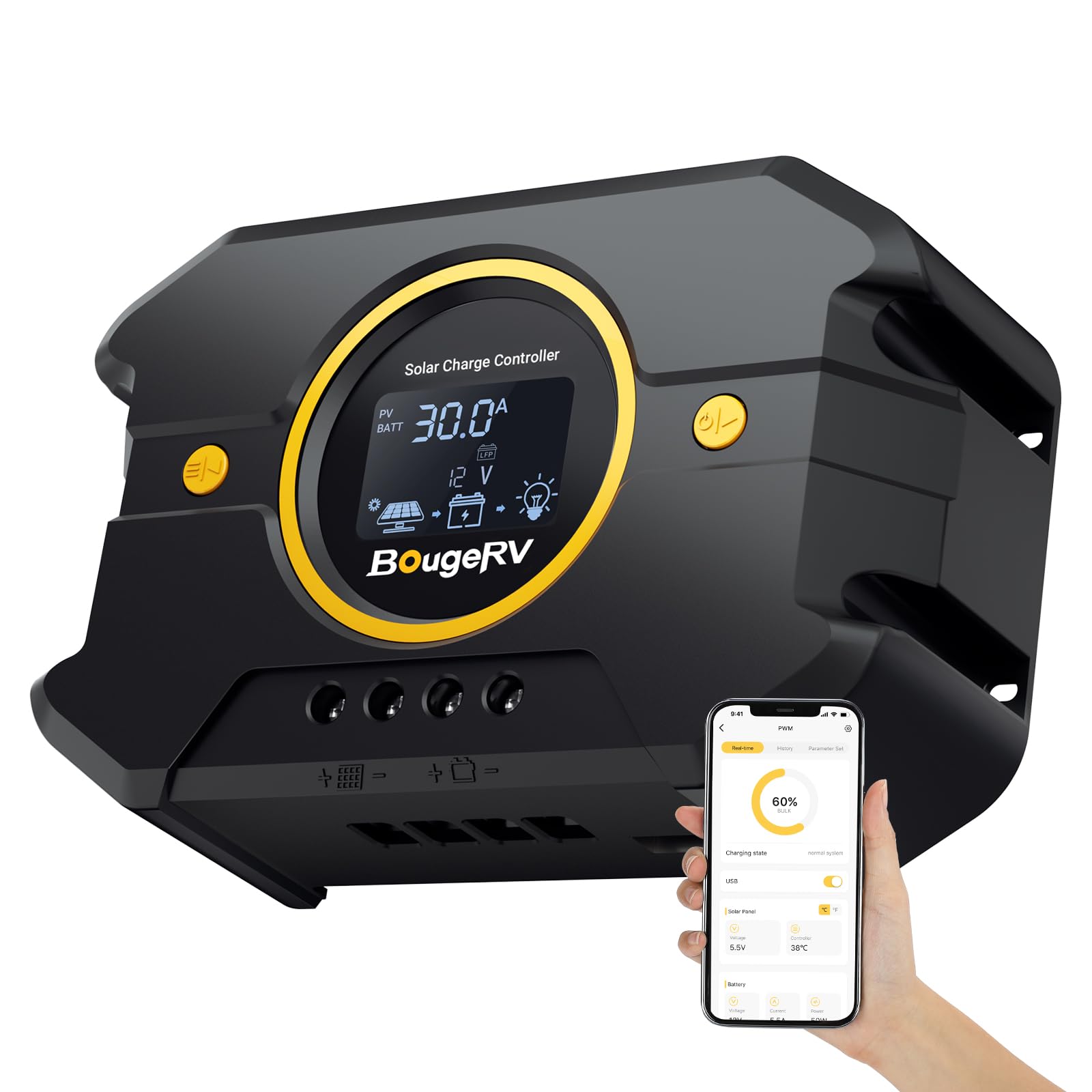
The BougeRV Li 30A packs a wide battery compatibility list into a budget-friendly PWM package. It explicitly supports LiFePO4, Ternary Lithium, and LTO chemistries, each with dedicated LCD icons so you never have to guess which preset you selected. The backlit display cycles through PV input and battery voltage every three seconds, and it includes a lithium jump-start function that can revive a deeply discharged battery — a feature often missing from entry-level controllers. With a 55V max PV input and up to 900W on 24V, it handles small to medium solar arrays without pushing its thermal limits.
The included spade terminals are a thoughtful addition for neat wiring, but multiple users report that the screw-down wire clamps are too small for 10 AWG wire, making a tight connection difficult. Several reviews mention melted wires at the connection point when the screws were not torqued down properly, so high-quality ring terminals or a slightly smaller wire gauge are recommended for safety. The plastic housing feels lightweight, but the unit holds up well in dry indoor environments like garages, RV cabinets, and sheds.
For its price, the BougeRV Li 30A delivers solid PWM regulation with excellent lithium support that many controllers in this tier lack entirely. The Achilles’ heel is the small terminal size, which demands careful installation. If you are willing to take the extra step of using crimped ring terminals and a proper screwdriver, this unit offers exceptional value for a mixed-battery fleet.
Why it’s great
- Dedicated LCD settings for LiFePO4, Ternary, and LTO lithium batteries
- Jump-start function revives over-discharged lithium batteries
- Budget-friendly price for a 30A PWM unit
Good to know
- Wire terminals are too small to comfortably fit 10 AWG stranded wire
- Several user reports of melted connections when screws were not fully tightened
4. 80A PWM Solar Charge Controller (YKYWTRWL)

This 80A PWM controller is built for oversized lead-acid battery banks where raw current capacity matters more than advanced charging algorithms. It handles up to 1920W of panel input on a 24V system, making it one of the highest-amperage PWM options available without jumping to a commercial-grade industrial unit. The ABS plastic shell is reinforced with an aluminum heat sink that stays surprisingly cool even at 25A continuous output, a sign of adequate thermal engineering for its class. The dual USB outputs allow direct device charging, though the 5V output is best suited for phones rather than high-draw gadgets.
This is not an MPPT controller despite vague marketing text. Users who expected MPPT performance were disappointed, but those who understood it as a high-current PWM unit found it reliable for running inverters and deep well pumps. The load output is rated at 300W maximum rather than 80A, which trips up some buyers trying to power heavy DC loads directly from the load terminals. The manual is famously poor — nearly unreadable with confusing diagrams — but the controller itself is straightforward: connect battery first, then panels, and adjust the load mode with the single button.
The main reliability concern is a reported failure rate that includes at least one fire incident under over-50% load. Multiple reviews mention units that stopped charging after a few weeks, and return disputes are not uncommon. For users who have had good units, the 80A PWM has lasted for years in off-grid desert cabins. If you need high PWM amperage for a 24V lead-acid bank and you understand the risk, this is a capable controller — but for critical systems, the premium Renogy MPPT is a safer investment.
Why it’s great
- Rare 80A PWM capacity handles large 24V battery banks up to 1920W
- Thick aluminum heat sink stays cool even under sustained high current
- Works well with large lead-acid banks in off-grid desert and cabin setups
Good to know
- Not MPPT technology despite misleading marketing claims in the manual
- Non-trivial failure rate reported including at least one melted terminal incident
5. Bateria Power 10A MPPT Solar Charge Controller (SunRock 10)

The Bateria Power SunRock 10 proves that MPPT technology can be shrunk down to a truly portable footprint. Measuring just 3.7 inches by 2.4 inches and barely an inch thick, this controller fits into a motorcycle side case or a portable solar kit without adding bulk. It uses genuine MPPT tracking that, according to user testing, delivers roughly 4A on a 100W panel compared to 3A on a typical PWM — a 33% improvement in harvest that justifies the upgrade. The SAE connector system makes it truly plug-and-play, with two extension cables included for flexible panel placement.
The controller is built for 12V batteries only, with a strict 30Voc maximum input voltage, so it is limited to single 12V panels or small parallel arrays. It supports Gel, AGM, Flooded, and LiFePO4 batteries, though the user must select the battery type during setup. The LCD and LED indicator light provide basic status feedback, but the screen is tiny and hard to read in direct sunlight. A small but important detail from ham radio users: the controller generates RF noise on certain frequencies, but a toroid choke on the power cable eliminates the interference entirely.
For small applications — keeping a motorcycle battery topped off, maintaining a boat starter battery, or powering a portable ham radio station — the SunRock 10 delivers real MPPT benefits in a form factor no other controller matches. The 2W always-on draw on early units was concerning, but later firmware revisions seem to have fixed the idle consumption. If your system exceeds 150W panel capacity, step up to a larger controller, but for compact 12V needs, this is the most efficient ultra-portable option available.
Why it’s great
- True MPPT tracking in a tiny, portable package ideal for motorcycles and portable kits
- SAE quick-connectors make setup and breakdown fast without tools
- Delivers roughly 33% more charging current than a comparable PWM unit
Good to know
- Limited to 12V batteries and 30Voc max panel input
- Generates RF noise that may interfere with ham radio equipment without a toroid filter
FAQ
Do I need MPPT or PWM for a small 100W portable solar kit?
Can I use a 24V-rated controller on a 12V battery system?
What happens if I exceed the controller’s max solar input voltage (Voc)?
Final Thoughts: The Verdict
For most users, the best solar charge controller winner is the Renogy Rover 40A MPPT because it combines the highest tracking efficiency in this roundup with Bluetooth monitoring and full battery flexibility. If you need a weatherproof controller that can live outside without shelter, grab the Renogy Voyager 20A PWM. And for a compact portable system where every ounce matters, nothing beats the Bateria Power SunRock 10 MPPT.

Mo Maruf
I created WellFizz to bridge the gap between vague wellness advice and actionable solutions. My mission is simple: to decode the research and give you practical tools you can actually use.
Beyond the data, I am a passionate traveler. I believe that stepping away from the screen to explore new environments is essential for mental clarity and physical vitality.