Our readers keep the lights on and my smoothie glass nicely filled. As an Amazon Associate, I earn from qualifying purchases.
Nothing ruins a tiling project faster than adhesive that skims over, slides off the trowel, or dries before your tile is pressed into place. The difference between a floor that feels solid for decades and one that develops hollow spots within months often comes down to the paste you spread before the tile ever meets the subfloor.
I’m Mohammad Maruf — the founder and writer behind WellFizz. I’ve spent countless hours digging through technical specs, viscosity data, and real-world adhesion reports to build this guide around what actually determines bond strength in ceramic tile adhesives.
Whether you’re laying fresh kitchen flooring, patching a bathroom wall, or repairing a chipped vanity surface, choosing the right product is critical. This guide cuts through the confusion to deliver the best ceramic tile adhesive for your specific project and skill level.
How To Choose The Best Ceramic Tile Adhesive
Selecting the right adhesive isn’t about picking the strongest tube on the shelf. It’s about matching the adhesive’s working time, viscosity, and water resistance to your specific subfloor material, tile size, and the drying conditions of your room.
Working Time vs. Drying Speed
Premixed mastics like Henry 314 offer a long open time, which is forgiving when you need to adjust a tile’s position. But if you work too slowly, the adhesive can form a skin before the tile is fully embedded. Fast-drying repair pastes, such as the Magic Chems grout filler, cure in 20 to 30 minutes — ideal for small touch-ups but useless for a full floor installation because they set before you can spread the next row.
Water Resistance and Subfloor Compatibility
Bathroom and kitchen adhesives must resist moisture without breaking down. Check for labels like “water repellent” or “water resistant” — Henry’s #430 rates as water repellent and carries ASTM E 84 Class A fire ratings, making it safe for damp subfloors. Concrete subfloors need a higher-bond, alkali-resistant product, while wood subfloors demand a flexible adhesive that won’t crack with seasonal expansion.
Color Matching and Repair Kits
For chipped porcelain or cracked ceramic tiles, standard mastic won’t hide the damage. Specialized repair kits like the MendMight Porcelain Repair Kit include multiple pigments to blend into the epoxy paste, allowing you to match white, beige, gray, and even marble-like tones. The trade-off is that color matching requires patience — you’ll often need to mix small test batches to get an invisible finish.
Quick Comparison
On smaller screens, swipe sideways to see the full table.
| Model | Category | Best For | Key Spec | Amazon |
|---|---|---|---|---|
| Henry 314 Premixed Mastic | Premixed Mastic | Small wall and floor tile installations | 1-quart, medium viscosity, water resistant | Amazon |
| Henry #430 Tile Adhesive | Liquid Mastic | Moisture-prone subfloors and vinyl tile | 0.51-quart, dries clear, ASTM E 84 Class A | Amazon |
| Ankita Color Match Repair Kit | Repair Kit | Fixing chips and cracks on ceramic floor tiles | Paste form, 7 pigments, water resistant | Amazon |
| MendMight Porcelain Repair Kit | Epoxy Putty | Detailed color-matched tub and sink repairs | 5.6-ounce putty, 6 pigments, sandable finish | Amazon |
| Magic Chems Grout Repair Kit | Grout Filler | Refreshing narrow grout lines on bathroom walls | 8.8-ounce paste, silicone-based, fast dry | Amazon |
In‑Depth Reviews
1. Henry 314 Premixed Mastic Adhesive

The Henry 314 is a classic premixed mastic that strikes the right balance between a long working time and a strong, water-resistant hold. Its medium viscosity spreads smoothly with a notched trowel and remains tacky long enough to adjust tiles before the bond sets, which makes it particularly forgiving for first-time tilers laying a wall or small floor area.
Users consistently praise its grab strength on concrete and plastic subfloors, though the drying speed demands fast execution — reviewers note that it can crumble if left exposed too long before the tile is pressed in. The 1-quart pail covers roughly 10 to 12 square feet at standard notch depth, making it ideal for single-bathroom backsplashes or small counter repairs rather than whole-room installations.
The main downside is the container’s lid durability. Several customers reported split lids and dried top layers from shipping damage. Despite that, the usable product underneath performed to expectation, and Henry’s customer service handled the replacement requests quickly. For a mid-range, all-around adhesive that works on walls, floors, and countertops, this is the most versatile starting point.
Why it’s great
- Medium viscosity spreads easily and holds tile in place without sagging
- Water-resistant formula suitable for damp bathrooms and kitchens
- Long open time allows tile adjustment before the bond sets
Good to know
- Dries quickly once exposed — you must tile fast or the mastic forms a skin
- Weak lid seals can result in damaged product during shipping
2. Henry #430 Tile Adhesive

The Henry #430 is a liquid adhesive designed primarily for flooring applications, with a unique feature set that sets it apart from standard mastics: it dries clear, it actively reduces tile slippage on vertical or sloped subfloors, and it carries ASTM E 84 Class A and Class I ratings for flame and smoke spread. Those ratings make it a safer choice when tiling near heat sources or in commercial-adjacent spaces.
Its moisture-repellent chemistry also means it bonds securely to subfloors with slightly elevated moisture content, which is common in basements and slab-on-grade installations. Several reviewers noted that it remains sticky even after 24 hours on wood subfloors, giving you an extra day to finish a staggered layout. That same long drying time, however, can frustrate users who want to walk on the floor the same day — one reviewer mentioned that even the thinnest coat took “forever” to dry clear before they could set the tile.
The 0.51-quart pail is compact and best suited for small patches rather than full-room coverage. Some users found the liquid consistency too runny for vertical wall tile, but on horizontal wood or concrete floors its self-leveling behavior simplifies the troweling step. If your priority is a moisture-safe, fire-rated bond for a small floor repair, this is a smart, specialized choice.
Why it’s great
- Dries clear for a clean finish around visible tile edges
- Moisture resistant with Class A fire rating (ASTM E 84)
- Extended tack life helps with slow, careful tile layouts
Good to know
- Very thin consistency that can run off vertical wall applications
- Small 0.51-quart size limits use to patches and small areas
3. Ankita Tile Repair Kit (Color Match)
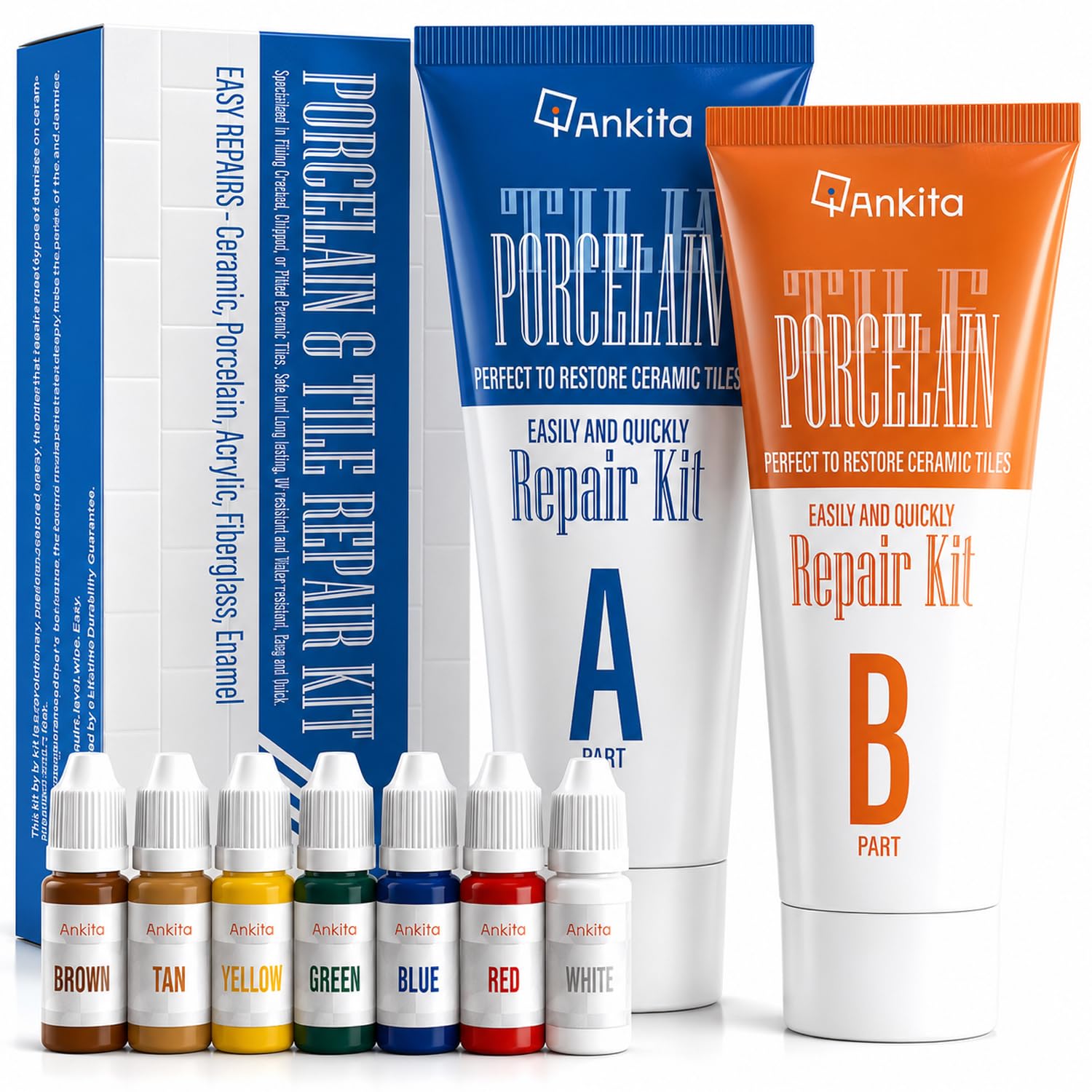
The Ankita Color Match Tile Repair Kit is a paste-based system that combines a super strong adhesive with seven pigments — white, beige, gray, almond, blue, black, and a universal tone — to help you blend repairs into existing ceramic or porcelain tiles. It addresses the most common frustration of tile repair: making the filler invisible against the surrounding surface.
User feedback highlights that the adhesion is genuinely strong, with one reviewer successfully filling scratches and thin spots in an old enamel sink. However, achieving a smooth texture requires sanding, and even then the finish can feel rougher than the original glaze. Another reviewer noted that their color-match shifted to a cream shade over time, suggesting the pigments may not be UV-stable in all lighting conditions. The curing process takes several hours, limiting the kit to small repairs you can leave untouched overnight.
The kit includes only Part A and Part B for mixing, and the instructions are minimal. Beginners may struggle with getting the pigment ratio right on the first try. But for the price, you get a dedicated ceramic repair tool that handles chips, cracks, and scratches across multiple surface types — including acrylic and laminate — making it a versatile addition to any DIY toolkit.
Why it’s great
- Seven included pigments allow close color matching for common tile shades
- Strong permanent bond that resists water after full cure
- Works on ceramic, porcelain, acrylic, and laminate surfaces
Good to know
- Color can shift over time or cure to a different tone than intended
- Sanding required to smooth the repair, which may leave visible texture
4. MendMight Porcelain Repair Kit
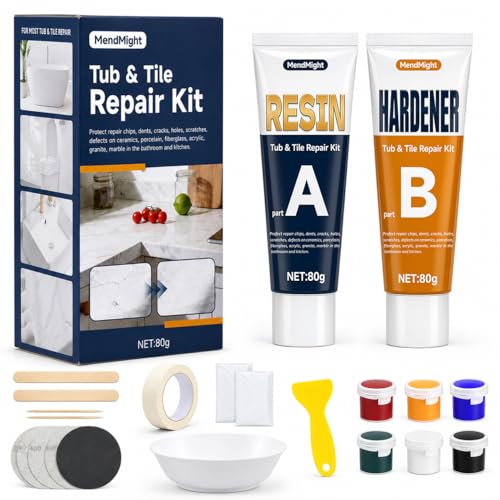
The MendMight Porcelain Repair Kit takes a different approach than paste-based fillers: it uses a two-part epoxy putty that hardens into a sandable, water-resistant finish after curing. The kit includes six tint colors (white, black, red, blue, yellow, green) that you mix directly into the epoxy to create custom shades from off-white to stone and marble-like tones.
Users report that the putty fills hairline cracks and chips with impressive precision. One reviewer used it to repair a white tile crack so seamlessly that the damage became invisible after sanding. Another dragged a small amount of gray color across a white base to mimic a marble pattern on an engineered countertop. The sanding step is critical — the included multi-grit paper lets you level the repair flush with the tile surface, but deep chips require thin, layered applications to avoid a pitted final surface.
Color matching is the trickiest part. The six pigments offer broad flexibility, but mixing beige or almond from scratch takes trial and error, and the instructions don’t include ratio guides. For renters needing a move-out touch-up or homeowners fixing a single tile, the MendMight kit delivers professional-looking results if you’re patient with the color blending process.
Why it’s great
- Sandable epoxy creates a flush, nearly invisible repair surface
- Six mixable pigments allow custom color matching beyond basic white
- Water-resistant finish holds up in wet tub and sink environments
Good to know
- Color mixing requires patience and trial since no ratio guide is included
- Deep repairs need multiple thin layers to avoid a pitted final surface
5. Magic Chems Tile Grout Repair Kit
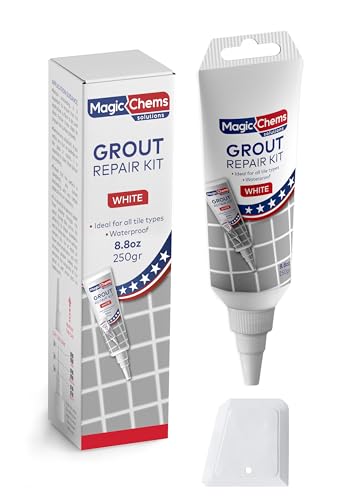
The Magic Chems Grout Repair Kit is not an adhesive in the traditional mastic sense — it is a silicone-based paste designed to fill, recolor, and seal existing grout lines rather than bond new tiles to a subfloor. Its primary use case is cosmetic restoration: refreshing yellowed or cracked grout in bathroom showers, kitchen backsplashes, and floor joints.
Users report that the paste applies easily from the tube, stays thick enough to stay in place on vertical wall joints, and dries hard within 20 to 30 minutes. A single 8.8-ounce tube covers roughly 50 square feet of standard-width grout lines, making it extremely budget-friendly compared to re-grouting an entire room. The included spatula helps press the paste into narrow joints and scrape away excess before it sets.
The main limitation is that this kit only addresses the grout itself — it cannot repair chipped tiles or replace failing adhesive underneath. The white shade works well for bright bathroom tiles, but the ivory version came labeled inconsistently (both beige and ivory on opposite sides of the box), and some users found the ivory tone more yellow than expected. For a fast, easy grout facelift at a low entry cost, this kit delivers consistent results.
Why it’s great
- Fast 20-30 minute dry time allows same-day foot traffic restoration
- High coverage rate of roughly 50 sq ft per tube reduces overall cost
- Thick silicone paste stays in vertical grout lines without sagging
Good to know
- Only addresses grout restoration, not tile adhesion or chip repair
- Color labeling inconsistencies between beige and ivory versions
FAQ
Can I use premixed mastic for floor tile or only wall tile?
How long should I wait before grouting after applying adhesive?
Why does my tile adhesive stay sticky for days?
Can I apply ceramic tile adhesive over painted drywall?
How do I fix a chipped ceramic tile without replacing it?
Final Thoughts: The Verdict
For most users, the best ceramic tile adhesive winner is the Henry 314 Premixed Mastic because it offers the best balance of working time, water resistance, and ease of use for small-to-medium wall and floor projects. If you need a moisture-safe bond with fire ratings for a basement floor repair, grab the Henry #430 Tile Adhesive. And for color-matched chip repairs on porcelain or ceramic surfaces, nothing beats the sandable precision of the MendMight Porcelain Repair Kit.

Mo Maruf
I created WellFizz to bridge the gap between vague wellness advice and actionable solutions. My mission is simple: to decode the research and give you practical tools you can actually use.
Beyond the data, I am a passionate traveler. I believe that stepping away from the screen to explore new environments is essential for mental clarity and physical vitality.