Our readers keep the lights on and my smoothie glass nicely filled. As an Amazon Associate, I earn from qualifying purchases.
Racing drones are built for one thing: raw speed and split-second precision. Unlike camera drones that prioritize stable footage, these quads shed every gram of unnecessary weight to deliver the kind of agile, pulse-pounding flight that turns empty fields into personal racetracks. The difference between winning a gate and clipping it often comes down to your choice of frame, motor, and video transmission system.
I’m Mohammad Maruf — the founder and writer behind WellFizz. Every drone below was selected after analyzing hundreds of hours of flight data, customer durability reports, and real-world performance specs to find the machines that actually hold up to repeated racing and freestyle punishment.
Whether you are chasing your first gate or looking to upgrade your rig, this guide breaks down the technical specs and real-world crash tolerance of the best drones for racing on the market today.
How To Choose The Best Drone For Racing
Racing drones operate in a different world than aerial photography platforms. The key is understanding that every gram of weight and every millisecond of latency matters when you are threading through gates at sixty miles per hour. Focus on the specs that directly affect your ability to react and recover.
Frame Size and Propeller Diameter
The frame size determines the propeller diameter, and the prop diameter dictates how the drone handles air. Smaller 65mm and 2.5-inch “whoop” drones excel indoors and in tight, technical courses because they can change direction instantly. Larger 5-inch frames carry more momentum, making them faster on open tracks but harder to maneuver through sharp turns. Match the frame size to your typical flying environment, not your ambition.
Motor KV Rating and Battery Voltage
Motor KV — the number of RPM per volt — tells you how fast a motor spins. Higher KV motors (like 27000KV on a tiny whoop) deliver explosive acceleration on 1S batteries, while lower KV motors on a 5-inch rig running 6S produce smoother torque. A 16000KV motor on a 1S drone will feel sluggish compared to a 27000KV motor, but the same 16000KV motor on a 2S setup becomes a rocket. Always evaluate KV in the context of the battery voltage you plan to use.
Video Transmission and Protocol
Analog systems offer the lowest latency and the broadest compatibility with budget goggles, making them the standard for serious racing. Digital systems like Walksnail and DJI deliver crystal-clear video but introduce slightly more processing lag and are harder on the wallet. For competitive racing, analog is still the tool of choice. For freestyle and casual racing, digital clarity often wins. And do not ignore the receiver — ExpressLRS (ELRS) has become the gold standard for range and packet rate over Frsky or Flysky.
Quick Comparison
On smaller screens, swipe sideways to see the full table.
| Model | Category | Best For | Key Spec | Amazon |
|---|---|---|---|---|
| DJI Avata 2 Fly More Combo | Cinewhoop/FPV | Immersive freestyle racing | 4K/60fps, 155° FOV, Propeller Guards | Amazon |
| GEPRC Vapor-X5 HD O4 Pro | 5-inch Freestyle | High-speed freestyle racing | DJI O4 Air Unit Pro, 5mm Arms | Amazon |
| DJI Neo 2 Motion Fly More Combo | Beginner FPV | Entry-level FPV racing | 4K, RC Motion 3, Obstacle Sensing | Amazon |
| CADDXFPV Walksnail Avatar Pro Kit | VTX Upgrade | Upgrading analog to digital | 1080p/60fps, 4km Range, 22ms Latency | Amazon |
| BETAFPV ELRS V3 Air65 | Tiny Whoop | Indoor racing and practice | 17.3g, 27000KV, 5.82:1 Thrust Ratio | Amazon |
| BETAFPV Cetus Pro FPV Kit | Beginner Kit | Learning the basics of FPV | Altitude Hold, Turtle Mode, 3 Flight Modes | Amazon |
| EMAX Tinyhawk 2 Freestyle | 2.5-inch Freestyle | Outdoor freestyle on a budget | 2S, 7000KV, 200mw VTX | Amazon |
| EMAX Tinyhawk 2 RTF Kit | Beginner Kit | Complete starter racing kit | Includes goggles and controller | Amazon |
| EMAX Tinyhawk 2 Indoor (New Model) | Indoor Whoop | Indoor FPV training | 1-2S, 16000KV, RunCam Nano 2 | Amazon |
In‑Depth Reviews
1. DJI Avata 2 Fly More Combo

The DJI Avata 2 sets a new standard for immersive racing and freestyle. Its integrated propeller guards let you fly confidently in tighter spaces than any open-prop 5-inch drone, while the 1/1.3-inch sensor captures crisp 4K/60fps footage with a 155-degree field of view that makes every dive feel cinematic. The RC Motion 3 controller translates hand gestures into fluid flight commands, dropping the learning curve significantly for pilots moving from video games to real gates.
At roughly 23 minutes of battery life in relaxed flight, the Avata 2 gives you more airtime per pack than most racing drones, though aggressive throttle punches will drain it faster. The 100 Amp Hour battery rating in the specs is a clear data error — the actual Intelligent Flight Battery delivers about 30 Wh, providing solid endurance for a cinewhoop. DJI’s Goggles 3 offer a crisp, low-latency feed that keeps your reactions sharp even through tight gaps.
This drone is not built for competitive racing against purpose-built 5-inch quads, but for the vast majority of pilots who want a blend of speed, safety, and cinematic quality, it is the most complete package available. The Easy ACRO mode lets you execute flips and rolls with a single stick input, making it a joy for both new FPV pilots and experienced flyers looking for a reliable, durable machine.
Why it’s great
- Built-in propeller guards allow indoor flying without fear
- 155-degree FOV camera delivers immersive POV footage
- Motion controller makes learning FPV intuitive and fast
Good to know
- Battery life drops to ~17 minutes during aggressive flying
- Not designed for competitive gate racing against 5-inch builds
- Requires DJI Goggles 3 or N3 for full FPV experience
2. GEPRC Vapor-X5 HD O4 Pro

The GEPRC Vapor-X5 is a purpose-built 5-inch freestyle machine that combines the DJI O4 Air Unit Pro with GEPRC’s own SPEEDX2 E-series motors for smooth, powerful thrust. The 5mm carbon fiber arms are noticeably thicker than standard frames, giving this quad the rigidity needed to survive sketchy landings and unexpected branch encounters. The CNC aluminum lens housing on the O4 Pro camera protects the sensor while adding a premium feel.
Equipped with a 1300mAh 6S battery, the Vapor-X5 delivers punchy climbs and quick directional changes that make it a blast on open freestyle courses. The front lip design on the frame provides extra lens protection, a smart touch that saves your camera in head-on impacts. Some users report that motor shafts are aluminum rather than titanium, which can snap on hard strikes — a known compromise to keep weight down. The drone comes pre-configured with ELRS 2.4G and GPS, so binding and satellite lock are straightforward.
This is not a beginner quad. The power-to-weight ratio on 6S requires a pilot who understands throttle management and PID tuning. But for intermediate and advanced pilots seeking a high-quality bind-and-fly that feels custom-built, the Vapor-X5 delivers exceptional video clarity and flight characteristics. The battery lead length is something to watch — trimming it or securing it with a strap prevents prop strikes during aggressive freestyle.
Why it’s great
- Thick 5mm carbon fiber arms provide serious crash durability
- DJI O4 Pro camera delivers exceptional low-light video
- Pre-activated components reduce setup hassle
Good to know
- Motor shafts are aluminum and can snap on hard impacts
- Battery leads may need shortening to avoid prop strikes
- Requires advanced soldering skills for motor or VTX repairs
3. DJI Neo 2 Motion Fly More Combo
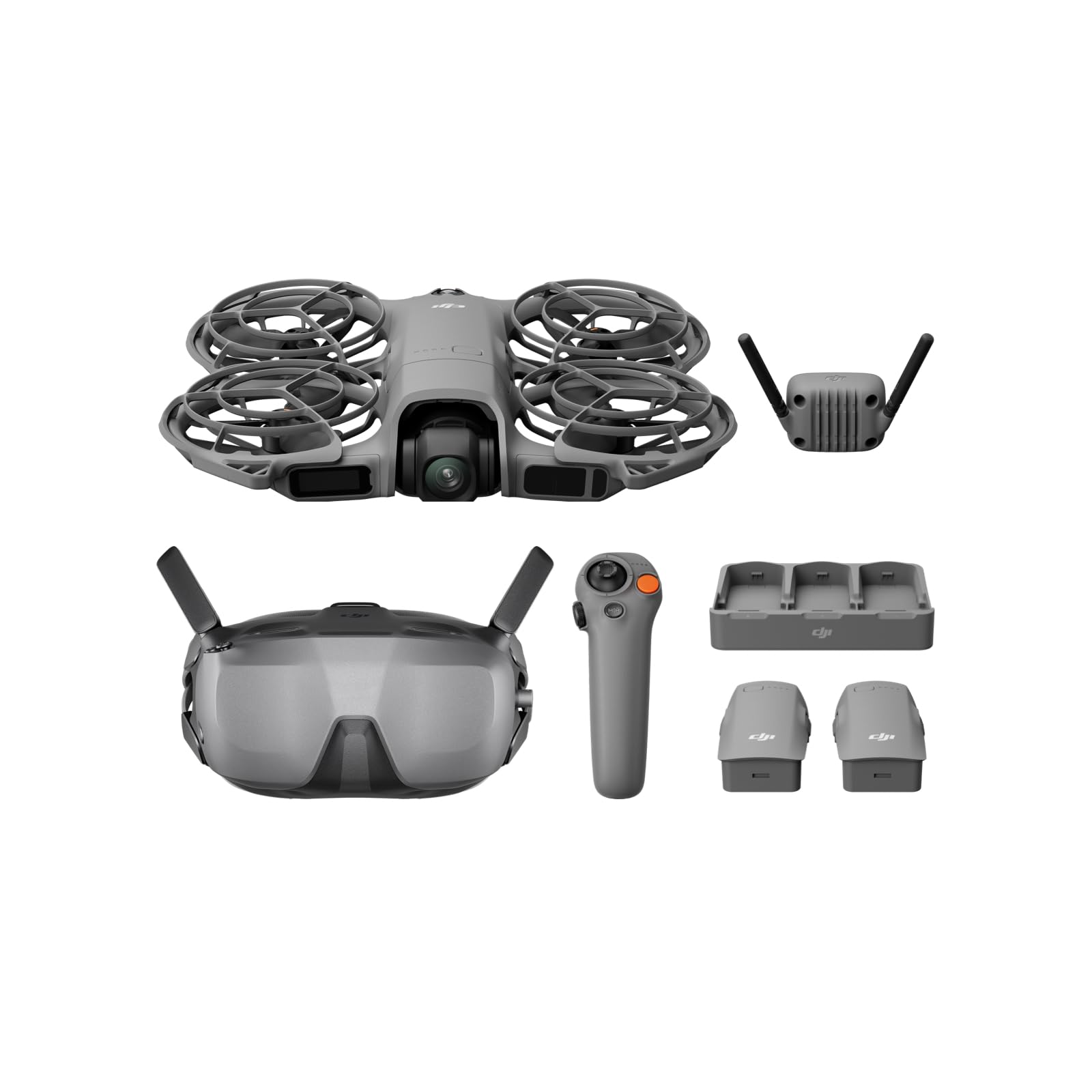
The DJI Neo 2 is the lightest true FPV drone in this roundup at just 151 grams, making it C0 certified and exempt from most registration requirements. It pairs the RC Motion 3 controller with Goggles N3 for a complete immersive racing experience that feels more like a video game than traditional piloting. The Motion controller translates wrist tilts into banked turns, which is surprisingly intuitive for new pilots.
The camera records 4K video with smooth stabilization, though the smaller sensor doesn’t match the Avata 2 or a dedicated GoPro in low light. The omnidirectional obstacle sensing is a genuine safety net that prevents crashes when you misjudge a gap — a feature almost unheard of on racing-oriented drones. The Fly More Combo includes three batteries and a charging hub, recognizing that short flight times around 10 minutes per pack are the trade-off for the ultra-light design.
Where the Neo 2 falls short for serious racers is speed. It is not meant to compete with 5-inch builds on an open track. Its strength lies in making FPV accessible: palm takeoff, gesture control, and ActiveTrack mean you can be flying immersive circuits within minutes of unboxing. For the beginner who wants to experience FPV racing without building a quad from scratch, this kit is the most friction-free option.
Why it’s great
- Obstacle sensing prevents common beginner crashes
- Motion controller makes FPV intuitive for new pilots
- C0 certified weight means no registration needed
Good to know
- Flight time is only about 10 minutes per battery
- Not competitive against purpose-built racing quads
- Motion controller lacks the precision of traditional gimbals
4. CADDXFPV Walksnail Avatar Pro Kit

The CADDXFPV Walksnail Avatar Pro Kit is a digital video transmission system designed to retrofit an existing analog racing drone into a high-definition machine. The 1/1.8-inch Starvis II sensor captures 1080p/60fps footage with remarkable clarity in low light, making it a strong choice for pilots who fly at dusk or through shaded forest tracks. The 22ms latency is competitive with analog systems, meaning you won’t feel a distracting delay when snapping through gates.
The Air Unit weighs just 33 grams, which is light enough for most 3-inch and 5-inch frames without throwing off the center of gravity. It supports both 20x20mm and 25.5×25.5mm mounting patterns, so installation is straightforward on most modern racing frames. The built-in 32GB storage and Gyroflow stabilization mean you can record butter-smooth footage without strapping on an external GoPro. The 4-kilometer range claim holds up well in open air, though dense tree cover will reduce penetration.
The biggest concern with this unit is reliability. Multiple users report that the VTX is sensitive to static discharge and can fry after the first flight if not properly grounded. Adding a TVS protection diode or a capacitor to your power leads is strongly recommended. When it works — and it does work well — the image quality and color accuracy are a noticeable step up from the previous generation Walksnail hardware.
Why it’s great
- Starvis II sensor delivers excellent low-light performance
- Built-in Gyroflow stabilization for smooth footage
- Compact 33g weight suits most racing frames
Good to know
- VTX can fry from static discharge without additional protection
- Requires Walksnail-compatible goggles for operation
- Not a complete drone — VTX unit only
5. BETAFPV ELRS V3 Air65 Brushless Whoop

The BETAFPV Air65 is a purpose-built indoor racing whoop that weighs just 17.3 grams, making it one of the lightest brushless quads available. The 0702SE II 27000KV motors paired with GF 1219S 3-blade props deliver a thrust-to-weight ratio of 5.82:1, which translates to explosive acceleration that feels completely disproportionate to its tiny size. The 5IN1 Air flight controller integrates FC, ESC, OSD, RX, and a 25-400mW VTX into a 3.6g board, keeping the build incredibly clean.
On a 260mAh 1S battery, you can expect about 4 to 5 minutes of indoor flight time with the VTX set to 25mW. The C03 camera produces a clear analog image that is perfectly serviceable for racing through gates in your living room. The ELRS V3 protocol gives you rock-solid control link even through multiple walls, and the binding process is straightforward if your transmitter is on the same firmware version. The frame is durable enough to survive full-speed crashes into walls and furniture.
The Air65 is not a beginner drone. The powerband is aggressive, and the first-gen canopy breaks relatively easily. Pilots coming from toy-grade drones will find the throttle response overwhelming indoors. It also requires analog FPV goggles and an ELRS radio — nothing is included in the box besides the quad itself. For experienced pilots who want the best indoor racing experience available, however, this tiny whoop is unmatched in power and agility.
Why it’s great
- Extreme 5.82:1 thrust-to-weight ratio for explosive acceleration
- Ultra-light 17.3g design bounces off obstacles
- ELRS V3 protocol provides excellent range and penetration
Good to know
- First-gen canopy is fragile and may need replacement
- Requires analog goggles and ELRS transmitter separately
- Too powerful for absolute beginners flying indoors
6. BETAFPV Cetus Pro FPV Kit

The Cetus Pro FPV Kit from BETAFPV is the only complete ready-to-fly kit in this guide that includes a transmitter, goggles, batteries, and a charger. This makes it the single best option for someone who wants to start racing without piecing together components from different vendors. The brushless whoop drone features a Normal/Sport/Manual mode selector that lets you progress from stable hovering to full acro flight at your own pace.
The altitude hold function in Normal mode uses a barometer to keep the quad at a constant height, which is a massive help for new pilots who haven’t yet developed throttle feel. The self-protection function automatically disarms the motors after a hard collision, preventing burnt ESCs and stripped gears. Turtle mode, which lets the quad flip itself upright after a crash, means you spend less time walking to retrieve your drone and more time flying. The included LiteRadio 2 SE transmitter uses the Frsky D8 protocol, which is widely supported but not as modern as ELRS.
The VR02 goggles are box-style and adequate for learning, though the image quality and field of view are noticeably below what you’d get from a higher-end goggle. The flight time hovers around 3 to 5 minutes per 450mAh battery depending on how aggressively you fly. Despite these compromises, the Cetus Pro gives you a complete, functional FPV racing setup that reliably teaches the fundamentals of manual flight.
Why it’s great
- Complete kit includes everything needed to fly immediately
- Altitude hold mode reduces beginner crashes significantly
- Turtle mode saves walk-of-shame retrievals
Good to know
- Flight time is only 3-5 minutes per battery
- Included goggles have limited field of view
- Transmitter uses Frsky D8, not the modern ELRS protocol
7. EMAX Tinyhawk 2 Freestyle BNF

The Tinyhawk 2 Freestyle is a 2.5-inch bind-and-fly drone designed for outdoor ripping. Its 7000KV motors on 2S power deliver a satisfying balance of speed and control for backyard courses and park racing. The RunCam Nano 2 camera combined with the switchable 25/100/200mW VTX provides a clear analog feed with enough power to fly through moderately dense tree lines without breakup. The carbon fiber frame keeps weight low while maintaining the rigidity needed for hard banked turns.
Flight time with the included 450mAh 2S battery ranges from 5 to 7 minutes depending on throttle habits. The 7000KV motors are quiet enough that you can fly in a suburban backyard without drawing complaints from neighbors, which is a practical advantage over higher-pitched motors. The VTX range is noticeably better than the original Tinyhawk, and the receiver locks on reliably at distances over 500 yards in open areas. Turtle mode is present but less effective than on smaller whoops because the exposed props have less contact surface on the ground.
The plastic standoffs are a weak point — they save weight but snap on hard impacts, and a crash that breaks a standoff can leave the flight controller loose inside the frame. The exposed antenna on the back is also vulnerable to prop strikes when the quad cartwheels. Owners report that replacing the stock battery connector with an XT30 improves current delivery and connector longevity. For pilots looking for an outdoor micro that bridges the gap between whoops and full 5-inch quads, this is a proven performer.
Why it’s great
- Quiet 7000KV motors are neighborhood-friendly
- Switchable 200mW VTX provides solid range
- Great bridge between indoor whoops and 5-inch builds
Good to know
- Plastic standoffs break easily in crashes
- Exposed antenna vulnerable to prop strikes
- Battery connector upgrade to XT30 improves performance
8. EMAX Tinyhawk RTF Micro Indoor Racing Drone

The original EMAX Tinyhawk RTF kit remains one of the most beginner-friendly entry points into FPV racing. It includes the drone, a pair of FPV goggles, a transmitter, and a carry case — everything except the batteries (you’ll need to buy the 450mAh 1S packs separately). The drone itself is surprisingly quick for a whoop, reaching speeds around 25-35 mph out of the box, and the real-time FPV feed has minimal lag compared to WiFi-based systems.
The goggles are box-style with a single screen, and while the image quality is adequate for learning, the headset is on the heavier side and can become uncomfortable over longer sessions. The transmitter uses the EMAX protocol, which works fine out of the box but is not compatible with the Betaflight ecosystem as easily as Frsky or ELRS radios. The drone has three flight modes — auto-level, horizon, and acro — letting you step up to manual flight as your skills improve.
Durability reports are polarized. Many users report surviving hundreds of crashes with only minor scuffs, while a smaller subset reports frame splits and receiver failures from gentle indoor bumps. The key is that this kit is designed for learning, not winning races. The real value is in the complete package: you can unbox it, charge the batteries, and be flying FPV within 20 minutes. That simplicity is exactly what a true beginner needs to decide whether the hobby is for them before investing in separate components.
Why it’s great
- Complete kit with goggles and controller included
- Three flight modes for progressive learning
- Surprisingly fast for a whoop at 25-35 mph
Good to know
- Goggles are heavy and can be uncomfortable over time
- Transmitter protocol is not easily upgradeable
- Durability can be inconsistent between units
9. EMAX Tinyhawk 2 Indoor FPV Racing Drone (New Model)

The EMAX Tinyhawk 2 Indoor model is the dedicated indoor version of the popular Tinyhawk line, featuring 16000KV motors and a lightweight frame optimized for tight indoor tracks. The RunCam Nano 2 camera delivers a clean analog feed with decent dynamic range for indoor lighting conditions, and the switchable 25/100/200mW VTX lets you bump up power when flying through multiple rooms. The 1S to 2S compatibility means you can fly gently on 1S indoors or swap to 2S for spirited outdoor sessions.
On a 300mAh 1S battery, flight time is around 4 to 5 minutes of indoor acro. Upgrading to a 650mAh 1S pack extends that to about 6 minutes but adds noticeable weight that affects handling. The 16000KV motors provide ample thrust for flips, rolls, and fast corridor runs, though the drone feels noticeably slower flying in a large open park compared to the Tinyhawk 2 Freestyle version. The frame is durable enough for typical indoor crashes, but the motor connectors are a known weak point — directly soldering the motor wires to the board eliminates the intermittent stalling issues that the stock connectors cause on 1S.
This drone is best suited for pilots who have already learned the basics on a simulator or a toy-grade drone and want a dedicated indoor trainer that can also handle calm outdoor flying. The Betaflight configuration is straightforward for anyone familiar with the software, and the stock PID tuning flies well out of the box. Community support is strong, with plenty of tuning guides and replacement parts available online. Just budget for extra props and a soldering iron early on.
Why it’s great
- Runs on both 1S and 2S for flexible power options
- RunCam Nano 2 provides clear indoor FPV feed
- Excellent indoor agility for tight technical courses
Good to know
- Motor connectors cause stalling issues on 1S
- Feels slow in large outdoor spaces
- Occasional VTX defects reported on newer units
FAQ
What is the difference between bind-and-fly and ready-to-fly racing drones?
Why do racing drones use analog video instead of digital?
How does propeller size affect racing performance?
What battery connector should I use for a racing drone?
Final Thoughts: The Verdict
For most users entering the sport, the drones for racing winner is the DJI Avata 2 Fly More Combo because it combines immersive FPV with built-in propeller guards and cinematic 4K video, making it the most versatile racing-adjacent drone on the market. If you want raw indoor power and agility, grab the BETAFPV ELRS V3 Air65. And for a complete beginner package that teaches you to fly without any additional gear, nothing beats the BETAFPV Cetus Pro FPV Kit.

Mo Maruf
I created WellFizz to bridge the gap between vague wellness advice and actionable solutions. My mission is simple: to decode the research and give you practical tools you can actually use.
Beyond the data, I am a passionate traveler. I believe that stepping away from the screen to explore new environments is essential for mental clarity and physical vitality.