Our readers keep the lights on and my smoothie glass nicely filled. As an Amazon Associate, I earn from qualifying purchases.
A cheap AV receiver isn’t a compromise—it’s a gateway. The real challenge isn’t finding a budget-friendly unit; it’s cutting through the marketing noise to find one that delivers clean amplification, reliable HDMI switching, and the right channel count without wasting money on features you’ll never use. After analyzing hours of user feedback and spec sheets for nine of the most popular models under the premium radar, the picture is clear: value is hidden in the details, not the price tag.
I’m Mohammad Maruf — the founder and writer behind WellFizz. This guide is built from deep market research and hundreds of verified buyer experiences, focusing purely on the hardware specs and real-world performance that define a genuinely great cheap av receiver.
I break down the essential specs, real-world performance quirks, and the hidden trade-offs that separate a smart buy from a regretful one so you can walk away knowing exactly which receiver matches your setup and your budget.
How To Choose The Best Cheap AV Receiver
Buying a budget-friendly AV receiver requires a sharp eye for what actually matters. Avoid getting distracted by inflated wattage claims or fancy logos. Focus on the specific channels you need, the video resolution your TV requires, and the streaming features you will actually use daily.
Channel Count: 5.1, 5.2, or 7.2?
A 5.1 or 5.2 receiver (five speakers plus one or two subwoofers) is the sweet spot for most living rooms. A 7.2 setup adds rear surround channels, which requires more space and careful speaker placement. If you have a small to medium room, a quality 5.2 unit will often sound better than a stretched 7.2 receiver pushing underpowered speakers.
HDMI Version and eARC Support
HDMI 2.1 with eARC is essential if you own a modern 4K TV and want to pass high-bitrate audio from built-in streaming apps back to your receiver. For gaming on PS5 or Xbox Series X, look for 4K/120Hz pass-through and VRR. If your setup is simpler, HDMI 2.0 with ARC is still perfectly capable and saves money.
Room Calibration and Ease of Setup
Automatic room calibration (like YPAO from Yamaha or Audyssey from Denon) can dramatically improve sound quality in an untreated room. A good calibration system fixes timing and equalization issues that a manual setup cannot. This feature alone separates a great entry-level receiver from a frustrating one.
Quick Comparison
On smaller screens, swipe sideways to see the full table.
| Model | Category | Best For | Key Spec | Amazon |
|---|---|---|---|---|
| Denon AVR-S670H | Mid-Range | Streaming & Multi-Room | 75W x 5, HEOS, 8K | Amazon |
| Onkyo TX-NR6100 | Premium | Gaming & THX Cinema | THX Select, 7.2, 8K | Amazon |
| Yamaha RX-V4A | Mid-Range | Music Streaming | MusicCast, Wi-Fi, AirPlay 2 | Amazon |
| JBL MA710 | Premium | Turntable & Power | 110W x 7, Phono Input | Amazon |
| Pioneer VSX-935 | Mid-Range | Dolby Atmos Height | 7.2, Dolby Atmos Virtualization | Amazon |
| Onkyo TX-NR5100 | Premium | Gaming Features | 7.2, 4K/120Hz, VRR | Amazon |
| Yamaha RX-V385 | Budget | Entry-Level Clarity | YPAO, 5.1, Bluetooth | Amazon |
| Sony STRDH590 | Budget | Simplicity & FM Radio | S-Force PRO, 5.2, Bluetooth | Amazon |
| JBL MA310 | Budget | Compact Design | 60W x 5, 5.2, White | Amazon |
In‑Depth Reviews
1. Denon AVR-S670H

The Denon AVR-S670H delivers a compelling mix of modern connectivity and reliable audio performance. With 75 watts per channel across five channels, it provides ample clean power for bookshelf speakers like KEF Q150s in a medium-sized room. The inclusion of 8K/60Hz and 4K/120Hz pass-through ensures it is ready for the latest gaming consoles, and the HEOS platform allows seamless multi-room streaming via Wi-Fi or Bluetooth.
Setup is remarkably straightforward. The on-screen menu guides you through speaker calibration using the included Audyssey microphone, which dramatically improves sound staging. One remote controls both the TV and the receiver, and HDMI ARC/eARC integration means the receiver powers on and off with your television. The phono input is a rare and welcome find at this price point for vinyl enthusiasts.
The HEOS app can be unreliable for streaming services like Spotify, occasionally introducing lag or failing to connect. This is a minor inconvenience for a wired setup, but wireless users should test compatibility early. For the core home theater experience, the S670H delivers exceptional clarity and ease of use without demanding a premium budget.
Why it’s great
- Audyssey room calibration is accurate and easy to run
- Phono input for turntable connectivity
- 8K/60Hz and 4K/120Hz pass-through for next-gen gaming
Good to know
- HEOS streaming can be unreliable via Wi-Fi
- Only 5 channels, no Atmos height channels
- Speaker wire clips are closely spaced
2. Onkyo TX-NR6100
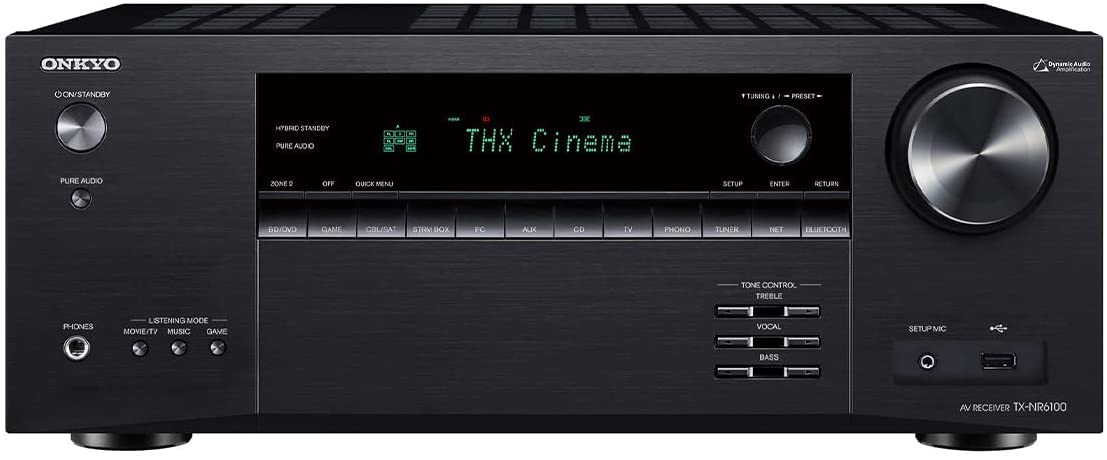
The Onkyo TX-NR6100 is a THX Select-certified 7.2-channel receiver built for serious home theater enthusiasts. It delivers 210 watts per channel for dynamic peaks and handles demanding 5.2.2 Dolby Atmos or DTS:X configurations without breaking a sweat. Three of its six HDMI inputs are 40Gbps HDMI 2.1 ports, fully supporting 4K/120Hz, VRR, and ALLM for an uncompromised gaming experience.
Real-world performance is outstanding, with owners reporting it drives Klipsch 5.1 setups with excellent headroom and clarity. The accompanying app allows deep customization of sound modes per device, and the unit runs cooler than competing receivers from other brands. The THX certification ensures it meets stringent standards for accurate sound reproduction at reference levels.
Reliability concerns have been noted, with a few users reporting HDMI processing failures after two years of use. The remote is not backlit, which can be frustrating in a dark theater room. The inputs 4 through 6 do not support Zone 2 video, limiting flexibility for multi-room setups. Despite these quirks, its feature set for the price is hard to beat.
Why it’s great
- THX Select certification ensures reference-level sound
- Three 40Gbps HDMI 2.1 inputs for gaming
- Runs cooler than many competitors
Good to know
- Reported HDMI 2.1 failures after extended use
- Remote control is not backlit
- Inputs 4-6 do not support Zone 2 video
3. Yamaha RX-V4A

The Yamaha RX-V4A is a 5.2-channel receiver that shines brightest for music lovers. With built-in Wi-Fi, AirPlay 2, Spotify Connect, and the MusicCast multi-room platform, it handles Pandora, TIDAL, Deezer, and Qobuz natively. The receiver supports Dolby TrueHD and DTS-HD Master Audio, and its YPAO automatic room calibration optimizes speaker timing and tonal balance within minutes.
Sound quality is described as clean, detailed, and precise. Users report it drives 140-watt towers and a 10-inch subwoofer effortlessly in a condo-sized living room. The HDMI 2.1 inputs support 8K/60B and 4K/120AB with HDCP 2.3, making it future-ready for gaming on the Xbox Series X. Voice control via Alexa or Google Assistant adds hands-free convenience.
The setup process can be unintuitive. The on-screen menu is sometimes delayed, and the remote’s tiny buttons are difficult to operate by feel. Bluetooth audio introduces a noticeable delay when used in a second room. Several users report HDMI switching issues on certain TV models. The MusicCast app is excellent, but the hardware interface lags behind.
Why it’s great
- Excellent MusicCast streaming and multi-room support
- AirPlay 2 and native Spotify Connect
- HDMI 2.1 with 8K/60B and 4K/120AB
Good to know
- Remote has tiny, hard-to-press buttons
- Bluetooth audio delay for secondary zones
- Setup menus can be laggy and confusing
4. JBL MA710

The JBL MA710 is a 7.2-channel powerhouse delivering 110 watts per channel and the latest 8K video passthrough. It supports up to 7.1 or 5.1.2 channel configurations for Dolby Atmos and DTS:X, making it a strong choice for immersive audio. The inclusion of a moving magnet phono input is a standout feature, allowing direct connection of a turntable without an external preamp.
Owners consistently praise its ability to drive floorstanding speakers like Polk ES60s with authority, delivering impressive quality for the cost. The shallow chassis design fits easily into media consoles, and the 6 HDMI inputs (plus eARC) provide generous connectivity. Network streaming via Apple AirPlay 2 and Google Chromecast is built-in, though the streaming app ecosystem is limited.
The setup process can be confusing due to an initial mandatory firmware update that is not clearly explained. The remote lacks a backlight, requiring a phone flashlight in dark rooms. It does not downmix DTS-HD Master Audio to 2.1 channels, which is a notable limitation for stereo-only setups. Firmware updates have been infrequent, with the last update over a year ago.
Why it’s great
- High 110W per channel for powerful audio
- Integrated phono input for vinyl
- Shallow depth fits most media consoles
Good to know
- Mandatory firmware update complicates first-time setup
- No DTS-HD Master Audio downmix for 2.1
- Remote is not backlit
5. Pioneer VSX-935
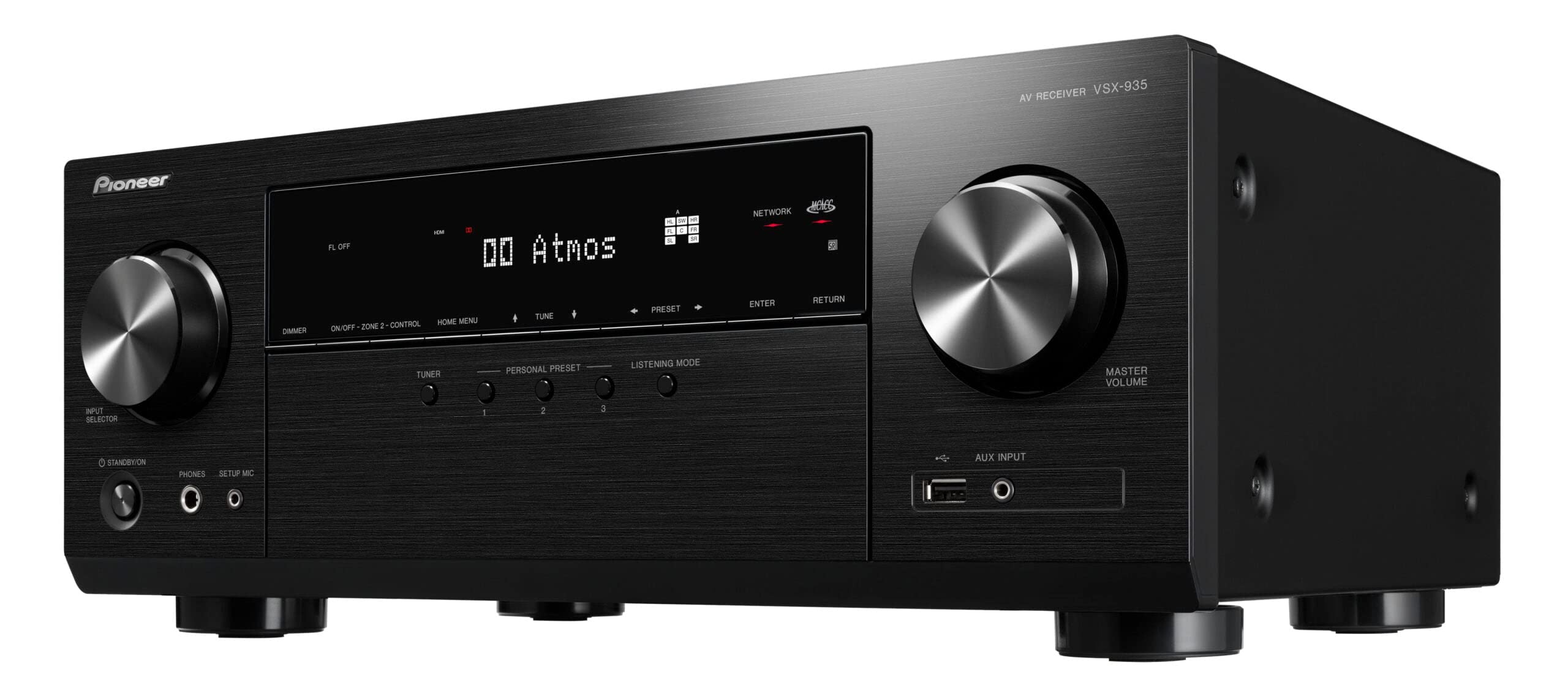
The Pioneer VSX-935 is a 7.2-channel network receiver equipped with Dolby Atmos Height Virtualization technology, which creates a convincing overhead sound field without requiring physical height speakers. It features HDMI 2.1 with 8K pass-through and enhanced gaming features including VRR and QFT. The receiver also supports streaming via built-in Wi-Fi and Bluetooth.
Sound quality is described as crisp, clear, and loud, with a gradual volume curve that accelerates above 50 percent for dramatic home theater effects. The RF remote provides reliable control, and the clear display includes a dimmer for dark rooms. Dual-zone output allows audio in a second room. Owners report it replaced older Onkyo units with a noticeable improvement in clarity.
Bluetooth connectivity has been flagged as unreliable by some users, with two-way streaming being difficult to access and often dropping. The interface can feel outdated compared to newer competitors. First-time setup requires a firmware update, and the initial unit may be DOA in rare cases. The room correction is basic compared to YPAO or Audyssey systems.
Why it’s great
- Dolby Atmos Height Virtualization without extra speakers
- HDMI 2.1 with 8K and gaming features
- Reliable RF remote with clear display
Good to know
- Bluetooth implementation is inconsistent
- Interface feels outdated
- Basic room correction
6. Onkyo TX-NR5100

The Onkyo TX-NR5100 is a 7.2-channel receiver that prioritizes gaming performance without inflating the price. It supports 4K/120Hz HDR pass-through, Variable Refresh Rate, Auto Low Latency Mode, and Quick Frame Transport, all essential for competitive gaming on modern consoles. The receiver also features eARC for high-bitrate audio from TV apps and supports Dolby Atmos and DTS:X.
Sound quality is generally good, with an easy-to-navigate on-screen menu and a large, clear display. Setup is relatively straightforward, and the remote is simpler than previous Onkyo generations. The speaker connections, however, are mixed: the front channels use spring-loaded clips while the surrounds use twist-style binding posts, which can be confusing. The display is brighter than some users prefer in a dark room.
Reliability and Bluetooth performance are the biggest concerns. Some units have failed entirely within two years, and Bluetooth often has sync issues with low-latency headphones. The receiver is advertised as 7.2 but is actually a 7.1 unit (only one subwoofer pre-out). AirPlay can interfere with Bluetooth connectivity on Mac devices, causing random disconnections.
Why it’s great
- Full HDMI 2.1 gaming support (4K/120Hz, VRR, ALLM)
- eARC for high-bitrate audio from TV apps
- Large, clear display screen
Good to know
- Bluetooth sync issues with low-latency headphones
- Advertised as 7.2 but is a 7.1 unit
- Some units have reported failure after 18 months
7. Yamaha RX-V385

The Yamaha RX-V385 is a reliable 5.1-channel entry-level receiver that focuses on delivering warm, clear sound without unnecessary extras. It features YPAO auto-calibration technology, which adjusts speaker levels and distances for optimal sound in your room. The unit supports 4K Ultra HD passthrough with HDR10, Dolby Vision, and Hybrid Log-Gamma, making it fully compatible with modern TVs.
Sound quality is consistently praised, with owners noting it outperforms similarly priced Sony receivers in clarity and warmth. High-resolution audio playback up to 192kHz/24-bit is supported, and the receiver handles Blu-ray audio with precision. The 5-way binding posts accept banana plugs, making speaker connection easy. Bluetooth is basic but functional for music streaming from a phone.
It has only four HDMI inputs, which may be limiting for users with multiple devices. The receiver does not support eARC, so high-bitrate audio from TV apps is capped at standard ARC. The manual is only available online, and the audio menu settings are quite complex for beginners. The on-screen display is basic and text-only.
Why it’s great
- YPAO calibration dials in sound quickly
- Warm, clear sound that outperforms peers
- 5-way binding posts with banana plug support
Good to know
- Only 4 HDMI inputs
- No eARC support
- Manual available online only
8. Sony STRDH590
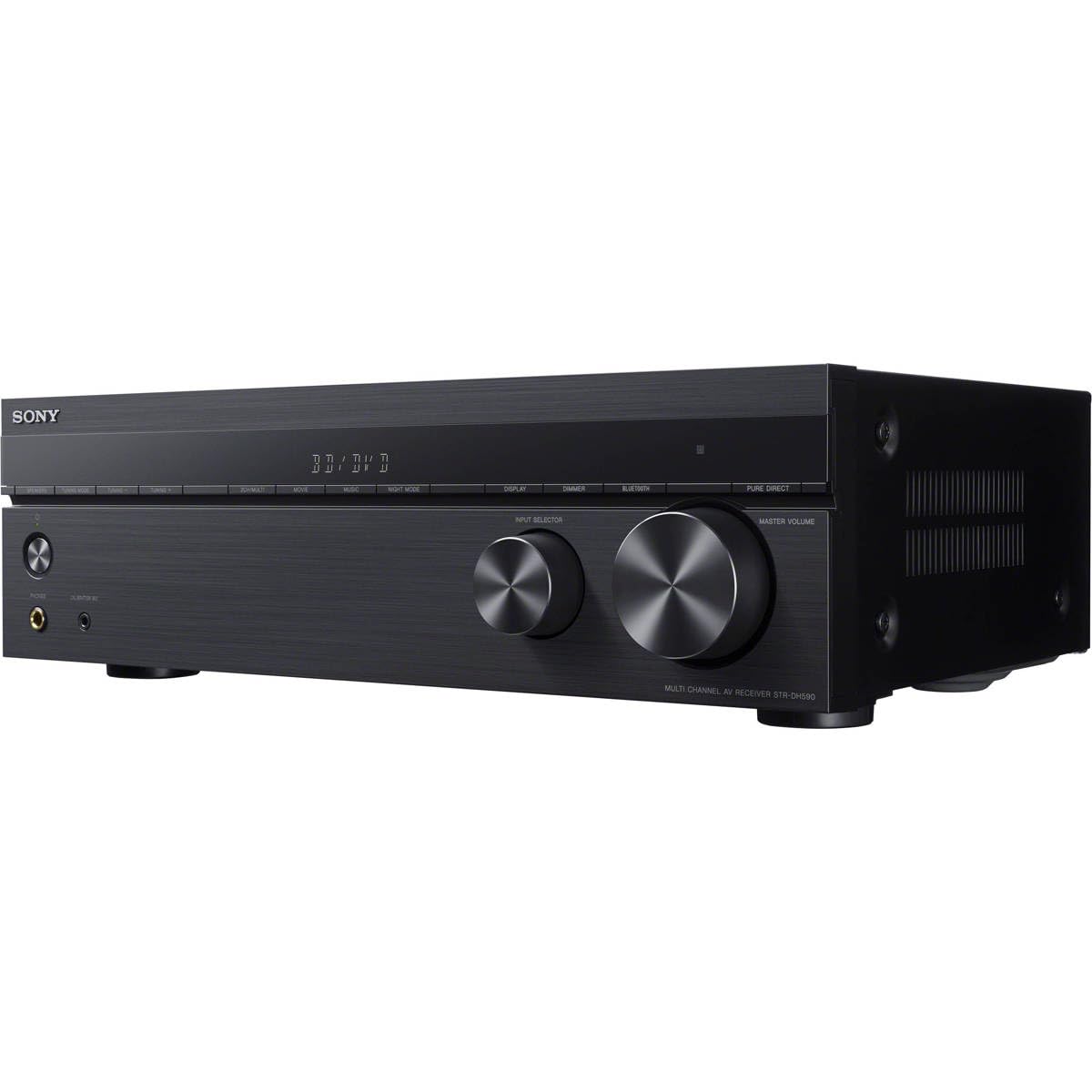
The Sony STRDH590 is a straightforward 5.2-channel receiver built for simplicity. It features S-Force PRO virtual front surround, which creates a convincing surround effect from just two speakers, and 4K HDR passthrough with HDCP 2.2. The receiver includes Bluetooth with standby mode, allowing it to turn on from your phone for music streaming. It also has a built-in FM radio tuner and a 1/4-inch headphone jack.
Setup is relatively easy with an on-screen menu, and the included calibration microphone helps balance speaker levels automatically. The slim chassis runs cooler than many competitors, fitting into tighter entertainment centers. Owners report it drives older speakers like KEF Carina 2s and Optimus speakers well, producing good quality sound for the price. The remote control is simple and effective, with one-button switching between FM, TV, and Bluetooth.
The input jacks are spaced tightly together, making it difficult to plug in thick HDMI cables. There is no phono input for turntables, and it lacks A/B speaker switching. The FM antenna wire is basic and may require an upgrade for weak signal areas. It does not support eARC, so audio from TV apps is limited to standard ARC bandwidth. No AM tuner is included.
Why it’s great
- Simple one-button input switching
- Slim, cool-running chassis
- Bluetooth standby feature
Good to know
- Tightly spaced input jacks
- No eARC or phono input
- No AM tuner
9. JBL MA310

The JBL MA310 is a 5.2-channel AV receiver with a distinctive white finish and a shallow chassis that fits easily into compact media consoles. It delivers 60 watts per channel, enough for driving bookshelf and in-wall speakers in a medium-sized room. The unit supports native 5-channel decoding of Dolby and DTS formats, and includes Bluetooth 5.1 with Low Energy for wireless music streaming from a phone or tablet.
Owners praise its attractive design and sound quality, noting it drives Polk ES60 towers and in-wall systems with impressive authority for the size. The on-screen setup menu via HDMI ARC is intuitive, and the receiver can automatically power on and off with the TV. The shallow depth is a standout feature for users with tight shelving, and the white color fits modern home decor.
Initial setup is complicated by a mandatory firmware update that is not clearly documented. The remote lacks a backlight, making it nearly impossible to navigate in a dark room. The auto shut-off timer defaults to 20 minutes and must be changed manually. It does not support DTS-HD Master Audio downmix for 2.1 setups, which limits compatibility with Blu-ray audio for stereo-only users.
Why it’s great
- Shallow depth fits tight media consoles
- White finish suits modern decor
- HDMI ARC with auto on/off via TV
Good to know
- Remote is not backlit
- Mandatory firmware update complicates setup
- No DTS-HD Master Audio downmix for 2.1
FAQ
Can I use a 7.2 receiver with only 5 speakers?
Is Dolby Atmos worth it on a budget receiver?
What is eARC and do I need it?
Does room calibration make a big difference on a cheap receiver?
Final Thoughts: The Verdict
For most users, the cheap av receiver winner is the Denon AVR-S670H because it combines reliable Audyssey room calibration, a phono input, and essential 8K gaming features in an easy-to-use package. If you want THX-certified power and full 7.2-channel Atmos for a dedicated theater room, grab the Onkyo TX-NR6100. And for a simple, no-fuss entry point with excellent sound clarity, nothing beats the Yamaha RX-V385.

Mo Maruf
I created WellFizz to bridge the gap between vague wellness advice and actionable solutions. My mission is simple: to decode the research and give you practical tools you can actually use.
Beyond the data, I am a passionate traveler. I believe that stepping away from the screen to explore new environments is essential for mental clarity and physical vitality.