Our readers keep the lights on and my smoothie glass nicely filled. As an Amazon Associate, I earn from qualifying purchases.
The sidewalk outside your home sees more abuse than nearly any other concrete surface on your property. Sun, rain, snow, salt, freeze-thaw cycles, foot traffic, and the occasional lawnmower edge all conspire to turn a smooth walkway into a cracked, chipped, uneven hazard. While replacing an entire slab is expensive and disruptive, the right cement or filler can buy you years of service life with a single afternoon’s work.
I’m Mohammad Maruf — the founder and writer behind WellFizz. I’ve spent countless hours researching the chemical formulations, cure times, and application techniques that separate a quick cosmetic fix from a repair that actually bonds with the substrate and resists the weather extremes that destroy cheap patches.
This guide compares five very different approaches to sidewalk repair so you can match the material to the damage. Whether you need a hydraulic cement that stops running water, a flexible filler that moves with temperature swings, or a dry powder that blends invisibly with aged concrete, I’ve organized the options by use case to help you find the best cement for sidewalks for your specific repair situation.
How To Choose The Best Cement For Sidewalks
Choosing the right sidewalk repair product starts with diagnosing the damage. A hairline crack from surface shrinkage needs a completely different chemistry than a structural gap where water pools or a spalled corner that has lost its edge. The three variables that matter most are bond strength, flexibility, and cure profile.
Bond Strength and Substrate Preparation
The strongest formulation in the world fails if the old concrete is dirty, oily, or loose. Products like SIKA SikaLatex R boost tensile adhesion to over 500 psi by acting as a chemical bridge between the old slab and the new patch. Without this bond, even a premium filler becomes a separate island that pops loose during freeze-thaw. Always clean the crack with a wire brush or compressed air before applying any repair material.
Flexibility vs. Rigidity for Freeze-Thaw Climates
Rigid Portland-cement patches work well for structural fills (holes deeper than 1/2 inch), but they crack again when the slab underneath expands and contracts with temperature swings. Flexible latex- or rubber-based fillers, such as the Bluestar Flexible Crack Filler, stretch slightly and survive seasonal movement without breaking the seal. If your sidewalk sees sub‑freezing winters, a flexible filler is almost always the safer bet for crack repair.
Cure Time and Foot Traffic
Some products cure in five minutes (Quikrete Hydraulic Water Stop Cement), while others require 24 hours before the patch can bear weight. For high‑traffic walkways leading to a front door, a fast‑set hydraulic cement lets you reopen the path the same day. For decorative patios or low‑traffic zones, a slower‑curing granular powder that hardens overnight often yields a better color match and smoother finish.
Quick Comparison
On smaller screens, swipe sideways to see the full table.
| Model | Category | Best For | Key Spec | Amazon |
|---|---|---|---|---|
| SIKA SikaLatex R | Bonding Adhesive | Adding tensile strength to mortar patches | 500 psi bond strength | Amazon |
| Magic Crack Filler 2.5LB | Granular Powder | No‑mess dry application on driveways | 32 fl. oz. bottle, no shelf life | Amazon |
| Quikrete Hydraulic Water Stop | Hydraulic Cement | Stopping active leaks below grade | Sets in 3–5 minutes | Amazon |
| Bluestar Flexible Crack Filler | Latex Filler | Weather‑resistant crack repair | Flexible down to freezing | Amazon |
| ConSandtrate Crack Filler | Cementitious Powder | Self‑healing narrow cracks | Water-activated, self‑healing | Amazon |
In‑Depth Reviews
1. SIKA SikaLatex R

SIKA SikaLatex R is not a standalone filler — it is a liquid bonding adhesive and acrylic fortifier that you mix with Portland cement or mortar to dramatically improve adhesion. When used as a bonding grout, it creates a chemical weld between the old concrete and the new patch that reaches 500 psi of tensile strength. That number matters because most sidewalk patches fail at the interface, not within the filler itself.
The gallon size is ideal for homeowners who plan multiple repairs or a single large patch (say, a spalled corner of a slab). It resists freeze-thaw damage by densifying the cement matrix, which reduces water absorption. Reviewers report patches that held for years, even in northern climates, until a full renovation finally replaced the slab. The 30‑day full cure time sounds long, but the patch can bear light foot traffic within 24 hours.
One caveat: the product has a one‑year shelf life, so check the date code before buying. It also requires mixing — this is not a pour‑and‑forget solution. But for anyone who wants their patch to actually stay bonded rather than pop out next spring, SikaLatex R is the most reliable foundation you can buy.
Why it’s great
- Converts ordinary mortar into a high‑strength structural bond
- Proven freeze-thaw resistance reduces re‑cracking risk
- Works as both an admix and a primer for maximum versatility
Good to know
- Requires mixing with cement or mortar — not a standalone filler
- One‑year shelf life means you must verify the expiration date
- 30‑day full cure before the bond reaches ultimate strength
2. Magic Crack Filler 2.5LB
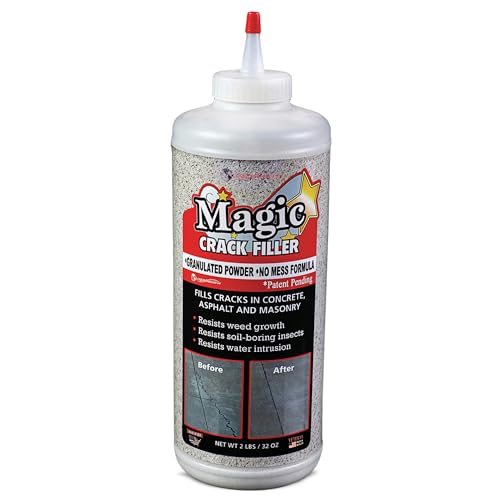
Magic Crack Filler takes the opposite approach from traditional cement: it is a dry granular powder that you pour directly into the crack, tamp down, and activate with water. No mixing bucket, no trowel, no chemical gloves required. The synthetic‑rubber-based formula hardens into a flexible solid that moves with the slab rather than cracking under thermal stress.
The 2.5‑pound bottle (32 fluid ounces by volume) covers a surprising amount of linear feet — reviewers filled dozens of small cracks on a driveway from a single bottle. For larger gaps over 1/4 inch wide, users recommend pre‑filling the bottom with sand, then topping with the filler to avoid wasting material. The color blends well with aged gray concrete; multiple reviews mention that after drying overnight, the repairs are “almost unnoticeable.”
The biggest advantage is the lack of a shelf‑life panic. Unlike cement‑based products that degrade in the garage over winter, this powder stays usable indefinitely. It also self‑levels slightly when misted, which leaves a flush surface rather than a raised ridge. For a DIYer who wants a clean, fast, low‑mess repair on a driveway or walkway, this is the easiest product to recommend.
Why it’s great
- Zero mixing required — just pour, dampen, and walk away
- Flexible synthetic rubber formula resists re‑cracking in freeze-thaw
- No expiration date makes it ideal for long‑term garage storage
Good to know
- Large cracks need a sand backfill to avoid excessive filler use
- Color match is good but not perfect for every shade of concrete
- Long‑term durability beyond one winter is still unverified by users
3. Quikrete Hydraulic Water Stop Cement

When water is actively seeping through a crack in a foundation wall or a basement‑level sidewalk, you need a hydraulic cement that sets against water pressure — not a filler that requires a dry substrate. Quikrete Hydraulic Water Stop Cement sets in three to five minutes and expands slightly as it cures, locking itself into the crack like a wedge. It works above and below grade, making it the only choice on this list for wet‑condition repairs.
The 10‑pound box is compact but dense; you mix only what you can apply in under three minutes because the material goes from workable to rock‑hard fast. Reviewers emphasize that you must carve the crack into a dovetail shape (wider at the back) for the cement to mechanically lock. Used correctly, it stops running water instantly — one reviewer reported it sealing a leak that two other brands had failed to stop.
This is not a cosmetic product. The color is lighter than standard gray concrete, and the surface texture is rough. It is designed for function over finish. For the homeowner dealing with a wet basement or a leaking retaining wall, this cement is the most effective emergency repair tool in the category.
Why it’s great
- Sets and cures even under active water pressure
- Mechanical wedge lock prevents patch blowout
- Compact 10‑pound box is easy to store and transport
Good to know
- Must be mixed and applied in under 3 minutes — no margin for error
- Color is noticeably lighter than standard sidewalk concrete
- Not designed for large surface‑area patches; best for narrow, deep cracks
4. Bluestar Flexible Concrete Crack Filler

Bluestar Flexible Crack Filler is a latex‑rubber paste designed for the one thing rigid cement patches cannot do: stretch. In climates where sidewalks see 80‑degree summer heat and sub‑zero winter freezes, the slab expands and contracts continuously. A rigid patch shears away from the edges within a season. The Bluestar filler stays elastic, maintaining its seal through temperature cycles that would crack traditional mortar.
The 16‑ounce bottle uses a squeeze‑tube nozzle that lets you apply directly into cracks up to one inch wide. Reviewers note that for deep cracks, multiple layers are needed — the filler dries slightly rubbery and can sag on vertical surfaces if applied too thick. Cleanup is with water, which is a major convenience advantage over solvent‑based sealants. The gray color is available in two shades (gray and light gray), though some users found the two indistinguishable after drying.
One reviewer reported that after six months, a small section of filler fell out due to poor adhesion on a dusty crack. The lesson: blow out the crack with compressed air and dampen it slightly before application. Used correctly, this filler outlasts a single‑season patch and is forgiving enough for a beginner to apply without special tools.
Why it’s great
- Flexible formula survives seasonal expansion and contraction
- Water cleanup keeps the job simple and non‑toxic
- Can fill cracks up to one inch wide with layered application
Good to know
- Adhesion suffers if the crack is not cleaned and dried thoroughly
- Color‑match is imperfect — may not blend with every concrete tone
- Not suitable for structural repairs or holes deeper than 1 inch
5. ConSandtrate Concrete Crack Filler
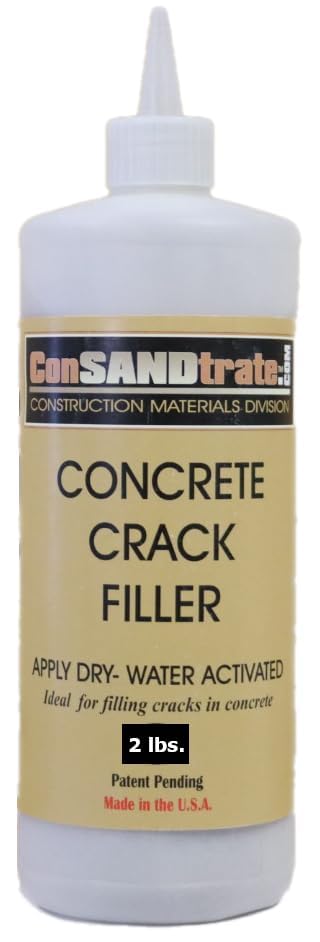
ConSandtrate is a cementitious powder that activates with water and is marketed for hairline to medium cracks (roughly 1/8 inch wide). Its stand‑out claim is a “self‑healing” polymer that re‑bonds when moisture hits the crack again — a useful feature for sidewalks where rain and sprinkler overspray are constant. The 2‑pound bottle uses a Yorkere‑style nozzle that helps direct the fine powder into narrow gaps without overspill.
Application is straightforward: pour the powder into the crack, tap it down, brush off the excess from the surrounding concrete, and mist with water. Reviewers report that the material blurs cracks visually and feels slightly softer than concrete after drying — more of a flexible fill than a rigid patch.
The biggest limitation is depth: the powder does not bond well in cracks deeper than about 1/2 inch unless you fill the bottom with sand first. Also, the final color can shift from brownish to gray as it dries, which may cause a temporary mismatch if the concrete is stained. For the price and simplicity, though, ConSandtrate is a solid entry‑level option for anyone who wants a fast, no‑mix repair on narrow surface cracks.
Why it’s great
- Self‑healing polymer re‑bonds when moisture re‑enters the crack
- Fine grains flow easily into hairline and narrow cracks
- Water‑only activation means zero mixing equipment needed
Good to know
- Not suitable for deep cracks without a sand backfill
- Color may shift from tan to gray during drying
- Remains slightly softer than concrete — not a structural repair
FAQ
Can I use hydraulic cement to fill a wide sidewalk crack that has no water leak?
How do I prepare a sidewalk crack before applying filler?
What causes my sidewalk patch to crack again within a year?
Final Thoughts: The Verdict
For most users, the best cement for sidewalks winner is the Magic Crack Filler 2.5LB because it combines the simplest application method (pour, dampen, done) with a flexible synthetic‑rubber formula that handles freeze‑thaw cycles better than rigid cement — and it has no shelf‑life expiration. If you need to stop active water leaks or repair a basement wall, grab the Quikrete Hydraulic Water Stop Cement. And for a structural patch where bond strength must outlast the slab itself, nothing beats the SIKA SikaLatex R as a bonding admixture under new mortar.

Mo Maruf
I created WellFizz to bridge the gap between vague wellness advice and actionable solutions. My mission is simple: to decode the research and give you practical tools you can actually use.
Beyond the data, I am a passionate traveler. I believe that stepping away from the screen to explore new environments is essential for mental clarity and physical vitality.