Our readers keep the lights on and my smoothie glass nicely filled. As an Amazon Associate, I earn from qualifying purchases.
A lithium battery charger is not a universal brick. Use the wrong voltage curve or skip the balance circuit, and a premium battery pack loses capacity fast — or, in the worst case, becomes unsafe. Choosing a charger designed specifically for your battery’s chemistry (LiFePO₄, LiPo, Li-ion) is the single most important decision for performance and lifespan.
I’m Mohammad Maruf — the founder and writer behind WellFizz. I’ve spent months cross-referencing charge algorithms, real-world customer reports, and safety certifications to separate the chargers that genuinely protect lithium cells from those that just turn on and hope for the best.
The right unit prevents over-voltage, manages cell balance, and delivers the correct absorption profile for your pack. Read on for the definitive list of the best charger for lithium batteries available now.
How To Choose The Best Charger For Lithium Batteries
Lithium batteries demand a constant-current/constant-voltage (CC/CV) charging profile that terminates at a precise voltage. A charger designed for lead-acid (which floats higher and never fully stops) will continuously overcharge a lithium pack, causing the Battery Management System (BMS) to disconnect early or, over time, degrade the cells. Before you buy, lock in three decisions: chemistry compatibility, current rating, and balance capability.
Chemistry Compatibility — LiFePO₄ vs LiPo vs Li-ion
LiFePO₄ (lithium iron phosphate) cells require a 3.65 V per cell absorption voltage. Standard LiPo and Li-ion cells charge to 4.2 V per cell. A charger that cannot switch between these profiles will either under-charge (leaving capacity on the table) or over-charge (triggering the BMS cutoff and shortening cycle life). Always match the charger’s declared chemistry list to your battery’s label.
Current Rating and Battery Capacity
The charging current, measured in amps (A), should be roughly 0.2C to 0.5C of your battery’s amp-hour rating. For a 50 Ah battery, that means 10 A to 25 A. A 5 A charger will eventually fill a 100 Ah pack, but it may take over 20 hours. A 30 A charger on a 20 Ah battery could overwhelm the BMS and trip protection. Match the charger’s amperage to your typical battery size.
Balance Charging vs Bulk Charging
Multi-cell lithium packs (e.g., 3S, 4S, 6S) need individual cell voltage monitoring during charge — a “balance charge” mode. Without balancing, one cell can drift above 4.2 V while others lag, causing that cell to degrade rapidly. Bulk-only chargers (common in automotive LiFePO₄ maintainers) rely entirely on the battery’s internal BMS. For hobby packs (LiPo, Li-ion in RC gear), balance charging is mandatory. For drop-in LiFePO₄ replacement batteries, bulk charging from a compatible CC/CV source works fine.
Quick Comparison
On smaller screens, swipe sideways to see the full table.
| Model | Category | Best For | Key Spec | Amazon |
|---|---|---|---|---|
| CTEK 56-926 Lithium US | Premium Smart Charger | Long-term LiFePO₄ maintenance | 4.3 A, 8-step CC/CV, spark-free | Amazon |
| VEVOR 35-Amp Smart Charger | High-Current Multi-Chemistry | Large LiFePO₄ & lead-acid packs | 35 A max, 3.6″ LCD display | Amazon |
| SKYRC iMAX B6AC V2 | Hobby Balance Charger | RC LiPo/Li-ion 1S-6S packs | 6 A, 50 W, AC/DC input | Amazon |
| Aorika LiPo Balance Charger | Dual-Channel RC Charger | Simultaneous charge 2 RC packs | 10 A × 2, 150 W AC input | Amazon |
| BROODAY 24V 30A LiFePO₄ Charger | Chemisry-Specific Fast Charger | 24V LiFePO₄ packs (RVs, boats) | 30 A, 29.2 V, Anderson connector | Amazon |
| ECO-WORTHY 12V 5A Smart Charger | Entry-Level Maintainer | Trickle-charge car/marine LiFePO₄ | 5 A, two-year auto detection | Amazon |
| YONHAN 15A Battery Charger | Budget Multi-Chemistry | 12V/24V LiFePO₄ & lead-acid | 15 A, 9-stage, temp compensation | Amazon |
In‑Depth Reviews
1. CTEK 56-926 Lithium US

The CTEK 56-926 is a fully automatic 12 V LiFePO₄ charger and maintainer that uses an 8-step charging algorithm — from desulfation (for recovery) through bulk, absorption, and finally float/pulse maintenance. It delivers 4.3 A, which is ideal for batteries between 5 Ah and 60 Ah, and can maintain packs up to 120 Ah. Spark-free connection and reverse polarity protection make it safe to connect directly to the vehicle without disconnecting the battery.
Users report reliable performance on modern luxury vehicles with lithium starter batteries, including the Range Rover V8 and similar high-draw platforms. The charge profile keeps the BMS happy during extended storage periods — winter parking, long trips, or seasonal vehicles. The lack of a manual amperage adjustment means you trust the algorithm entirely, but CTEK’s reputation for clean, spike-free DC output justifies the premium pricing.
If you need a set-and-forget solution for a drop-in LiFePO₄ battery in a car, motorcycle, or boat, this is the safest, most polished unit on the market. It is not designed for hobby LiPo packs or for charging below 4.3 A — but for its intended use, it is nearly flawless.
Why it’s great
- 8-step patented program tests, charges, and maintains without over-voltage risk
- Spark-free connection and reverse polarity protection built in
- Connect-and-forget simplicity with no button pressing required
Good to know
- Fixed 4.3 A output — not adjustable for larger or smaller packs
- Most expensive option reviewed; premium justified by safety and reliability
2. VEVOR Smart Battery Charger, 35-Amp

The VEVOR 35-Amp packs a 3.6-inch LCD display, auto-detection for 6/12/24 V systems, and compatibility with LiFePO₄ and lead-acid chemistries. Its standout feature is Force Mode — a trickle-like pulse that can recover deeply discharged lithium batteries below the BMS wake threshold. The unit pushes up to 35 A during bulk charging (rated 20 A for lithium), tapering down as the battery fills, which cuts charge time on large 100+ Ah packs significantly.
Customers consistently praise the force mode for reviving batteries that other chargers rejected as “dead.” The desulfation mode (for lead-acid) and supply mode (for low-voltage lithium) add versatility. The fan is audible but not intrusive, and the unit stays cool even at high output. The main drawback reported is the LCD visibility in direct sunlight — it washes out in bright outdoor conditions.
For anyone who maintains multiple battery types across a garage, boat, and workshop, this single unit replaces a wall of dedicated chargers. It does not offer individual cell balancing for hobby packs, but for automotive-grade LiFePO₄, it is a powerhouse.
Why it’s great
- Force mode recovers deeply discharged lithium cells that other chargers reject
- High 35 A peak current dramatically reduces charge time on large packs
- Single unit covers 6/12/24 V lead-acid and 12/24 V LiFePO₄
Good to know
- LCD hard to read in bright outdoor light
- No individual cell balance function for multi-cell hobby packs
3. SKYRC iMAX B6AC V2

The SKYRC iMAX B6AC V2 is a household name among RC enthusiasts. This updated version includes an internal AC power supply, eliminating the need for a separate brick. It supports LiPo, LiFe, Li-ion, NiMH, NiCd, and Pb chemistries, with balance charging for 1S-6S lithium packs. Charge current is adjustable up to 6 A (50 W from AC, 80 W from DC), which is adequate for most hobby-sized packs up to 5000 mAh.
Users note that the unit is remarkably quiet — the fan barely whispers compared to budget chargers. The LCD interface is intuitive after a short learning curve, and the charger automatically detects cell count in auto mode. The unit made a cameo appearance rebuilding a 2006 Honda Insight IMA hybrid battery, proving its versatility extends beyond RC gear.
One limitation: the lack of a soft-start circuit causes a small spark when plugging in the AC cord. It’s not dangerous, but it wears the connector over time. For its price, the B6AC V2 delivers professional-grade balance precision in a compact desktop package.
Why it’s great
- Balance charges 1S-6S LiPo/Li-ion/LiFe with per-cell monitoring
- Integrated AC power supply — no extra brick needed
- Nearly silent fan operation; cool during typical sessions
Good to know
- No soft-start circuit — minor spark when connecting AC power
- Maximum 50 W output limits charge speed on larger packs
4. Aorika LiPo Battery Charger (SAIL6)
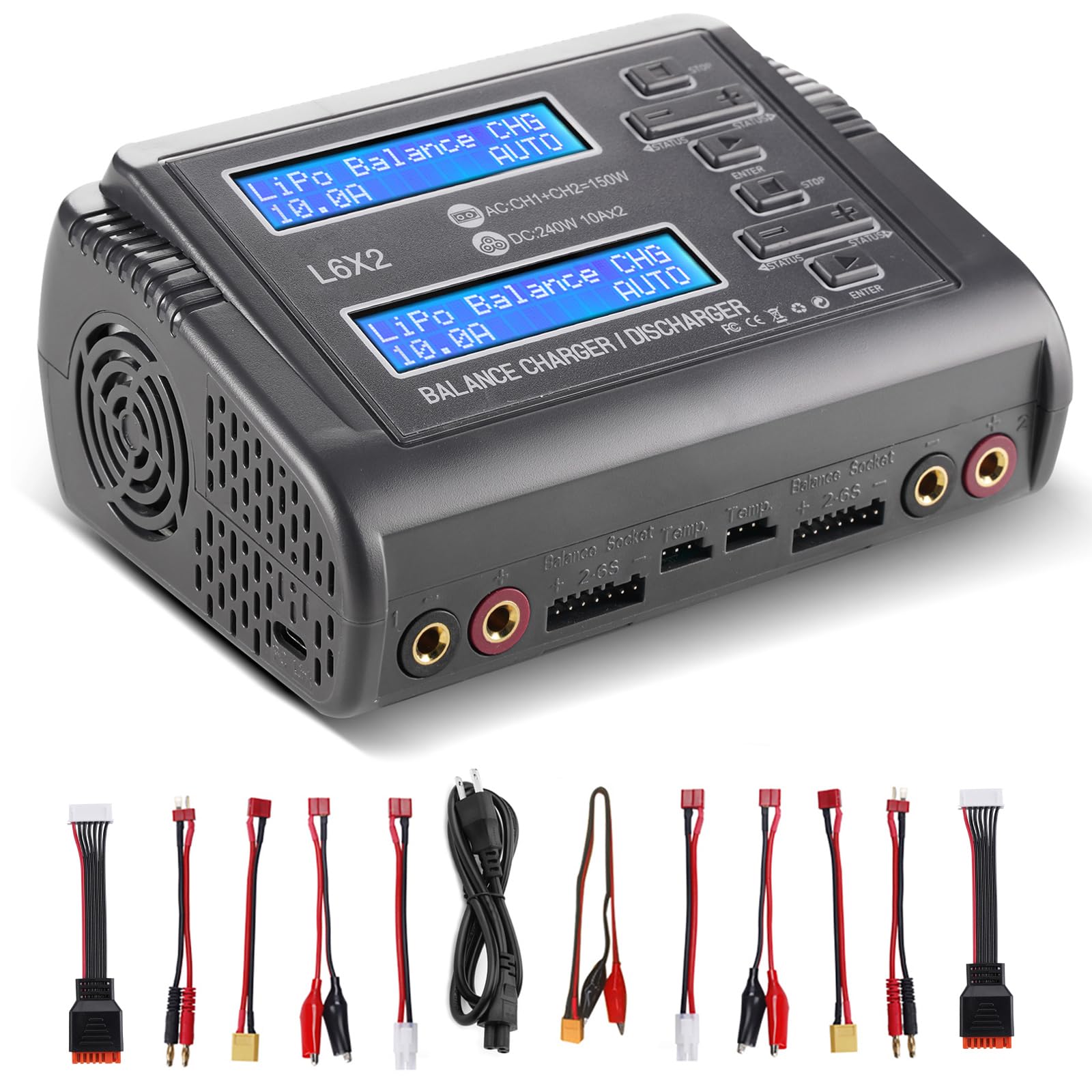
The Aorika SAIL6 is a dual-channel balance charger that can charge two independent lithium batteries simultaneously — a massive time-saver for RC pilots and drone racers who fly multiple packs in a session. Each channel delivers up to 10 A (150 W total from AC, 240 W from DC), supporting 1S-6S LiPo, Li-ion, LiFe, LiHV, plus NiCd/NiMH and lead-acid.
The interface uses a large screen and a simple rotary dial for navigation. Users report a short learning curve but once programmed, the unit remembers up to 20 memory presets. The included accessory kit (XT60, Tamiya, banana plugs, balance extension cables) covers nearly every common RC connector. The internal fan is quiet — described by one user as “like a sleep noise device.”
One caveat: the charger does not include a Traxxas plug, so owners of Traxxas-brand RC vehicles need a separate adapter. Outside of that, the SAIL6 offers excellent charge speed and balance precision for the price, especially if you routinely charge multiple packs.
Why it’s great
- Dual independent channels charge two different packs at the same time
- 10 A per channel — fast bulk and balance charging for up to 6S packs
- 20 programmable memory slots for quick battery profiles
Good to know
- No Traxxas adapter included — separate purchase needed
- Learning curve for first-time balance charger users
5. BROODAY 24V 30A LiFePO₄ Charger
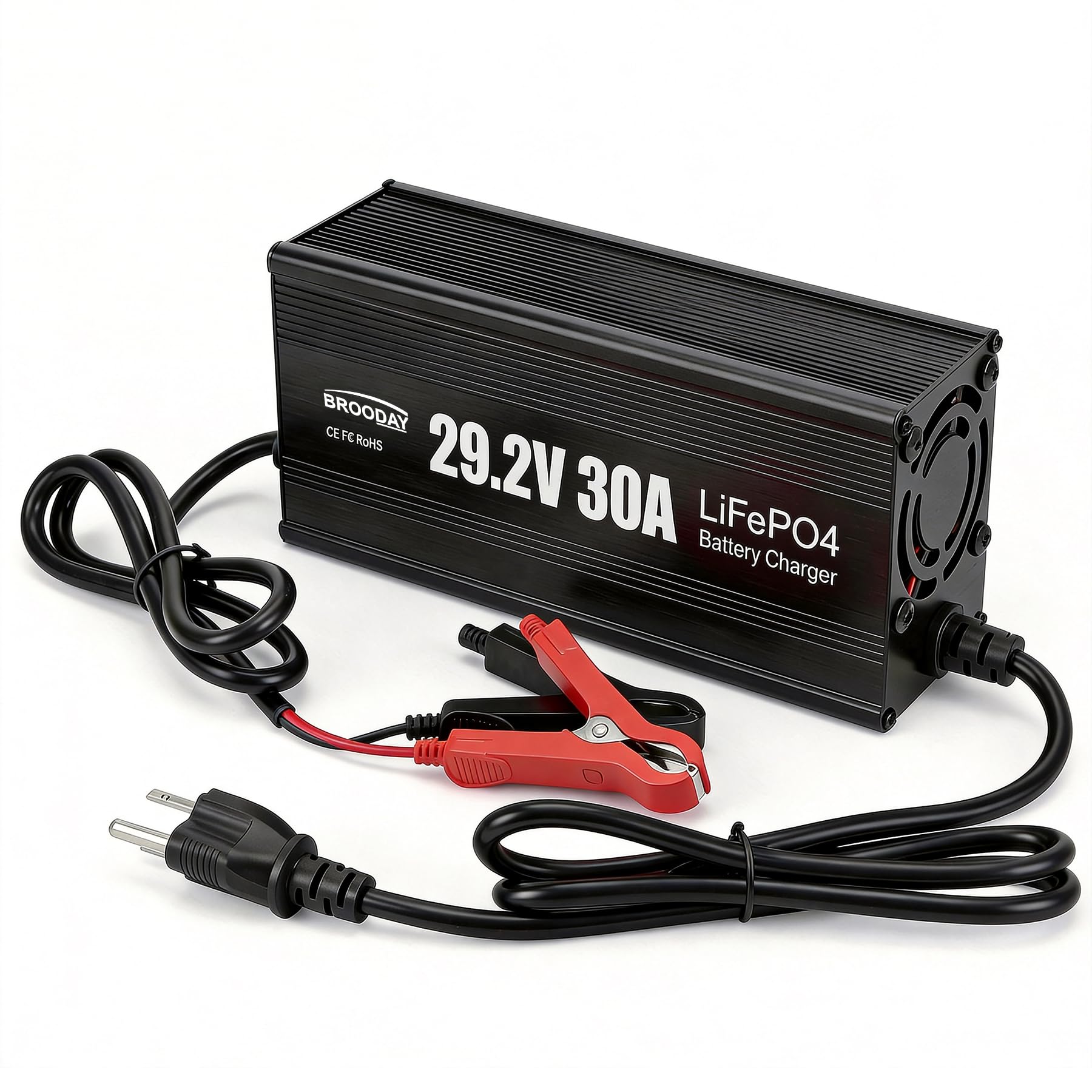
The BROODAY 24V 30A charger is built for one job only: charging 24 V lithium iron phosphate batteries. Unlike universal chargers that try to cover every chemistry, this unit delivers exactly 29.2 V (the correct absorption voltage for 8-cell LiFePO₄ in series) at a full 30 A. It is ideal for RV house batteries, boat banks, and heavy equipment that need to refill quickly without waiting overnight.
The charger uses a smart chip for CC/CV control and includes soft-start, over-current, over-voltage, and short-circuit protection. CE, FCC, and RoHS certifications back the safety claims. Users confirm it charges a 50 Ah 24 V pack in about 3 hours without overheating. The Anderson Powerpole connector is robust for high-current applications, though some buyers swap the ring terminals for copper lugs to reduce contact resistance.
This is not a general-purpose charger — it will damage lead-acid or standard LiPo batteries if accidentally connected. But for a dedicated 24 V LiFePO₄ system, it delivers the fastest safe charge in this price tier.
Why it’s great
- Exact 29.2 V absorption voltage for 24 V LiFePO₄ — no over/under charge risk
- 30 A output refills large packs in 3–6 hours
- Full certification suite (CE, FCC, RoHS) for safety confidence
Good to know
- Only works with 24 V LiFePO₄ — incompatible with lead-acid or other lithium types
- Alligator clips should be replaced with copper lugs for best performance
6. ECO-WORTHY 12V 5A Smart Charger

The ECO-WORTHY 12V 5A is a budget-friendly automatic charger and maintainer for 12 V lead-acid and LiFePO₄ batteries. It is very small — 2.76″ deep × 5.83″ wide — and includes three output lead sets: alligator clips, ring terminals, and an SAE connector with a 10 A inline fuse. The auto-detection algorithm identifies the battery chemistry and switches between bulk, absorption, and float stages.
This unit shines as a winter maintainer for motorcycles, classic cars, and lawn equipment. Users report it keeps a Harley battery topped off all winter with no issues. The desulfation feature (for lead-acid) is a bonus. Some units run warm during bulk charging, so ventilation is recommended. One user noted that the charger struggled to push past a 0.5 A ceiling when a small LED light was drawing power — it works best on a dedicated battery with minimal parasitic load.
For users who need a reliable, low-amp tender for lithium batteries and don’t want to spend for a premium brand, the ECO-WORTHY delivers solid value. It is not a fast charger, but as a maintainer, it is effective and compact.
Why it’s great
- Auto-detects LiFePO₄ and lead-acid for correct charge profile
- Includes three sets of output leads (clips, rings, SAE) for versatile installation
- Compact footprint fits in tight battery compartments
Good to know
- 5 A output — slow for large or deeply depleted packs
- May struggle to charge if battery has a constant small load attached
7. YONHAN 15A Battery Charger

The YONHAN 15A is a multi-chemistry charger that works with 12 V and 24 V LiFePO₄, plus all lead-acid types (AGM, GEL, SLA, flooded). Its 9-stage charge process includes pulse repair (desulfation for lead-acid, which also helps condition lithium BMS communication), temperature compensation, and an automatic memory function that remembers the last mode setting. The unit outputs 15 A at 12 V and 8 A at 24 V.
Customer feedback highlights the desulfation cycle: users report bring old batteries back to 84% state-of-health after a single restore run. The unit is small and lightweight for a 15 A charger, and the fan is noticeably quieter than most competitors. However, the charger is not designed for long-term unattended maintenance — the manual advises against leaving it connected for more than 12 hours in float mode. The touch button for mode selection is also reported as finicky by some users.
For a budget-friendly garage tool that covers both lithium and lead-acid, the YONHAN is a strong pick. It charges fast, includes comprehensive safety protection, and fits easily on a shelf.
Why it’s great
- 9-stage algorithm with pulse repair improves battery health
- 15 A output at 12 V — quick recharge for medium-size packs
- Compact and lightweight with excellent build quality
Good to know
- Not intended for long-term floating (max 12 hours unattended)
- Touch button for mode selection can be unresponsive
FAQ
Can I use a lead-acid charger on a LiFePO₄ battery?
What does the “C” rating mean for charging lithium batteries?
Is it safe to leave a lithium charger connected overnight?
What does the absorption voltage mean for LiFePO₄ vs LiPo?
Final Thoughts: The Verdict
For most users, the charger for lithium batteries winner is the CTEK 56-926 because its 8-step algorithm and spark-free safety make it the most reliable long-term maintainer for automotive LiFePO₄ batteries. If you need high current for large packs, grab the VEVOR 35-Amp. And for RC hobbyists charging multiple LiPo packs, nothing beats the dual-channel speed of the Aorika SAIL6.

Mo Maruf
I created WellFizz to bridge the gap between vague wellness advice and actionable solutions. My mission is simple: to decode the research and give you practical tools you can actually use.
Beyond the data, I am a passionate traveler. I believe that stepping away from the screen to explore new environments is essential for mental clarity and physical vitality.