Our readers keep the lights on and my smoothie glass nicely filled. As an Amazon Associate, I earn from qualifying purchases.
Pulling clean, articulate low-end from a speaker that sits flush against your drywall is the central challenge of in-ceiling audio. Most units deliver thin mid-range and a complete absence of sub-bass, leaving your home theater or whole-house system feeling flat. Finding a ceiling speaker that genuinely moves air without an external subwoofer requires understanding driver size, enclosure design, and power handling at a deeper level.
I’m Mohammad Maruf — the founder and writer behind WellFizz. I’ve spent hundreds of hours cross-referencing frequency response graphs, impedance curves, and real-user bass performance claims to sort the speakers that merely claim deep bass from those that actually deliver it.
After poring over dozens of models, I’ve narrowed the field down to nine contenders that represent the best ceiling speakers with bass money can buy. This guide breaks down exactly what separates a boxy, hollow ceiling speaker from one that rattles the couch.
How To Choose The Best Ceiling Speakers With Bass
Not all in-ceiling speakers are created equal when it comes to low-frequency output. The physics of a shallow mounting depth works against bass reproduction, so manufacturers must get clever with driver materials, porting, and cone excursion to produce anything below 80 Hz. Here are the specs that matter most for buyers chasing that chest-thump from above.
Woofer Size and Material
Larger woofers move more air. An 8-inch driver will invariably produce deeper, more tactile bass than a 6.5-inch driver at the same power level. Material matters too — polypropylene cones offer decent mid-bass punch, while Cerametallic or woven glass-fiber cones deliver superior stiffness-to-mass ratio, reducing breakup distortion at higher volumes. For dedicated home theater use, prioritize 8-inch woofers. For background music in smaller rooms, a quality 6.5-inch may suffice.
Frequency Response and the 50 Hz Threshold
The published frequency response is the first spec to check. Speakers that claim extension below 50 Hz are rare in the in-ceiling form factor and usually employ a dedicated subwoofer driver or a band-pass port design. A speaker rated down to 34 Hz, like the Polk 70-RT, is doing something fundamentally different from one that bottoms out at 63 Hz. Keep in mind that the -10 dB point (not the -3 dB point) tells the true story of usable bass — many manufacturers fudge these numbers.
Built-In Amplification vs. Passive Design
Integrated Bluetooth amplifier kits offer convenience but often compromise on bass headroom. The amplifier inside a budget all-in-one unit is typically limited to 20-30 watts RMS, which is insufficient to drive an 8-inch woofer to its full potential. Passive speakers give you the freedom to pair with a high-current AV receiver or external amplifier, unlocking significantly cleaner low-end at higher volumes. If bass is your priority, the passive route almost always wins.
Pivoting Drivers and Controlled Dispersion
A fixed-angle ceiling speaker fires straight down, which can make bass sound distant and diffuse. Speakers with pivoting tweeters — and especially those with pivoting woofers like the Klipsch CDT series — allow you to aim the sound toward the listening position. This doesn’t increase total bass output, but it does improve the perceived impact by directing the energy where you sit. Controlled Dispersion Technology (CDT) further tightens the soundstage by reducing reflections off nearby walls.
Quick Comparison
On smaller screens, swipe sideways to see the full table.
| Model | Category | Best For | Key Spec | Amazon |
|---|---|---|---|---|
| Klipsch CDT-5800-C II | Passive | Dolby Atmos height channels | 8″ pivoting Cerametallic woofer | Amazon |
| Polk Audio 70-RT | Passive | Full-range 3-way performance | 34 Hz frequency response | Amazon |
| Yamaha NS-IC800 | Passive | Clean, neutral soundstage | 8″ woofer, 140W max power | Amazon |
| Klipsch R-5502-W II | Passive | LCR channels, high-output | Dual 5.25″ Cerametallic woofers | Amazon |
| Klipsch CDT-5650-C II | Passive | Surround/Atmos in small rooms | 6.5″ woofer, 15° tilt | Amazon |
| Polk Audio 255c-RT | Passive | Center channel clarity | Dual 5.25″ mid/woofers | Amazon |
| Herdio 6.5″ (2 Pairs) | Powered Kit | Whole-home wireless audio | 600W system, 4 speakers | Amazon |
| Herdio 6.5″ (4 Speakers) | Powered Kit | Covered patio, garage, kitchen | 100 ft Bluetooth range | Amazon |
| Pyle PDICBT852RD | Powered Kit | Budget-friendly whole-room | 8″ polypropylene woofer | Amazon |
In‑Depth Reviews
1. Klipsch CDT-5800-C II In-Ceiling Speaker

The Klipsch CDT-5800-C II is the undisputed heavyweight in the in-ceiling bass category. Its 8-inch pivoting Cerametallic woofer combined with a 1-inch titanium tweeter and horn-loaded Tractrix technology delivers a presence that few ceiling speakers can touch. The woofer can be angled up to 15 degrees, directing low-frequency energy toward the listening position rather than losing it in the ceiling cavity. Users consistently report dramatic improvements when upgrading to this model from smaller 6.5-inch units, especially in dedicated Dolby Atmos setups.
The Controlled Dispersion Technology (CDT) allows independent aiming of the tweeter and woofer, which tightens the soundstage and minimizes reflections off nearby walls — critical for rooms with open floor plans. The treble and mid-bass attenuation switches on the front baffle let you tune the response to your room’s acoustics without requiring external EQ. The magnetic SlimTrim grille sits nearly flush with the drywall, and the paintable surface disappears completely into the ceiling.
This is a passive speaker, meaning you’ll need an external amplifier or AV receiver to drive it. That’s a feature, not a drawback — it allows you to match the CDT-5800-C II with high-current amplification that extracts every ounce of low-end. Users note that pairing it with a subwoofer is still recommended for the very deepest movie LFE, but for music and general surround duty, the bass output is genuinely surprising for an in-ceiling form factor.
Why it’s great
- Pivoting 8″ Cerametallic woofer delivers true subwoofer-like extension
- Horn-loaded tweeter provides clear, efficient highs with low distortion
- CDT allows independent driver aiming for perfect soundstage
Good to know
- Requires external amplifier
- Premium price per speaker
- Best performance with subwoofer for home theater LFE
2. Polk Audio 70-RT 3-Way In-Ceiling Speaker

The Polk Audio 70-RT stands alone in this roundup as the only 3-way in-ceiling speaker, and it shows in the frequency response. With a 7-inch subwoofer, a 2.5-inch dedicated midrange driver, and a 0.75-inch dome tweeter, it hits a rated low-end of 34 Hz — the deepest extension of any speaker here. That subwoofer driver is specifically designed for ceiling enclosures, using Polk’s patented Power Port technology to smoothly transition air movement from the port to the listening area, reducing turbulence and port noise at high output.
The Vanishing Series paint-anywhere sheer grille ensures the speaker blends seamlessly into the ceiling, and the rotating cam system makes installation tool-free and secure. The 70-RT’s design requires a deeper ceiling cavity than typical 2-way speakers — roughly 4 inches of clearance — which is worth verifying before cutting holes. Once installed, the sonic payoff is immediate: a rich, full-bodied sound with tight, articulate bass that handles complex movie soundtracks and bass-heavy music without strain.
Users report that the 70-RT sounds excellent out of the box but truly opens up after a 80-90 hour break-in period. The built-in “Normal” and “Reflective” treble switches let you adjust the high-frequency response to account for ceiling height and nearby boundaries. This is a wired-only passive speaker, so pairing it with a quality AV receiver or amplifier is non-negotiable, but the result is arguably the most complete ceiling speaker system under per unit.
Why it’s great
- 3-way design with dedicated subwoofer for true deep bass
- 34 Hz frequency response is class-leading
- Power Port reduces distortion at high output
Good to know
- Requires deep ceiling cavity (4″ minimum)
- Wired-only; no Bluetooth option
- Mid-bass drop-off may need EQ adjustment
3. Yamaha NS-IC800 8-Inch In-Ceiling Speaker (Pair)

The Yamaha NS-IC800 delivers the kind of neutral, balanced sound Yamaha is known for, paired with genuinely respectable bass from its 8-inch woofer. The 2-way design uses a 1-inch dome tweeter that swivels up to 15 degrees, allowing you to aim the highs toward the listening area while the woofer fires downward. The frequency response extends to 28 kHz on the top end, but the real story is the low-end: users report palpable, punchy bass that can be felt upstairs in adjacent rooms, unusual for an in-ceiling speaker at this price tier.
The build quality is a clear step up from many competitors. The full-coverage magnetic grille has no visible bezel, giving a truly flush, clean appearance. The spring-loaded binding posts are gold-plated and accept bare wire, pin connectors, or banana plugs. Unlike some budget models, the back of the speaker is fully enclosed with a plastic housing that protects the driver from dust and debris in unconditioned attic spaces — a thoughtful detail for long-term reliability. The included cutout template is sturdy and reusable.
Where the NS-IC800 truly shines is in music playback. While it handles home theater surround sound duties capably — clear dialogue and robust soundtrack bass — it’s the musicality that sets it apart. The smooth frequency response makes acoustic guitar, piano, and vocals sound natural rather than hyped. For buyers who want a single pair of quality ceiling speakers that pull double duty for movies and critical music listening, this pair offers exceptional value. Users recommend pairing them with a subwoofer for full home theater LFE, but admit the built-in 8-inch woofer holds its own admirably.
Why it’s great
- 8″ woofer delivers surprising low-end presence
- Fully enclosed back protects driver in attics
- Neutral, musical sound signature
Good to know
- Wired-only; no built-in amplification
- High-frequency extension not ideal for treble-sensitive listeners
- Requires AV receiver or amplifier
4. Klipsch R-5502-W II In-Wall / In-Ceiling Speaker (Two-Pack)
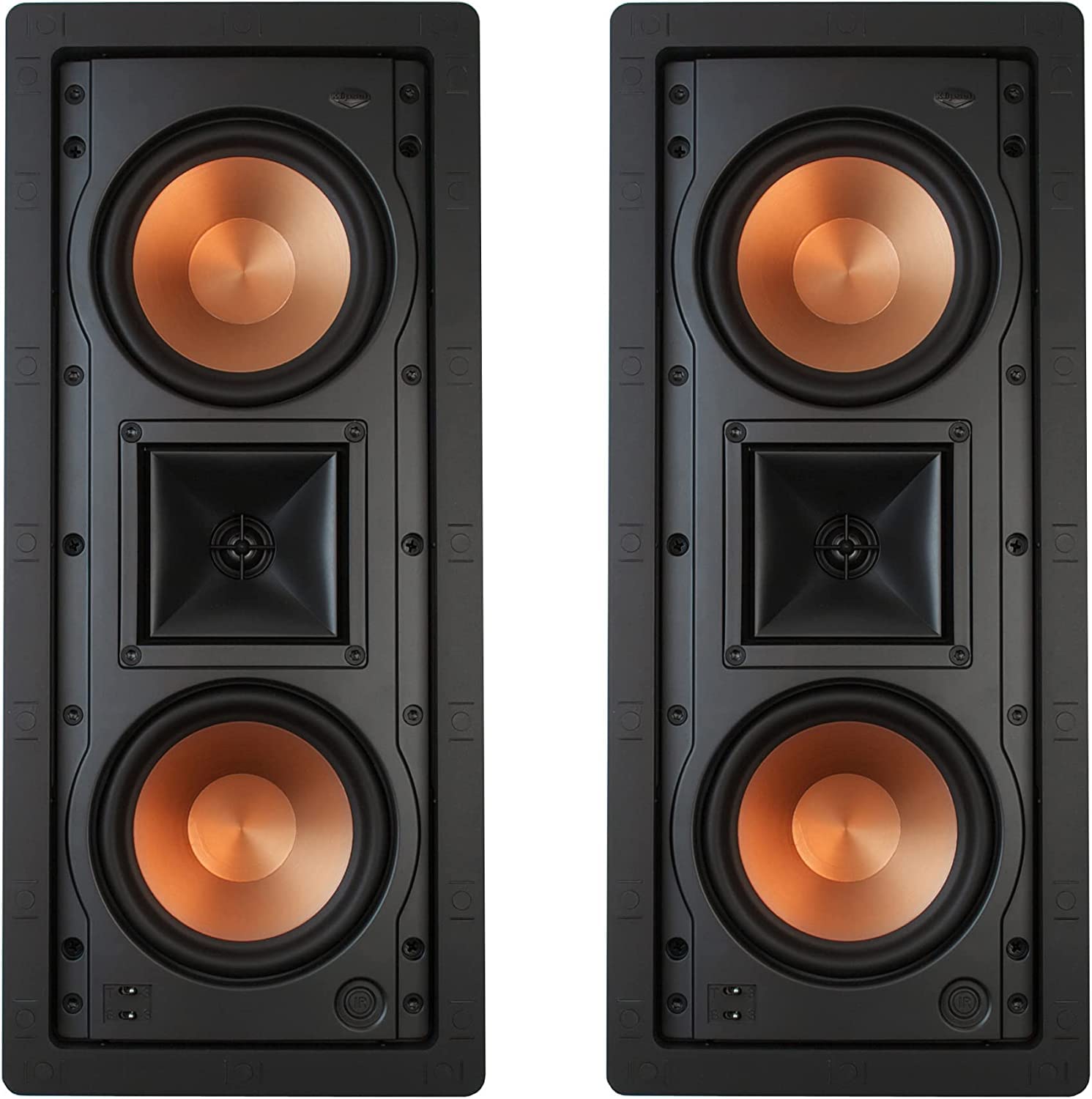
The Klipsch R-5502-W II isn’t a traditional ceiling speaker — it’s an LCR (Left, Center, Right) design that can be mounted horizontally or vertically in either walls or ceilings. Its secret weapon for bass is dual 5.25-inch Cerametallic cone woofers working in tandem. Two smaller woofers can move the same total air volume as a single larger one, while often offering better mid-bass punch and lower distortion due to reduced cone excursion per driver.
The 1-inch titanium diaphragm compression driver mated to a pivoting 90° x 90° square Tractrix Horn gives this speaker tremendous efficiency and output capability. Users report that the R-5502-W II can fill large rooms with sound at surprisingly low distortion levels, even at high volume. The magnetic paintable grille keeps the installation clean, and the included template makes the cutout process precise. Because it’s designed for LCR duty, the speaker handles dialogue and center-channel information with exceptional clarity, but the dual woofers also deliver authoritative low-end for music and movie effects.
This two-pack is a premium investment, but it fundamentally changes what an in-ceiling system can do. By using these as front left and right channels in a 5.1 or 7.1 setup, you get a true full-range experience that rivals many freestanding tower speakers. The key requirement is a high-quality AV receiver that can deliver sufficient clean power to each speaker — a 100-watt-per-channel amp is the minimum starting point. Buyers who have integrated these into a full Klipsch reference system consistently rate them five stars for sheer dynamic impact.
Why it’s great
- Dual 5.25″ Cerametallic woofers for powerful low-end
- High-efficiency horn design plays loud with low distortion
- Versatile horizontal or vertical mounting
Good to know
- Requires powerful external amplification
- Premium two-pack pricing
- Best suited for LCR channels, not surrounds
5. Klipsch CDT-5650-C II In-Ceiling Speaker

The Klipsch CDT-5650-C II is the smaller sibling of the CDT-5800, featuring a 6.5-inch Cerametallic woofer instead of an 8-inch. It still delivers the signature Klipsch horn-loaded efficiency and Controlled Dispersion Technology, but in a more compact, budget-friendly package. The 15° tilt on the entire driver assembly allows you to angle the sound toward the listening area, which significantly improves the perceived bass impact compared to a fixed downward-firing speaker.
Users rave about this speaker for Dolby Atmos height channels and rear surround duty in smaller rooms. The 1-inch titanium tweeter with Linear Travel Suspension (LTS) produces smooth, detailed highs that integrate well with other Klipsch speakers in a multi-channel system. The treble and mid-bass attenuation switches let you fine-tune the response to suit the room, and the magnetic SlimTrim grille keeps the installation looking clean. At volumes that would cause lesser speakers to distort, the CDT-5650-C II remains composed and clear.
While the 6.5-inch woofer can’t match the absolute low-end of an 8-inch driver, it produces surprisingly punchy mid-bass that makes movie explosions and music kick-drums feel substantial. Several users note that in a small room with low ceilings, this speaker sounds remarkably full and immersive without needing a subwoofer for casual listening. For dedicated home theater, a sub remains essential, but the CDT-5650-C II’s bass performance for its size and price point is excellent.
Why it’s great
- 15° pivoting driver for directional bass placement
- Horn-loaded efficiency plays loud with low distortion
- Compact size fits standard 8″ ceiling cutouts
Good to know
- 6.5″ woofer cannot match 8″ for deep sub-bass
- Requires external amplification
- Best as surround/Atmos, not primary LCR
6. Polk Audio 255c-RT In-Wall Center Channel Speaker

The Polk Audio 255c-RT is a dedicated center channel speaker designed for in-wall or in-ceiling use in a surround sound system. It features dual 5.25-inch mid/woofers and a 1-inch swivel-mount silk dome tweeter, all powered by Polk’s Dynamic Balance technology and the patented Power Port. The Power Port design channels air from the port smoothly into the room, reducing turbulence and port chuffing — which means cleaner, more extended bass from a relatively compact in-wall form factor.
This speaker is designed to offset reflective surfaces and eliminate sound distortion, making it ideal for rooms where aesthetics demand a clean, hidden center channel. The “Vanishing Series” wafer-thin grille is paintable and disappears into the ceiling or wall. The rotating cam system makes installation vibration-free and secure, and the included template ensures perfect fit. Users consistently praise how the 255c-RT makes dialogue and center-channel effects crystal clear, with a focused, articulate soundstage that anchors the front of the room.
For bass performance specifically, the 255c-RT delivers solid, controlled low-end for a center channel. Audyssey calibration in many AV receivers sets the crossover around 40 Hz, which is unusually low for a passive in-wall speaker with 5.25-inch woofers. While it’s not a replacement for a full-range LCR, it complements the other Polk Vanishing Series speakers beautifully when used as part of a matched system. Users note that the speaker benefits from an 85-90 hour break-in period to smooth out the mid-range and maximize bass response.
Why it’s great
- Power Port reduces distortion for cleaner bass
- Silk dome tweeter provides smooth, non-fatiguing highs
- Easy installation with rotating cam system
Good to know
- Designed primarily as center channel
- Requires external amplification
- Needs break-in period for optimal mid-bass
7. Herdio 6.5″ Bluetooth Ceiling Speakers (2 Pairs)

The Herdio 2-pair kit takes a different approach to ceiling speaker bass by including a 4-channel wall amplifier. The amplifier’s built-in EQ and volume control allow you to dial in the low-end response for each pair of 6.5-inch speakers. The included wall receiver features Bluetooth 5.0, USB, AUX, and a microphone input, making it a true all-in-one audio hub for a garage, patio, or kitchen. The speakers themselves use a 1-inch silk dome tweeter for clean highs and a polypropylene woofer for punchy mid-bass.
Installation is straightforward: run the included 16 AWG speaker wire from the amplifier to each speaker, mount the wall plate, and plug in the power adapter. The flush-mount design sits cleanly in the drywall, and the paintable grille allows you to match your ceiling color. Users report that the system sounds loud and clear, with enough low-end to satisfy casual listening in medium-sized rooms. The Bluetooth connection is stable up to the rated 30-foot range, and the ability to stream from any smartphone makes it convenient for parties or daily background music.
For bass output, the 6.5-inch drivers in this kit produce respectable mid-bass but cannot deliver the deep sub-bass rumble of larger 8-inch woofers or dedicated subwoofers. The amplifier’s internal power supply is sufficient for background music and moderate-volume listening, but at maximum volume on bass-heavy tracks, the lows can become slightly compressed. Users recommend using the included AUX input with a higher-quality source for better dynamics, and adding a separate subwoofer if deep bass is a priority. For the price of four speakers and an amplifier, this kit delivers tremendous value for whole-home audio.
Why it’s great
- Complete 4-speaker kit with wall amplifier included
- Bluetooth 5.0 streaming from any device
- Multi-source inputs for versatile use
Good to know
- 6.5″ woofers limited in deep bass
- Amplifier power may compress at high volumes
- Some users report Bluetooth connection issues with 4 speakers
8. Herdio 6.5″ Bluetooth Ceiling Speakers (4 Speakers)

This Herdio kit is a close sibling to the one above, but it emphasizes a longer Bluetooth range (100 feet unobstructed) and a slightly different amplifier configuration. It also includes four 6.5-inch speakers, making it ideal for covering a large open-plan living area, a covered patio, or a commercial space like a retail store or restaurant. The flush-mount design and paintable grilles keep the installation discreet, and the included cutout template makes the job easy for a DIYer.
The speakers use 2-way drivers with a 6.5-inch woofer and a built-in tweeter, producing clear sound with adequate low-end for background music. The amplifier box includes a 3.5mm AUX input alongside Bluetooth and can power all four speakers simultaneously. Users report that the sound quality is “excellent” for the price, with crisp highs and sufficient bass for casual listening. The installation is simplified by the spring-loaded terminals and the included 16-foot connection cable between the active and passive speakers.
Bass performance is solid for a 6.5-inch driver in a sealed ceiling enclosure. The low-end is not room-shaking, but it provides enough warmth and punch to make music sound full rather than tinny. Where this kit excels is in coverage — four speakers spread across a large space create an even, enveloping sound field that a single pair cannot match. Users note that the Bluetooth connection is reliable and easy to pair, with no dropout issues within the claimed range. For a budget-conscious whole-home audio solution, this kit is hard to beat.
Why it’s great
- 100 ft Bluetooth range for large spaces
- Four speakers provide even coverage
- Easy DIY installation with included template
Good to know
- 6.5″ drivers limit deep bass extension
- Amplifier may be underpowered for critical listening
- Bluetooth device name not customizable
9. Pyle PDICBT852RD 8″ Bluetooth Ceiling Speaker Pair

The Pyle PDICBT852RD is the budget entry in this list, but it holds a unique advantage: an 8-inch polypropylene woofer at a price point where most competitors offer only 6.5-inch drivers. The larger woofer cone moves more air, giving this pair a genuine low-end advantage over similarly priced kits. The included Bluetooth amplifier control box streams wirelessly from any device and powers both the active and passive speakers with a claimed 250-watt max output.
The 2-way design pairs the 8-inch woofer with a 0.5-inch polymer tweeter, covering a frequency response of 60 Hz to 20 kHz. Real-world users report good bass and mid-range with no distortion at high volumes, especially after adding insulation above the ceiling cavity to reinforce the low-end. The directional tweeter is a welcome feature at this price, allowing you to aim the highs toward the listening area. The spring-loaded terminals and included template make installation quick for a DIY project.
The catch is that the included Bluetooth amplifier is notably underpowered for the 8-inch woofers. Several users note that upgrading to a separate FOSI or similar powered Bluetooth receiver dramatically improves bass response and overall clarity. The amplifier also has limited range (approximately 30 feet) and cannot pair to two devices simultaneously. For buyers who are willing to invest an additional -30 in an external amp, this speaker pair can outperform units costing twice as much. As a drop-in all-in-one system, the bass is decent for the price but leaves headroom on the table.
Why it’s great
- 8″ woofer provides genuine bass at budget price
- Bluetooth 5.0 streaming included
- Directional tweeter for better soundstage
Good to know
- Included amplifier is underpowered for the woofers
- Limited Bluetooth range and device switching
- Consider external amp upgrade for full bass potential
FAQ
Can I get true subwoofer-level bass from an in-ceiling speaker?
Does a larger woofer always mean better bass in ceiling speakers?
Are active (Bluetooth) ceiling speakers good for bass?
How important is the ceiling cavity for bass performance?
Final Thoughts: The Verdict
For most users, the ceiling speakers with bass winner is the Klipsch CDT-5800-C II because its pivoting 8-inch Cerametallic woofer and Controlled Dispersion Technology deliver genuinely impactful low-end that can be aimed exactly where you sit, all in a discreet, flush-mount package. If you want the deepest possible extension from a single speaker, grab the Polk Audio 70-RT for its class-leading 34 Hz frequency response and 3-way driver design. And for a budget-friendly whole-home solution that still offers decent bass from an 8-inch woofer, nothing beats the value of the Pyle PDICBT852RD pair, especially when paired with a better amplifier.

Mo Maruf
I created WellFizz to bridge the gap between vague wellness advice and actionable solutions. My mission is simple: to decode the research and give you practical tools you can actually use.
Beyond the data, I am a passionate traveler. I believe that stepping away from the screen to explore new environments is essential for mental clarity and physical vitality.