Our readers keep the lights on and my smoothie glass nicely filled. As an Amazon Associate, I earn from qualifying purchases.
Living in a rural area means accepting that cell signal is a suggestion, not a promise. You’ve watched the bars drop when you step inside, listened to calls fragment into static, and learned exactly which spot on the property you have to stand in to send a text. A dedicated signal booster is the only hardware solution that amplifies the faint whisper of a distant tower into a usable connection, and the choices range from compact in-vehicle units to whole-home systems capable of covering 15,000 square feet. The critical variable isn’t the sticker price—it’s the gain in decibels, the frequency bands your carrier actually uses, and whether the outdoor antenna can reach the tower at all.
I’m Mohammad Maruf — the founder and writer behind WellFizz. I’ve spent dozens of hours analyzing amplification specs, FCC certification data, and real-world user reports from the most signal-starved corners of the country to build this guide.
After sorting through gain ratings, antenna types, coverage claims, and installation realities, these picks represent the honest best for anyone searching for a truly reliable cell phone booster for rural areas.
How To Choose The Best Cell Phone Booster For Rural Areas
Rural signal boosting is different from suburban or urban boosting. The tower might be 10 miles away, blocked by a ridge or a stand of trees, and broadcasting on a specific low-band frequency that cheaper boosters ignore. You aren’t buying a gadget—you’re buying the ability to hold a conversation without shouting into the void.
Decibel Gain and the Real Coverage Math
Gain is measured in dB, and every 3 dB doubles the effective power of the signal. A 65 dB booster is not a little weaker than a 72 dB booster—it is dramatically less capable of pulling a signal out of noise. For rural use, look for a minimum of 65 dB of uplink and downlink gain. The coverage area numbers on the box (4,000 sq ft, 8,000 sq ft) assume an open floor plan with no structural interference. In a real rural home with thick walls, metal roofing, or a basement, expect 50-70% of the claimed range. A higher gain rating gives you a genuine buffer against those losses.
Frequency Band Support and Carrier Lock-in
Your carrier’s rural signal almost certainly lives on Band 12, 13, or 17 (700 MHz) or Band 5 (850 MHz). These low frequencies travel farther and pass through walls better than the higher bands used in cities. If a booster does not support those specific bands, it may amplify nothing useful. T-Mobile also uses Band 71 (600 MHz) in many rural expansion areas, but several otherwise excellent boosters omit it. Before buying, check your carrier’s dominant band in your zip code using a tower-locator app, then cross-reference it against the booster’s frequency table. A booster that covers every band from 700 to 2600 MHz is ideal for future-proofing across carriers.
Antenna Separation: The Most Overlooked Failure Point
The outdoor antenna and the indoor antenna must be physically separated—vertically and horizontally—or the booster will detect its own signal and throttle down to prevent oscillation. A minimum of 20 feet of vertical separation and 30 feet of horizontal separation is the standard. In a vehicle, this means mounting the outside antenna on the roof and placing the inside antenna as far away as possible (e.g., on the dashboard with the phone in the cup holder). In a house, the outdoor antenna must be on the roof or a mast, and the indoor antenna must be on a different floor or at the opposite end of the building. Buyers who skip this step often report “no improvement” and return a perfectly good unit.
Quick Comparison
On smaller screens, swipe sideways to see the full table.
| Model | Category | Best For | Key Spec | Amazon |
|---|---|---|---|---|
| HiBoost 10K SL | Whole Home | Large homes with app-based tuning | 70 dB gain, 5500 sq ft coverage | Amazon |
| HiBoost 4K Mate | Whole Home | Mid-sized homes with LCD & app setup | 65 dB gain, 4500 sq ft coverage | Amazon |
| ZORIDA Ver 5S Pro | Whole Home | Families needing 72 dB of raw power | 72 dB gain, 4000 sq ft coverage | Amazon |
| weBoost Home Complete | Whole Home | Homes with one dominant carrier signal | Up to 100X boost, 7500 sq ft coverage | Amazon |
| HiBoost 8K Plus | Whole Home | Large multi-room coverage with dual antennas | 70 dB gain, 8000 sq ft coverage | Amazon |
| SureCall Fusion2Go OTR | Vehicle | Fleet trucks & RVs needing rugged durability | 50 dB gain, patented 2XP uplink technology | Amazon |
| weBoost Drive 4G-X OTR | Vehicle | Truckers needing reliable in-cab signal | 50 dB gain, 17” omni antenna included | Amazon |
| HiBoost Car & SUV | Vehicle | Personal cars & SUVs with magnetic antenna | 50 Ohm precision-grade RF connectors | Amazon |
| CEL-FI GO G41 | Premium Whole Home | Massive homes or extreme fringe areas | 100 dB gain, 15000 sq ft coverage | Amazon |
In‑Depth Reviews
1. HiBoost 10K SL

The HiBoost 10K SL strikes the hardest balance between raw amplification and practical usability for a rural home. Its 70 dB of gain and coverage claim of up to 5500 square feet means it can push through a two-story house with a basement, provided the outdoor antenna has a clear line of sight to the tower. The directional antenna is far more effective at pulling a weak signal from a distant tower than an omni antenna, and the included LCD screen plus Bluetooth app let you tune the antenna angle while watching real-time signal strength. Real users in forested valleys report jumping from under 1 Mbps to over 25 Mbps down after dialing in the aim.
The kit comes with a through-window cable that avoids drilling, though running the 50-foot outdoor cable cleanly through a wall or under a sill requires patience. The unit supports all major carriers and works with Band 12/13/17 (700 MHz) and Band 5 (850 MHz), which covers the low-band frequencies most rural towers broadcast on. It does not support T-Mobile Band 71 (600 MHz), so T-Mobile users in deep fringe areas should verify their local tower before purchasing. The Signal Supervisor app includes a live chat feature, and multiple users report that the US-based support team helped them realign antennas and troubleshoot oscillation issues quickly.
For a home where the best outside signal is one bar of 4G LTE, this booster consistently delivers three to four bars inside across multiple rooms. The automatic gain control prevents it from over-amplifying and causing feedback, and the metal chassis keeps out interference from household electronics. It’s a mid-range investment that solves the problem for most rural property sizes without requiring a contractor to install.
Why it’s great
- Excellent gain-to-price ratio for whole-home coverage
- App and LCD make antenna tuning a one-person job
- Responsive US-based tech support via the app
Good to know
- Lacks support for T-Mobile Band 71 (600 MHz)
- Large homes may need the 15K model for full roof-to-basement coverage
- Directional antenna requires precise aiming toward the tower
2. ZORIDA Ver 5S Pro
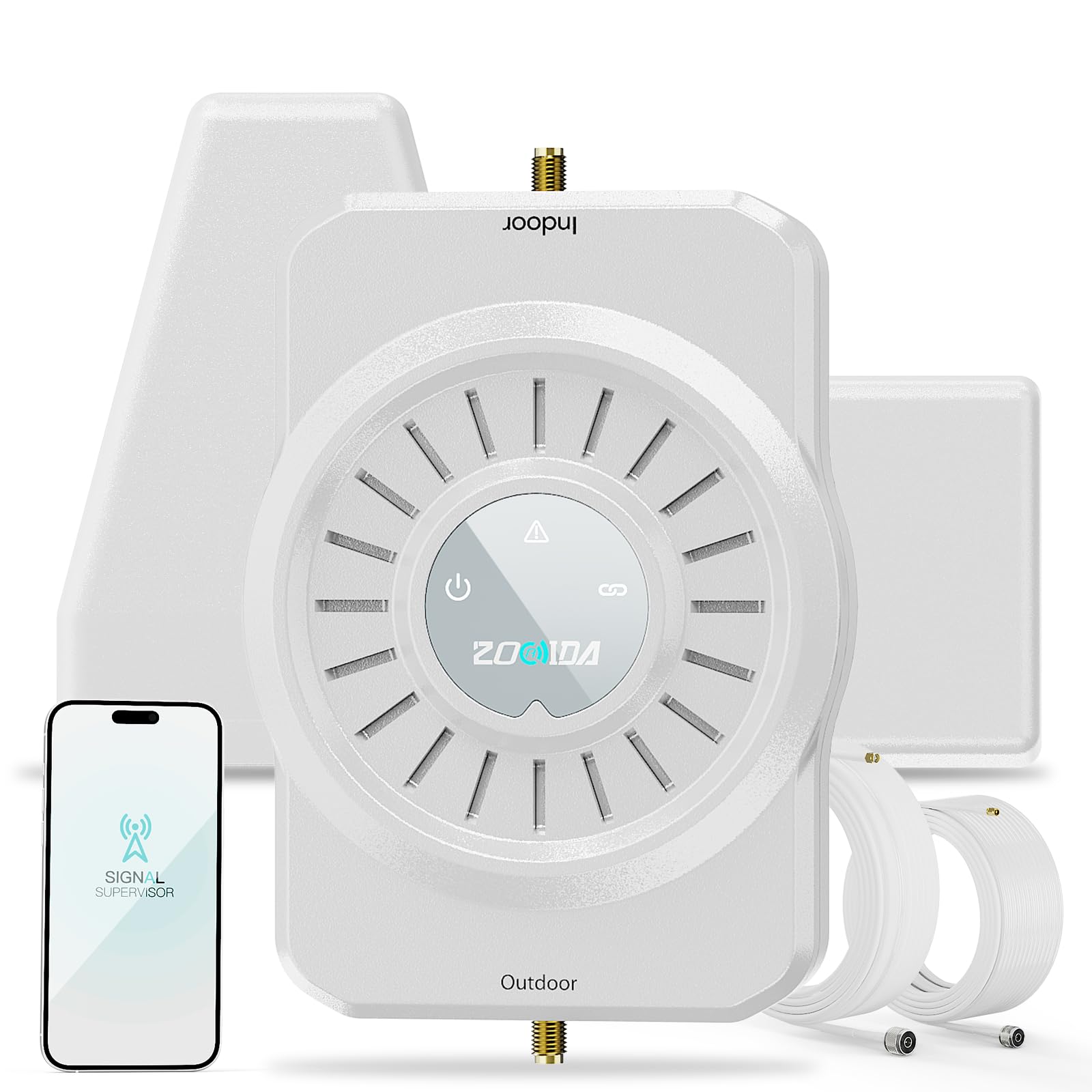
The ZORIDA Ver 5S Pro enters the market with the highest gain rating in the mid-range tier: 72 dB, which is genuinely rare at this level. That extra power translates into a meaningful ability to pull a signal out of a true dead zone, not just a weak zone. Users in rural Michigan and remote national forest campsites report going from zero usable signal to stable 4G and 5G connections that support HD video streaming. The unit covers up to 4000 square feet, which is honest for a three-to-four-room spread, and it supports all US carriers across a very wide frequency range from 700 MHz up to 2700 MHz.
The ZORIDA app walks you through real-time signal measurements during installation, which is a feature normally reserved for more expensive models. The high-gain antennas are included in the box, and the outdoor antenna connects via standard SMA connectors that allow for cable extension if the mast needs to be farther from the house. Users who mounted the antenna 18 feet above ground and used a tower-finding app reported the best results. The three-year warranty and lifetime US-based tech support match the coverage of premium brands, and multiple reviews specifically praise the responsiveness of the support team, particularly an agent named Noah who helped with complex installations.
One nuance from real-world testing: the unit works best when the donor antenna has a clear line of sight and at least one bar of outside signal to amplify. In extremely deep valleys with zero signal anywhere on the property, even 72 dB may not be enough. But for the vast majority of rural properties where a faint signal exists somewhere on the roof, this booster delivers more amplification per dollar than almost anything else on the market.
Why it’s great
- 72 dB gain is class-leading for the price tier
- Very wide frequency band coverage for carrier flexibility
- Excellent customer support with extended warranty
Good to know
- Requires at least a weak outside signal to function
- Some users reported hardware revision mix-ups during shipping
- App connectivity issues on certain phone models
3. HiBoost 4K Mate
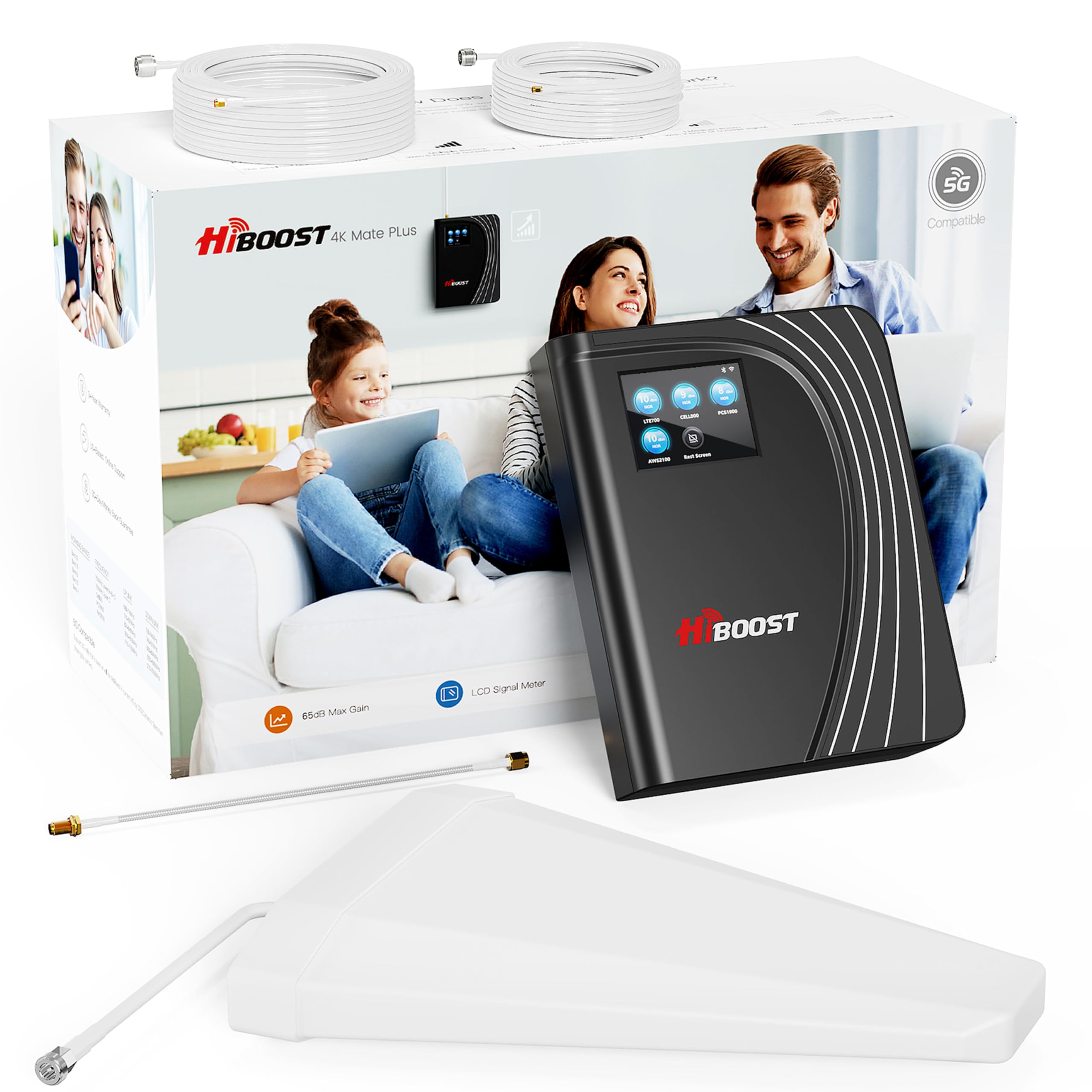
The HiBoost 4K Mate is the sensible choice for a mid-sized rural home or cabin where the layout is straightforward and the budget needs to stretch. Its 65 dB gain and 4500 square foot coverage rating are honest numbers—users in a 2000-square-foot mountain home with metal siding went from zero usable signal to four bars of 4G LTE after installing the outdoor antenna on a 30-foot mast. The built-in LCD touch screen and companion app let you fine-tune the antenna direction while watching the signal change in real time, which eliminates the back-and-forth guessing game that plagues cheaper boosters without display feedback.
The kit includes a through-window cable that avoids drilling, and the installation guide is straightforward enough for someone who has never handled coaxial cable. It supports the essential low bands (12, 13, 17 at 700 MHz and Band 5 at 850 MHz) plus higher bands up to 3500 MHz, making it compatible with 5G DSS deployments. A common real-world refinement: users in steel buildings or with metal roofs report needing to add a higher-gain antenna kit (available separately from HiBoost) to achieve full coverage, which adds cost but transforms the system’s capability in challenging structures. The 4K Mate also features adaptive signal management that automatically adjusts gain to prevent oscillation, which is a genuine help in homes where the indoor and outdoor antennas are closer than the recommended 20-foot vertical separation.
The trade-off is that 65 dB is the floor for serious rural use. If your outside signal is below -115 dBm (very weak), this booster will improve it, but not as dramatically as a 72 dB or 100 dB unit. It’s a solid mid-range pick for the buyer who has a reasonable outside signal and wants to distribute it through a modest home without overspending.
Why it’s great
- LCD display simplifies antenna aiming significantly
- 5G compatible with good band coverage
- Through-window cable eliminates drilling
Good to know
- 65 dB may struggle with extremely weak signals
- Steel buildings may require an upgraded antenna kit
- App refresh can lag on steel roofs due to Bluetooth range
4. weBoost Home Complete

The weBoost Home Complete is the strongest residential booster weBoost offers, and it delivers exactly what the brand promises when the conditions are right. It claims coverage up to 7500 square feet and can boost a weak signal by up to 100 times. In the right scenario—a home with a clear line of sight to a tower 12 to 15 miles away—users report signal readings as low as -67 dBm inside the house, which is excellent. The kit includes an outside directional antenna with a pole mount bracket and an inside panel antenna that mounts on a wall without drilling. The weBoost app helps locate the nearest cell tower and shows your signal strength before and after installation, which takes the guesswork out of aiming. It supports all major US carriers and works on 4G and 5G frequencies, and the DIY installation is designed for a homeowner with basic tools.
The critical limitation is that the directional antenna locks onto one carrier at a time. If your household uses both Verizon and T-Mobile, you have to choose one to amplify, and the other carrier’s users will see little to no improvement. Multiple verified reviews note that the coverage is not truly “whole house” unless you are within 15 to 20 feet of the indoor antenna—farther away, the signal drops dramatically back to near-baseline levels. In one case, a user with an outside signal of -120 dBm (extremely weak) got strong signal only within a few feet of the panel antenna, and weBoost support confirmed that the system requires a decent outside signal to perform well. That makes the Home Complete a fantastic option for the rural home with moderate signal outside (at least -110 dBm) that needs a clean, reliable boost in the main living area, but less ideal for deep fringe conditions where every dB counts.
Why it’s great
- Excellent performance when outside signal is moderate
- Trusted brand with strong US-based support
- App makes tower location and tuning straightforward
Good to know
- Coverage radius is limited near the indoor antenna
- Single-carrier amplification limits multi-carrier households
- Not effective in extremely weak signal areas (-120 dBm or worse)
5. HiBoost 8K Plus

For a spacious rural home, a metal building, or a property where you need signal across multiple separate rooms, the HiBoost 8K Plus brings a second indoor antenna into the equation. The 70 dB of gain and 8000 square foot coverage claim are backed by a design that includes one built-in antenna in the main unit and one external panel antenna that can be placed in a separate room, providing more even distribution than a single-antenna system. Users in 4500-square-foot, three-floor homes report eliminating dropped calls on Verizon and AT&T, and those in metal buildings saw AT&T jump from one bar to solid 5G while other carriers improved as well. The Automatic Gain Control (AGC) and the HiBoost app with LCD display let you monitor and adjust without climbing onto the roof twice.
Like other HiBoost models, it supports the critical low bands (700 MHz, 850 MHz) and the mid-bands (1700/2100 MHz, 1900 MHz) used by all major carriers. The kit includes two outdoor coax cables, a through-window cable, and mounting accessories, so most installations can be completed in an afternoon. A common real-world note: the 8K Plus does not support T-Mobile Band 71 (600 MHz), so T-Mobile customers in fringe areas should check their tower’s primary band before buying. Users also found that the claimed coverage is somewhat optimistic for multi-floor layouts—a three-story home may need the even larger 15K model to reach the basement effectively. Still, for a single-story ranch or a two-story home with an open floor plan, the dual-antenna setup provides noticeably more consistent coverage than a single-antenna booster of similar gain.
Why it’s great
- Dual indoor antennas provide better multi-room coverage
- 70 dB gain is competitive for demanding rural conditions
- AGC prevents oscillation and simplifies setup
Good to know
- No support for T-Mobile Band 71 (600 MHz)
- Coverage claims are optimistic for multi-story homes
- Installation requires careful cable routing for the second antenna
6. SureCall Fusion2Go OTR

The SureCall Fusion2Go OTR is engineered specifically for the abuse of long-haul trucking and overland travel. Its patented 2XP technology delivers double the uplink power of a standard vehicle booster, which is critical when your phone needs to shout back to a tower that is barely audible. The omni-directional outdoor antenna transmits and receives in all directions, so you do not need to aim it—it works regardless of which way the truck is facing, and it includes a built-in ground plane that works on metal, fiberglass, wood, or plastic roofs. The antenna mounts via a 3/8 x 24 thread mount, and the kit includes a 10-foot integrated cable, mounting bracket, and hardware with thread-lock glue to withstand road vibration. Users report that in canyons where the signal was -119 dBm (essentially dead), the booster brought it up to -95 dBm (average usable), enabling streaming where texting was previously impossible.
The Fusion2Go OTR supports all North American carriers on 5G and 4G LTE and allows multiple users to connect simultaneously. The optional mast extension lets you raise the antenna height from 16 inches to 32 inches, which can make a meaningful difference when driving through hilly terrain. The unit is weather-tested against water and dust, and it survived branch impacts at highway speeds. A few negative reviews note that in certain deep dead zones with zero signal whatsoever, the booster cannot create a signal from nothing—it needs at least a whisper of an outside signal to amplify. There are also mixed reports from truckers who drove consistent routes and saw no improvement in known dead spots, suggesting that the booster’s effectiveness depends heavily on the specific terrain and tower distance of the route.
Why it’s great
- Patented 2XP uplink power improves talk-back in fringe areas
- Durable, weather-proof design for commercial truck use
- Omni antenna works without aiming, ideal for moving vehicles
Good to know
- Requires at least a minimal outside signal to function
- Performance varies significantly by route and terrain
- Higher price point than comparable in-vehicle boosters
7. weBoost Drive 4G-X OTR

The weBoost Drive 4G-X OTR is the most powerful in-vehicle booster from the most recognized brand in the category. It delivers 50 dB of gain through a weather-resistant 17-inch omni-directional antenna, which is designed for mounting on a truck mirror or CB antenna bracket. The system supports multiple users simultaneously, so everyone in the cab can benefit, and it includes a 3-way CB antenna mount, mast extension, and side exit adapter that simplify installation on a big rig. Users report that in areas where the phone showed no bars at all (e.g., Teton Canyon, Mesa Verde), the booster pulled in enough signal for 4G email and web browsing. In areas with a very weak signal (around -115 dBm), speeds improved roughly tenfold, and the signal strength increased by 20 to 30 dB. The unit is FCC approved and comes with a 2-year warranty.
A critical detail from experienced users: the large OTR antenna is far more effective than the small 4-inch magnetic antennas that come with standard car boosters. The height and surface area of the 17-inch antenna capture a signal that the small antennas cannot touch. The inside antenna placement also matters enormously—laying the phone directly on the indoor antenna patch yields the best results, and the metal roof of a truck eliminates the need for horizontal separation (the roof itself provides the isolation). Some users noted that the thread-lock glue included in the kit is essentially superglue, so careful alignment before tightening is essential. While this booster does not work miracles in absolutely zero-signal zones, it consistently turns a flickering, unusable signal into a functional connection for voice and data on the road.
Why it’s great
- 17-inch antenna outperforms smaller magnetic antennas
- Proven brand with excellent customer service and exchange policy
- Multiple users supported simultaneously in the cab
Good to know
- Does not create signal from zero—needs a faint outside signal
- Installation requires careful antenna and cable placement
- Performance varies by phone model and carrier
8. HiBoost Car & SUV
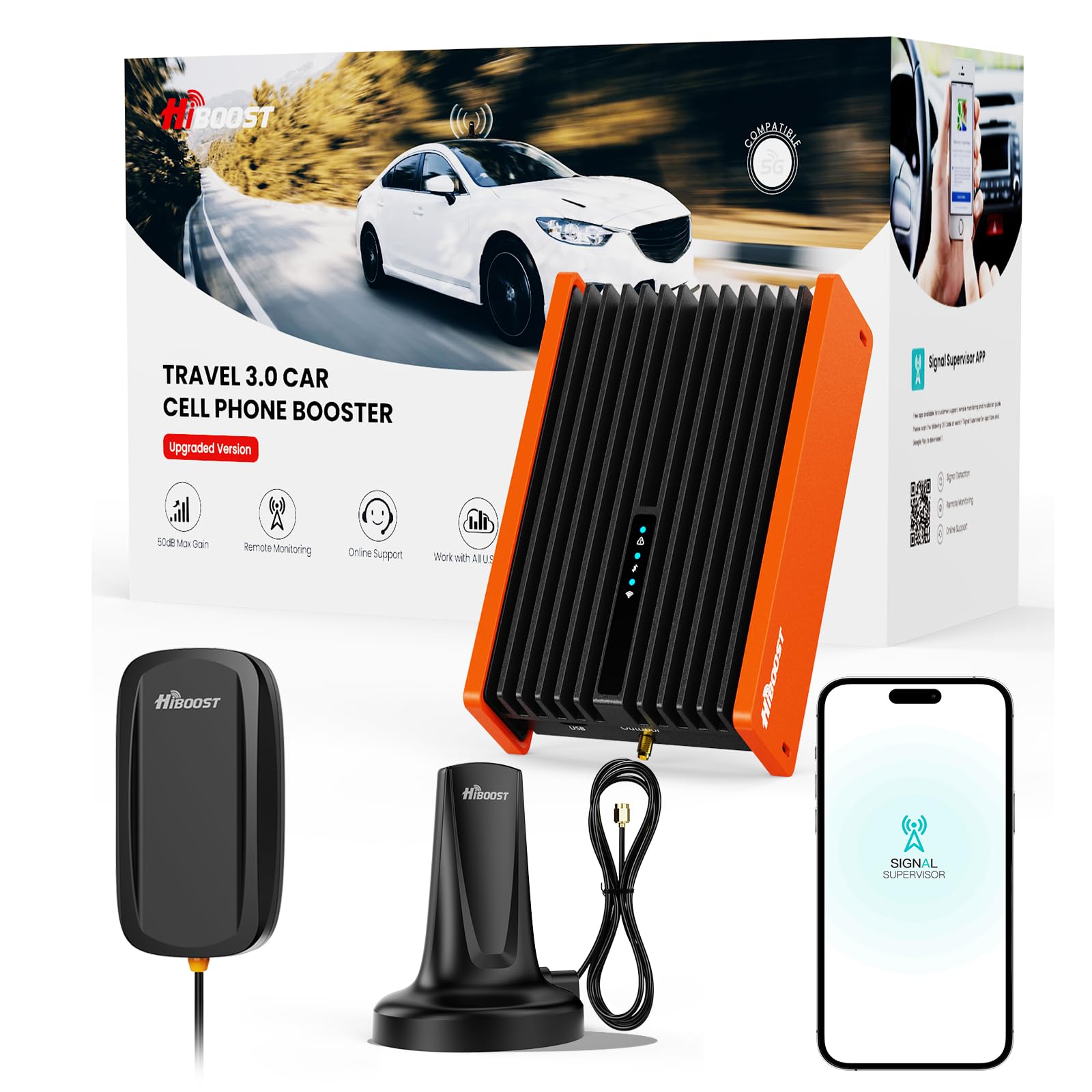
The HiBoost Car & SUV is a precision-engineered vehicle booster that prioritizes signal purity and heat management. It uses 50 Ohm RF connectors throughout the signal path, which reduces transmission loss compared to cheaper connectors and allows the booster to deliver a cleaner amplified signal to your phone. The honeycomb briquette design of the booster body increases heat dissipation by 30 percent, so the unit maintains consistent output during long summer drives without thermal throttling. The magnetic roof antenna is upgraded to be dustproof, oilproof, and waterproof, and it uses strong magnets that stay attached to the roof at highway speeds. Users in Toyota Tacomas and Ford Super Duties report going from two bars to four bars of usable signal after installation, with support for all major carriers and 5G.
The “Signal Supervisor” app provides live status monitoring and includes detailed installation videos that walk you through the optimal placement of the inside antenna. A common refinement from real-world use: the power cord is slightly short for full-size trucks, so you may need to plan the routing carefully or use an extension. The antenna separation requirement is significant—placing the outside antenna on the roof and the inside antenna as far forward on the dashboard as possible (or even on the rear deck in an SUV) is necessary to prevent signal loopback. Some users in smaller vehicles found that the available separation distance was insufficient, resulting in only a one-to-two bar improvement rather than the full potential. The 3-year after-sales maintenance and multiple contact methods (email, phone, app chat) provide strong support for troubleshooting the install.
Why it’s great
- 50 Ohm connectors minimize signal loss for cleaner amplification
- Enhanced heat dissipation prevents throttling on long drives
- Durable magnetic antenna stays secure at highway speeds
Good to know
- Power cord length may be tight in full-size trucks
- Antenna separation is critical—smaller vehicles may struggle
- Some users report only modest improvement depending on vehicle layout
9. CEL-FI GO G41
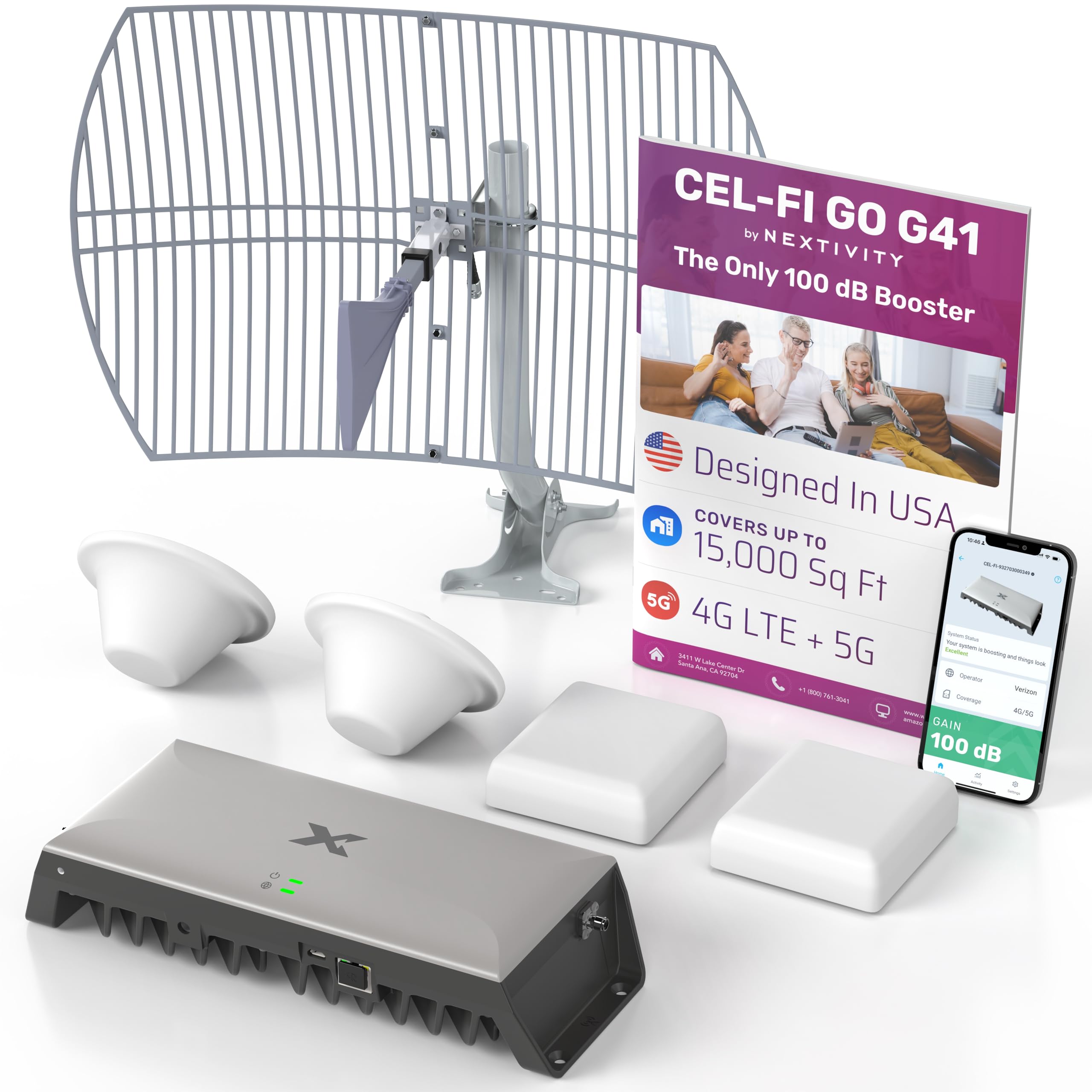
The CEL-FI GO G41 is not a booster for the faint of budget—it is the endgame solution for the most extreme rural signal challenges. With a staggering 100 dB of gain and coverage rated up to 15,000 square feet, it sits in a class of its own. The 4th generation IntelliBoost chipset supports true 5G NR and 4G LTE, and it intelligently manages up to two bands simultaneously. The kit includes two dome antennas and two panel antennas, giving you the flexibility to choose the best indoor antenna type for your layout. Users in remote homes with zero service and metal roofs report jumping from -108 dBm outside to -75 dBm throughout the house, which is the difference between no connection and full bars of usable 4G LTE. The system is designed and assembled in California and carries full FCC certification (ID YETG41-BE).
The installation is more involved than a consumer-grade booster—running the outdoor cables, mounting the antennas, and configuring the software takes a full day for most users. The payoff is that it replaces the need for satellite internet in some cases, providing fast enough data for streaming and hotspot use. Customer service is exceptional, with one reviewer noting that the CEO personally followed up on an issue. A technical limitation to understand: the G41 amplifies only two bands at a time (selectable from the supported set: 700 MHz, 850 MHz, 1700/2100 MHz, 1900 MHz). If your carrier uses multiple bands and your phone prefers a non-amplified band (e.g., Band 30 or 66), the booster may not improve performance for that device. This is a niche problem, but it matters in areas where carrier aggregation is active across many bands.
Why it’s great
- 100 dB gain is the highest allowed by the FCC for consumer use
- Covers up to 15,000 square feet with proper setup
- Exceptional build quality and US-based support
Good to know
- Amplifies only two bands simultaneously, which may conflict with carrier aggregation
- Installation is complex and time-consuming
- Significant investment that is best suited for extreme fringe locations
FAQ
Will a cell booster work if I have zero signal outside my home?
Does a cell booster work for all carriers at the same time?
Final Thoughts: The Verdict
For most users, the cell phone booster for rural areas winner is the HiBoost 10K SL because it delivers 70 dB of gain and app-based tuning at a reasonable investment, covering a typical rural home without requiring a professional install. If you need extreme range and have a very weak outside signal, grab the CEL-FI GO G41. And for reliable in-vehicle boosting on long rural drives, nothing beats the weBoost Drive 4G-X OTR.

Mo Maruf
I created WellFizz to bridge the gap between vague wellness advice and actionable solutions. My mission is simple: to decode the research and give you practical tools you can actually use.
Beyond the data, I am a passionate traveler. I believe that stepping away from the screen to explore new environments is essential for mental clarity and physical vitality.