Our readers keep the lights on and my smoothie glass nicely filled. As an Amazon Associate, I earn from qualifying purchases.
Finding a drone that balances a sharp camera, solid flight time, and hassle-free operation often feels like a compromise between power and portability. The sub-250-gram category has changed the game, offering professional features without the burden of government registration, but sifting through the marketing hype to find the truly capable airframes remains the real challenge.
I’m Mohammad Maruf — the founder and writer behind WellFizz. I’ve spent countless hours analyzing flight logs, transmission specs, gimbal stabilization data, and customer durability reports to separate the genuine flyers from the toys.
After reviewing dozens of models across every price tier, this guide delivers a clear, no-nonsense breakdown of the absolute best drones for adults, ranked by real-world performance and long-term reliability.
How To Choose The Best Drones For Adults
Choosing the right adult drone means weighing weight regulations, camera quality, flight stability, and battery endurance against your specific flying style. The market is flooded with specs that look good on paper but fail in real wind or low light, so understanding the non-negotiable components is the first step toward a satisfying purchase.
Weight Class and Registration
The 249-gram threshold is the single most important regulatory factor. Drones under this weight, like many premium folding models, are exempt from FAA Remote ID and registration requirements. Heavier airframes (over 250g) generally offer larger sensors and more wind resistance at the cost of mandatory compliance paperwork.
Gimbal vs. Electronic Stabilization
A physical 3-axis brushless gimbal mechanically counteracts pitch, roll, and yaw, producing genuinely smooth footage even in wind. Electronic Image Stabilization (EIS) crops the sensor to reduce jitter, which works in calm conditions but degrades image quality and fails when the drone banks hard. For any serious aerial photography, a mechanical 3-axis gimbal is table stakes.
Transmission Technology
Wi-Fi-based transmission is the weak link in budget drones, prone to interference and dropouts beyond a few hundred feet. Digital transmission systems — often proprietary and using wired tethering or dual-antenna relays — maintain a stable, low-latency HD feed at distances over three miles. Always verify the transmission type, not just the advertised range.
Quick Comparison
On smaller screens, swipe sideways to see the full table.
| Model | Category | Best For | Key Spec | Amazon |
|---|---|---|---|---|
| DJI Mini 5 Pro | Premium | Pro-level footage | Omnidirectional obstacle sensing | Amazon |
| Holy Stone HS600D | Premium | High wind stability | Level-6 wind resistance | Amazon |
| Bwine F7MINI | Mid-Range | Built-in screen controller | 5.5″ display remote | Amazon |
| Bwine F7GB2 Pro | Mid-Range | High-altitude flights | 2000m altitude ceiling | Amazon |
| Ruko Drone | Mid-Range | Long flight sessions | 96 min total flight time | Amazon |
| HOVERAir X1 | Mid-Range | Self-flying vlogs | Hands-free palm launch | Amazon |
| Gleesfun G11PRO | Mid-Range | Beginner photography | 3-axis brushless gimbal | Amazon |
| DJI Neo | Entry-Level | Controller-free selfies | 135g weight, palm takeoff | Amazon |
| Potensic ATOM LT | Entry-Level | Budget practice flying | 80 min flight with 2 bats | Amazon |
In‑Depth Reviews
1. DJI Mini 5 Pro Fly More Combo
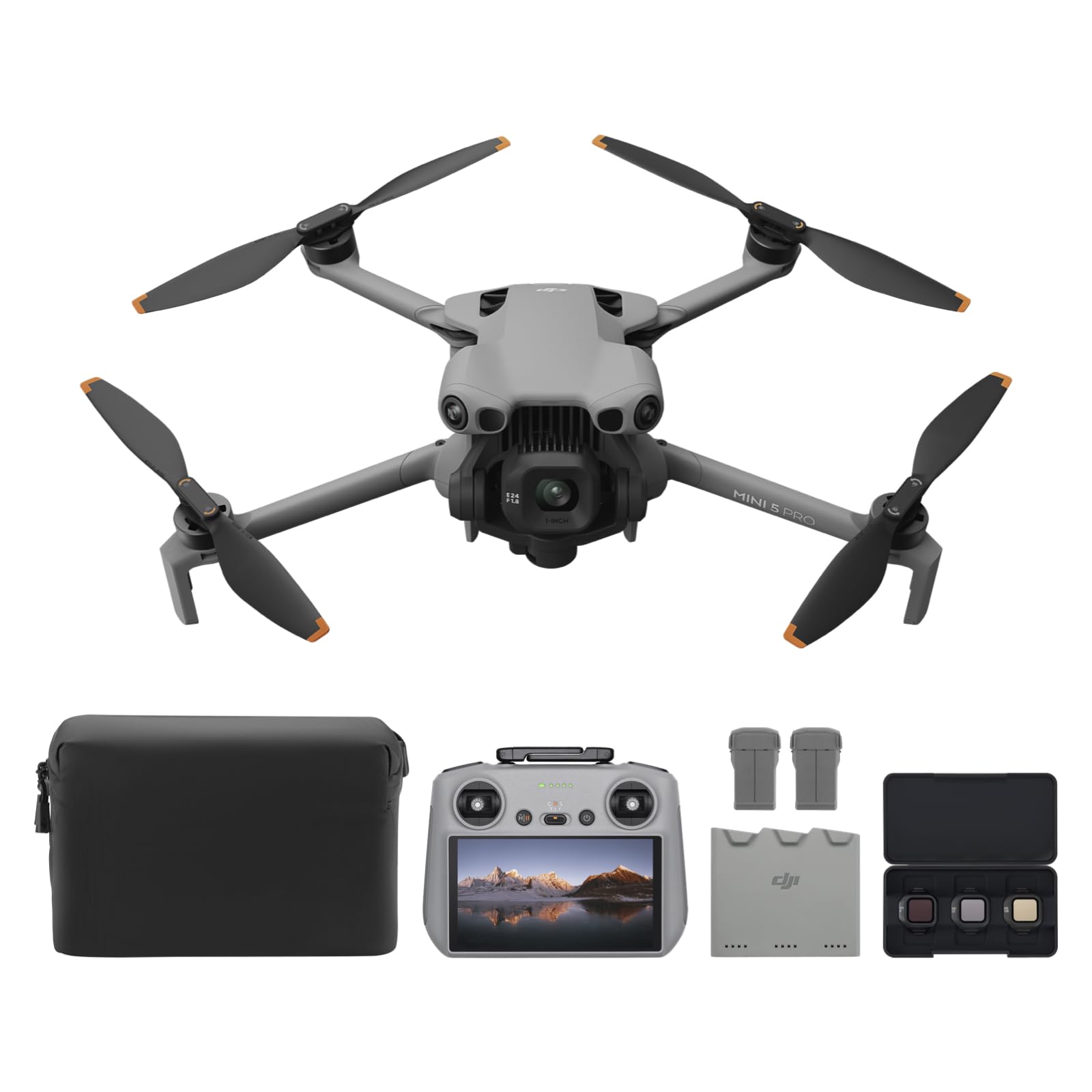
The DJI Mini 5 Pro sets the standard for the entire sub-250-gram category, and the Fly More Combo elevates it with three batteries and the DJI RC 2 controller. Its 1-inch CMOS sensor captures native 4K/60fps HDR video with a dynamic range that beats every other compact drone in this list. The 225-degree gimbal rotation enables true vertical filming — a huge plus for social media creators — and the combination of forward LiDAR and vision sensors delivers omnidirectional obstacle avoidance, a safety net rarely seen outside professional cinema rigs.
Flight characteristics are refined: ActiveTrack 360° locks onto subjects with customizable tracking modes that handle cycling and running without losing the lock. The 36-minute per-battery endurance is conservative in light winds, and the fast-charging hub refuels all three packs in roughly 115 minutes. The internal 42GB of storage eliminates the need for an SD card, though you lose expandability if you fill it up mid-trip.
The only real drawbacks are the mandatory FAA registration (it sits right at the 250-gram line with the battery) and the reality that its obstacle sensors — while excellent for a drone this size — still struggle with thin branches and power lines. For anyone wanting a polished, all-in-one system that grows with their skills, this is the benchmark.
Why it’s great
- 1-inch CMOS with true 4K/60fps HDR
- Omnidirectional obstacle sensing
- 225° gimbal for vertical filming
- Fast charging hub for three batteries
Good to know
- Requires FAA registration
- No expandable storage
- Top-tier price point
2. Holy Stone Sentinel HS600D

The Holy Stone HS600D punches into premium territory with a reinforced 603-gram frame and a dedicated 1/2-inch Sony CMOS sensor paired with an f/1.8 aperture. This combination delivers genuine 8K photo resolution and 4K HDR video with noticeably better low-light performance than sensor-matched competitors. The 3-axis mechanical gimbal is joined by an additional EIS layer, creating dual stabilization that keeps footage locked even in level-6 wind conditions — a spec verified by customer reports of stable flights in 30-40 mph gusts.
Transmission uses a wired-relay digital system rated for 20,000 feet, and real-world user tests confirm reliable feeds past 3,000 feet before signal hesitation appears. The two 3500mAh batteries deliver roughly 30-34 minutes of real flight per pack, and the bundle includes a hard carrying case, spare props, and a gimbal protector. The beginner mode with automatic altitude limits and multi-sensor safety — TOF, GPS, and optical flow — makes this a viable first drone for adults who don’t want to outgrow their purchase in three months.
The downsides are minor but real: the controller relies on a phone screen rather than a built-in display, and the camera lacks manual ISO and exposure time controls, which serious photographers will miss. For anyone who flies in open, breezy landscapes and needs rock-solid footage, the HS600D is a tank.
Why it’s great
- Sony sensor with f/1.8 aperture
- Verified level-6 wind resistance
- Dual 3-axis gimbal plus EIS
- Long 20,000 ft digital transmission
Good to know
- No built-in controller screen
- Limited manual camera controls
- Requires FAA registration
3. Bwine F7MINI 4K/8K
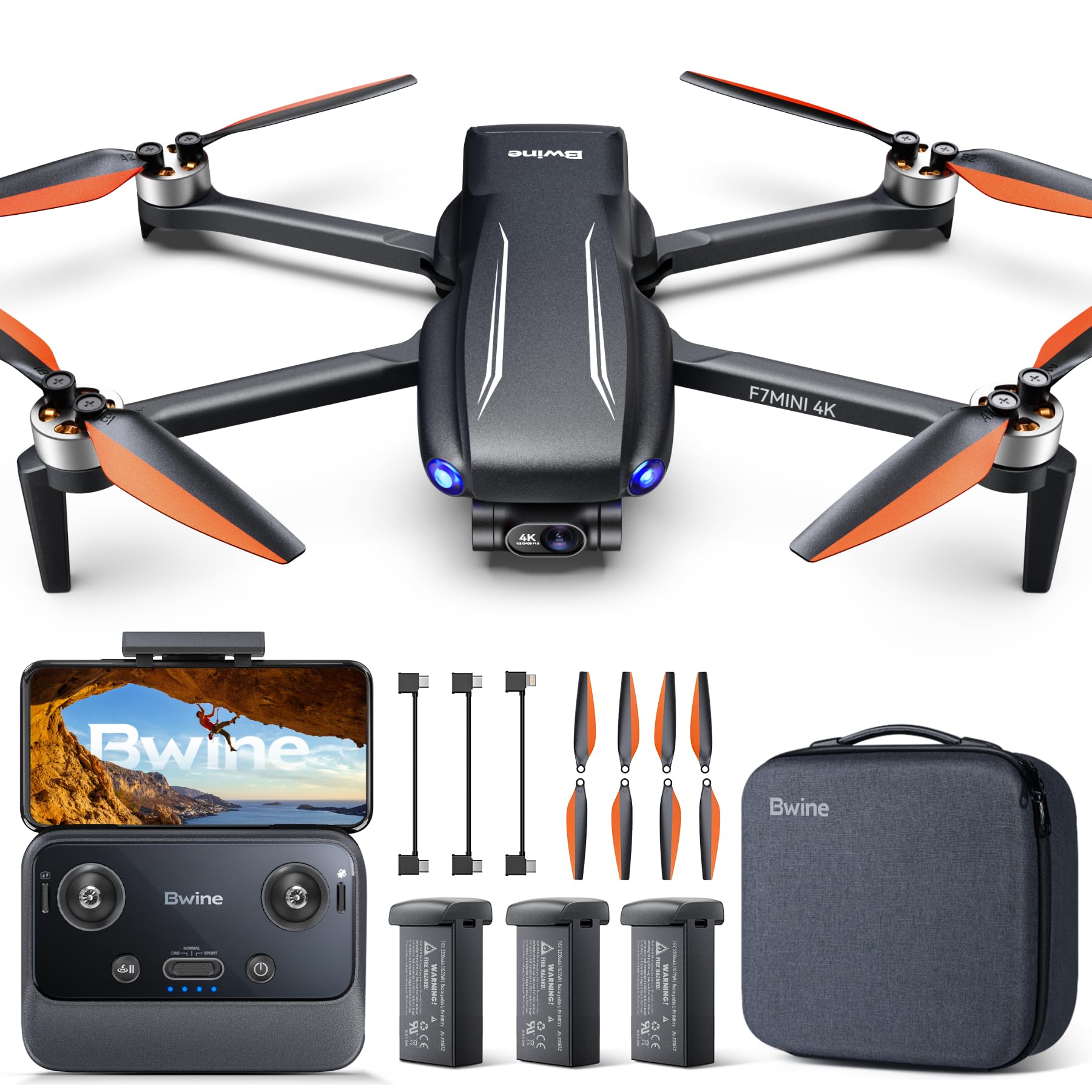
The Bwine F7MINI addresses the single biggest annoyance of drone flying: needing a phone to see the live feed. Its remote controller houses a bright 5.5-inch touchscreen that eliminates the cable tether and screen brightness worries. The drone itself stays under the 249-gram threshold, making it FAA registration-free, while still packing a 48MP 1/2-inch CMOS sensor with an F1.8 aperture that outputs 8K photos and 4K/30fps video. The physical 3-axis gimbal plus EIS combo handles level-5 wind with confidence, and the 1503 brushless motors push the top speed to 31 mph.
Flight endurance averages 30-32 minutes per battery — confirmed by multiple user logs — and the three included batteries push total airtime past 90 minutes. The digital transmission system claims 20,000 feet (6 km) of zero-latency feed, with real-world user reports of clean video past 3,000 feet. GPS smart features like Follow Me, Waypoint, and Orbit fly execute accurately, and the 120dB locator buzzer makes retrieval easy if the drone lands in tall grass.
The trade-off for the sub-250g weight is a slightly smaller sensor than the 1-inch class, which shows in low-light shots where noise creeps in. The built-in screen also introduces a single point of failure — if it breaks, you cannot use a phone as a backup. Still, for adults who prioritize convenience and hate fumbling with phone mounts, this is the most thoughtful package in its class.
Why it’s great
- Built-in 5.5″ touchscreen controller
- FAA-exempt at 249g
- 3-axis gimbal plus EIS
- Three batteries included
Good to know
- Sensor struggles in low light
- No phone-as-backup if screen fails
- Transmission drops past 3,000 ft
4. Bwine F7GB2 Pro

The Bwine F7GB2 Pro is engineered for mountain flyers and property inspectors who need reliable performance at altitude. Its 1806 brushless motors and internal barometer keep it controllable at 2,000 meters above sea level, and the level-6 wind resistance certification means it holds position in gusts that ground competitors. The one-click detachable 4K camera rides on a 3-axis brushless gimbal with a 120° FOV and 5x digital zoom, though true optical quality stops at the gimbal stabilization level — the zoom is digital and introduces artifacts.
Three 2600mAh batteries rated to UL 2054 safety standards deliver roughly 25 minutes of real flight each, totaling 75 minutes of mixed flying. The transmission uses a 10,000-foot range system that holds up well in open terrain, though dense forest reduces that by about half. GPS functions including Follow Me, Waypoint, and Orbit execute cleanly, and the auto-return on low battery or signal loss has been consistently reliable in user reports.
The carrying shell case is robust and protective, and the 2-year warranty with responsive customer support (multiple users report quick replacements) adds long-term peace of mind. The main compromises are the digital-only zoom and a remote screen that washes out in direct sunlight. For anyone flying at elevation or in coastal winds, the F7GB2 Pro is the most altitude-capable option in the mid-range bracket.
Why it’s great
- 2000m altitude capability
- Level-6 wind resistance
- UL-certified batteries with 2-year warranty
- Detachable 3-axis gimbal camera
Good to know
- Digital zoom degrades image
- Remote screen hard to read in sun
- Heavier than 250g
5. Ruko Drone 4K UHD

The Ruko drone targets endurance above all else, bundling three intelligent batteries that collectively deliver 96 minutes of rated flight time. Real-world testing puts per-battery endurance around 28-30 minutes combined with moderate wind, which still edges out most competitors in this price segment. The camera system uses a 1/2-inch 48MP CMOS sensor that outputs 8K stills and 4K/30fps video, stabilized by a 3-axis brushless gimbal and additional EIS for redundancy. The 20,000-foot R2 digital transmission system uses a wired tether to eliminate Wi-Fi interference, and user tests show clear feeds past 4,000 feet without frame drops.
The sub-250-gram weight keeps it FAA-exempt, yet the foldable design and included hard case make it genuinely portable. AI-assisted takeoff and landing, combined with quadruple positioning (GPS, barometer, TOF, and optical flow), create a beginner-friendly experience that doesn’t sacrifice control. The built-in beeper is loud enough to locate the drone in tall brush, a detail that saves hours of searching.
Customer service is a standout here — multiple reports of quick replacement for defective batteries or crash-damaged units. The main downsides are the joystick sensitivity, which takes some getting used to, and the lack of audio recording in video. For road-trippers and vacation documentarians who want maximum airtime per charging cycle, the Ruko delivers the best flight-to-charge ratio in its class.
Why it’s great
- 96-minute total flight time
- FAA-exempt at 248g
- 20,000 ft digital transmission
- AI-assisted takeoff and landing
Good to know
- Sensitive joystick controls
- No audio in recordings
- Low-light performance is average
6. HOVERAir X1 Combo Plus

The HOVERAir X1 redefines simplicity by stripping away the controller entirely. At 125 grams, it is the lightest drone on this list and drops into a jacket pocket fully folded. The premise is straightforward: launch from your palm, select a flight path (Hover, Follow, Zoom Out, Orbit, or Bird’s Eye), and let the drone film you hands-free. The tracking algorithms lock onto subjects at up to 15 mph, making it viable for cyclists, skateboarders, and runners. Video tops out at 2.7K/30fps with HDR support, and the triple stabilization system keeps footage smooth enough for social media uploads.
The fully enclosed propeller guards are a safety standout — you can operate it near people and tight spaces without constant worry. The 32GB internal storage eliminates SD card hassle, and downloading clips via the Hover X1 App or USB is straightforward. Each battery supports roughly 11 minutes of real flight time, and the combo plus includes a charging hub for multiple packs. Customer reviews consistently praise its durability after crashes that would destroy conventional drones.
The X1 does not have obstacle avoidance, and it struggles in wind above level 4. It also does not work over water — the optical flow sensor loses reference, and multiple users report crashes into ponds. For a dedicated self-flying camera that prioritizes portability and ease of use over raw specs, it is an excellent specialized tool.
Why it’s great
- 125g hyper-portable design
- Hands-free palm launch and tracking
- Fully enclosed propeller guards
- 32GB internal storage
Good to know
- No obstacle avoidance
- Fails over water surfaces
- Limited wind resistance (level 4)
7. Gleesfun G11PRO 6K

The Gleesfun G11PRO aims to democratize mechanical gimbal stabilization at an accessible price point, and it largely succeeds. The three-axis brushless gimbal uses precision motors and a dedicated control chip to maintain millisecond-synchronized stability across pitch, roll, and yaw, producing footage that rivals drones costing twice as much. The camera captures 6K photos and 4K/30fps video through a 1/3.2-inch CMOS sensor — smaller than the competition but adequate in good light. The GQ2.0 digital transmission system uses a dual-antenna, plug-and-play wired connection rated for 10,000 feet, and user reports confirm stable feeds past half that distance.
Battery life is a highlight: the GL2.0 Smart Battery Management system delivers roughly 35 minutes per pack (two included), with fast charging that refuels in about 2.5 hours. Over 300 charge cycles with 80% capacity retention makes this a long-term investment for regular flyers. The Cruise Control technology simplifies cinematic shots by auto-maintaining altitude and heading, a feature that genuinely helps beginners get smooth footage without constant stick corrections.
FAA compliance is confirmed with a Remote ID QR code on the frame. The main weaknesses are the smaller sensor — disappointing in low light — and a 357-gram weight that requires FAA registration. The 40-piece accessory kit is generous, but the additional weight limits portability compared to sub-250g rivals. For value-conscious adults who prioritize gimbal quality above all else, the G11PRO is a smart pick.
Why it’s great
- True 3-axis brushless gimbal
- Fast-charging with 300+ cycle life
- Cruise Control for steady footage
- Extensive accessory kit
Good to know
- Small sensor struggles in low light
- Requires FAA registration at 357g
- Heavier limit for pocket carry
8. DJI Neo Three-Battery Combo

The DJI Neo is the smartest entry point for adults who want DJI quality without the DJI price tag. At 135 grams, it slips into a pocket and requires no FAA registration, but the real innovation is the controller-free operation: palm takeoff, subject tracking, and QuickShots modes (Dronie, Circle, Helix, Boomerang) are all accessible via the DJI Fly app or voice control. The 4K UHD camera uses DJI’s stabilization algorithms to deliver smooth footage despite the lack of a mechanical gimbal, and the full-coverage propeller guards make it safe for indoor and close-proximity use.
The three-battery combo extends total flight time beyond 54 minutes, with each pack providing roughly 15-18 minutes of real flying. Transmission range is rated at 10 kilometers with the controller (sold separately), though using only the phone Wi-Fi reduces that significantly. The subject tracking is genuinely impressive — the Neo locks onto a person and follows them through turns and elevation changes, making it an excellent vlog companion for hikers and runners.
The lack of obstacle avoidance is the biggest limitation — the Neo will fly into a tree branch without hesitation. Wind resistance is level 4, so gusty days ground it. It also produces noticeable propeller noise in the audio track. For a fun, grab-and-go drone that makes impressive social content with zero learning curve, the Neo is unmatched in its weight class.
Why it’s great
- 135g hyper-portable design
- Controller-free palm launch
- Accurate subject tracking
- DJI stabilization in 4K
Good to know
- No obstacle avoidance
- Propeller noise in audio
- Limited wind resistance
9. Potensic ATOM LT GPS Drone

The Potensic ATOM LT fills the budget-friendly slot with no compromises on the fundamentals. Weighing exactly 249 grams, it sidesteps FAA registration entirely while still carrying a 2.5K camera with a Sony sensor and ShakeVanish 2.0 electronic stabilization. The 118° FOV with adjustable tilt (-90° to +20°) gives decent framing flexibility for the price. The two 3000mAh intelligent batteries provide a genuine 40 minutes each, totaling 80 minutes of flight — besting many more expensive models.
The PixSync 2.0 transmission system maintains a smooth HD feed up to 4 kilometers, and the four GNSS supports (GPS, GLONASS, Galileo, BeiDou) ensure fast satellite lock and reliable auto-return. Beginner-friendly features include three flight modes, one-key takeoff, and an intuitive remote with Type-C/Lightning adapter cables. The brushless motors handle level-5 wind conditions with stable hover, and the fold-up design packs down to 3.5 x 5.6 x 2.3 inches.
The camera is the limiting factor: 2.5K resolution at 30fps is reasonable for practice footage but lacks the crispness needed for professional content. Users note that it requires good light to avoid shadow artifacts, and the lack of a TOF chip means stability suffers in low light or over water. GPS acquisition can be slow at first. For the budget-conscious adult who wants a reliable, long-flying trainer with genuine GPS features, the ATOM LT is an outstanding entry point.
Why it’s great
- 80-minute total flight time
- FAA-exempt at 249g
- 4 GNSS support for GPS accuracy
- Beginner-friendly flight modes
Good to know
- Camera limited to 2.5K resolution
- No TOF chip for low-light stability
- Slow GPS acquisition at startup
FAQ
Do I need FAA registration for a sub-250g drone?
Why does my 4K drone footage look shaky even in light wind?
Is a longer transmission range always better?
Can I fly a drone in rain or snow?
What does “Smart Return-to-Home” actually do?
Final Thoughts: The Verdict
For most users, the best drones for adults winner is the DJI Mini 5 Pro Fly More Combo because it delivers professional-grade image quality, omnidirectional obstacle avoidance, and a refined flight experience in a sub-250-gram frame that grows with your skills. If you want a built-in controller screen that eliminates phone tethering, grab the Bwine F7MINI. And for budget-friendly training without compromising GPS reliability and flight time, nothing beats the Potensic ATOM LT.

Mo Maruf
I created WellFizz to bridge the gap between vague wellness advice and actionable solutions. My mission is simple: to decode the research and give you practical tools you can actually use.
Beyond the data, I am a passionate traveler. I believe that stepping away from the screen to explore new environments is essential for mental clarity and physical vitality.