Our readers keep the lights on and my smoothie glass nicely filled. As an Amazon Associate, I earn from qualifying purchases.
Whether you’re framing a sunset over a ridge, a real estate listing, or a mountain biker carving a trail, the bottleneck is always the same vibration-free, gimbal-stabilized footage. A drone that delivers shaky video or muddy stills is just a noisy toy—what you need is a true aerial camera platform that locks focus and smooths motion from takeoff to landing.
I’m Mohammad Maruf — the founder and writer behind WellFizz. I’ve spent hundreds of hours dissecting sensor specs, gimbal architectures, and transmission protocols to separate real photography tools from marketing flights of fancy.
This guide distills that research into actionable recommendations so you can confidently choose from the best drones for photography without getting lost in spec sheets or chasing the wrong features.
How To Choose The Best Drones For Photography
Choosing a photography drone comes down to matching the camera hardware, stabilization system, and flight endurance to the kind of content you actually produce. Consumer drone marketing often buries the real spec hierarchy: gimbal quality, sensor size, and bit rate matter far more than counting megapixels on paper.
Gimbal Axis Count: 3-Axis vs 2-Axis vs Electronic Only
A mechanical 3-axis gimbal independently compensates for pitch, roll, and yaw — meaning your footage stays level even when the drone banks hard or hits a gust of wind. Two-axis gimbals drop yaw stabilization, which introduces micro-jitter during turns. Pure electronic image stabilization (EIS) crops the sensor and can produce warping artifacts, so it’s best left for compact action drones where portability is the priority.
Sensor Size and Aperture
The physical size of the image sensor determines how much light the camera collects. A 1/1.3-inch CMOS sensor (found on premium sub-250g drones) dramatically outshines a 1/2.3-inch sensor in twilight and shadow detail. A wider aperture (f/1.8) further improves low-light capture, but also narrows depth of field — good for separating a subject from the background in aerial portraits.
Transmission Range and Controller Latency
Photography missions often require flying beyond line-of-sight to frame a distant landmark. Look for digital transmission systems (OcuSync, PixSync, or proprietary digital links) rather than standard Wi-Fi. Digital transmission offers lower latency and higher bitrate video feedback at ranges over 3 miles. A built-in screen on the controller removes reliance on a phone’s brightness and connection.
Flight Time and Battery Ecosystem
Single-battery flight times from 30 to 50 minutes are common in mid-range and premium models, but total mission duration depends on how many batteries come in the bundle. Parallel charging hubs that can refuel three packs simultaneously are critical for long shooting days — they can cut total downtime from hours to under 90 minutes.
Quick Comparison
On smaller screens, swipe sideways to see the full table.
| Model | Category | Best For | Key Spec | Amazon |
|---|---|---|---|---|
| Potensic ATOM 3 Fly More Combo | Camera Drone | Pro-grade travel footage | 1/1.3” CMOS, 4K 60fps HDR, 120-min flight | Amazon |
| DJI Mavic 4 Pro Fly More Combo | Flagship | Professional cinematography | 100MP Hasselblad, 6K 60fps HDR | Amazon |
| DJI Mini 5 Pro Fly More Combo Plus | Sub-250g | Travel & hobby photography | 1-inch CMOS, 4K HDR, ActiveTrack 360° | Amazon |
| HOVERAir X1 PROMAX | Action | Self-filming adventure content | 8K30fps, 42 km/h follow, 64GB storage | Amazon |
| DCX Volo X EZ AI | AI Safety | Worry-free night flights | 45-min flight, LiDAR 360° avoidance | Amazon |
| Bwine F7GB2 Pro | Long Range | High-altitude landscape shooting | 20,000ft max altitude, L6 wind resistance | Amazon |
| Bwine F7MINI 4K | Portable | No-FAA-travel photography | 249g, 4K30fps, 3-axis gimbal, 96-min flight | Amazon |
| Holy Stone HS790 | Beginner | First-time aerial photographers | 6K photo, 3-axis gimbal, 30,000ft range | Amazon |
| Ruko F11PRO 2 | All-round | Family & estate photography | 6K photo, 10,000ft range, 70-min flight | Amazon |
| Ruko Drone with 4K UHD | Value | High-value 8K captures | 48MP 8K photo, 3-axis gimbal, 96-min flight | Amazon |
| HOVERAir X1 Drone | Ultraportable | Spontaneous social media clips | 2.7K30fps HDR, 125g, hands-free follow | Amazon |
In‑Depth Reviews
1. Potensic ATOM 3 Fly More Combo (RC PTD 2)
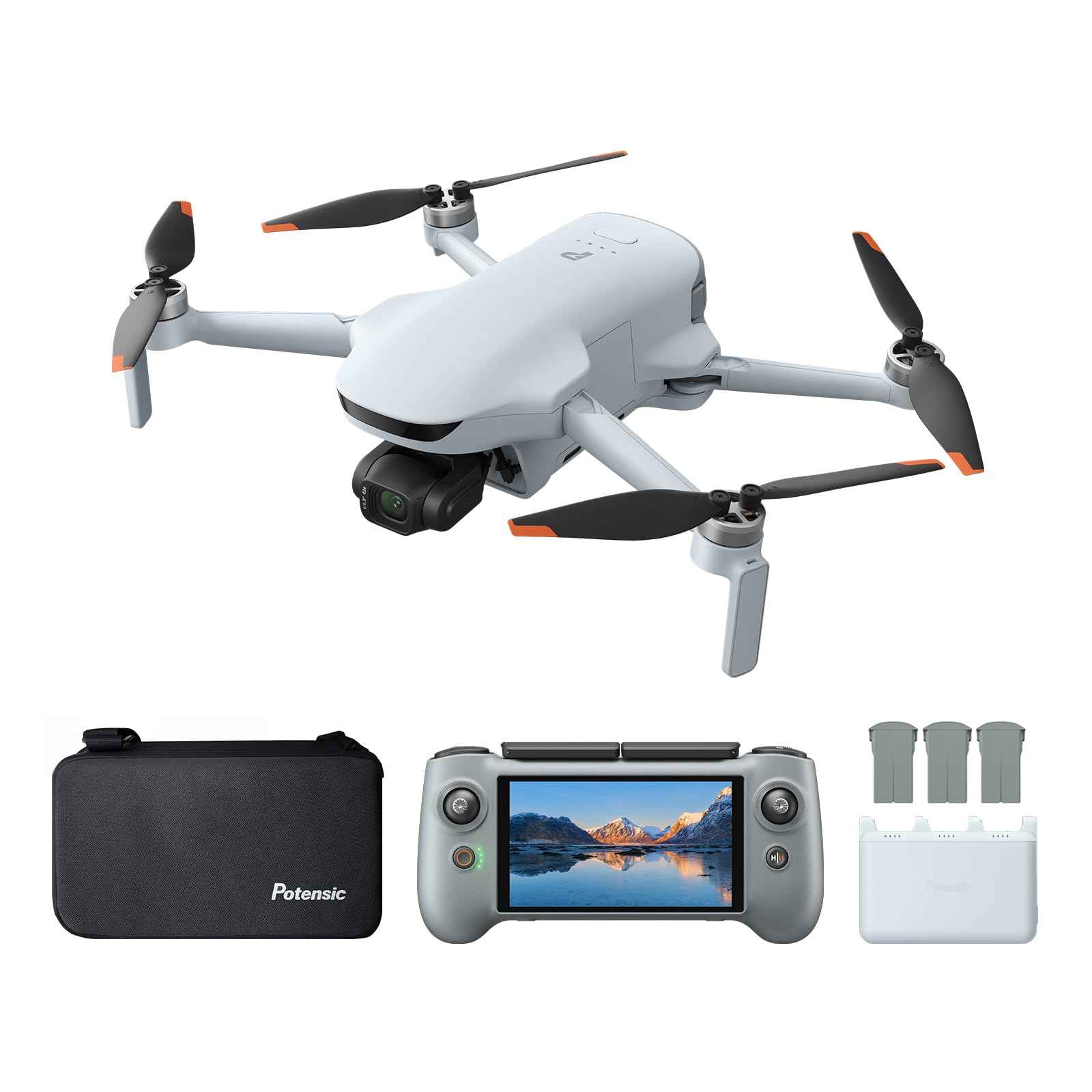
The ATOM 3 packs a 1/1.3-inch CMOS sensor — the same class found in many prosumer mirrorless cameras — and delivers 4K 60fps HDR video with P-Log for flexible color grading. The mechanical 3-axis gimbal eliminates yaw wobble during fast orbits, and PixSync 5.0 transmission pushes a stable 1080p/60fps live feed to the built-in 5.5-inch FHD touchscreen out to a true 16-kilometer range.
Three batteries in the Fly More bundle give a combined 120 minutes of flight, with a 65W parallel charging hub that refuels all three in about 90 minutes. AI Tracking 2.0 tracks subjects below 4 meters when using the optional propeller guard — a practical edge for low-altitude biking or running shots. The drone stays under 249 grams, so no FAA registration is required.
Vertical 2.7K shooting, CineRoll slow motion at 7x, and panorama modes make it a complete aerial camera platform that outperforms many drones costing twice as much. For photographers who need one tool for travel, portraits, and action, this is the most balanced choice on the market today.
Why it’s great
- Sensor size matches larger premium drones in a sub-249g body
- P-Log mode for professional color grading workflows
- Fast 65W parallel charging chub cuts field downtime dramatically
Good to know
- Propeller guard (needed for low-altitude AI Track) sold separately
- No microSD card included in the bundle
2. DJI Mavic 4 Pro Fly More Combo

The Mavic 4 Pro sets a new bar with a 100-MP 4/3-type Hasselblad main camera and dual tele lenses for optical zoom without resolution loss. The 360-degree Infinity Gimbal allows unobstructed 360° rotation, which unlocks dynamic whip-pan and dolly-zoom-style moves that a standard 3-axis gimbal cannot replicate. Video tops out at 6K 60fps HDR in 10-bit color depth.
Omnidirectional obstacle sensing rated at 0.1 lux lets you fly confidently at night with the same collision avoidance as daytime. The O4+ video transmission system pushes a 10-bit HDR feed up to 30 kilometers — a serious advantage for large-scale landscape or real-estate missions. Three batteries deliver around 51 minutes each, and the parallel charging hub keeps the workflow moving.
The included DJI RC 2 remote has a bright 7-inch rotatable screen. Keep in mind that operating this drone over 249g triggers Remote ID and FAA registration. For working cinematographers and serious hobbyists who need the sharpest stills and highest bitrate video, this is the uncompromising flagship.
Why it’s great
- 4/3-type Hasselblad sensor rivals ground-based mirrorless cameras
- 360° gimbal enables creative shots impossible on other drones
- 30km O4+ transmission with 10-bit HDR live view
Good to know
- Requires FAA registration and Remote ID
- Battery weight pushes total takeoff weight over 250g
3. DJI Mini 5 Pro Fly More Combo Plus
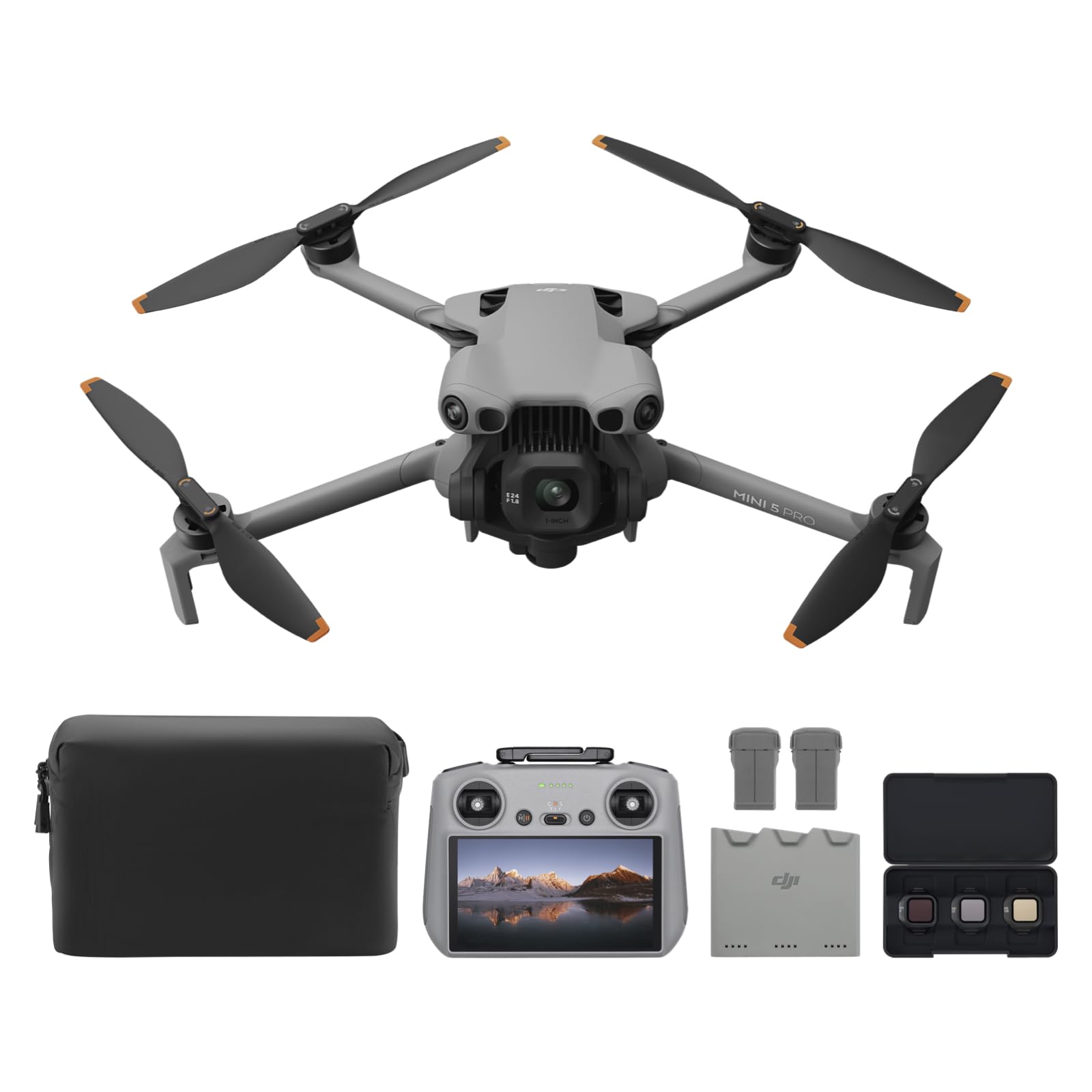
The Mini 5 Pro upgrades to a 1-inch CMOS sensor — a significant leap over the 1/2.3-inch sensor found on earlier generations — and wraps it in a 249g frame that slips into a jacket pocket. Video is 4K 60fps HDR with a 225-degree gimbal that flips to full vertical orientation for social-ready portrait clips. ActiveTrack 360° uses forward-facing LiDAR to lock onto a subject and automatically recompose the shot.
Nightscape omnidirectional obstacle sensing uses the same 0.1-lux sensor as the Mavic 4 Pro, so low-light flying is genuinely safe. The Fly More Plus bundle includes three batteries that each deliver up to 52 minutes, plus ND filters and a charging hub. The DJI RC 2 controller has a bright 5.5-inch screen with no phone required.
One nuance: fitting the larger-capacity batteries pushes the drone over 249g, which triggers FAA Remote ID requirements. For photographers who want professional tracking, a 1-inch sensor, and extreme portability in one package, the Mini 5 Pro hits a sweet spot between size and capability.
Why it’s great
- 1-inch CMOS sensor for excellent dynamic range in a tiny frame
- 225° gimbal with true vertical filming for social media
- Nightscape obstacle sensing for safe low-light flights
Good to know
- With Plus batteries the drone exceeds 249g, requiring Remote ID
- No US warranty coverage — service depends on DJI’s current policy
4. HOVERAir X1 PROMAX
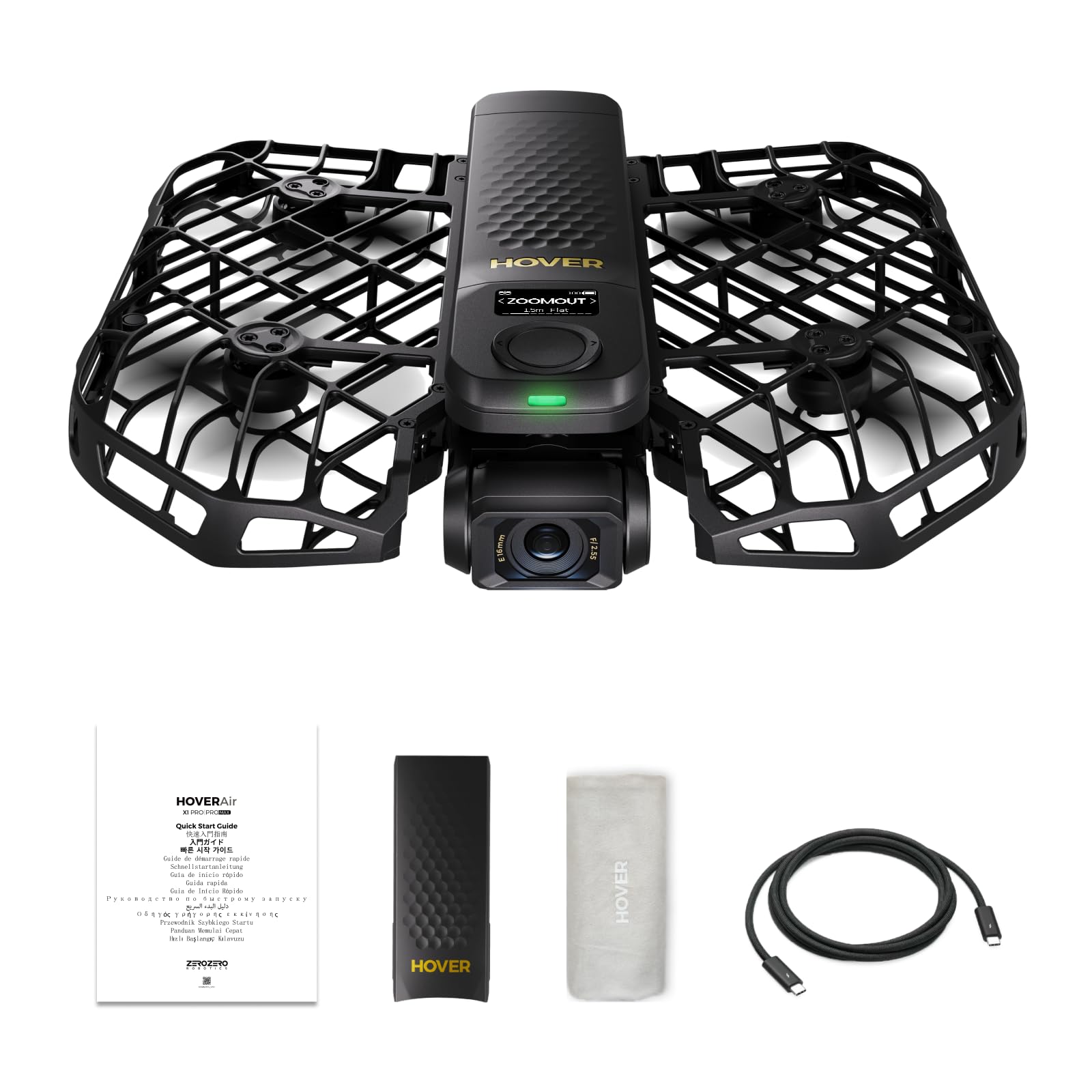
The X1 PROMAX is a flying action camera that shoots 8K at 30fps in horizontal mode and 4K 30fps in vertical mode. It uses a 2-axis mechanical gimbal paired with EIS and horizon leveling — not as steady as a 3-axis gimbal, but far lighter and quieter, which makes sense for a 192g drone designed to follow skiers and cyclists at 26 mph. The OmniTerrain system enables flight over snow, water, and cliffs without altitude sensor confusion.
Rear collision detection uses a Time-of-Flight sensor that brakes when obstacles appear within 3m/s approach speed. Full autonomous modes — Hover, Follow, Dolly Track, Zoom Out — are all launched by voice or a single button press on the drone body. The PROMAX carries 64GB of internal storage and accepts microSD cards up to 1TB.
Battery endurance is tighter than a traditional camera drone: each pack delivers roughly 16-18 minutes of active flight, and the standard kit includes only one battery. For content creators who prioritize unique first-person perspectives over endurance, this drone provides shots no gimbal-on-a-stick can replicate.
Why it’s great
- 8K30fps video in a 192g body — unmatched resolution per gram
- Rear ToF collision sensor for safer self-flying tracking
- Flies over water and snow, which GPS drones avoid
Good to know
- 2-axis gimbal won’t match 3-axis stability during high-wind turns
- Single battery bundle; extra batteries are a necessary investment
5. DCX Volo X EZ AI
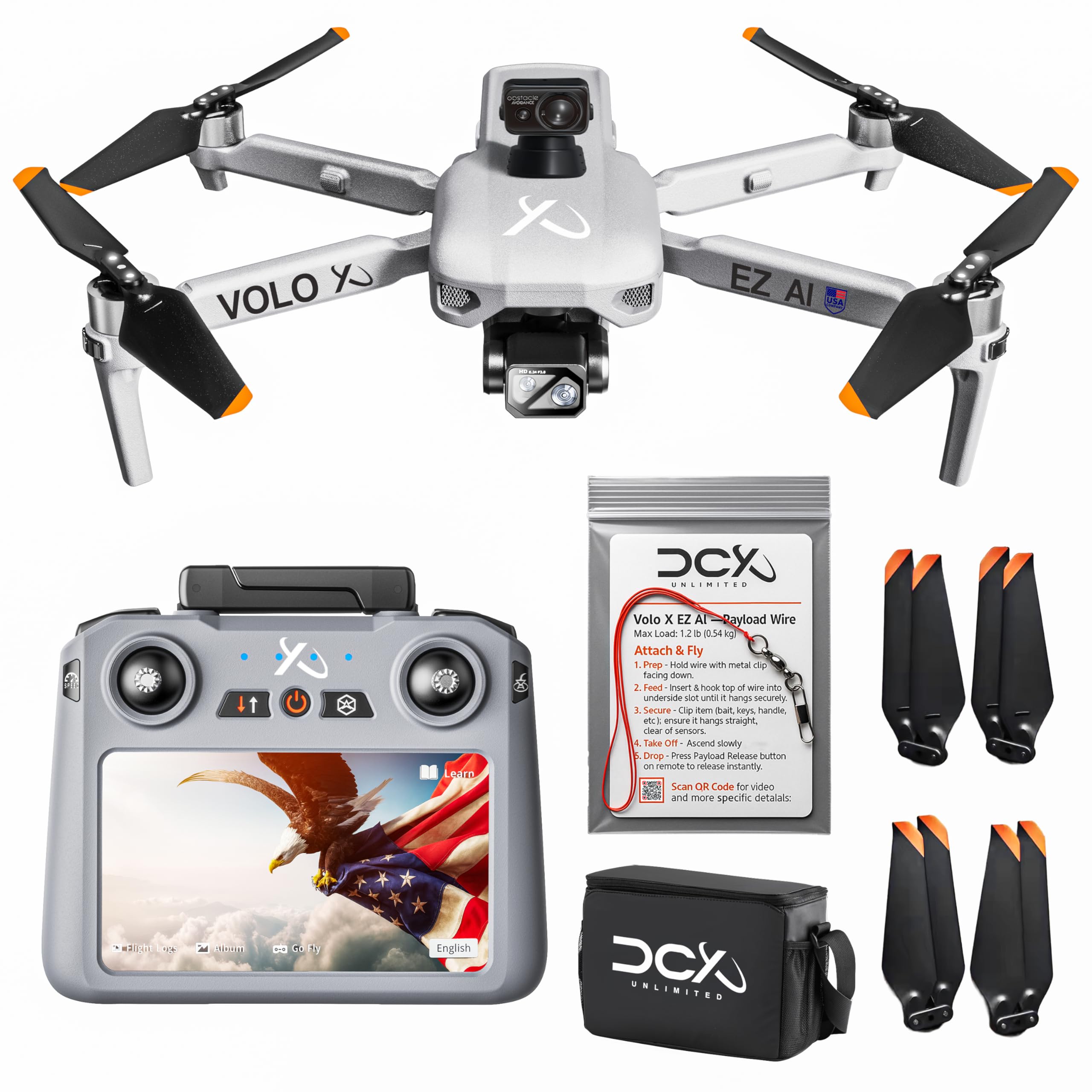
The Volo X EZ AI differentiates itself with full LiDAR 360° obstacle detection — not just forward-facing sensors — and no geofencing or height limits, which appeals to creative shooters in open landscapes. The 4K camera rides a 3-axis mechanical gimbal with EIS, and the integrated controller screen displays a real-time 1080p feed. A smart night mode with an LED spotlight adds utility for dawn and dusk shoots.
Flight time reaches 45 minutes per battery, and the 4-mile digital transmission range is consistent with the mid-premium tier. The unique payload release mechanism can carry and drop up to 1.2 pounds — a rare feature for aerial photography if you need to place a prop or marker from the air. US-based customer support is a standout for buyers who want to avoid overseas call centers.
Some users report that the power-on sequence is slower than expected, and the controller occasionally loses sync with the drone, which resets the live feed. For photographers who prioritize obstacle safety and daytime range above all, the Volo X delivers a solid, regulation-friendly package.
Why it’s great
- Full 360° LiDAR obstacle tracking in all flight directions
- No geofencing or altitude restrictions
- Payload release mechanism expands creative and practical uses
Good to know
- Controller sync can drop unexpectedly during long sessions
- Power-on sequence is more complex than average
6. Bwine F7GB2 Pro

The F7GB2 Pro is built for high-altitude landscape work. The 1806 brushless motor, barometer, and onboard sensors hold steady at 20,000 feet with Level 6 wind resistance — meaning it stays stable in winds up to about 35 mph. The 4K UHD camera with a 120° FOV sits on a 3-axis gimbal with 5x digital zoom and a detachable mount for lens cleaning or replacement.
Three 2600mAh UL-certified batteries (Model DS 9028115-3S) give 75 total minutes of flight. The 10,000-foot transmission range holds solid over open terrain, and the controller’s overlays make camera adjustments without needing to look away from the sky. The Bwine app includes basic exposure filters and background music for quick social uploads.
Downsides include a remote screen that washes out in bright sunlight and SD card compatibility that can be picky — a Samsung 128GB EVO Select is known to work reliably. For mountain photographers and real estate pilots covering large properties, the altitude and wind tolerance make this a workhorse that beats its sticker price.
Why it’s great
- Proven stable flight at 20,000 feet with L6 wind rating
- Detachable 4K camera with 3-axis gimbal for easy servicing
- UL-certified battery packs meet rigorous safety standards
Good to know
- Remote screen difficult to read in direct sunlight
- SD card compatibility is narrow — test before shooting
7. Bwine F7MINI 4K
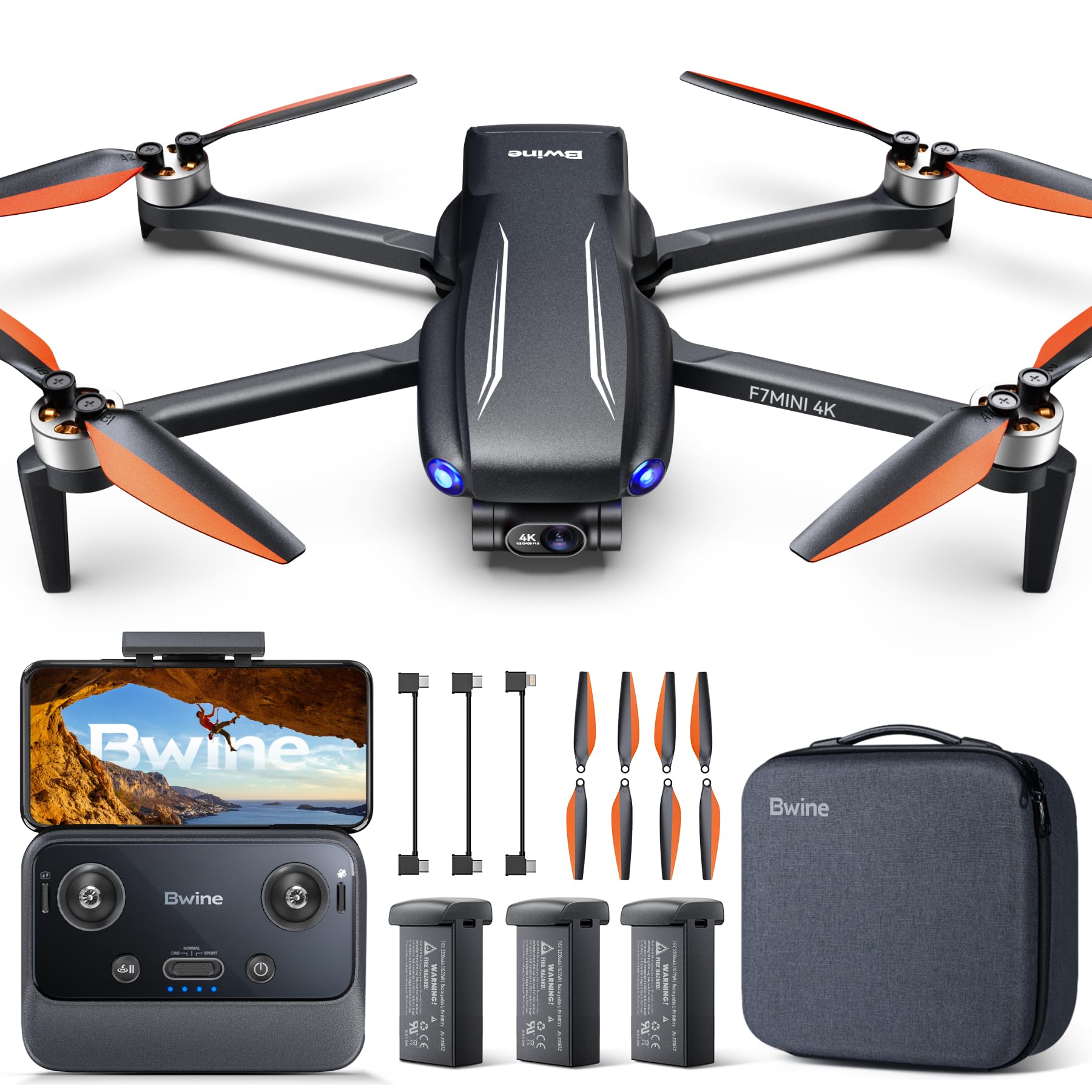
The F7MINI balances a 3-axis gimbal, 48MP 4K30fps camera, and 249g weight so you can take it anywhere without FAA paperwork. The gimbal uses motor-and-sensor feedback to keep the frame level during pitch and roll, and the EIS smoothes out any residual micro-shake. The 1503 brushless motor delivers 31 mph top speed and holds steady in Level 5 winds.
Three 2200mAh batteries with PD 3.0 fast-charging support produce 96 minutes of total flight time — roughly 32 minutes per pack. The IP-based 6-kilometer transmission link holds a clean 1080p feed with zero signal loss in open country. GPS smart features include waypoint, orbit, precision follow with 0.5-meter accuracy, and a 120dB buzzer for recovery.
A built-in 5.5-inch screen on the controller eliminates the need to fumble with a phone. The optical flow positioning system even enables stable indoor flight when GPS cannot lock. For photographers who need a go-anywhere camera drone with professional gimbal stabilization, this is a top-tier travel companion.
Why it’s great
- 3-axis gimbal in a 249g FAA-exempt package
- PD 3.0 fast charging reduces turnaround time between batteries
- Optical flow allows indoor flight without GPS lock
Good to know
- Controller to phone file download is slower than direct microSD
- Beginner mode limits distance and height until switched off
8. Holy Stone HS790
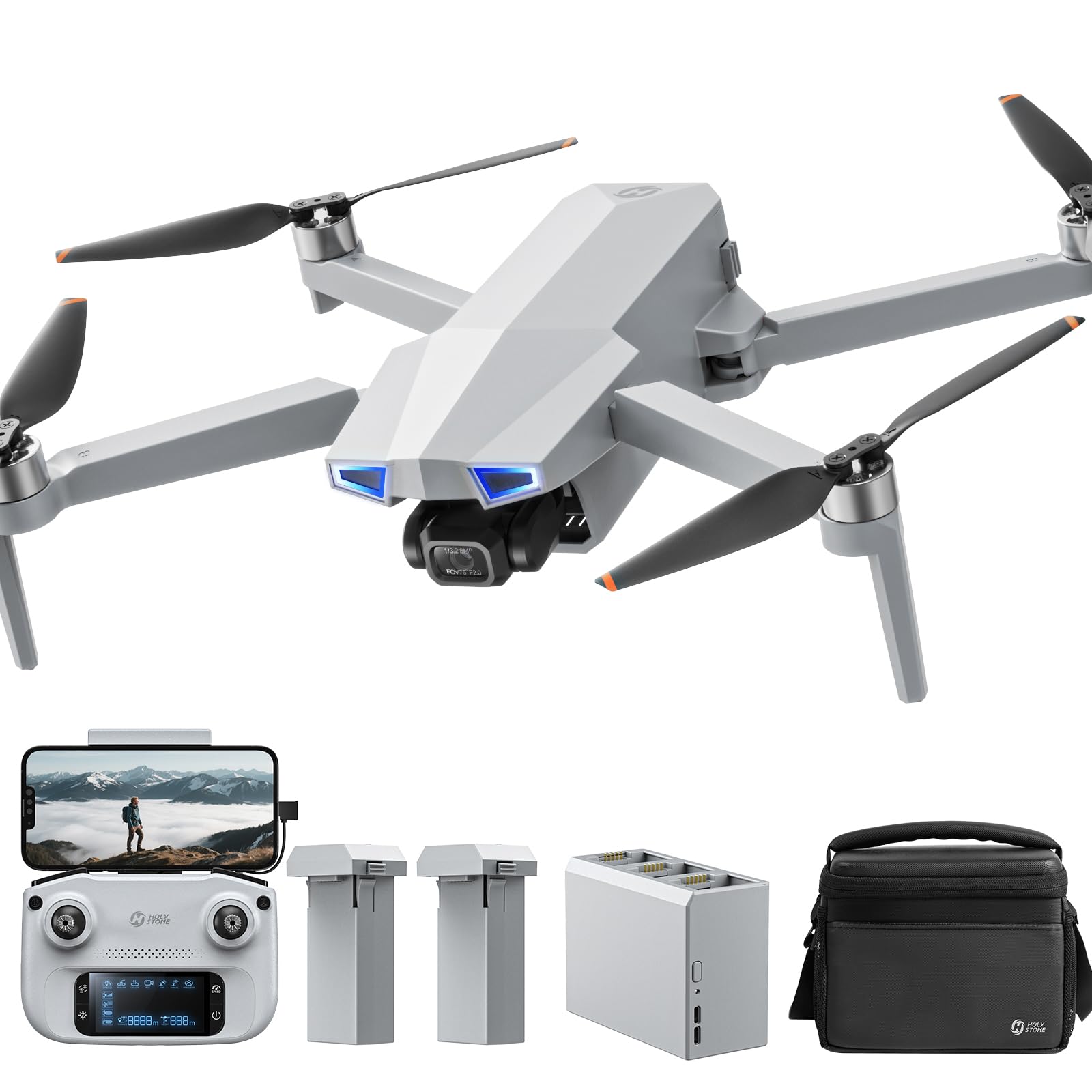
The HS790 provides a 3-axis brushless gimbal and 4K 30fps recording at an entry-level price point that undercuts most gimbal-equipped rivals. The 6K photo mode uses software interpolation for larger still files, but the real benefit is the mechanical stabilization that keeps horizons straight and eliminates rolling shutter artifacts common in budget drones. Holy Stone’s Wi-Fi repeater extends the 4K live feed to an advertised 30,000 feet.
Two 3200mAh LiPo batteries with a smart PD charging hub (also functioning as a power bank) give up to 60 minutes total flight. Integrated Remote ID ensures FAA compliance without an external module. Beginner Mode limits altitude and speed for new pilots, while advanced flyers can unlock full manual rates. The included carrying case organizes the drone, remote, batteries, and accessories neatly.
The AI Night Mode adds some brightness in low light but doesn’t significantly improve capture beyond standard exposure. The app side is best served by the older HT FLY version rather than the latest bloatware build. For photographers on a tighter budget who refuse to compromise on gimbal stabilization, the HS790 delivers remarkable stability per dollar.
Why it’s great
- True 3-axis gimbal at a sub-premium price point
- Integrated Remote ID for hassle-free FAA compliance
- PD charging hub doubles as an external power bank
Good to know
- AI Night Mode adds little real-world detail to captures
- App reliability improved by using the legacy HT FLY version
9. Ruko F11PRO 2

The F11PRO 2 is designed for adults who want cinematic 4K 30fps footage without the learning curve. The 3-axis mechanical gimbal keeps the frame steady during cruise flight, and the 6K photo mode captures detail for cropping later. The 10,000-foot digital transmission link provides a clean real-time view for backyards, parks, and suburban landscapes.
Two 3200mAh batteries deliver 70 minutes total — enough for two rounds of shooting without returning to the car. GPS Auto Return-to-Home activates on low battery, signal loss, or button press, and a dedicated beginner mode limits speed and altitude. The included hard carrying case has cutouts that keep everything in place during transit.
One common hiccup: automatic return on low battery can trigger a landing that isn’t where you expect, and the camera can buzz if something blocks the gimbal on startup. For grandparents wanting to document family reunions or retirees exploring their property from above, the F11PRO 2 offers simplicity and reliability in a recognizable Ruko package.
Why it’s great
- 3-axis mechanical gimbal delivers genuinely smooth home videos
- Beginner mode builds confidence before full manual flying
- 10,000-foot range covers large properties without signal loss
Good to know
- Auto RTH cannot be disabled in beginner mode
- Gimbal can whir if obstructed during power-up
10. Ruko Drone with 4K UHD Camera

This Ruko model packs a 1/2-inch 48MP CMOS sensor that captures 8K stills and 4K 30fps video, with a 3-axis brushless gimbal plus EIS for dual-layer stabilization. The 20,000-foot digital transmission uses an R2 digital system rather than consumer Wi-Fi, which eliminates the interference and latency common in entry-level drones. Total package weight sits under 249g, sidestepping FAA registration entirely.
Three 2200mAh batteries deliver 96 minutes of flight, secured in a protective carrying case that also holds the advanced controller, spare propellers, and a screwdriver. AI-assisted takeoff and landing works in tandem with GPS, barometer, and optical flow sensors to hold a precise hover even in moderate wind. Customer feedback consistently praises the 48MP still quality and the responsiveness of the R2 transmission.
Battery life per battery is closer to 30 minutes than the advertised 32 minutes in moderate wind, but the three-pack still gives over an hour and a half of shooting. A small number of early units shipped with defective batteries, but Ruko’s support has a strong track record of overnight replacements. For photographers who want the highest resolution stills in a lightweight, registration-free package, this is a compelling value.
Why it’s great
- 48MP 8K photo resolution is tops for the sub-250g class
- R2 digital transmission eliminates Wi-Fi interference
- 3-axis gimbal with EIS for dual stabilization layers
Good to know
- Battery life per pack lags slightly behind competitors
- Some units reported battery defects; support is responsive
11. HOVERAir X1 Drone (Combo Plus)

The original HOVERAir X1 redefined the pocket drone category at 125 grams — lighter than most smartphones — and completely enclosed propeller guards mean no registration, no folding, and no delicate setup. The camera tops out at 2.7K 30fps with HDR and a triple stabilization system (2-axis mechanical plus EIS plus horizon leveling), which is enough for sharp social clips and hiking memories. Six pre-programmed flight paths — Hover, Follow, Zoom Out, Orbit, Bird’s Eye, Manual — are all launched from the palm of your hand.
The internal 32GB storage avoids carrying SD cards, and the Hover X1 App transfers files wirelessly to your phone for instant sharing. Each battery supports about 11 minutes of flight — 22 total with the two-battery Combo Plus — and the drone charges via USB-C. It flies in winds up to Level 4 (under 16 mph) and is not rated for use above 2,000 meters.
There is no obstacle avoidance whatsoever, and it does not fly over water — the downward-facing optical sensors get confused by reflective surfaces, causing the drone to drop altitude. For photographers who shoot on flat, dry terrain and want a no-fuss, no-registration drone that follows them hands-free, the X1 delivers a uniquely low-friction experience.
Why it’s great
- 125g completely enclosed drone; no FAA registration
- Palm takeoff and pre-programmed shots need zero flight skill
- Durable build survives crashes that would damage open-prop drones
Good to know
- No obstacle avoidance; will crash into branches or wires
- Cannot fly over water — optical sensors lose lock
FAQ
Do I need FAA registration for a drone under 250 grams?
How important is optical zoom vs digital zoom for aerial photography?
Why does my drone footage look jittery even with a 3-axis gimbal?
Final Thoughts: The Verdict
For most photographers, the best drone for photography is the Potensic ATOM 3 Fly More Combo because its 1/1.3-inch sensor, 3-axis gimbal, and 120-minute total flight time deliver professional results without the flagship price tag. If you need maximum resolution and color depth for professional grading, step up to the DJI Mavic 4 Pro. And for travelers who refuse to compromise on portability, the DJI Mini 5 Pro packs a 1-inch sensor into a pocket-friendly body.

Mo Maruf
I created WellFizz to bridge the gap between vague wellness advice and actionable solutions. My mission is simple: to decode the research and give you practical tools you can actually use.
Beyond the data, I am a passionate traveler. I believe that stepping away from the screen to explore new environments is essential for mental clarity and physical vitality.