Our readers keep the lights on and my smoothie glass nicely filled. As an Amazon Associate, I earn from qualifying purchases.
Getting stunning aerial footage isn’t just about the highest megapixel count. A drone’s camera is useless if the platform it rides on is shaky, unpredictable, or grounded after ten minutes. The real challenge is finding a quadcopter that balances sensor quality, gimbal stability, flight time, and intelligent flight modes without emptying your wallet.
I’m Mohammad Maruf — the founder and writer behind WellFizz. Every drone in this guide has been evaluated through a rigorous filter of camera sensor specs, gimbal axes, transmission range, wind resistance ratings, and flight time data, backed by hundreds of hours analyzing market specifications and real user footage samples.
After sifting through dozens of contenders across every price tier, I’ve landed on the models that actually deliver on their camera promises. This guide breaks down the best drone with best camera for beginners, hobbyists, and serious content creators alike.
How To Choose The Best Drone With Best Camera
Selecting a camera drone means juggling sensor resolution, stabilization mechanics, flight endurance, and smart pilot assist features. Beginners often fixate on 4K resolution alone, but the gimbal and transmission system matter far more for usable footage. Here is what to look for.
Gimbal Axes and Stabilization
A 2-axis gimbal corrects pitch and roll, keeping the horizon level. A 3-axis gimbal adds yaw correction, removing that subtle twisting motion during turns and wind gusts. For real cinematic smoothness, a 3-axis brushless gimbal paired with Electronic Image Stabilization (EIS) is the gold standard. A 2-axis gimbal works for casual flying but will show micro-jitters in fast sideways flight.
Transmission Range and Latency
Manufacturers quote “20,000 feet” range, but that is often in perfect, unobstructed conditions. Real-world range in suburban areas is typically half the stated figure. Look for a dedicated digital transmission system (like DJI O4 or Ruko’s R2) over standard Wi-Fi, as digital feeds offer lower latency and resist interference from other 2.4GHz devices.
Weight Class and FAA Registration
Drones under 249 grams are exempt from FAA registration and Remote ID requirements in the US. This sub-250g class is ideal for travelers and beginners. Once you add larger batteries or accessories that push weight over 250g, you must register the drone and display your registration number. The “Fly More Combo” bundles often include batteries that push the total weight over this threshold.
Wind Resistance and Motor Type
Brushless motors are non-negotiable for stable flight outdoors. They run cooler, last longer, and provide consistent thrust. A drone rated for Level 5 or Level 6 wind resistance can handle gusts up to about 30 mph, keeping your camera platform steady when the breeze picks up. Coreless or brushed motors belong in indoor toys, not aerial photography platforms.
Quick Comparison
On smaller screens, swipe sideways to see the full table.
| Model | Category | Best For | Key Spec | Amazon |
|---|---|---|---|---|
| DJI Mini 5 Pro | Premium | Pro-Level Aerial Content | 1-inch CMOS, 3-axis gimbal | Amazon |
| Ruko F13PRVR8 | Premium | Extended Flight Sessions | 96 min flight (3 batteries) | Amazon |
| Bwine F7MINI 4K | Premium | Controller Built-In Screen | 5.5″ 1080P RC screen | Amazon |
| Holy Stone HS600 | Mid-Range | FAA-Compliant Long Range | 20,000 ft transmission | Amazon |
| DCX Volo X EZ AI | Premium | 360° Obstacle Avoidance | LiDAR obstacle detection | Amazon |
| SIMREX G29 | Mid-Range | Smart Flight Modes | GPS Auto Return, Follow Me | Amazon |
| Oddire HK11 | Mid-Range | Budget GPS Performance | 48 min flight (2 batteries) | Amazon |
| REDRIE HK33 | Budget | Entry-Level Aerial Fun | 2-axis gimbal, Level 5 wind | Amazon |
| DJI Flip (RC-N3) | Premium | Ultra-Portable 4K | Carbon fiber prop guards | Amazon |
In‑Depth Reviews
1. DJI Mini 5 Pro Fly More Combo Plus
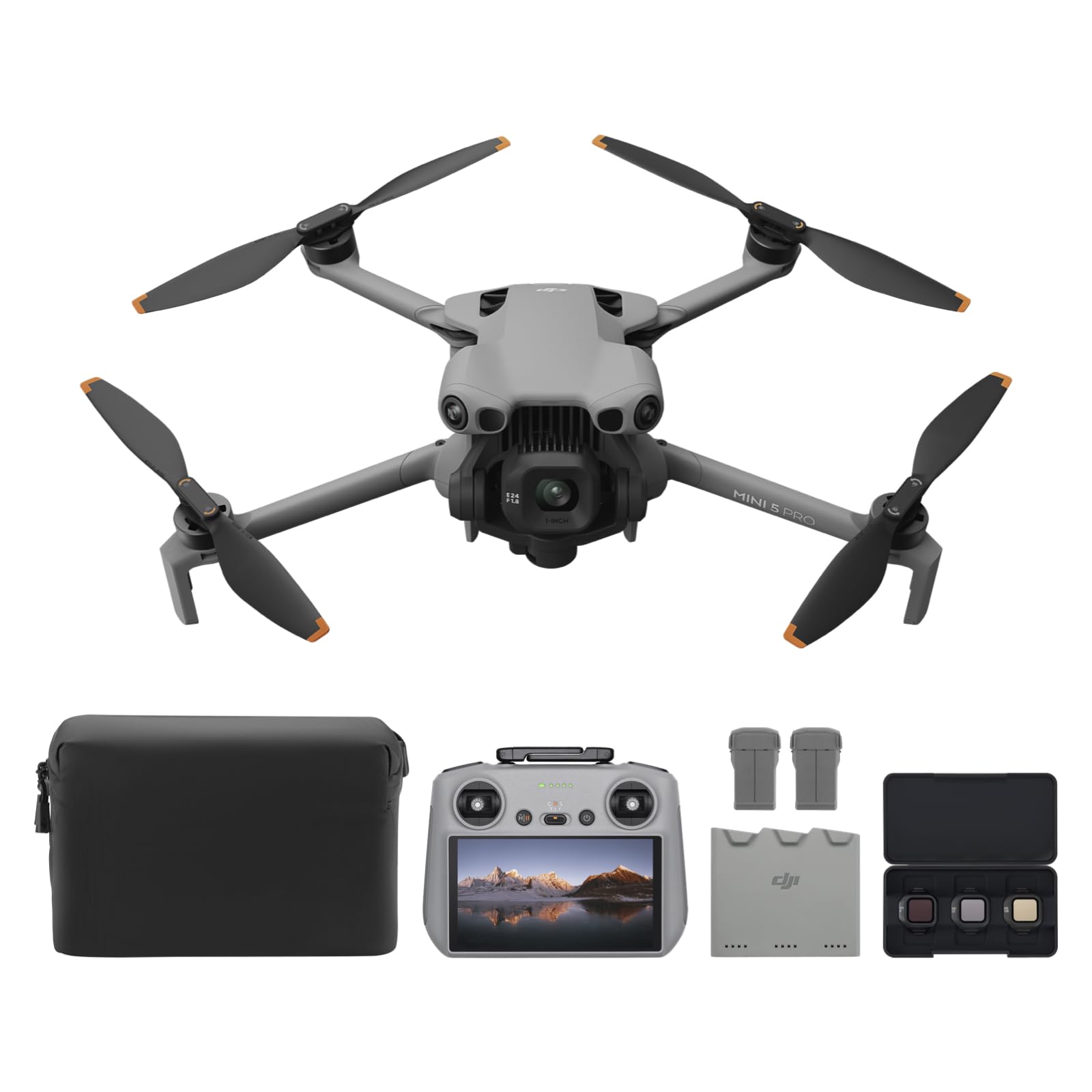
The DJI Mini 5 Pro sits at the top of the consumer drone food chain, pairing a 1-inch CMOS sensor with a 3-axis gimbal that delivers true 4K/60fps HDR footage with exceptional dynamic range. The 225° gimbal rotation enables true vertical filming without cropping the sensor, a huge advantage for social media creators who shoot for TikTok or Instagram Reels. The Nightscape omnidirectional obstacle sensing uses forward-facing LiDAR to detect objects in all directions, including during low-light conditions, making this one of the safest drones to fly at dusk.
ActiveTrack 360° locks onto moving subjects with customizable tracking modes, maintaining focus even during fast cycling or running scenarios. The Fly More Combo Plus includes three Intelligent Flight Battery Plus packs that push flight time to up to 52 minutes each, though the larger batteries push the total weight over 249g, requiring FAA registration. The O4 digital video transmission system delivers a rock-solid feed at up to 20,000 feet with minimal latency.
Bundle extras include an ND filter set, a two-way charging hub, and a shoulder bag. The 42GB of internal storage means you can start recording immediately without hunting for a microSD card. For serious content creators who need professional-grade stabilization and sensor quality in a sub-250g frame, this is the benchmark.
Why it’s great
- 1-inch CMOS captures far more light than standard 1/2.3-inch sensors
- Omnidirectional obstacle sensing with LiDAR adds safety margin
- 225° gimbal rotation enables uncropped vertical filming
Good to know
- Fly More Combo Plus batteries push weight over 249g, requiring FAA registration
- DJI Care Refresh warranty may not be available to US customers
- Premium pricing reflects professional-grade components
2. Ruko Drone with 4K UHD Camera

The Ruko drone delivers what many in the mid-premium bracket cannot: 96 minutes of combined flight time across three intelligent batteries, each packing 2200mAh of capacity. The 1/2-inch CMOS 48MP sensor captures 8K photos and smooth 4K/30fps video, backed by a proper 3-axis brushless gimbal paired with EIS. The result is footage that stays silky smooth even in moderate wind, with professional-tier color and clarity that punches above its weight class.
Weighing under 249g, this drone is FAA-exempt and pocketable when folded. The R2 digital transmission system provides a stable 20,000-foot feed without relying on Wi-Fi, eliminating the interference issues that plague budget-level FPV drones. The AI-driven takeoff and landing system, combined with quadruple positioning (GPS, barometric, TOF, and optical flow), makes this a genuinely beginner-friendly platform that also satisfies experienced pilots.
The built-in beeper helps locate the drone if you lose sight of it, and the three auto-return safety features (one-click, low battery, and signal loss) provide peace of mind. The carrying case and full accessory kit make this a complete out-of-box solution for travelers and family adventurers alike.
Why it’s great
- 96-minute total flight time with three included batteries
- 3-axis brushless gimbal with EIS delivers smooth professional footage
- R2 digital transmission avoids Wi-Fi interference issues
Good to know
- Joysticks are sensitive and may require practice for precise control
- No audio recording on video captures
- Customer service is responsive but propeller failures have been reported
3. Bwine F7MINI 4K (RC3)
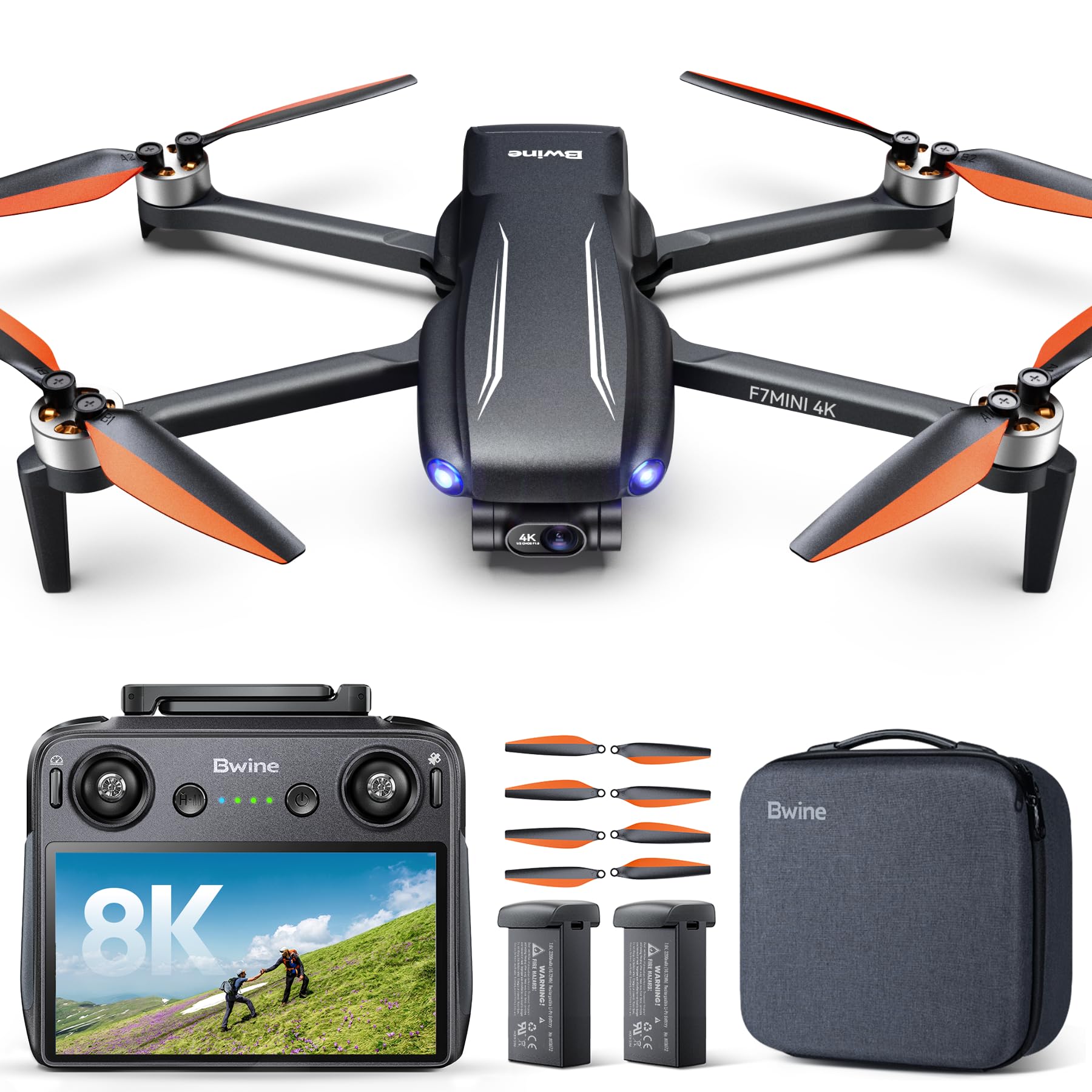
The Bwine F7MINI 4K (RC3) eliminates the biggest hassle with FPV flying — you no longer need to mount your phone on the controller. The remote features a bright 5.5-inch 1080P screen running at 60Hz and 500 nits, making it fully visible even under direct sunlight. With 32GB of internal storage on the controller, you can review and save shots instantly without transferring files to a separate device.
Under the hood, the F7MINI packs a 48MP sensor with an F1.8 aperture that captures 8K photos and 4K UHD video. The 3-axis brushless gimbal with EIS keeps footage stable even in gusty conditions, and the 20,000-foot digital transmission system maintains a 0.1-second latency in clear environments. The drone weighs under 249g, keeping it FAA-exempt and travel-friendly.
Smart flight modes include Active Track with 0.5-meter accuracy, Cruise Control for steady speed-holding shots, Orbit Flight for 360° circling, and Waypoint Planning for pre-mapped routes. The 120dB buzzer accessible via the app helps locate the drone if it lands out of sight. Two 2200mAh batteries provide a combined 64 minutes of flight time, and PD 3.0 fast charging cuts downtime significantly.
Why it’s great
- Built-in 5.5″ 1080P screen controller eliminates phone dependency
- 3-axis gimbal with EIS provides smooth 4K footage
- Active Track with 0.5m accuracy for reliable subject following
Good to know
- File transfer from controller to phone is slow; computer transfer is faster
- Range in dense urban areas drops from 6km to around 4.5km
- Charger is not included; must use PD 3.0 compatible charger
4. Holy Stone HS600 2-Axis Gimbal

The Holy Stone HS600 stands out for its FAA-compliant integrated Remote ID, meaning you do not need to purchase a separate module to fly legally. The 2-axis gimbal with EIS stabilization captures 4K/30fps video through a Sony sensor-enhanced camera, delivering clear footage that works well for YouTube content and social media sharing. The dual-axis setup eliminates pitch and roll shake, though yaw correction requires manual pilot smoothness.
Transmission range hits 20,000 feet using a Wi-Fi repeater built into the remote controller. Holy Stone’s latest connection technology allows a single USB data cable link between the controller and smartphone, bypassing Wi-Fi for real-time image streaming. The Level 6 wind resistance rating means the HS600 handles breezy conditions better than many competitors in its tier.
The 2500mAh battery delivers around 28 minutes of flight time per charge. GPS intelligent functions include one-key return, lost signal return, and low battery return. The carrying case is included, and the drone weighs 541g, placing it above the FAA-exempt threshold, so registration is required.
Why it’s great
- Integrated Remote ID eliminates the need for a separate module
- Level 6 wind resistance handles gusty conditions well
- Sony sensor-enhanced camera with EIS delivers stable 4K footage
Good to know
- 2-axis gimbal lacks yaw correction; turns show slight twisting motion
- Camera has no manual ISO or exposure controls
- No RAW photo format support
5. DCX Volo X EZ AI Drone
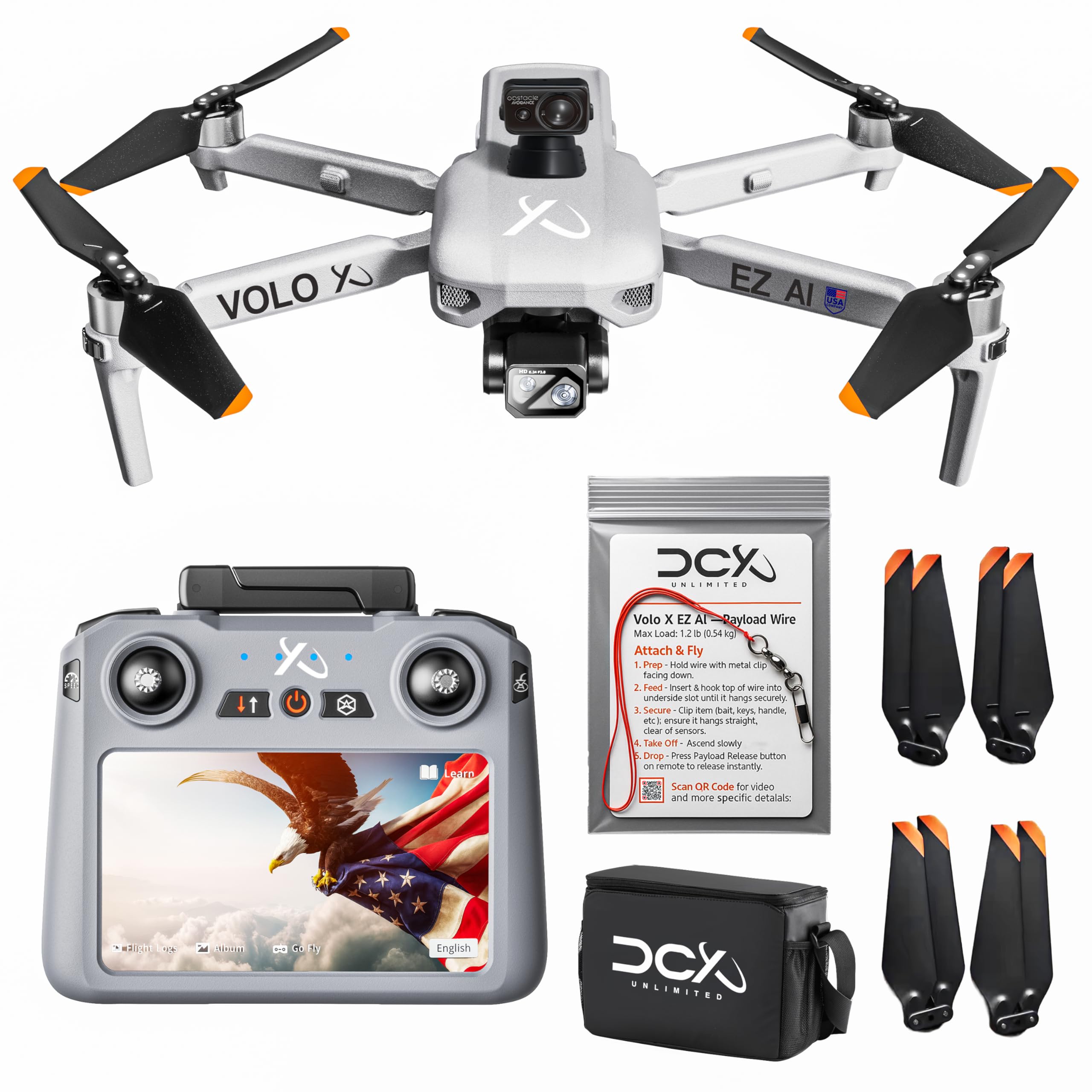
The DCX Volo X EZ AI drone is built around 360° obstacle detection using LiDAR sensors, making it one of the safest camera drones for beginners who worry about collisions. The AI-assisted flight control system handles Follow Me mode automatically, keeping the subject centered without manual stick input. The 4K camera sits on a 3-axis gimbal with EIS, producing cinematic-quality video even during dynamic movement.
With a 45-minute flight time and a 4-mile transmission range, this drone is designed for extended exploration without battery anxiety. The FAA Remote ID compliance is built in, and the drone experiences no geofencing limits or height restrictions, giving experienced pilots full creative freedom. The Smart Night Mode and LED spotlight enable safe flying after dark, a rare feature at this tier.
The built-in Payload Release mechanism can carry and release objects up to 1.2 pounds on command, adding a fun utility aspect for dropping small packages or markers. The foldable design fits into the included carrying case, and American-based customer support is available around the clock. The power-on sequence takes some getting used to, but overall reliability is solid.
Why it’s great
- 360° LiDAR obstacle detection protects against collisions in all directions
- No geofencing limits or height restrictions for unrestricted flight
- Built-in payload release mechanism for dropping up to 1.2 lbs
Good to know
- Power-on sequence requires a specific short-press then long-press order
- Controller can occasionally lose sync with drone, freezing the FPV screen
- Obstacle avoidance may miss very thin branches
6. SIMREX G29 GPS Drone

The SIMREX G29 delivers a comprehensive feature set aimed at beginners who want to learn intelligent flight modes without a steep learning curve. The 90° electrically adjustable 4K camera on a single-axis tilt allows you to frame shots from straight ahead to directly below, while the 5G WiFi FPV provides a real-time view on your phone at up to 2,296 feet. Optical Flow and Altitude Hold sensors keep the drone locked in position when GPS is unavailable, such as during indoor flight.
GPS Auto Return engages when the signal drops or the battery runs low, and the Find My Drone feature on the app shows the drone’s last known location on a map. Gesture Control lets you trigger photos and videos with a wave of your hand, perfect for solo travelers. Waypoint Flight and Circle Around modes enable pre-planned cinematic sequences without active piloting.
The brushless motors provide quiet operation and strong wind resistance for stable flight on breezy days. Two batteries deliver a combined 40 minutes of flight time. The foldable arms make the G29 compact for packing, and Headless Mode removes orientation confusion for new pilots. This is a solid entry-level platform that grows with your skill level.
Why it’s great
- Gesture control enables hands-free photo capture
- Optical Flow and Altitude Hold maintain position without GPS
- USB-C charging on batteries simplifies cable management
Good to know
- Camera quality is decent for the tier but not true 4K sharpness
- Controller with phone dock works well but live video can lag in urban areas
- Requires calibration every power-on sequence
7. Oddire HK11 GPS Drone

The Oddire HK11 offers a rare combination at its tier: GPS-based intelligent flight modes and a 4K camera inside a sub-249g frame. The adjustable 110° wide-angle lens tilts up to 90 degrees via remote or app control, capturing 4096x3072P photos and 2048x1088P videos that look crisp on social media. The 5G WiFi transmission module with a built-in signal repeater claims a range of 1,640 feet, though real-world suburban range is closer to 500 feet.
GPS features include Auto Return Home on low battery or signal loss, Waypoint Flight, Orbit Fly, and GPS Follow. The 7.7V 1800mAh batteries output more voltage than standard 7.4V or 3.7V packs, resulting in snappier motor response and better overall flight dynamics. Two batteries provide a combined stated flight time of 48 minutes, and the brushless motors offer Level 5 wind resistance.
The foldable design fits into a compact carrying case, and the lack of FAA registration requirements makes it a grab-and-go option for spontaneous outings. The X DRONE GO app includes built-in filters and background music for quick social sharing. Beginners should note that compass calibration is required before each flight session.
Why it’s great
- GPS intelligent modes at a budget-friendly price point
- 7.7V batteries provide stronger motor response than standard voltage packs
- Under 249g, no FAA registration needed
Good to know
- Max range in real suburban conditions is about 300-500 meters
- Buzzer noise meanings (compass calibration alerts) not fully explained in manual
- Requires X DRONE GO app rather than the main app listed
8. REDRIE HK33 Foldable Drone
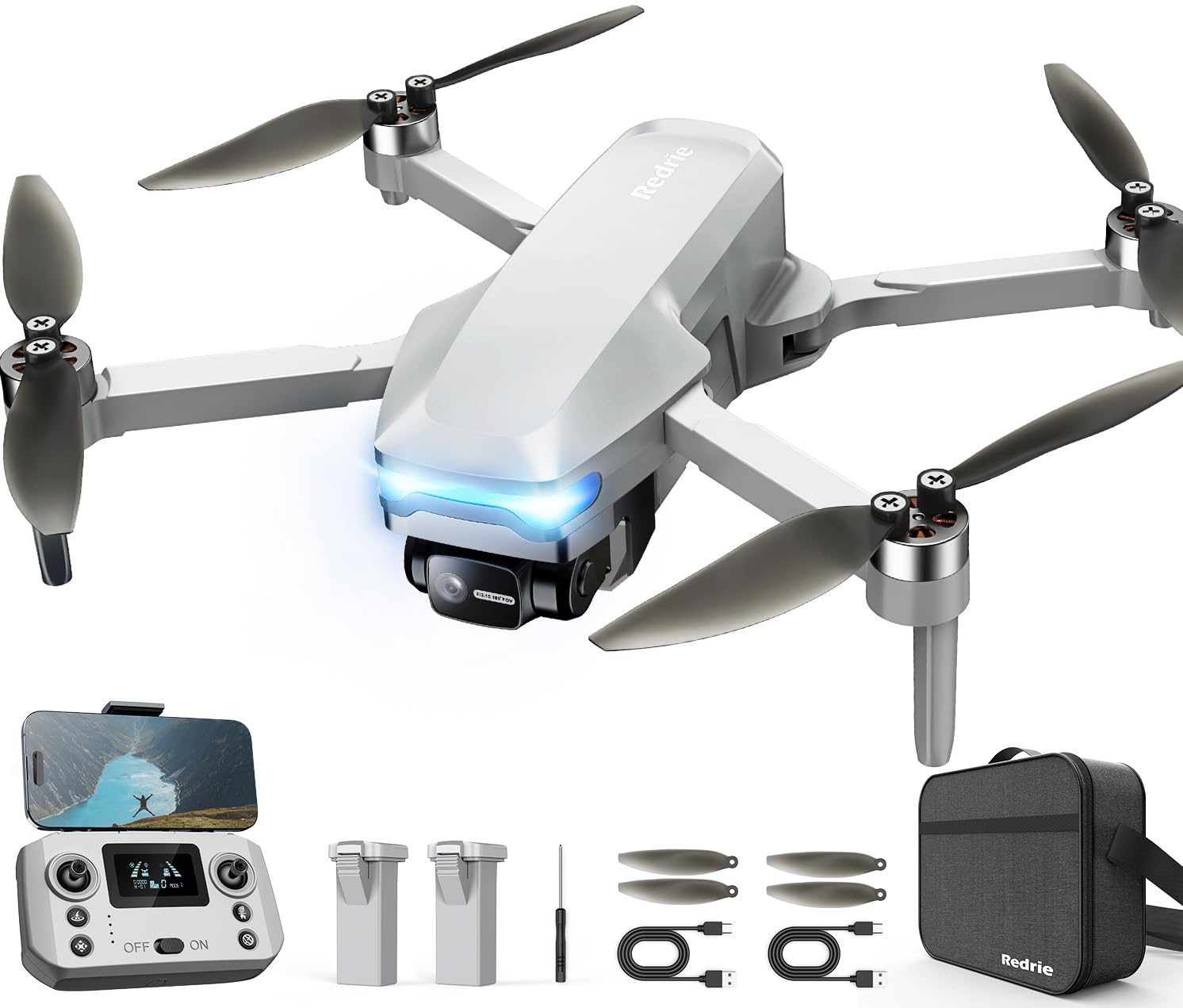
The REDRIE HK33 is engineered for first-time pilots who want a taste of aerial photography without a major financial commitment. The 2-axis gimbal paired with the F2.15 aperture 110° ultra-wide lens reduces shakes significantly compared to fixed-mount cameras, though you will still see some yaw drift during aggressive turns. The camera captures 4096x3072P photos and 2048x1088P videos, which is sharp enough for social sharing but not on par with true UHD 4K drones in higher tiers.
The brushless motors provide enough thrust to handle Level 5 winds, keeping the platform steady when the breeze picks up. The 5G WiFi FPV feed reaches up to 985 feet for stable video transmission, while the signal repeater extends the control range to 1,640 feet. GPS features include Auto Return Home on signal loss, low battery, or range exceedance, along with Follow Me, Route Planning, and Fly Around modes.
Two 1800mAh batteries deliver a total flight time of 40-45 minutes. The foldable frame comes with a carrying case, making it easy to toss in a backpack for hiking or park trips. Weighing under 249g, it requires no FAA registration. Several user reports highlight excellent durability after multiple crashes, a crucial advantage for learners.
Why it’s great
- Excellent durability survives crashes well, ideal for beginners
- Brushless motors handle Level 5 wind resistance
- Includes carrying case, extra battery, and spare propellers
Good to know
- 2-axis gimbal only: yaw twist visible during fast turns
- Video quality is 2K upscaled to 4K, not native 4K
- Cell phone holder on remote is flimsy
9. DJI Flip (RC-N3)

The DJI Flip brings DJI’s signature camera quality into a uniquely portable form factor with full-coverage carbon fiber propeller guards. Weighing under 249g, it requires no FAA registration and can launch directly from your palm. The 1/1.3-inch CMOS sensor records 4K/60fps HDR video with wide dynamic range, handling sunrise and sunset contrast without clipping highlights. The 3-axis gimbal stabilization is typical DJI quality — smooth, responsive, and reliable.
The RC-N3 remote controller connects to your smartphone for the FPV feed, with DJI’s O4 digital transmission system providing a range of up to 44,000 feet (13km) in open environments. Subject tracking keeps a person or object centered in the frame automatically, making the Flip perform like a personal cameraman. The 31-minute maximum flight time covers most shooting sessions, though extra batteries are recommended for all-day outings.
The Flip is optimized for quick deployment — fold it out, power on, and launch from your hand in under 30 seconds. Forward-facing obstacle avoidance adds a layer of protection for beginners, though there is no rear or side obstacle sensing. For travelers who want DJI-grade image quality in the smallest possible package, the Flip is a compelling choice.
Why it’s great
- Palm takeoff and carbon fiber prop guards make it ultra-safe for beginners
- 1/1.3-inch sensor with 4K/60fps HDR delivers excellent dynamic range
- Full O4 digital transmission system with 44,000ft range
Good to know
- Only forward obstacle avoidance; rear/side protection absent
- Additional batteries, case, and storage are separate purchases
- Some modes (e.g., 4K/60fps) require controller connection; not available with phone-only operation
FAQ
Do I need FAA registration for a sub-250g drone with a 4K camera?
Is a 2-axis gimbal good enough for professional-looking 4K footage?
Why does my drone advertise 20,000 feet range but loses signal at 500 feet?
Final Thoughts: The Verdict
For most users, the best drone with best camera winner is the Ruko with 4K UHD Camera because it delivers a true 3-axis gimbal, 96 minutes of flight time across three batteries, and a 48MP sensor — all in an FAA-exempt sub-249g frame. If you want professional-grade sensor performance and obstacle avoidance, grab the DJI Mini 5 Pro Fly More Combo Plus. And for a budget-friendly entry into GPS-assisted 4K flying, nothing beats the REDRIE HK33 for durability and value.

Mo Maruf
I created WellFizz to bridge the gap between vague wellness advice and actionable solutions. My mission is simple: to decode the research and give you practical tools you can actually use.
Beyond the data, I am a passionate traveler. I believe that stepping away from the screen to explore new environments is essential for mental clarity and physical vitality.