Our readers keep the lights on and my smoothie glass nicely filled. As an Amazon Associate, I earn from qualifying purchases.
The thrill of a drone evaporates the instant the video feed stutters, the control stick feels unresponsive, and the aircraft enters a failsafe return-to-home at the worst possible moment. For serious flyers, range isn’t a spec sheet number—it’s the difference between capturing the shot you framed and watching a distant speck disappear behind a hill. This guide focuses exclusively on drones engineered to maintain a rock-solid connection at distances where consumer Wi-Fi drones simply give up.
I’m Mohammad Maruf — the founder and writer behind WellFizz. I’ve spent countless hours filtering transmission protocol specifications, battery chemistry trade-offs, and gimbal stabilization data to isolate the models that actually deliver on their promised range under real-world interference.
Whether you need to survey a large property or film expansive landscapes, finding a reliable drone with longest range means looking past marketing numbers to the actual transmission hardware, antenna design, and regulatory frequency bands that keep you connected.
How To Choose The Best Drones With Longest Range
Transmission range claims are the most inflated number in the drone industry. A model advertised at 10 kilometers might lose signal at 1.5 kilometers in a suburban neighborhood with Wi-Fi interference. Understand what makes range real before you buy.
Transmission Protocol: Digital vs Wi-Fi
Dedicated digital transmission protocols—like DJI O4, Autel SkyLink, or Potensic PixSync—use proprietary compression and frequency hopping that penetrate obstacles far better than standard Wi-Fi repeaters. If long range matters, avoid drones that rely on the drone broadcasting its own Wi-Fi hotspot. The controller binding method matters more than the antenna count.
Frequency Bands and Antenna Architecture
Dual-band or tri-band radios (2.4GHz, 5.8GHz, 900MHz) give you options: lower frequencies penetrate trees and buildings better; higher frequencies deliver cleaner video at open-sky distance. Drones with external, movable antennas on the controller generally maintain lock longer than those with fixed internal antennas. Look for 4-antenna MIMO configurations.
Battery Capacity and Flight Time Correlation
Range is meaningless if the battery dies before you reach the horizon. A drone with 30 minutes of hover time might deliver only 12 minutes of usable out-and-back range at full speed. Calculate roughly 2/3 of the advertised flight time for real-world round-trip range. Multiple-battery bundles mitigate this, but fast charging (PD 3.0 support) matters when you are in the field.
Regulatory Constraints on Range
In the United States, the FAA requires VLOS (Visual Line of Sight) at all times for recreational flights, which functionally limits legal range to about half a mile for most pilots. That said, the drone’s maximum transmission capability gives you a safety buffer for strong signal retention at that legal limit, and it matters for professional Part 107 operations with waivers.
Quick Comparison
On smaller screens, swipe sideways to see the full table.
| Model | Category | Best For | Key Spec | Amazon |
|---|---|---|---|---|
| Autel EVO 2 Pro V3 | Premium Professional | Professional cinematography | 15km SkyLink 2.0, 6K HDR | Amazon |
| DJI Mini 5 Pro | Premium Compact | Travel & obstacle avoidance | 52-min flight, 1-inch CMOS | Amazon |
| Potensic ATOM 2 | Mid-Range Premium | Long range with screen controller | 10km PixSync 4.0, 96-min total | Amazon |
| Bwine F7MINI 4K(RC3) | Mid-Range | Under-249g with screen RC | 20,000ft range, 5.5-inch 1080p RC | Amazon |
| DJI Flip Fly More | Premium Consumer | Safe indoor/outdoor flying | Carbon-fiber guards, 31-min flight | Amazon |
| Holy Stone HS790 | Mid-Range | Value with 3-axis gimbal | 30,000ft Wi-Fi repeater, 60-min total | Amazon |
| K600PRO GPS Drone | Mid-Range Pro | Built-in screen with 50x zoom | 15km FPV, 5.5-inch touchscreen RC | Amazon |
| Bwine F7GB2 Pro | Mid-Range | High altitude performance | 10,000ft range, 75-min total | Amazon |
| Antigravity A1 Explorer | Premium 360 FPV | Immersive 360° flight & goggles | 10km range, 8K 360 video | Amazon |
| HOVERAir X1 PROMAX | Premium Action | Hands-free action filming | 8K@30fps, 42 km/h follow | Amazon |
| Ruko Drone 4K | Budget-Friendly | Entry-level with good flight time | 20,000ft digital feed, 96-min total | Amazon |
In‑Depth Reviews
1. Autel Robotics EVO 2 Pro V3
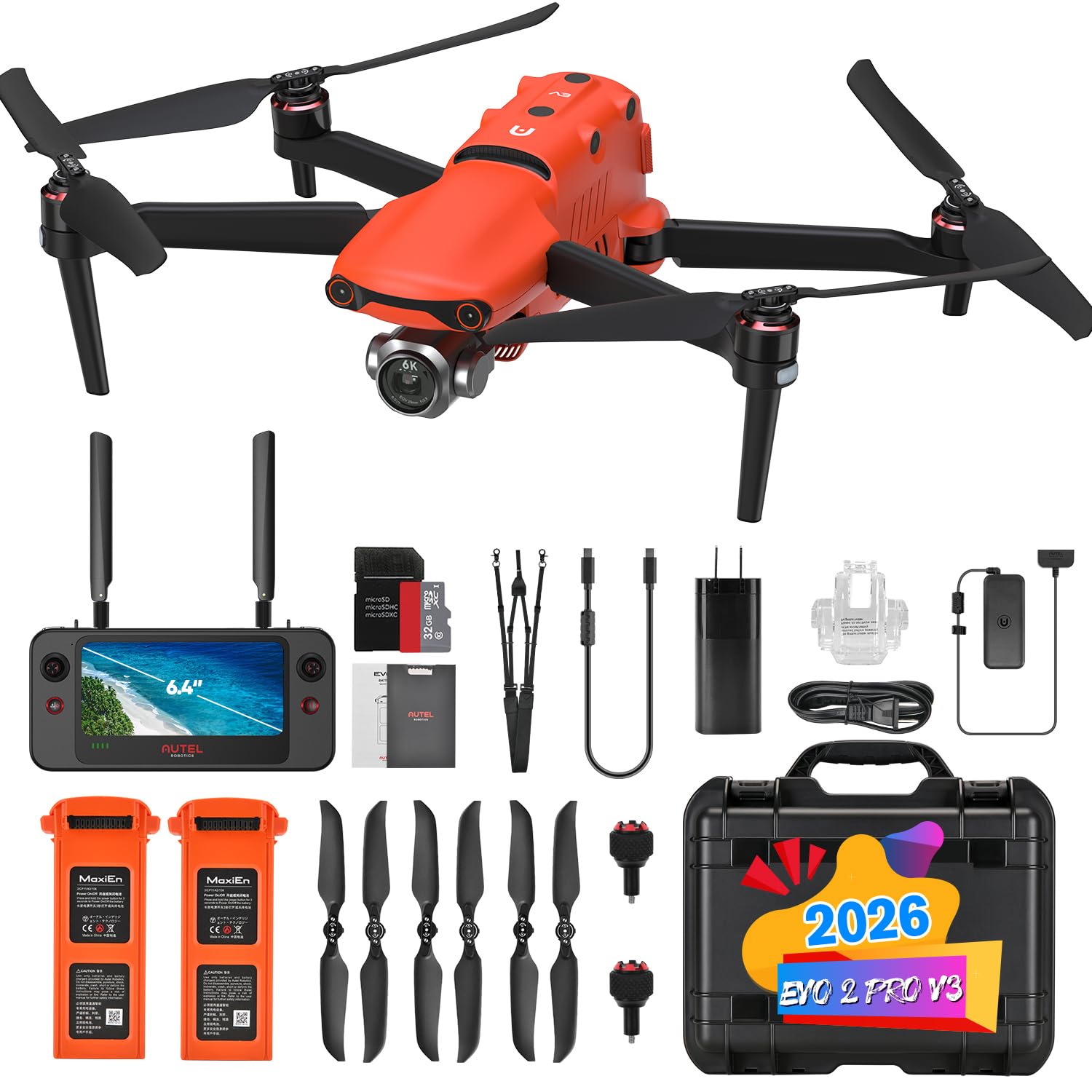
The EVO 2 Pro V3 is Autel’s top-tier offering, built around a 1-inch CMOS sensor that captures 6K HDR video with a 12-bit color depth—68.6 billion colors versus the 1 billion of a 10-bit sensor. The adjustable aperture (F/2.8 to F/11) gives you exposure control without ND filters, a rare convenience. Its SkyLink 2.0 transmission system uses tri-band frequency hopping (2.4GHz, 5.8GHz, 900MHz) to maintain a stable 2.7K live feed up to 15 kilometers, making it the absolute best in class for raw range and signal integrity.
The Moonlight Algorithm 2.0 pushes ISO to 44000, enabling usable low-light footage that competitors struggle to match. The drone includes 12 visual sensors for omnidirectional obstacle avoidance, though users report it still struggles with thin wires. Flight time sits at 40 minutes with the standard battery, and the bundled Smart Controller SE features a 6.4-inch OLED screen rated IP43 against weather.
Professional surveyors and cinematographers praise its optical 3D mapping accuracy (within 1-3 tenths of a foot) and complete lack of geofencing restrictions. The only real friction point is the controller’s Android interface, which differs enough from the phone app that first-time setup requires patience. For serious commercial work, this is the benchmark.
Why it’s great
- 15km tri-band transmission with 2.7K live feed
- 6K HDR with 12-bit color depth and adjustable aperture
- 360° obstacle avoidance with 12 sensors
- No geofencing restrictions for professional mapping
Good to know
- Controller interface less intuitive than phone app
- Charging batteries may require multiple restarts
- Premium price bundle
2. DJI Mini 5 Pro Fly More Combo Plus
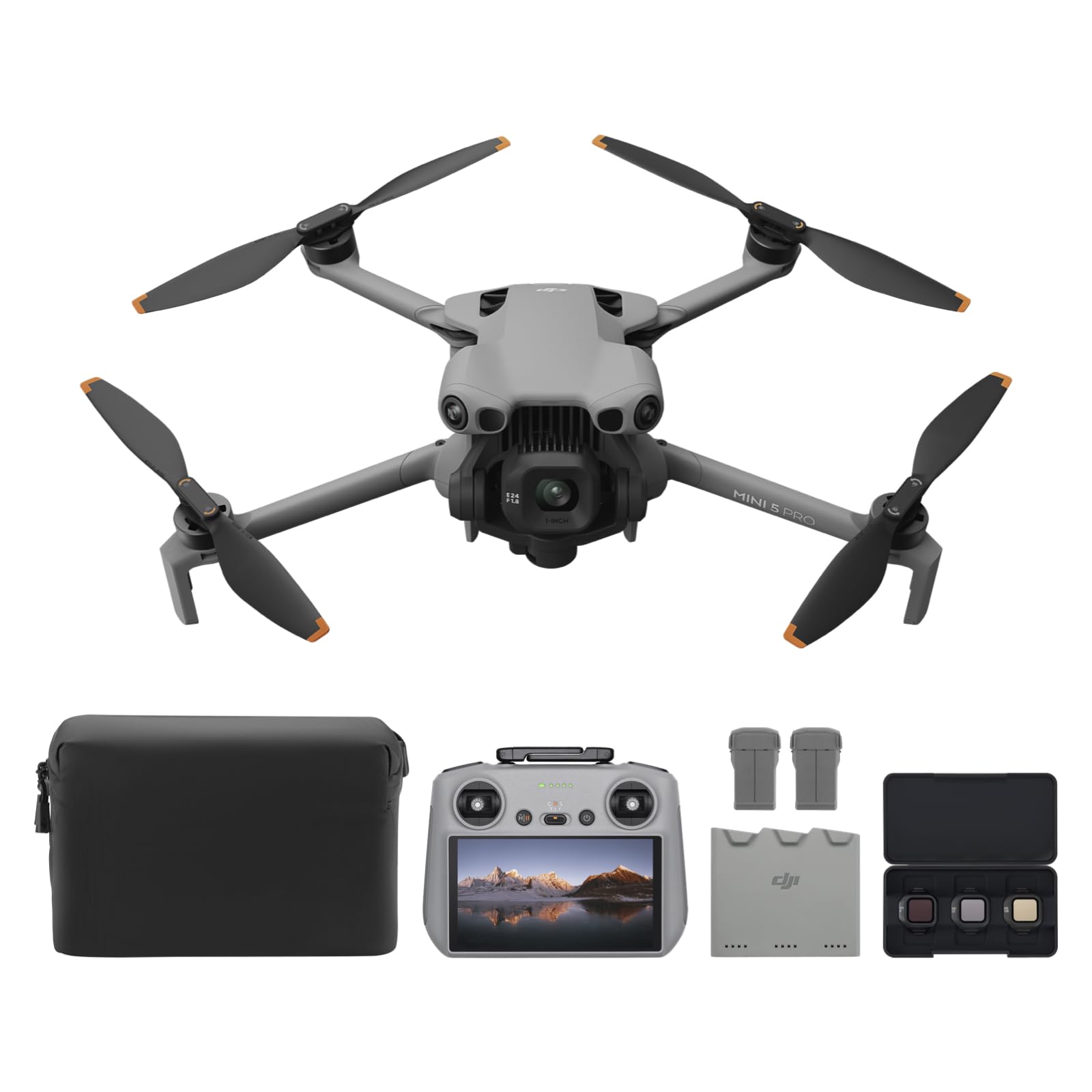
The Mini 5 Pro packs DJI’s latest 1-inch CMOS sensor into a sub-250-gram frame, delivering 4K/60fps HDR video with a 225-degree rotating gimbal for true vertical filming. The Fly More Combo Plus includes three Intelligent Flight Battery Plus units that extend flight time to 52 minutes each, though real-world endurance hovers around 35-45 minutes depending on wind. The DJI RC 2 controller’s bright screen eliminates phone tethering, and the Nightscape omnidirectional obstacle sensing uses forward-facing LiDAR to detect objects in low light.
ActiveTrack 360° is noticeably more responsive than previous generations, keeping cyclists and runners centered in the frame even during tight turns. The 42GB of internal storage means you rarely need a microSD card for short sessions. Pilots should note that adding the larger battery pushes the total weight over 249 grams, triggering FAA Remote ID requirements. Some users experienced firmware update issues and a charging hub malfunction out of the box, but DJI’s ecosystem and flight app remain the most polished in the industry.
For travel and general content creation, this is the most refined sub-250g drone available. The sensor quality and tracking algorithms justify the premium over last-generation models, though the lack of DJI Care Refresh in the US market is a notable risk.
Why it’s great
- 1-inch CMOS with 4K HDR and 225° gimbal rotation
- Nightscape LiDAR obstacle sensing
- 52-minute flight with Plus batteries
- 42GB internal storage
Good to know
- Large battery pushes weight over 249g FAA limit
- No DJI Care Refresh available in US
- Firmware updates can fail on first attempt
3. Potensic ATOM 2 Fly More Combo
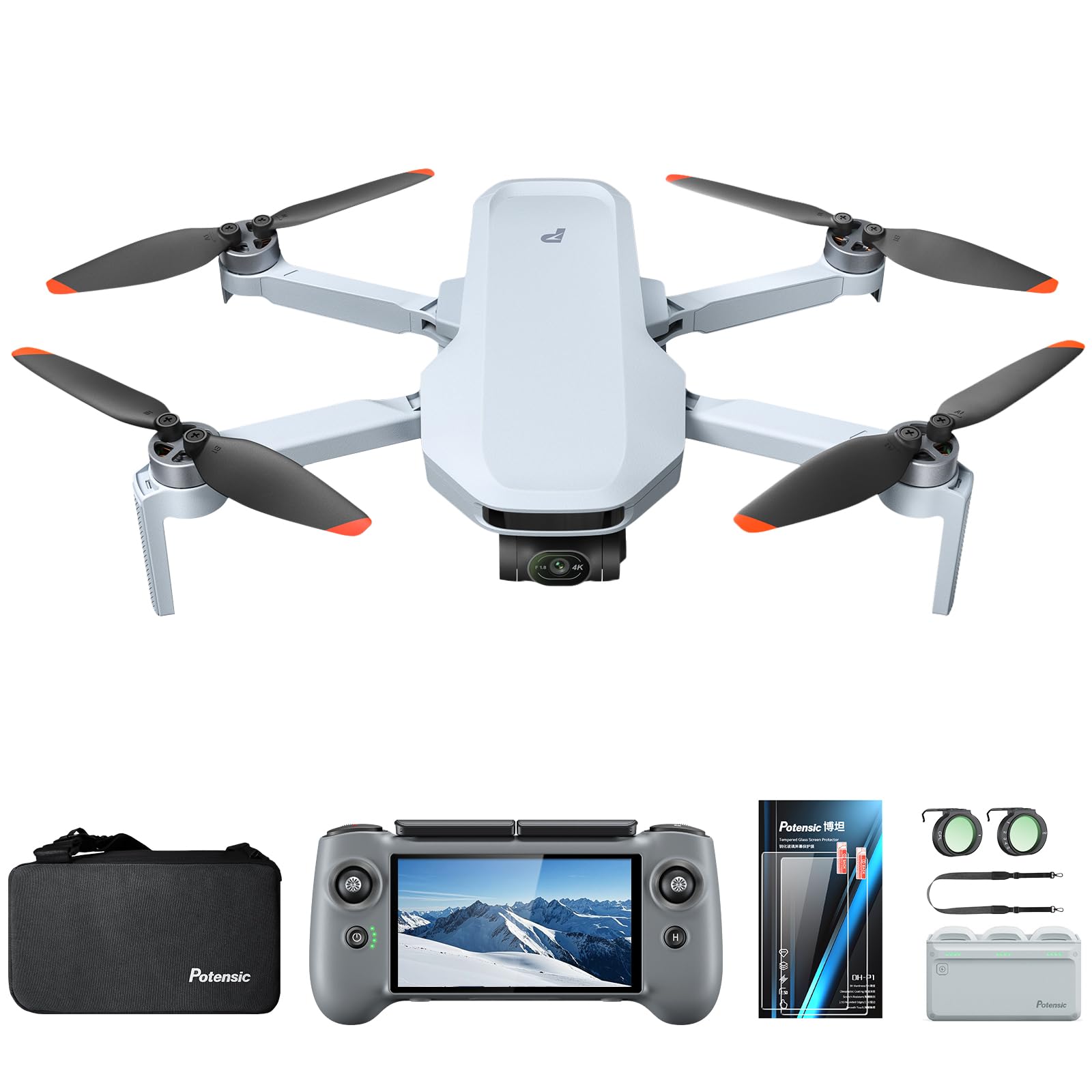
The ATOM 2 is the most compelling mid-range option for pilots who want a dedicated screen controller without paying DJI prices. The PTD 1 remote features a 5.5-inch 1920×1080 touchscreen at 700 nits, making it readable in direct sunlight—a critical detail for long-range FPV flights. PixSync 4.0 transmission technology delivers a stable 1080p/30fps feed up to 10 kilometers, with low latency that feels responsive even at medium distances. The 1/2-inch Sony CMOS sensor captures 48MP photos and 4K/30fps HDR video with a 3-axis gimbal that handles moderate wind without micro-jitters.
The bundle includes three batteries that charge simultaneously in 1.3 hours via the included PD hub, totaling 96 minutes of flight time. AI tracking modes—Spotlight, Follow, and Parallel—use onboard processing rather than the app, reducing delay. The drone weighs under 249 grams, exempting it from FAA registration. Included ND and CPL filters add versatility for outdoor shooting without extra purchases.
Community feedback highlights the screen controller as the standout feature, eliminating phone calls and notifications mid-flight. A few users noted occasional app interface lag on older Android phones used as secondary displays, but the RC itself runs smoothly. For the price, the range-to-screen-quality ratio is unmatched.
Why it’s great
- 10km PixSync 4.0 digital transmission
- 700-nit built-in touchscreen controller
- 96 minutes total flight with 3 batteries
- Under 249g with ND/CPL filters included
Good to know
- Glossy screen may need matte protector for glare
- AI tracking less robust than DJI ActiveTrack
- Requires initial firmware update routing
4. Bwine F7MINI 4K(RC3)
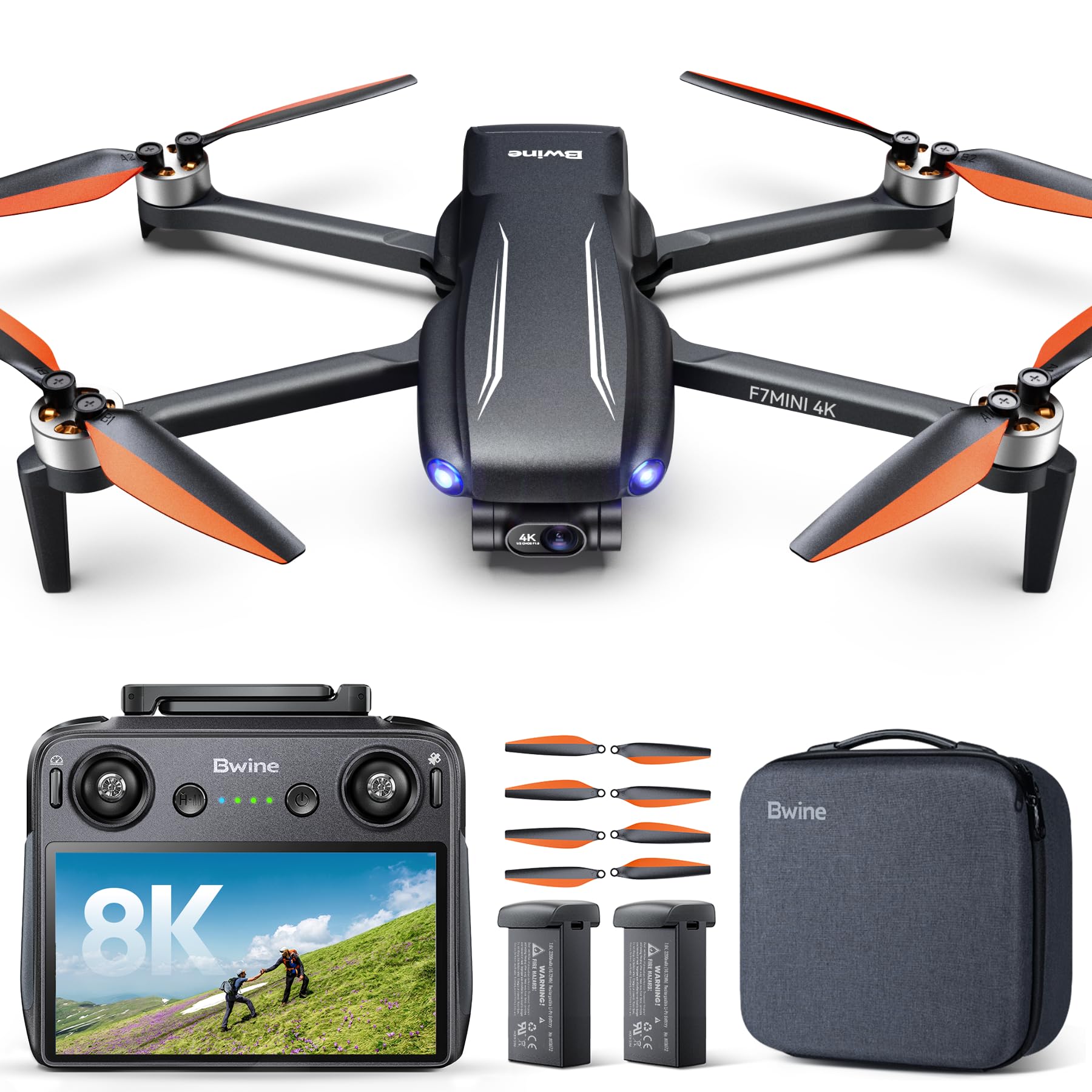
The F7MINI 4K(RC3) brings a 5.5-inch 1080P 500-nit screen controller to the sub-250g class at a very accessible price point. The 20,000-foot digital transmission system uses a 2.4GHz Wi-Fi-based protocol that delivers a 4.5km stable signal in urban settings with 0.1-second latency—impressive for a non-proprietary system. The 3-axis brushless gimbal paired with EIS delivers smooth 4K/30fps footage from a 48MP sensor with an F1.8 aperture for better low-light performance.
Two high-capacity 2200mAh batteries provide 64 minutes of total flight time, and the included carrying case keeps everything organized. The RC3 controller has 32GB of internal storage plus a microSD slot, so you can review footage without transferring files immediately. Vertical shooting mode and built-in filters simplify social media uploads. The Dynamic Home Point feature updates the return location based on controller position, useful for moving boat or car launches.
Reviewers consistently praise the screen clarity and ease of setup. Signal dropouts are rare in suburban environments, though the Wi-Fi-based system may struggle near cell towers or high-density interference. Bwine offers a 2-year warranty and responsive after-sales support. For new pilots who want a screen RC without paying +, this is the smart pick.
Why it’s great
- 5.5-inch 1080p controller screen included
- 20,000ft digital transmission with low latency
- Under 249g with FAA exemption
- 2-year warranty and 64-min total flight
Good to know
- Wi-Fi-based system (not dedicated digital protocol)
- Screen brightness 500 nits, lower than premium RCs
- Batteries charge individually without PD hub
5. DJI Flip Fly More Combo
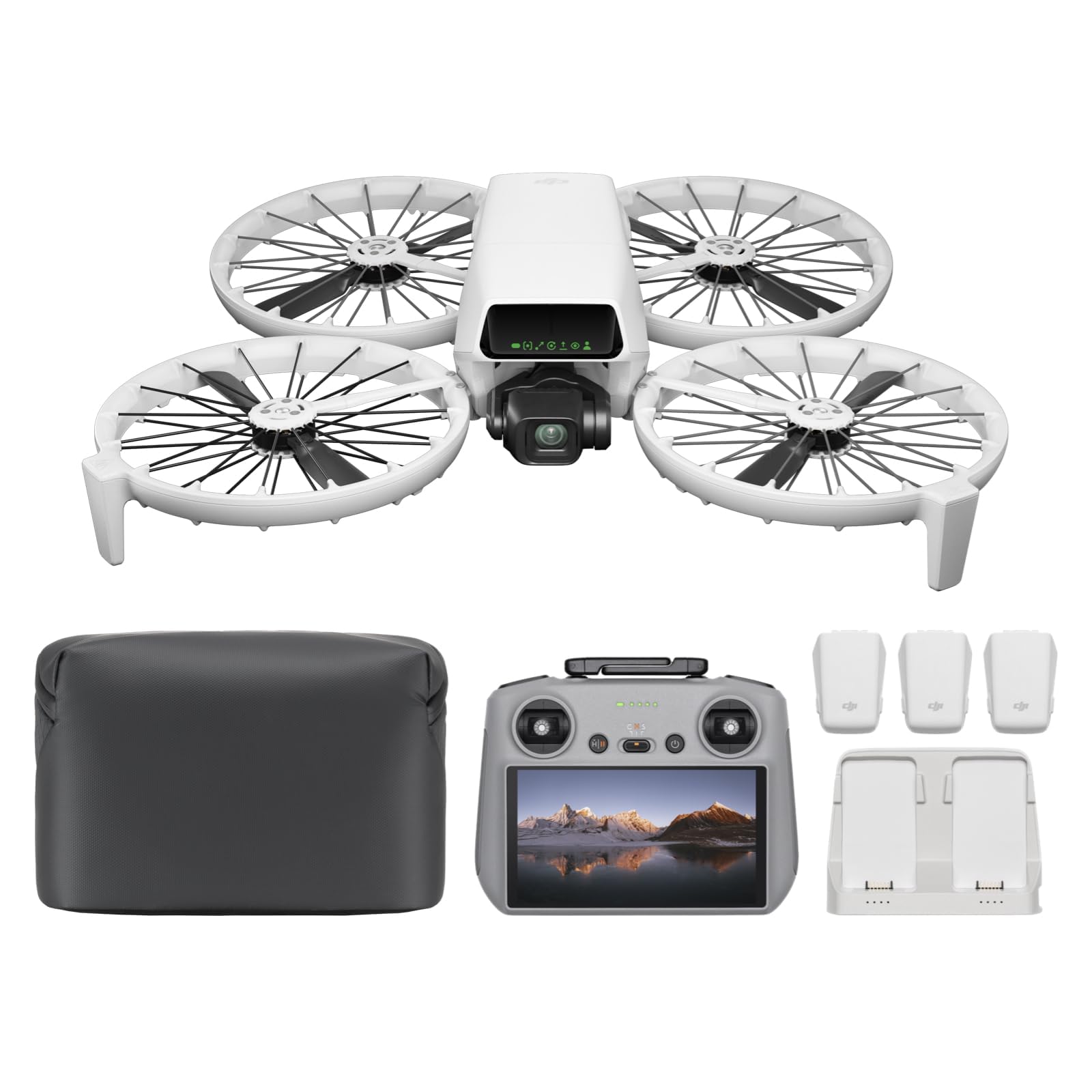
The DJI Flip is built around a unique folding design with integrated carbon-fiber propeller guards that let you launch from your palm and fly safely indoors near people. The 1/1.3-inch CMOS sensor captures 4K/60fps HDR video with impressive dynamic range, and the RC 2 controller’s high-bright screen eliminates phone cables. The Fly More Combo includes three batteries, a parallel charging hub, and a shoulder bag for a total of 93 minutes of flight time.
Subject tracking keeps a locked target whether you are hiking or at a party, and the HDR video handles sunrise/sunset contrast without blowing out highlights. The full-coverage guards are durable enough to bump into walls without damage, making this the best choice for beginners nervous about crashing. Flight time per battery reaches 31 minutes, though real-world use with wind cuts that to around 25 minutes.
The main limitation is wind resistance—the lightweight design and exposed prop guards mean it struggles in gusts above 15 mph. Some users report needing a 100W charger to fast-charge the batteries quickly (sold separately). For family-oriented footage and safe indoor flying, the Flip is uniquely suited.
Why it’s great
- Integrated carbon-fiber guards for safe flying
- Palm takeoff and hands-free subject tracking
- 4K/60fps HDR from 1/1.3-inch sensor
- Under 249g with 93-min total flight
Good to know
- Not stable in winds above 15 mph
- Requires separate purchase for fast charger
- Prop guards increase drag, reducing max speed
6. Holy Stone HS790
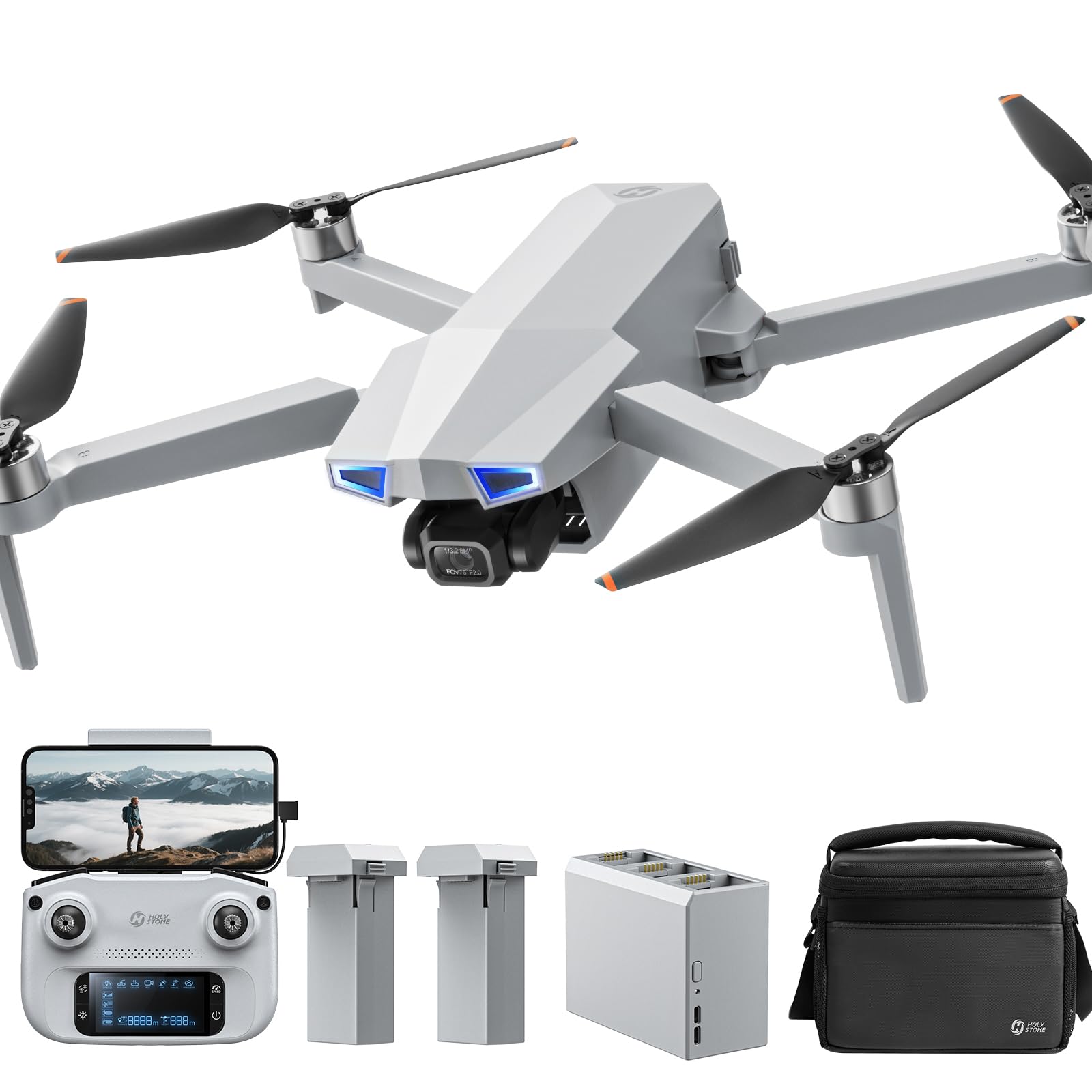
The HS790 claims a 30,000-foot transmission range via an advanced Wi-Fi repeater system. In open field conditions with clear line of sight, it holds a usable 4K FPV feed at about 1.5 to 2 miles—impressive for a Wi-Fi protocol. The 3-axis brushless gimbal delivers genuinely smooth 4K/30fps footage, and the 6K photo mode offers headroom for cropping. Two intelligent batteries and a smart PD charging hub that doubles as a power bank provide 60 minutes of total flight time.
Built-in Remote ID compliance means you meet FAA regulations without an external module. Beginner-friendly features like one-key takeoff/landing, altitude hold, and headless mode make it accessible for new pilots, while the 1506 brushless motors provide enough torque for stable flight in moderate wind. The Night Flying Mode improves visibility during twilight flights, though it doesn’t significantly improve low-light image quality.
The main trade-off is the lack of a dedicated digital transmission system. FPV latency is noticeable at longer ranges, and the Wi-Fi link can drop in environments with heavy interference. The HS790 represents the upper limit of what Wi-Fi-based drones can achieve, making it a strong budget-conscious choice for open-area flying.
Why it’s great
- 30,000ft transmission for the price point
- 3-axis gimbal with 4K/30fps stabilized video
- Built-in Remote ID compliant
- PD charging hub doubles as power bank
Good to know
- Wi-Fi repeater system, not dedicated digital link
- FPV latency increases with distance
- Camera angle control location not intuitive
7. K600PRO GPS Drone
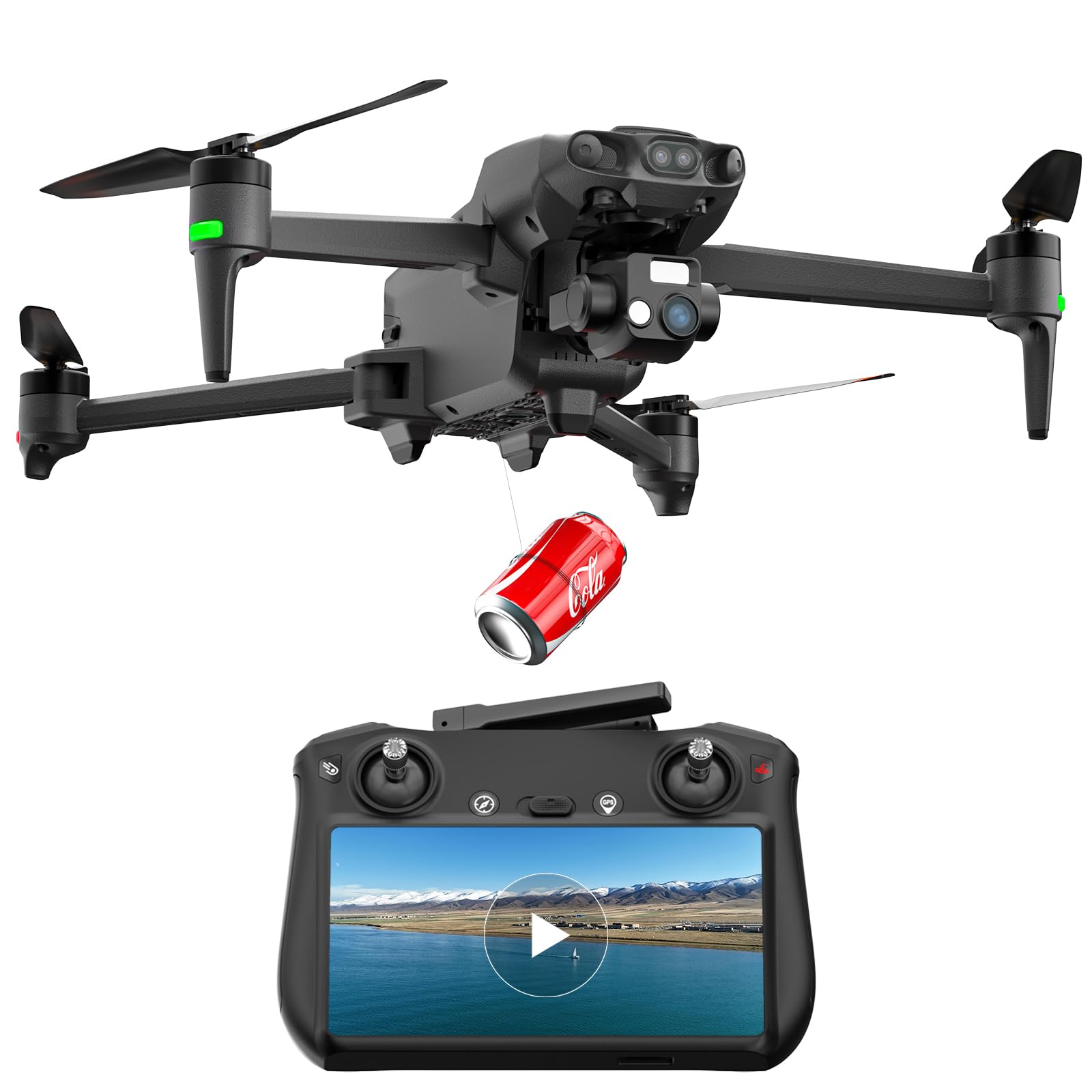
The K600PRO targets users who need inspection-grade zoom capability without moving to enterprise pricing. Its 50x zoom (optical and digital combined) lets you inspect rooftops, power lines, or distant infrastructure while staying at a safe distance. The 5.5-inch touchscreen controller provides a clear real-time FPV view without a phone, and the 15km transmission range gives you the buffer to maintain signal at the legal VLOS limit. The EIS (electronic image stabilization) with a 3-axis gimbal keeps footage watchable, though the 4K sensor lacks the dynamic range of larger CMOS chips.
An 11.1V 3500mAh battery provides up to 55 minutes of flight time, with Type-C charging for convenience. TOF sensors plus 6 GPS satellites improve low-altitude stability by double, making this drone forgiving for beginners despite its professional feature set. Follow Me mode, orbit, and waypoint flight are all functional and easy to activate from the touchscreen.
Some reviewers noted that the gimbal struggles during aggressive yaw maneuvers, causing horizon tilt that requires manual correction. The 50x zoom is mostly digital, so quality degrades noticeably past 10x. For property inspection and hobbyist surveillance work, the K600PRO offers unique value.
Why it’s great
- 50x zoom for inspection work
- 5.5-inch touchscreen controller with 15km range
- 55-minute flight with Type-C charging
- Beginner-friendly with TOF altitude sensors
Good to know
- Digital zoom degrades image beyond 10x
- Gimbal may tilt during fast yaw
- Brand has limited long-term market presence
8. Bwine F7GB2 Pro

The F7GB2 Pro is engineered for mountain flying. Its 1806 brushless motors combined with a barometer and 6-level wind resistance rating allow takeoff at 2000 meters altitude in thin air—a spec most consumer drones cannot match. The 4K camera with a 3-axis gimbal and 5x digital zoom handles high-altitude thermal currents without introducing micro-jitters. Transmission range is listed at 10,000 feet, though users report reliable control out to nearly 3,000 feet before signal loss triggers auto-return.
Three 2600mAh UL 2054-certified batteries provide 75 minutes of total flight time. The FAA Remote ID is embedded directly on the drone arm, so you do not need a separate module. Smart GPS functions including Follow Me, Waypoint, and Orbit are stable and responsive. The included carrying shell case protects the drone during rough transport.
One limitation is the controller screen, which can be difficult to read in direct sunlight. Some cameras output a slight distortion during fast turns, but at the price point, the image quality is competitive. For pilots who need to fly above tree line, the F7GB2 Pro is purpose-built.
Why it’s great
- Certified 2000m altitude takeoff capability
- L6 wind resistance for high-thermal flying
- UL 2054-certified batteries with 75-min total
- Embedded FAA Remote ID on drone arm
Good to know
- Controller screen hard to see in bright sun
- Camera distortion during fast turns
- Transmission range shorter than Wi-Fi competitors
9. Antigravity A1 Explorer Bundle
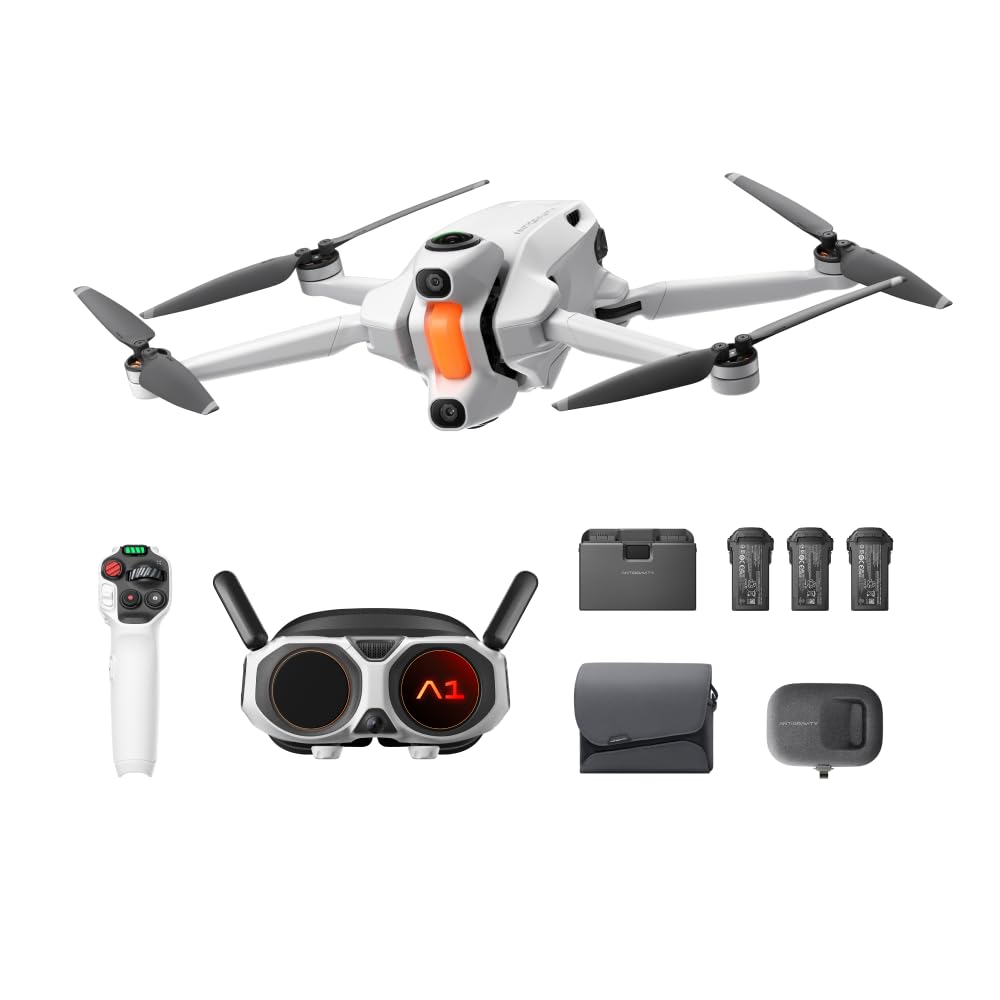
The A1 Explorer redefines range by removing the need to frame shots mid-flight. Its 360-degree camera captures everything around the drone at 8K resolution, letting you reframe footage on a computer after landing. The Vision Goggles feature dual 1-inch Micro-OLED displays with a 90-degree field of view, delivering an immersion level unmatched by smartphone-based FPV systems. The 10km HD transmission keeps the 360 feed stable enough for post-flight reframing.
The FreeMotion Mode lets beginners fly by simply pointing the controller where they want to go, while FPV Mode offers wrist-based directional control for experienced pilots. Omnidirectional obstacle avoidance combines 360-degree sensing with front and downward binocular vision. The Auto Editing 2.0 software automatically reframes 360 footage into traditional cinematic clips, complete with music syncing—useful for social media content creators who want polished results without manual editing.
The biggest drawback is weight: at 2.27 kilograms in the bundle, it is not a travel drone. The Vision Goggles, while impressive, require a short learning curve to use comfortably. Battery life reaches 39 minutes with the high-capacity battery, but using the standard battery to keep weight under 249g cuts flight time significantly. For pilots who prioritize immersive FPV over raw sensor quality, the A1 is unlike anything else on this list.
Why it’s great
- 8K 360 video for post-flight reframing
- Vision Goggles with Micro-OLED and 90° FOV
- Omnidirectional obstacle avoidance
- Auto Editing reframes footage automatically
Good to know
- Heavy bundle at 2.27 kg
- Goggles learning curve for new users
- Very high price point
10. HOVERAir X1 PROMAX
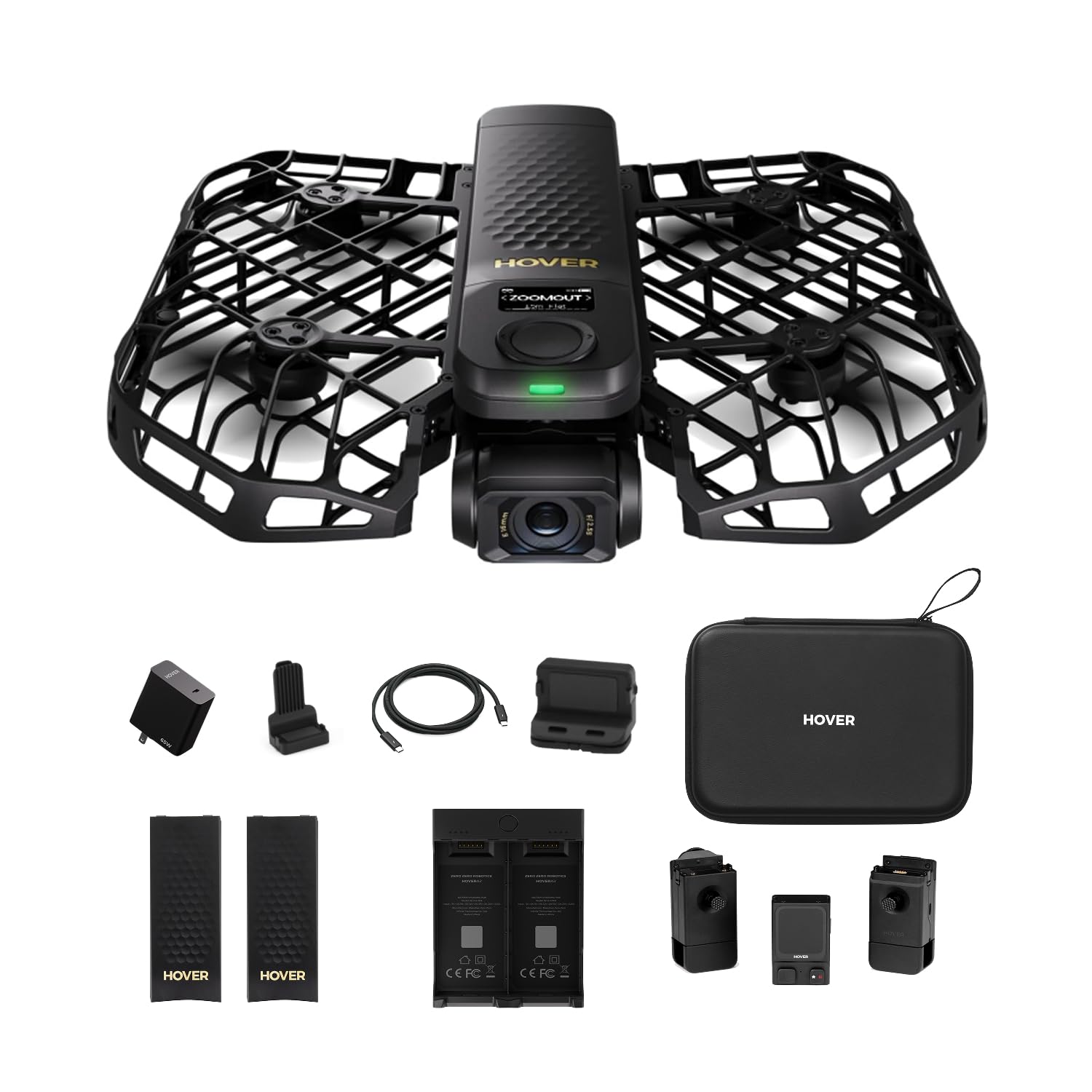
The X1 PROMAX is an action camera that flies. Weighing 192 grams with a fully enclosed, foldable design made from aerospace-grade HEM material, it launches from your palm and follows you hands-free via voice command or simple button press. The upgraded motor and aerodynamic frame allow a follow speed of 42 km/h (26 mph) and a top burst speed of 60 km/h, making it ideal for cyclists, skiers, and runners who need a tracking drone that keeps up. The 8K@30fps horizontal video (4K@30fps vertical) with SmoothCapture 2.0 stabilization (2-axis gimbal plus EIS) delivers shake-free footage even at full sprint.
OmniTerrain technology enables stable flight over snow, water, and uneven ground without altitude drift. Rear ToF collision detection brakes the drone before hitting obstacles at up to 3 m/s, adding safety during complex movements. The device includes 64GB of internal storage and supports external SD cards up to 1TB. The app allows manual control and flight mode configuration, though the drone is designed to be autonomous.
Some users report software glitches with gesture controls, particularly on Samsung S22 Ultra. The battery life is shorter than traditional drones at roughly 20 minutes per charge. For action sports creators who want a drone that behaves like a wearable camera, the X1 PROMAX is purpose-first design.
Why it’s great
- 8K@30fps video with 2-axis gimbal + EIS
- 42 km/h follow speed for action sports
- 192g weight with hand launch and voice control
- Rear ToF collision detection for safety
Good to know
- Software gestures may be buggy on some phones
- ~20 min flight time per battery
- No physical remote for manual pilots
11. Ruko Drone with 4K UHD Camera

The Ruko 4K drone offers the most accessible entry point for pilots who want a dedicated digital transmission system without spending mid-range money. Its R2 digital system provides a claimed 20,000-foot range with a real-time feed that avoids the interference common to Wi-Fi drones. The 3-axis brushless gimbal paired with a 48MP 1/2-inch CMOS sensor delivers 8K photos and 4K/30fps video that, while not professional-grade, is well above what toy-class drones produce. The 96-minute total flight time from three 2200mAh batteries means less waiting for charges during a day of flying.
Weighing under 249 grams, the drone is FAA-exempt and folds into a palm-sized package for travel. AI takeoff and landing, plus quadruple positioning (GPS, barometric, TOF, optical flow), make it forgiving for beginners. The built-in beeper helps locate the drone if it lands in tall grass. Ruko’s customer support is consistently praised in reviews for sending replacement batteries and even refurbished units after crashes.
The main compromises are image quality (the 8K photo is interpolated, not native) and joystick sensitivity, which new pilots may find twitchy. The digital feed, while better than Wi-Fi, has a shorter real-world range than the listed 20,000 feet in urban areas. For first-time buyers wanting a taste of long-range flying without a large investment, this is the safest bet.
Why it’s great
- Digital transmission (not Wi-Fi) for cleaner feed
- 96 minutes total flight with 3 batteries
- Under 249g and FAA-exempt
- Excellent customer support reputation
Good to know
- 8K photo resolution is interpolated, not native
- Sensitive joysticks for new pilots
- Real-world range shorter than spec in cities
FAQ
Do I need an FAA license to fly a long-range drone?
What causes signal loss at long distances?
How many minutes should I budget for a 2-mile flight?
Final Thoughts: The Verdict
For most users, the best drone with longest range depends on your budget and use case. If you need professional-grade range and image quality and have the budget for it, the Autel EVO 2 Pro V3 delivers the most reliable 15km transmission in its class with 6K HDR footage. If you want a compact travel drone with a built-in screen that still reaches 10km, grab the Potensic ATOM 2 Fly More Combo — the best value for the range-to-screen-quality ratio. And for pilots flying at altitude or in high-wind mountain environments, nothing beats the high-altitude certified Bwine F7GB2 Pro.

Mo Maruf
I created WellFizz to bridge the gap between vague wellness advice and actionable solutions. My mission is simple: to decode the research and give you practical tools you can actually use.
Beyond the data, I am a passionate traveler. I believe that stepping away from the screen to explore new environments is essential for mental clarity and physical vitality.