Our readers keep the lights on and my smoothie glass nicely filled. As an Amazon Associate, I earn from qualifying purchases.
Flying after sunset transforms any landscape into a canvas of city lights and starry skies, but standard drone cameras turn that canvas into grainy, unusable footage. The challenge is finding a quadcopter whose sensor and gimbal can handle low-light conditions without washing out detail or introducing crippling noise. This guide breaks down the features that separate a truly capable nighttime flyer from a marketing claim.
I’m Mohammad Maruf — the founder and writer behind WellFizz. I’ve spent hundreds of hours analyzing sensor specs, gimbal stability data, flight logs, and real-user experiences to find which drones actually deliver usable night footage versus those that just look good in product photos.
From sub-250g portables to pro-level imaging platforms, these are the best drones with night vision that balance low-light camera performance with reliable flight hardware.
How To Choose The Best Drones With Night Vision
Night flying pushes every drone component to its limit. The camera must gather enough light without introducing digital noise. The gimbal must hold the frame steady when the pilot can barely see the horizon. And the battery must deliver enough time to compose shots in the dark. These are the specs that separate night-capable drones from daytime-only toys.
Sensor Size and Aperture
A 1/2.3-inch or larger CMOS sensor with an f/1.8 or wider aperture captures significantly more light than a standard sensor. Wider apertures let the camera shutter open faster, reducing motion blur in low light. Drones that advertise “night mode” but pack a tiny sensor often produce muddy or overexposed results — check the millimeter spec rather than the marketing language.
Gimbal Axis Count
A 3-axis brushless gimbal is non-negotiable for night footage. At dusk, the human eye compensates for drift, but the camera records every micro-vibration. Three-axis stabilization smooths pitch, roll, and yaw independently, turning shaky twilight clips into cinematic sequences. Two-axis or electronic-only stabilization struggles to keep the horizon level when light levels drop.
Flight Time and Battery Management
Night shoots often require multiple takes because the pilot cannot see the frame as easily. A drone that offers 30 minutes or more per battery gives you time to adjust settings and reframe. Look for kits that include at least two intelligent batteries — swapping packs mid-shoot is faster than waiting for a single charge, especially when the golden hour is already passing.
Quick Comparison
On smaller screens, swipe sideways to see the full table.
| Model | Category | Best For | Key Spec | Amazon |
|---|---|---|---|---|
| Potensic ATOM 2 Fly More | Premium | AI night tracking and 4K HDR low-light | 1/2″ Sony CMOS, f/1.8 aperture | Amazon |
| DJI Mini 5 Pro Fly More | Premium | Omnidirectional obstacle sensing at night | 1-inch CMOS, 4K/60fps HDR | Amazon |
| DJI Mini 3 + RC-N1 | Mid-Range | Portable 4K HDR with long flight time | 1/1.3″ sensor, dual native ISO | Amazon |
| Holy Stone HS790 | Mid-Range | Night Shot mode and 30,000ft transmission | 6K photo, 3-axis gimbal, AI Night Shot | Amazon |
| Ruko F13 Pro | Mid-Range | 8K photo and under-249g travel compliance | 48MP sensor, 3-axis gimbal + EIS | Amazon |
| Bwine F7GB2 Pro | Mid-Range | High-altitude night flights up to 2000m | 4K camera, 3-axis gimbal, 75-min total time | Amazon |
| Holy Stone HS900 | Mid-Range | Beginner-friendly night flying under 250g | 48MP photo, SONY 1/2.3″ sensor | Amazon |
| PLEGBLE Screen Controller | Budget | Built-in 5″ screen for immediate FPV at night | 4K@30fps, EIS stabilization, 70-min total time | Amazon |
| Gleesfun G11PRO | Budget | 6K photo and cruise control for steady night video | 3-axis gimbal, 6K photo, GQ2.0 transmission | Amazon |
In‑Depth Reviews
1. Potensic ATOM 2 Fly More Combo
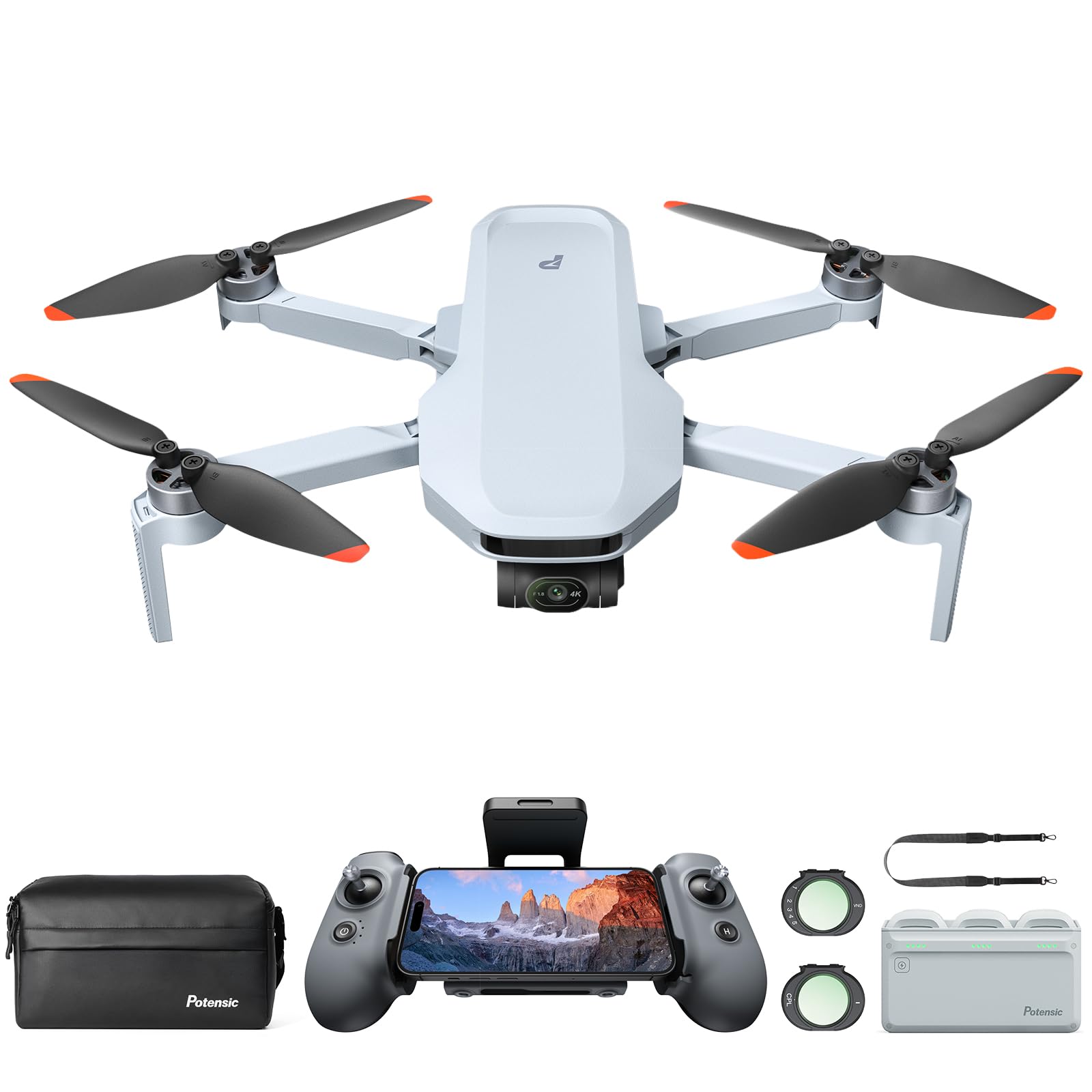
This is the night-flying specialist of the sub-250g class. The Sony 1/2-inch CMOS sensor combined with an f/1.8 aperture captures nearly twice the light of standard drone sensors, and the dedicated AI Night Shot mode processes multiple exposures in real-time to reduce noise without washing out city lights. The 3-axis gimbal holds that light-gathering sensor steady even in level-5 winds, producing 4K HDR video that looks clean at dusk.
Inside the Fly More Combo, you get three intelligent batteries that deliver 96 minutes of total flight time, plus a parallel charging hub that refuels all three packs in about 1.3 hours. The PixSync 4.0 transmission system pushes 1080p live view out to 10 kilometers — a real advantage when you are framing a night skyline from a distance. The kit also includes ND and CPL filters that cut reflections on water and glass during twilight shoots.
Weighing 245 grams, the ATOM 2 avoids FAA registration entirely. The AI Track feature locks onto moving subjects in low light, and the Dolly Zoom and CineRoll modes add cinematic movement without manual stick input. The only real gap is the absence of omnidirectional obstacle sensing — you will want to stay visual in tight spaces at night.
Why it’s great
- AI Night Shot produces clean video in very low light
- 96-minute total flight time with fast-charging hub
- Under 250g — no FAA registration needed
Good to know
- No omnidirectional obstacle sensors
- Requires phone for FPV view (no built-in screen)
2. DJI Mini 5 Pro Fly More Combo
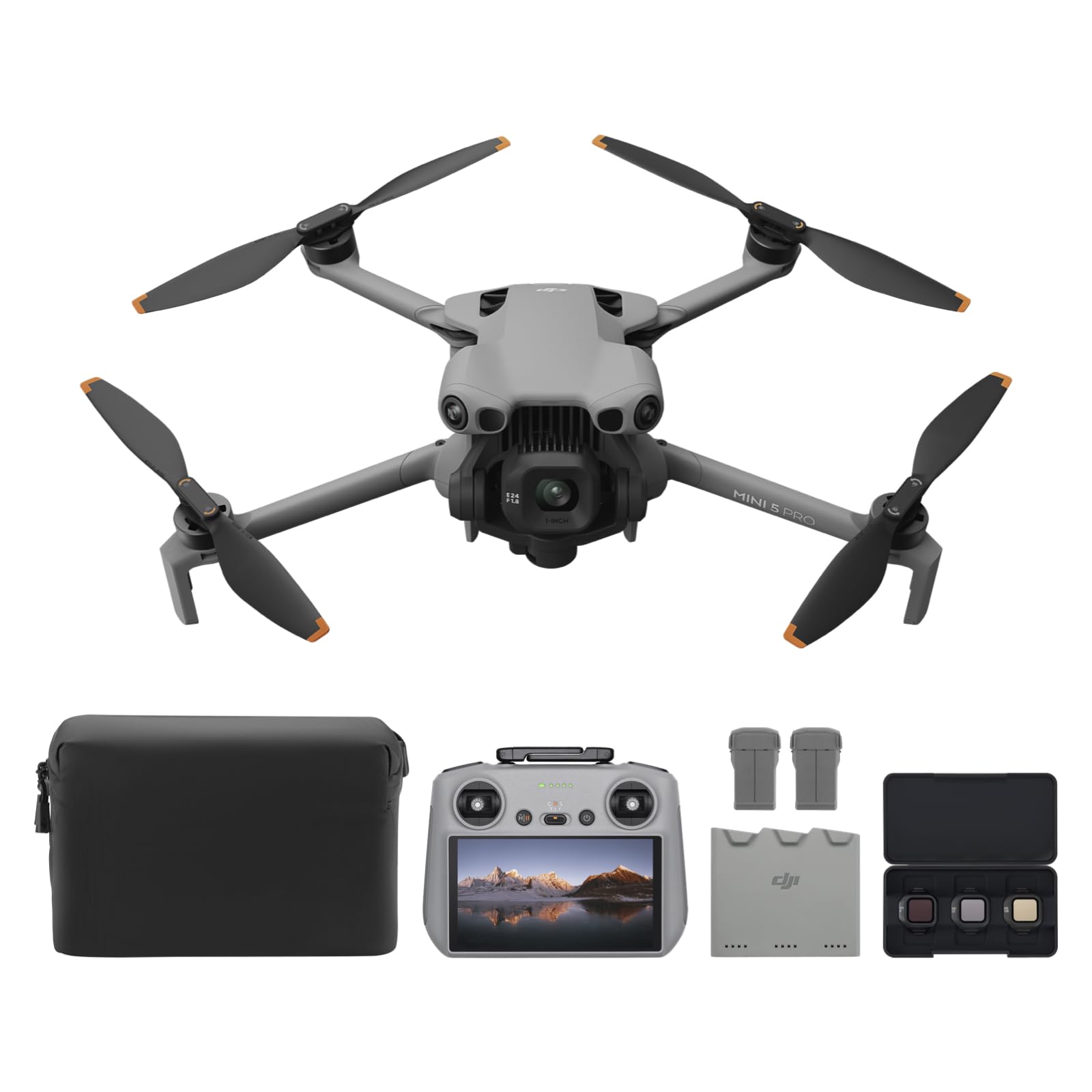
The 1-inch CMOS sensor in the Mini 5 Pro is the largest sensor available in any sub-250g drone, and it shows immediately in night footage. Where smaller sensors produce blotchy noise at ISO 1600, this sensor stays clean up to ISO 3200 with HDR processing that retains highlight detail in street lamps and shadows in tree lines. The 225-degree gimbal rotation enables true vertical filming, which is a massive advantage for social-media framing during twilight city shoots.
What makes this the safest night flyer is the full omnidirectional obstacle sensing system, including forward-facing LiDAR. At night, depth perception is poor, and even experienced pilots misjudge distances. The Mini 5 Pro detects obstacles in all directions and automatically routes around them, even during return-to-home. The 42GB internal storage means you never forget an SD card when heading out for a dusk session.
The Fly More Combo includes three batteries (about 36 minutes each, real-world), a two-way charging hub that powers all three in roughly 115 minutes, and an ND filter set for controlling exposure in transitional light. The DJI RC 2 controller has a built-in screen, so no phone is required — one less thing to blind-adapt to in the dark.
Why it’s great
- 1-inch sensor delivers class-leading low-light image quality
- Omnidirectional obstacle sensing for night safety
- Built-in screen remote — no phone needed
Good to know
- Requires FAA registration (just over 249g with accessories)
- GEO zone restrictions may limit flying near airports
3. DJI Mini 3 with RC-N1 Controller

The Mini 3 uses a 1/1.3-inch sensor with dual native ISO, which means it handles high-contrast night scenes — bright neon signs next to dark alleys — better than many larger drones. The 4K HDR video mode combines multiple exposures per frame, so highlights stay detailed and shadows retain texture. This is the entry point into DJI’s sub-250g ecosystem without sacrificing nighttime image quality.
Flight time hits 38 minutes per battery in the standard configuration, and the bundle includes a Deco Gear backpack and a 64GB microSD card so you are ready to fly out of the box. The true vertical shooting option rotates the gimbal 90 degrees, giving you a native portrait frame perfect for Instagram or TikTok night reels without cropping the 4K stream.
The RC-N1 controller requires a smartphone for FPV, which is a minor inconvenience at night when your eyes are adjusting between the sky and a bright screen. The O2 transmission reaches 10 kilometers, but signal loss can happen faster in urban environments with interference from buildings and power lines.
Why it’s great
- Dual native ISO sensor clean at high ISOs
- True vertical shooting for social media night clips
- Under 249g — no FAA registration
Good to know
- Requires phone for FPV screen
- No omnidirectional obstacle sensing
4. Holy Stone HS790
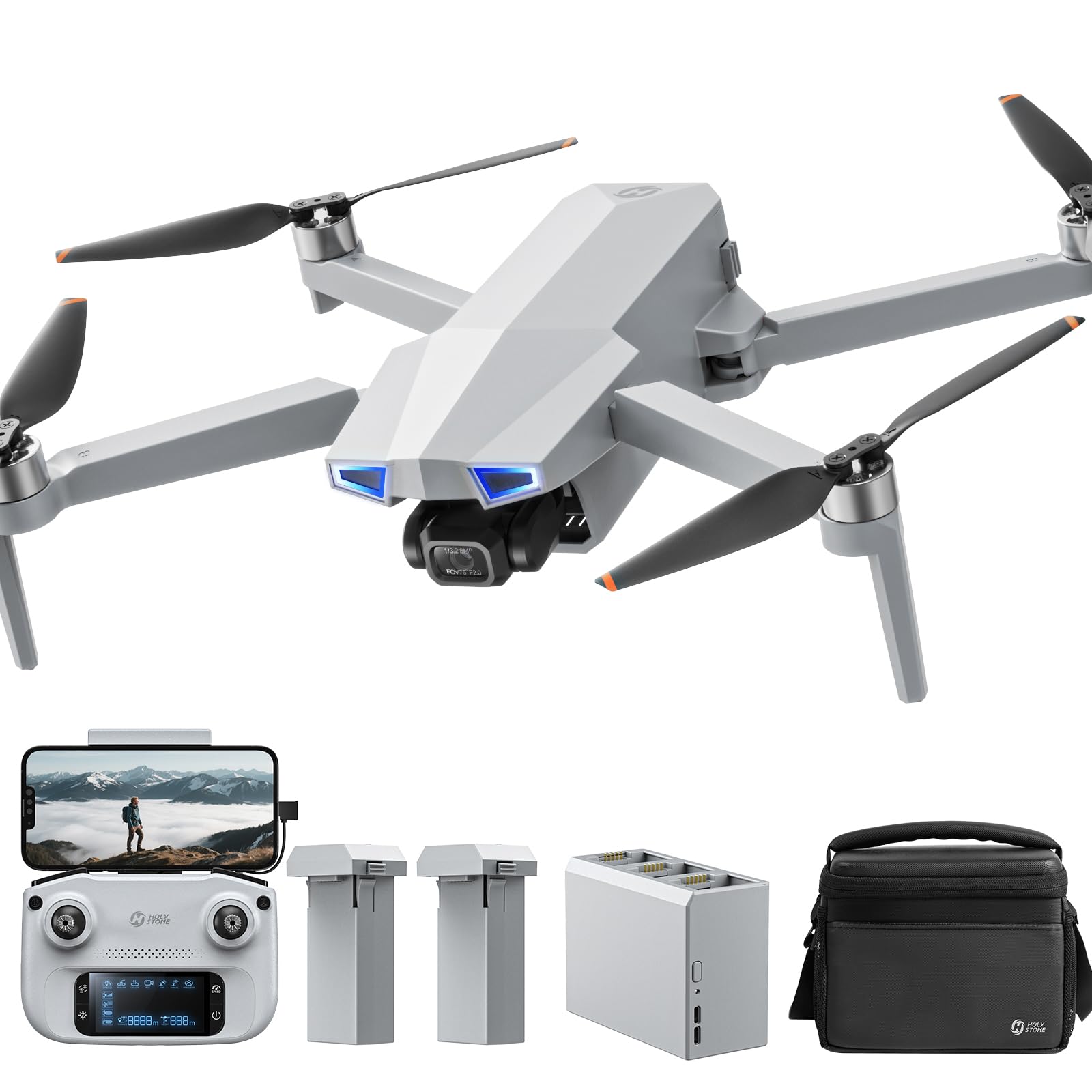
The HS790 is Holy Stone’s most night-focused model yet. The dedicated AI Night Shot mode stacks multiple frames to pull detail out of near-dark scenes, and while it is not as refined as the Potensic or DJI systems, it produces usable footage in environments where standard drones output only black frames. The 3-axis brushless gimbal does the heavy lifting for stability, keeping the 6K camera level during dusk flights.
The 30,000-foot Wi-Fi repeater transmission is one of the longest ranges in this tier, and the low-latency streaming means you see what the camera sees with minimal lag — critical when you are navigating by FPV after sunset. Two intelligent batteries deliver 60 minutes of combined flight time, and the Smart PD Charging Hub doubles as a power bank for charging phones or tablets on location.
Built-in Remote ID compliance saves you the trouble of adding an external module, and the brushless 1506 motors provide enough torque to handle level-5 wind gusts. The side-mounted gimbal control on the remote takes some getting used to, and the AI Night Mode adds only marginal improvement in very low light — the real value here is the transmission range and overall stability.
Why it’s great
- 30,000ft transmission range for long-distance night flights
- AI Night Shot improves low-light image quality
- Charging hub doubles as power bank for field use
Good to know
- Camera angle control on side of remote, not intuitive
- Night mode adds minimal benefit in very dark conditions
5. Ruko F13 Pro

The F13 Pro packs a 48MP sensor capable of 8K stills, and when paired with the 3-axis brushless gimbal and electronic image stabilization, the night photography potential is impressive for its weight class. The AI takeoff and landing system uses quadruple positioning — GPS, barometric hold, TOF, and optical flow — to land precisely even when the ground is hard to distinguish in dim light.
Three intelligent batteries provide 96 minutes of total airtime, and the 20,000-foot digital transmission system avoids Wi-Fi interference, keeping the FPV feed stable during urban night flights. The built-in beeper is a small but practical feature for recovering the drone after a night landing in tall grass or a dark field — you press a button on the controller and the drone chirps until you find it.
At 248 grams, it stays under the FAA registration threshold, and the compact foldable design slips into a jacket pocket. The joystick sensitivity is high, so new night pilots should start in beginner mode before attempting low-light maneuvers.
Why it’s great
- 8K photo resolution for cropping night stills
- 96-minute total flight time with 3 batteries
- Beeper helps locate drone after dark landings
Good to know
- Sensitive joysticks — requires steady hands at night
- No built-in screen on remote
6. Bwine F7GB2 Pro

If your night flying happens in mountains or high-altitude terrain, the F7GB2 Pro is built for it. Certified to operate up to 2000 meters with level-6 wind resistance, this drone maintains stability where thinner air and gusty conditions would cripple a standard quadcopter. The 1806 brushless motors sustain consistent RPM even at altitude, so the 4K camera with 3-axis gimbal stays locked on target.
Three 2600mAh batteries deliver 75 minutes of total flight time, and the UL 2054 safety certification on the batteries means they are tested against overcharge and thermal runaway — a relevant concern when charging packs in a hotel room before a night shoot. The 10,000-foot control range is shorter than the Holy Stone or DJI options, but the signal remains strong through tree cover and urban obstacles.
The 5x digital zoom loses some resolution at full magnification, but it is useful for composing tight night shots without moving the drone closer and risking a collision in the dark. Customer support consistently resolves issues quickly, and the 2-year warranty provides peace of mind for a drone that will see frequent outdoor use.
Why it’s great
- 2000m altitude certified for mountain night flights
- Level-6 wind resistance keeps gimbal stable in gusts
- UL-certified batteries for safe charging
Good to know
- 10,000ft range shorter than some competitors
- Digital zoom reduces resolution at max magnification
7. Holy Stone HS900

The HS900 is the most accessible night-capable drone on this list. The SONY 1/2.3-inch CMOS sensor with an f/2.6 aperture captures enough light for twilight and well-lit night scenes, and the 3-axis brushless gimbal ensures the footage is smooth even when the wind picks up after sunset. At 249 grams, there is no FAA registration, and the foldable design makes it a pack-and-go companion for evening travel.
The 20,000-foot transmission range gives you enough distance to frame cityscapes from a safe spot, and the GPS auto-return and RTH features provide a safety net when visibility drops. The two included batteries charge in about 1.3 hours with a QC 3.0 charger, and the OTA firmware updates keep the flight software current without needing a computer.
Beginner-friendly features like one-key takeoff, altitude hold, and headless mode make it a safe choice for pilots new to night flying. The trade-off is the f/2.6 aperture, which gathers less light than the wider f/1.8 lenses on the premium models — expect usable video in dusk city settings rather than pure darkness.
Why it’s great
- Entry-level price with genuine 3-axis gimbal
- Under 250g, no registration required
- OTA firmware updates keep it current
Good to know
- f/2.6 aperture limits low-light performance
- Battery life near 30 min, but only 2 included
8. PLEGBLE 4K Screen Controller Drone
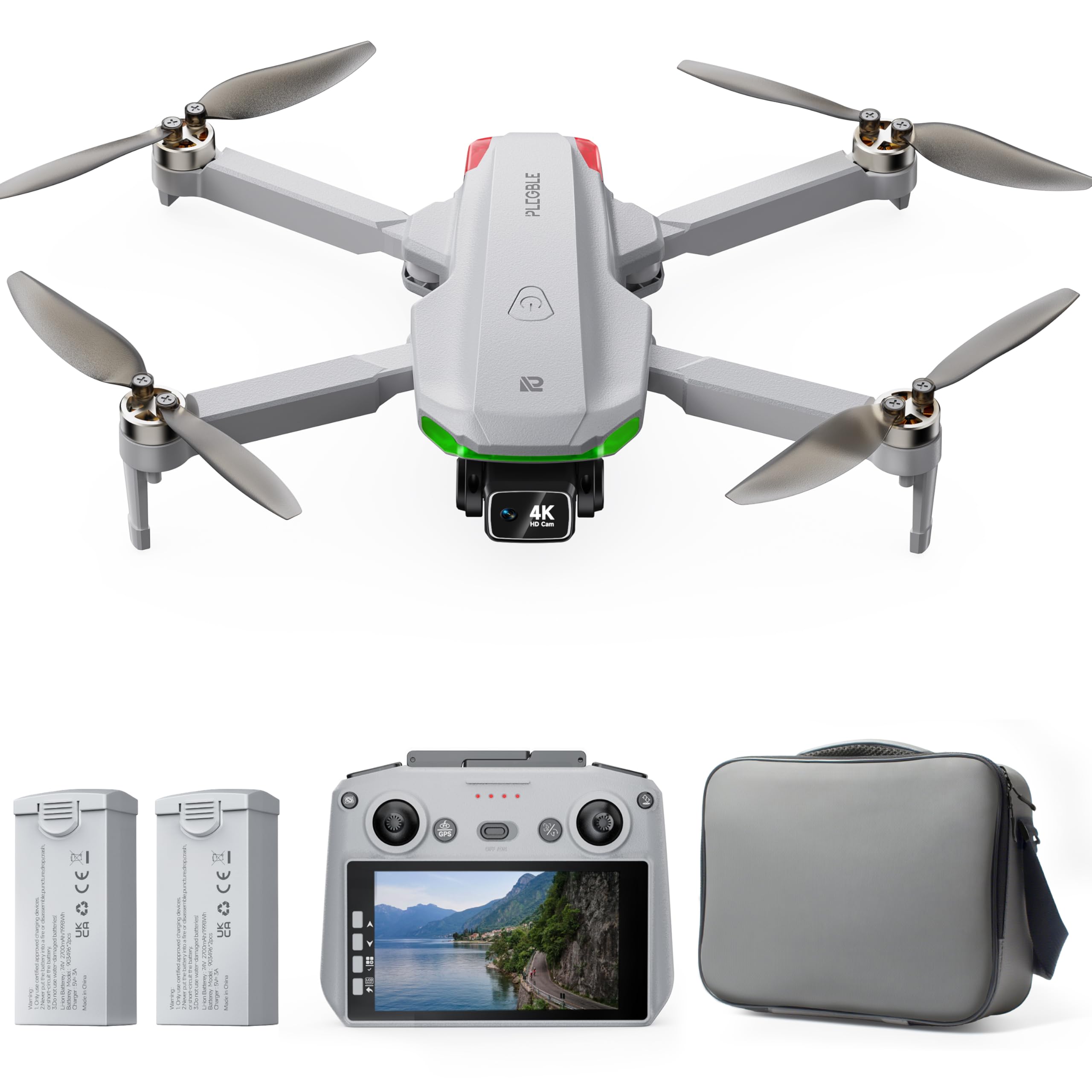
The biggest frustration when flying at night is the phone screen glare making FPV impossible. PLEGBLE solves this with a 5-inch HD screen built directly into the controller — no phone cradle, no bright screen blinding you during dark flights. The 4K camera with EIS stabilization handles city twilight well, and the optical flow positioning helps the drone hold position when GPS signals are weak in urban canyons.
Two 2700mAh batteries provide 70 minutes of total flight, and the USB-C fast charging brings both packs back quickly. The follow-me, waypoint, and circle flight modes work reliably in GPS mode, allowing for hands-free tracking shots during nighttime runs or bike rides. At under 249 grams, it avoids FAA registration entirely.
The EIS stabilization is electronic rather than mechanical, so it handles wind less gracefully than the 3-axis gimbal drones on this list. The 600-meter effective range is significantly shorter than the competition, and the Wi-Fi connection is susceptible to interference in dense urban environments.
Why it’s great
- Built-in controller screen eliminates phone glare at night
- Under 249g, no FAA registration needed
- 70-minute total flight with two batteries
Good to know
- Electronic stabilization less effective than 3-axis gimbal
- 600m effective range limits long-distance night flying
9. Gleesfun G11PRO

The G11PRO proves that a 3-axis brushless gimbal is not exclusive to premium drones. This budget-friendly model uses the same gimbal architecture as models costing twice as much, keeping the 6K camera stable during dusk flights. The cruise control feature maintains a steady heading and speed, which is especially valuable at night when depth perception is compromised and manual stick control gets sloppy.
The GQ2.0 digital transmission reaches 10,000 feet with a wired connection to the phone, avoiding Wi-Fi dropouts. Two 3200mAh batteries deliver 70 minutes of total flight, and the GL2.0 smart battery system fast-charges in about 2.5 hours. The kit includes a carrying case, 40 accessories, and FAA Remote ID compliance out of the box.
Customer reviews consistently highlight the responsive support team, with several users reporting free replacements after crashes. The camera image quality is good for the price tier but lacks the dynamic range of the Sony or DJI sensors — keep expectations realistic for very dark environments.
Why it’s great
- True 3-axis brushless gimbal at a budget price
- 6K photo resolution for cropping night stills
- FAA Remote ID compliant, no extra module needed
Good to know
- Sensor dynamic range limited in very low light
- Notable size — 357g, requires FAA registration
FAQ
What does night vision mean on a drone?
Can I fly any drone at night legally?
How does AI Night Shot actually work?
Final Thoughts: The Verdict
For most users, the best drones with night vision winner is the Potensic ATOM 2 Fly More Combo because it combines the widest low-light aperture, a dedicated AI Night Shot mode, and 96 minutes of total flight in a sub-250g frame that avoids FAA registration. If you want full omnidirectional obstacle sensing for stress-free night flying, grab the DJI Mini 5 Pro Fly More Combo. And for the best entry-level balance of gimbal stability and night features, nothing beats the Holy Stone HS900.

Mo Maruf
I created WellFizz to bridge the gap between vague wellness advice and actionable solutions. My mission is simple: to decode the research and give you practical tools you can actually use.
Beyond the data, I am a passionate traveler. I believe that stepping away from the screen to explore new environments is essential for mental clarity and physical vitality.