Our readers keep the lights on and my smoothie glass nicely filled. As an Amazon Associate, I earn from qualifying purchases.
Whether you’re working remotely from a campground, running critical equipment at a construction trailer, or trying to keep the family entertained during an RV trip, a reliable internet connection is no longer a luxury—it’s a necessity. The problem is that public Wi-Fi is slow, insecure, and often capped at a device limit that makes group travel a headache, while standard home routers simply cannot speak the language of a cellular tower.
I’m Mohammad Maruf — the founder and writer behind WellFizz. I’ve spent hundreds of hours analyzing cellular router specifications, carrier compatibility matrices, VPN throughput benchmarks, and real-world user feedback to separate the signal boosters from the signal wasters.
This guide cuts through the carrier confusion to help you find the best cellular router for your specific use case, whether you need a travel-sized companion or a business-grade failover solution.
How To Choose The Best Cellular Router
Not all cellular routers are created equal. A model that works beautifully as a travel hotspot may lack the ruggedness and carrier aggregation needed for a permanent off-grid setup. Before you buy, match the router’s hardware to your exact environment and data demands.
Modem Category and Carrier Aggregation
The modem chipset defines your speed ceiling. A Cat 4 modem (150 Mbps down) is fine for basic email and browsing, but Cat 6 (300 Mbps) and Cat 12 (600 Mbps) models use carrier aggregation to bond multiple spectrum bands, delivering much higher throughput in congested areas. If you need cutting-edge speeds, a 5G NR router with sub-6 GHz support provides multi-gigabit potential—but only if your carrier offers 5G coverage at your location.
Antenna Options and Connectors
Internal antennas are fine for a hotel room, but if you’re in an RV parked among trees or a home with weak signal, you need external antenna ports. Routers with SMA or RP-SMA connectors let you attach high-gain Yagi or omni-directional antennas to pull in a marginal signal. Detachable antennas also allow you to upgrade later without replacing the entire unit.
Dual-SIM and Failover Logic
A single SIM leaves you vulnerable if that carrier’s tower goes down or the network becomes congested. Dual-SIM routers with automatic failover can switch between carriers based on signal strength or data allotment. Look for models that support “active failover” rather than just a manual toggle—this feature alone can save you hours of downtime.
VPN Throughput and Security
If you plan to tunnel traffic through a VPN for secure remote work, the router’s processor matters. WireGuard is vastly faster than OpenVPN on most hardware—compare maximum VPN speeds in the specs. A router that caps OpenVPN at 30 Mbps will struggle with HD video conferencing, while one that hits 300 Mbps on WireGuard will handle the entire office.
Software and User Interface
Some routers run proprietary firmware with limited settings; others run OpenWrt, giving you access to thousands of plugins (AdGuard, custom DNS, band locking). OpenWrt-based units are more flexible but require a steeper learning curve. For most travelers and home users, an intuitive app-based interface with captive portal support is the best balance of power and simplicity.
Quick Comparison
On smaller screens, swipe sideways to see the full table.
| Model | Category | Best For | Key Spec | Amazon |
|---|---|---|---|---|
| GL.iNet GL-XE3000 (Puli AX) | 5G | Business continuity / Events | 6400 mAh built-in battery | Amazon |
| MOFI6500-5GXeLTE-RM520-HP | 5G | Rural / Business-class failover | 3.4 Gbps data rate | Amazon |
| Cudy P5 | 5G | Power users / Band lock | Qualcomm SDX62 chipset | Amazon |
| Teltonika RUTX11 | 4G Cat 6 | Industrial / Mission-critical | Aluminum housing / RMS | Amazon |
| MoFi MOFI4500 | 4G LTE | Rural / Extended range | Max-range antennas incl. | Amazon |
| GL.iNet GL-X2000 (Spitz Plus) | 4G Cat 12 | RV / Dual-SIM failover | 2402 Mbps Wi-Fi 6 | Amazon |
| TP-Link Roam 7 BE3600 | Travel Wi-Fi 7 | Hotel / Cruise / Home backup | 90 device capacity | Amazon |
| Cudy LT500 Outdoor | 4G Cat 4 | Remote cabin / Camera sites | IP65 / PoE powered | Amazon |
| GL.iNet GL-MT3000 (Beryl AX) | Travel Wi-Fi 6 | Light travel / VPN on the go | USB-C powered | Amazon |
In‑Depth Reviews
1. GL.iNet GL-XE3000 (Puli AX)
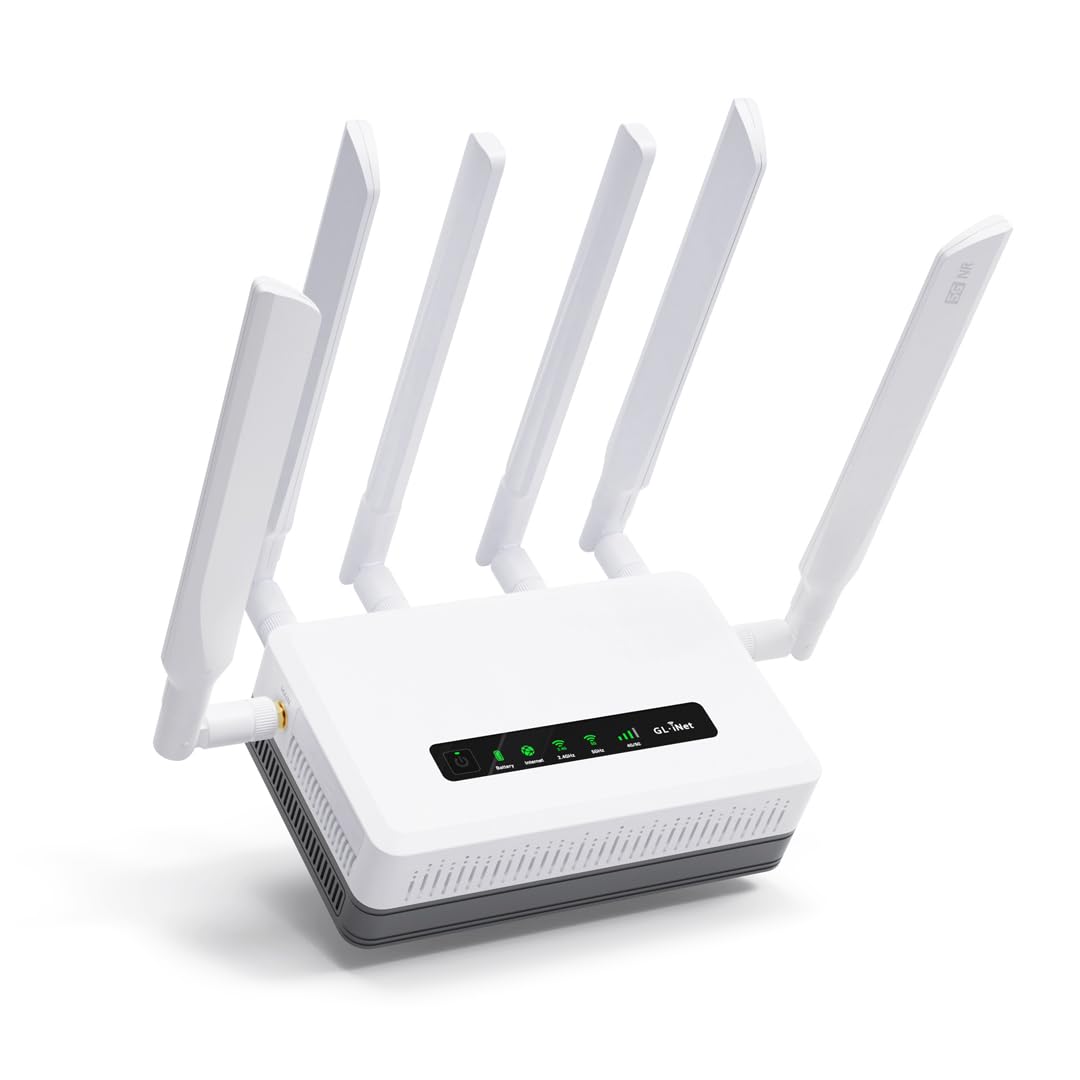
The Puli AX is the ultimate fail-safe companion for remote offices, events, and situations where a power outage cannot be an excuse for downtime. Its built-in 6400 mAh battery keeps the Wi-Fi 6 network alive for up to 8 hours, so your critical cloud services and video meetings never drop even when the grid does. The dual-SIM slot works with both 5G (NSA and SA) and 4G LTE networks, and it automatically fails over to the stronger connection.
On the software side, the Puli AX runs on OpenWrt, giving you access to thousands of plug-ins including AdGuard Home for ad blocking and advanced parental controls. The VPN performance is outstanding—up to 300 Mbps on WireGuard and 150 Mbps on OpenVPN, plenty for HD conferencing and large file transfers. The physical toggle switch lets you instantly enable your VPN profile without digging into the admin panel during an emergency.
The unit does come with a premium price tag, and its chunky design reflects the large battery inside. Setup is straightforward for the open-source crowd, but less technical users may need to lean on the support team for initial configuration. If you need zero-downtime connectivity in a portable package, this is the all-in-one solution that covers every base.
Why it’s great
- Built-in battery keeps you online for hours during outages
- 5G speeds with dual-SIM automatic failover
- OpenWrt firmware with extensive plugin support
Good to know
- Premium price reflects the battery and 5G chipset
- Initial setup may require OpenWrt familiarity
2. MOFI6500-5GXeLTE-RM520-HP
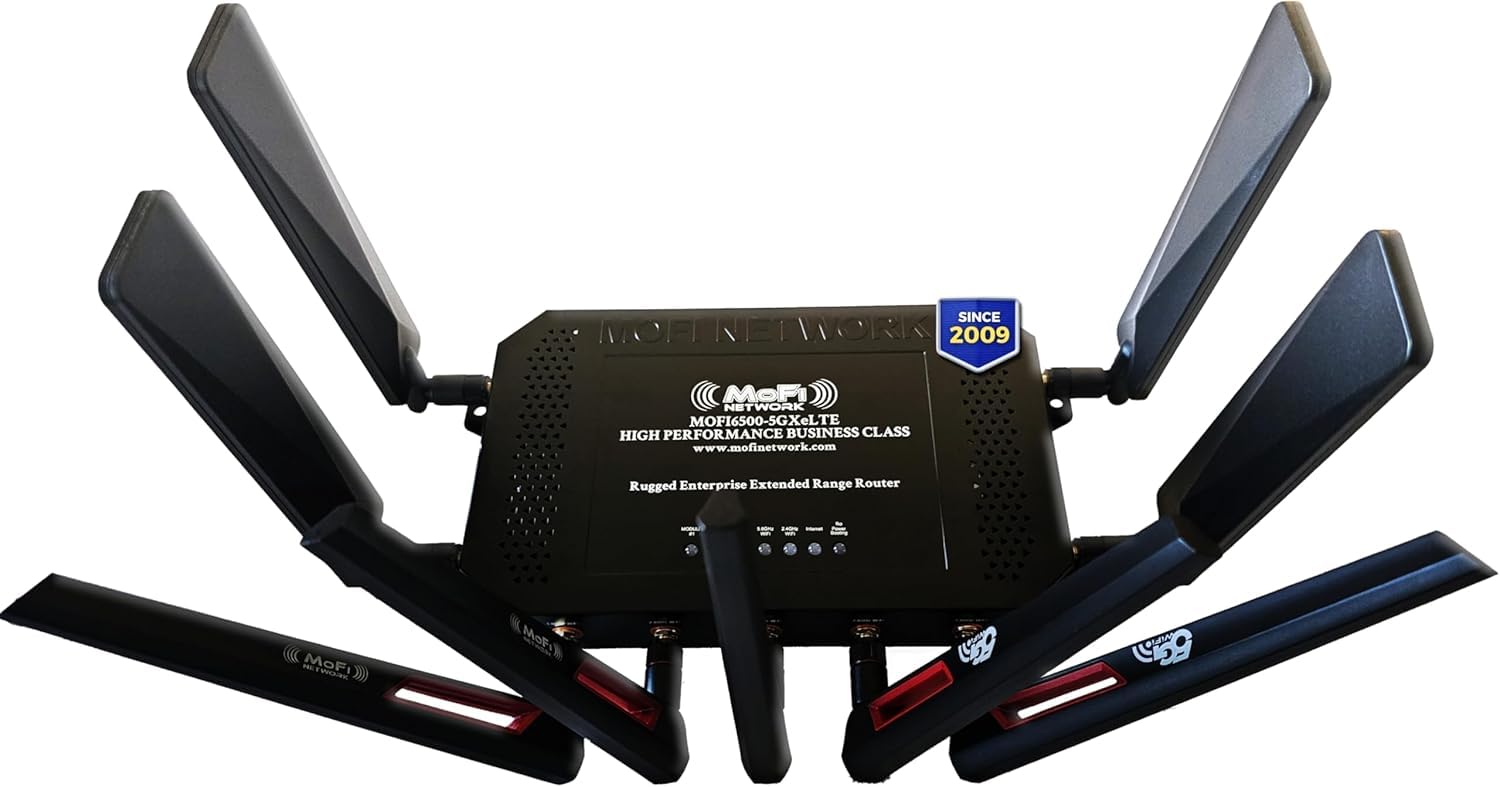
MoFi’s 6500 series is built for the toughest locations. The full metal case dissipates heat efficiently, making it ideal for attics, garages, or RV compartments that bake in the summer sun. It pulls in a weak signal and amplifies it using built-in Wi-Fi 6 amplification and four high-gain 5G antennas. Users in rural areas regularly report jumping from one bar to four bars after swapping a Verizon hotspot for this unit.
The dual-SIM failover is genuinely automatic—it switches between carriers based on signal quality, not just availability. The interface provides detailed band lock information (band 3, 5, 13, 66) and lets you lock the router to a specific channel if you find the fastest tower. It also supports IP pass-through, VPN protocols including Zerotier, and includes a free support line that actually answers in minutes according to many owners.
The main catch is the dual-SIM functionality: it supports failover, not simultaneous bonding. If you need both SIMs active at the same time for load balancing, you need the separate DUAL model. Also, the sticker price sits at the top of the market, but for anyone who depends on their connection for work or security monitoring, the reliability justifies the investment.
Why it’s great
- Rugged metal construction with excellent heat dissipation
- Amplified Wi-Fi 6 with powerful external antennas
- Automatic carrier failover with detailed band lock controls
Good to know
- Dual-SIM is failover only, not simultaneous bonding
- Top-tier price point for the fully loaded configuration
3. Cudy P5 5G NR AX3000

The Cudy P5 packs Qualcomm’s Snapdragon SDX62 and IPQ5018 chipsets, delivering download speeds up to 3.4 Gbps on 5G NR NSA networks. This is a proper CPE (Customer Premises Equipment) router for homes or RVs that want to replace a wired ISP connection entirely. It supports Wi-Fi 6 with MU-MIMO, so your entire household can stream, game, and video call simultaneously without buffer wheel nightmares.
Advanced users will appreciate the granular controls: TTL modification to bypass hotspot throttles, band locking to lock onto the fastest LTE or 5G channel, and a full suite of VPN clients including WireGuard, OpenVPN, IPsec, and Zerotier. The detachable 4x5dBi cellular antennas give you room to upgrade to high-gain panels if you need to pull signal from a distant tower.
Setup can be fussy if your carrier (especially Verizon) has whitelisted device policies. Some users report the SIM not being recognized immediately, and tech support response times are inconsistent. The router also runs warm during heavy usage, so airflow matters. If you are comfortable troubleshooting initial carrier compatibility, the P5’s speed and feature depth are unmatched at this tier.
Why it’s great
- Qualcomm SDX62 delivers multi-gigabit 5G speeds
- Extensive band locking and TTL controls
- Supports six VPN protocol types
Good to know
- Carrier whitelisting may cause initial SIM detection issues
- Runs warm; needs good ventilation
4. Teltonika RUTX11

Teltonika’s RUTX11 is an industrial-grade LTE Cat 6 router that prioritizes reliability above all else. The CNC-milled aluminum chassis is built to survive vibration, temperature swings, and dirty power environments—think factory floors, agricultural irrigation controllers, and fleet vehicles. It features four Gigabit Ethernet ports, dual-SIM with automatic failover, and dual-band Wi-Fi 5, which is more than enough for machine-to-machine communication and SCADA networks.
Where the RUTX11 really shines is remote management. It integrates fully with Teltonika RMS, allowing an IT admin to push firmware updates, change VPN profiles, and monitor signal strength from a central dashboard. The device supports multiple VPN tunnels, including OpenVPN, IPsec, and PPTP, and includes a stateful firewall. Carrier compatibility covers AT&T, Verizon, and T-Mobile across North, Central, and South America.
The trade-offs are speed and Wi-Fi technology. With Cat 6 topping out at 300 Mbps and Wi-Fi 5, this is not the router for streaming 4K to a dozen devices. Some users have also reported quality control issues—a unit that died before six months with frustrating support. For enterprise deployments or unattended installations where stability is king, the RUTX11 is a proven workhorse, but check the warranty terms carefully.
Why it’s great
- Rugged aluminum case designed for harsh environments
- Teltonika RMS for centralized remote management
- Dual-SIM failover with multi-VPN support
Good to know
- Max 300 Mbps throughput with Wi-Fi 5 only
- Reported quality control issues with some units
5. MoFi MOFI4500 4G LTE

For anyone living in a rural dead zone, the MOFI4500 is the router that turns a whisper of signal into a usable connection. It comes packaged with two upgraded MOFI-UWMB-MAXRANGE1 antennas that already outperform most internal hotspot antennas, and it accepts external Yagi or omni antennas via SMA connectors to pull in distant towers. Users commonly report going from one bar on a Jetpack to four bars with this setup.
The MOFI4500 supports Verizon, AT&T, and T-Mobile bands including the crucial band 71 (600 MHz) for long-range rural coverage. The interface gives you detailed channel information and allows you to lock specific bands to avoid a congested tower. A standout feature is the programmable periodic reboot—essential in fringe areas where the modem can drift off the best tower over time. The built-in wireless repeater mode also extends the range of an existing Wi-Fi network.
Setup is simple: insert a carrier-unlocked SIM and power on. However, some users hit a wall with the initial configuration—the admin portal is less polished than consumer routers. The 4G LTE Cat 4 modem means speeds top out around 150 Mbps, so heavy streaming households may want more. But when the alternative is HughesNet or nothing, the MOFI4500 is a lifesaving purchase that pays for itself quickly.
Why it’s great
- Included max-range antennas boost weak signals significantly
- Supports band locking and periodic reboot for stability
- Easy SIM swap and setup for beginners
Good to know
- Cat 4 modem limited to 150 Mbps theoretical max
- Admin interface feels outdated compared to OpenWrt routers
6. GL.iNet GL-X2000 (Spitz Plus)
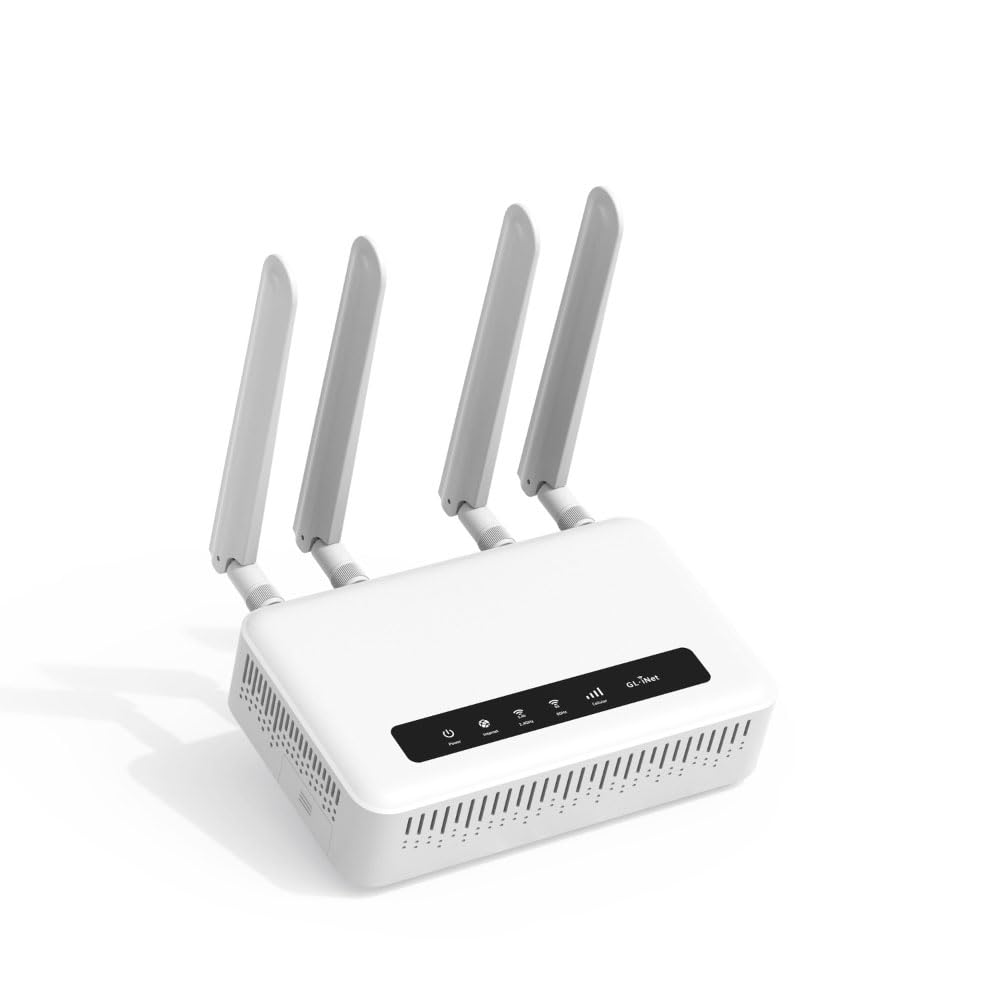
The Spitz Plus from GL.iNet is tailor-made for the RV and travel trailer crowd. With a Cat 12 modem supporting three-carrier aggregation, it can pull down theoretical speeds up to 600 Mbps when the signal is good, and it uses multi-WAN to combine Ethernet, repeater, cellular, and tethering connections. If you park near a Starlink dish, the Ethernet port handles that, while the cellular slot provides backup.
It is AT&T and T-Mobile certified, and users report seamless automatic failover between SIMs. The four SMA connectors are interchangeable, so you can attach your old Winegard antenna or a directional panel for better range. Wi-Fi 6 delivers solid 2402 Mbps on the 5 GHz band, and the OpenWrt firmware lets you install AdGuard or custom VPN profiles. The wall-mount kit makes it easy to secure inside a cabinet.
One major headache: AT&T in some regions (like Texas) has denied compatibility with this IMEI, so verify carrier whitelisting before buying. The router is also heavier and bulkier than a pure travel router—it’s designed for semi-permanent installation, not a carry-on bag. For RVers who want to tether multiple devices across carriers with reliable failover, the Spitz Plus is the sweet spot between price and performance.
Why it’s great
- Cat 12 modem with three-carrier aggregation for high speeds
- Multi-WAN handles Ethernet, LTE, and tethering
- OpenWrt firmware with extensive customization
Good to know
- AT&T whitelisting issues reported in some regions
- Heavier design suited for permanent mounting
7. TP-Link Roam 7 BE3600

TP-Link’s Roam 7 is the first portable router to pack Wi-Fi 7 into a tiny chassis, delivering 3600 Mbps aggregate wireless speeds. It does not support the 6 GHz band, so you get top performance on 5 GHz (2882 Mbps) and 2.4 GHz (688 Mbps), which is still plenty for streaming 4K and gaming across up to 90 devices. The 2.5 Gbps WAN port is future-proof for high-speed hotel Ethernet or home fiber backup.
Where this router really excels is its captive portal handling. Log in once on the Tether app, and the router automatically re-authenticates with hotel or cruise ship Wi-Fi, so you never have to type a password on every device. It runs on USB-C power—use the included adapter or a power bank—and fits in a jacket pocket. VPN support includes OpenVPN, WireGuard, PPTP, and L2TP, and TP-Link has signed CISA’s Secure-by-Design pledge.
The interface is app-based and beginner-friendly, but power users will miss OpenWrt and advanced band-locking controls. The USB port supports storage sharing, not modem tethering. Some users note that the setup wizard requires an Ethernet connection initially, which is inconvenient at airports with only Wi-Fi. For travelers who prioritize ease of use, device count, and the latest Wi-Fi standard, the Roam 7 is a compelling all-rounder.
Why it’s great
- Wi-Fi 7 with 3600 Mbps aggregate throughput
- One-tap captive portal login for hotels and cruises
- Supports up to 90 devices simultaneously
Good to know
- No 6 GHz band support
- App-based interface; no OpenWrt or advanced band controls
8. Cudy LT500 Outdoor 4G LTE

The Cudy LT500 is built for places where a router cannot be indoors—solar-powered gate cameras, barn Wi-Fi, or a remote workshop. The IP65-rated weatherproof housing keeps out rain and dust, while 4 kV lightning protection provides peace of mind during storms. It comes with a 24V passive PoE adapter, meaning a single Ethernet cable supplies both power and data up to 50 feet away.
The Cat 4 modem delivers up to 150 Mbps, which is sufficient for security camera streams and light browsing. The detachable 5 dBi antennas offer a clear upgrade path: swap them for high-gain directional antennas using the SMA connectors. Management is handled through a web interface that includes DNS encryption (Cloudflare, NextDNS) and basic VPN support. The pole and wall-mount hardware are included, making installation straightforward.
The big drawbacks are speed and support. Cat 4 is not future-proof at all—do not expect to stream 4K video or run a home office off this unit. One reviewer reported total failure after a month with zero customer support response. The short included Ethernet cable (around 3 feet) is also frustrating for a device designed to be mounted far from the switch. For low-bandwidth outdoor applications, the LT500 is a cost-effective option, but it is not a primary internet solution.
Why it’s great
- Weatherproof IP65 housing with lightning protection
- PoE powered for easy remote installation
- Detachable SMA antennas for signal upgrades
Good to know
- Cat 4 modem limited to 150 Mbps max throughput
- Reported reliability issues and poor customer support
9. GL.iNet GL-MT3000 (Beryl AX)

The Beryl AX is the champion of pocket-sized connectivity. It fits in a jeans pocket, runs on USB-C (laptop or power bank), and delivers Wi-Fi 6 speeds up to 3000 Mbps. This is not a cellular modem—it is a travel router that connects to hotel Ethernet or airport Wi-Fi and creates your own encrypted network. For cruisers on Royal Caribbean Starlink or families sharing one hotel connection across eight devices, the Beryl AX eliminates the login-anonymous insecurity of public Wi-Fi.
The OpenWrt firmware is a playground for network tinkerers: pre-installed OpenVPN and WireGuard, a physical toggle to instantly enable VPN or AdGuard, and support for 5,000+ plugins. The VPN cascade feature is unique—you can run a VPN server to access your home network and a VPN client for global browsing simultaneously. The 2.5G multi-gigabit WAN port keeps your wired connection faster than most hotel Ethernet.
The only downside is that it is not a cellular router itself. You must source internet from an existing wired or Wi-Fi source. The 2.4 GHz and 5 GHz SSIDs are separate by default (no band steering), which is a minor annoyance. For anyone flying through Heathrow, staying on a cruise, or using a work laptop that forbids local VPN software, the Beryl AX is the ultimate security gadget that disappears into your bag until needed.
Why it’s great
- Ultra-portable USB-C powered travel router
- Physical toggle for instant VPN activation
- OpenWrt with VPN cascade and AdGuard support
Good to know
- Not a cellular modem—requires existing internet source
- Separate SSIDs for 2.4 GHz and 5 GHz bands
FAQ
Will any cellular router work with my existing SIM card?
How important are external antenna ports for RV use?
Can I use a 5G router with a 4G LTE SIM card?
What is band locking and when would I need it?
What does captive portal support mean for travel routers?
Final Thoughts: The Verdict
For most users, the best cellular router winner is the GL.iNet GL-X2000 (Spitz Plus) because it blends Cat 12 speed, dual-SIM failover, Wi-Fi 6, and OpenWrt flexibility at a mid-range price that fits both RV life and home backup scenarios. If you need a built-in battery for true power-outage resilience, grab the GL.iNet GL-XE3000 (Puli AX). And for the ultimate carry-on security device that turns any hotel Ethernet into your private VPN-protected network, nothing beats the pocket-sized GL.iNet GL-MT3000 (Beryl AX).

Mo Maruf
I created WellFizz to bridge the gap between vague wellness advice and actionable solutions. My mission is simple: to decode the research and give you practical tools you can actually use.
Beyond the data, I am a passionate traveler. I believe that stepping away from the screen to explore new environments is essential for mental clarity and physical vitality.