Our readers keep the lights on and my smoothie glass nicely filled. As an Amazon Associate, I earn from qualifying purchases.
Handing a child a smartphone often opens a door to endless screen-time battles, social media exposure, and a device that is more fragile than a toy. The real challenge is finding a phone that gives them the independence to call or text while locking down the internet, games, and apps that fuel distraction. Parents need a device built for control—not one that requires constant supervision.
I’m Mohammad Maruf — the founder and writer behind WellFizz. I’ve spent hundreds of hours dissecting the specifications, parental control architectures, and real-world feedback on devices marketed specifically for children to separate the genuinely safe options from the ones that just look the part.
Whether you need a no-internet flip phone or a fully managed Android starter device, this guide cuts through the noise to surface the definitive cell phone for kids that actually gives parents control and kids a healthy introduction to mobile ownership.
How To Choose The Best Cell Phone For Kids
The market is split between toy phones that look real but offer zero cellular connectivity and feature phones that strip away the distractions of a full smartphone. Picking the wrong one means either a useless plastic brick or a device that still gives your child access to the open web. Focus on these three factors first.
Parental Control Depth
A kids phone must allow you to manage contacts, block specific apps, and limit screen time from your own phone. The best systems let you approve every new contact and app request remotely, and they block unknown callers automatically. If a phone lacks tamper-proof parental controls, it is not a kids phone—it is just a small smartphone.
Internet Access Toggle
The safest kids phone is one with no web browser and no app store. Some devices physically prevent internet access by design, while others let you toggle it on and off through a parent dashboard. Decide whether your child needs any online capability at all. A no-internet device eliminates the risk of cyberbullying, inappropriate content, and endless YouTube loops.
Battery Life and Durability
Children forget to charge devices. A kids phone should last at least a full day of moderate use, and ideally multiple days on standby. The build must survive drops onto concrete, spills at the dinner table, and being tossed into a backpack. Silicone bumpers and pre-installed screen protectors are not optional extras—they are essential for the device to survive the first week.
Quick Comparison
On smaller screens, swipe sideways to see the full table.
| Model | Category | Best For | Key Spec | Amazon |
|---|---|---|---|---|
| Teracube Thrive | Full Control | First real smartphone with total parent oversight | 64GB storage / 4000mAh battery | Amazon |
| Tracfone TCL Flip 2 | Flip Phone | Simple talk and text with zero internet | 16GB storage / 6.8h talk time | Amazon |
| Tracfone Nokia 2760 Flip | Flip Phone | Budget-friendly talk and text only | 4GB storage / 3.8h talk time | Amazon |
| MOMILLA Smart Phone | Learning Toy | Educational games and creative play for ages 3-7 | 1500mAh battery / 200+ games | Amazon |
| GOCINA Smart Phone | Toy Phone | Toddler play phone that mimics a real smartphone | 32GB SD card / silicone case | Amazon |
In‑Depth Reviews
1. Teracube Thrive Kids Smart Phone

The Teracube Thrive is the only device on this list that combines a full Android smartphone experience with tamper-proof parental controls that let you manage everything from contact approval to screen time limits remotely. It comes pre-loaded with a durable case and screen protector, and the 4000mAh battery with 64GB storage gives it real staying power for a child who uses it daily for approved calls, texts, and educational apps.
The Thrive Parent App gives you GPS tracking in real time, so you always know where your child is during school pickups or after-school activities. The built-in spam blocker and restricted contacts list prevent unknown callers from reaching your child, which is a critical safety feature that basic flip phones do not offer. Plus, the device is 5G compatible, meaning it will not feel obsolete in a year if you choose to upgrade the service plan.
Battery life is rated around 24 hours on a full charge, which is solid for a full-featured Android device. Keep in mind that the phone requires activation on Teracube Wireless with a monthly plan starting around a dollar per day—this is not a buy-it-and-use-it device, but the control it provides is unmatched among the other options here.
Why it’s great
- Full Android OS with remote parent control app for contacts, apps, and screen time
- Real-time GPS tracking and spam call blocker built in
- Comes with durable case, screen protector, and express replacement warranty
Good to know
- Requires Teracube Wireless activation and a monthly plan—not compatible with other carriers out of the box
- Some users report needing a separate licensing fee for full parental control features
2. Tracfone TCL Flip 2

The TCL Flip 2 is a no-frills flip phone that runs a clean version of Android without any app store, web browser, or social media access. With a 2.8-inch internal screen and an external caller ID display, it delivers exactly what a child needs: talk and text, plus a 2MP camera for the occasional photo. The 1850mAh battery provides 6.8 hours of talk time and days of standby, which means you will not be hunting for the charger every evening.
Big buttons and a powerful speaker make the TCL Flip 2 easy for small hands and young ears to use. It supports Wi-Fi and Bluetooth for connectivity, and the microSD slot allows expansion up to 128GB for music or photos. Because it is locked to Tracfone, you are on a prepaid plan starting around twenty dollars per month—but after 60 days of service, Tracfone unlocks the device, giving you the freedom to switch to a cheaper carrier like US Mobile.
The real strength of this phone is what it does not have. There is no way for a child to install apps, browse the internet, or stumble onto inappropriate content. If you want a phone that is purely for calling and texting with zero digital distraction, this is your best bet. The camera is basic, but for a child’s first phone, that is a feature, not a flaw.
Why it’s great
- No app store, no browser, no social media—purely talk and text
- Unlocks after 60 days on Tracfone for use on cheaper carriers
- MicroSD expansion up to 128GB for music and photos
Good to know
- Locked to Tracfone initially; plans start around /month
- 2MP camera is very low quality compared to any modern smartphone
3. Tracfone Nokia 2760 Flip

The Nokia 2760 Flip is a no-frills feature phone that brings the classic flip-phone reliability parents remember, with 4G connectivity for clear calls. It runs Kai OS, which keeps the interface simple but does include a basic web browser and email—so it is not a completely internet-free device. The 1450mAh battery gives 3.8 hours of talk time and an impressive 21.4 days of standby, making it one of the longest-lasting phones on standby here.
Children can use this phone to call, text, take 5MP photos with the rear camera flash, and access basic web features if you allow it. Because it runs Kai OS, it lacks the robust parental control infrastructure that a full Android phone like the Teracube Thrive provides. You cannot remotely approve contacts or block apps from your phone—you need to set up restrictions directly on the device.
For a parent on a strict budget who wants a simple talk-and-text phone that just works, the Nokia 2760 is a solid entry point. Keep in mind that 4GB of internal storage is very limited, so this is not the device for a child who wants to load up on music or photos. The Tracfone activation process has been a sticking point for some users, so expect a bit of patience during initial setup.
Why it’s great
- Extremely long 21-day standby battery life
- Classic flip phone design that is simple and easy to use
- 5MP rear camera with flash for basic photo needs
Good to know
- Only 4GB internal storage—very limited for media
- Kai OS includes a browser and email, not a fully sandboxed environment
4. MOMILLA Kids Smart Phone

The MOMILLA Smart Phone is a toy designed for children ages 3 to 12 who are too young for a real smartphone but want the experience of one. It features a 3.97-inch touchscreen, dual cameras with 20+ filters, and over 200 pre-loaded educational games organized into STEM, Montessori, and logic categories. There is no SIM card slot, no internet access, and no social media—this is purely a learning and creativity device.
The standout feature for parents is the built-in parental dashboard that lets you set time limits, password-protect accounts, and view statistics on which educational games your child plays most. The 1500mAh battery is adequate for a day of intermittent play, and the silicone case with lanyard makes it easy for small hands to carry. The device also includes a vlog mode where kids can record themselves with cartoon frames, which encourages storytelling and self-expression.
Charging requires at least four hours on the first use using a 20W or lower charger—using a stronger charger can prevent the device from charging at all. Some users reported screen issues after a few weeks, so while the concept is strong, long-term durability is not guaranteed. For a child in the 3-7 age range who wants a phone-like experience with no risks, this is a great entry-level option.
Why it’s great
- Over 200 educational games covering STEM, logic, and language skills
- Parent dashboard with screen time limits and activity stats
- No internet, no social media, no SIM card—completely safe digital space
Good to know
- Cannot take selfies; camera limitations reported by users
- Some units developed glitches or stopped turning on after a few weeks
5. GOCINA Kids Smart Phone
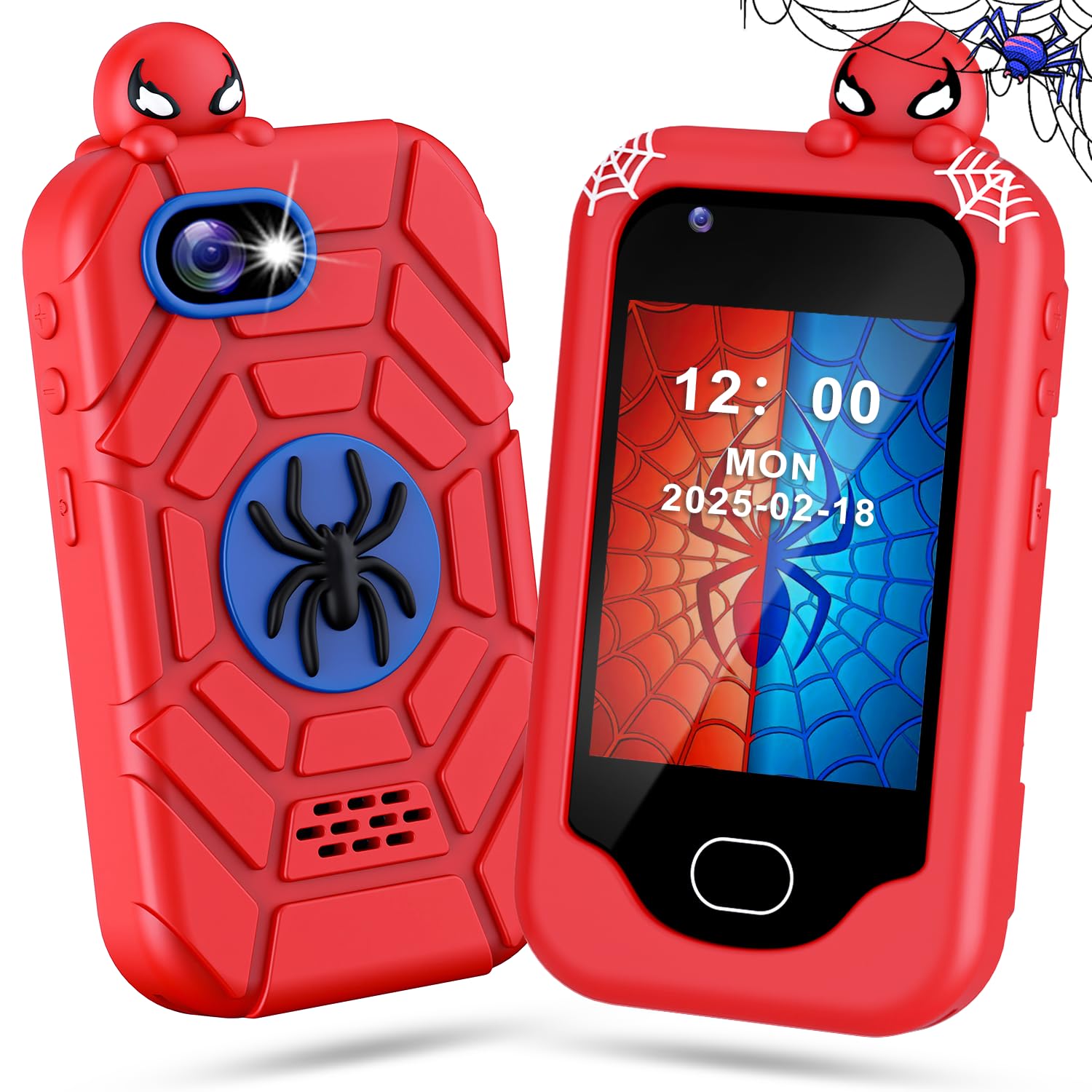
The GOCINA Smart Phone is a toy designed for toddlers aged 3 to 8 who want to mimic their parents without the risks of a real smartphone. It comes with a 32GB SD card pre-installed, front and rear cameras with 23 cartoon frames, and apps for music, games, and basic learning. The 4.2-inch size is designed for small hands, and the included silicone case provides drop protection that has held up well in real-world use according to customer reviews.
There is no SIM card slot, no cellular connectivity, and no internet access—this is purely a toy phone that plays music, takes photos, and runs pre-loaded educational games. Parents can trust that there is zero chance of their toddler stumbling onto social media, the open web, or inappropriate content. The battery life is rated as solid by users, and the device charges via a Type-C cable, which is convenient for modern households.
The biggest limitation is that this device does not make phone calls or send texts—it is a pretend phone, not a communication device. For a toddler who just wants to play with a phone that looks like yours, it is a great distractor. But if you need your child to actually call you, look at a flip phone or a proper kids smartphone instead. Some users noted that the camera quality is basic and the device is best for children under age 6.
Why it’s great
- Completely offline—no internet, no social media, no SIM card
- Comes with 32GB SD card for storing photos and music
- Durable silicone case with drop protection for young children
Good to know
- Cannot make or receive phone calls or texts—toy only
- Best suited for toddlers up to age 6; older children will outgrow it fast
FAQ
Can a kids phone block social media completely?
Do I need a monthly plan for a kids phone?
What age is appropriate for a kids phone with GPS tracking?
Final Thoughts: The Verdict
For most users, the cell phone for kids winner is the Teracube Thrive because it gives parents total remote control over contacts, apps, screen time, and location while still running a full Android OS that grows with the child. If you want a pure talk-and-text device with zero digital distraction, grab the Tracfone TCL Flip 2. And for a toddler who just needs a safe pretend phone, nothing beats the GOCINA Smart Phone.

Mo Maruf
I created WellFizz to bridge the gap between vague wellness advice and actionable solutions. My mission is simple: to decode the research and give you practical tools you can actually use.
Beyond the data, I am a passionate traveler. I believe that stepping away from the screen to explore new environments is essential for mental clarity and physical vitality.