Our readers keep the lights on and my smoothie glass nicely filled. As an Amazon Associate, I earn from qualifying purchases.
Separating a genuine aerial camera platform from a toy with spinning blades comes down to three things: gimbal stabilization, sensor size, and reliable GPS logic. Without these, even a high-resolution video feed looks like a shaky home movie. The market is flooded with drones that claim 4K but deliver grainy, jittery footage the moment the wind picks up. This guide cuts through the marketing noise to focus on the hardware that actually delivers smooth, cinematic results.
I’m Mohammad Maruf — the founder and writer behind WellFizz. My research process involves cross-referencing dozens of technical spec sheets, analyzing real customer flight logs, and comparing transmission stability across multiple price tiers to find which models genuinely deliver on their camera promises.
Whether you’re after a sub-250g portable unit for travel or a feature-packed machine with omnidirectional obstacle avoidance, this breakdown of the best drone with camera options will help you match the right airframe to your skill level and shooting goals.
How To Choose The Best Drone With Camera
Buying a camera drone isn’t just about the highest resolution number on the box. You need to align the drone’s core systems — gimbal, transmission, battery, and sensors — with how you actually plan to use it, whether that’s real estate photography, hiking documentation, or casual backyard flying.
Gimbal Stabilization: Mechanical vs. Electronic
Electronic Image Stabilization (EIS) crops the frame and can introduce a jelly-like effect during fast motion. A 3-axis mechanical gimbal physically isolates the camera from vibration and aircraft movement, producing consistently smooth footage. For any serious aerial photography, a mechanical gimbal is a non-negotiable feature.
Weight Class and Regulatory Headaches
Drones under 250 grams (like most of the mini models in this guide) are exempt from FAA registration and Remote ID requirements for recreational use. Crossing that threshold means you must register the drone, display the ID on the exterior, and follow stricter operational rules. If you travel frequently, the sub-250g class saves significant hassle.
Transmission System and Real-World Range
Wi-Fi-based transmission is common on budget models but suffers from interference and limited range. Proprietary digital transmission systems (like PixSync or GQ2.0) use dedicated radio frequencies for longer range and lower latency. Check the rated distance carefully — a 4-kilometer claim in open fields might drop to 1.5 kilometers in suburban environments with Wi-Fi congestion.
Quick Comparison
On smaller screens, swipe sideways to see the full table.
| Model | Category | Best For | Key Spec | Amazon |
|---|---|---|---|---|
| DJI Mini 5 Pro (Fly More Combo Plus) | Premium | Serious content creators | 1-inch CMOS, 4K/60fps HDR | Amazon |
| DJI Mini 5 Pro | Premium | High-quality travel footage | Omnidirectional obstacle sensing | Amazon |
| Bwine F7MINI 4K(RC3) | Mid-Range | Built-in screen controller | 5.5-inch 1080p controller screen | Amazon |
| Bwine F7GB2 Pro | Mid-Range | Extended flight sessions | 75 mins flight (3 batteries) | Amazon |
| Gleesfun G11PRO | Mid-Range | Stable 3-axis gimbal on a budget | 10,000ft digital transmission | Amazon |
| HOVERAir X1 | Mid-Range | Hands-free action tracking | 125g weight, palm takeoff | Amazon |
| Potensic ATOM LT | Entry-Level | First-time flyers | 80 mins flight (2 batteries) | Amazon |
| Oddire HK11 | Entry-Level | GPS-assisted beginners | 48 mins flight (2 batteries) | Amazon |
| REDRIE HK33 | Budget | Casual low-cost flying | 2-axis gimbal stabilization | Amazon |
In‑Depth Reviews
1. DJI Mini 5 Pro Fly More Combo Plus
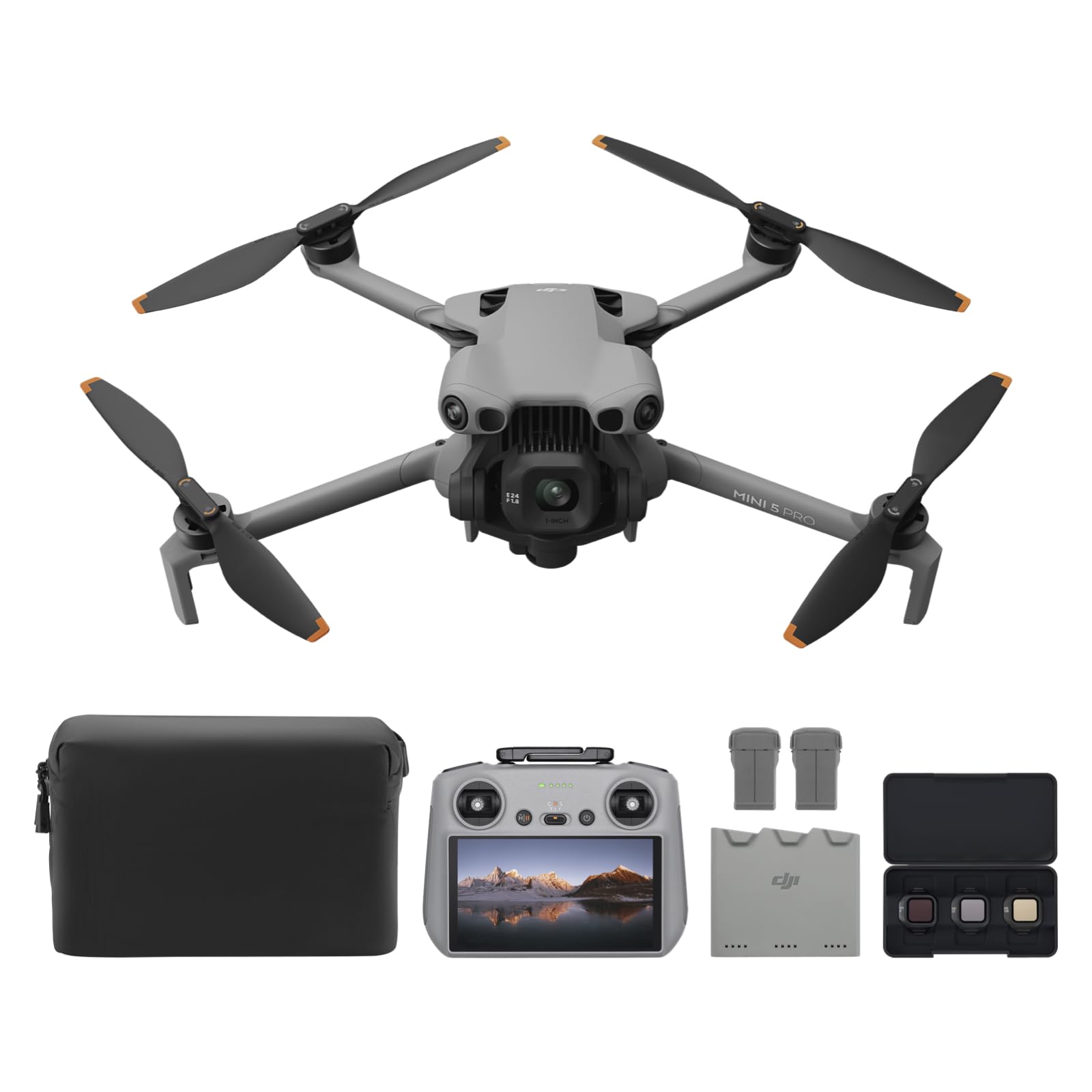
The Fly More Combo Plus is the definitive package for anyone who wants to maximize airtime without compromise. It includes three Intelligent Flight Battery Plus units that deliver up to 52 minutes of flight per battery, plus a two-way charging hub, ND filter set, and a shoulder bag — everything needed for extended shooting sessions. The DJI RC 2 controller adds a bright built-in screen, eliminating the need to mount a phone.
At the core is a 1-inch CMOS sensor capturing 4K/60fps HDR video with true vertical filming capability through the 225-degree gimbal rotation. The Nightscape omnidirectional obstacle sensing system uses forward-facing LiDAR and vision sensors to detect hazards even in low light, making this one of the safest consumer drones for night flights. ActiveTrack 360° keeps moving subjects framed automatically with customizable tracking modes.
The main trade-off is weight management: with the larger batteries and any accessory (ND filters, landing gear), the total takeoff weight exceeds 250 grams, which triggers FAA Remote ID requirements. The RC 2 controller is also noticeably heavy, so a neck lanyard is recommended for comfort. Despite these minor points, the image quality and safety features set a new benchmark in the sub-250g form factor.
Why it’s great
- 1-inch sensor delivers professional-grade 4K/60fps HDR video
- Omnidirectional obstacle sensing with LiDAR for night safety
- 52-minute battery with fast charging hub extends field time
Good to know
- Larger batteries push weight over 250g, requiring FAA registration
- RC 2 controller is heavy; a lanyard helps during long flights
- Premium price positions it above casual user budgets
2. DJI Mini 5 Pro
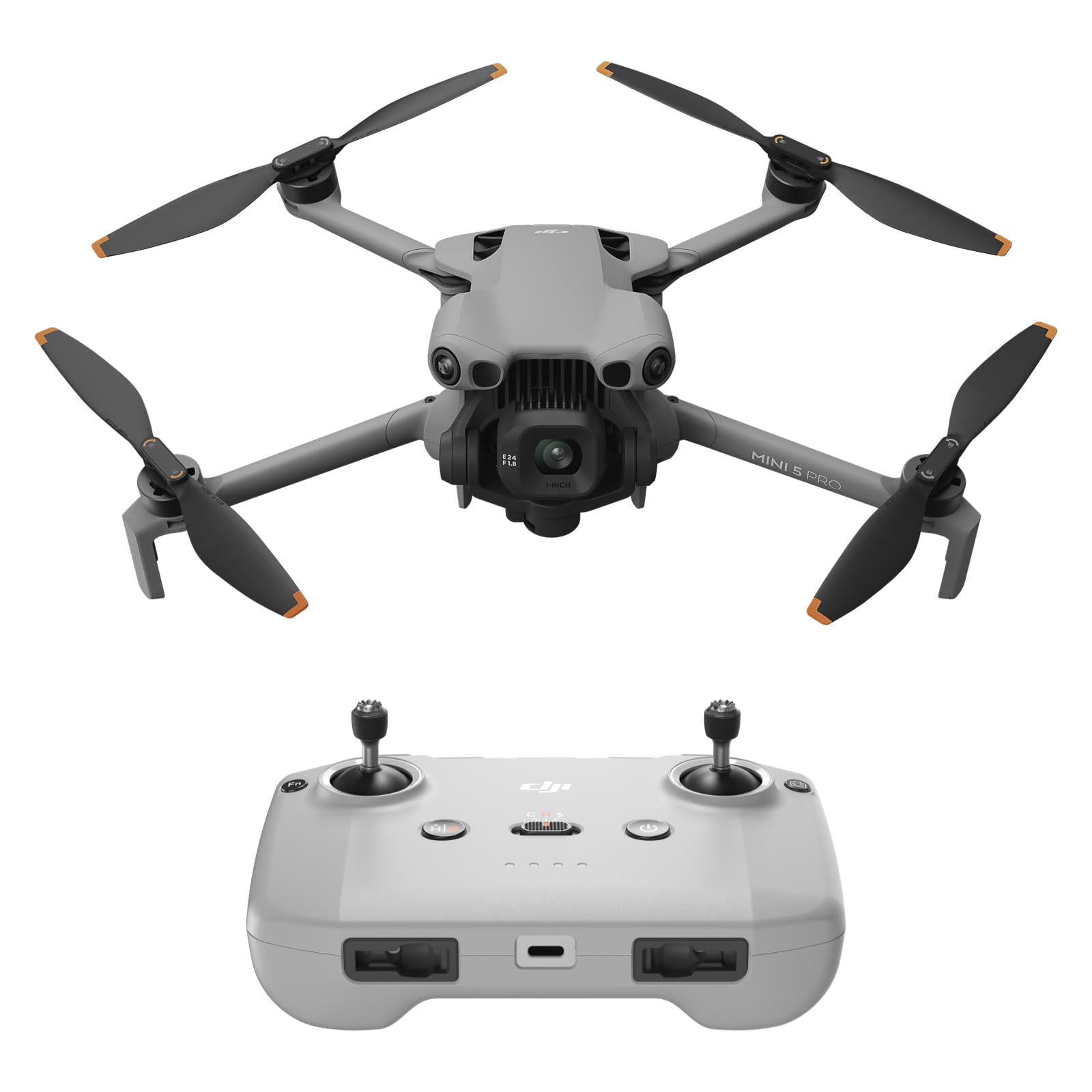
The standard DJI Mini 5 Pro package shares the same 1-inch CMOS sensor, 4K/60fps HDR video capability, and 225-degree gimbal as its Fly More sibling, but comes with a single standard battery (36-minute flight) and the DJI RC-N3 controller that requires a smartphone. This is the entry point into DJI’s flagship mini series for those who already own a good phone and want to keep the initial investment lower.
The Nightscape omnidirectional obstacle sensing is identical across both versions, meaning you get forward-facing LiDAR and vision sensors that detect obstacles in all directions for safe return-to-home even after sunset. The 42GB of internal storage eliminates the need for a microSD card out of the box, and the palm-sized foldable design fits easily into a jacket pocket. ActiveTrack 360° with customizable tracking modes handles cycling, running, and vehicle subjects with impressive stability.
Battery life at 36 minutes is still class-leading for a sub-250g drone, but serious shooters will want to budget for extra batteries. The RC-N3 controller works well but leaves you dependent on your phone’s screen brightness and battery life. If you prioritize portability and obstacle avoidance over maximum airtime, this is the cleanest travel companion available.
Why it’s great
- 1-inch sensor with 225-degree gimbal for versatile framing
- Omnidirectional obstacle sensing with LiDAR for night safety
- Sub-250g, no FAA registration for recreational use
Good to know
- Single battery limits field time to 36 minutes
- Requires a smartphone for live view (RC-N3 controller)
- Premium price gap to mid-range models is significant
3. Bwine F7MINI 4K(RC3)
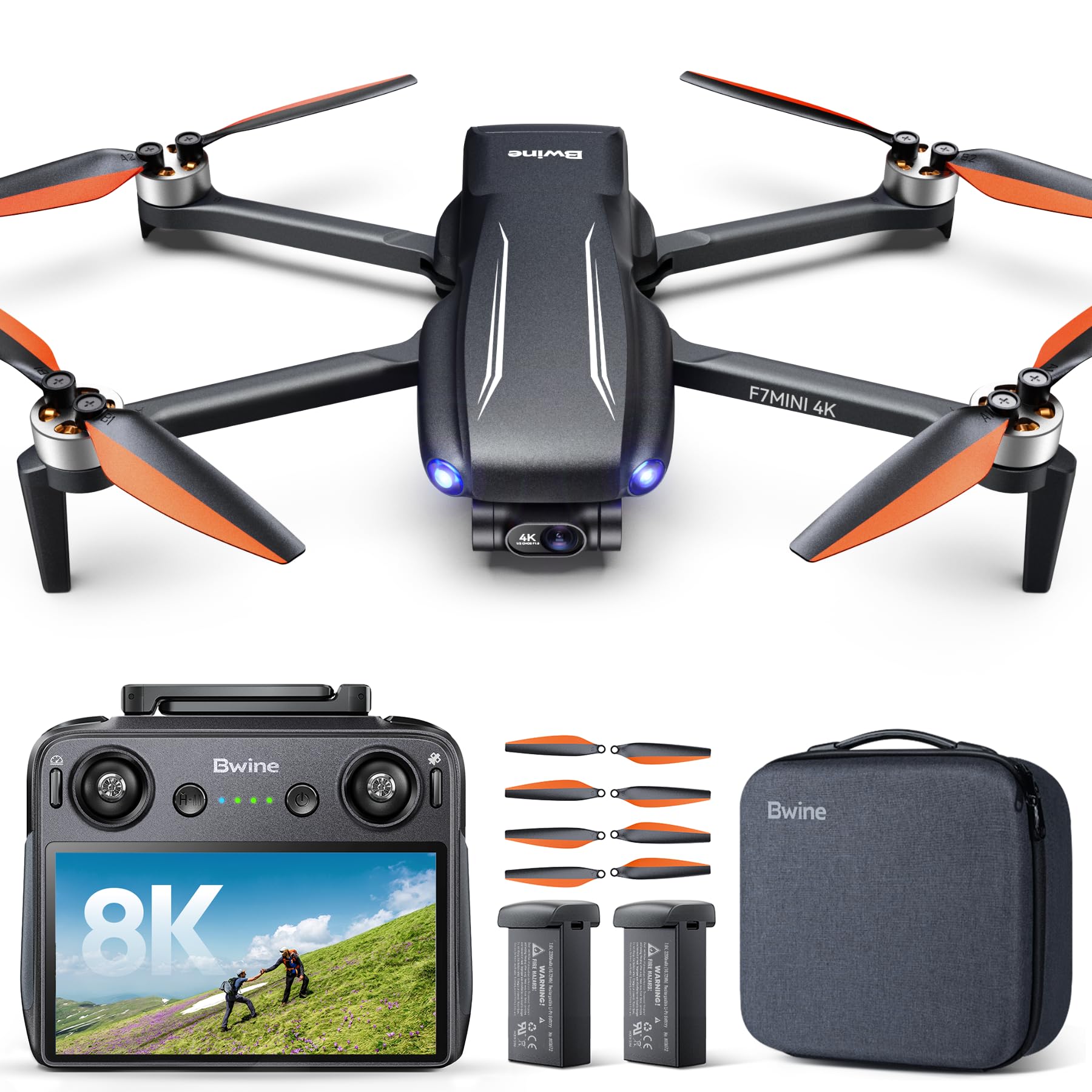
The Bwine F7MINI 4K(RC3) stands out for one primary reason: the remote controller features a built-in 5.5-inch 1080p screen with 500 nits of brightness, eliminating any reliance on a smartphone. This is rare in the mid-range segment and makes a huge difference when flying in bright sunlight. The controller also includes 32GB of internal storage for saving and reviewing shots directly on the remote.
Camera specs are solid with 8K photo resolution and 4K UHD video captured through a 3-axis brushless gimbal with EIS. The F1.8 aperture and 48MP effective resolution produce detailed daytime footage. Transmission range is rated at 20,000 feet (6km) with a 0.1-second latency, though real-world suburban performance is closer to 4.5km. GPS features include Active Track with 0.5m accuracy, Cruise Control, Orbit Flight, and Waypoint Planning.
At under 249 grams, it avoids FAA registration entirely. The two included batteries deliver a combined 64 minutes of flight time (32 minutes each), and the drone supports PD 3.0 fast charging. The 120dB buzzer via the app helps locate the drone if it goes down in tall grass. The controller screen isn’t removable, so you can’t use a phone as a backup, but the screen quality makes that a non-issue for most users.
Why it’s great
- Built-in 5.5-inch 1080p controller screen (no phone needed)
- 3-axis gimbal with 8K photo and 4K video capture
- Sub-250g with 64-minute total flight time
Good to know
- Controller screen is non-removable, no phone backup option
- Transmission range drops significantly in dense urban areas
- PD 3.0 fast charger not included in the box
4. Bwine F7GB2 Pro

The Bwine F7GB2 Pro is built for extended shooting sessions. It ships with three 2600mAh intelligent batteries that together deliver 75 minutes of total flight time. The batteries comply with UL 2054 safety standards, and the drone supports a 65W fast charger (sold separately) that can replenish a battery in roughly 90 minutes. This makes it ideal for covering large properties, farmland, or multiple survey locations in one trip.
The 4K detachable camera rides on a 3-axis brushless gimbal with a 120-degree FOV lens and 5x digital zoom. The larger CMOS sensor handles low-light and night scenes better than smaller sensors found on budget models. Wind resistance is rated at Level 6, and the drone can operate at altitudes up to 2,000 meters, which is useful for mountain or hilltop flights. Transmission range is rated at 10,000 feet with a stable 3,000-meter control range.
The FAA certification is completed with a QR-coded Remote ID on the drone arm, so you’re legal for commercial use. The carrying shell case protects everything during transport, and Bwine includes a 2-year warranty. The main drawbacks are the 550-gram weight (requires FAA registration) and the remote screen that can be hard to read in direct sunlight. The app includes filters and background music for quick social sharing.
Why it’s great
- Three batteries provide 75-minute total flight time
- 3-axis gimbal with 4K detachable camera and 120° FOV
- Level 6 wind resistance and 2,000m altitude ceiling
Good to know
- 550g weight requires FAA registration and Remote ID
- Remote screen is difficult to see in bright sunlight
- 65W fast charger not included in the package
5. Gleesfun G11PRO

The Gleesfun G11PRO brings a genuine 3-axis brushless gimbal to the mid-range price point, a feature typically reserved for higher-tier models. The gimbal uses three-axis positioning to control pitch, roll, and yaw, maintaining stable balance even in gusty conditions. The camera captures 6K photos and 4K/30fps video through a 1/3.2-inch CMOS sensor, with Cruise Control technology that automatically maintains stability during one-key takeoff shots.
The GQ2.0 digital transmission system uses a two-way dual-antenna design for real-time transmission up to 10,000 feet. The controller connects to your phone via a wired plug-and-play connection (Type-C, Micro-USB, or Lightning cables included), eliminating Wi-Fi lag. The GL2.0 Smart Battery Management System delivers 35 minutes per battery (two included for 70-minute total) with fast charging in about 2.5 hours and over 300 charge cycles.
The kit is FAA-compliant with a QR-coded Remote ID and includes 40 pieces — from the camera protector and portable bag to spare propellers and screws. The drone handles wind surprisingly well thanks to its brushless motors, and the follow-me mode works reliably for tracking moving subjects. The most common complaint involves the included battery charger cable, so investing in a faster aftermarket charger is sensible for heavy users.
Why it’s great
- True 3-axis brushless gimbal for smooth footage at this price
- Two batteries provide 70 minutes total flight time
- Wired phone connection eliminates Wi-Fi transmission lag
Good to know
- Package weight over 250g requires FAA registration
- Included charging cable is slow; an aftermarket charger helps
- App interface has a learning curve for advanced modes
6. HOVERAir X1

The HOVERAir X1 redefines what a drone with a camera can be by eliminating the remote controller entirely. Weighing only 125 grams — lighter than most smartphones — it launches directly from your palm with one button and follows you using advanced tracking algorithms. Pre-programmed flight paths include Hover, Follow, Zoom Out, Orbit, and Bird’s Eye, making it ideal for cyclists, skateboarders, and hikers who want automated footage without learning complex controls.
The camera captures 2.7K/30fps and 1080p HDR video with a triple stabilization system. The fully enclosed design with safety guards allows worry-free close-range shooting, and 32GB of internal storage keeps your footage private — no SD cards or cloud uploads required. Each battery supports roughly 20 intelligent flight paths (11 minutes per battery), and the combo package includes a charging hub for multiple batteries.
The X1 is not designed for long-range exploration or high-altitude flights. It has no GPS-based return-to-home and struggles in winds above Level 4 or at altitudes over 2,000 meters. It also cannot operate over water reliably. For its intended use — close-proximity action sport filming and vlogging — it is unmatched in portability and ease of use. The lack of a controller means no FAA registration is needed.
Why it’s great
- Ultra-light 125g, no FAA registration required
- Palm takeoff and pre-programmed flight paths for hands-free use
- Fully enclosed safety guards for close-range shooting
Good to know
- 11-minute battery life limits each session
- No GPS return-to-home; cannot fly over water
- Wind resistance limited to Level 4; not for high altitudes
7. Potensic ATOM LT

The Potensic ATOM LT is engineered specifically for beginners who want a real GPS drone without the complexity of higher-end models. The standout feature is the 80-minute total flight time from two 3000mAh intelligent batteries — 40 minutes per battery — which is exceptional at this price tier. The PixSync 2.0 transmission system provides a smooth HD video feed up to 4 kilometers, giving beginners room to practice without range anxiety.
The camera uses a Sony sensor for 2.5K@30fps HD video and 2560×1440 photos with ShakeVanish 2.0 EIS stabilization. The 118-degree FOV and vertical +20° to -90° adjustable angle offer good framing flexibility. The drone supports four GNSS systems (GPS, GLONASS, Galileo, BeiDou) for fast satellite lock and accurate Auto Return Home, Follow Me, Waypoint, and Circle Fly modes. The brushless motors handle Level 5 wind conditions.
At under 249 grams, it avoids FAA registration. The drone only operates in GPS mode, so it cannot fly indoors or in areas without satellite reception. The camera is good for daytime use but struggles in low light, and the EIS stabilization can introduce artifacts during fast lateral movement. The app supports iOS 11 and Android 7.0 or higher, and the included Type-C and Lightning cables ensure phone compatibility.
Why it’s great
- 80-minute total flight time (40 min per battery) leads the category
- 4KM PixSync 2.0 transmission for stable long-range video
- Quad-GNSS support for fast and accurate GPS lock
Good to know
- GPS-only mode; cannot fly indoors or without satellite signal
- 2.5K resolution falls short of true 4K cameras
- EIS stabilization struggles in low-light conditions
8. Oddire HK11

The Oddire HK11 is a purpose-built beginner drone that emphasizes GPS reliability and physical durability. The advanced GPS module triggers Auto Return Home when battery runs low or the connection breaks, and the drone also supports GPS Follow, Route Planning, and Fly Around modes. The 7.7V 1800mAh batteries (two included) deliver 48 minutes of total flight time with more consistent power output than lower-voltage alternatives.
The 4K UHD camera features an F2.15 110-degree wide-angle lens with 90-degree remote-controlled tilt. The camera captures 4096x3072P photos and 2048x1088P videos, with files saved directly to an SD card or synced to your mobile device. The 5G WiFi transmission with a signal repeater in the remote controller provides stable FPV video at up to 500 meters — enough for most beginner flight scenarios. The brushless motor and Level 5 wind resistance keep the drone stable in moderate breezes.
Weighing exactly 249 grams, it avoids FAA registration. The HK11 is surprisingly durable — multiple customer reports confirm it survives concrete crashes with no damage. The included carrying case and extra propellers suggest the manufacturer expects beginners to bump into things. The one notable downside is the app situation: the main app listed in the manual doesn’t work; you need to search for “XDRONE GO” instead. Compass recalibration is required every power-on, and the beep meanings aren’t clearly explained in the manual.
Why it’s great
- Reliable GPS Auto Return prevents flyaways for beginners
- Extremely durable — survives concrete crashes with no damage
- 7.7V batteries offer more consistent power than 3.7V alternatives
Good to know
- App confusion — use “XDRONE GO” not the one in the manual
- Compass calibration required every power-on
- Beep tones for warnings aren’t documented in the manual
9. REDRIE HK33
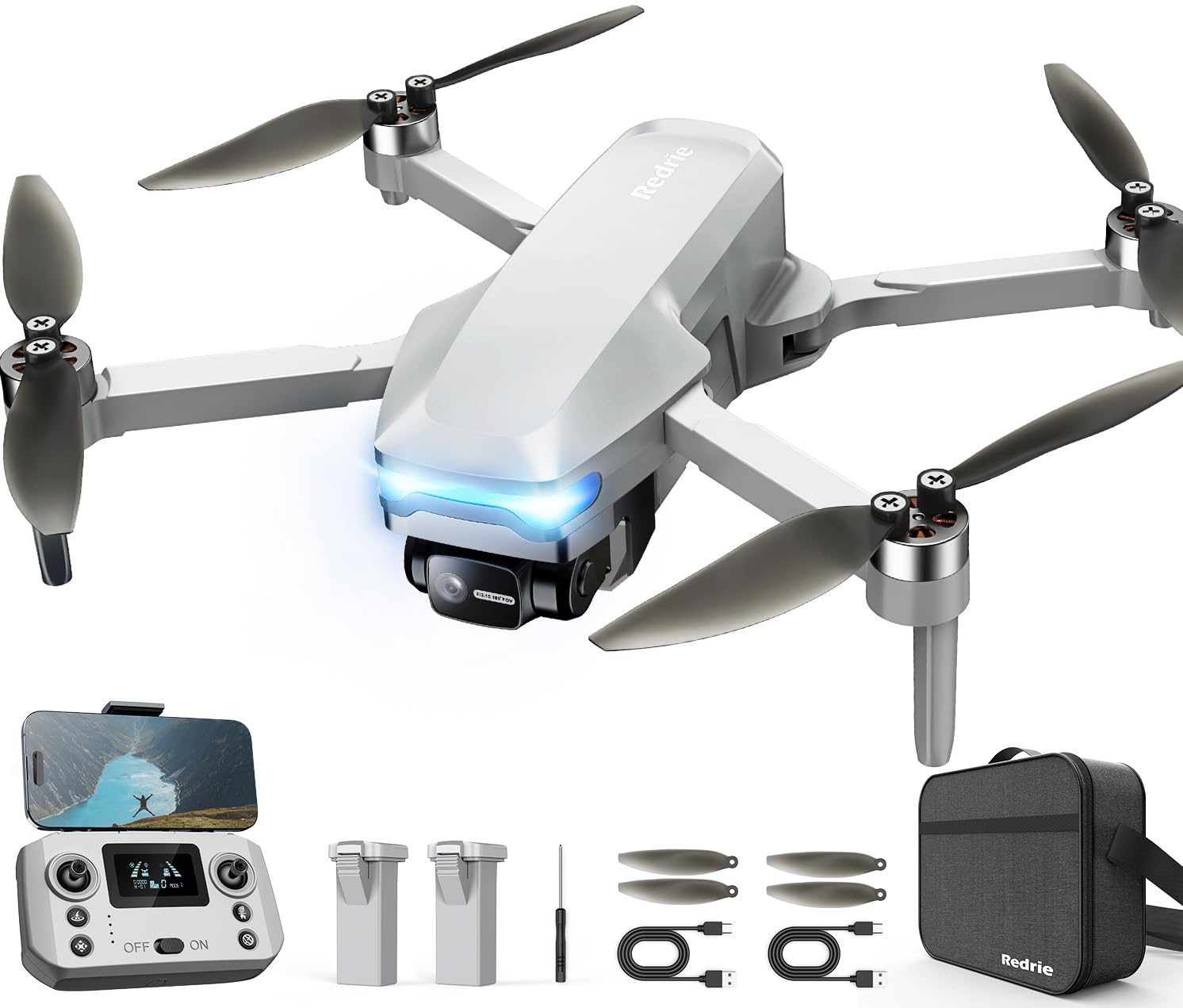
The REDRIE HK33 is the most budget-conscious option in this lineup, but it does not cut corners on the key beginner feature: a 2-axis gimbal. While not as smooth as a 3-axis system, the 2-axis gimbal eliminates the most distracting camera shake — pitch and roll — that plagues non-stabilized models. The F2.15 110-degree ultra-wide lens captures 4K stills (4096x3072P) and 2K video (2048x1088P) with a 90-degree remote-controlled angle adjuster for switching between landscape and portrait framing.
Flight performance is handled by upgraded brushless motors that provide stable flight even in Level 5 winds. The 5G WiFi module enables low-latency FPV transmission up to 300 meters for video and 500 meters for signal range via the signal repeater. The GPS module supports Auto Return Home on signal loss or low battery, along with GPS Follow, Route Planning, and Fly Around modes. Two 1800mAh batteries deliver a combined 40-45 minutes of flight time.
At under 249 grams, the HK33 requires no FAA registration. The foldable design and included carrying case make it genuinely portable. The camera quality is decent for the price point but noticeably softer than 4K models with larger sensors. The cell phone holder on the remote is flimsy and may not securely hold larger phones. For the price, this is an excellent risk-free entry point for someone who wants to learn aerial photography without a significant financial commitment.
Why it’s great
- 2-axis gimbal at a budget-friendly price point
- Brushless motors with Level 5 wind resistance
- Under 249g, no FAA registration required
Good to know
- Camera resolution is softer than true 4K drone cameras
- Phone holder on remote is flimsy
- Video transmission range limited to 300 meters
FAQ
What does the 250-gram weight limit mean for flying a drone with camera?
How does a 3-axis gimbal differ from electronic stabilization in practice?
Final Thoughts: The Verdict
For most users, the best drone with camera winner is the DJI Mini 5 Pro Fly More Combo Plus because it combines a 1-inch CMOS sensor, omnidirectional obstacle sensing, and extended battery life in a package that stays under 250g with standard batteries. If you want a built-in controller screen and the freedom to fly without a phone, grab the Bwine F7MINI 4K(RC3). And for a hands-free tracking camera that fits in your pocket for action sports, nothing beats the HOVERAir X1.

Mo Maruf
I created WellFizz to bridge the gap between vague wellness advice and actionable solutions. My mission is simple: to decode the research and give you practical tools you can actually use.
Beyond the data, I am a passionate traveler. I believe that stepping away from the screen to explore new environments is essential for mental clarity and physical vitality.