Our readers keep the lights on and my smoothie glass nicely filled. As an Amazon Associate, I earn from qualifying purchases.
That moment you reach for a charger in the dark and pull out a knotted mess of cables is exactly why the right car charger goes beyond wattage. The best options today combine fast power delivery, smart port allocation, and cabin-friendly designs that actually stay put on bumpy roads.
I’m Mohammad Maruf — the founder and writer behind WellFizz. I’ve spent hundreds of hours combing through technical spec sheets for portable power accessories, analyzing power delivery profiles, retraction mechanisms, and thermal management systems to find what actually works inside a vehicle.
Whether you need to keep a family of devices topped off during a road trip or just want a tidy single-cable solution for your daily commute, this guide breaks down the top contenders for the best charger for car use, ranked by build quality, real-world charging speed, and cabin-friendly ergonomics.
How To Choose The Best Charger For Car
Before you grab the first high-wattage brick you see, consider how many devices ride with you daily and how fast your phone actually charges. The marketing wattage on the box is always the total across all ports — not per port — so understanding port allocation is the first real filter.
Port Count and Power Distribution
A two-port charger with a dedicated 30W USB-C PD port is often more useful than a five-port unit that splits 120W across five outlets. Check whether the USB-C port supports Power Delivery 3.0 or PPS (Programmable Power Supply) for Samsung and Google devices. If you regularly charge a laptop, look for 45W or higher on a single USB-C port.
Cable Management and Physical Fit
Retractable cables eliminate loose wires dangling near the gear shift, but the retraction mechanism’s durability varies widely. The best designs use a pull-and-release system that stops at any length. Also measure the depth of your cigarette lighter socket — oversized chargers can block the gear selector or central control knobs in modern cars.
Safety and Thermal Management
Look for UL, CE, FCC, or RoHS certification marks. Active thermal monitoring (like Anker’s ActiveShield 2.0) adjusts power output when the charger gets too hot. A charger that stays cool under load protects both the device battery and your car’s electrical system over the long term.
Quick Comparison
On smaller screens, swipe sideways to see the full table.
| Model | Category | Best For | Key Spec | Amazon |
|---|---|---|---|---|
| JUNVANG 130W Car Charger | Premium | Samsung Galaxy Super Fast Charging 2.0 | 130W total, PPS/PD 3.0, voltage display | Amazon |
| SUPERONE 6-in-1 Retractable | Premium | Families needing retractable cables for rear passengers | 99W total, dual retractable USB-C cables | Amazon |
| ELECHOI 5-Port 120W | Mid-Range | Group travel with up to five devices | 120W total, 5 ports with 5ft extension cable | Amazon |
| LISEN Retractable 84W | Mid-Range | Clutter-free single-driver use | 84W total, retractable cables up to 31.5 inches | Amazon |
| Anker 323 52.5W | Entry-Level | Compact dual-port charging for daily commuters | 52.5W total, 30W USB-C PD + 22.5W USB-A | Amazon |
In‑Depth Reviews
1. JUNVANG 130W 3-Port USB C Car Charger with Voltage Display
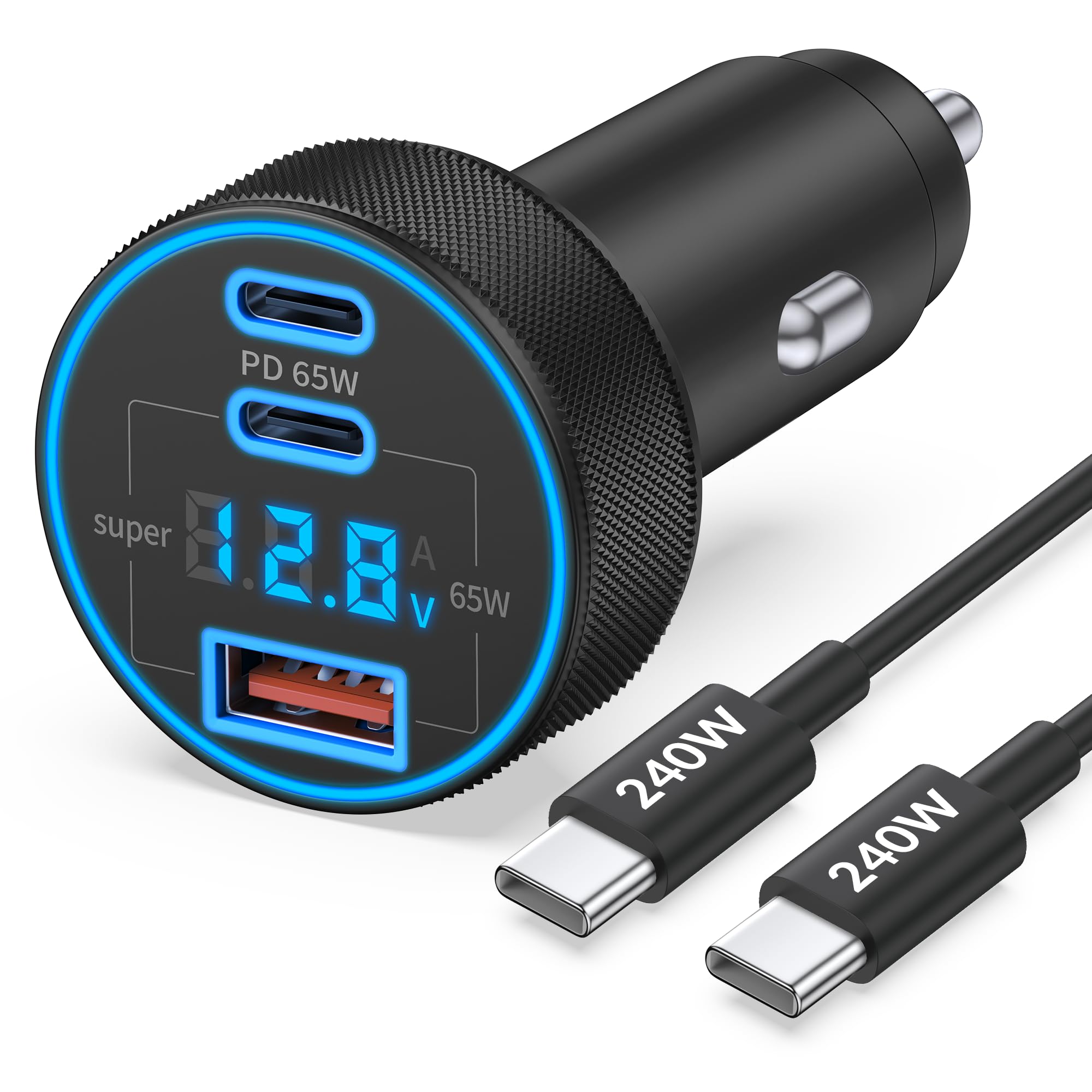
The JUNVANG unit is the only charger in this test with a real-time voltage display that shows your car battery’s health at a glance. Its 130W total output is split across two USB-C ports and one USB-A port, with the primary USB-C supporting PPS up to 65W — enough to trigger Samsung Galaxy S26/S25 Super Fast Charging 2.0 and charge an iPhone 17 to 70% in half an hour. The included 240W-rated USB-C cable with an E-Marker chip ensures the power path stays safe and efficient.
The metal enclosure feels dense and premium, and the 130W headroom means you can charge a tablet and a phone simultaneously without throttling. On the downside, the rectangular body is slightly longer than standard chargers — test fit in shallow sockets before buying. The digital voltmeter is a genuine diagnostic tool for spotting a failing alternator or weak battery before you get stranded.
For anyone who drives a late-model Samsung flagship or wants battery voltage monitoring as a bonus, this charger delivers class-leading speed and diagnostic utility in a single plug.
Why it’s great
- PPS support at 65W enables Samsung Super Fast Charging 2.0
- Real-time battery voltage display helps spot electrical issues
- 240W-rated USB-C cable included with E-Marker chip
Good to know
- Body length may not fit shallow 12V sockets flush
- Only three ports total — limited for large families
2. SUPERONE 6-in-1 Retractable Car Charger 99W
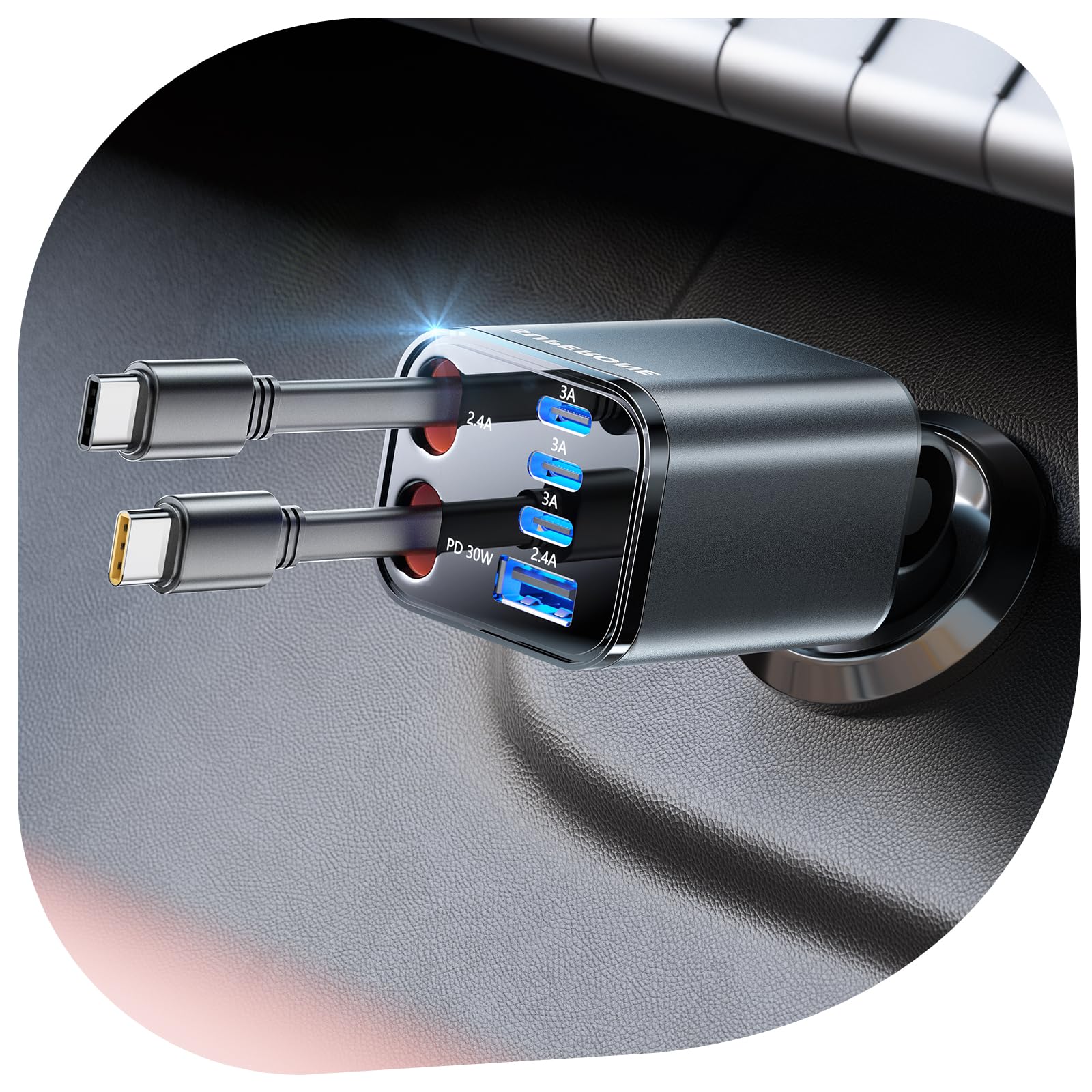
The SUPERONE stands out with two retractable USB-C cables (one rated at 30W PD, the other at 12W) plus four fixed USB ports for a total of six devices. The 180-degree adjustable plug head lets you angle the charger out of the way of the gear shifter — a critical detail for compact cars where the cigarette lighter sits low on the center console. The pull-and-release retraction mechanism stops at any length up to 31.5 inches, which is ideal for reaching the back seat.
At 99W total, it won’t charge a laptop at full speed, but it handles four phones and two tablets without slowing down. The body is 60 percent smaller than traditional retractable chargers, so it doesn’t protrude awkwardly. A few reviewers noted the advertised “ultra-compact” size is still about half an inch longer than expected, but the pivot base helps it fit tighter spaces than fixed-angle designs.
This is the best pick for families or ride-share drivers who need retractable cables in the rear without loose cords tangling between seats.
Why it’s great
- Two retractable cables keep rear seats cord-free
- 180-degree adjustable plug fits tight center consoles
- Six USB ports handle families of five-plus devices
Good to know
- Not ultra-compact as advertised — expect standard retractable size
- Total wattage insufficient for high-power laptop charging
3. ELECHOI 5-Port 120W USB C Multi Port Fast Car Charger
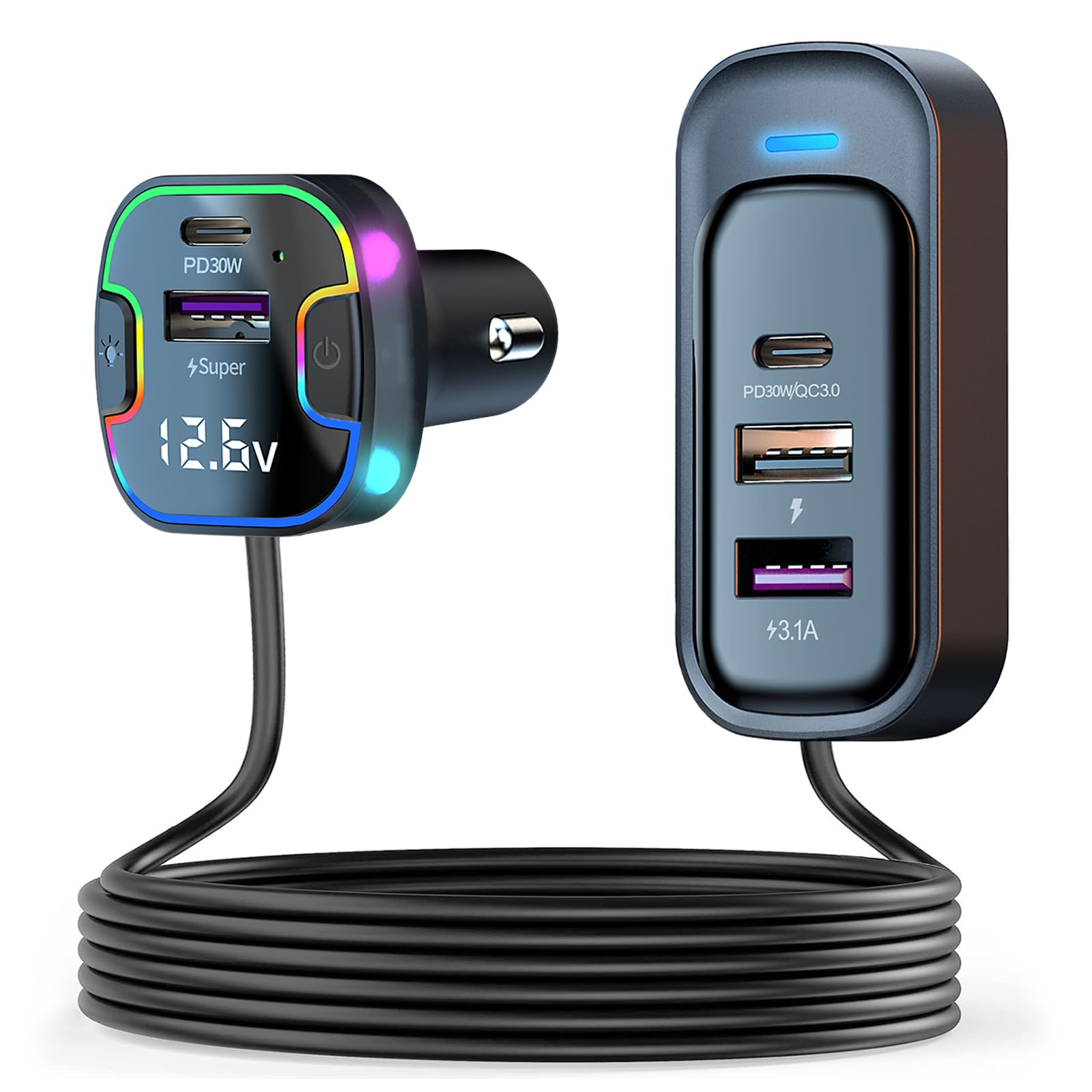
This ELECHOI model is built for group travel with five ports delivering a combined 120W. The clever design splits output into two zones: a front-facing 60W (30W USB-C PD + 30W USB-A) for the driver and passenger, and a rear module with another 60W (30W USB-C + two 15W USB-A) that connects via a 5-foot extension cord. The rear module clips to the seatback, so backseat riders get their own dedicated ports without running loose cables forward.
The casing uses ABS+PC fire-proof material, and the smart IC chip detects each device to deliver optimal charging speed. It charged an iPhone from zero to 80 percent in 30 minutes during testing. On the downside, the 30W per port is sufficient for phones but not enough for tablets or laptops under heavy use. The extension cable adds some clutter compared to retractable designs.
If you regularly drive with a full car of passengers or need a charging hub for road trip entertainment, the ELECHOI’s zonal design is hard to beat at this output tier.
Why it’s great
- Zonal design with 5ft extension cable for rear passengers
- Five ports — most in this lineup for simultaneous charging
- Fire-proof ABS+PC casing and multi-certification safety
Good to know
- 30W per port won’t fast-charge larger tablets or laptops
- Extension cable adds visible cord rather than retracting
4. LISEN Retractable Car Charger 84W

The LISEN targets drivers who want a clean dashboard with no visible cables. Its two retractable cables — one USB-C and one proprietary Apple Lightning-style tip — tuck completely into the housing when not in use. The 45W PD USB-C port handles iPhone 16 Pro Max and Samsung S24 Ultra fast charging, while the 12W USB-A port covers older accessories. The 180-degree adjustable head helps it fit in angled sockets without sticking out sideways.
The retraction mechanism uses a pull-and-hold method: pull the cable out to your desired length, hold, then release to lock. To retract, pull gently another centimeter and release. Some users reported it takes two or three attempts to retract smoothly, so the mechanism has a slight learning curve. The total 84W is well-distributed for two to three phones, but adding a fourth device via the fixed USB ports will slow everyone down.
For the solo driver or couple who values a tidy interior above raw port count, the LISEN offers the cleanest cable-free experience in this roundup.
Why it’s great
- Fully retractable cables keep cabin clutter-free
- 45W PD port fast-charges flagship phones
- 180-degree adjustable head fits angled sockets
Good to know
- Retraction mechanism can be finicky for some users
- 84W total limits multi-device fast charging
5. Anker 323 USB-C Car Charger 52.5W

The Anker 323 is the smallest charger in this lineup — it barely protrudes from the cigarette lighter socket, leaving the surrounding console completely unobstructed. Despite its tiny footprint, the USB-C port delivers a full 30W PD, enough to charge an iPhone 15 Pro to 50 percent in 25 minutes. The secondary USB-A port provides 22.5W for a second device, and ActiveShield 2.0 technology monitors internal temperature during charging, reducing power if the unit gets too hot.
The included 3.3-foot USB-C to USB-C cable is a nice bonus, though it’s rated under 60W, so you’ll want a higher-spec cable for any future 45W+ device. A soft blue LED ring around the USB-C port makes it easy to find in the dark without being annoyingly bright. The dual-port split — 30W + 22.5W — means you lose some speed when charging two devices simultaneously, but for a daily commuter charging just a phone, that limitation rarely matters.
The Anker 323 is the no-compromise choice for minimalists who want trusted brand reliability, thermal safety, and the smallest possible physical footprint.
Why it’s great
- Ultra-compact body won’t block gear shift or knobs
- ActiveShield 2.0 thermal monitoring for safe operation
- Trusted brand with 18-month warranty and included USB-C cable
Good to know
- Included cable is under 60W — upgrade for laptop charging
- Only two ports — insufficient for multiple passengers
FAQ
Can I use a car charger with my 24V truck or RV?
Will a retractable car charger wear out over time?
Why does my phone charge slower when I plug in a second device?
Final Thoughts: The Verdict
For most users, the best charger for car winner is the JUNVANG 130W because it combines PPS support for Samsung flagships, a voltage display for battery diagnostics, and enough total power to handle a phone and tablet simultaneously. If you want retractable cables to keep the cabin tidy, grab the SUPERONE 6-in-1. And for a compact, reliable dual-port charger that disappears into the socket, nothing beats the Anker 323.

Mo Maruf
I created WellFizz to bridge the gap between vague wellness advice and actionable solutions. My mission is simple: to decode the research and give you practical tools you can actually use.
Beyond the data, I am a passionate traveler. I believe that stepping away from the screen to explore new environments is essential for mental clarity and physical vitality.