Our readers keep the lights on and my smoothie glass nicely filled. As an Amazon Associate, I earn from qualifying purchases.
Finding a drone that an 8-year-old can actually fly without tears, broken propellers, or a trip to the roof is harder than it looks. Most toy drones either zip out of control or shatter on first contact with a wall, leaving parents frustrated and kids disappointed. The right choice balances safety, durability, and simplicity so the first flight is fun, not a failure.
I’m Mohammad Maruf — the founder and writer behind WellFizz. I’ve spent countless hours analyzing crash-test data, battery life claims, and real parent reviews to identify the drones that truly work for young beginners without breaking the bank.
Each drone in this guide was selected for its ability to survive impacts, offer intuitive controls, and keep kids engaged. Whether you need a camera option or an obstacle-avoiding indoor flyer, this roundup of the best drone for 8 year olds covers the most reliable picks on the market today.
How To Choose The Best Drone For 8 Year Olds
Not every drone marketed to kids is actually suitable for an 8-year-old. The wrong choice leads to frustration, broken parts, and a dusty drone in the closet. Focus on three core areas: safety design, control simplicity, and real-world durability.
Propeller Guards and Full-Body Protection
A drone without propeller guards is a recipe for disaster in the hands of a child. Fully enclosed guards prevent injuries and protect the rotors from snapping on impact. Look for models with sturdy ABS or nylon surrounds that can handle repeated tumbles off furniture and walls.
Altitude Hold and Headless Mode
Altitude hold locks the drone at a set height so the child only needs to steer, not juggle throttle and direction simultaneously. Headless mode eliminates orientation confusion — “forward” always means away from the pilot, regardless of which way the drone faces. These two features separate flyable toys from frustration machines.
Battery Life and Spare Batteries
Most kid drones get 5 to 10 minutes per charge. Buying a model that includes two batteries effectively doubles playtime. Swapping a battery in seconds beats waiting 40 minutes for a recharge. Prioritize drones with modular batteries that are easy to remove and charge.
Weight and Indoor Suitability
Drones under 250 grams don’t require FAA registration, making them hassle-free for parents. Lightweight foam or plastic construction also reduces damage from crashes. For indoor use, choose a drone designed specifically for enclosed spaces — ones that rely on optical flow sensors to stay stable near walls.
Quick Comparison
On smaller screens, swipe sideways to see the full table.
| Model | Category | Best For | Key Spec | Amazon |
|---|---|---|---|---|
| SIMREX X800 | Camera Drone | First aerial photos & stable hover | 30 min flight (2 batteries) | Amazon |
| SYMA X100 | Obstacle Avoidance | Indoor beginners needing crash prevention | 4-way infrared sensors | Amazon |
| Helatt FPV Camera Drone | FPV Camera | Kids who want a live video feed | 1080P + optical flow positioning | Amazon |
| Holy Stone HS210T | 2-in-1 Land/Fly | Ground racing & indoor acrobatics | 16 min flight (2 batteries) | Amazon |
| Innofans Spider Mini | Foam Stunt Flyer | Budget-friendly outdoor fun | 10 min flight (2 batteries) | Amazon |
In‑Depth Reviews
1. SIMREX X800 Drone With Camera

The SIMREX X800 earns the top spot because it combines altitude hold with optical flow positioning — two features that give an 8-year-old a nearly stationary hover indoors. At just 96 grams, this foldable quadcopter is light enough to minimize crash damage yet stable enough to capture 1080P video through its manually adjustable lens. The rainbow RGB LEDs help kids keep visual track during dimmer indoor sessions.
Two 1000mAh modular batteries deliver up to 30 minutes of total flight time, which is exceptional in this tier. Swapping batteries takes seconds, so play doesn’t grind to a halt while a single pack recharges. Headless mode and three speed settings let the child progress from slow indoor learning to faster outdoor maneuvers as confidence builds. The gravity-sensing phone control adds an intuitive tilt-to-steer option that younger pilots pick up immediately.
Customer feedback consistently praises the drone’s ability to hover within a one-foot radius indoors, though drafts from open windows can push it off course. The camera quality is adequate for a starter drone — fine for backyard memories but not sharp enough for detailed photography. The phone mount on the remote feels a bit flimsy, so parents may want to handle the phone attachment themselves.
Why it’s great
- Optical flow positioning keeps the drone locked in place for easy control
- 30 minutes of flight time across two batteries eliminates frequent recharging
- Foldable design fits easily into a backpack for park trips
Good to know
- Phone mount on the controller is not very secure
- Camera resolution feels lower than advertised 1080P
- Struggles in anything more than a light breeze outdoors
2. SYMA X100 Drone for Kids

The SYMA X100 is the only drone in this lineup with active obstacle avoidance — four infrared sensors detect walls and furniture within about 12 inches, then steer the drone away automatically. For an 8-year-old flying in a living room with lamps, coffee tables, and curious pets, this feature drastically reduces crash frequency. The fully enclosed propeller guard adds another layer of safety by blocking contact with spinning blades.
Two speed modes let beginners start slow, and the one-key 360° flip button provides instant fun without requiring advanced stick skills. Altitude hold keeps the X100 steady at a fixed height, so kids focus on steering rather than fighting the throttle. The tough ABS body has survived multiple tumbles in real-world testing without cracks or broken arms.
Some users note that the obstacle avoidance can be overly cautious — it may bump the drone away from a hedge or curtain in an unexpected direction. The battery life of about 20 minutes total (across two packs) is decent but not class-leading. The initial pairing sequence requires careful reading of the manual; skipping steps can cause the drone to fail to arm on the first attempt.
Why it’s great
- Infrared obstacle avoidance prevents many indoor crashes automatically
- Full propeller guard protects fingers and rotors during collisions
- 360° flip function adds instant wow factor for young pilots
Good to know
- Obstacle avoidance can cause unpredictable movement near soft surfaces
- Remote control pairing process is easy to mess up initially
- Not designed for outdoor use in any wind
3. Helatt Drone with 1080P FPV Camera

For kids who want to see what their drone sees, the Helatt FPV model delivers a live 1080P video feed straight to a phone via the Bokigibi app. The camera tilts up to 90° manually, allowing the child to frame shots of the backyard or a family picnic from above. Optical flow positioning keeps the drone locked in a hover, which directly translates to smoother video compared to budget drones that drift constantly.
One-key takeoff and landing remove the intimidation factor for first-time pilots. Gesture selfie mode lets the drone snap a photo when the child waves — a fun trick that impresses friends. The drone folds down to a compact size and comes with a carrying case, making it easy to bring to the park. Two batteries provide roughly 24 minutes of combined flight time, which is competitive with more expensive options.
Some users report that one of the two batteries occasionally fails to show a proper charge light. The app interface isn’t the most polished, and the WiFi connection can lag if the drone drifts beyond about 50 meters. For pure indoor flying, the camera adds weight that makes the drone slightly less nimble than non-camera models.
Why it’s great
- Live 1080P FPV feed gives kids a pilot’s-eye view from the ground
- Optical flow positioning keeps footage stable during hover
- Comes with a carrying case for easy transport
Good to know
- App interface feels dated and can lag at range
- One battery may arrive with a faulty charge indicator
- Slightly heavier than pure stunt drones, reducing agility
4. Holy Stone HS210T Mini Drone
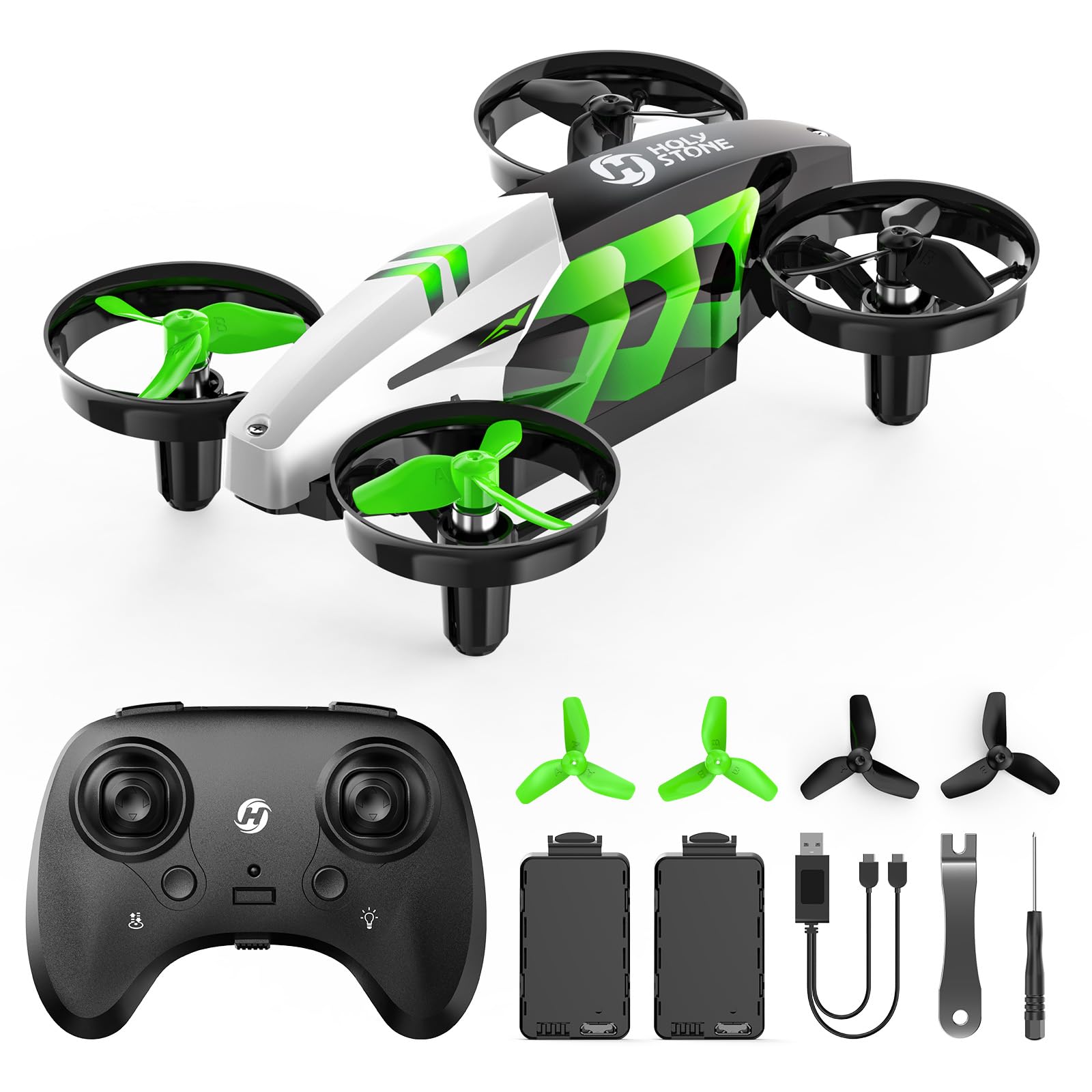
The Holy Stone HS210T stands out because it doubles as a remote-controlled car. Switch to Ground Race Mode and the drone drives across the floor with drifts and spins — a feature that extends play value when indoor flying space is limited. The 360° nylon ABS propeller guards are noticeably more robust than the thin plastic found on cheaper models, and they survive repeated impacts without cracking.
Four different flight postures plus one-button 3D flips give kids enough variety to stay engaged without overwhelming them. The altitude hold function locks the drone at a fixed height, and the two included modular batteries deliver about 16 minutes of total flight time. The 2.4GHz remote supports multiple drones flying simultaneously without interference, which is handy for siblings or playdates.
Some users find the battery attachment and removal process stiff, especially for small hands. Initial trim adjustment is often necessary — the drone may drift left or right out of the box until you calibrate it using the trim buttons. The drone is strictly for indoor use; outdoor flights in any breeze will push it off course quickly.
Why it’s great
- Ground race mode adds driving fun when flying space is tight
- Extra-durable nylon ABS propeller guards resist cracking
- Supports multi-drone play without signal interference
Good to know
- Batteries are difficult for small fingers to remove from the charger
- Needs out-of-box trim adjustment to stop drifting
- Not suitable for outdoor flying in any wind
5. Innofans Spider Mini Drone
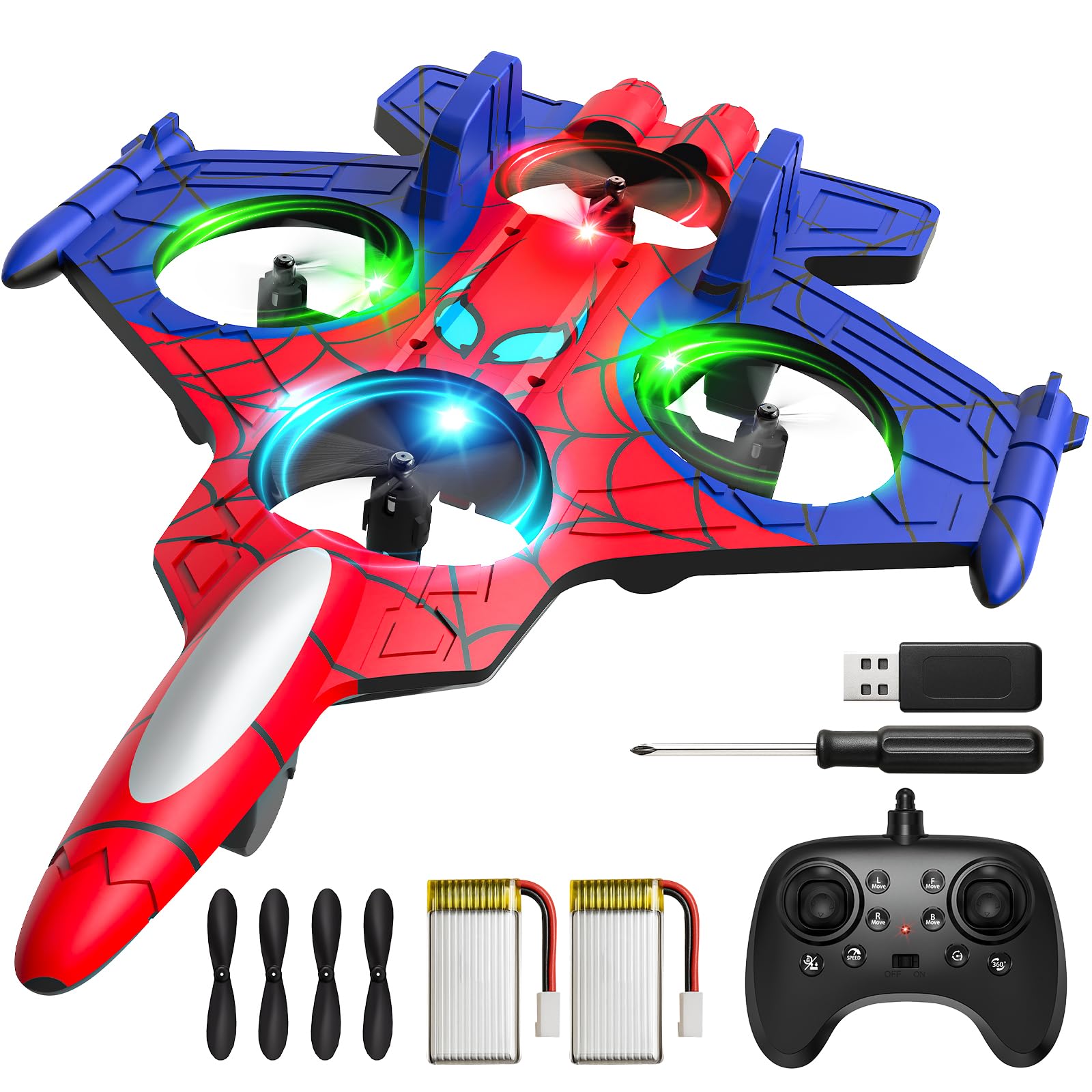
The Innofans Spider Mini is the most affordable entry point in this guide, built from lightweight foam that absorbs crashes better than rigid plastic. Its spider-inspired shape with flashing LED lights appeals to kids who want a cool-looking flyer rather than a camera platform. The drone performs 360° flips, one-button return-to-home, and headless mode — all essential features for a first drone experience.
Two 450mAh batteries provide about 10 minutes of total flight time, which is on the lower end but acceptable given the price point. The 2.4GHz remote offers three speed modes, so an 8-year-old can start on the slow setting and graduate to faster maneuvers. The foam construction means it survives crashes that would shatter a plastic drone, though the prop guards are less substantial than those on more expensive models.
Some buyers report that the drone struggles to hold altitude consistently, requiring constant throttle adjustment that frustrates younger pilots. The camera listed in some ad variations is absent from this specific model — confirm the “Spider” version before purchasing. The foam body picks up dirt and scuffs quickly, and the drone is strictly an outdoor toy since the foam can create drag indoors.
Why it’s great
- Lightweight foam construction survives hard crashes without breaking
- Spider design with LED lights looks exciting to young kids
- Three speed modes let beginners progress at their own pace
Good to know
- Altitude hold is inconsistent, requiring frequent throttle input
- Foam body attracts dirt and scuffs after outdoor use
- No camera despite some listings suggesting otherwise
FAQ
Is an 8-year-old coordinated enough to fly a drone?
How much flight time should I expect from a kid’s drone?
Can an 8-year-old fly a drone with a camera?
Final Thoughts: The Verdict
For most families, the best drone for 8 year olds is the SIMREX X800 because it combines optical flow stability, 30 minutes of total flight time, and a 1080P camera in a lightweight package. If you want the safest indoor option with active obstacle avoidance, grab the SYMA X100. And for a budget-friendly outdoor stunt drone that survives repeated crashes, nothing beats the Innofans Spider Mini.

Mo Maruf
I created WellFizz to bridge the gap between vague wellness advice and actionable solutions. My mission is simple: to decode the research and give you practical tools you can actually use.
Beyond the data, I am a passionate traveler. I believe that stepping away from the screen to explore new environments is essential for mental clarity and physical vitality.