Our readers keep the lights on and my smoothie glass nicely filled. As an Amazon Associate, I earn from qualifying purchases.
Getting cement wall paint wrong means a weekend of work washed away by the first rain or a scuff that reveals raw, dusty gray underneath. Cement is thirsty, alkaline, and textured in ways regular wall paint simply cannot handle. The right coating locks onto that porous surface, blocks moisture, and delivers a finish that stays intact through seasons of abuse.
I’m Mohammad Maruf — the founder and writer behind WellFizz. I have spent hundreds of hours analyzing technical specs, reading application reports, and comparing chemical formulations across dozens of concrete and masonry coatings to understand what actually bonds to bare cement and what just peels off.
This guide breaks down the best cement wall paint for basement walls, garage floors, patios, and vertical masonry. Every product here was selected for its real adhesion to uncoated concrete and its resistance to moisture, alkali, or foot traffic. I’ve focused on legitimate waterproofing claims, real coverage rates, and the fast-dry or low-fume features that matter when you are painting in a tight space like a basement or garage.
How To Choose The Best Cement Wall Paint
Selecting a coating for cement surfaces requires looking past color and sheen. The chemistry between the paint and the alkaline concrete substrate determines whether the finish bonds permanently or flakes off within months. Here are the three specifications that separate reliable cement paints from general-purpose wall paints.
Waterproofing and Hydrostatic Pressure
For basement walls or retaining walls that sit against damp soil, standard paint does nothing. You need a formulation that resists positive hydrostatic pressure — the force of water pushing from behind the wall. The higher the PSI rating, the more water pressure the coating can handle without blistering or delaminating. A rating of 12 psi, for example, is appropriate for most below-grade concrete walls.
Alkali Resistance
Fresh cement is highly alkaline, often reaching a pH of 12 or 13. Standard latex paint reacts with this alkalinity and saponifies — turning sticky, discoloring, and losing adhesion. Quality masonry paints are formulated to withstand pH levels up to 13, forming a chemical barrier that neutralizes the alkali before it can attack the binder. If you are painting new concrete, this spec is non-negotiable.
Finish Type and Surface Application
The finish determines both appearance and function. Semi-gloss and satin finishes are easier to clean and work well on vertical basement walls that may collect splashes. Flat or matte finishes hide surface imperfections better but are harder to wash. For horizontal cement floors in garages or patios, look for slip-resistant textured finishes or coatings explicitly rated for foot and vehicle traffic. The finish also affects how thickly the paint can be applied — some textured coatings fill hairline cracks, while smooth stains require a perfectly prepped surface.
Quick Comparison
On smaller screens, swipe sideways to see the full table.
| Model | Category | Best For | Key Spec | Amazon |
|---|---|---|---|---|
| INSL-X WaterBlock | Waterproofing | Basement walls & foundations | 12 psi hydrostatic pressure | Amazon |
| KILZ Decorative Coating | Textured | Patios & driveways | Fills hairline cracks | Amazon |
| RUST BULLET DuraGrade | Industrial | Garages & basements | No etching required | Amazon |
| Rust-Oleum Concrete & Garage | Epoxy-Acrylic | Garage floors | UV & weather resistant | Amazon |
| INSL-X TuffCrete | Acrylic Stain | Horizontal & vertical masonry | 300–400 sq ft coverage | Amazon |
| Glidden Porch and Floor | Multi-Surface | Wood & concrete decks | Scratch & scuff resistant | Amazon |
| Glidden Total Interior | All-in-One | Painted masonry & trim | Paint & primer in one | Amazon |
In‑Depth Reviews
1. INSL-X WaterBlock Acrylic Masonry Waterproofer

This is the product to reach for when water is actively leaking through a block wall. The WaterBlock formulation is rated to withstand 12 psi of hydrostatic pressure, which is enough to hold back groundwater on most residential poured-concrete or cinder-block foundation walls. The acrylic base resists alkali up to pH 13, so it bonds to fresh masonry without the saponification that destroys ordinary paints. Coverage is limited to 75 to 125 square feet per gallon, which is thinner than standard wall paint — but that density is exactly what allows two coats to form a continuous waterproof membrane.
User reports consistently show that two coats on properly prepared interior basement walls stop leaks that have persisted for ten years. The included can opener and stir stick reduce friction for first-time users. The paint dries fast enough that a second coat can typically be applied the same day if surface temperatures stay between 50°F and 90°F. On horizontal applications like retaining-wall caps, performance holds but the semi-gloss finish is easier to clean than flat alternatives.
The main limitation is the coverage area — a single gallon may not finish a standard basement wall in one go, especially on rough block where the paint soaks in aggressively. Buyers should order extra gallons to compensate for surface texture. The white base cannot be tinted to dark colors without compromising the waterproof warranty, so color options are limited.
Why it’s great
- Withstands 12 psi hydrostatic pressure — genuine waterproofing
- Alkali resistant up to pH 13, safe for new concrete
- Fast drying, recoat same day in optimal conditions
Good to know
- Coverage is only 75–125 sq ft per gallon, very thick
- Limited color offerings — white is the flagship
- Requires specific surface and air temperature range for cure
2. KILZ Decorative Concrete Coating

This coating is engineered for horizontal cement surfaces where appearance and traction matter equally. The formula packs a speckled aggregate that gives a stone-like look while filling hairline cracks up to a certain width. It resists hot tire pick-up, meaning parked vehicles won’t peel the coating when the asphalt gets hot. The acrylic base also handles UV exposure and household chemicals without fading, making it a legitimate candidate for driveways, pool decks, and walkways.
Drying times are competitive — one hour to the touch and three to four hours before recoating. Full cure takes 72 hours, but light foot traffic is allowed after 24. Coverage depends heavily on the surface; smooth concrete may need two coats, while rough masonry can call for four. Users report that using a black foam roller (specifically the Rust-Oleum #306214) produces the best texture. The gray color is neutral enough to anchor most outdoor color palettes.
Several buyers note that the tan variant dries browner than the swatch suggests, so ordering a sample quart first is wise if color matching is critical. The coating also requires a thorough surface prep: etching or sanding to remove gloss, then cleaning to remove all dust. Some users needed three to four coats over a white primer to achieve full hide, which eats into the coverage per gallon.
Why it’s great
- Fills hairline cracks for a smoother surface
- Hot tire pick-up resistant for driveways
- Fast to touch in one hour
Good to know
- Color can deviate from online swatches
- May need three to four coats on rough concrete
- Not suitable for vertical walls
3. RUST BULLET DuraGrade Concrete Paint

RUST BULLET’s DuraGrade eliminates the most tedious part of painting concrete — the acid etching step. The formula adheres directly to clean, dry concrete without primer or etching, which saves a full day of prep for a two-car garage. The coating is industrial-grade, resisting heavy foot traffic, vehicle weight, and common garage chemicals like oil and antifreeze. It is UV and weather resistant, so it works as a floor paint for both indoor basements and outdoor patios.
The gloss finish creates a shiny, wet look that many users report still holding strong after five years in midwestern freeze-thaw cycles with road salt exposure. Coverage is listed at 300 to 350 square feet per gallon per coat, though several users report needing three coats for full hide over stained concrete. The paint is thick and should be applied in thin coats using a sturdy roller to avoid bubbles. Drying time varies with humidity, but two to three days between coats is common in dry air.
The biggest drawback is the strong odor. Multiple reviews emphasize the need for a respirator and gloves, and mineral oil is required to clean paint off skin — regular soap does not work. Also, the coverage claims are optimistic; one user covering 575 square feet needed 2.5 gallons for two coats, exceeding the estimate by a significant margin. Extra paint cannot be returned, so careful measurement is essential.
Why it’s great
- No acid etching or primer needed — saves prep time
- Holds up to extreme weather and road salt
- Resistant to oil, grease, and chemicals
Good to know
- Strong fumes require a respirator and ventilation
- Coverage is often less than stated
- Non-refundable if over-ordered
4. Rust-Oleum Concrete & Garage Floor Paint and Primer

This one-part epoxy-acrylic from Rust-Oleum sits at the intersection of durability and ease of use. The formula is UV and weather resistant, so it can handle both garage floors and covered outdoor patios without yellowing. The satin finish is glossy enough to look like a wet seal but not slippery underfoot. Coverage is listed at 300 to 400 square feet per gallon, which is competitive for this category, and the paint can be applied with a standard roller.
Users frequently describe the consistency as similar to thin Elmer’s glue, which means the first coat soaks into porous concrete aggressively. Multiple thin coats — three applied 24 hours apart — produce a uniform matte-satin finish. One user painted a concrete deck around a pool and achieved a beautiful wet look. The paint adheres well to properly cleaned concrete, but some reviews warn that it can scratch off with a fingernail if the surface was not thoroughly prepared or if a top coat was skipped.
The primary concern is that the one-part epoxy is not as hard as a two-part epoxy system. For garages that see heavy traffic, hot tire pick-up, or dropped tools, this may not be enough. Several reports of delamination on basement floors that were not perfectly sealed suggest that surface prep is more critical here than with some competitors. Still, for an average homeowner’s garage, this paint offers excellent value and an approachable application process.
Why it’s great
- Easy to roll on, no complex mixing
- UV resistant — won’t yellow in sunlight
- Generous coverage at 300–400 sq ft per gallon
Good to know
- Thinner consistency requires three coats
- Not as hard as two-part epoxy
- Surface prep is critical for adhesion
5. INSL-X TuffCrete Waterborne Acrylic Concrete Stain

This INSL-X product blurs the line between stain and paint. Applied in one coat, it stains the concrete with a translucent finish that shows the natural texture beneath. Two coats produce an opaque painted look. The waterborne acrylic formula makes cleanup easy — soap and water — and the coating resists cleaning detergents, oils, and scrubbing without fading. Coverage is 300 to 400 square feet per gallon, making it one of the more economical options from a purely volumetric standpoint.
Users applying it to new concrete (three months old) report that no etching or grinding was required, as the stain is self-priming and self-sealing. One detailed review described using a Wagner cordless sprayer for multiple coats and achieving a custom random look by diluting with 20 percent water. The Desert Sand color matches many house exteriors and holds up well on horizontal surfaces like sidewalks and porch slabs. The finish is durable enough that painted concrete around a house and fountain slab survived regular foot traffic without flaking.
The color can be lighter than the color chart suggests, particularly when applied as a single coat. Some users received the wrong color on large orders, and the consistency changes as it dries — shifting from a paint-like wet look to a stained matte appearance. This product is best for homeowners who want color on their concrete without the thick film build of a waterproofing paint. It is not appropriate for below-grade basement walls that face hydrostatic water pressure.
Why it’s great
- Self-priming and self-sealing on new concrete
- Can be applied as a one-coat stain or two-coat paint
- Easy cleanup with soap and water
Good to know
- Color dries lighter than the chart
- Inconsistent color on multi-gallon orders
- Not a waterproof membrane for wet basements
6. Glidden Grab-N-Go Porch and Floor Paint

Glidden’s Porch and Floor paint is a workhorse for outdoor decking, porch floors, and concrete steps that see regular foot traffic. The satin finish resists scratches and scuffs while maintaining color retention over seasons of sun exposure. Coverage reaches up to 400 square feet per gallon, and the paint dries to the touch in two to four hours, with recoat possible after eight hours. The formulation includes a waterproofing element that sheds rain on sloped wood or concrete surfaces.
Users consistently praise the one-coat coverage over wood, particularly when applied in direct sunlight at temperatures around 70°F. The light gray color works well as a cool-surface coating for pool decks — one reviewer verified that the paint stayed non-slip even when wet. Multiple users noted that the consistency was perfect, neither too thick nor too thin, and that it leveled nicely without leaving lap marks.
Quality control is inconsistent. Several reviews mention cans containing paint that was hard and lumpy from the start, even after machine shaking, indicating possible storage or age issues. Another user specifically called out the “fast drying” claim as misleading, noting that their paint dried no faster than any standard floor paint. This is not a true waterproofing paint for below-grade masonry — it is a tough porch paint that works best on well-prepped wood or sealed concrete above ground.
Why it’s great
- Excellent one-coat coverage on wood decks
- Resists scratches and scuffs
- Satin finish stays non-slip when wet
Good to know
- Some cans arrive with hardened paint
- “Fast drying” claim contested by users
- Not a waterproof membrane for basements
7. Glidden Total Interior Wall Paint & Primer All-in-One
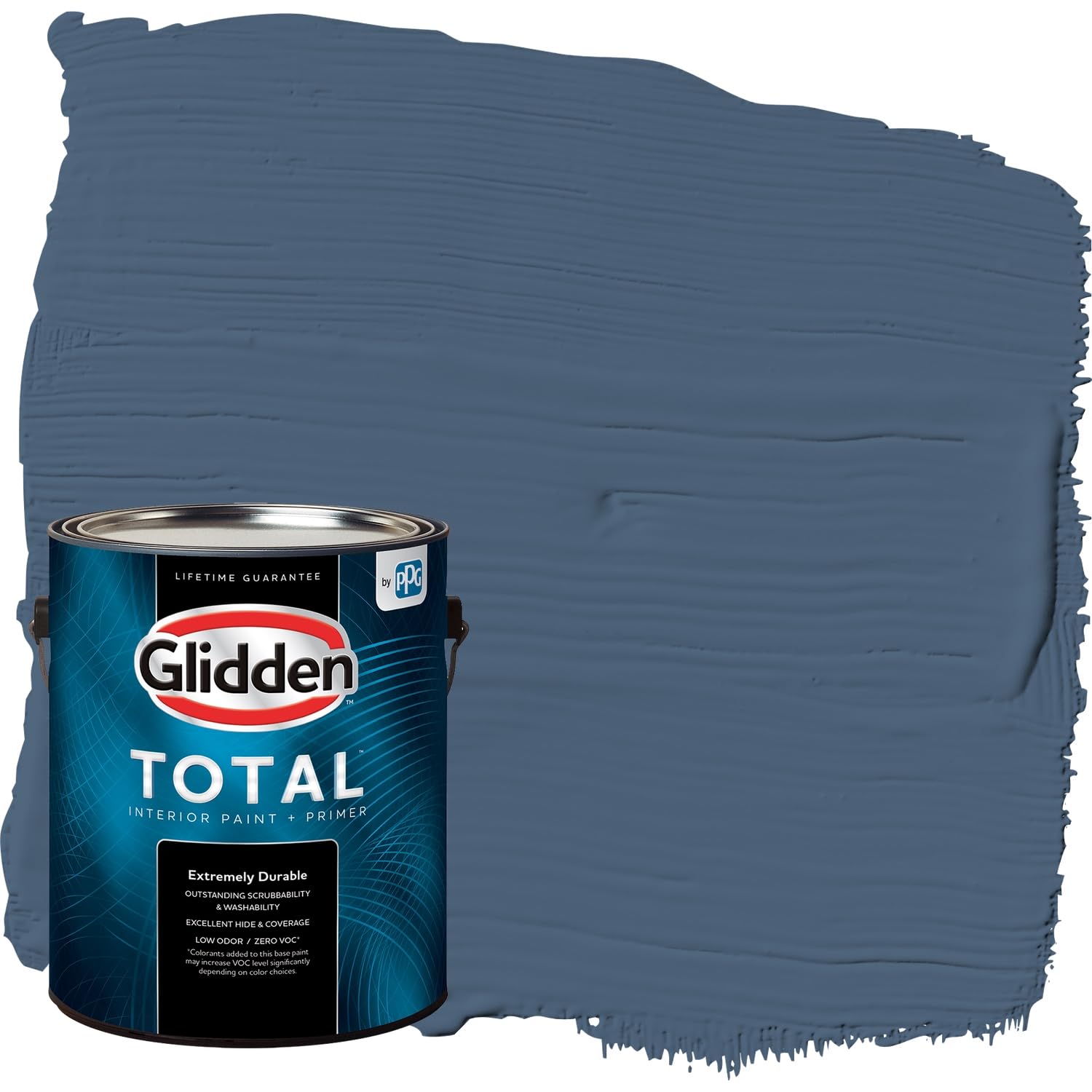
This Glidden paint is formulated for interior walls, ceilings, and trim on properly prepared drywall, plaster, masonry, wood, and metal. It is not a specialized masonry or waterproof coating, but it does bond to cement surfaces that have been primed or previously painted. The all-in-one paint and primer formulation provides good hide and coverage on darker surfaces when used with the right base. The semi-gloss finish offers outstanding scrubbability, which is useful for basement playrooms or laundry rooms where walls get dirty.
Customers praise the Blue Fjord color specifically for use on doors and furniture, with several noting that the can design includes clips for reopening and resealing — a small but appreciated quality-of-life feature. The paint dries quickly with a mild odor, making it suitable for interior use in occupied homes. Coverage is up to 400 square feet per gallon, and the low-VOC formulation keeps indoor air quality reasonable even after multiple coats.
This paint is not a solution for damp basement walls or unprimed cinder block. It lacks alkali resistance and will fail on fresh concrete. A significant batch error is documented where paint labeled as a color came out pure white, requiring a return. For decorative trim on interior masonry or for refreshing a painted cement accent wall, this is an affordable option. For structural waterproofing or raw cement, it is the wrong tool.
Why it’s great
- Paint and primer in one reduces coats on prepped surfaces
- Easy-to-reclose can design
- Low VOC for interior use
Good to know
- Not formulated for fresh or unsealed cement
- Documented batch color errors
- Lacks alkali resistance for new masonry
FAQ
Can I use regular interior paint on cement walls?
Do I need to prime bare concrete before painting?
How do I prepare a cement wall for painting?
How many coats of cement paint do I need?
Can I tint white cement wall paint to a dark color?
Final Thoughts: The Verdict
For most users, the best cement wall paint winner is the INSL-X WaterBlock because it solves the core problem of moisture penetration with a verified 12 psi hydrostatic rating while resisting alkalinity up to pH 13. If you want a decorative, slip-resistant coating for a patio or driveway, grab the KILZ Decorative Concrete Coating. And for an industrial-grade floor paint that skips the etching step and resists vehicle traffic and chemicals, nothing beats the RUST BULLET DuraGrade.

Mo Maruf
I created WellFizz to bridge the gap between vague wellness advice and actionable solutions. My mission is simple: to decode the research and give you practical tools you can actually use.
Beyond the data, I am a passionate traveler. I believe that stepping away from the screen to explore new environments is essential for mental clarity and physical vitality.