Our readers keep the lights on and my smoothie glass nicely filled. As an Amazon Associate, I earn from qualifying purchases.
Separating plasma from whole blood or isolating cellular components in a clinical or research setting demands a centrifuge that delivers consistent relative centrifugal force (RCF) without excessive noise or vibration. The wrong machine wastes precious samples, extends processing cycles, and introduces variability into protocols that require repeatable results.
I’m Mohammad Maruf — the founder and writer behind WellFizz. In assembling this guide, I’ve analyzed the build quality, motor technology, rotor versatility, and safety mechanisms of dozens of models to help you select a unit that fits both your clinical workflow and lab footprint.
Whether you run a medical office, a dental practice specializing in PRP therapy, or a small biochemistry lab, understanding the differences between brushless DC motors, maximum RCF ratings, and programmable memory matters. This guide breaks down the seven most compelling options to help you choose the best centrifuge machine for your specific separation needs.
How To Choose The Best Centrifuge Machine
Selecting a benchtop centrifuge goes deeper than picking the highest RPM number. Your protocol — whether it’s platelet-rich plasma (PRP) preparation, urine sedimentation, or general serum separation — dictates the minimum RCF and the rotor configuration you need. A machine that hits 4,000 RPM but maxes out at 1,800 xg may still be inadequate for protocols requiring 3,000 xg.
RCF — The True Measure of Separation Force
Relative centrifugal force (RCF), expressed in multiples of gravity (xg or g), is calculated from rotor radius and rotational speed. Two machines spinning at the same RPM can deliver different RCF values if their rotor diameters differ. Always compare RCF ratings, not just RPM numbers, when evaluating separation power.
Rotor Versatility and Tube Compatibility
Fixed-angle aluminum alloy rotors provide faster separation and greater durability than swing-bucket rotors, but they require the correct tube adapters. If you work with 2 mL, 5 mL, 10 mL, and 15 mL tubes interchangeably, look for a model that ships with multiple adapters or offers an easily adjustable rotor to accommodate different sizes.
Noise Floor and Vibration Control
A centrifuge that drifts across the benchtop during a spin cycle compromises safety and sample integrity. Machines with cast-iron bases, vacuum-suction feet, and maintenance-free brushless DC motors typically maintain a noise output below 60 dB and remain anchored during high-speed runs.
Safety & Programmable Memory
Electronic lid interlocks prevent accidental opening while the rotor is in motion, and automatic lid release upon completion saves time in busy labs. For high-volume or multi-protocol workflows, a machine with stored program slots — allowing you to recall specific time and speed combinations without manual re-entry — dramatically reduces setup errors.
Quick Comparison
On smaller screens, swipe sideways to see the full table.
| Model | Category | Best For | Key Spec | Amazon |
|---|---|---|---|---|
| ONiLAB PRP Benchtop 6x15mL | Mid-Range | Quiet PRP prep | 5,000 RPM / 2,600 xg / ≤56 dB | Amazon |
| LABHOUSE LC500-8 Programmable | Premium | Multi-protocol labs | 4,000 RPM / 1,967 xg / 9 programs | Amazon |
| LAB FISH 8-Tube (B0BKPB46RH) | Mid-Range | 8-tube capacity | 5,000 RPM / 3,074 xg / aluminum rotor | Amazon |
| JOANLAB LC-8S Benchtop | Mid-Range | Balanced speed & support | 5,000 RPM / 3,074 xg / 8-tube rotor | Amazon |
| Microyn MT-Spinplus-6 | Premium | Long-term durability | 5,000 RPM / 3,074 xg / US support | Amazon |
| CGOLDENWALL 8x15mL | Entry-Level | Budget-conscious labs | 4,000 RPM / 1,880 xg / ≤65 dB | Amazon |
| LAB FISH 6-Tube (LC-6S-1) | Entry-Level | Compact starter unit | 5,000 RPM / 3,074 xg / 6-tube rotor | Amazon |
In‑Depth Reviews
1. ONiLAB Lab PRP Benchtop Centrifuge 6x15mL/10mL/7mL/1.5-5mL

The ONiLAB unit earns its top position by combining a whisper-quiet brushless DC motor (measured ≤56 dB) with an LCD display that lets you toggle between RPM and RCF readouts — a feature that saves math errors during protocol setup. The cast-iron base and vacuum-suction feet keep the 11.4-pound chassis anchored even during unbalanced load events, which several users noted triggered a clear error code rather than mechanical damage.
Two quick-start programs (P1/P2) eliminate repetitive keypad entry for common spin profiles, and the fixed-angle rotor accepts 6 tubes of varying sizes — 1.5 mL, 5 mL, 7 mL, 10 mL, and 15 mL — via included adapters. The lid interlock prevents opening until the rotor has fully stopped, and the automatic release upon completion shaves seconds off multi-sample workflows.
Amazon reviews consistently highlight the quiet operation and responsive customer support. One reviewer reported a damaged circuit board after an unbalanced spin; the manufacturer sent free replacement parts from overseas within a week. This level of post-purchase service, combined with CE, cTUVus, and FCC certifications, makes the ONiLAB a standout choice for clinics and mobile phlebotomists who demand reliability without racket.
Why it’s great
- Two programmable quick-start presets reduce setup time
- Exceptionally quiet operation below 56 dB
- Lightweight yet stable with vacuum-suction feet
Good to know
- 6-tube capacity max; not ideal for high-volume labs
- Power adapter input is a known weak point per long-term user feedback
2. LABHOUSE Centrifuge Machine PRP PRF LC500-8
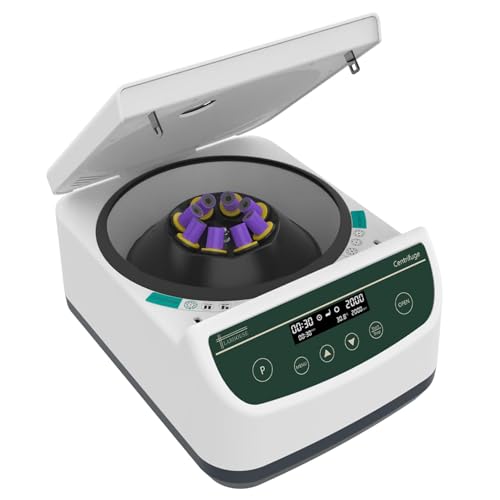
The LABHOUSE LC500-8 stands apart with nine programmable memory slots — more than any other model in this roundup — allowing a busy lab to store distinct protocols for PRP, PRF, urine sediment, and general serum separation without re-entering time and speed parameters. The wide-voltage technology compensates for fluctuations in mains power, delivering consistent 500–4,000 RPM performance even in facilities with unstable electrical supply.
An 8-well fixed-angle aluminum rotor accepts 2 mL, 5 mL, 10 mL, and 15 mL tubes, and the dedicated vibration protection circuit cuts power if the imbalance exceeds safe amplitude — a safeguard that prevents catastrophic rotor failure. The chamber ventilation design pulls heat away from the sample chamber, protecting temperature-sensitive specimens during extended 30-plus-minute spin cycles.
At 19.58 pounds, this is the heaviest unit reviewed, which contributes to its rock-solid stability during high-gravity runs. User feedback notes that the machine requires careful tube balancing, but those who follow protocol report clean separations with minimal debris. For labs transitioning between multiple assay types daily, the LABHOUSE’s preset memory alone justifies its premium position.
Why it’s great
- Nine custom program slots for rapid protocol recall
- Vibration and temperature protection circuits
- Heavy cast construction minimizes bench drift
Good to know
- Maximum RCF of 1,967 xg is lower than some alternatives
- Requires precise sample balancing to avoid shutdown
3. LAB FISH Lab Benchtop Centrifuge Machine 8 x 2ml/5ml/10ml/15ml

The LAB FISH 8-tube model delivers the highest relative centrifugal force in this mid-range tier — 3,074 xg at 5,000 RPM — making it a strong candidate for protocols that demand aggressive separation, such as platelet-rich plasma isolation from whole blood. The aluminum alloy fixed-angle rotor provides low-speed braking for fast, effective pelleting without resuspending the pellet, and the LCD display shows time, speed, and RCF simultaneously.
Users in dental offices and small pathology labs praise the machine’s quiet operation and portability; the unit weighs 14.27 pounds and fits easily into a travel case for mobile phlebotomy work. The intelligent electronic lock automatically opens the lid when the run ends, and an audible alarm sounds if the rotor stops due to a fault. The SHORT button allows quick pulses without entering a full program, useful for brief spins.
Build quality is consistent with the mid-range positioning: the ABS casing is durable but not industrial-grade, and the vacuum-suction feet hold well on smooth surfaces. Customer reviews are uniformly five-star, with specific callouts for adapter availability and straightforward setup. For labs that need eight-tube throughput at a mid-range investment, this LAB FISH unit hits the performance-per-dollar sweet spot.
Why it’s great
- High 3,074 xg RCF suitable for PRP and serum separation
- 8-tube capacity with adapter set for multiple tube sizes
- Compact and lightweight for travel
Good to know
- Casing is ABS plastic rather than steel
- Limited to fixed-angle rotor; no swing-bucket option
4. JOANLAB Benchtop Centrifuge Machine LC-8S

The JOANLAB LC-8S mirrors the LAB FISH 8-tube machine in specs — 5,000 RPM, 3,074 xg max RCF, aluminum rotor — but distinguishes itself through a reputation for responsive manufacturer support. Multiple reviewers described situations where minor malfunctions (blank screen, stuck lid) were resolved with a no-cost replacement unit within two weeks, even months after purchase.
The LCD display alternates between RPM and RCF in real time, and the SHORT button enables instantaneous centrifugation for quick sample sedimentation without setting a timer. The hollow soundproof cover and suction feet keep noise to a comfortable level — several users specifically noted the machine is quieter than previous bench-top units they had rotated through. The transparent perspective window lets you observe the spin cycle without opening the lid.
One concerning review reported a lid button failure that required the emergency pull-cord to release, though the same reviewer did not mention contacting support. For most buyers, the combination of 8-tube capacity at 3,074 xg, relatively low weight (14.02 pounds), and strong manufacturer backup makes the JOANLAB a reliable runner-up to the top picks.
Why it’s great
- Excellent customer support with free replacement reported
- Real-time RPM and RCF display toggle
- Large 8-tube capacity with adapter set
Good to know
- Lid button reliability concerns reported by a small number of users
- Similar specs to LAB FISH 8-tube at slightly higher cost
5. Microyn Digital Bench-top Centrifuge MT-Spinplus-6

The Microyn MT-Spinplus-6 is the only model in this lineup with US-based customer support, a detail that matters when a benchtop centrifuge is a daily-use tool and downtime costs real money. Despite being listed as a lower-tier product in raw data due to its 6-tube capacity, its build quality and longevity push it into a premium recommendation: reviewers report multiple years of trouble-free operation, with one user replacing the unit only after two years of continuous use.
The digital display shows time (20 seconds to 99 minutes) and speed (100–5,000 RPM, up to 3,074 xg), though note the panel displays speed divided by 10 — multiply the shown number by 10 for actual RPM. A dedicated short-spin button provides convenience, and the lid interlock automatically releases upon completion to save time. The 40-watt brushless motor is efficient and generates minimal heat.
The primary drawback is the 6-tube maximum, which may be restrictive for high-throughput operations. Additionally, one reviewer noted a lid alignment quirk: the new unit’s lid required a specific closing angle to avoid popping open during a run. For buyers prioritizing durability, US-based warranty service, and user-tested longevity, the Microyn remains a strong premium choice despite its smaller capacity.
Why it’s great
- US-based manufacturer support and one-year warranty
- Proven track record of multi-year daily use
- Efficient 40W brushless motor with short-spin button
Good to know
- 6-tube capacity only; no 8-tube option
- Speed display format can cause confusion (multiply by 10)
6. CGOLDENWALL Centrifuge Machine Lab PRP Benchtop 8x15ml
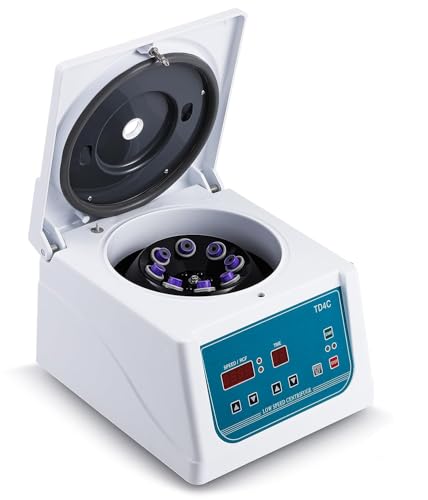
The CGOLDENWALL 8x15ml machine brings an 8-tube capacity to an entry-level price point, making it an accessible option for clinics and labs with modest separation demands. The speed range of 100–4,000 RPM and a maximum centrifugal force of 1,880 xg suit basic PRP preparation, urine sedimentation, and general clinical chemistry protocols where extreme g-force is not required.
The LED display allows intuitive adjustment of time (1–99 minutes or continuous mode), speed, and RCF. The lid lock reduces noise and air resistance, keeping the operating sound below 65 dB — audible but not disruptive in a small office setting. The machine weighs 14.72 pounds and occupies a compact footprint, fitting easily on crowded benchtops.
Customer reviews are uniformly positive, with users praising its reliability for blood processing and its stability during operation. The timer only begins counting after the set speed is reached, a design detail that ensures accurate run timing. For budget-conscious buyers who need eight-tube throughput and are willing to accept a lower maximum RCF, this CGOLDENWALL model delivers dependable performance without stretching the budget.
Why it’s great
- 8-tube capacity at an entry-level investment
- Easy-to-read LED display with timer and RCF
- Compact and stable on the benchtop
Good to know
- Maximum 1,880 xg may limit use in high-RCF protocols
- Notable noise level up to 65 dB
7. LAB FISH PRP Lab Benchtop Centrifuge Machine 6 x 15ml

The LAB FISH 6-tube model shares the same motor and electronics platform as its 8-tube sibling but offers a lower entry point for buyers who process fewer samples per batch. The 500–5,000 RPM range delivers up to 3,074 xg, matching the mid-range leaders in raw separation power. The fixed-angle aluminum rotor accepts 2 mL, 5 mL, 10 mL, and 15 mL tubes via adapters, and the LCD display provides intuitive control over time (10 seconds to 99 minutes 59 seconds).
Users in dental clinics and small pathology labs consistently note the unit’s quiet operation and ease of use. The instant centrifugation (SHOT) button allows quick spins without a formal program, and the intelligent electronic lock opens the lid automatically at the end of each cycle. The compact dimensions and 14.3-pound weight make it suitable for both fixed benchtop installation and travel to satellite offices.
While the 6-tube capacity is the clear trade-off, the machine’s high RCF output and proven reliability in PRP applications mean that buyers sacrificing tube count aren’t sacrificing separation quality. Customer reviews are overwhelmingly five-star, with specific praise for the machine’s stability and simple setup. For solo practitioners or mobile phlebotomists who prioritize portability and power, this LAB FISH 6-tube is a logical choice.
Why it’s great
- High 3,074 xg RCF in a compact 6-tube form
- Instantaneous spin button for quick protocols
- Lightweight and easy to travel with
Good to know
- 6-tube limit may require multiple runs for larger batches
- Adapters not included for all tube sizes
FAQ
What is the difference between RPM and RCF in a centrifuge machine?
Can I use a PRP centrifuge for other types of laboratory separation?
How important is a programmable memory in a centrifuge machine?
Why does my centrifuge machine vibrate or drift across the benchtop?
Final Thoughts: The Verdict
For most users, the best centrifuge machine winner is the ONiLAB PRP Benchtop Centrifuge because it balances ultra-quiet brushless motor performance, two programmable presets, and a compact footprint that fits small medical offices and mobile phlebotomy kits. If you need nine stored protocols and built-in vibration protection for a multi-protocol lab, grab the LABHOUSE LC500-8. And for a budget-friendly eight-tube workhorse with solid separation power, nothing beats the CGOLDENWALL 8x15mL.

Mo Maruf
I created WellFizz to bridge the gap between vague wellness advice and actionable solutions. My mission is simple: to decode the research and give you practical tools you can actually use.
Beyond the data, I am a passionate traveler. I believe that stepping away from the screen to explore new environments is essential for mental clarity and physical vitality.