Our readers keep the lights on and my smoothie glass nicely filled. As an Amazon Associate, I earn from qualifying purchases.
You smell dampness or see a suspicious dark patch near the baseboard, and suddenly every real estate listing, every basement storage box, and every kids’ play mat feels suspect. That creeping worry about hidden mold growth is one of the most common stressors for homeowners renting or buying older properties. A do-it-yourself test is the first concrete step toward either peace of mind or a plan of action — cutting out the anxiety and guesswork that often lead to unnecessary, expensive professional inspections.
I’m Mohammad Maruf — the founder and writer behind WellFizz. My analysis of this category involves cross-referencing lab accreditation claims, culture-medium formulations, test-count-to-coverage ratios, and the real chemical mechanisms (settle plates vs. swab vs. tape lift) that separate a useful screening tool from an expensive placebo.
The best way to confirm visible or suspected mold contamination without calling in a specialist is to use a best diy mold test kit that matches your specific surface or air-sampling scenario while including clear protocols for interpreting or submitting results.
How To Choose The Best DIY Mold Test Kit
Unlike a simple air freshener purchase, choosing a mold kit requires matching three variables: what surface or air volume you suspect is contaminated, whether you need a lab-certified document for a landlord or doctor, and how many rooms you need to sample in one batch. The wrong test method (e.g., an air settle plate for a wall cavity leak) can miss hidden growth entirely.
Sampling Method: Air Settle vs. Surface Swab vs. Tape Lift
Air settle plates detect airborne spores circulating in a room — ideal for general air quality screening but poor at pinpointing a hidden patch behind drywall. Surface swabs actively wipe a specific spot (baseboard, shower grout) and transfer spores onto a growth medium. Tape lifts (adhesive strips pressed onto a surface) preserve the exact physical structure of the spore for more detailed identification under microscopy. Kits that only supply one type of sampling tool limit your ability to investigate different scenarios.
Lab Accreditation and Report Depth
If you need a formal document for a real estate disclosure, insurance claim, or health provider, the laboratory performing the analysis should be AIHA-LAP, LLC accredited. Some brands include free lab analysis and same-day reporting; others charge a per-sample fee that can exceed the kit price. Skim the fine print: genus-level identification lists a mold family (e.g., Aspergillus), while species-level identification drills into the specific species (e.g., Aspergillus niger). Genus-level is usually sufficient for home screening decisions.
Quick Comparison
On smaller screens, swipe sideways to see the full table.
| Model | Category | Best For | Key Spec | Amazon |
|---|---|---|---|---|
| DIY Mold 3 Test Kit (Seeml Labs) | Lab Analysis | Certified lab report with same-day turnaround | AIHA-LAP, LLC accredited lab included | Amazon |
| Detekt Indoor Air Quality Test Kit | Dual Screening | Simultaneous mold and bacteria testing | 12 tests total (6 mold + 6 bacteria) | Amazon |
| SRUI 14-Test Mold Kit | Multi-Room Count | Covering large homes with 14 sampling points | 14 individual agar dish tests | Amazon |
| Evviva Sciences 10-Test Kit | Surfaces | Targeted surface swab and air testing | 10 agar petri dishes + 10 swabs | Amazon |
| lkiochil 8-Test Mold Kit | Budget Screening | Quick spot-checking small spaces | 8 settle-plate tests per kit | Amazon |
In‑Depth Reviews
1. DIY Mold 3 Test Kit (Seeml Labs)

The Seeml Labs kit is the desktop solution for anyone who wants a legally defensible, AIHA-LAP, LLC accredited lab report without paying extra per-sample fees. The package contains one swab and two tape strips — an intentionally minimal but precise toolkit designed for targeted surface sampling rather than broad air screening. The lab fee is baked into the purchase price, so there are no surprises when you request analysis.
Users consistently highlight the responsive customer service: lab analyst Michael proactively calls to confirm receipt and explain results, and the report arrives the same day the lab receives your sample. The report lists all detected mold genera with concentrations, though it does not differentiate between species or provide specific toxin levels — a distinction that matters for academic rigor but is rarely actionable for home remediation decisions.
The three-test format is best suited to investigating a single suspected area (a patch of ceiling, a wall behind furniture, a musty closet). If you need to sample multiple rooms simultaneously, the low test count forces you to choose which spots get analyzed first. For the buyer who values a certified document and direct lab support over raw quantity of tests, this is the most cost-efficient route.
Why it’s great
- AIHA-accredited lab analysis included at no additional cost
- Professional one-on-one support from lab staff
- Same-day turnaround on report after sample receipt
Good to know
- Only 3 test opportunities per purchase — limited for multi-room homes
- Report provides genus-level data, not species or mycotoxin specifics
2. #1 Indoor Air Quality Test Kit by Detekt
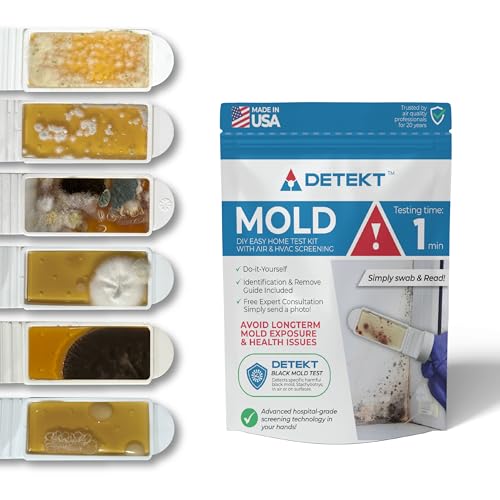
Detekt’s kit carves out a unique spot in the category by packaging six mold tests alongside six bacteria tests within the same box. That split means you can investigate a water-damaged area for microbial growth beyond just fungi — useful if you suspect sewage backup, floodwater contamination, or a humidifier breeding ground. The sterile agar test slides replace traditional petri dishes with a slimmer, less spill-prone format.
The brand includes secure vent clips (no messy tape) for HVAC testing and provides a species identification guide that covers over three times the number of mold species compared to most competitor booklets. If the visual chart leaves you uncertain, Detekt offers free expert photo consultation — you email images of your growth and a specialist walks through the identification. No lab mailing or extra shipping fees are required.
Because the kit uses settle-plate and surface-swab methods without a spore-trap pump, the air-sampling component is semi-quantitative at best. Users report visible growth in as early as 24 hours, but the non-quantified result is best used as a binary screening tool (mold present vs. absent) rather than a measure of airborne spore concentration.
Why it’s great
- Simultaneous mold and bacteria testing from one kit
- Free expert photo consultation included with purchase
- Includes HVAC vent clips — no adhesive tape required
Good to know
- Air sampling is semi-quantitative — not a spore trap equivalent
- Species identification guide requires careful interpretation
3. SRUI 14-Test Mold Kit

The SRUI kit is the volume play for homeowners who want to sample every room, each HVAC vent, and the crawlspace in a single testing session without running out of dishes. Fourteen individual agar plates allow you to run air settle tests in the living room, kitchen, bedrooms, basement, and attic simultaneously — then use the remaining plates for targeted surface swabs on any suspicious spots.
Instructions are straightforward: expose each dish to the test environment for a specific time, seal, and incubate. Users report clear growth within 2–4 days, and the included identification guide offers photo references for common genera. The standout feature is the free photo-based lab analysis — you snap a picture of the grown culture and email it to SRUI, who returns a professional written assessment within 24–36 hours. This bridge between self-testing and formal analysis removes the ambiguity that frustrates many buyers.
The trade-off is that the photo assessment is visual only, so it cannot detect spores that fail to germinate on the specific agar medium or differentiate between morphologically similar species. For a first-pass survey — find out whether there is a mold problem and which general type you are dealing with — the 14-test format plus free lab consultation is unmatched in sheer coverage.
Why it’s great
- 14 tests allow simultaneous multi-room and HVAC coverage
- Free photo analysis with detailed written report within 36 hours
- Includes swabs and air-exposure protocols in one box
Good to know
- Photo evaluation is visual only — non-germinating spores are missed
- Identification booklet could benefit from clearer photography
4. Evviva Sciences 10-Test Mold Kit

Evviva Sciences takes a different approach: ten pre-filled agar petri dishes teamed with ten cotton-tipped swabs, putting the focus on active surface collection rather than passive air settling. That swab-heavy design is an advantage when you have visible discoloration on a specific joint, baseboard, or grout line and want to confirm whether it is active fungal growth or just staining.
The kit includes a downloadable mold information guide (PDF) with side-by-side photos and risk descriptions, though veteran users note the guide simplifies identification and lacks the granular detail needed to differentiate similar-looking species. For genus-level confirmation of a suspicious spot, the swab method is faster and more reliable than air sampling because you transfer the exact suspect material onto the growth medium.
The optional lab analysis from an AIHA-certified facility costs extra per dish. Some buyers report frustration with turnaround time and communication when opting for the paid lab route, while others found the self-interpretation sufficient for their needs. If you are comfortable comparing growth appearance against the included guide and only need a yes/no answer about a specific surface, the out-of-box experience is straightforward and affordable.
Why it’s great
- Ten swabs enable detailed surface testing of specific spots
- Downloadable guide provides visual references for common molds
- AIHA-certified lab available for paid confirmatory analysis
Good to know
- Lab analysis costs extra per dish and may cause delays
- Guide is simplified — species-level ID requires microscope or paid lab
5. lkiochil 8-Test Mold Kit
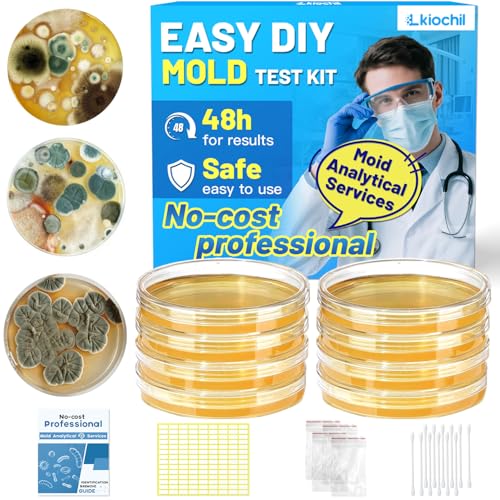
This eight-test kit from lkiochil is the entry-level workhorse for renters or first-time buyers who want a quick binary check — is there an active airborne mold problem in this space? — without the learning curve of swab protocols or lab submission forms. The instructions ask you to mark each test location, expose the settle plate for the designated period, and incubate at room temperature.
Results appear in 24–48 hours via a color-change card on the test dish: visible growth and a shift from the original agar color indicate contamination. Users who tested after a known water leak reported that two of six samples grew mold, allowing them to pinpoint the affected zone before calling a professional. A separate buyer used the kit to refute an expensive ductwork quote, finding no black mold after testing multiple locations.
The design lacks swabs, tape strips, or vent clips, so it cannot sample surfaces directly or test inside HVAC ducts with precision. It is also entirely self-interpreted — there is no included species guide beyond a basic contamination-level color reference. For a budget-conscious quick spot check in a small apartment or single room, the simplicity is a virtue. For a detailed investigation of a suspected hidden source, you will outgrow this kit immediately.
Why it’s great
- Eight tests provide generous sampling for a single room or small home
- Color-change indication makes results easy to read without lab training
- Saved one user thousands by disproving an expensive remediation quote
Good to know
- No swabs or tape — surface and HVAC testing is not supported
- No guided species identification, only a general growth indicator
FAQ
Can a DIY kit detect black mold (Stachybotrys)?
How many tests do I really need for a 3-bedroom house?
What does genus-level identification tell me that species-level does not?
Should I test room air or surfaces first?
How long should I incubate the plates before reading results?
Final Thoughts: The Verdict
For most users, the best diy mold test kit winner is the DIY Mold 3 Test Kit by Seeml Labs because it eliminates guesswork with accredited lab analysis included and same-day turnaround — the closest you can get to a professional report without the professional fee. If you want to also screen for bacteria and use free photo consultation instead of mailing samples, grab the Detekt Indoor Air Quality Test Kit. And for comprehensive multi-room coverage that lets you test every floor and crawlspace in one go, nothing beats the SRUI 14-Test Mold Kit.

Mo Maruf
I created WellFizz to bridge the gap between vague wellness advice and actionable solutions. My mission is simple: to decode the research and give you practical tools you can actually use.
Beyond the data, I am a passionate traveler. I believe that stepping away from the screen to explore new environments is essential for mental clarity and physical vitality.