Our readers keep the lights on and my smoothie glass nicely filled. As an Amazon Associate, I earn from qualifying purchases.
A cycling camera does more than just record a ride — it acts as a silent witness, a performance logger, and a storytelling tool all in one. Whether you are dodging city traffic, descending a gravel fire road, or logging a century ride, the footage you capture is only as valuable as the camera’s ability to stay stable, stay powered, and stay out of your way. That is what separates a purpose-built cycling camera from a general action cam that happens to be mounted on handlebars.
I’m Mohammad Maruf — the founder and writer behind WellFizz. I have spent hundreds of hours analyzing specifications, studying real-world user reviews, and cross-referencing stabilization algorithms, battery chemistries, and mounting compatibility to identify the cameras that genuinely earn a spot on a bike. This guide focuses on what matters most to cyclists: vibration resistance, runtime per charge, GPS data integration, and low-light sensor performance for dawn and dusk rides.
This guide evaluates nine models ranging from dedicated bike radar cameras to premium 8K action cams to help you find the best cycling camera for your specific riding style and budget.
How To Choose The Best Cycling Camera
Cycling cameras sit at the intersection of action videography and safety equipment. The wrong choice means shaky footage that makes you nauseous, a dead battery halfway through a long ride, or a mounting system that rattles loose on the first bump. Before you sort by resolution or price, lock in these four criteria that define a camera’s fitness for cycling duty.
Stabilization: The Difference Between Butter and Jitter
Handlebar vibration at 20 mph on asphalt transmits a constant high-frequency tremor into the camera body. A basic electronic image stabilization (EIS) system using only a 2-axis gyro cannot cancel that tremor, producing footage that looks like a small earthquake. Look for 6-axis gyro stabilization at minimum, and on premium models, horizon-leveling systems such as DJI’s HorizonSteady or GoPro’s HyperSmooth 6.0 with Horizon Lock. These systems eliminate both low-frequency sway (pedal bob) and high-frequency chatter (road vibration) simultaneously.
GPS Integration and Data Overlay
A cycling camera that records speed, distance, elevation, and route coordinates onto the video file transforms raw footage into a ride log. Integrated GPS chips capture this data without requiring a separate cycling computer. The key spec here is GPS acquisition time — sensors that lock satellites in under 60 seconds are essential for rides that start under tree cover or between tall buildings. Cameras without built-in GPS can still record coordinates if paired with a phone app, but that drains the phone battery and introduces wireless latency.
Battery Runtime and Hot-Swap Strategy
A century ride typically lasts 5 to 8 hours. No single camera battery covers that duration at 4K resolution. The smart approach is a camera with user-swappable batteries and a dual charger. Pay attention to runtime at your target resolution and frame rate, not the manufacturer’s optimistic “1080p standby” figure. Models that support USB-C pass-through power are ideal for ultra-long brevets or bikepacking trips where you carry a power bank. Cold weather (below 40°F) can cut lithium-ion capacity by 30% — premium Enduro-style batteries handle this much better.
Mounting Versatility and Vibration Dampening
A camera mounted on handlebars with a rigid plastic bracket transmits every bump directly into the footage. Look for cameras that offer either a vibration-dampening mount in the box or compatibility with aftermarket isolators. For safety-focused cyclists, a seat-post mounted rear camera with integrated radar (such as the Garmin Varia series) provides a fundamentally different value proposition: it alerts you to approaching vehicles while recording them. Helmet mounts are ideal for POV footage but shift the camera’s center of mass, which some riders find fatiguing on long days.
Quick Comparison
On smaller screens, swipe sideways to see the full table.
| Model | Category | Best For | Key Spec | Amazon |
|---|---|---|---|---|
| DJI Osmo Action 5 Pro | Premium Mid | All-day rides with horizon-level stabilization | 4 hr battery / 1/1.3″ sensor | Amazon |
| Insta360 Ace Pro 2 | Premium | Low-light cycling and Leica color science | 8K video / 1/1.3″ sensor | Amazon |
| DJI Osmo Action 6 | Flagship | 8K resolution and variable aperture | 50GB built-in / 1/1.1″ sensor | Amazon |
| GoPro HERO13 Black | Premium | 5.3K HDR video and accessory ecosystem | 5.3K60 video / HyperSmooth 6.0 | Amazon |
| Garmin Varia RCT715 | Safety | Rear radar, tail light, and incident recording | 153-yard radar / 1080p30 | Amazon |
| Vantrue F1 | Dash Cam | Front+rear permanent motorcycle/bike dash cam | IP67 / 4K+1080P dual | Amazon |
| Xtra Edge Pro | Value Pro | Budget-conscious 4K cycling enthusiast | 4K60fps / 65ft waterproof | Amazon |
| Hupejos D700 | Bike Computer | Cycling computer + camera 2-in-1 | GPS speed/route / IP65 | Amazon |
| AKASO Brave 4 | Budget | Entry-level handlebar POV on a tight budget | 4K30fps / 90-min battery | Amazon |
In‑Depth Reviews
1. DJI Osmo Action 5 Pro Hiking Combo
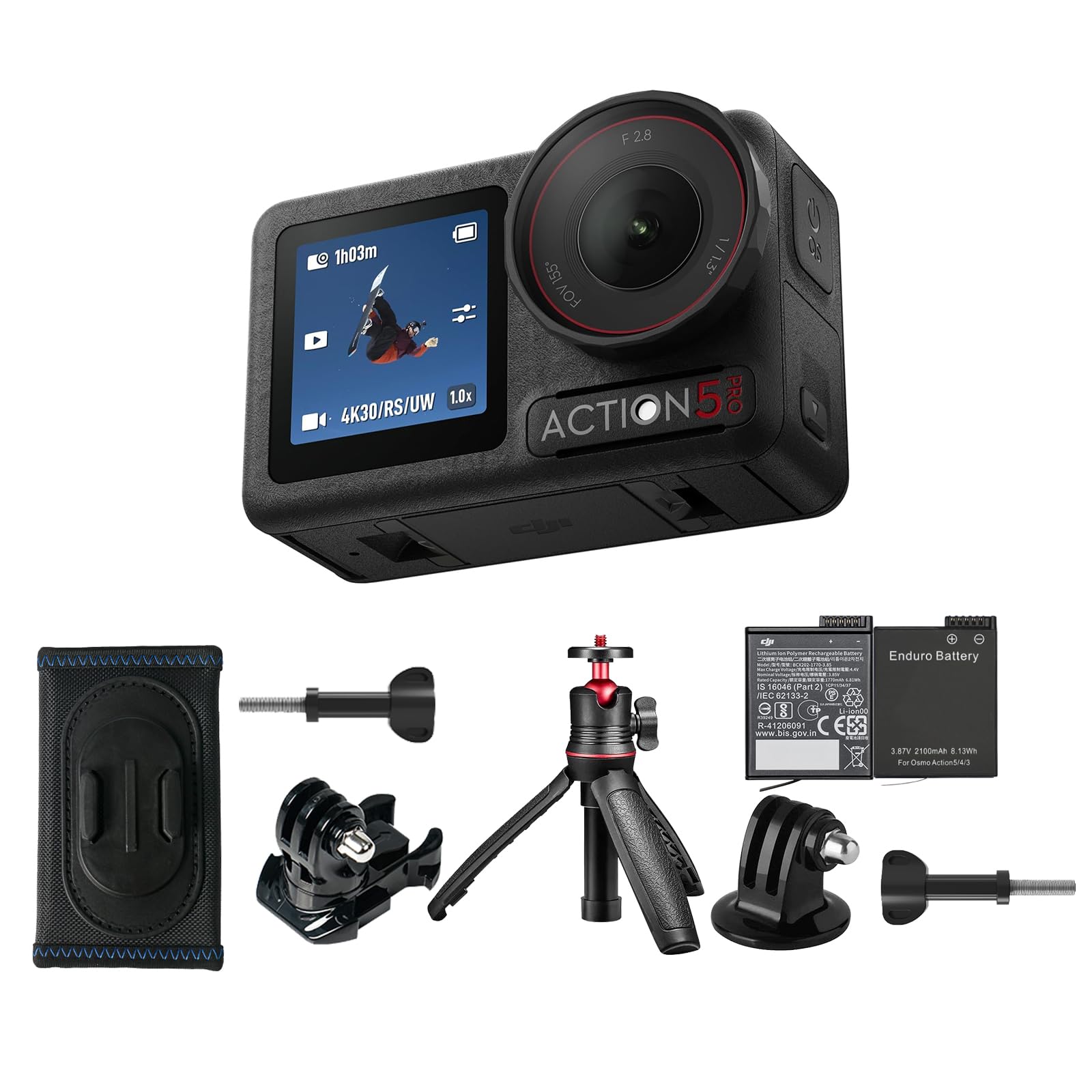
The DJI Osmo Action 5 Pro sits in the sweet spot between professional-grade stabilization and real-world cycling endurance. Its 1/1.3-inch sensor with 2.4µm pixels delivers clean footage even during twilight rides, and the 13.5-stop dynamic range preserves detail in high-contrast scenes where a bike exits a shaded trail into bright sunlight. The 1950mAh Extreme Battery Plus provides 4 hours of continuous recording — enough for most fondo and gran fondo distances without a mid-ride swap.
The 360° HorizonSteady stabilization is the defining feature for cyclists. It eliminates the roll-axis shake that standard EIS cannot handle, meaning your footage stays perfectly level even when you are carving corners on a descent or riding over rumble strips. The Hiking Combo bundle includes an extra battery, a mini extension rod, and a backpack strap mount, which adds versatility beyond handlebar use. The dual OLED touchscreens are readable in direct sunlight, a practical advantage when adjusting settings mid-ride without stopping.
Audio quality is best paired with an external DJI Mic 2 for wind-free vlogging at speed. The built-in microphone captures noticeable wind noise above 15 mph unless you use the optional foam windsock. The IP68 waterproof rating to 20 meters makes it suitable for rainy commutes and post-ride rinse-offs without a housing. Overall, this is the most complete cycling camera package for riders who want one camera that handles everything from bikepacking trips to competitive road racing.
Why it’s great
- Industry-leading HorizonSteady kills roll-axis vibration
- 4-hour battery covers nearly any ride length
- IP68 waterproof to 20m without a case
- Dual OLED screens visible in harsh sunlight
Good to know
- Wind noise is significant without an external mic or foam cover
- Side USB port door can come loose on rough terrain
- Magnetic mounting system requires careful alignment for secure fit
2. Insta360 Ace Pro 2 Bike Bundle
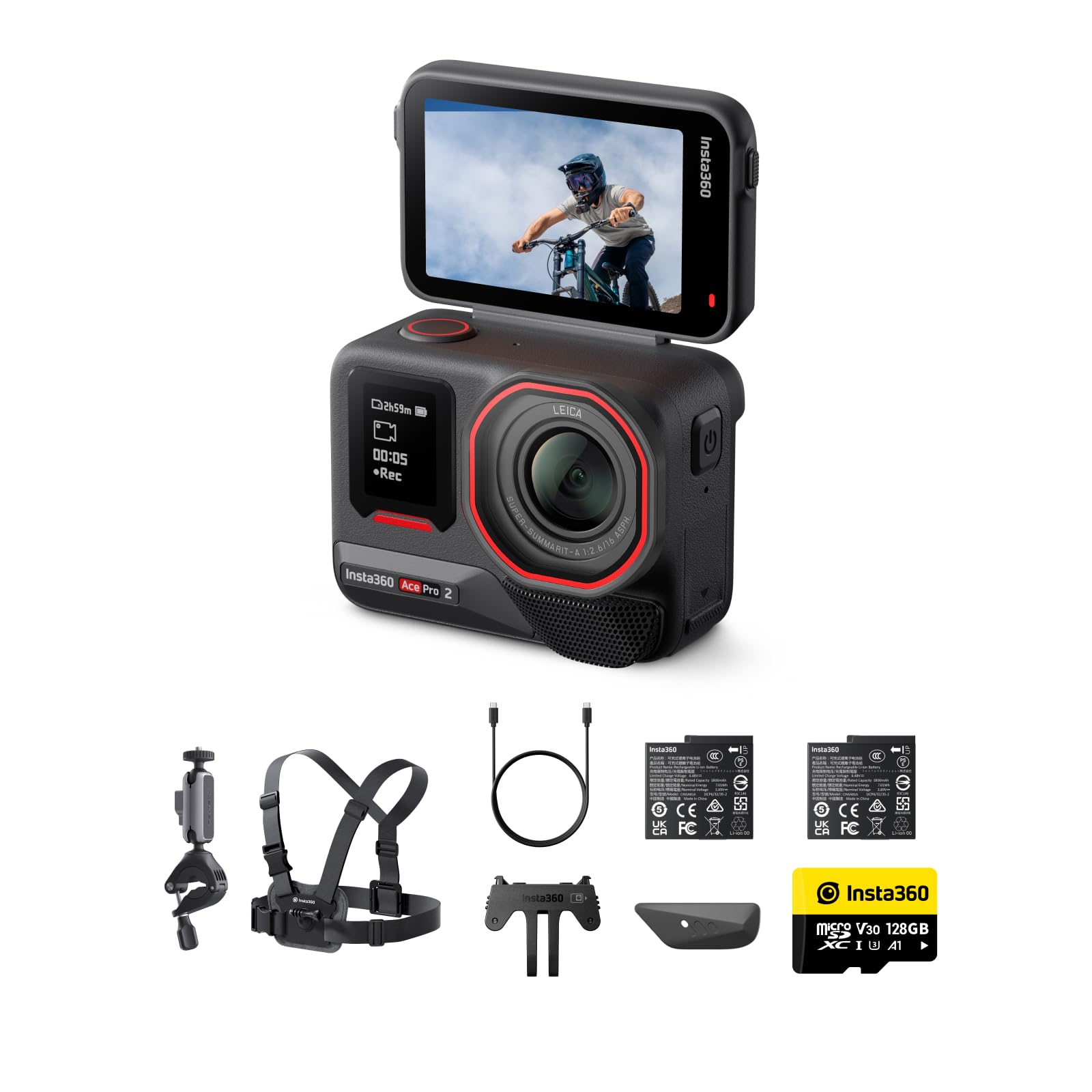
The Insta360 Ace Pro 2 brings a co-engineered Leica Summarit lens and a dedicated Pro Imaging Chip to the cycling category, with the primary advantage being its exceptional low-light performance. The PureVideo mode delivers usable 4K60fps footage in conditions where most action cameras produce noisy, muddy images — think pre-dawn commutes, tunnel sections, or forested singletrack at dusk. The 1/1.3-inch sensor and 13.5-stop dynamic range match the DJI Action 5 Pro for highlight retention, but the Leica color profiles give the footage a noticeably more cinematic look straight out of camera.
The Bike Bundle includes a dedicated bike mounting kit, two batteries, a 128GB microSD card, and the new Wind Guard. The Wind Guard is effective at reducing wind noise during handlebar-mounted vlogging, though it is a physical add-on that can be misplaced. FlowState stabilization combined with the 157° wide-angle lens and MegaView FOV keeps the horizon level during aggressive cornering and braking. The 2.5-inch flip touchscreen has 70% higher pixel density than the previous generation, making it much easier to frame shots in bright sunlight without squinting.
Magnetic mounting makes swapping between handlebar, helmet, and chest mounts seamless — a practical advantage for cyclists who switch disciplines between road, gravel, and mountain biking. The Dual AI Chip enables in-camera highlight detection and auto-editing, which saves post-ride processing time if you share clips frequently. The included battery pair provides roughly 3 hours of combined 4K60fps Active HDR recording, so consider a power bank for rides exceeding 75 miles. The lack of built-in GPS means you rely on the Insta360 app and phone GPS for data overlay, which adds one more device dependency.
Why it’s great
- Best-in-class low-light performance with PureVideo mode
- Leica color science produces rich, filmic footage
- Wind Guard significantly reduces audio interference
- Flip screen is excellent for low-angle and selfie shots
Good to know
- No built-in GPS — speed data requires phone pairing
- Standard bundle lacks a robust tripod or rotation mount
- Battery life in Active HDR mode is under 90 minutes per cell
3. DJI Osmo Action 6 Enhanced Combo
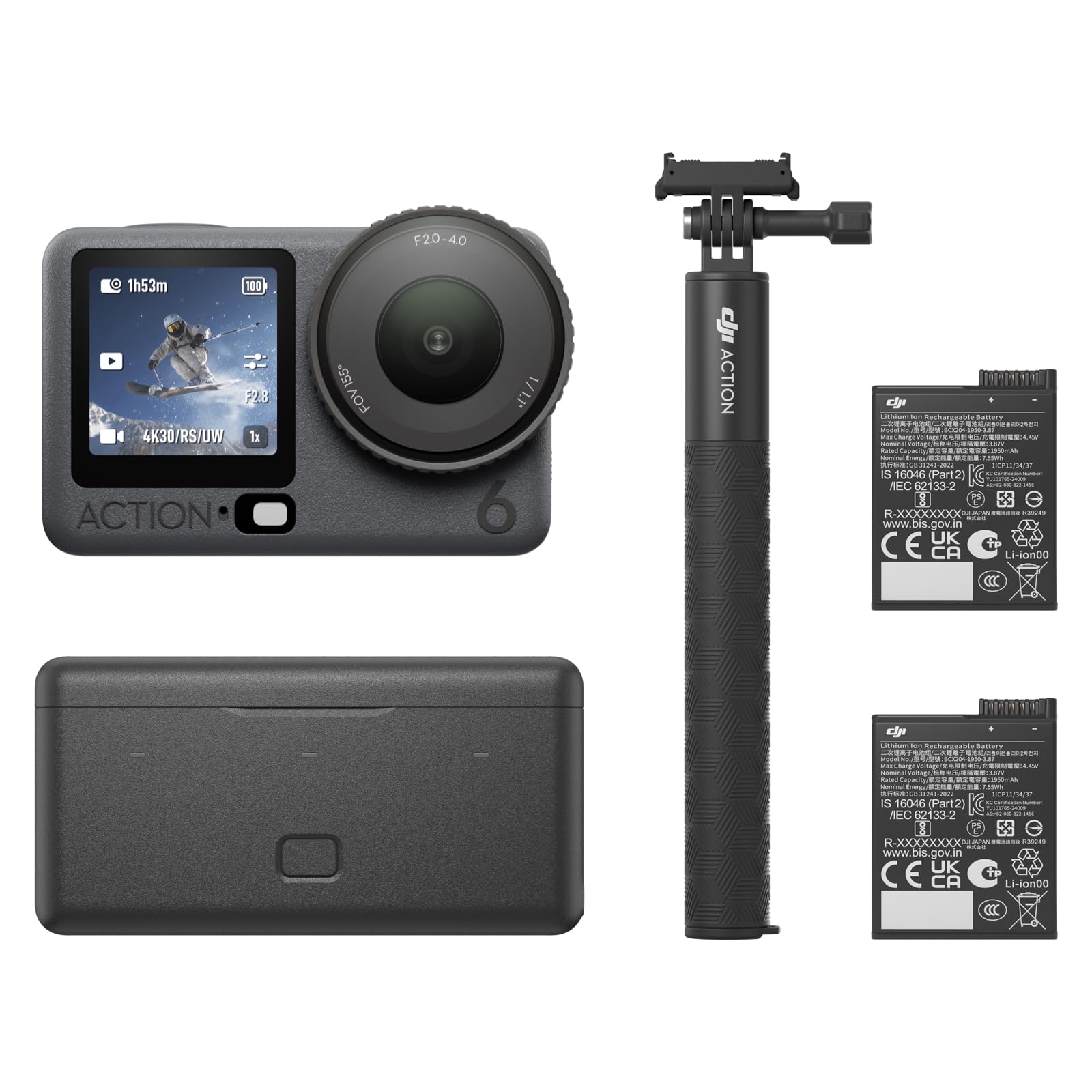
The DJI Osmo Action 6 is the most technically advanced cycling camera on this list, thanks to its 1/1.1-inch square sensor and variable aperture f/2.0–f/4.0 lens — a first for any action camera. The mechanical aperture adjusts to lighting conditions on the fly, reducing the need for ND filters during bright-day rides and opening up wide at dawn or dusk. The sensor oversamples 8K video, allowing reframing in post without visible resolution loss, which is valuable for creating both horizontal and vertical edits from a single ride.
For cyclists, the 50GB of built-in storage is a practical hedge against forgetting a microSD card. Combined with wireless cloud upload, you can back up footage without physically handling the card after a ride. HorizonSteady works up to 4K60fps and keeps the horizon locked even on technical singletrack where the bike pitches and yaws unpredictably. The Enhanced Combo includes a 1.5-meter extension rod, two Extreme Battery Plus cells, and a multifunctional battery case that can charge the camera and a phone simultaneously — a thoughtful touch for bikepackers who carry minimal gear.
The variable aperture introduces one trade-off: at f/4.0, which kicks in automatically under bright sunlight, you lose some of the shallow depth-of-field effect that fixed wide-aperture cameras provide. However, for cycling footage where the primary goal is sharp, stable, all-light recording rather than cinematic background blur, the trade-off is well worth it. The audio capture is the weakest link — the built-in microphone is below average, and the camera requires a separate DJI Mic 2 for decent sound. The magnetic mounting system is identical to the Action 5 Pro’s, which means parts are interchangeable across both DJI models.
Why it’s great
- Variable aperture adapts exposure without ND filters
- 50GB internal storage is a life-saver for long tours
- 1/1.1-inch sensor captures more detail than any competitor
- Enhanced Combo battery case doubles as phone charger
Good to know
- Built-in microphone quality is disappointing at speed
- Aperture closes to f/4.0 in bright light, reducing flexibility
- Touchscreen responsiveness drops inside the waterproof case
4. GoPro HERO13 Black Bundle
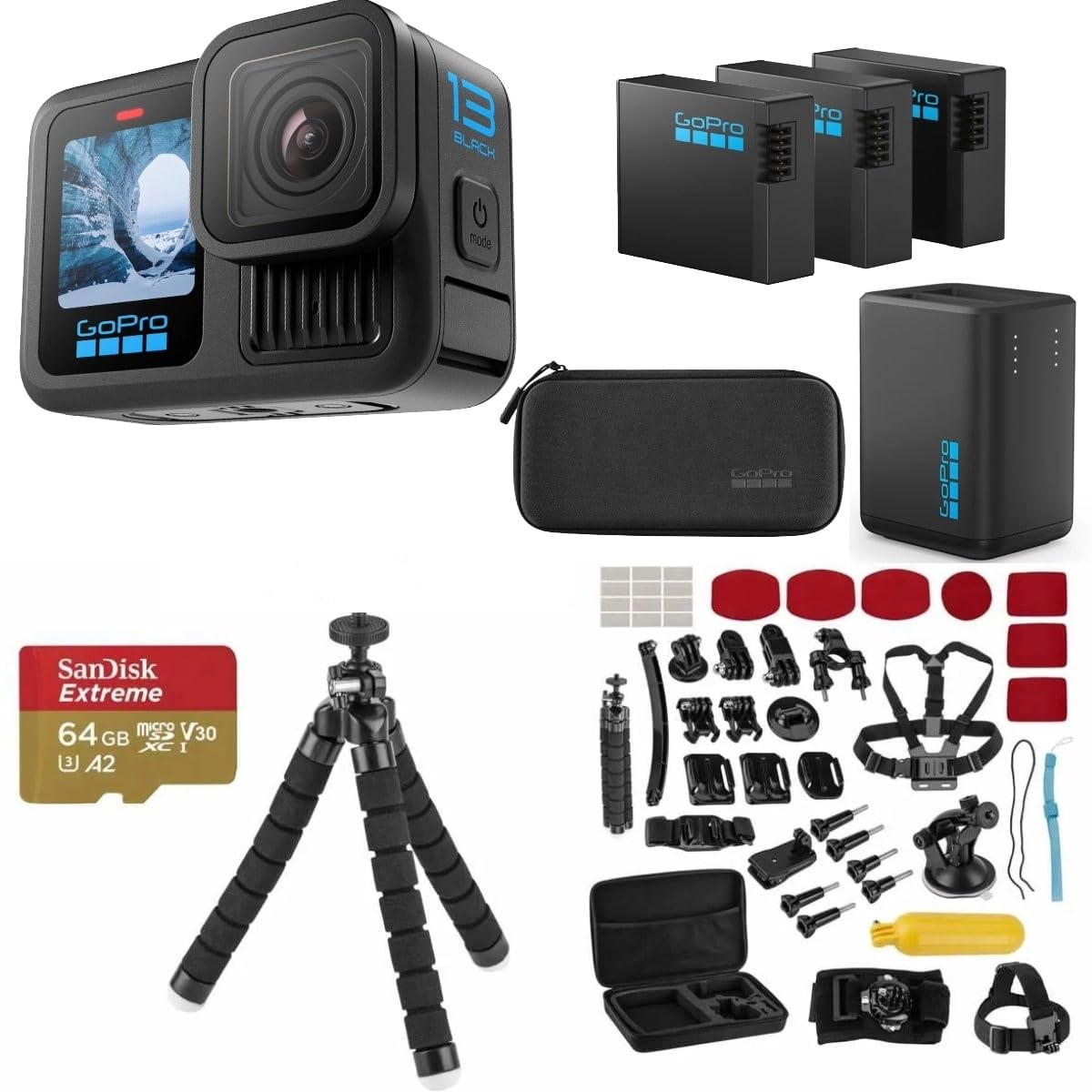
The GoPro HERO13 Black is the most recognizable name in action cameras, and this 47-piece bundle delivers a true ready-to-ride kit. The core advantage is the 5.3K60 HDR video, which has 91% more pixels than standard 4K, giving you substantial cropping and reframing flexibility in post-production. HyperSmooth 6.0 with Horizon Lock is GoPro’s best stabilization yet — it keeps the horizon perfectly level during high-speed descents and eliminates the jello effect that plagued earlier GoPro models on road bikes.
The bundle includes three 1900mAh Enduro batteries and a dual charger. These Enduro cells perform significantly better in cold weather than standard lithium-ion batteries, maintaining runtime down to 14°F (-10°C). That matters for winter cyclists in northern climates. The included 64GB SanDisk card and adhesive helmet mount kit get you started immediately. The HB-Series auto-detect lens system allows swapping to ultra-wide or macro lenses, though the standard lens covers 90% of cycling use cases without modification.
The Achilles’ heel of this bundle is the battery charger inconsistency reported by some users — occasionally one of the three batteries fails to charge. This is a quality-control variance rather than a systemic flaw, but it is worth testing all three batteries immediately upon receipt. The GP-Log and 10-bit color support give advanced editors more latitude for color grading, though casual users will find the auto-mode footage perfectly watchable. The camera measures slightly heavier than DJI’s Action 5 Pro, which is noticeable on long rides when mounted on a helmet rather than the handlebars.
Why it’s great
- 5.3K60 HDR video provides massive reframing headroom
- Enduro batteries excel in sub-freezing temperatures
- Largest accessory ecosystem of any action camera
- GP-Log and 10-bit color for professional post-processing
Good to know
- Bulkier and heavier than DJI equivalents in the same class
- Charger QC has been inconsistent across bundles
- Wind noise management requires third-party accessories
5. Garmin Varia RCT715

The Garmin Varia RCT715 redefines what a cycling camera can be by packaging radar, a tail light, and a camera into a single seat-post-mounted unit. Its primary function is safety: the radar detects vehicles approaching from up to 153 yards (140 meters) behind and alerts you through a paired Garmin Edge computer, a compatible wearable like a Fenix watch, or the Varia smartphone app. The camera continuously records 1080p30 video onto the included 16GB SD card, and if an incident is detected via the accelerometer, it automatically saves footage from before, during, and after the event.
The value of the Varia RCT715 for road cyclists cannot be overstated. The radar provides situational awareness that a forward-facing camera alone cannot deliver — you know exactly how fast a car is approaching and whether it is moving to pass or staying behind you. The tail light operates in solid high, low, day flash, and night flash modes, with battery life ranging from 4 to 6 hours depending on mode, all while recording. The visual and audible alerts reduce the need to constantly check over your shoulder, which improves aerodynamic position and reduces neck strain on long rides.
The camera resolution is the main limitation: 1080p30 is adequate for capturing license plates and incident context but not for cinematic ride recaps. If you want both high-quality forward-facing video and rear safety, you will need to run the Varia in combination with a separate handlebar-mounted camera. The Varia app provides basic footage review and control, but it does not replace a dedicated video editor. Setup with Garmin Edge computers is seamless and near-instant; pairing with third-party head units can be more finicky. The RCT715 is the only camera here that genuinely reduces crash risk rather than just documenting it.
Why it’s great
- Radar detection gives you eyes on traffic you cannot hear yet
- Auto-incident saving preserves critical evidence
- Bright tail light with multiple flash patterns
- Seamless integration with Garmin Edge ecosystem
Good to know
- 1080p30 video is fine for evidence but not for content creation
- Battery life with radar + light + recording at 4 hours is tight for all-day rides
- Works best as a rear safety camera alongside a separate front cam
6. Vantrue F1 Motorcycle Dash Cam

The Vantrue F1 is fundamentally different from the action cameras above — it is a permanent, hardwired dash camera system designed to be installed on a motorcycle or bicycle and left in place. The system records 4K front and 1080P rear video simultaneously through two IP67-rated waterproof cameras that can be mounted on the handlebars, fork, or rear rack. The main DVR unit is weather-sealed and designed to be tucked away inside a frame bag or under the seat, away from rain and vibration.
The key advantages for cyclists are the full-body IP67 waterproofing (every connector, terminal, and camera body is sealed), the built-in GPS that stamps speed and route coordinates onto the video, and the 512GB SD card support for weeks of loop recording. The wired remote control includes a lock button for manually saving footage and a microphone for voice notes. The G-sensor automatically locks footage upon impact, and the loop recording ensures the camera never stops recording as long as power is supplied. The 160° wide-angle front and rear lenses cover three lanes of traffic, capturing license plates and road signs that narrower lenses miss.
The Vantrue F1 is not a content-creation tool — it does not have a screen, and its Wi-Fi connection via the Vantrue app is useful for file transfers and settings but slow for previewing large 4K clips. Installation requires running power cables from the battery or a switched power source, which adds complexity compared to a clip-on action camera. The audio is functional but not vlog-grade, and there is no stabilization beyond the camera’s built-in sensor — footage reflects the bike’s vibration accurately, which is fine for evidence but not for smooth ride edits. For commuters and touring riders who treat their camera as essential safety equipment rather than a filmmaking tool, the F1 is the most reliable long-term solution in this list.
Why it’s great
- Full IP67 waterproofing across all components survives any weather
- GPS speed and route overlay provides strong evidentiary footage
- Supports up to 512GB for weeks of continuous loop recording
- Wired remote with instant save and voice memo is excellent for incident capture
Good to know
- No stabilization means footage shows true bike vibration
- Installation is more involved than a clip-on action camera
- Wi-Fi file transfers are slow for 4K clips
7. Xtra Edge Pro Action Camera
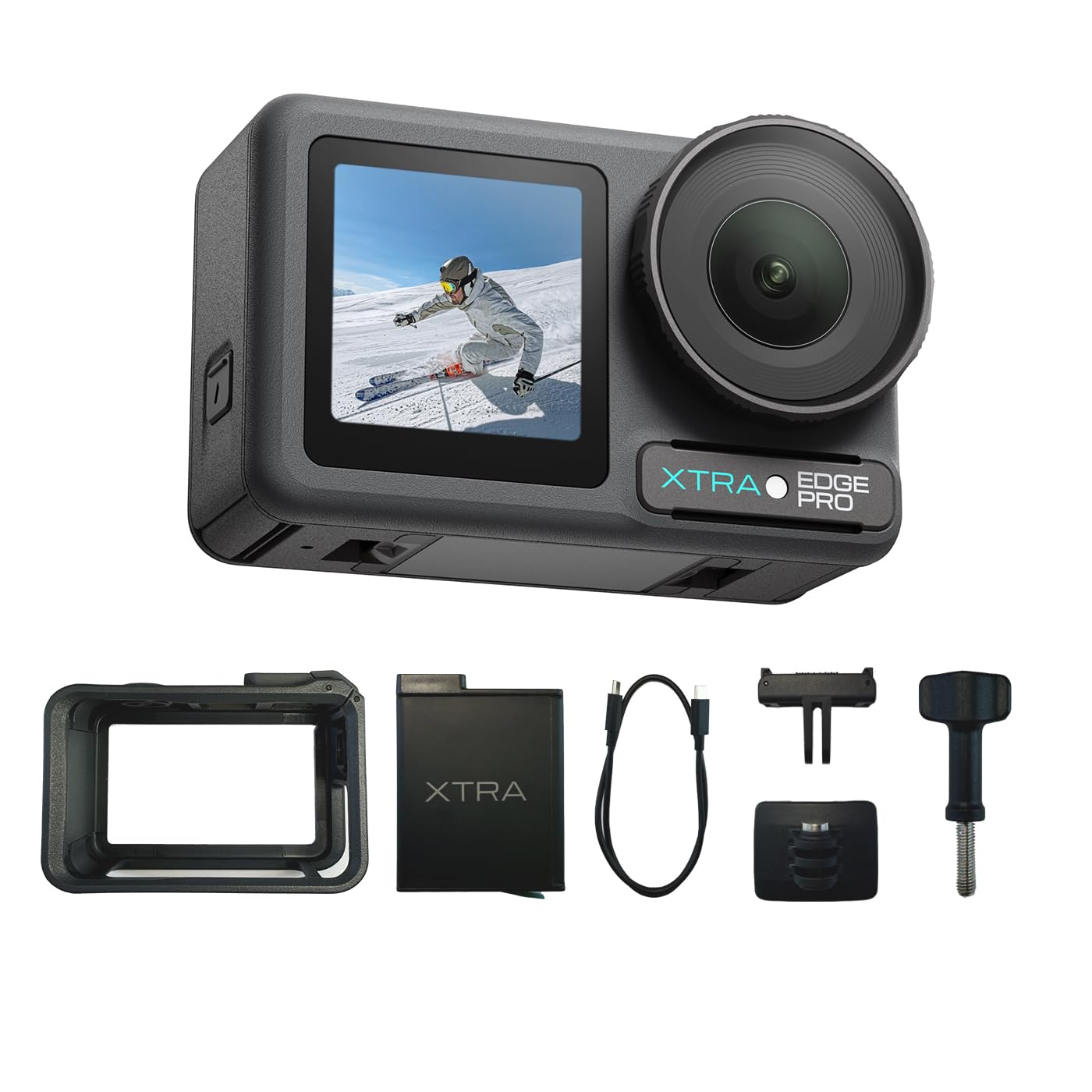
The Xtra Edge Pro delivers premium-tier hardware — a 1/1.3-inch sensor, 4K60fps video, and 65-foot waterproofing without a housing — at a mid-range price point. The large sensor is the same class used in the DJI Action 5 Pro, which means decent low-light performance and good dynamic range for a camera in this segment. The Night View Mode actually works, providing usable footage in dusk and indoor conditions where smaller-sensor cameras produce unusable noise.
The stabilization suite includes 360 Lock, TiltGuard, and MotionMaster, which collectively do a credible job canceling handlebar vibration. It is not as smooth as DJI’s HorizonSteady, but the gap is narrower than the price difference suggests. The bundle includes a cold-resistant battery, a dual-facing mount adapter, and a protective frame. The 240-minute advertised battery life is achievable at 1080p30; at 4K60fps, expect closer to 90 minutes per charge, which is standard for the category.
The trade-offs appear in the accessory compatibility and software polish. The mount uses a proprietary system that is not directly compatible with GoPro or DJI mounts, so you will be locked into Xtra Edge’s ecosystem unless you use a third-party adapter. The mobile app is functional but lacks the refinement of DJI’s Mimo app or GoPro’s Quik app — pairing can take multiple attempts, and file transfer speeds are slower. The build feels rugged, and user reviews report it surviving tumbles off mountain bikes without damage. For value-conscious cyclists who want a large sensor and solid stabilization without paying flagship prices, the Xtra Edge Pro is a strong contender.
Why it’s great
- Large 1/1.3-inch sensor punches above its price class
- Waterproof to 65ft without a case, great for wet commutes
- Good stabilization bundle with 360 Lock and TiltGuard
- Includes cold-resistant battery for winter riding
Good to know
- Proprietary mount system limits third-party compatibility
- Mobile app pairing and file transfer are slower than top rivals
- 4K60fps battery runtime is around 90 minutes
8. HUPEJOS D700 Sport DV
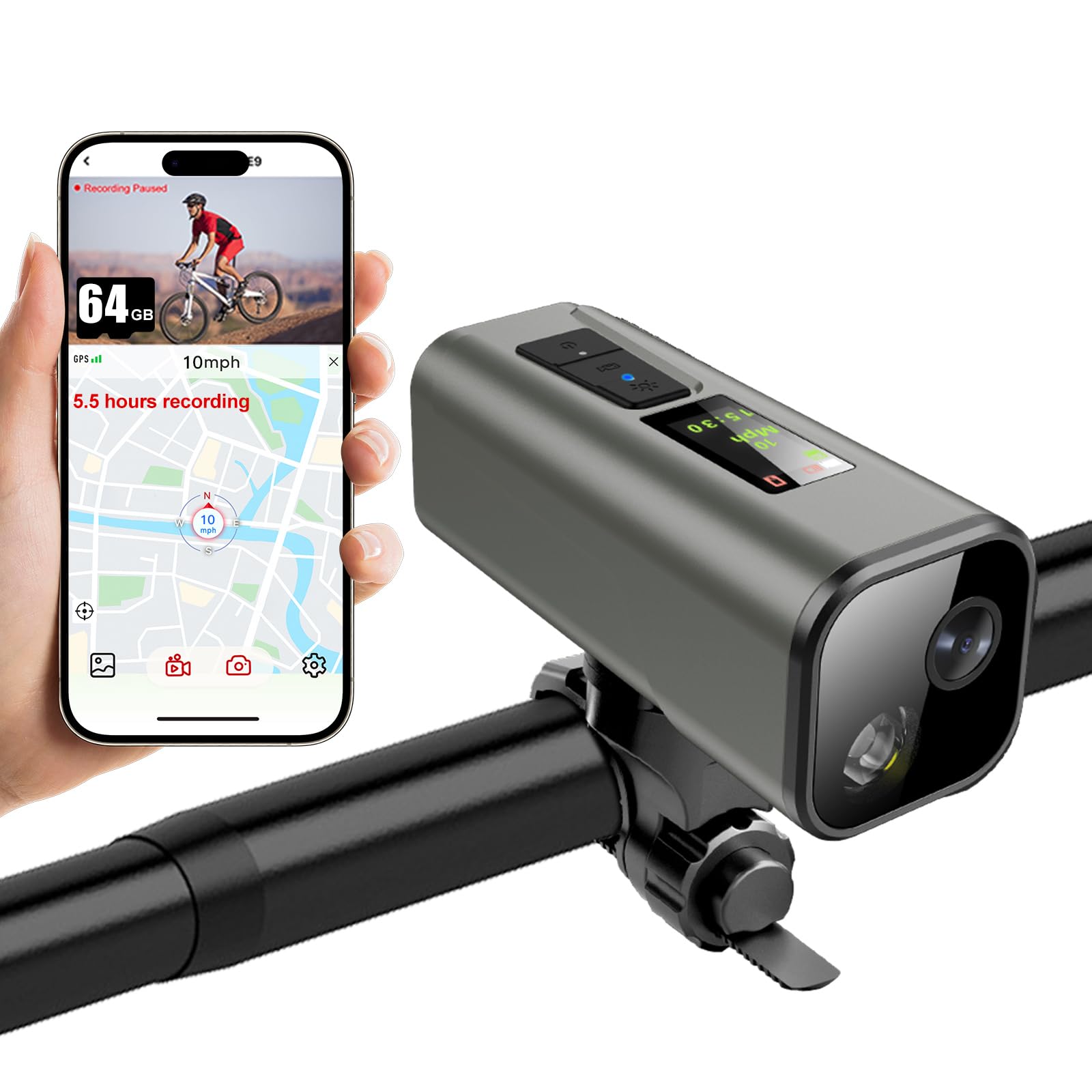
The HUPEJOS D700 is the only camera in this list that doubles as a cycling computer. It includes a built-in GPS tracker that records speed, distance, and route data, then overlays that information directly onto the recorded video. The 0.96-inch IPS screen displays real-time speed, functioning as a basic bike computer so you can leave your Garmin or Wahoo at home. The IMX335 night vision sensor captures surprisingly clean footage in low-light conditions, making it a viable option for commuters who ride before sunrise or after sunset.
The 6-axis stabilization is genuinely effective — user reviews consistently report smooth footage even on rough pavement and gravel paths. The three-mode adaptive headlight (Strong/Low/Flash) with a 4000-4500K color temperature provides practical illumination for night riding without blinding oncoming traffic. The IP65 rating means it is rainproof but cannot be submerged, which is acceptable for road cycling but not for mountain biking through creek crossings. The included 64GB card is a welcome inclusion for a model in this price range.
The D700’s primary limitation is the app experience. The Wi-Fi connection process is clunky, requiring manual reconnection each time you open the app, and the lack of a 180-degree rotation setting means footage from an upside-down handlebar mount orientation cannot be corrected in-app. Time zone and DST settings are missing, so the timestamp overlay may be wrong depending on your location. These are software issues that could be addressed with firmware updates, but as of the latest user reports, they remain open. For riders who prioritize GPS data logging and ride analytics in a single device over a polished app experience, the D700 delivers unique value at an accessible price point.
Why it’s great
- GPS speed and route data overlays directly onto video
- IMX335 sensor delivers strong low-light and night footage
- Integrated headlight adds practical utility for commuters
- 6-axis stabilization handles gravel and rough roads well
Good to know
- Wi-Fi pairing is unreliable and requires reconnection
- No upside-down mount rotation correction in the app
- Plastic build feels less durable than premium competitors
9. AKASO Brave 4 Action Camera
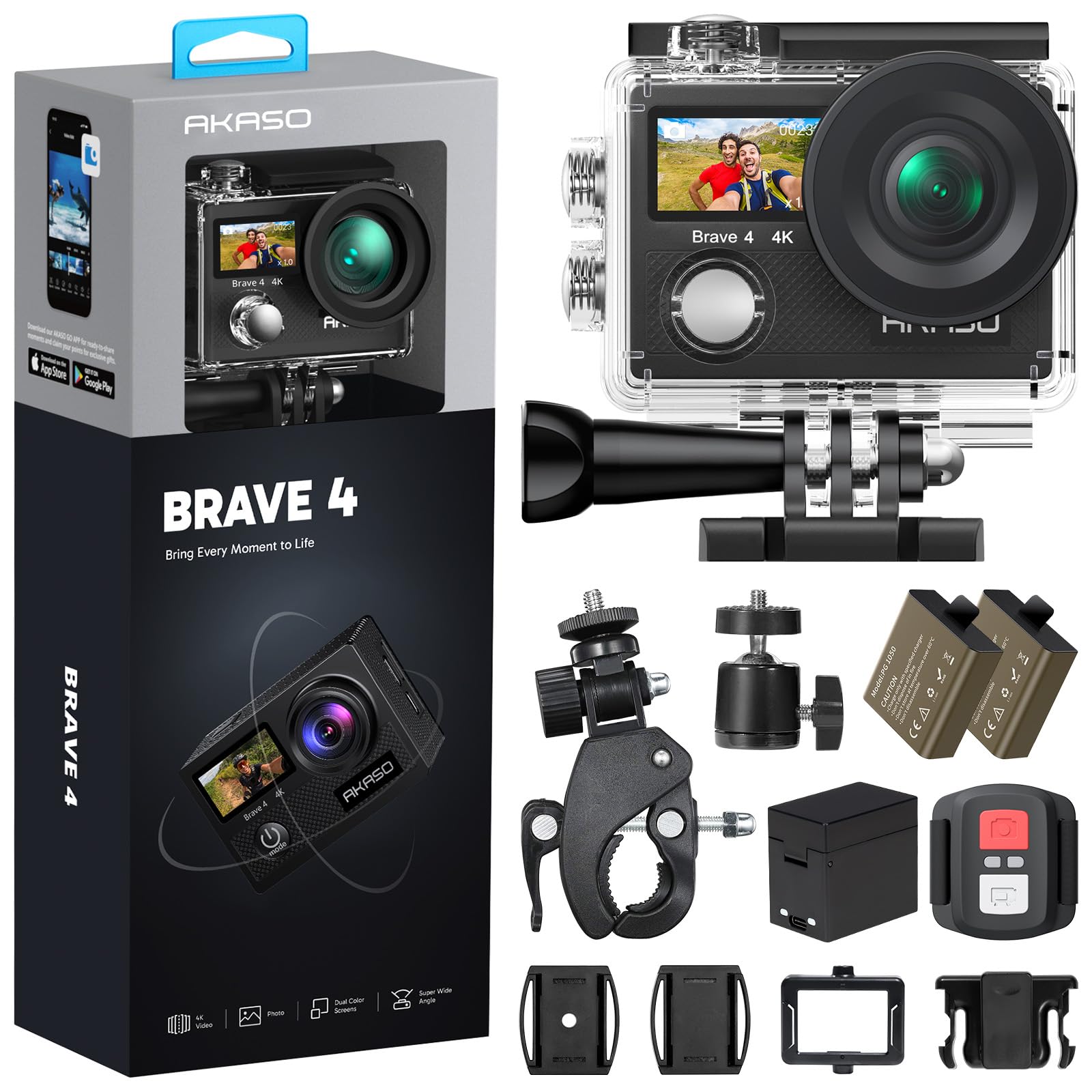
The AKASO Brave 4 is the most budget-friendly entry point into cycling cameras, and it earns its place by including a comprehensive accessory kit that covers nearly every mounting scenario a new cyclist needs. The 4K30fps video and 20MP photos are adequate for daytime ride recording, and the 170° adjustable viewing angle allows you to narrow the field of view to 70° when you want less warping at the edges. The included waterproof case extends the depth rating to 131 feet, making it capable of snorkeling trips after the ride ends.
The stabilization relies on a gyroscope-based EIS system that is noticeably less effective than the 6-axis systems found in mid-range and premium models. On smooth pavement the footage is fine, but on rough chip-seal roads or gravel, the jitter becomes visible. The dual-screen setup — a 2-inch rear main screen and a 0.96-inch front screen — is helpful for framing selfie shots and checking battery status while mounted. The two 1050mAh batteries each provide roughly 90 minutes of recording, and the included dual USB charger keeps the spare topped up.
The Brave 4’s Wi-Fi app is functional but limited in range (about 33 feet), and the video quality is noticeably softer than 4K from DJI or GoPro cameras — the bitrate is lower, and fine detail like distant license plates or trail signs is harder to read. The build quality is surprisingly good for the price point, with user reviews noting it survived drops and even toddler abuse. For first-time cycling camera buyers who are not sure if they will use the footage long-term, the AKASO Brave 4 provides a low-risk entry with enough features to decide whether a cycling camera is worth upgrading later.
Why it’s great
- Comprehensive accessory kit covers handlebar, helmet, and chest mounts
- Included waterproof case to 131 feet adds swim/snorkel versatility
- Dual charger and two batteries reduce downtime between rides
- 170° adjustable FOV lets you choose between wide and narrow views
Good to know
- EIS stabilization is weak on rough surfaces and gravel
- 4K video bitrate is lower, resulting in softer detail
- Wi-Fi range is short and the app experience is basic
FAQ
Do I need a dedicated cycling camera or can I use a regular action camera mounted on my bike?
What frame rate and resolution should I use for cycling footage?
How do I prevent wind noise when recording on a bike?
Is a rear-facing camera as important as a front-facing one on a bike?
How long should the battery last for a typical cycling camera on a long ride?
Final Thoughts: The Verdict
For most cyclists, the best cycling camera winner is the DJI Osmo Action 5 Pro because it combines best-in-class 360° HorizonSteady stabilization with a 4-hour battery that actually covers century rides, a 1/1.3-inch sensor for excellent dynamic range, and IP68 waterproofing that handles weather without a housing. If you prioritize low-light performance and Leica color profiles, grab the Insta360 Ace Pro 2. And for road safety first and foremost — the ability to see vehicles approaching from 153 yards behind and automatically save incident footage — nothing beats the Garmin Varia RCT715.

Mo Maruf
I created WellFizz to bridge the gap between vague wellness advice and actionable solutions. My mission is simple: to decode the research and give you practical tools you can actually use.
Beyond the data, I am a passionate traveler. I believe that stepping away from the screen to explore new environments is essential for mental clarity and physical vitality.