Our readers keep the lights on and my smoothie glass nicely filled. As an Amazon Associate, I earn from qualifying purchases.
Dropping your phone mid-sprint or watching the battery die on a century ride isn’t just frustrating—it’s a safety risk. A dedicated cycling GPS eliminates that anxiety, offering rugged, weatherproof navigation and performance tracking that a smartphone simply can’t match. These devices are purpose-built to lock onto satellite signals, log every pedal stroke, and guide you home, even when cellular service fades.
I’m Mohammad Maruf — the founder and writer behind WellFizz. I spend hundreds of hours each quarter parsing hardware specs, combing through verified user reports, and cross-referencing satellite chipset performance, battery cycle data, and sensor compatibility to deliver clear, actionable buying advice for athletes and commuters alike.
Whether you’re chasing a new PR or exploring unfamiliar gravel routes, finding the best cycling gps means balancing navigation detail, battery endurance, and sensor support to match how and where you actually ride.
How To Choose The Best Cycling GPS
Cycling GPS units are multi-year investments that demand careful consideration of your riding style, typical route complexity, and tolerance for data tinkering. Below are the four critical factors that separate a forgettable device from one that becomes an indispensable part of every ride.
Navigation Depth and Offline Capability
Not all cycling GPS units navigate the same way. Some provide simple breadcrumb trail lines, while others render full-color offline maps with street names, points of interest, and on-device rerouting. If you frequently explore new areas or ride in remote zones without cell coverage, a unit with pre-loaded or downloadable offline maps—and the ability to recalculate a course when you stray—is non-negotiable. Units that only show a course line will leave you guessing at unmarked intersections.
Battery Life and Charging Standard
Battery life claims often vary wildly between “demanding use” (full GPS, always-on mapping, sensor data streaming) and “battery saver” modes that dim the screen and reduce polling rates. For century riders, bikepackers, or anyone who logs multiple long days between charges, look for a unit that offers at least 20 hours in full GPS mode. USB-C charging has become the standard on newer models, offering faster refueling and one-cable convenience—avoid devices still using micro-USB if your other gear has already transitioned.
Sensor Ecosystem and Radar Integration
Your cycling GPS becomes the dashboard hub for a wider ecosystem: heart rate monitors, speed/cadence sensors, power meters, electronic shifting groupsets, and rear-view radar. ANT+ remains the de facto protocol for cycling sensors due to its low latency and ability to pair multiple devices simultaneously. Bluetooth-only units limit your options, especially for power meter data fields and radar. Verify that the unit supports ANT+ and ideally lists specific compatible sensor brands before purchase.
Screen Type and Sunlight Readability
Touchscreen interfaces offer intuitive map panning and data field customization, but they can become frustrating when wet, gloved, or bouncing over rough terrain. Button-controlled units sacrifice some map-scrolling convenience but deliver reliable tactile feedback in any condition. Regardless of input method, the display must remain legible under direct sunlight—check for transflective LCD (memory-in-pixel) technology or high-nits brightness ratings. Color screens provide richer map detail but can consume more power; monochrome or semi-color displays often deliver superior battery endurance.
Quick Comparison
On smaller screens, swipe sideways to see the full table.
| Model | Category | Best For | Key Spec | Amazon |
|---|---|---|---|---|
| Garmin Edge 1040 | Premium | Serious endurance and racing | 35 hours (demanding), 35h battery | Amazon |
| Garmin Edge 540 | Premium | Mid-level racers and climbers | 26 hours (demanding), multi-band GNSS | Amazon |
| Bryton Rider S810 | Premium | Ultra-long rides and bikepacking | 50 hours, 3.5″ touchscreen | Amazon |
| Wahoo ELEMNT Bolt V3 | Premium | Seamless app integration | 20 hours, button control | Amazon |
| Bryton Rider 650 | Mid-Range | First-time upgrade from phone | 33 hours, pre-loaded USA maps | Amazon |
| Magene C606 V2 | Mid-Range | Feature-packed hill climbers | 25 hours, 2.8″ color touchscreen | Amazon |
| iGPSPORT iGS630 | Mid-Range | Long battery with iClimb training | 35 hours, 150+ data fields | Amazon |
| Sigma ROX 11.1 EVO | Mid-Range | Compact and waterproof builds | 18 hours, IP67 rated | Amazon |
| iGPSPORT BSC300T | Value | Budget-conscious all-rounders | 20 hours, touchscreen + buttons | Amazon |
In‑Depth Reviews
1. Garmin Edge 1040

The Garmin Edge 1040 stands as the benchmark for serious cyclists who demand uncompromising accuracy and endurance. Its multi-band GNSS chipset locks onto satellite signals in the most challenging environments—think deep forest canopy or narrow urban corridors—delivering position data that remains reliable even when other units drift. The 3.5-inch color touchscreen is bright enough for direct sunlight and responsive enough for gloved fingers, while the included speed, cadence, and premium heart rate sensors provide a complete out-of-box ecosystem.
Battery performance is class-leading: up to 35 hours in demanding use, and an impressive 70 hours in battery saver mode. That means multi-day bikepacking trips or week-long tours without hunting for a wall outlet. The Power Guide feature recommends wattage targets throughout a course, and the Stamina function gives real-time insight into how much longer you can push before fading. Automatic Wi-Fi syncing to Garmin Connect, Strava, and TrainingPeaks happens in the background without phone intervention.
The main trade-off is size—the 1040 is notably larger than the Edge 540, and the flush out-front mount is sold separately. Some users find the sheer number of customization options overwhelming initially, though the streamlined interface introduced in recent firmware updates has reduced the learning curve. For riders who prioritize battery endurance and multi-band precision over compactness, this is the definitive choice.
Why it’s great
- Multi-band GNSS delivers exceptional accuracy in tricky terrain
- 35-hour demanding-use battery with 70-hour saver mode
- Full sensor bundle included (HR, speed, cadence)
- Seamless Wi-Fi syncing to third-party platforms
Good to know
- Large footprint compared to Edge 540
- Out-front mount sold separately
- Steep learning curve for screen customization
2. Garmin Edge 540

The Garmin Edge 540 delivers the same multi-band GNSS accuracy and performance analytics as its larger sibling but in a more compact, button-controlled body. For riders who prefer tactile feedback over touchscreens—especially during wet rides or when wearing thick winter gloves—the five-button layout is intuitive and responsive. The ClimbPro ascent planner works on any ride, not just pre-loaded courses, showing remaining ascent and grade so you can pace your effort on every climb.
Battery life spans 26 hours in demanding mode and stretches to 42 hours in battery saver mode, enough for multi-day stage races or back-to-back centuries. Daily suggested workouts adapt to your training load and recovery status when paired with a compatible power meter and heart rate monitor, effectively acting as a personal coach on your handlebars. The Stamina and Power Guide features mirror the 1040’s capabilities, giving serious cyclists the same analytical depth at a lower entry point.
The primary limitation is the lack of a touchscreen, which makes map scrolling and waypoint selection slower compared to touch-enabled units. Setup also requires patience—the 84-page manual is online-only, and configuring data screens involves some trial and error. Once dialed in, however, the 540 becomes a reliable, data-rich companion that doesn’t distract from the ride.
Why it’s great
- Multi-band GNSS for pinpoint accuracy
- Button controls work perfectly with gloves and rain
- ClimbPro on every ride without course pre-load
- Targeted adaptive coaching adjusts to your fitness
Good to know
- No touchscreen for map navigation
- Steep initial setup and customization process
- Out-front mount not included
3. Bryton Rider S810

The Bryton Rider S810 obliterates battery anxiety with a claimed 50 hours of life, making it the go-to unit for ultra-distance events, multi-day bikepacking, and remote gravel expeditions. The 3.5-inch color touchscreen is one of the largest in its class, and an adaptive ambient light sensor automatically adjusts brightness so the display remains readable from high-noon glare to shaded singletrack. Physical buttons line the edges for tactile control when the trail gets rough, wet, or both.
Navigation is fully offline—pre-loaded maps and turn-by-turn guidance function via GPS satellites without any cell service, and the unit recalculates your route on-device if you stray from the path. Climb Challenge 2.0 provides a visual breakdown of upcoming gradients and remaining ascent, while Strava Live Segments integration turns familiar roads into competitive time trials. ANT+ support extends to heart rate, speed, cadence, power meters, rear-view radar, and even FE-C smart trainers for indoor sessions.
The S810 is not without quirks. A small but notable number of users report inconsistent GPS behavior on organized rides, and the lack of a dedicated out-front mount in the box is an oversight at this price point. Customer support responsiveness has also drawn criticism. For riders who prioritize battery endurance above all else and are willing to accept occasional software roughness, the S810’s range is unmatched.
Why it’s great
- Industry-leading 50-hour battery life
- Large 3.5-inch touchscreen with adaptive brightness
- Full offline navigation with on-device rerouting
- Climb Challenge 2.0 and Strava Live Segments support
Good to know
- Occasional GPS drift reported on pre-planned routes
- No out-front mount included
- Customer support inconsistent based on user reports
4. Wahoo ELEMNT Bolt V3
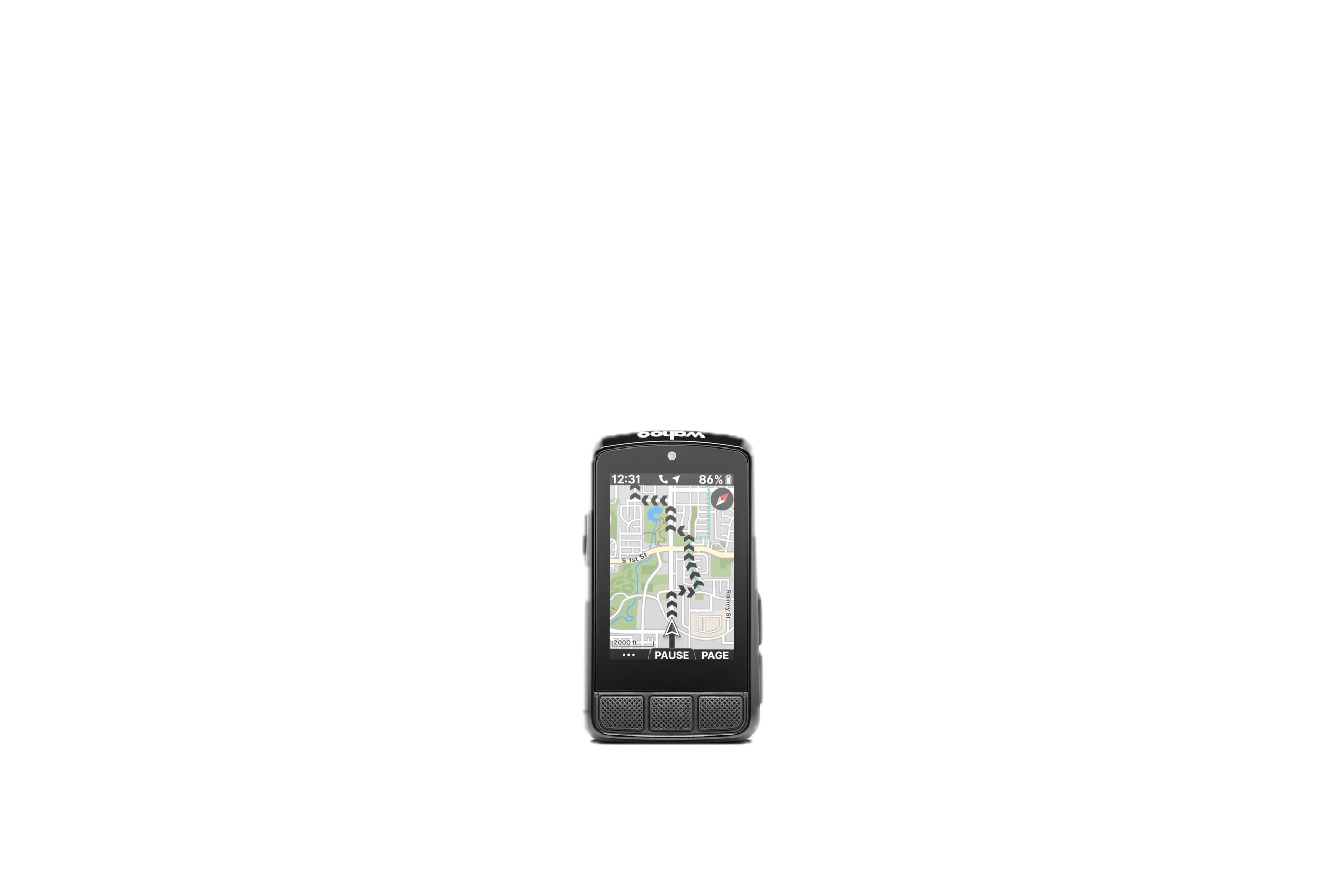
Wahoo’s ELEMNT Bolt V3 refines the formula that made previous versions beloved: dead-simple setup, reliable button navigation, and seamless integration with third-party routing platforms. Routes saved in Strava, Ride With GPS, or Komoot automatically download to the device via Wi-Fi, and the Take Me To feature lets you pick a destination on the map page for on-the-fly route generation. The 2.3-inch LCD display is crisp in sunlight, and the five-button interface is intuitive enough to operate without looking down.
The Bolt V3’s 20-hour battery covers all but the longest single-day rides, and the unit supports ANT+ radar integration so approaching vehicles appear as dots on the screen with LED alerts. Smart notifications for calls, texts, and messaging apps appear as pop-ups, with a Do Not Disturb toggle for focused intervals. The unit weighs just 84 grams, making it one of the lightest premium cycling GPS options available, and the IPX7 waterproof rating handles heavy downpours without issue.
The primary trade-off is battery—20 hours trails competitors like the Garmin Edge 540 and Bryton S810 by a significant margin for multi-day riders. The color display is also less vivid than high-end Garmins, and the companion app moved away from the older ELEMNT app, which some users found less polished. For riders who prioritize simplicity, reliable route sync, and tactile button feedback over maximum battery endurance, the Bolt V3 is a top-tier choice.
Why it’s great
- Automatic route downloads from Strava, RWGPS, Komoot
- Intuitive button control works with gloves and rain
- Lightweight 84g design
- ANT+ radar integration with LED alerts
Good to know
- 20-hour battery short for ultra-endurance
- Screen less vibrant than premium Garmin units
- App transition left some features behind
5. Bryton Rider 650
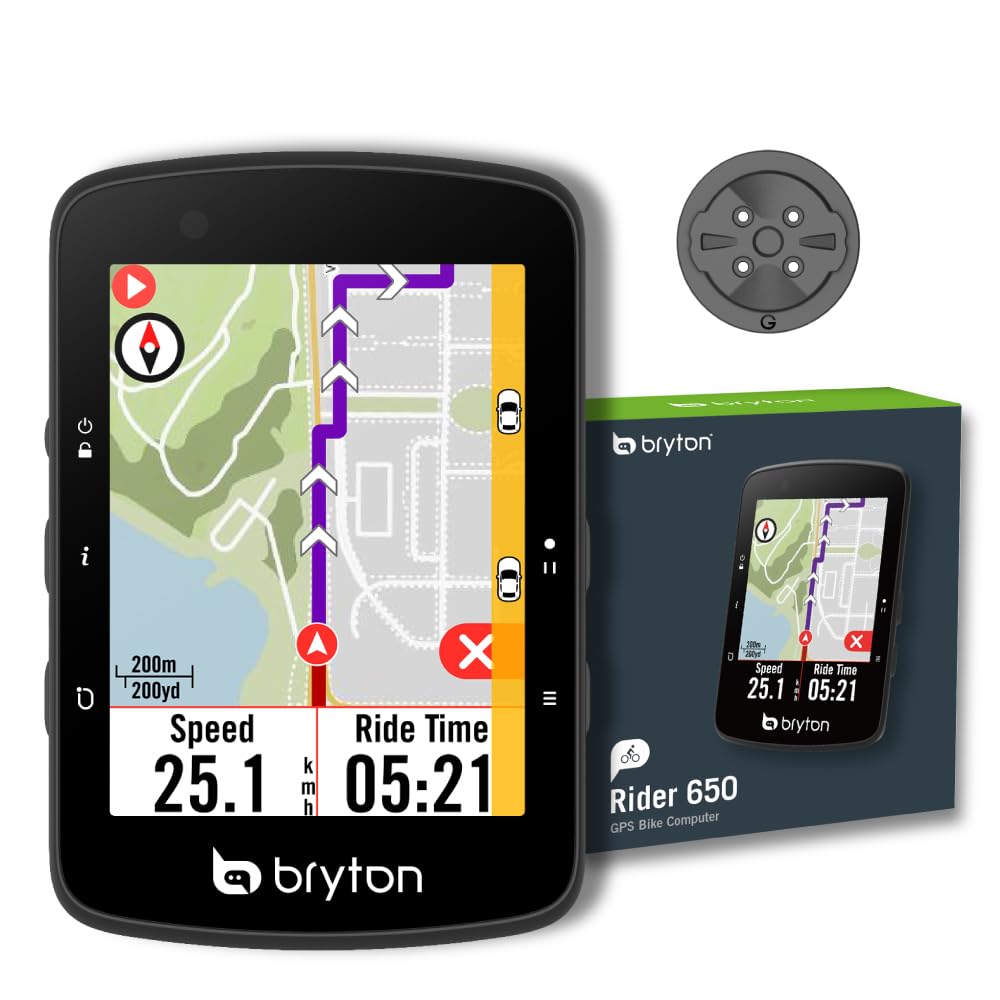
The Bryton Rider 650 is designed for cyclists who want to leave their phone behind without breaking the bank. The 2.8-inch color touchscreen offers a smartphone-like interface that makes transitioning from app-based navigation feel natural, and the pre-loaded OSM maps show street names and points of interest—not just a breadcrumb line. An ambient light sensor automatically adjusts screen brightness so the display stays visible in direct sun and shaded trails alike.
Battery endurance is a standout feature at 33 hours, beating many units at twice its price and making it suitable for weekend tours or a full week of commuting without charging. Climb Challenge 1.0 provides color-coded segments showing grade, distance, and ascent on pre-planned routes, and Live Tracking lets family follow your location in real-time. ANT+ support includes heart rate, speed, cadence, power meters, and rear-view radar, plus electronic shifting compatibility with Di2 and eTap.
The Rider 650 does not connect directly to Wi-Fi—all syncing happens through the Bryton Active app on your phone, which must remain powered on. The interface, while intuitive, lacks the polish of Garmin’s Connect ecosystem, and screen brightness falls short of the most expensive flagships. For price-conscious riders who need long battery, color maps, and solid sensor support, this unit delivers outstanding value without feeling like a compromise.
Why it’s great
- Excellent 33-hour battery life for the price
- Pre-loaded full-color OSM maps with street names
- Smartphone-like touchscreen interface
- ANT+ radar and electronic shifting support
Good to know
- No Wi-Fi; syncing requires phone app to be open
- Screen less bright than premium competitors
- Ecosystem not as refined as Garmin Connect
6. Magene C606 V2
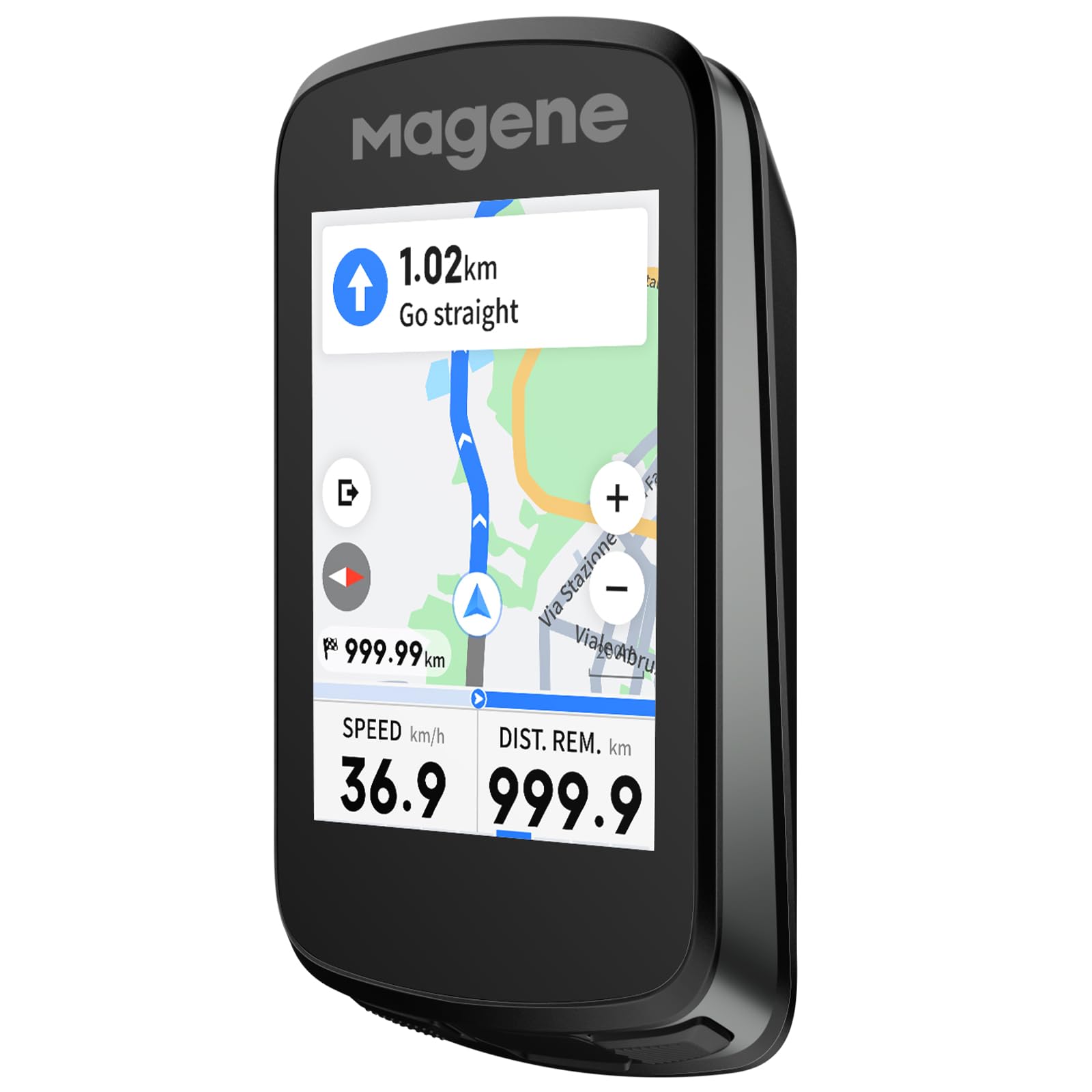
Magene’s C606 V2 packs an impressive feature set into a well-rounded mid-range package, distinguishing itself with a Multi-Scenario ClimbPro that provides full route climb planning and automatic mid-ride detection—similar to Garmin but at a significantly lower entry price. The 2.8-inch color touchscreen is responsive and bright, and the IPX7 waterproof rating means heavy rain won’t interrupt your ride. Cycling Dynamics support unlocks power phase, seated/standing time, and platform center offset when paired with compatible power meters.
Strava Live Segments sync automatically via Wi-Fi, with approach alerts and live PK battle displays that add a competitive edge to familiar roads. The C606 V2 also offers smart wireless camera control for DJI Action and Insta360 cameras, letting you start and stop recording from the handlebars. Battery life hits 25 hours, which is competitive for the segment, and the included protective case and tempered glass screen protector add peace of mind out of the box.
The screen can appear slightly dim under the harshest midday sun compared to higher-end Garmins, and the radar integration lacks the color-coded speed differentiation found on more expensive units. Setup through the Magene app is straightforward, but the overall user experience doesn’t feel as polished as the Wahoo or Garmin ecosystems. For cyclists who want climbing analytics, live segments, and camera control without paying premium-tier prices, the C606 V2 is a compelling choice.
Why it’s great
- Multi-Scenario ClimbPro with automatic climb detection
- Strava Live Segments with Wi-Fi auto-sync
- Smart camera control for DJI/Insta360
- Cycling Dynamics with compatible power meters
Good to know
- Screen brightness could be better in direct sunlight
- Radar lacks color-coded vehicle speed differentiation
- User interface not as refined as Garmin/Wahoo
7. iGPSPORT iGS630

The iGPSPORT iGS630 is a purpose-built training tool that focuses on climbing analytics and comprehensive data recording without the premium price tag. The iClimb function provides a climbing route preview that helps you plan physical effort and records data by segment, making it a strong alternative to Garmin’s ClimbPro for riders who love hills. Five satellite systems (GPS, Beidou, GLONASS, Galileo, QZSS) ensure fast, accurate positioning, and the 35-hour battery life is class-leading for the mid-range category.
The 2.8-inch color display delivers over 150 riding data fields across customizable screens, and the unit supports ANT+/Bluetooth dual protocol for pairing with a wide range of sensors, heart rate monitors, and smartwatches. Offline map navigation allows you to download global maps and save multiple routes, with off-course warnings that alert you when you stray from the planned path. Real-time tracking displays teammate locations during group rides, helping avoid wrong turns.
The iGS630 relies on button-only input—there is no touchscreen, which can make scrolling through long menus tedious. The screen is also dimmer in low-light conditions compared to higher-end models, and the app ecosystem, while functional, is less polished than Garmin Connect. For riders who want a durable, long-battery training computer with robust climbing features and don’t mind a button-only interface, the iGS630 is a strong mid-range performer.
Why it’s great
- Excellent 35-hour battery life
- iClimb function for climb previews and segment data
- 5-satellite support for reliable positioning
- Real-time group ride tracking
Good to know
- Button-only interface; no touchscreen
- Screen not ideal in low-light conditions
- App ecosystem less refined than Garmin/Wahoo
8. Sigma ROX 11.1 EVO

The Sigma ROX 11.1 EVO is a compact, IP67-rated cycling GPS that prioritizes water resistance and a small footprint over screen size. The transmissive display is readable in most conditions, and the touchscreen interface allows for intuitive menu navigation despite the 2.4-inch form factor. It’s e-bike ready and supports both indoor and outdoor training modes, making it a versatile companion for riders who swap between road, trail, and turbo sessions.
Setup and configuration happen through the Sigma Data Center app, which offers customizable screens and color backgrounds. Route import from Komoot and Ride With GPS is supported, and waypoint alerts with adjustable turn prompts provide basic navigation guidance. The unit pairs with ANT+ sensors for speed, cadence, heart rate, and even power meters, though power calculation is limited compared to dedicated training computers.
The 18-hour battery is on the lower end of this list—enough for day-long rides but short of what multi-day bikepackers need. Some users have reported occasional GPS drift on singletrack trails, and US-based customer support is notably absent, which can be a concern if issues arise. For riders who want a compact, affordable, waterproof unit for day rides and mixed terrain, the ROX 11.1 EVO is a capable but niche option.
Why it’s great
- Compact size fits easily on any handlebar
- IP67 waterproof rating for heavy rain
- E-bike ready with multiple training modes
- Touchscreen interface for menu navigation
Good to know
- 18-hour battery life is limited for long days
- GPS drift reported on narrow singletrack
- No US-based customer support
9. iGPSPORT BSC300T

The iGPSPORT BSC300T proves that you can get a functional, feature-rich cycling GPS without spending a premium. The 2.4-inch touchscreen is supplemented by six physical buttons, allowing you to switch between intuitive touch control and reliable tactile input when riding in rain or with gloves. Five-satellite global positioning (GPS, Beidou, GLONASS, Galileo, QZSS) ensures fast lock times and accurate speed, distance, and elevation data even in challenging environments.
Offline map navigation supports global map downloads, route saving, and turn prompts with off-course warnings that notify you until you’re back on track. The BSC300T delivers over 130 riding data fields including grade, cadence, and temperature, and the ANT+/Bluetooth 5.0 dual protocol pairs with speed, cadence, heart rate sensors, e-bike systems, and smart trainers. Real-time tracking for group rides and seamless Strava/Komoot sharing through the iGPSPORT app round out the connectivity package.
Battery life is rated at 20 hours, which is adequate for most day rides but falls short of the 35-hour iGS630 for multi-day endurance use. The touchscreen is smaller than many competitors, and the lack of a USB-C cable in the box is a minor annoyance. For riders on a budget who still want offline navigation, dual-protocol sensor support, and a touchscreen interface, the BSC300T delivers surprising value and reliability.
Why it’s great
- Affordable entry point with touchscreen and buttons
- 5-satellite global positioning for fast lock
- Offline maps with off-course warnings
- ANT+ and Bluetooth 5.0 dual protocol support
Good to know
- 20-hour battery is mid-range at best
- Smaller touchscreen may feel cramped
- USB-C cable not included in the box
FAQ
Do I need a cycling GPS if I already have a smartphone with GPS?
How accurate are cycling GPS devices under tree cover or in cities?
Can I use a cycling GPS for indoor trainer sessions?
What does ClimbPro or iClimb actually do?
How often should I update maps and firmware on my cycling GPS?
Final Thoughts: The Verdict
For most users, the best cycling gps winner is the Garmin Edge 1040 because it combines unmatched multi-band GNSS accuracy, 35-hour demanding-use battery, and a full sensor bundle that covers everything from power output to climbing profiles. If you want the same analytical depth in a compact, button-controlled body, grab the Garmin Edge 540. And for the budget-conscious rider who refuses to compromise on navigation and sensor support, nothing beats the value of the Bryton Rider 650.

Mo Maruf
I created WellFizz to bridge the gap between vague wellness advice and actionable solutions. My mission is simple: to decode the research and give you practical tools you can actually use.
Beyond the data, I am a passionate traveler. I believe that stepping away from the screen to explore new environments is essential for mental clarity and physical vitality.