Our readers keep the lights on and my smoothie glass nicely filled. As an Amazon Associate, I earn from qualifying purchases.
The difference between a faint diastolic murmur and a clean waveform often comes down to the hardware pressed against a patient’s chest wall. An acoustic mismatch or a noisy electronic amplifier can mask the subtle sounds that guide critical decisions in the ED, ICU, or a crowded clinic.
I’m Mohammad Maruf — the founder and writer behind WellFizz. I’ve spent weeks cross-referencing frequency response charts, amplification gain curves, chestpiece geometry data, and hundreds of verified clinical reviews to map which digital and analog stethoscopes actually deliver the clarity a doctor needs at the bedside.
This guide breaks down the top performers across mechanical and electronic designs, from lightweight titanium dual-heads to active noise-canceling digital models, so you can confidently pick the best digital stethoscope for doctors that matches your workflow.
How To Choose The Best Digital Stethoscope For Doctors
Picking the right tool begins with a clear understanding of your daily auscultation environment. A quiet private practice demands different acoustic performance than a trauma bay with ventilators and alarms. Here are the critical factors to weigh.
Amplification Method: Analog Acoustics vs. Digital Enhancement
Pure analog stethoscopes rely on the mechanical resonance of the chestpiece and tubing to transmit sound. Digital scopes, on the other hand, use a piezoelectric sensor to convert acoustic waves into electrical signals, then amplify and filter them. If you regularly work with faint heart sounds or soft lung crackles in a noisy department, a digital model with at least 20x amplification and active noise cancellation can make the difference between a confident diagnosis and a repeat listen.
Chestpiece Design: Tunable, Dual-Head, or True Bell
Modern tunable diaphragms let you shift from low to high frequency by changing pressure, but many cardiologists still prefer a true bell for catching subtle gallops like S3 and S4. Dual-head chestpieces give you both a dedicated bell and a diaphragm, while convertible designs like the Littmann Cardiology IV offer an open or closed bell on one side. Material matters too — titanium is lighter and dampens less sound than stainless steel, though brass offers a warmer, fuller tonal character.
Digital Features: Recording, Waveform, and Telehealth
If you teach residents, collaborate with remote specialists, or need to document auscultation findings, Bluetooth-connected digital stethoscopes let you record sound clips and view real-time waveform visualizations on a smartphone app. This feature alone can transform a routine exam into a shareable digital record. Bear in mind that app subscriptions are common on advanced models, so factor that into total cost of ownership.
Tubing Length and Binaural Comfort
A 22-inch tube is acoustically the purest, but makes it hard to hang the scope around your neck during rounds. At 27-28 inches you sacrifice a marginal amount of high-frequency transmission, but gain daily comfort and mobility. Adjustable binaurals with soft-sealing silicone eartips are non-negotiable — a poor seal leaks sound and undermines even the most expensive chestpiece.
Quick Comparison
On smaller screens, swipe sideways to see the full table.
| Model | Category | Best For | Key Spec | Amazon |
|---|---|---|---|---|
| Littmann CORE Digital | Digital | Telehealth & waveform analysis | 40x amplification, active noise cancellation | Amazon |
| Welch Allyn Harvey DLX | Analog | Cardiology & pulmonology precision | Corrugated diaphragm, true brass bell | Amazon |
| 3M Littmann Cardiology IV | Analog | Critical care high-fidelity auscultation | 2x louder, 60% deeper bell | Amazon |
| MDF ProCardial Titanium | Analog | Lightweight daily carry with premium acoustics | Lightweight titanium body, C34 channel tubing | Amazon |
| ADC Adscope 602 Cardiology | Analog | EMS and loud environment noise rejection | Surgical stainless steel, extra-deep bell | Amazon |
| ADC Adscope 606 Ultra Lightweight | Analog | Long shifts and student use | 130g weight, AFD tunable technology | Amazon |
| MDF MD One RoseGold | Analog | Budget-conscious reliable general auscultation | Acoustic pyramid chamber, dual-head stainless steel | Amazon |
| Welch Allyn Harvey DLX 28″ | Analog | Full-range hospital rounds with extra tubing length | 28″ length, chrome-plated brass head | Amazon |
In‑Depth Reviews
1. 3M Littmann CORE Digital Stethoscope
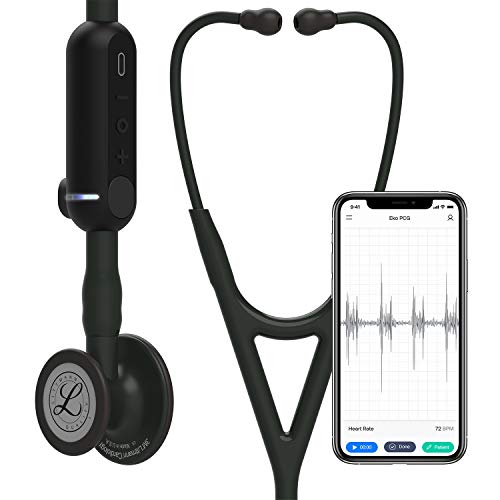
The Littmann CORE is the most advanced stethoscope in the 3M lineup, combining the tunable dual-sided stainless steel chestpiece of the Cardiology IV with a digital module that provides up to 40x amplification and active noise cancellation. In a busy ICU with competing ventilator and monitor noise, the CORE effectively filters background rumble so you can focus on the respiratory and cardiac waveforms that matter. The accompanying Eko app lets you visualize, record, and share sound clips — a strong advantage for teaching residents or documenting findings for a remote cardiologist.
Toggle between analog and amplified mode on the fly, and the soft-sealing ear tips deliver a comfortable fit during extended rounds. The 27-inch tubing is long enough to drape around the neck without sacrificing acoustic fidelity, and the full stainless steel construction feels durable despite the added digital electronics. Keep in mind that some advanced app features require a subscription after the initial trial period, and you will need a smartphone or tablet to access the waveform visualization and recording functionality.
For doctors who regularly need to document auscultation or work in loud environments, the CORE’s noise cancellation and amplification are category-defining. It is not the cheapest scope on the market, but the combination of analog reliability and digital utility makes it a one-unit solution that replaces both a traditional cardiology scope and a separate recording device.
Why it’s great
- Up to 40x amplification helps detect faint heart and lung sounds
- Active noise cancellation makes it usable in noisy clinical areas
- Bluetooth connectivity enables waveform viewing and sound sharing
Good to know
- App subscription may be required for full features after trial
- Requires battery charging and a phone or tablet for digital functions
2. Welch Allyn Harvey DLX Adult Cardiology Stethoscope

The Harvey DLX has been a staple in cardiology for decades, and for good reason. Its double-head chestpiece features a true brass bell for sub-audible low-frequency sounds and a corrugated diaphragm that excels at midrange frequencies — a combination that many experienced clinicians still prefer over tunable single-head designs. The chrome-plated brass binaural and chestpiece provide a warm, rich tonal response that reveals S3 gallops and subtle mitral stenosis murmurs with clarity that few analog scopes match.
Interchangeable comfort-sealing ear tips and a rotatable binaural help customize the fit, though the chestpiece is noticeably heavier than titanium competitors. The 27-inch dual-lumen tubing is modular and replaceable, which extends the scope’s service life well beyond a decade — a real advantage for long-term owners. Some users report that the chestpiece screws can loosen over time, but this is easily addressed with routine checks.
If your practice demands pure acoustic transparency without batteries, Bluetooth, or any electronics in the chain, the Harvey DLX delivers a sound signature that many top cardiologists still call the gold standard. It is not the lightest scope, but the acoustic fidelity is difficult to beat at any price point.
Why it’s great
- True bell and corrugated diaphragm provide exceptional frequency range
- Fully modular design allows repairs and part swaps to extend lifespan
- Warm, clear midrange ideal for detecting gallops and murmurs
Good to know
- Chestpiece is heavier than titanium or aluminum alternatives
- Some units ship without extra ear tips or diaphragm included
3. 3M Littmann Cardiology IV Diagnostic Stethoscope

The Cardiology IV is engineered specifically for the most demanding environments — ED, cardiac ICU, and step-down units where subtle changes in patient status must be caught immediately. Littmann claims it is more than twice as loud as the next leading competitor’s stethoscope, and that claim holds up in real-world comparisons. The tunable dual-sided chestpiece is 40% larger than the Classic III and features a 60% deeper bell, allowing you to sense low-frequency Korotkoff sounds and S4 gallops with remarkable clarity.
The trade-off for that acoustic purity is the 22-inch tubing length. While many clinicians prefer the shorter tubing for acoustic reasons, it makes hanging the scope around your neck difficult. The chestpiece is also heavier than the MDF titanium models, which some users notice during long shifts. On the positive side, the soft-sealing ear tips block ambient noise effectively, and the 7-year warranty provides peace of mind for a serious investment.
If your work takes you into high-acuity areas where you need every decibel of natural sound transmission, the Cardiology IV is the analog benchmark. Pair it with the optional non-chill bell sleeve for patient comfort, and you have a scope that stays reliable shift after shift.
Why it’s great
- Twice the loudness of comparable stethoscopes in the same class
- Large chestpiece with deep bell captures very low frequencies
- Soft-sealing ear tips provide excellent passive noise isolation
Good to know
- 22-inch tubing is too short to comfortably wear around the neck
- Heavier than titanium or ultra-lightweight analog competitors
4. MDF Instruments ProCardial Cardiology Titanium Stethoscope
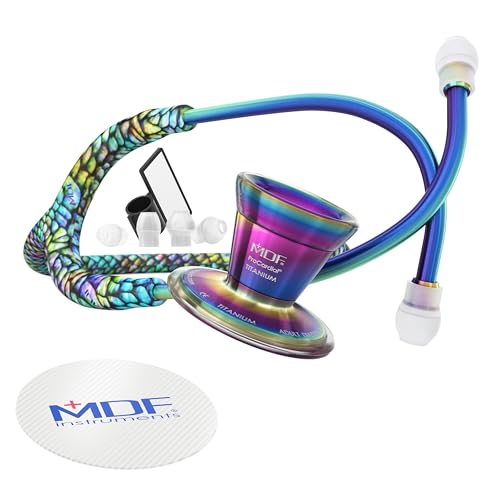
MDF’s ProCardial Titanium line solves the weight problem that plagues many cardiology-grade scopes. The chestpiece is machined from lightweight titanium with an extra-deep diaphragm and bell, delivering sound quality on par with heavier stainless steel models while significantly reducing neck strain during long rounds. The C34 tubing has 34 internal channels etched into the wall that direct sound waves without interference, resulting in clean transmission of heart, lung, and bowel sounds.
The dual-head design uses a true bell and diaphragm that you rotate via the stem — no tunable membrane to second-guess. The patented Acoustic Pyramid Chamber and SafetyLock eartip adaptors ensure a consistent acoustic seal across multiple users by letting you swap between small, medium, and large silicone tips. MDF backs the scope with a full lifetime warranty and a free-parts-for-life program, making this one of the best value propositions in the premium analog space.
Some users find the titanium body still carries noticeable weight when worn around the neck, and the 28-inch tubing is long enough for comfortable draping. If you want the acoustic performance of a cardiology scope without the neck fatigue of a heavy stainless steel head, the ProCardial Titanium is an outstanding pick.
Why it’s great
- Lightweight titanium chestpiece reduces neck strain on long shifts
- C34 channeled tubing delivers clear, artifact-free sound
- Lifetime warranty with free parts for life program
Good to know
- Still slightly heavy around the neck compared to ultra-light hybrids
- Pediatric chestpiece sold separately for infant exams
5. ADC Adscope 602 Cardiology Stethoscope

The Adscope 602 from ADC is built with a singular focus: maximize sound amplification and ambient noise rejection in chaotic environments. Emergency medical services and trauma bay clinicians consistently rank this scope above higher-priced alternatives because the combination of a deep bell and an ultra-sensitive diaphragm delivers loud, clear lung and heart sounds even in the back of a moving ambulance. The chestpiece is machined from surgical stainless steel with a satin finish and is noticeably heavy — but that mass contributes directly to its ability to damp external vibration and amplify internal acoustics.
The non-chill bell and diaphragm retaining rim improve patient comfort during cold-exam conditions, and a spare diaphragm is included in the box. The 27-inch tube length is standard for cardiology scopes, and the binaurals are adjustable for a custom fit. Some clinicians note that the weight of the chestpiece feels out of proportion to the tubing, but this is a common trait among high-performance analog scopes designed for noise rejection.
If your daily work involves auscultation in loud, high-motion settings — think EMS, busy ERs, or field operations — the Adscope 602’s noise-canceling characteristics and raw amplification make it a smart investment. It is not the scope for quiet private practice, but for the places where sound is hardest to catch, it excels.
Why it’s great
- Exceptional ambient noise rejection for EMS and trauma bay use
- Surgical stainless steel chestpiece provides durable, long-lasting construction
- Extra-deep bell delivers very loud low-frequency sound transmission
Good to know
- Chestpiece is heavy and can feel unbalanced on the tubing
- Not ideal for clinicians who prefer a lightweight, discreet scope
6. ADC Adscope 606 Ultra Lightweight Cardiology Stethoscope

Weighing just 130 grams, the Adscope 606 is up to 40% lighter than competing cardiology models, making it the most comfortable scope to wear around your neck during a 12-hour shift. Despite the featherweight build, ADC managed to include proprietary Adjustable Frequency Design (AFD) technology that lets you switch between low and high frequencies by varying pressure on the chestpiece — light touch for low-frequency heart sounds, firmer pressure for higher-pitched lung sounds. The large-bore aluminum alloy binaurals and Adsoft Plus silicone eartips provide a comfortable acoustic seal that stays put even with repeated movement.
The 27-inch dual-channel tubing is phthalate-free and latex-free, and the scope is individually acoustic tested in the USA before shipping. Some experienced clinicians note that while the 606 offers excellent clarity for heart sounds, breath sounds through the diaphragm are not as dramatically amplified as on heavier cardiology scopes. The short tubing also means you cannot easily drape it around your neck — a design trade-off for the lightweight construction.
For medical students, residents, or any clinician who prioritizes all-day comfort without sacrificing the acoustic performance needed for accurate auscultation, the Adscope 606 is a standout value. The included extra eartips, pouch, and ID tag add to the convenience of a ready-to-use package.
Why it’s great
- Extremely lightweight design reduces neck and shoulder fatigue
- AFD technology provides versatile frequency tuning without a rotating head
- Individually acoustic tested; includes free parts for life
Good to know
- Breath sound amplification is less pronounced than on heavier models
- Short tubing makes neck carry awkward for some users
7. MDF Instruments MD One RoseGold Stainless Steel Stethoscope
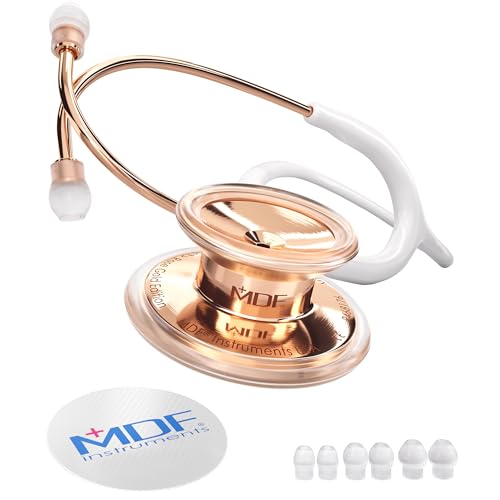
The MD One from MDF is the budget-friendly entry point into the world of quality dual-head stethoscopes without cutting corners on acoustic engineering. The chestpiece is constructed from acoustically-superior stainless steel with a patented Acoustic Pyramid Chamber that routes sound waves for clean transmission. It uses a true bell and diaphragm design — you rotate the stem to switch between them — rather than a tunable membrane, which some clinicians prefer for clarity across low and high frequencies.
The tubing is thicker and longer than many comparably priced scopes, and it is latex-free. The ErgonoMax headset with dual-leaf spring construction and three sizes of ComfortSeal silicone eartips ensures a personalized, comfortable fit. Users consistently report that the MD One delivers sound quality that competes with models at twice the price, especially for Korotkoff sounds during blood pressure measurement and general lung and bowel auscultation. The scope is backed by MDF’s full lifetime warranty and free-parts-for-life program.
While the MD One does not offer the ambient noise rejection of premium cardiology scopes, it outperforms most entry-level and generic hospital-issue stethoscopes by a wide margin. For medical students, nurses, and doctors who need a reliable daily driver without breaking the department budget, this is one of the strongest options on the market.
Why it’s great
- Excellent acoustic performance at a very accessible price point
- True bell and diaphragm design instead of tunable membrane
- Lifetime warranty with free parts for life
Good to know
- Noise isolation is inferior to premium cardiology and digital models
- Slightly heavier feel compared to titanium or ultra-lightweight options
8. Welch Allyn Harvey DLX Double Head 28″ Stethoscope

This variant of the Harvey DLX extends the tubing to 28 inches, addressing the primary complaint about shorter cardiology scopes: the inability to comfortably wear it around the neck during hospital rounds. It retains the same double-head chestpiece with a true brass bell and a flat diaphragm that clinicians have trusted for generations. The chrome-plated brass binaural and chestpiece contribute to the scope’s signature warm tonal quality and durability.
The rotatable binaural and interchangeable comfort-sealing ear tips allow for a custom fit, and the overall construction feels robust enough to withstand years of daily use. Welch Allyn has a strong reputation for making stethoscopes that last beyond a decade, and the 28-inch DLX is no exception — users regularly report passing these scopes down to new residents after years of service. The only downside is that the brass chestpiece is heavier than modern stainless steel or titanium alternatives, and the tubing, while reliable, can feel slightly long for clinicians who prefer a more compact setup.
If you want the acoustic signature of the Harvey DLX but need the extra length for practical neck carry, this is your version. It is a scope built for the working physician who refuses to compromise on sound quality for the sake of weight savings.
Why it’s great
- 28-inch tubing allows comfortable neck draping during rounds
- Warm, clear acoustic response from chrome-plated brass components
- Extremely durable construction; easily lasts a decade or more
Good to know
- Brass chestpiece is heavier than titanium or aluminum alternatives
- Some units may not include extra ear tips or spare diaphragm
9. Eko CORE 500 Digital Stethoscope Earpiece

The Eko CORE 500 is sold as a replacement or extra earpiece for the CORE 500 Digital Stethoscope system, but it is worth considering here because it represents the entry-level point into Eko’s digital ecosystem. The earpiece uses TrueSound technology to minimize artifact during auscultation and provides up to 40x sound amplification with seven volume levels. Active noise cancellation helps reduce unwanted background noise, making it suitable for moderately busy environments. The unit is compatible with all variants of the CORE 500 Digital Stethoscope, which is sold separately.
Users report that the digital sound is very accurate and that the noise cancellation works well in practice. The silver finish is clean and professional, and the build quality from Eko is solid. However, this is strictly a component of a larger system — you need the main stethoscope head to get full functionality, and without it, this earpiece cannot function as a standalone scope. A handful of users noted that the earpiece threads onto the tubing for traditional mode, enabling both digital and analog listening paths.
If you already own a CORE 500 system and need a backup earpiece, or if you are building a modular digital stethoscope setup from Eko, this is a convenient replacement part. For doctors looking for a complete digital stethoscope, the Littmann CORE remains the more practical all-in-one solution.
Why it’s great
- Provides up to 40x amplification with clear, artifact-free digital sound
- Active noise cancellation improves clarity in noisy settings
- Compatible with all CORE 500 system variants
Good to know
- Stethoscope head sold separately; this is only the earpiece component
- Not a complete stethoscope solution on its own
FAQ
Do digital stethoscopes really help hear heart murmurs better than analog models?
Can I use a digital stethoscope without a smartphone app?
What tubing length is ideal for hospital rounds?
Is a titanium stethoscope worth the extra investment?
Final Thoughts: The Verdict
For most users, the best digital stethoscope for doctors winner is the 3M Littmann CORE Digital because it merges the trusted analog chestpiece of the Cardiology IV with digital amplification and noise cancellation that actually works in real-world noisy environments. If you want pure acoustic transparency without batteries or Bluetooth, grab the Welch Allyn Harvey DLX. And for a lightweight analog scope that won’t strain your neck during long rounds, the MDF ProCardial Titanium is the smartest option on the market.

Mo Maruf
I created WellFizz to bridge the gap between vague wellness advice and actionable solutions. My mission is simple: to decode the research and give you practical tools you can actually use.
Beyond the data, I am a passionate traveler. I believe that stepping away from the screen to explore new environments is essential for mental clarity and physical vitality.