Our readers keep the lights on and my smoothie glass nicely filled. As an Amazon Associate, I earn from qualifying purchases.
Disinfecting is not just about the immediate kill — it is about the lasting barrier. The difference between a surface that is merely wet with bleach and one that stays protected against recontamination for hours is the difference between a temporary solution and true hygiene infrastructure. Households, pet owners, and anyone managing high-touch zones need a disinfectant that works on contact and keeps working after the cloth is tossed.
I’m Mohammad Maruf — the founder and writer behind WellFizz. I analyze antimicrobial chemistries, dwell-time data, and consumer-grade kill claims to identify the cleaning products that deliver measurable, practical protection for real homes.
This guide ranks the most effective cleaners available right now, separating long-term protectors from one-and-done sprays so you can choose the best disinfectant for your specific surfaces, schedule, and sensitivity to scent.
How To Choose The Best Disinfectant
Most buyers grab whichever bottle has “kills 99.9% of germs” on the front, but that label claim is meaningless without the surface type, dwell time, and contact method. Here are the three factors that separate a disinfectant that actually works from one that just smells like it does.
Surface Compatibility and Residue
Hard, non-porous surfaces like sealed granite, glazed tile, stainless steel, and formica accept most disinfectants without damage. Soft surfaces — upholstery, carpets, bedding — require a formulation labeled for porous use. Bleach-based sprays can discolor fabric and leave a corrosive residue that degrades rubber and vinyl seals over time. Protectant formulas (like Microban 24) create a polymer film that stays active for up to 24 hours, meaning you do not have to reapply after every touch.
Dwell Time vs. Speed of Kill
Every label lists a contact time — the surface must remain visibly wet for that duration to achieve a true kill. A disinfectant that claims a 10-second sanitize is faster, but often requires a pre-clean step for grease or soap scum. A 2-minute dwell product demands more patience but typically penetrates deeper into biofilm. Choose a short dwell for high-traffic vertical surfaces (light switches, door frames) and a longer dwell for kitchen counters where food residue is common.
Dispensing Method and Cost Per Use
Wipes are convenient but expensive per square inch. Sprays cover more area with less waste but risk oversaturation. Concentrates (like OdoBan) require dilution but drop the cost per gallon to pennies. Consider how many surfaces you clean daily: a single-bottle spray works for small apartments; a concentrate gallon suits a multi-bathroom household or pet-heavy home where floors, laundry, and upholstery all need regular disinfection.
Quick Comparison
On smaller screens, swipe sideways to see the full table.
| Model | Category | Best For | Key Spec | Amazon |
|---|---|---|---|---|
| Microban Multi-Purpose Cleaner | Spray | 24-hour residual protection | 24-hour residual kill on non-porous surfaces | Amazon |
| Clorox ToiletWand Refills | Pad | No-touch toilet cleaning | Pre-loaded with glycolic acid | Amazon |
| Lysol Disinfecting Wipes | Wipe | Quick all-surface wipes | 3X stronger than paper towels | Amazon |
| Amazon Basics Disinfecting Wipes | Wipe | Budget multi-pack refill | 15-second kill time | Amazon |
| OdoBan Disinfectant Concentrate | Concentrate | Fabric & air freshening | 256 oz per 2-pack (dilutable) | Amazon |
In‑Depth Reviews
1. Microban Multi-Purpose Cleaner, 32 oz., 2 Pack
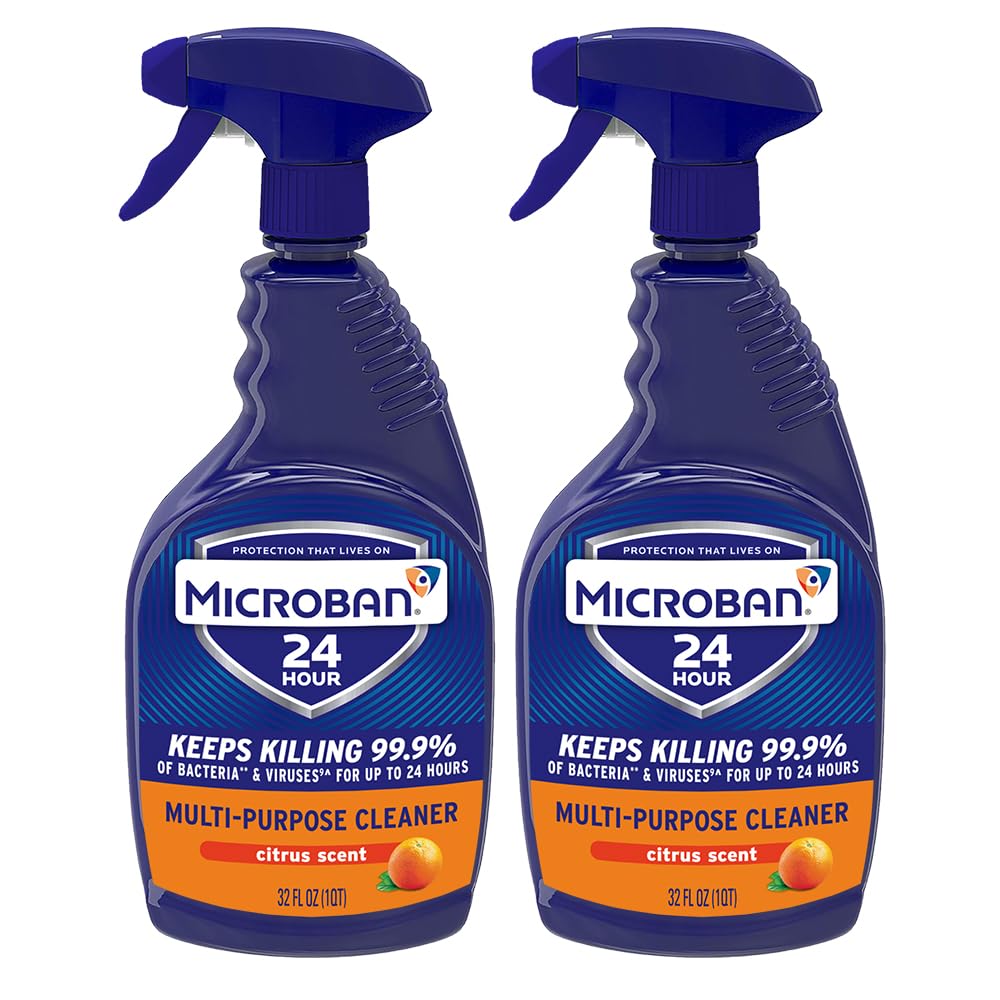
Microban 24 is the only product in this lineup that keeps killing bacteria for a full day after application. The formula bonds to hard, non-porous surfaces and creates a persistent antimicrobial film that does not wash away with normal contact. That means you can spray a countertop in the morning and still have protection after kids, pets, and meal prep have passed over it. The 2-pack delivers 64 oz of ready-to-use spray — enough to treat an entire kitchen and two bathrooms without rationing.
Users consistently praise the mild citrus scent, noting it lacks the harsh chemical burn of traditional bleach sprays. The no-rinse formula is safe on sealed granite, glazed tile, formica, corian, and stainless steel, and it actively penetrates soap scum and greasy soils during the cleaning step. This is not just a disinfectant — it is a daily surface-maintenance tool that eliminates the need to re-wipe after every touch.
Customer feedback highlights that it leaves a streak-free, non-sticky finish even on glass and glossy appliances. The 24-hour residual claim depends on the surface remaining dry and undisturbed — heavy scrubbing with a degreaser mid-day will strip the film. For most home routines, though, one morning spray keeps the entire day’s high-touch zones protected.
Why it’s great
- True 24-hour residual antibacterial protection
- Safe on sealed stone, tile, and stainless steel
- No sticky residue or bleach odor
Good to know
- Not for use on food-contact surfaces
- Must leave surface undisturbed for full 24-hour claim
2. Clorox ToiletWand Refills, Rainforest Rush, 30 Count

This system replaces both the liquid toilet cleaner and the traditional brush. Each pad is pre-loaded with Clorox cleaner that kills 99.9% of germs on contact, and the hexagonal shape scrubs the under-rim curve that round brushes routinely miss. The active ingredient is glycolic acid — a mild chelating agent that dissolves hard water scale and lime deposits without the eye-stinging chlorine vapor of bleach tablets.
The no-touch mechanism is the real draw: users click the pad onto the wand, scrub, then press the button to drop the pad directly into the trash. No rinsing a brush, no storing a slimy caddy, no aerosolized droplets from swirling. Reviewers regularly mention that this low-barrier system makes them clean the toilet more often — weekly maintenance becomes a 30-second task rather than a dreaded chore.
The biggest practical concern is pad adhesion. Several long-term users report pads detaching mid-scrub, especially on rough mineral deposits. The cost per pad (~) adds up in households with multiple toilets, and the refill packs are not compatible with generic wand handles. For light weekly upkeep, it is the most sanitary option. For a deep descaling session every 6 weeks, you will still need a separate bowl gel and dedicated brush.
Why it’s great
- Disposable pad eliminates germy brush storage
- Glycolic acid dissolves hard water stains effectively
- Hexagonal pad reaches under-rim crevices
Good to know
- Pads occasionally detach during heavy scrubbing
- High per-pad cost for households with 3+ toilets
3. Lysol Disinfecting Wipes, Lemon & Lime Blossom, 80 ct. (3 Pack)
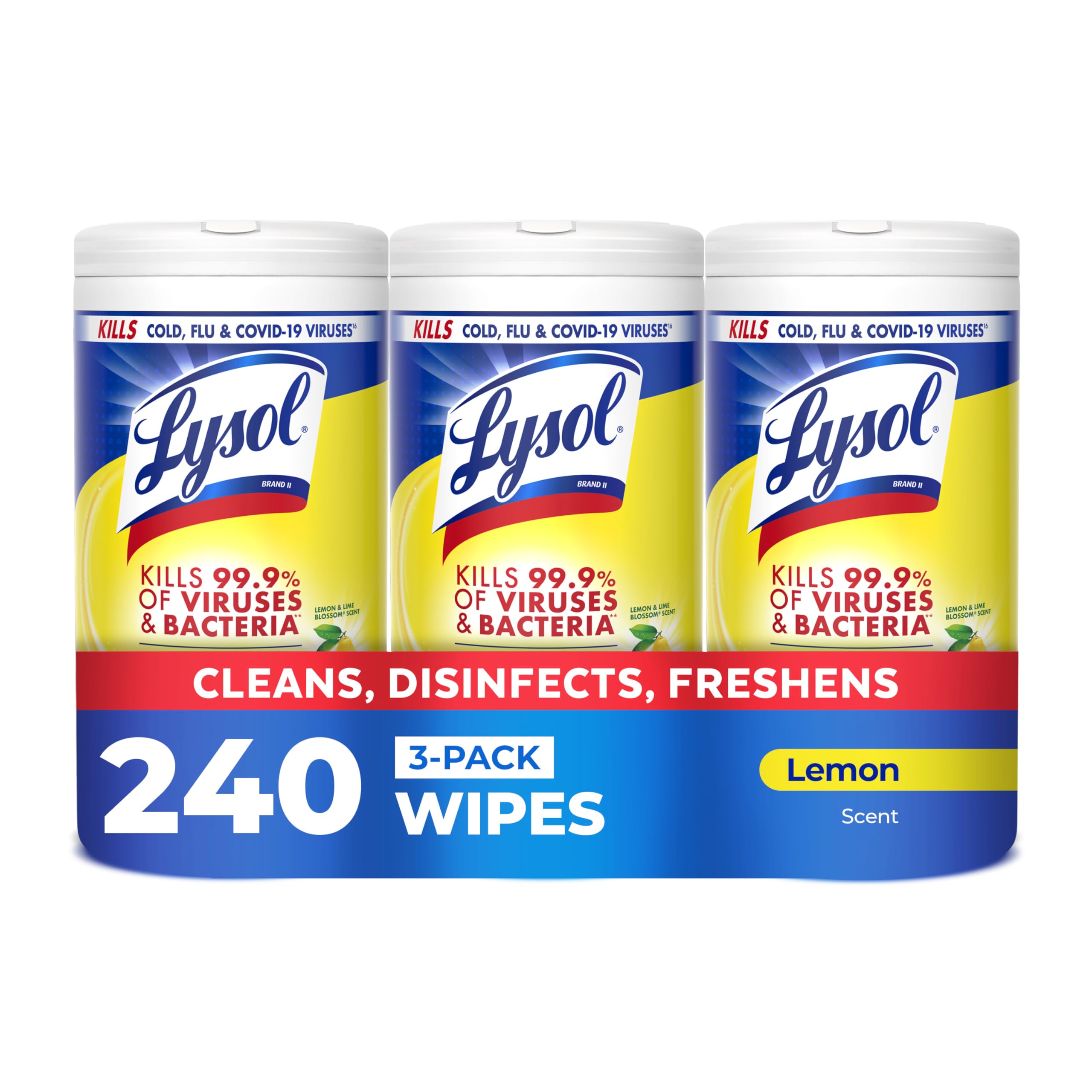
Lysol wipes are the category standard for a reason: they balance grab-and-go convenience with a validated kill claim against COVID-19, 8 cold and flu viruses, Staph, E. coli, MRSA, RSV, Salmonella, and Strep in 2 minutes. The wipe material is 3X stronger than a paper towel — it lifts baked-on grease, soap scum, and dried food spills without shredding or leaving lint. This makes it the only wipe here suitable for kitchen stovetops, microwave exteriors, and bathroom vanities in a single pass.
The Lemon & Lime Blossom scent is noticeably pleasant compared to the bleach-heavy aroma of Clorox wipes. Users with electronics-heavy households appreciate the label’s explicit approval for smartphones, tablets, keyboards, mice, remote controls, and gaming consoles. The 240-count 3-pack delivers roughly 3 months of daily kitchen-and-bathroom wiping for a single person, which translates to a reasonable cost per wipe.
The biggest drawback is the trade-off between kill time and wetness. The surface must stay wet for the full 2 minutes to achieve disinfection, but these wipes are not saturated enough to keep a large countertop wet for that duration. Users often need to use two wipes in sequence — one to wet the surface, one to keep it moist — which doubles per-use cost. For small surfaces like light switches, doorknobs, and faucet handles, a single wipe is perfectly adequate.
Why it’s great
- Safe on electronics, sealed wood, and stainless steel
- Strong substrate resists tearing on tough messes
- Pleasant, non-chemical citrus-lime scent
Good to know
- 2-minute dwell requires two wipes for large surfaces
- Not a residual protectant — reapplication needed after each touch
4. Amazon Basics Disinfecting Wipes, Lemon & Fresh Scent, 340 Count
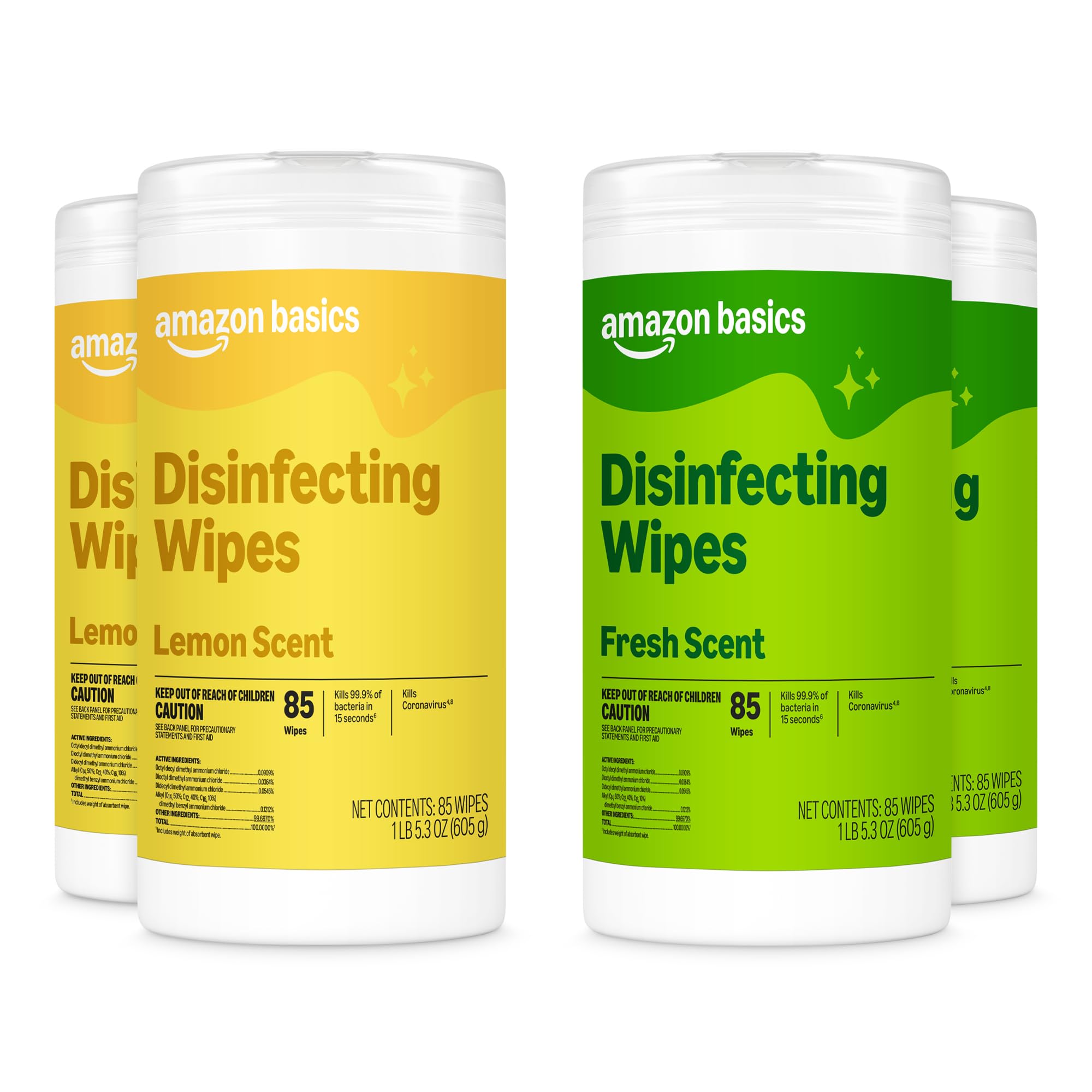
Amazon Basics delivers the same EPA-registered kill claim as Lysol — 99.9% of bacteria, including cold & flu virus, E. coli, Salmonella, and the virus that causes COVID-19 — at a noticeably lower price per wipe. The 340-count bundle splits into 2 Lemon Scent canisters and 2 Fresh Scent canisters, giving variety without fragrance fatigue. The wipes are slightly thinner than Lysol, but users consistently report they hold up during scrubbing without tearing through on typical kitchen and bathroom messes.
The 15-second sanitize claim is faster than Lysol’s 2-minute dwell, which means one wipe can cover a standard countertop without the surface drying before the contact time expires. The secure lid design keeps the wipes moist through the life of the canister — a common failure point on budget wipes. Reviewers note that these remain wet to the last wipe, a sign of good seal engineering in the lid gasket.
The trade-off is that the thinner wipe absorbs less liquid, so it does not soak heavy caked-on grime as effectively as Lysol. For wiping down doorknobs, light switches, remote controls, and countertops after quick kitchen spills, the performance is nearly identical to the name brand. For heavy-duty degreasing, you may need an extra wipe per session. The canisters themselves contain 20% post-consumer recycled plastic, which is a small sustainability edge over many generic competitors.
Why it’s great
- Lowest per-wipe cost in this lineup
- 15-second dwell works on fast-paced cleaning
- Two-scent variety prevents olfactory fatigue
Good to know
- Thinner wipe requires more passes for grease
- Not suitable for electronics or sealed wood (no label claim)
5. OdoBan Disinfectant Concentrate, Eucalyptus Scent, 2 Gallons

OdoBan is the only liquid concentrate in this roundup, which means it can stretch far beyond the kitchen counter. Each gallon dilutes into dozens of ready-to-use spray bottles, and the same solution disinfects hard surfaces, deodorizes carpets, removes pet stains from upholstery, and even serves as a laundry refresher. The eucalyptus scent is noticeably fresh without being medicinal — users with scent sensitivities consistently report it does not trigger headaches or breathing irritation.
The bleach-free formula is safe on colored fabrics, delicate synthetics, and sealed wood floors, unlike chlorine-based concentrates that strip dye and degrade finishes. Reviewers in multi-pet households specifically call out its ability to lift urine enzymes from carpet fibers and mattress pads, breaking down odor at a chemical level rather than just masking it. The 2-gallon bundle provides enough concentrate for roughly 16 gallons of ready-to-use solution — a cost-per-use that undercuts every spray and wipe option on this list dramatically.
The main operational hurdle is dilution discipline. Users must follow the label ratios precisely (1 oz per quart of water for disinfecting, 2 oz per gallon for laundry) — too little dilution fails the kill claim, too much wastes product and may leave a sticky residue. The product also requires a 10-minute dwell time on hard surfaces, which is longer than any spray or wipe here. For deep-cleaning projects — post-sick-room disinfection, crate cleaning, athletic gear refresh — the concentration is unbeatable. For a quick daily countertop wipe, the preparation is overkill.
Why it’s great
- Extreme cost efficiency — dilutes to ~16 gallons of spray
- Works on fabric, carpet, laundry, and hard surfaces
- Bleach-free and fabric-safe with a mild eucalyptus scent
Good to know
- 10-minute dwell time is longer than any wipe or spray
- Requires precise mixing ratios for disinfectant claim
FAQ
Can I use Lysol wipes on stone countertops?
Does Microban 24 work on fabric surfaces?
Why does Clorox ToiletWand use glycolic acid instead of bleach?
How long does OdoBan stay effective once diluted?
Can I mix different disinfectants for stronger results?
Final Thoughts: The Verdict
For most users, the best disinfectant winner is the Microban Multi-Purpose Cleaner because its 24-hour residual protection eliminates the need to re-wipe every time a surface is touched. If you want the fastest grab-and-go solution, grab the Lysol Disinfecting Wipes. And for whole-home deep cleaning — including fabric, carpet, and laundry — nothing beats the cost efficiency of OdoBan Disinfectant Concentrate.

Mo Maruf
I created WellFizz to bridge the gap between vague wellness advice and actionable solutions. My mission is simple: to decode the research and give you practical tools you can actually use.
Beyond the data, I am a passionate traveler. I believe that stepping away from the screen to explore new environments is essential for mental clarity and physical vitality.