Our readers keep the lights on and my smoothie glass nicely filled. As an Amazon Associate, I earn from qualifying purchases.
A frustratingly dull kitchen knife is not just a cooking annoyance—it is a safety hazard that forces you to apply excessive pressure, increasing the risk of slips and cuts. The solution is not a professional whetstone session or an expensive electric grinder; it is a simple, reliable pull-through tool designed to restore a razor-sharp edge in seconds with zero guesswork.
I’m Mohammad Maruf — the founder and writer behind WellFizz. I have spent hundreds of hours researching the mechanical engineering and material science of consumer knife sharpeners, analyzing tungsten carbide hardness ratings, ceramic rod density, angle preset accuracy, and suction base vacuum force to determine which tools genuinely deliver consistent results for the home cook.
After evaluating dozens of models against real-world cutting tests, I have narrowed the market to the handful of tools that balance ease of use with effective edge restoration. This is your complete guide to finding the best easy knife sharpener for your kitchen routine.
How To Choose The Best Easy Knife Sharpener
Not every pull-through sharpener is built the same. The cheap single-slot models often strip too much metal or fail to hone, leaving you with a burred edge that dulls again after one meal prep. To avoid wasting time and money, focus on the three factors that separate a capable tool from a drawer filler.
Stage Count and Abrasive Material
The best easy knife sharpeners use at least two stages: a coarse tungsten carbide slot to set a new edge on a dull blade, and a fine ceramic slot to hone and polish that edge. Three-stage models add a dedicated slot for scissors or a finer finishing ceramic. The carbide removes metal quickly—essential for restoring a neglected blade—while the ceramic refines the edge without excessive wear. Avoid sharpeners that rely on a single abrasive surface; they cannot correct a truly dull edge.
Pre-Set Sharpening Angle
Most Western-style knives (Wusthof, Zwilling) are ground to a 20-degree edge, while Asian-style knives (Shun, Global) often sit at 14–16 degrees. A sharpener with a fixed angle that matches your blade type will produce consistent results without guesswork. Adjustable-angle sharpeners, like the Cangshan model, allow you to dial in the exact angle (14–24 degrees) for greater versatility across different knife collections. Using the wrong angle can leave an edge too obtuse to cut efficiently or too acute to hold its edge.
Stability and Safety Features
A pull-through sharpener moves against the blade with significant lateral force. If the base slips or the handle lacks grip, you risk losing control and cutting yourself. Look for a non-slip rubberized base or a powerful suction cup that anchors the sharpener to the counter. Ergonomic handles with finger guards also reduce the chance of the blade sliding onto your hand during the pull stroke. A stable platform lets you apply even, confident pressure—critical for a clean, burr-free edge.
Quick Comparison
On smaller screens, swipe sideways to see the full table.
| Model | Category | Best For | Key Spec | Amazon |
|---|---|---|---|---|
| SHARPAL 191H | Mid‑Range | Versatile 3‑in‑1 sharpening + scissors | 3‑stage (carbide + ceramic + scissor slot) | Amazon |
| Cangshan 1026108 | Mid‑Range | Angle‑adjustable for mixed knife collections | Adjustable 14‑24° sharpening angle | Amazon |
| Edgemaker Pro 331 | Premium | Rotating crossed steels for long‑term use | Replaceable/rotatable hardened steel rods | Amazon |
| ZWILLING 2‑Stage | Premium | Western‑style knife owners wanting brand match | Coarse/fine preset for Western blades | Amazon |
| Smith’s Pull‑Thru | Budget | Ultra‑simple maintenance for basic kitchen knives | Carbide + ceramic preset slots | Amazon |
In‑Depth Reviews
1. SHARPAL 191H 3‑Stage Knife Scissors Sharpener
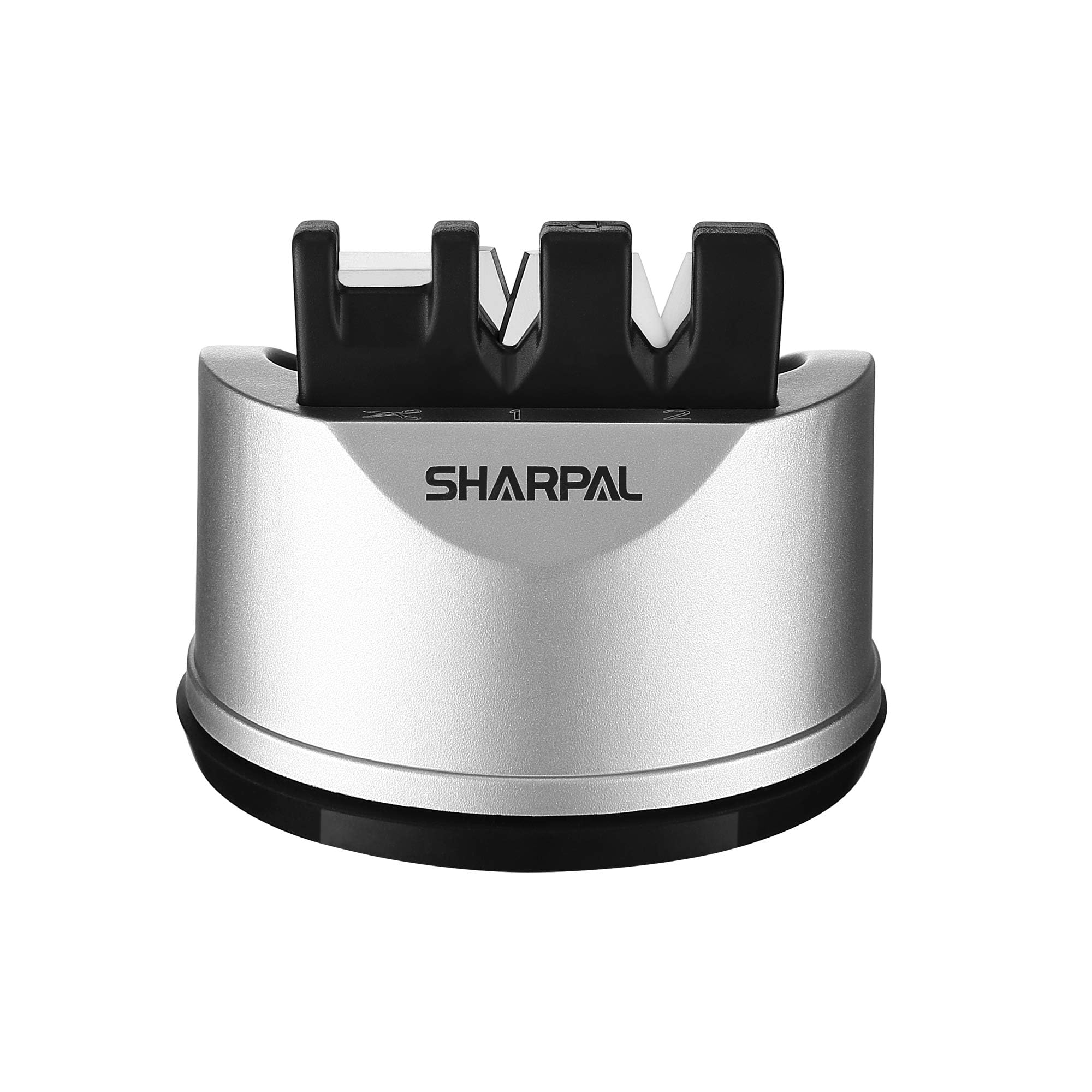
The SHARPAL 191H stands out because it packs three dedicated abrasive surfaces—tungsten carbide for fast edge setting, ceramic for precision honing, and a separate carbide slot for scissors—into a body that weighs just over 3 ounces. The enhanced suction base produces twice the holding force of typical pull-through sharpeners, so the unit stays planted on the counter even when you drag a dull chef’s knife through the coarse slot with moderate pressure. Customer feedback consistently praises the stability, with multiple users noting that the sharpener does not slide at all during use.
What makes this model genuinely easy is the black switch that activates the suction cup: place it on a smooth surface, press the switch, and both hands are free to guide the blade. The compact form factor (roughly 2.8 inches per side) slides into any cluttered kitchen drawer without complaint. The 3‑stage system also handles serrated blades on the ceramic side, adding versatility that single-purpose sharpeners lack. For a household that owns a mix of straight-edge kitchen knives and scissors, this is the most complete entry-level package available.
Users with arthritic wrists or limited hand strength report that the minimal pressure required delivers excellent results on both German-style and softer stainless blades. The included scissor sharpening slot genuinely restores dull shears to functional sharpness in a few passes, a feature missing from most competitors at this tier. After three years of normal home use, the carbide and ceramic components show no significant wear, backed by the manufacturer’s 3‑year defect warranty.
Why it’s great
- Triple‑stage system includes dedicated scissor slot, saving you from buying a separate tool
- Suction force is exceptionally strong—no slipping even with aggressive pulls
- Compact footprint fits into crowded drawers and takes almost no counter space
- 3‑year warranty from a US‑based company provides peace of mind
Good to know
- Suction base requires a perfectly smooth, clean surface to hold effectively; textured or wet counters weaken grip
- Not designed for high‑end single‑bevel Japanese knives like sashimi blades—those need a specialized stone
2. Cangshan 1026108 3‑Stage Adjustable Knife + Scissor Sharpener

The Cangshan 1026108 distinguishes itself through a rotating dial that shifts the sharpening angle from 14 to 24 degrees in 2‑degree increments, a rarity in the entry‑level pull‑through category. Cangshan spent 16 months developing industrial‑grade tungsten carbide components that can handle high‑alloy metal blades like those found on premium German and Japanese brands. The tool offers a coarse carbide side for restoring dull edges and a fine ceramic side for honing, plus a separate ceramic slot explicitly shaped for two‑piece kitchen shears.
For knife collectors who rotate between a 20‑degree Wusthof chef’s knife and a 16‑degree Shun Santoku, the adjustable angle eliminates the compromise that fixed‑angle sharpeners force upon mixed‑edge households. Real‑world feedback confirms that setting the dial to 16 degrees approximates the factory edge on most Asian‑style blades, while a 20‑degree setting works well for heavier Western knives. The nonslip rubberized base provides adequate stability, though several experienced users note that the angle‑adjustment mechanism feels a bit tight and should not be forced repeatedly.
The handle‑shaped grip keeps fingers safely away from the blade path, and the 10.9‑ounce weight gives the tool a substantial, non‑rattly feel. Some users report that the sharpener will not produce a hair‑whittling razor edge on its own—it excels at restoring functional sharpness rather than achieving mirror‑polish finishes. If you rotate between multiple knife angles and want a single tool that adapts without requiring a separate stone, this is the most capable adjustable pull‑through on the market at a mid‑range price point.
Why it’s great
- Adjustable angle (14–24°) means one tool works for both Western and Asian blade geometries
- Industrial‑grade carbide handles high‑hardness blade steels without chipping
- Dedicated scissor slot adds genuine utility for home kitchens
- Ergonomic handle shape improves safety and control during the pull stroke
Good to know
- Angle‑adjustment dial can feel notchy and may require careful handling to avoid jamming
- Not suitable for serrated knives or single‑bevel sashimi blades
- Some users find the suction base adequate but not as strong as the SHARPAL’s
3. Edgemaker Knife Sharpener Pro 331

The Edgemaker Pro 331 takes a fundamentally different approach from carbide‑embedded sharpeners: it uses two crossed hardened‑steel rods that perform both honing and sharpening through a mechanical action similar to a butcher’s steel. The absence of ceramic or carbide abrasives means the tool does not aggressively strip metal away, making it ideal for maintaining an already decent edge rather than rescuing a completely neglected blade. The high‑impact plastic body is genuinely unbreakable, and the rods can be pulled out, rotated 180 degrees, and reinserted to expose a fresh sharpening surface, extending the tool’s usable life to many years.
Customer reports confirm that one Edgemaker unit has lasted over eight years of daily use in a residential kitchen, and some users report a 35‑year lifespan on their original purchase. The crossed‑rod design gives the user tactile feedback—you can feel when the blade is sharp enough because the resistance changes—which helps prevent over‑sharpening. The tool works on wavy and serrated blades as well, a rare capability in the pull‑through world. Safety is addressed through clear printed instructions and a handle shape that keeps the fingers behind the blade path.
The downside is that the Edgemaker is not the best choice for a knife that has been truly neglected for years. Severely dull or damaged blades require a more aggressive first step (carbide or a diamond stone) before the Edgemaker can refine them. Additionally, the lack of a preset angle means the user’s technique matters more—you must draw the blade through at a consistent vertical orientation. For daily edge maintenance on a set of already‑functional knives, however, the Edgemaker’s longevity and rotating‑rod system make it a compelling premium‑tier option.
Why it’s great
- Rotatable steel rods create a fresh sharpening surface without buying replacement parts—lasts for years
- Works on serrated and wavy blades, not just straight edges
- Tactile feedback during sharpening helps you feel when the edge is restored
- Unbreakable plastic body; tested in demanding conditions by long‑term users
Good to know
- Not aggressive enough to restore a severely dull or chipped blade—you need a carbide tool for initial edge setting
- Requires consistent vertical pull technique; no angle guides or preset slots to compensate for sloppy form
4. ZWILLING 2‑Stage Pull‑Through Sharpener

ZWILLING, a name synonymous with premium German cutlery, offers this two‑stage pull‑through as a maintenance companion for its own blade lines. The tool provides a coarse slot for initial edge restoration and a fine slot for honing, both pre‑set at the 20‑degree angle that matches ZWILLING’s standard blade geometry. The non‑slip rubberized bottom keeps the unit stable on the counter, and the comfortable handle includes a finger guard that protects against accidental contact with the blade edge. The build uses ABS plastic, which feels durable enough for occasional weekly use.
Users report that the sharpener works best as a touch‑up tool between professional sharpenings, restoring a working edge without the learning curve of a whetstone. Several experienced users note that achieving a truly razor‑sharp finish requires multiple passes through both slots—this is not a one‑pull miracle worker. The coarse carbide grit removes metal effectively on moderately dull blades, but the fine ceramic slot leaves the edge sharper than a typical honing steel alone would. For owners of ZWILLING or other 20‑degree Western knives who want a branded maintenance solution, this sharpener delivers predictable, risk‑free results.
The tool’s main limitation is its narrow compatibility: the fixed 20‑degree angle does not suit Asian‑style blades ground at 14–16 degrees. Attempting to sharpen a Global or Shun knife in this sharpener will alter the edge angle in a way that reduces cutting performance. Additionally, users seeking a mirror‑polished edge straight out of the box may be disappointed by the functional—but not surgical—sharpness this tool produces. It is a competent, safe, and brand‑aligned option for ZWILLING knife owners who prioritize consistency over versatility.
Why it’s great
- Pre‑set 20‑degree angle perfectly matches ZWILLING and most Western‑style knives
- Finger guard and non‑slip base improve safety during use
- Two‑stage (coarse/fine) system handles both dull edges and routine honing
Good to know
- Fixed 20‑degree angle is not appropriate for Asian‑style knives (14–16°)
- Will not produce a razor‑sharp mirror finish; adequate for functional sharpness
- Multiple passes are required to fully restore a very dull blade
5. Smith’s Pull‑Thru Knife Sharpener
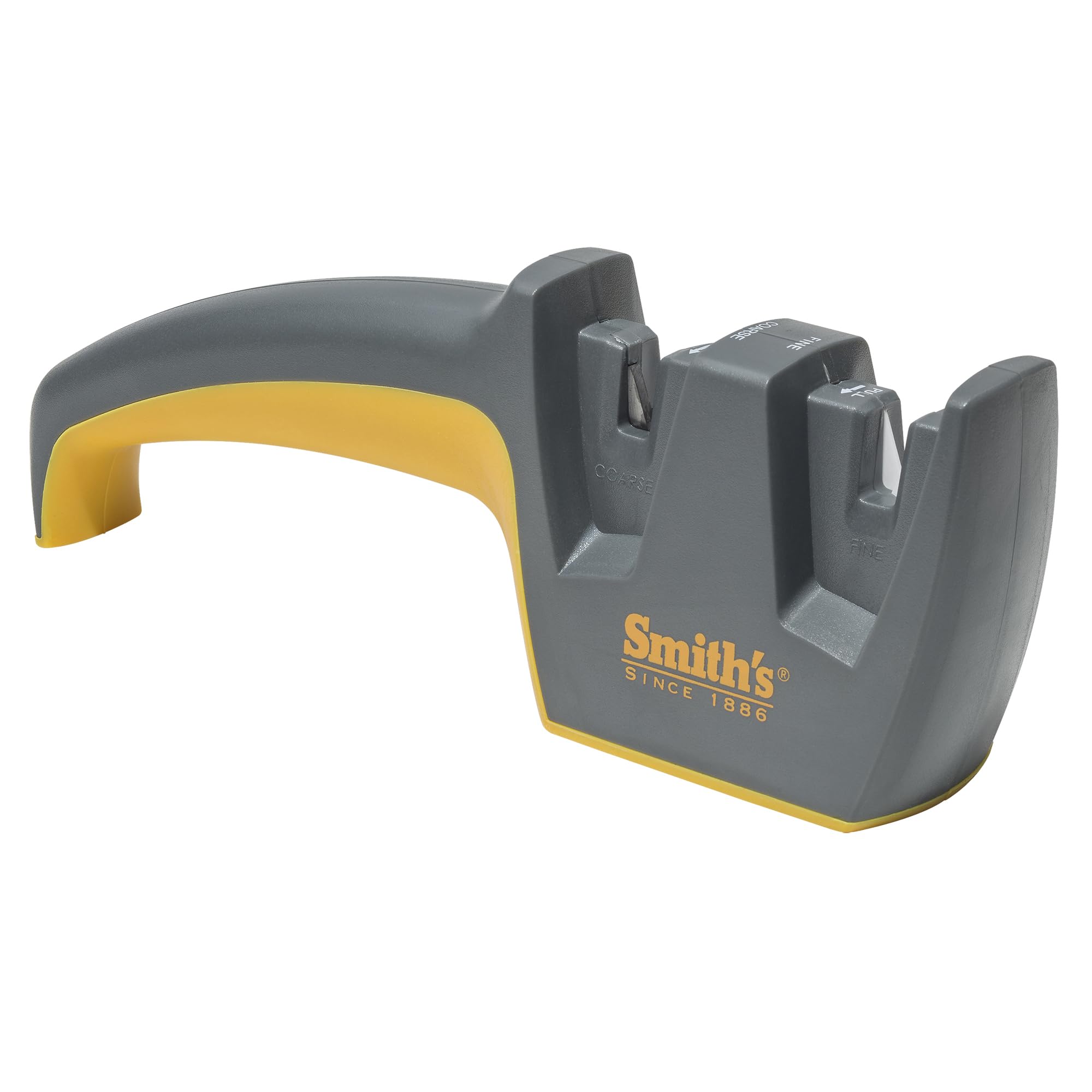
Smith’s has been in the sharpening business for decades, and the Pull‑Thru model represents the simplest possible entrance into guided edge maintenance. The tool offers two pre‑set slots: a coarse carbide side for reshaping dull or damaged straight edges and a ceramic side for final honing. The ergonomic soft‑grip handle provides comfortable control during the pull motion, and the non‑slip rubber base holds the unit steady on most counter surfaces. Both the carbide and ceramic components are replaceable, a feature that adds long‑term value at an entry‑level price point.
Customer feedback indicates that the Smith’s Pull‑Thru works well for maintaining knives that are already in reasonable shape—regular weekly use keeps the edge functional without effort. Users who expected the tool to rescue severely neglected blades from the back of the drawer report mixed results, consistent with the fact that coarse carbide settings still have a finite removal capacity. The 6‑inch length and slim profile make it easy to store in a utensil drawer or kitchen caddy, and the straightforward design requires zero learning curve: pull the knife through each slot three to five times and test the edge.
Several long‑term owners mention that the Sharpe’s performance is noticeably better on softer stainless steel blades than on high‑hardness alloy knives. The ceramic honing slot is effective for quick touch‑ups between deep sharpening sessions, but it will not correct an asymmetrical edge or a rolled burr. For households that simply want a no‑thought maintenance tool for basic kitchen knives, the Smith’s Pull‑Thru delivers reliable results at a budget‑friendly cost, with the added reassurance that replaceable parts keep it out of the landfill.
Why it’s great
- Carbide and ceramic components are replaceable, extending the tool’s usable life indefinitely
- Ergonomic soft‑grip handle reduces fatigue during multiple sharpening passes
- Non‑slip rubber base provides adequate stability on smooth counters
- Ultra‑simple operation with no angle adjustment or complex setup required
Good to know
- Less effective on high‑hardness alloy blades (D2, VG‑10) compared to softer stainless steel
- Will not restore severely damaged or chipped blades—needs a more aggressive first stage
- Some users report inconsistent results on very dull knives, requiring multiple sessions
FAQ
Will an easy pull‑thru sharpener ruin my expensive Japanese knives?
How often should I sharpen my kitchen knives with a pull‑thru tool?
Can a pull‑thru sharpener fix a chipped or very damaged blade?
Final Thoughts: The Verdict
For most users, the best easy knife sharpener winner is the SHARPAL 191H because it combines a three‑stage system (carbide, ceramic, scissors) with a suction base that genuinely stays put, all at a price that undercuts competitors. If you want adjustable angle control to match a mixed collection of Western and Asian blades, grab the Cangshan 1026108. And for long‑term edge maintenance with a tool that can last a decade, nothing beats the rotating‑rod system of the Edgemaker Pro 331.

Mo Maruf
I created WellFizz to bridge the gap between vague wellness advice and actionable solutions. My mission is simple: to decode the research and give you practical tools you can actually use.
Beyond the data, I am a passionate traveler. I believe that stepping away from the screen to explore new environments is essential for mental clarity and physical vitality.