Our readers keep the lights on and my smoothie glass nicely filled. As an Amazon Associate, I earn from qualifying purchases.
Pouring a glass of tap water should be a moment of refreshment, not a moment of doubt. With rising concerns over chlorine, lead, and PFAS in municipal supplies, the right drinking water filter system transforms your kitchen tap into a reliable source of clean, great-tasting water without the waste or cost of bottled alternatives.
I’m Mohammad Maruf — the founder and writer behind WellFizz. I’ve spent dozens of hours analyzing filter media specs, flow rate claims, and certification standards to separate the genuinely effective drinking water systems from those that just look good on a shelf.
Whether you rent a small apartment or own a family home, finding the best drinking water filter system comes down to matching the right filter technology to your specific tap water quality and your daily usage volume.
How To Choose The Best Drinking Water Filter System
Selecting the right system starts with understanding what is in your tap water and how much filtered water your household needs each day. Systems vary widely in filter media, installation type, and certification depth.
Filter Stages and Micron Rating
A filter’s micron rating determines the size of particles it can block. A 0.5-micron carbon block will handle sediment, chlorine, and some heavy metals, while a 0.01-micron ultrafiltration membrane catches smaller contaminants like bacteria. Multi-stage systems combine sediment filters, carbon blocks, and occasionally ion-exchange media to target a broader spectrum of impurities.
Installation Type: Countertop vs. Under Sink
Countertop units attach directly to your faucet or sit on the counter as dispensers — ideal for renters or anyone avoiding plumbing work. Under-sink systems connect to the cold water line and are hidden from view, offering larger filter capacities but requiring a few minutes of installation and cabinet space.
Certifications That Actually Matter
NSF/ANSI Standard 53 covers health-related contaminant reduction like lead and VOCs, while NSF 401 addresses emerging contaminants such as pharmaceuticals. IAPMO and WQA certifications add independent verification. A system that lists no third-party certification may still work, but you are trusting the brand’s own testing.
Quick Comparison
On smaller screens, swipe sideways to see the full table.
| Model | Category | Best For | Key Spec | Amazon |
|---|---|---|---|---|
| Waterdrop T3-T RO | Under Sink RO | Remineralized, high-purity water | 220 GPD, 7-stage RO | Amazon |
| AO Smith Claryum | Under Sink Carbon | Comprehensive contaminant reduction | Reduces 99% of 78 contaminants | Amazon |
| Frizzlife DS99 | Countertop Carbon | Fast flow, dual-stage filtration | 2 GPM, 0.5 micron | Amazon |
| SimPure V7 | Under Sink Carbon | Tool-free, high-capacity filtration | 20,000 gallon filter life | Amazon |
| Purewell Gravity | Countertop Gravity | No-power, ultra-fine filtration | 0.01 micron UF membrane | Amazon |
| Waterdrop ED01W | Countertop Electric | Instant electric dispensing | 200-gallon filter, 1-second dispense | Amazon |
| ZeroWater 32-Cup | Countertop Dispenser | Zero TDS, budget entry | 5-stage, TDS meter included | Amazon |
In‑Depth Reviews
1. Waterdrop T3-T Reverse Osmosis System
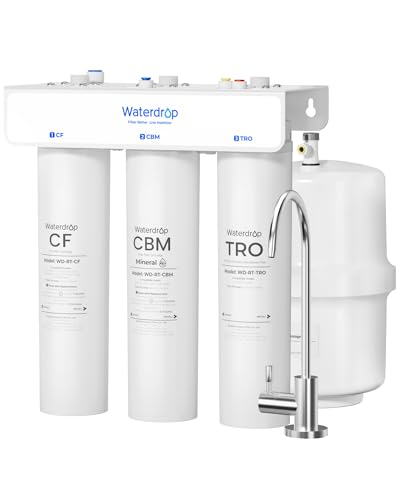
The Waterdrop T3-T delivers 220 gallons per day from a compact under-sink footprint that saves up to 40% more space than traditional tank-based RO units. Its 7-stage filtration includes a remineralization cartridge that adds back potassium, calcium, sodium, and magnesium — addressing the flat taste issue common with standard reverse osmosis systems. The 2:1 pure-to-drain ratio is notably efficient, wasting significantly less water than conventional RO systems that operate closer to 1:1 or worse.
Installation is rated at roughly 30 minutes thanks to simplified water lines and fewer connections, though the faucet does require a countertop hole. The all-in-one filter design twists out in seconds, with NFC technology providing smartphone reminders for replacement intervals. The CF filter lasts up to 6 months, the CBM filter up to 12 months, and the TRO filter up to 24 months, keeping long-term maintenance manageable.
Users report noticeably improved taste and peace of mind regarding PFAS and chemical contaminants. The system runs without electricity, relying on water pressure alone, and its rated flow fills five 16.9-ounce bottles in about one minute. For households seeking true purification with mineral restoration, this RO system sets a high standard in the mid-premium tier.
Why it’s great
- 220 GPD flow rate with fast recovery between uses
- Remineralization restores beneficial minerals lost during RO
- 2:1 pure-to-drain ratio reduces water waste
Good to know
- Countertop hole drilling required for faucet installation
- Initial setup requires careful connection to avoid leaks
- Higher upfront investment than carbon-only filters
2. AO Smith Claryum Under Sink Filter

The AO Smith Claryum system connects directly to your cold water line without requiring a separate faucet, making it one of the cleanest under-sink installations available. Its advanced Claryum filtration reduces up to 99% of 78 contaminants, including lead, PFAS/PFOA/PFOS, chlorine, chloramine, microplastics, mercury, and pharmaceuticals, while retaining beneficial minerals — no wastewater, no electricity, and no TDS stripping.
Each filter lasts 784 gallons or about 6 months, with a flow rate of 1.5 gallons per minute, which is fast enough for a family of four. The system measures 4 by 4 by 20.5 inches and fits into tight cabinet spaces. IAPMO certification against NSF/ANSI standards 42, 53, and 401 provides verified third-party validation for its contaminant reduction claims.
Long-term users highlight the consistent removal of metallic chlorine taste and the peace of mind that comes from certified microplastic reduction. The filter replacement is straightforward, though you must use the exact AO-MF-ADV cartridge to avoid leaks. Some users note availability can be inconsistent in local stores, so ordering replacements ahead is smart.
Why it’s great
- Certified reduction of 78 contaminants including PFAS and pharmaceuticals
- Retains healthy minerals while improving taste
- No electricity or wastewater required
Good to know
- Proprietary filter cartridge required — no generic alternatives fit
- Replacement filters can be harder to find locally
- Not designed for well water without pre-filtration
3. Frizzlife DS99 Countertop Filter
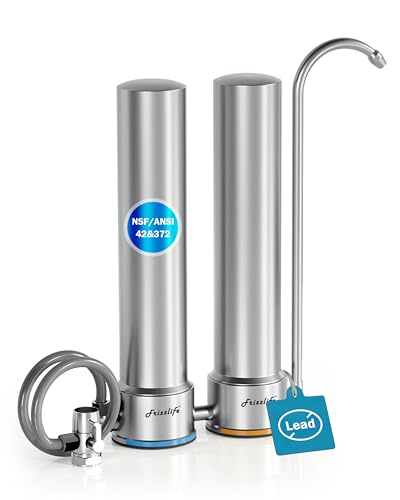
The Frizzlife DS99 delivers 2 gallons per minute from its dual-stage countertop design — among the fastest flow rates in this review. The two-stage system uses a PP membrane and activated coconut shell carbon block blended with KDF in the first stage, then a 0.5-micron carbon block with lead-reduction media in the second stage. It effectively reduces lead, chlorine, fluoride, heavy metals, and VOCs while preserving essential minerals.
The housing is constructed from food-grade 304 stainless steel with 1mm thick walls, rated to withstand 100,000 water hammer tests and 10,000 pulse tests. Installation is genuinely tool-free: the included hose attaches directly to your existing faucet with one of six included adapters, and a diverter valve lets you switch between tap and filtered water instantly. No electricity and zero wastewater.
Filter life is substantial — the first stage lasts up to 8 months and the second up to 12 months or 8,000 gallons. Users consistently praise the immediate taste improvement and sturdy build. The only real consideration is verifying that your faucet thread size is among the six included adapter sizes, though Frizzlife offers additional adapters upon request.
Why it’s great
- Extremely fast 2 GPM flow with no wait time
- All-metal 304 stainless steel construction resists bursting
- Simple tool-free countertop installation
Good to know
- Requires faucet thread compatibility check before purchase
- Does not reduce TDS — minerals are retained
- Dual-stage filters need separate replacements at different intervals
4. SimPure V7 Under Sink Filter

The SimPure V7 fits into tight under-sink spaces with its slim 3.6-by-3.6-inch profile while delivering a 5-stage filtration process that includes double-sediment membranes, KDF-55, and double-activated carbon blocks. With 0.5-micron filtration accuracy, it reduces lead, chlorine, bad tastes, and odors while retaining beneficial natural minerals. The system is not designed to lower TDS, so mineral content stays intact.
Installation claims a 3-minute time frame — attaching directly to a 3/8 or 1/2-inch cold water line using included converter fittings. No drilling is needed, making it suitable for renters and condo dwellers. The housing is made entirely from food-grade 304 stainless steel, avoiding the cracking and chemical degradation issues common with plastic under-sink filters over time.
Flow rate reaches 1.6 gallons per minute, filling an 8-ounce glass in about 3 seconds. A single V7 cartridge lasts up to 12 months or 20,000 gallons, which translates to very low annual maintenance cost. Some user feedback suggests actual micron rating may be closer to 5 microns than the advertised 0.5, but most report excellent taste improvement and easy setup.
Why it’s great
- Ultra-compact 3.6-inch wide design fits cramped cabinets
- 20,000-gallon filter life reduces per-gallon cost significantly
- No-drill installation works for renters and apartments
Good to know
- Does not reduce TDS — not suitable if zero-solids water is desired
- Some users report filter accuracy possibly below 0.5 microns
- Limited to cold water line connection only
5. Purewell Gravity Water Filter System

The Purewell gravity system uses zero electricity — it relies on gravity to pull water through a 3-stage filtration process that ends with a 0.01-micron hollow fiber UF membrane. That pore size is significantly smaller than the 0.2-micron membranes found on many competitors, allowing it to sieve out 99.99% of minuscule materials including bacteria and cysts while maintaining a 4-gallon-per-hour flow rate.
The countertop unit consists of an upper chamber for unfiltered tap water and a lower chamber for filtered water, with a transparent water level window that lets you check volume without opening the lid. The two included black carbon filters each serve up to 3,000 gallons, for a combined 6,000 gallons before replacement. The stand elevates the system for convenient countertop use.
Users transitioning from bottled water report the system pays for itself quickly, with noticeable elimination of chlorine smell and taste. The design is equally at home in RVs, camping setups, and emergency preparedness kits since it needs no plumbing or power connection.
Why it’s great
- 0.01-micron UF membrane catches bacteria and cysts
- No electricity, no plumbing — works anywhere
- 6,000-gallon total filter capacity with included pair
Good to know
- Gravity-dependent flow is slower than pressurized systems
- Actual water capacity less than 2.25 gallons due to filter displacement
- Does not reduce TDS; minerals remain in the water
6. Waterdrop ED01W Electric Pitcher
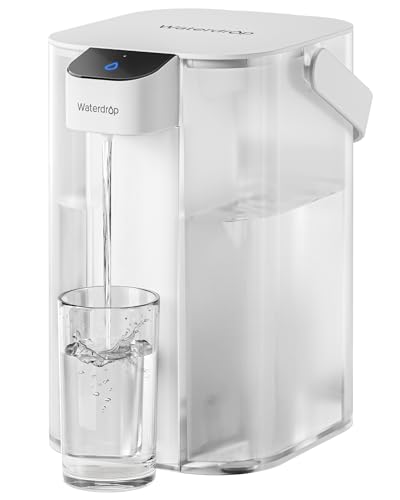
The Waterdrop ED01W breaks the traditional pitcher mold with an electric pump that dispenses filtered water in one second — no tipping, no waiting. Inside, a 0.5-micron premium carbon block filter delivers 10x more efficient filtration than standard pitcher filters, reducing over 45 contaminants including chlorine, lead, microplastics, and mercury. It is IAPMO certified against NSF/ANSI standards 42, 53, 401, and 372.
The rechargeable battery lasts up to 30 days on a full charge via USB-C, making this pitcher genuinely portable around the kitchen. The 15-cup capacity and 200-gallon filter life (roughly 3 months per filter) make it viable as a primary water source for small households or a convenient secondary option for larger families. The one-touch operation is intuitive enough for children and older adults alike.
Note that this system does not lower TDS — if you are looking for zero-solids water, Waterdrop offers a separate TDS-reduction model. User feedback consistently praises the great taste and the convenience of instant dispensing, though a few units required customer service intervention for battery issues, which Waterdrop reportedly handled quickly with replacements.
Why it’s great
- Instant electric dispensing eliminates pitcher tipping
- 30-day rechargeable battery with USB-C charging
- 200-gallon filter life reduces replacement frequency
Good to know
- Does not reduce TDS — retains dissolved minerals
- Requires occasional battery charging
- Smaller capacity than full-size countertop dispensers
7. ZeroWater 32-Cup Dispenser

The ZeroWater 32-Cup dispenser uses a 5-stage filtration process that includes ion-exchange technology to remove virtually all total dissolved solids, bringing tap water down to 0 TDS. The integrated instant-read TDS meter lets you verify filter performance at a glance — when the reading hits 006, it is time for a replacement. IAPMO certification confirms reduction of lead, chromium, mercury, and PFOA/PFOS.
At a 7.5-liter capacity, this is the largest pitcher-style dispenser in the lineup, suitable for households that go through several gallons daily. The 5-stage system targets both organic and inorganic materials through a combination of foam, carbon, ion-exchange, and ultrafiltration layers. The sliding hatch dispenser design is spill-free and more convenient than flip-top lids found on basic pitchers.
The trade-off is significant: users with high-TDS tap water (300-400 ppm) report filter life as short as 2.5 to 3 weeks, pushing annual replacement costs into the hundreds of dollars. The taste is exceptionally clean but some describe it as flat due to complete mineral removal. For homes with moderate TDS, the filter lasts 2-3 months, and the eco-friendly benefit of replacing hundreds of single-use plastic bottles remains compelling.
Why it’s great
- Achieves 0 TDS for truly purified-tasting water
- Large 32-cup capacity for high-volume households
- Integrated TDS meter removes guesswork for filter changes
Good to know
- Filter life is short on high-TDS water, increasing annual cost
- Removes all minerals including beneficial ones
- Slower filtration rate due to dense filter media
FAQ
What is the difference between a water filter and a water purifier?
How often should I replace the filter in my drinking water system?
Does a drinking water filter remove fluoride from tap water?
Final Thoughts: The Verdict
For most users, the best drinking water filter system winner is the Waterdrop T3-T RO because it combines thorough 7-stage purification, beneficial remineralization, and a space-saving tankless design without sacrificing flow rate. If you want certified contaminant reduction without the complexity of RO, grab the AO Smith Claryum. And for a budget-friendly entry that requires no installation at all, nothing beats the ZeroWater 32-Cup Dispenser — just keep replacement filter costs in mind if your water runs hot on TDS.

Mo Maruf
I created WellFizz to bridge the gap between vague wellness advice and actionable solutions. My mission is simple: to decode the research and give you practical tools you can actually use.
Beyond the data, I am a passionate traveler. I believe that stepping away from the screen to explore new environments is essential for mental clarity and physical vitality.