Our readers keep the lights on and my smoothie glass nicely filled. As an Amazon Associate, I earn from qualifying purchases.
When a loved one with dementia asks “Is it morning or night?” for the tenth time in an hour, a standard clock simply fails. Standard digital displays abbreviate “Dec” for December and show only “THU” for Thursday — cues that offer no meaning when short-term memory and visual processing decline. What’s needed is a clock that spells out the full day, shows the date without abbreviations, and uses large, high-contrast text to anchor the person in their daily timeline. These specialized dementia clocks also include auto-dimming, medication alarms, and intuitive displays that prevent confusion around AM/PM.
I’m Mohammad Maruf — the founder and writer behind WellFizz. I’ve spent dozens of hours analyzing the specifications, customer feedback, and build quality of the leading dementia clock models to pinpoint which ones actually remove daily confusion rather than adding frustrating complexity.
Whether you’re caring for someone with Alzheimer’s or looking for a gift that brings orientation back to each day, this guide examines the most reliable best dementia clock options available, focusing on display clarity, alarm usability, and overall ease of use.
How To Choose The Best Dementia Clock
A dementia clock is more than just a timepiece; it’s an orientation tool. The wrong clock adds confusion, while the right one restores a sense of normalcy. Focus on these three areas to make the right call.
Display legibility and font size
The best dementia clocks use full words for the day of the week (showing “Thursday” instead of “THU”) and avoid abbreviations for the month. A 10.1-inch screen or larger is ideal, as it allows bold, high-contrast characters that remain readable from across the room. Look for a display that separates the time, day, and date cleanly rather than cramming them together.
Day/night orientation features
Standard AM/PM indicators are too small and abstract for many people with memory loss. Premium dementia clocks display a contextual label like “Morning,” “Afternoon,” “Evening,” or “Night” in large text. Some models use icons such as a sun or moon. This simple visual cue answers the most common question better than any number could.
Alarm and reminder flexibility
Multiple independent alarms are crucial for medication schedules, meals, and appointments. Check whether the clock allows you to set different alarm times for different days, or at minimum supports several daily alarms. Models that include a medication reminder icon help those who no longer associate a beep with taking a pill. Also confirm that the alarm volume is adjustable and loud enough to be heard in another room.
Quick Comparison
On smaller screens, swipe sideways to see the full table.
| Model | Category | Best For | Key Spec | Amazon |
|---|---|---|---|---|
| Pastigio 10.1″ | Digital | Orientation with day-phase icons | 1024×600 IPS, 5 day phases | Amazon |
| American Lifetime Upgraded | Digital | Rugged daily use and reliability | 8″ display, wood frame | Amazon |
| Top Life Talking Clock | Voice Output | Visually or hearing impaired users | 85 dB voice, one-button talk | Amazon |
| AINFTIME 10.1″ | Digital | Multiple display styles and photo frame | 3 display modes, 12 alarms | Amazon |
| Mitoart 10.1″ | Digital | Voice time reporting, clear text | Voice announcement, auto DST | Amazon |
| CAZOKASI 8″ | Digital | Budget-friendly compact size | 8″ IPS, 15 alarms | Amazon |
| DayClocks Pine Wood | Analog | Classic decor and simple day tracking | 10″ analog, pine frame | Amazon |
In‑Depth Reviews
1. Pastigio 10.1″ Digital Clock
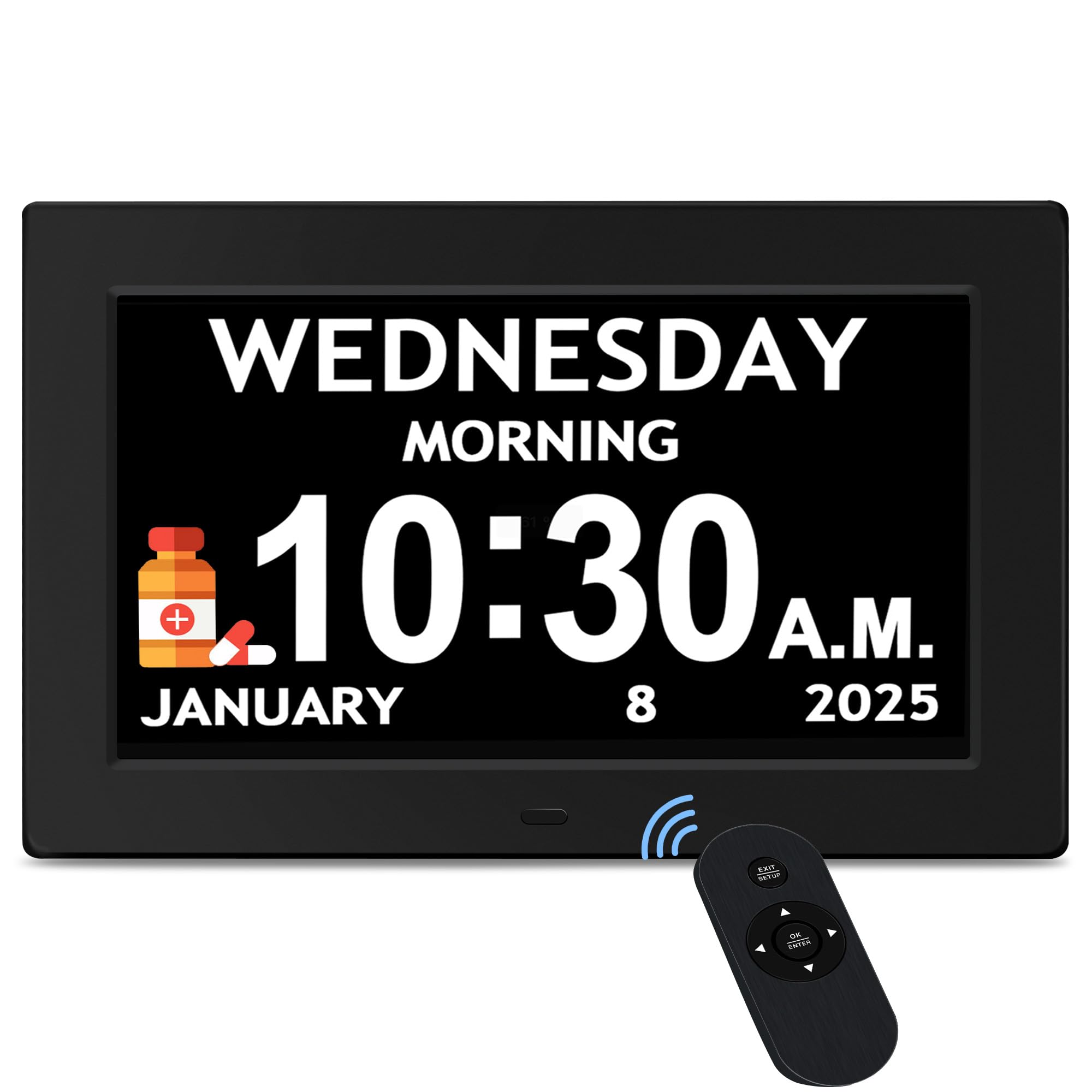
The Pastigio 10.1″ is the most thoughtfully designed dementia clock on this list. Its IPS display runs at 1024×600 resolution, and it divides each day into five clear phases — Before Dawn, Morning, Afternoon, Evening, Night — shown in large text so the user immediately knows whether it’s time to wake up or wind down. The screen also supports 8 languages and 5 display styles, making it highly adaptable.
You get 6 independent alarms plus 10 daily reminders, each with 5 adjustable volume levels and tones. The included remote control makes it easy to adjust settings from across the room, while the onboard buttons offer a backup. The auto-dimming adjusts to ambient light, and there are 5 manual brightness levels for fine-tuning. Batteries are included for backup settings.
Customers report that their spouses can finally track medication times independently, and the remote solves a common frustration with similar models — no more squinting at tiny back buttons. The only minor issue is that the remote can interfere with some space heaters, but this is rare and easily managed.
Why it’s great
- Five concrete day-phase labels answer the most common dementia question instantly
- Remote control and 6 alarms make it the most flexible for caregivers
- High-res IPS screen readable from any angle
Good to know
- Remote signal may interact with certain electric heaters
- Must stay plugged in at all times (no battery-only mode)
2. American Lifetime Upgraded Day Clock
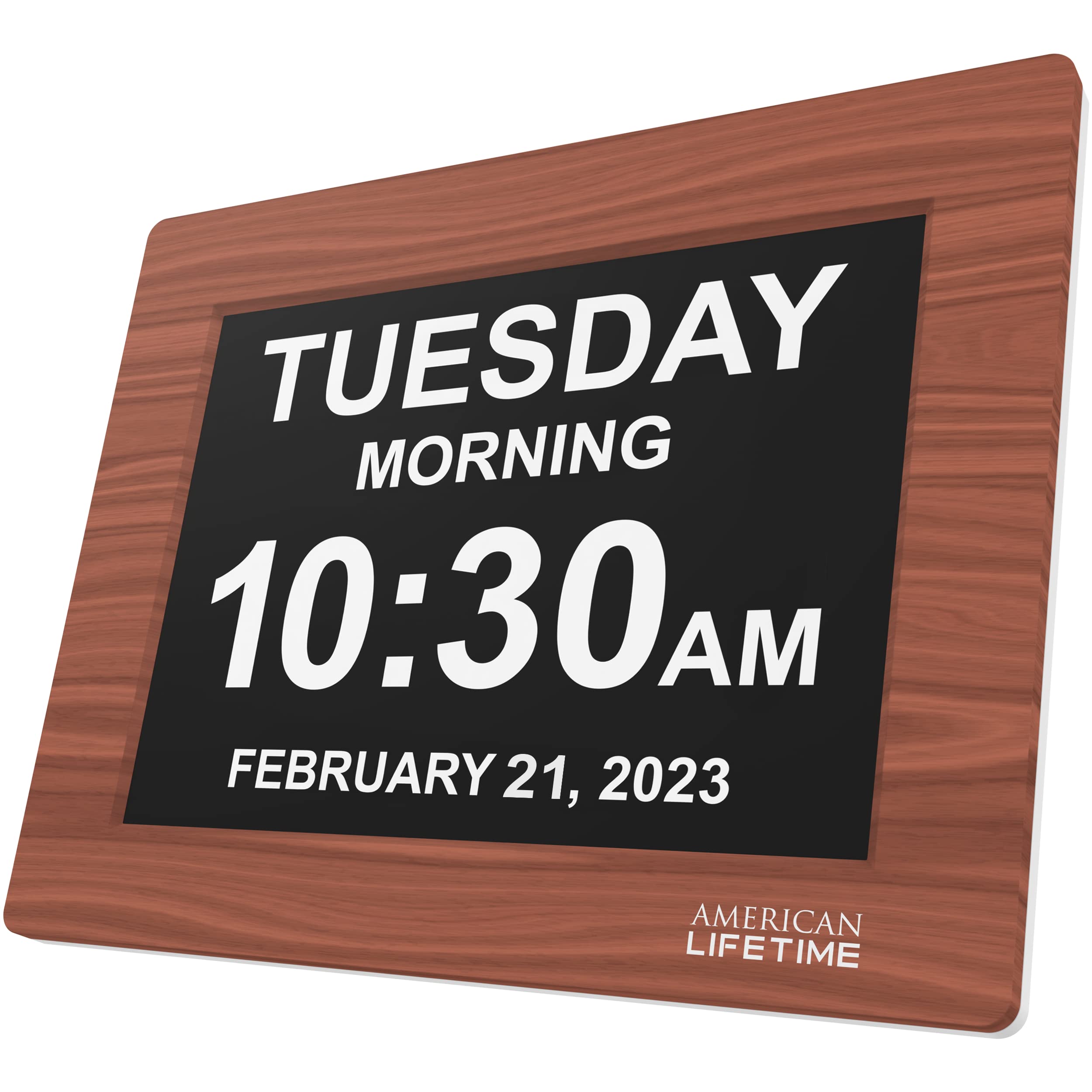
American Lifetime’s upgraded model combines a durable wood frame with a large, high-contrast display that clearly shows “Morning” or “Afternoon” rather than just AM/PM. This is a critical distinction for dementia users who can no longer interpret the two-letter format. The 8-inch screen is slightly smaller than some competitors, but the bold, uncluttered layout makes every character easy to distinguish.
The clock offers 5 customizable daily alarms — sufficient for medication, meals, and appointment reminders. Its auto-dimming feature transitions smoothly from bright daytime readability to a soft night glow. The included battery backup ensures settings survive a power outage. The build quality is robust enough to handle accidental drops, and the wood finish blends into home decor better than gloss plastic.
Customer feedback consistently mentions reliability and ease of use. One reviewer noted it helped their mother track time during the night without confusion. The only drawback is that the alarm options are less granular than the 10+ alarms found on some digital models, but for most caregiving routines, five is plenty.
Why it’s great
- Shows “Morning/Afternoon” in full text, not AM/PM
- Sturdy wood construction with good durability
- Auto-dimming and battery backup for reliable orientation
Good to know
- Limited to 5 alarms — not ideal for very complex schedules
- 8-inch screen is smaller than 10.1-inch competitors
3. Top Life Talking Clock

When vision loss accompanies dementia, a standard digital display becomes useless. The Top Life Talking Clock solves this with a single-button interface: press once to hear the time, press again to hear the day, date, and year. The voice is a clear neutral male tone, and at 85 dB it’s loud enough for users with significant hearing impairment.
The display itself is digital with large numerals, but the real value is the audio output. The screen can be completely turned off, eliminating light disturbance at night while maintaining full functionality. It runs on AC power or 3 AA batteries, and it retains all settings during power loss. The large, high-contrast 12/24-hour screen is easy to read when needed, but the talking feature makes it accessible even when the user can’t focus on the display.
Customers praise its simplicity: one button on top, no confusing menus. It’s also portable, making it easy to move from bedroom to living room. The main criticism is that the red case may not match all decor, but functionally it performs exactly as advertised.
Why it’s great
- Single-button talking feature eliminates need to read display
- 85 dB volume audible through doors and walls
- Screen off option prevents sleep disturbance
Good to know
- Red case may clash with some room decor
- Voice announcement is verbose (“It is …”) rather than concise
4. AINFTIME 10.1″ Dementia Clock
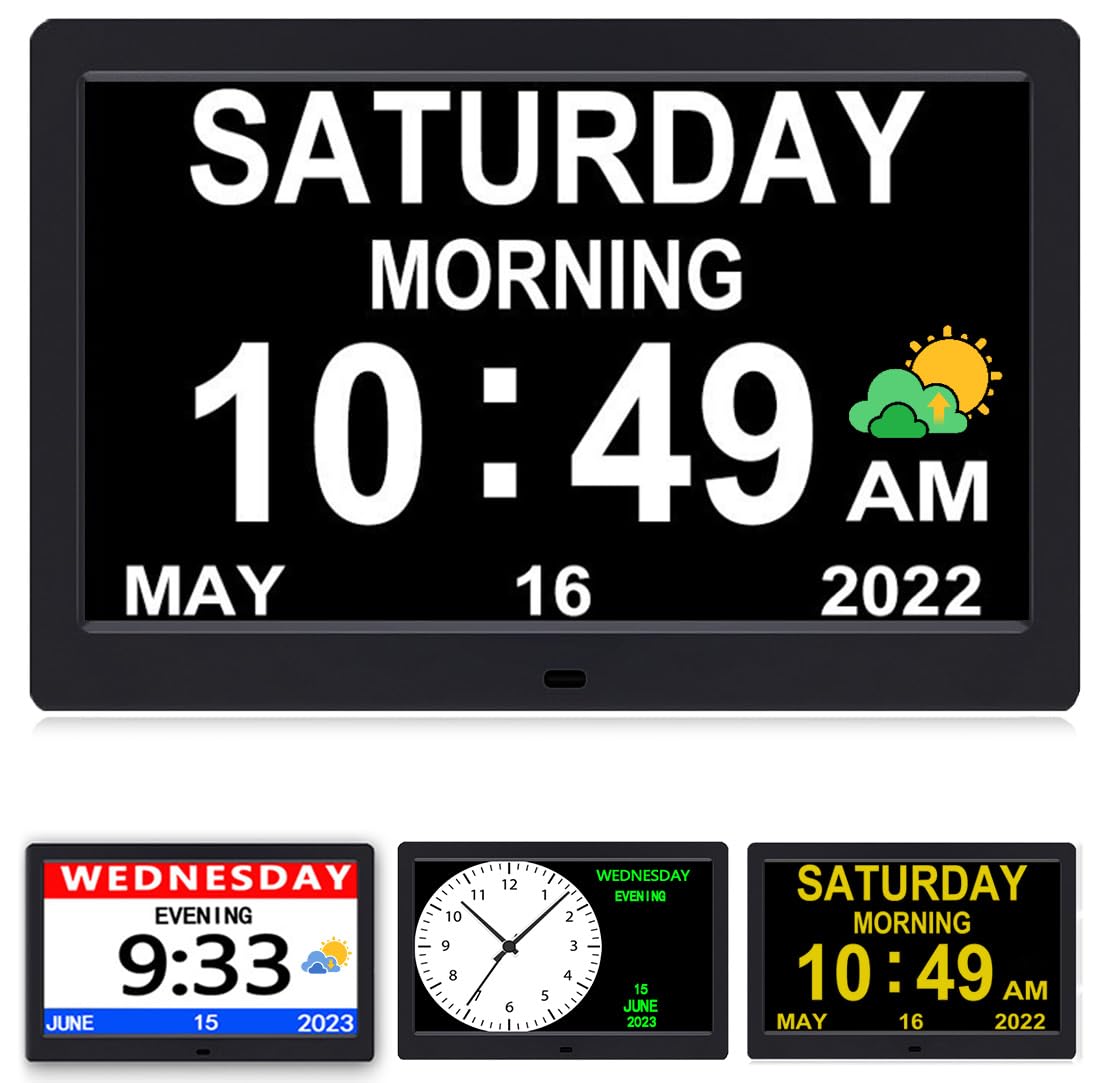
The AINFTIME clock packs an impressive number of features at a mid-range price. It offers three distinct display modes: an Elderly Clock mode with large non-abbreviated fonts, a Wall Clock mode for decorative use, and a Colorful Clock mode for younger viewers. This flexibility means the same device can serve multiple family members.
You get 12 daily alarm reminders, covering everything from medication to hydration. Smart brightness auto-adjusts between bright (7 am to 7:59 pm) and dim (8 pm to 6:59 am), with no blue light emission to disturb sleep. The clock also doubles as a digital photo frame for cherished memories. Automatic DST adjustment covers North America, the UK, and the EU — no manual fiddling.
Customers highlight the large legible numbers and the sun/moon indicator that shows whether it’s day or night. The unit is lightweight and portable. The main downside is that alarms cannot be set for specific days of the week — they run on a weekly cycle — and the single hanging hole can cause the clock to hang crooked due to cord weight.
Why it’s great
- Three display modes suit different ages and preferences
- 12 alarms exceed most competitors for reminder density
- Digital photo frame feature adds emotional value
Good to know
- Alarms run on a 7-day cycle — no specific day skipping
- Single wall-mount hole causes tilting with cord weight
5. Mitoart 10.1″ Digital Alarm Clock

Mitoart designed this clock around a single principle: make it as simple as possible for someone with cognitive decline to use. The 10.1-inch display shows the full weekday, month, and date in large bold characters with no confusing abbreviations. A voice timing function lets you press a button on the back or use the remote to hear the time spoken aloud, supporting 9 languages.
The auto-dimming feature automatically switches between 250 cd/m² day brightness and 50 cd/m² night brightness at 7 am and 7 pm respectively. Multiple alarms support medication reminders and schedule alerts. The interface is clean with one-click setup, and the unit is lightweight at 1.28 pounds.
Customer feedback emphasizes how easy it is to set up and how clear the display is across the room. The auto-dimming doesn’t disturb sleep, and the clock maintains accuracy through DST changes. The only critique is aesthetic — the white plastic finish may not appeal to everyone — but function prioritizes form here.
Why it’s great
- Voice time reporting in 9 languages helps visually impaired users
- Automatic DST adjustment removes caregiver hassle
- Ultra-clear full-spell display with no abbreviations
Good to know
- White plastic finish may show dirt or scratches
- Voice is on a separate button — not always intuitive at first
6. CAZOKASI 8″ Extra Large Digital Alarm Clock

The CAZOKASI 8-inch clock carves out a specific niche: it’s smaller than 10-inch models but uses a 16:9 IPS display that delivers better clarity than many 7-inch alternatives. This means it takes up less counter space while still providing a readable screen from across the room. It offers 4 time interfaces, 4 font colors, and 10 system languages — impressive flexibility for its size.
With 15 sets of alarms (12 general + 3 dedicated medication reminders for morning, noon, and evening), it has the highest alarm count on this list. Medication reminders are visually distinct, helping users associate a specific alarm with taking pills. Auto-dimming switches between bright mode (7 am–7:59 pm) and dim mode (8 pm–6:59 am). Power outage memory means it doesn’t reset if unplugged.
Customers love the oversized, crisp display and simple setup. The medication alarm feature is frequently called out as a lifesaver for caregivers. The main trade-off is the 8-inch screen — still large, but not as impactful as 10.1-inch panels for users with severe vision loss. Also, you cannot remove the AM/PM indicator if you prefer a different orientation method.
Why it’s great
- 15 total alarms with dedicated medication reminders for morning/noon/evening
- Compact 8-inch design with 16:9 IPS panel for clarity
- Multi-language support and 4 font color options
Good to know
- 8-inch display is smaller than premium 10.1-inch models
- AM/PM indicator cannot be hidden from the display
7. DayClocks Pine Wood Analog Day Clock
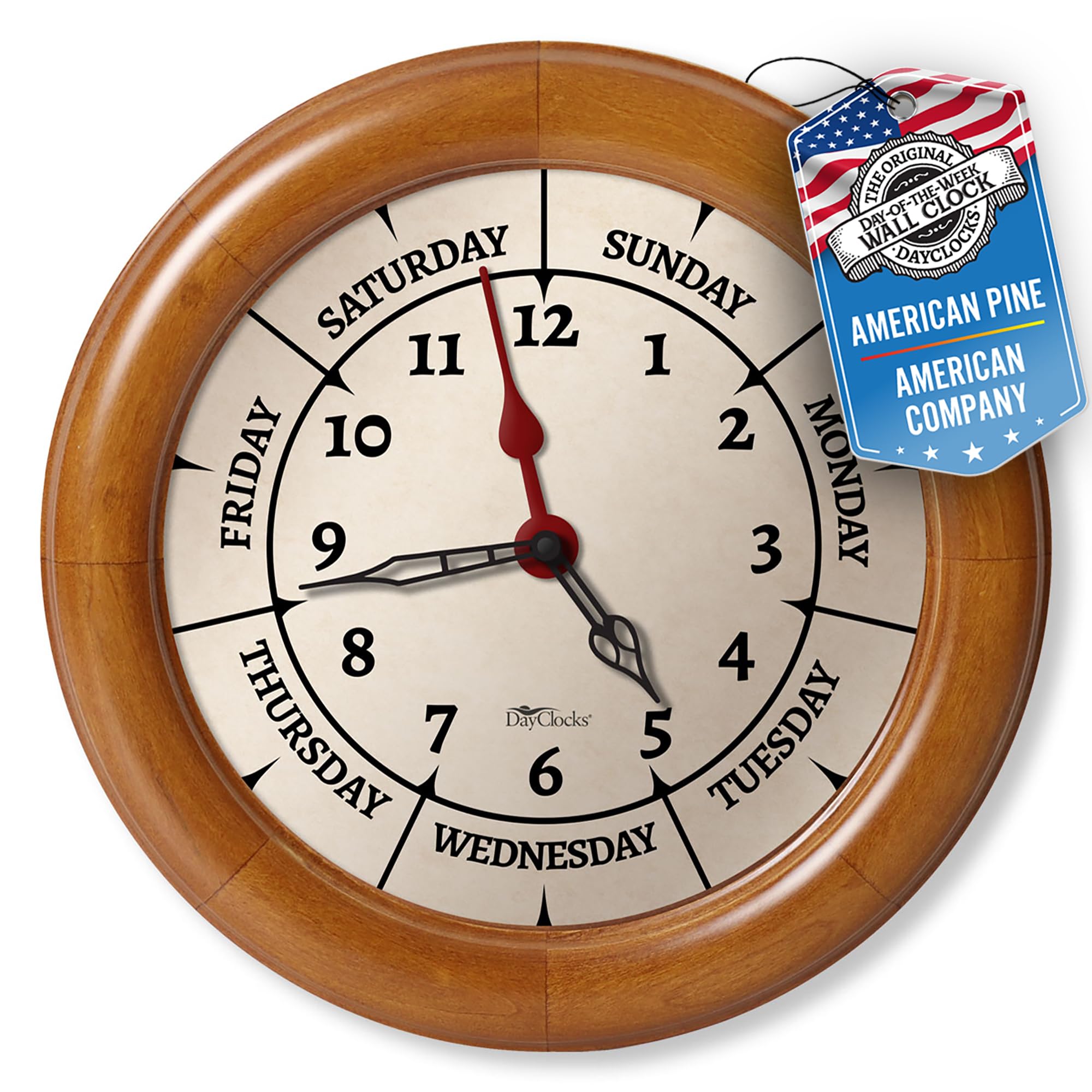
For those who prefer an analog aesthetic or need a battery-powered option for flexible placement, the DayClocks Pine Wood model offers a unique approach. Instead of a digital screen, it uses a standard analog clock face with an additional red hand that tracks the day of the week across a printed scale. This visual method works well for users who remember how to read an analog clock but lose track of which day it is.
The 10-inch frame is made from US-sourced pine wood, giving it a warm, furniture-quality look that blends into any room. It’s powered by a single AA battery (not included), so you can hang it anywhere — no cord required. The mechanism is quiet and reliable, and the glass cover protects the face. There are no alarms, no dimming, and no digital features, which simplifies operation for users overwhelmed by options.
Customers repeatedly call this clock a lifesaver for seniors and autistic children alike. The analog design eliminates screen glare and battery anxiety. However, its usefulness is limited to day-of-week tracking — it does not show the date, month, or time of day (morning vs. night). It also lacks alarms entirely, so it cannot serve as a medication reminder.
Why it’s great
- Battery-powered analog design is extremely simple and quiet
- Pine wood frame looks like traditional home decor
- Perfect for users who just need to track the day of the week
Good to know
- No alarms — cannot be used for medication or appointment reminders
- Does not show morning/evening, date, or month
- Smaller than many digital competitors (10-inch face)
FAQ
Why should I choose a digital dementia clock over a standard alarm clock?
Can I set alarms for specific days of the week on these clocks?
Do dementia clocks work for people who are also visually impaired?
Final Thoughts: The Verdict
For most users, the best dementia clock winner is the Pastigio 10.1” because it combines a high-resolution IPS display, five concrete day-phase labels, 6 alarms with 10 reminders, and a remote control — all at an accessible price. If you need audible time announcements for a loved one with vision loss, grab the Top Life Talking Clock. And for a durable, attractive wood-framed clock with “Morning/Afternoon” labels and robust battery backup, nothing beats the American Lifetime Upgraded.

Mo Maruf
I created WellFizz to bridge the gap between vague wellness advice and actionable solutions. My mission is simple: to decode the research and give you practical tools you can actually use.
Beyond the data, I am a passionate traveler. I believe that stepping away from the screen to explore new environments is essential for mental clarity and physical vitality.