Our readers keep the lights on and my smoothie glass nicely filled. As an Amazon Associate, I earn from qualifying purchases.
A downhill helmet isn’t a piece of gear you overthink—until you’re picking gravel out of your chin bar at the bottom of a rock garden. The difference between a lid that saves your jaw and one that just looks the part comes down to certification, weight, and how well the rotational protection system actually works when you need it most.
I’m Mohammad Maruf — the founder and writer behind WellFizz. I’ve spent hundreds of hours analyzing the structural engineering, foam layering, ventilation geometry, and real-world crash reports across the full spectrum of DH-certified full-face helmets to build this guide.
Your next set of handlebars deserves a lid that’s been tested against ASTM F1952-15 standards and proven to handle high-speed rotational impacts. This guide breaks down the critical specs and real-rider feedback to help you pick the best dh helmet for your head shape, riding style, and budget.
How To Choose The Best DH Helmet
Choosing a downhill helmet goes far beyond matching your goggles or budget. Every DH certified full-face helmet must pass the ASTM F1952-15 impact test, which simulates the kind of high-speed, high-angle crashes you encounter on steep terrain and bike park laps. But certification is just the starting point—the real difference lives in the shell material, the foam layering strategy, and the rotational impact management system.
Rotational Impact Systems
MIPS, Koroyd, and Spherical MIPS all tackle rotational forces, but they do it differently. MIPS uses a low-friction slip plane that allows the helmet to rotate slightly on impact, reducing the rotational motion transferred to the brain. Koroyd employs a honeycomb-like tubular structure that crushes consistently to absorb energy in both linear and oblique impacts. Spherical MIPS combines two shells with a ball-and-socket interface for omnidirectional rotation. The key isn’t which is newest; it’s which one fits your head shape without creating pressure points.
Weight & Ventilation Tradeoffs
A light DH helmet—around 600-700 grams for premium carbon models—reduces neck fatigue during long chairlift days and enduro stages. But light weight usually comes from a fiberglass or carbon shell paired with single-density EPS foam, which costs more. Heavier poly-alloy shells with multi-density EPS liners hit a lower price point but add 200-300 grams. Ventilation also varies widely: look for at least 15-20 vents with deep internal channeling, not just decorative ports, to keep your head cool on sustained climbs or hot summer park days.
Fit System & Strap Hardware
A DH helmet is only as good as its fit. The Fidlock magnetic buckle has become the gold standard because it’s glove-friendly and self-aligning. D-ring closures are more traditional and still secure, but they add fumbling time. Adjustable vertical and circumference retention systems—like the Ergo-Fit Ultra or Float Fit DH—let you dial in pressure distribution so the helmet stays planted during rough sections. Removable, washable cheek pads and crown liners also matter; they let you fine-tune fit and keep the helmet fresh after sweaty days.
Quick Comparison
On smaller screens, swipe sideways to see the full table.
| Model | Category | Best For | Key Spec | Amazon |
|---|---|---|---|---|
| Bell Super DH MIPS | Convertible | Enduro & Park versatility | Spherical MIPS, removable chin bar | Amazon |
| Smith Mainline | Full-Face | Aggressive downhill & EWS | Full Koroyd, MIPS, 3-position visor | Amazon |
| Troy Lee Designs Stage | Full-Face | Enduro racing | 690g weight, dual-density EPP/EPS | Amazon |
| Troy Lee Designs D4 Carbon | Premium Carbon | Elite DH & bike park | Carbon fiber shell, 24 vents | Amazon |
| iXS Trigger FF MIPS | Full-Face | Lightweight all-day DH | 595g weight, Ergo-Fit Ultra | Amazon |
| Fox Racing V Core MIPS | Dirt Bike/DH | Motocross & aggressive trail | Magnetic visor release, 13 vents | Amazon |
| Smith Engage MIPS | Trail/Enduro | Moderate trail riding | Zonal Koroyd, 20 vents | Amazon |
| Fly Racing Rayce | Full-Face | Budget DH entry | 930g, D-ring closure, TFV | Amazon |
| Leatt Helmet Mountain Bike Gravity 1.0 | Full-Face | Entry-level DH & BMX | 360 Turbine, breakaway visor | Amazon |
In‑Depth Reviews
1. Bell Super DH MIPS

The Bell Super DH MIPS occupies a rare spot in the market: it’s DH-certified under ASTM F1952-15 yet works as a trail helmet when you pop off the chin bar. The Fusion In-Mold polycarbonate shell bonds directly to variable-density EPS foam layers, creating a structure that handles both high-speed and low-speed impacts without excessive bulk. The Flex Spherical MIPS system adds a ball-and-socket interface between two shells, allowing omnidirectional rotation that MIPS alone can’t match.
The wraparound chin bar attaches without tools, so you can pedal up in open-face mode and snap the bar on for the descent. Riders report the helmet holds up well beyond 5,000 miles of mixed use, though the chin bar reattachment takes a little muscle memory. The Float Fit DH retention dial with Fidlock magnetic buckle delivers a secure, glove-friendly adjustment that stays put even on rough terrain.
Nineteen vents, two brow ports, and four chin bar vents push enough air through the channel matrix to keep you from overheating on sustained climbs. The Sweat Guide pad design wicks moisture away from goggles and glasses, which eliminates fogging on humid days. Replacement pads can be hard to find, so snag a spare set early.
Why it’s great
- Spherical MIPS provides comprehensive rotational protection for high and low speed impacts
- Tool-free removable chin bar turns a trail lid into a certified downhill helmet
- Fidlock magnetic buckle makes fastening easy with gloves
- Overbrow ventilation and deep air channels manage heat effectively
Good to know
- Chin bar reattachment requires deliberate effort and alignment practice
- Replacement padding kits are occasionally hard to source
- Build quality on velcro pads has been inconsistent for some riders after extended use
2. Troy Lee Designs D4 Carbon
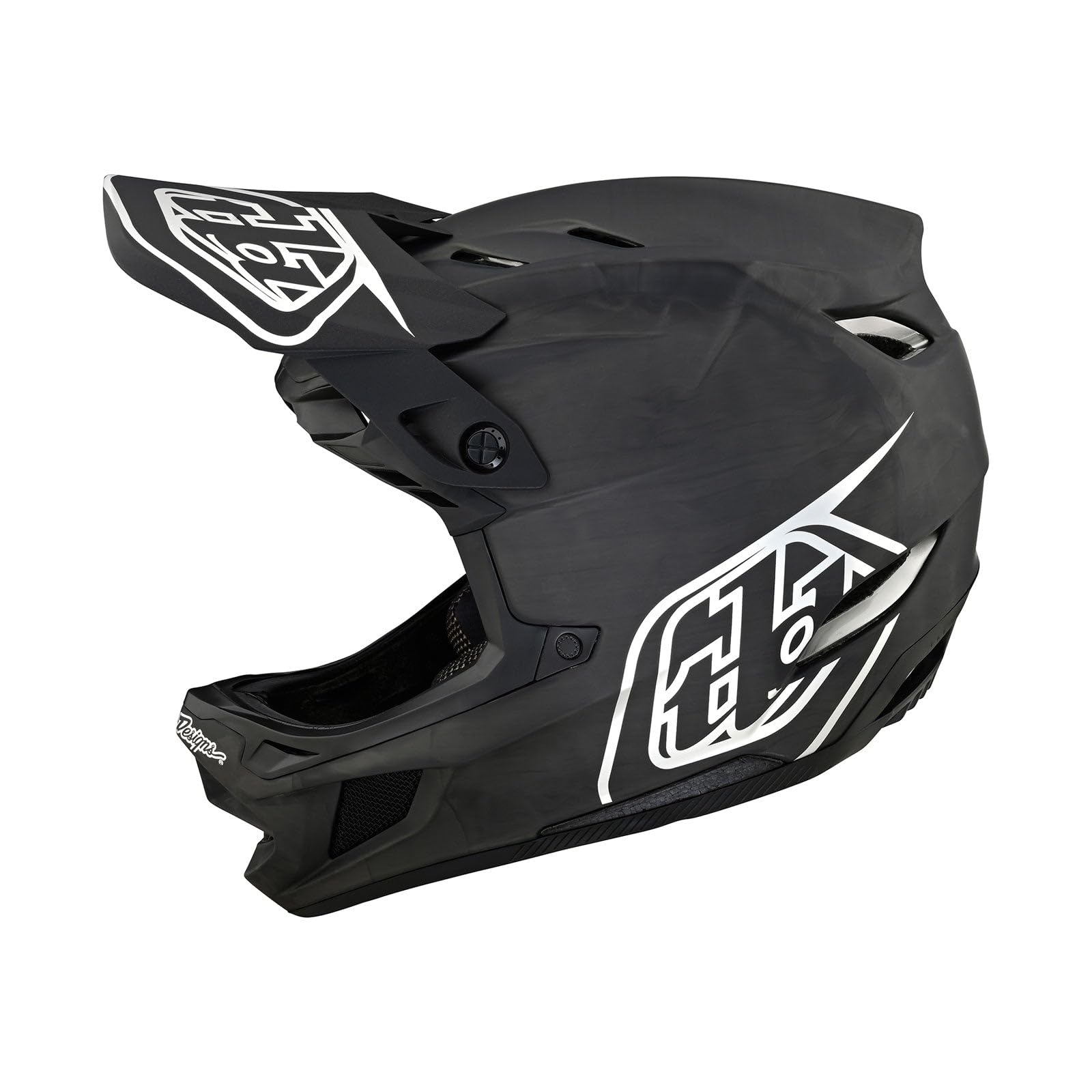
The Troy Lee Designs D4 Carbon sits at the top of the pyramid with a carbon fiber shell that cuts weight dramatically while exceeding ASTM F1952-15, ASTM F2032-15, and ASTM F2040-11 standards. The dual-density EPS and EPP foam sandwich handles high-speed impacts through the EPS layer while the EPP manages lower-speed crashes—a combination that lets the helmet survive multiple hits better than standard single-density designs.
Riders coming from the D3 report the D4 eliminates the neck fatigue issues of its predecessor thanks to the dramatic weight reduction. The helmet ships with a moisture-wicking, removable, and washable liner along with adjustable cheek pads to fine-tune the fit around the jawline. The Fidlock magnetic buckle snaps home cleanly with one hand, and the 24 vent ports—12 intake and 12 exhaust—create enough airflow that riders in hot climates report no overheating during extended park sessions.
The MIPS system is integrated into the carbon shell without adding appreciable bulk, and the breakaway visor screws are designed to shear on impact to reduce rotational neck loads. The D4 accommodates round head shapes exceptionally well, a noted improvement over competitors that create pressure points on wider skulls. Paint can chip from drops, so handle the shell with care between rides.
Why it’s great
- Carbon fiber shell delivers exceptional strength-to-weight performance
- Dual-density EPP/EPS foam handles multiple impact severity levels
- Superior ventilation with 24 intake and exhaust ports
- Excellent fit for rounder head shapes without pressure spots
Good to know
- Premium price point positions it well above most competitors
- Paint finish can chip from accidental drops on hard surfaces
- Break-in period of several rides before achieving perfect comfort
3. Smith Mainline

The Smith Mainline is purpose-built as a downhill-certified full-face that also carries EN1078 and NTA8776 E-bike certifications, making it one of the most broadly approved helmets on this list. What sets it apart is the complete Koroyd coverage—thousands of thermally welded plastic tubes that crush consistently upon impact to absorb energy in both linear and oblique crashes. This system works alongside a MIPS slip plane to handle rotational forces from multiple directions simultaneously.
Twenty-one fixed vents push air through the Koroyd structure, which is inherently more breathable than solid EPS foam because the honeycomb channels allow lateral airflow. The Mainline comes with three washable cheek pad kits, two crown liners, and two neck rolls—enough adjustability to dial in a truly custom fit around the jaw and temples. The visor adjusts into three positions to accommodate goggle or glasses use without obstructing peripheral vision.
Testers note the MIPS liner can generate some noise at speed, a minor tradeoff for the class-leading protection. The d-ring strap closure feels overbuilt for enduro use compared to magnetic options, but it’s proven secure for aggressive DH laps. The Mainline integrates seamlessly with Smith goggles, eliminating the nose pressure common with other helmet-goggle combos.
Why it’s great
- Complete Koroyd coverage provides exceptional energy absorption in linear and oblique impacts
- Multiple padding sets allow precise fit tuning for different head shapes
- Excellent ventilation through 21 fixed ports and internal Koroyd channels
- Certified for downhill, e-bike, and European standards simultaneously
Good to know
- MIPS liner can produce audible noise at higher speeds
- D-ring buckle is secure but less convenient than magnetic alternatives
- Higher price point limits accessibility for budget-constrained riders
4. Troy Lee Designs Stage

The Troy Lee Designs Stage is engineered specifically for enduro racing where you pedal up and bomb down. At approximately 690 grams, it’s lighter than many half-shell helmets yet carries full downhill certification (ASTM F1952-15). The shell construction uses a polyacrylite material with integrated EXO-Skeleton reinforcement around the chin bar, giving the jaw section structural stiffness without the weight penalty of a full composite shell.
The dual-density foam layer pairs EPP for low-speed impacts and EPS for high-speed hits, a strategy borrowed from motocross helmets that lets the Stage survive more than one crash without needing an immediate replacement. The 25 strategically placed intake and exhaust ports create a high-flow ventilation system that riders in hot climates—like South Florida—report keeps them consistently comfortable even on long pedaling sections. The MIPS system integrates without adding noticeable bulk or weight.
Troy Lee includes two liner options, three sets of cheek pads, two neck rolls, and a Fidlock magnetic buckle, giving you enough hardware to dial in the perfect fit for a wide range of head shapes. The breakaway visor screws shear off at a controlled torque to reduce neck loading during rotational crashes. The brand backs the lid with a three-year warranty and a crash replacement policy.
Why it’s great
- Extremely lightweight at 690g for a DH-certified full-face helmet
- Dual-density EPP/EPS foam handles multiple crash types without replacement
- High-flow ventilation with 25 ports keeps riders cool in hot conditions
- Generous padding sets allow precise fit customization for jaw and crown
Good to know
- Cheek pad attachment pins may have longevity concerns over extended use
- Maximum head size for M/L is 59cm, limiting larger skulls
- Finish is less glossy than premium carbon competitors
5. iXS Trigger FF MIPS
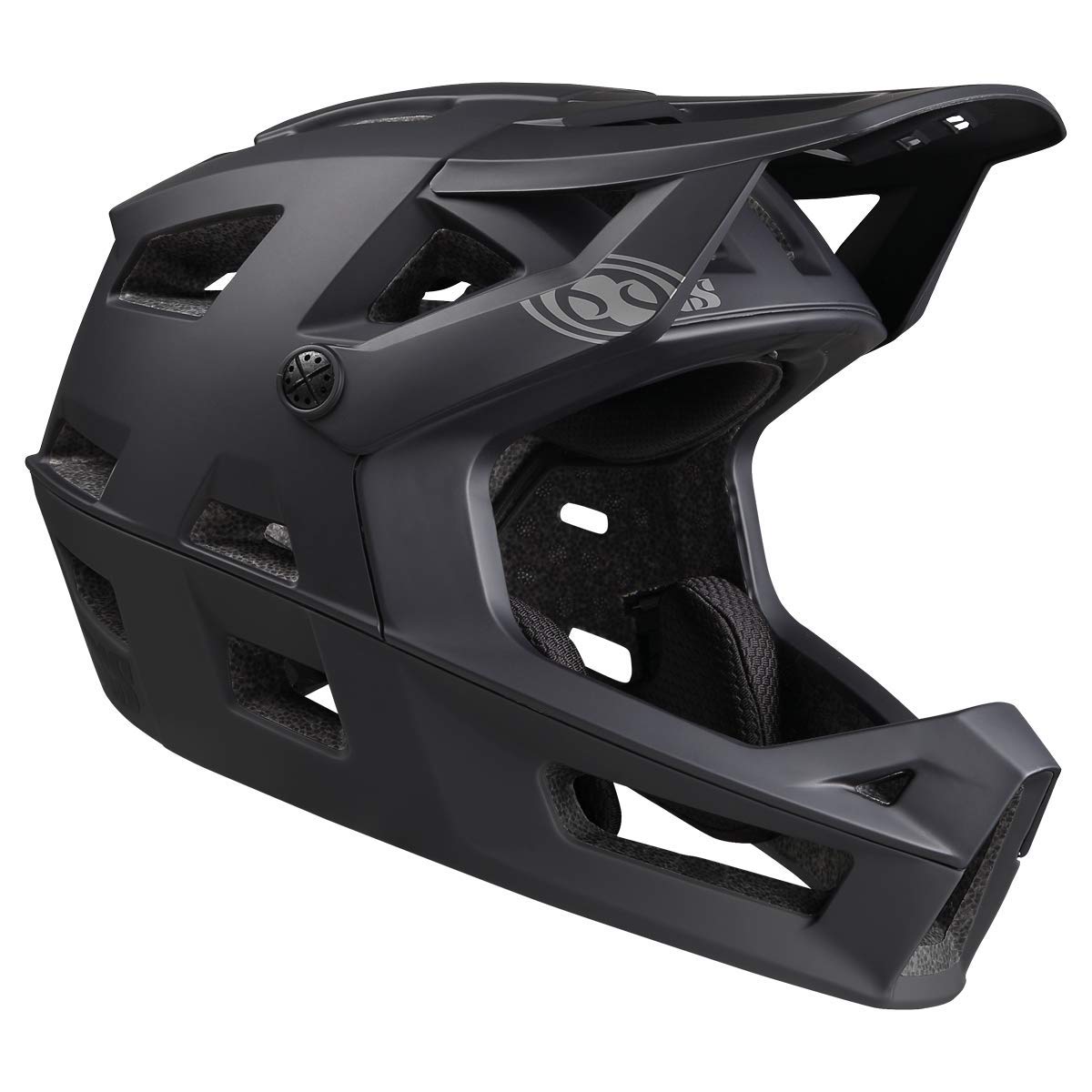
The iXS Trigger FF MIPS is a revelation for riders who prioritize low weight on the chairlift or during enduro stages. At approximately 595 grams, it’s one of the lightest DH-certified full-face helmets available—comparable to premium carbon options but at a substantially lower entry point. The patented all-in-one design integrates the EPS liner and chin bar as a single molded unit, eliminating weak bonding points and distributing impact loads across the entire structure.
The MIPS system is paired with the Ergo-Fit Ultra adjustable retention mechanism, which gives you both vertical and circumference dialing for a snug fit around the occipital bone. The Fidlock magnetic buckle engages quickly and securely, a major convenience when wearing gloves on cold mornings. Internal and external ventilation channels are strategically placed to pull cool air in through the front and push hot air out the rear exhaust ports, creating continuous airflow even at low speeds.
Riders report the Trigger has survived serious jaw impacts—one tester noted a hard crash that caused a concussion but likely prevented a jaw fracture—which speaks to the chin bar’s energy management. The two-position adjustable visor accommodates goggles without interfering with peripheral vision. The helmet lacks mesh screens on the front vents, so some users add their own bug mesh during buggy summer seasons.
Why it’s great
- Incredibly lightweight at 595g for a DH-certified full-face helmet
- Patented all-in-one construction with integrated EPS and chin bar
- Ergo-Fit Ultra provides both vertical and circumference adjustment
- Fidlock magnetic buckle enhances ease of use with gloves
Good to know
- No bug or debris screens on front vents, requiring aftermarket mesh
- Premium price point may be high for casual riders
- Limited color and finish options compared to bigger brands
6. Fox Racing V Core MIPS

The Fox Racing V Core MIPS blurs the line between mountain bike and motocross helmets, carrying both FMVSS 218 (DOT) and ECE 22.06 certifications alongside its MIPS rotational protection system. The injection-molded polycarbonate and ABS shell construction uses four shell sizes and five EPS sizes to achieve a precise fit that Fox is known for across its motocross lineup. The shell is designed to take repeated abuse from roost and trail debris without cracking.
The magnetic visor release system is a standout safety feature: the visor stays securely in place under normal riding conditions but detaches cleanly during a crash to reduce the risk of neck strain and rotation. Nine intake ports and four exhaust vents push moisture and heat out effectively, making the V Core comfortable even on hot summer moto rides. The closure uses a traditional double-ring strap, which is proven secure but takes longer to fasten than a Fidlock buckle.
Riders report the helmet saved their head in multiple crashes, with one reviewer noting it survived two direct impacts and continued to provide solid protection afterward. The removable and washable pads keep the interior fresh after sweaty track days. The V Core fits snugly by design—if you’re between sizes, Fox recommends sizing up to avoid pressure points.
Why it’s great
- Magnetic visor release reduces neck injury risk during rotational crashes
- DOT and ECE 22.06 certifications cover both MTB and motocross use
- Multiple shell and EPS sizes provide precise fit across head shapes
- Removable, washable pads enhance long-term hygiene
Good to know
- Double-ring strap is secure but less convenient than magnetic buckles
- Heavier than dedicated lightweight DH helmets due to moto-oriented construction
- Snug fit may require sizing up for riders between size ranges
7. Smith Engage MIPS

The Smith Engage MIPS is a trail-oriented full-face that prioritizes lightweight comfort and ventilation over downhill-specific certification. While it’s not ASTM F1952 certified, it carries CPSC 1203, CE EN 1078, and AS/NZS 2063 approvals, making it suitable for aggressive trail riding and enduro where you value pedaling efficiency over pure downhill impact protection. The zonal Koroyd coverage places the honeycomb energy-absorbing material in the most impact-prone zones—crown, temples, and rear—while leaving the rest of the helmet ventilated.
Twenty fixed vents work with the Koroyd’s internal air channels to create consistent airflow that riders report keeps them cool even on hot climbs. The Ionic+ lining uses silver fibers to control odor, and the low-bulk single-layer webbing reduces strap bulk under goggles or glasses. The adjustable visor has two positions that accommodate both goggles and glasses without obstructing the field of view.
The Engage fits heads that are longer front-to-back rather than round, and the MIPS slip plane integrates smoothly without creating pressure points. The ratchet retention system is smooth and easy to adjust on the fly. Some riders note the helmet can slip forward slightly on rougher terrain if you don’t wear glasses or goggles to anchor the front edge, so a goggle strap is recommended for aggressive descents.
Why it’s great
- Zonal Koroyd provides targeted impact absorption without adding weight
- Excellent ventilation with 20 fixed vents for hot ride conditions
- Lightweight, low-bulk design reduces neck fatigue during long pedals
- Adjustable two-position visor accommodates goggles or glasses
Good to know
- Not ASTM F1952 certified, limiting usage for pure downhill biking
- Can slip forward on rough terrain without goggle strap tension
- Buckle mechanism can be finicky to fasten compared to magnetic options
8. Fly Racing Rayce
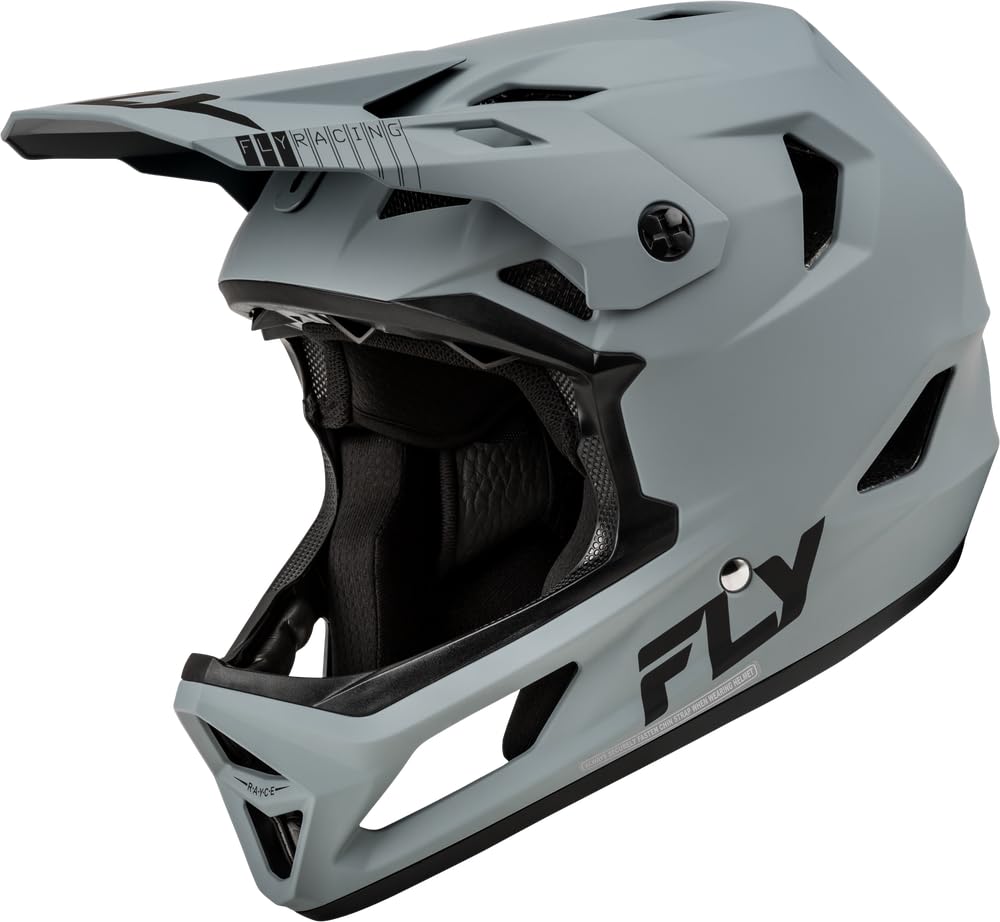
The Fly Racing Rayce brings ASTM F1952-15 DH certification to a price point that’s accessible for riders entering the gravity scene. The poly-alloy shell is bonded to an EPS liner that’s been tested against CPSC 1203 and CE EN1078 as well, giving you triple-certification coverage for bike park, trails, and pump track use. At approximately 930 grams in a medium, it’s not the lightest option, but the weight sits low on the head to avoid feeling top-heavy.
The True Functional Ventilation (TFV) system uses multiple intake ports at the front and exhaust vents at the rear to promote consistent airflow. Riders report the Rayce is well-ventilated for a budget DH helmet and stays comfortable during all-day park sessions without excessive heat buildup. The removable and washable liner and cheek pads make post-ride cleaning straightforward, which is important for helmets that see frequent use in dusty conditions.
The D-ring strap closure is secure and straightforward, though it takes more time to fasten than magnetic options. The adjustable visor with aluminum hardware allows quick positioning changes for different riding styles. The Rayce comes with a protective cloth bag, a nice touch that’s rare at this price point. The helmet fits true to size—testers with a 7 1/4 hat size reported the adult large fits snugly without pressure points.
Why it’s great
- Full ASTM F1952-15 DH certification at an accessible price point
- TFV ventilation system promotes consistent airflow for warm days
- Removable, washable liner and cheek pads maintain hygiene easily
- Includes protective cloth bag for storage and transport
Good to know
- 950g weight is heavier than premium lightweight options
- D-ring strap is slower to fasten than magnetic buckle systems
- Limited color and finish options compared to pricier brands
9. Leatt Helmet Mountain Bike Gravity 1.0
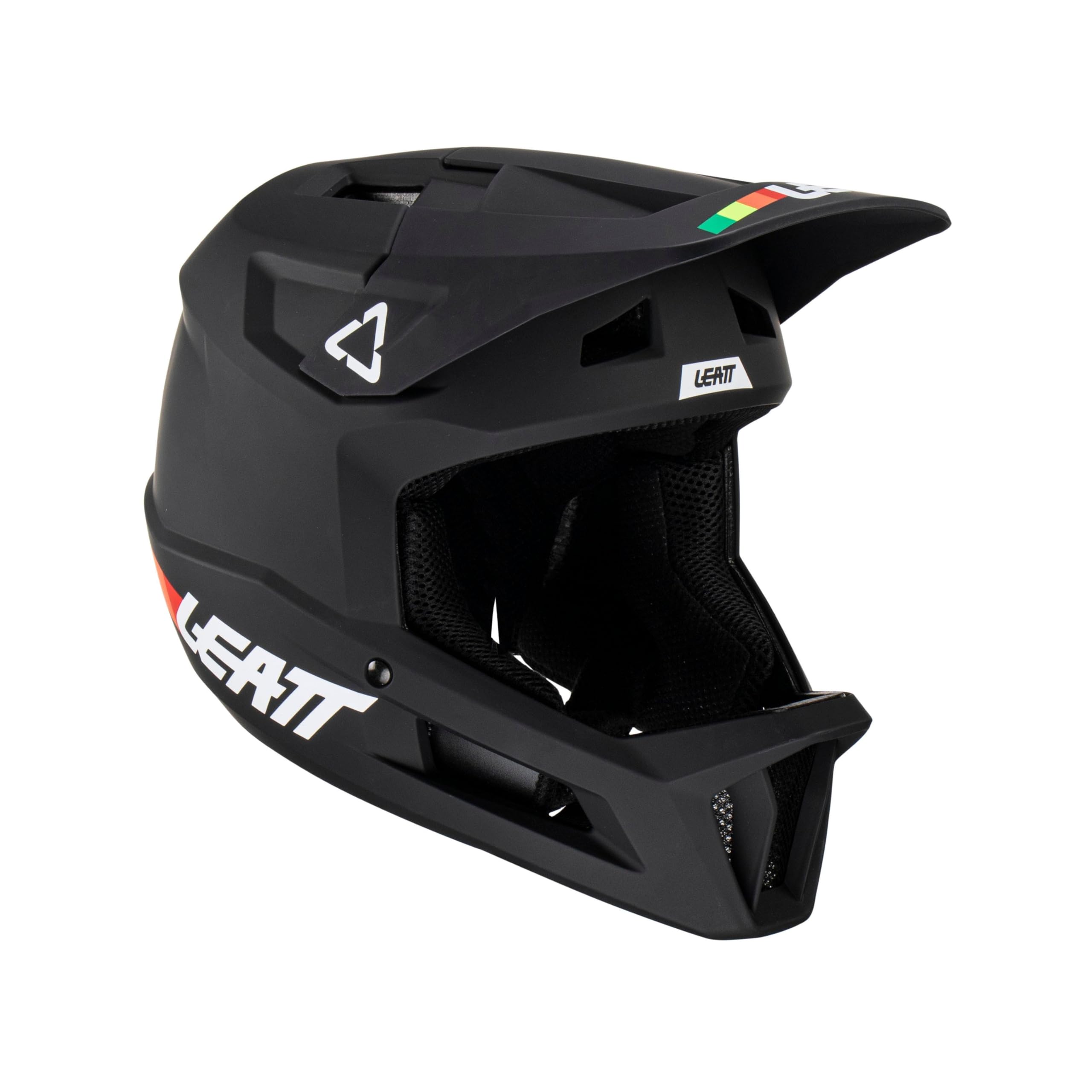
The Leatt Gravity 1.0 is the most affordable fully certified DH helmet in this guide, carrying ASTM F1952-10, EN1078, CPSC 1203, and AS/NZS 2063 certifications for global riding standards. The polymer shell sits over an impact foam liner designed for energy absorption, and the 360 Turbine Technology adds small cone-shaped turbines inside the liner that compress during a crash to help reduce peak acceleration at the point of impact. This is a low-cost rotational protection system that mimics some of the benefits of MIPS at a fraction of the price.
The acceleration breakaway visor is engineered to shear off during a crash to reduce the rotational force transmitted to the neck, a feature typically found on helmets in higher price brackets. The ventilation ports are positioned to channel air through the internal channels, and the washable inner liner makes maintenance easy after sweaty rides. At 900 grams, the Gravity 1.0 is lighter than the Fly Racing Rayce but still heavier than premium options.
Riders note the helmet fits well for BMX racing and entry-level gravity riding, with one parent reporting it was significantly lighter than motocross helmets their child had used for BMX. The chin bar provides solid protection for the price, though the venting design isn’t as advanced as mid-range options. The Gravity 1.0 is a smart starting point for new riders who want certified protection without a large financial commitment.
Why it’s great
- Quad-certified (ASTM, EN, CPSC, AS/NZS) for worldwide riding standards
- 360 Turbine Technology reduces peak impact acceleration at a low cost
- Breakaway visor reduces rotational neck loads during crashes
- Washable inner liner maintains hygiene after frequent use
Good to know
- Lacks true MIPS rotation system found on mid-range and premium helmets
- Ventilation design is less effective than higher-priced options
- Chin bar protection is adequate but not as robust as premium models
FAQ
Can I use a dirt bike helmet for downhill mountain biking?
How do I measure my head for a DH helmet?
When should I replace a downhill helmet after a crash?
Final Thoughts: The Verdict
For most riders, the best dh helmet winner is the Bell Super DH MIPS because it delivers Spherical MIPS protection, DH certification, and a convertible chin bar that transitions from trail to park without tools. If you want the lightest, most ventilated premium full-face, grab the Troy Lee Designs D4 Carbon. And for riders seeking solid certified protection on a budget, nothing beats the Fly Racing Rayce.

Mo Maruf
I created WellFizz to bridge the gap between vague wellness advice and actionable solutions. My mission is simple: to decode the research and give you practical tools you can actually use.
Beyond the data, I am a passionate traveler. I believe that stepping away from the screen to explore new environments is essential for mental clarity and physical vitality.