Our readers keep the lights on and my smoothie glass nicely filled. As an Amazon Associate, I earn from qualifying purchases.
Your bike computer tells you speed, power, and distance, but if the heart rate data feeding your training zones is a lagging, jumpy mess, every watt you push is built on guesswork. Wrist-based optical sensors shift during sprints, chest straps chafe on long climbs, and signal dropouts at the wrong moment can sabotage an entire interval session.
I’m Mohammad Maruf — the founder and writer behind WellFizz. I’ve spent countless hours cross-referencing optical sensor patents, battery cycle tests, and protocol compatibility matrices to isolate the cycling HRMs that actually deliver stable, real-time data when your effort spikes.
Whether you chase PRs on Zwift or grind century rides in the hills, the best cycling hrm must pair instantly, resist sweat, and read your pulse within one beat per minute of an ECG reference.
How To Choose The Best Cycling HRM
Selecting a heart rate monitor for cycling involves more than glancing at ratings. The dynamic arm motion of handlebar riding, road vibration, and heavy sweat create failure modes that wrist-worn trackers rarely survive. Here are the three decisions that matter most.
Optical vs. Chest Strap: Form Factor Trade-off
Optical armband monitors use LEDs and photodiodes to measure blood volume changes beneath the skin. They sit on your forearm or upper arm, away from the wrist-bending that plagues smartwatches during aggressive riding. Chest straps capture electrical signals (ECG-style) with higher beat-to-beat precision for HRV analysis. Armbands offer superior comfort on long rides and easier on-and-off at stops; chest straps deliver gold-standard accuracy for interval training where every second of recovery matters.
Connectivity Protocol: ANT+ vs. Bluetooth Dual-lock
Cycling computers from Garmin, Wahoo, and Hammerhead predominantly speak ANT+. If your head unit lacks Bluetooth, a Bluetooth-only HRM is a dead accessory. Dual-protocol units (ANT+ plus Bluetooth) allow simultaneous broadcasting to a bike computer and a phone running Zwift or Strava. The latest Bluetooth 5.0 chips reduce power draw and maintain stable connections through carbon frames that can interfere with signal propagation.
Battery Strategy: Rechargeable vs. Coin Cell
Rechargeable lithium-ion units eliminate the frustration of hunting for CR2032 batteries at the start of a training block. Some models last 200–400 hours per charge. Coin-cell designs (like the Polar H10) are lighter and replaceable mid-ride with a spare, but require periodic replacements. Consider your charging habits: if you forget to top off batteries, a quick-swap coin cell may suit you better than a dead rechargeable on race morning.
Quick Comparison
On smaller screens, swipe sideways to see the full table.
| Model | Category | Best For | Key Spec | Amazon |
|---|---|---|---|---|
| Polar H10 | Chest Strap | ECG-accurate HRV & interval training | 400-hour coin cell battery | Amazon |
| Wahoo TRACKR | Chest Strap | Rechargeable convenience with Zwift | 200-hour rechargeable battery | Amazon |
| Garmin HRM 600 | Chest Strap | Garmin ecosystem & running dynamics | 2-month rechargeable battery | Amazon |
| COOSPO HW9 | Armband | Long battery armband for road cycling | 35-hour rechargeable magnetic | Amazon |
| Scosche Rhythm+ 2.0 | Armband | HRV data & multi-sport versatility | 24-hour rechargeable, IP68 | Amazon |
| COOSPO HW807 | Armband | Budget entry-level armband | 20-hour rechargeable, IP67 | Amazon |
| CAT EYE Belt | Chest Strap | Replacement belt for CatEye sensors | Replacement strap only | Amazon |
In‑Depth Reviews
1. Polar H10
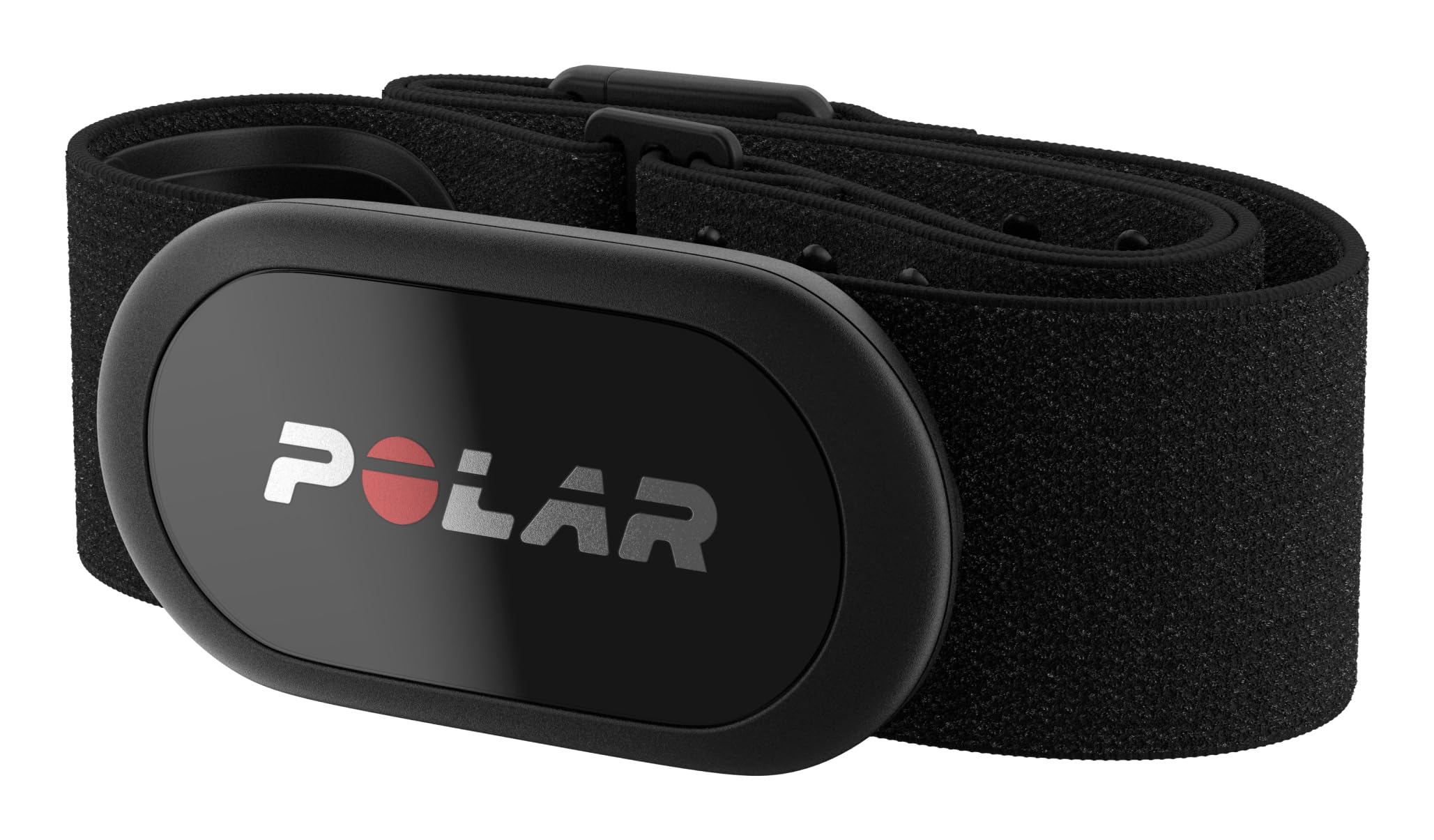
The Polar H10 remains the gold reference for cyclists who demand beat-to-beat precision. Its ECG-grade sensor captures HRV data within 2 ms of a medical-grade ECG, making it indispensable for riders who use HRV4Training or Morpheus to gauge recovery readiness. The 400-hour CR2025 battery lasts through an entire season of consistent riding before needing a swap.
The proprietary Pro strap uses silicone grippers and improved electrodes to prevent the slipping and interference common with third-party straps. It supports dual Bluetooth connections simultaneously, so you can stream heart rate to a Garmin Edge head unit via ANT+ while also broadcasting to Zwift on a phone. The internal memory stores one full session for times you leave the phone behind.
Some users report the included strap runs small for chest circumferences above 42 inches, requiring a separate XXXL strap from Polar. The battery door can pop open during aggressive motion if not fully tightened. Occasional firmware resets are needed after year-long use.
Why it’s great
- ECG-level accuracy for HRV and interval training
- Dual Bluetooth plus ANT+ and 5 kHz connectivity
- 400-hour battery life with replaceable coin cell
Good to know
- Strap too small for larger torso sizes
- Battery door can pop open under heavy motion
- Premium price compared to armband alternatives
2. Wahoo TRACKR Heart Rate Monitor

The Wahoo TRACKR solves the most persistent frustration of chest-strap ownership: finding a fresh CR2032 coin cell at 6 AM. Its high-capacity rechargeable battery delivers 200 hours of active use, and the USB-C charging port means you can top it off from the same cable you use for your bike computer. The soft silicone strap stays secure during high-cadence sprints without the rolling irritation common on older Wahoo TICKR straps.
Dual-protocol ANT+ and Bluetooth connectivity pairs instantly with Wahoo ELEMNT computers, Garmin Edge units, and the Zwift companion app. An integrated LED indicator confirms heart-rate detection, battery status, and active connection, removing the guesswork of whether the sensor is broadcasting. The TRACKR packs all the reliability of the TICKR lineage into a modern, seal-charged package.
The strap hook engagement mechanism is finicky at first; some users require a few attempts to latch it securely. The standard strap may feel snug for riders with a larger ribcage, and a third-party extended strap improves fit for some.
Why it’s great
- USB-C rechargeable with 200-hour battery life
- Seamless pairing with Wahoo and Zwift ecosystems
- LED indicators for quick status checks
Good to know
- Strap hook requires careful alignment
- Standard strap may not fit larger torsos
- No HRV storage without third-party app
3. Garmin HRM 600

The Garmin HRM 600 is built for cyclists who want more than heart rate — they want to close the loop with running dynamics and daily step tracking. The rechargeable battery lasts two months on a single charge and uses the same charging cable as Garmin Edge computers, so you carry one accessory for all your sensors. The sealed design eliminates the coin-cell compartment that can corrode over time.
During rides, the HRM 600 streams accurate real-time heart rate and HRV data to any compatible Garmin watch or Edge unit. When you dismount and run, it transmits stride length, vertical oscillation, and ground contact time balance. On days you don a smartwatch, the monitor records a full workout — heart rate, calories, speed, distance — and syncs directly to the Garmin Connect app once you’re back.
The strap is available in two sizes (XS–S and M–XL) for a tailored fit, and it is machine-washable to prevent salt buildup. The initial sizing chart can be confusing, and the premium price makes it overkill for casual riders who only need heart rate data.
Why it’s great
- Rechargeable battery with 2-month lifespan
- Advanced running dynamics for multi-sport athletes
- Standalone recording syncs to Garmin Connect
Good to know
- Overkill if you only need heart rate for cycling
- Sizing guide requires careful measurement
- Full features require Garmin watch or Edge unit
4. COOSPO HW9 Bluetooth 5.0 ANT+ Heart Rate Monitor Armband

The COOSPO HW9 is the armband to beat for endurance cyclists who log long hours in the saddle and cannot stop to charge. Its 35-hour rechargeable battery with fast magnetic charging allows a full week of training on a single plug-in. The optical sensor maintains ±1 BPM accuracy against ECG references, and the five-color LED indicator flashes zone changes so you can read your intensity at a glance without looking at a computer screen.
Bluetooth 5.0 and ANT+ provide dual-protocol connectivity that handles simultaneous broadcasting to a bike computer and a phone running Zwift or the Heartool app. The app allows you to customize your maximum heart rate, set vibration warnings if your rate exceeds a safe ceiling, and adjust the LED threshold colors. The soft, breathable nylon strap and lightweight 10-gram sensor reduce discomfort on long climbs compared to a chest strap.
A minority of units have failed within the first few weeks, reporting flatlined 50 BPM readings despite actual rates above 140. The strap also lacks auto shut-off, so you must remember to power down manually after rides to conserve battery.
Why it’s great
- 35-hour battery with fast magnetic charging
- Customizable HR zone LED and vibration alerts
- Comfortable armband for all-day rides
Good to know
- Early failure reports from a small batch of units
- No auto shut-off; must power down manually
- Strap stretches faster than premium competitors
5. Scosche Rhythm+ 2.0 Heart Rate Monitor Armband

The Scosche Rhythm+ 2.0 carves out a specific niche for cyclists who obsess over recovery and daily readiness. Its HRV mode captures RR interval data from subtle heartbeat variations and streams it directly to HRV4Training, Morpheus Training, or Welltory. The IP68 waterproof rating means it survives torrential rain and sweaty indoor trainer sessions without concern, and the 24-hour rechargeable battery covers multi-day events.
The strap adjusts to the forearm, bicep, or tricep and uses a breathable polyester fabric that stays put without cutting off circulation. Dual ANT+ and Bluetooth connectivity syncs simultaneously to a bike computer and a phone, mirroring sessions across Wahoo, Strava, and Peloton apps. The sensor is lightweight enough that you forget it until the LED blinks a zone change.
Some users report erratic readings during high-intensity intervals, with wild swings that don’t match a chest strap reference. The proprietary charger is easy to lose, and the fit can feel tight on larger biceps due to the lack of fine-grain adjustment after initial placement.
Why it’s great
- HRV and RRi data for recovery analysis
- IP68 waterproof for all-weather riding
- Secure fit on forearm, bicep, or tricep
Good to know
- Readings can swing wildly during hard intervals
- Proprietary charger not USB-C
- Tight fit on larger biceps
6. COOSPO Heart Rate Monitor Armband HW807

The COOSPO HW807 offers the core armband experience at an accessible entry point. Its patented optical sensor claims ±1 BPM accuracy, and the five-color LED zone indicator lets you see your effort level on the fly without taking eyes off the road. The 20-hour battery life covers a week of daily rides, and the IP67 rating shrugs off rain and sweat.
Connectivity spans Bluetooth 5.0 and ANT+, pairing with Garmin Edge computers, Wahoo units, Peloton bikes, and over 200 training apps including Zwift and Strava. The package includes two soft arm straps so you can rotate while one washes, and a free replacement cable is available within 12 months of purchase. At this price tier, it’s the most feature-complete armband for cyclists wanting to test the optical form factor.
Accuracy can drift during low-intensity recovery rides, with some users reporting readings 25–30 BPM higher than a chest strap baseline overnight. The color distinction between green and yellow LEDs is subtle in bright sunlight, and the strap bunches if worn too high on the bicep.
Why it’s great
- Entry-level price with dual-protocol connectivity
- Five-color LED zone readout
- Two straps included; free cable replacement
Good to know
- Low-intensity readings can be inaccurate
- LED colors hard to distinguish in bright sun
- Strap may bunch on smaller forearms
7. CAT EYE Heart Rate Belt

The CAT EYE Heart Rate Belt is a replacement strap designed for the CatEye HR-11 and compatible CatEye sensors. If you already own a CatEye HRM and the original belt has lost elasticity or the snap closure has weakened, this belt restores the contact pressure needed for reliable electrode contact. The synthetic fabric dries quickly after washing and resists odor buildup better than generic alternatives.
Users report that third-party budget belts often fail after only a few rides, causing erratic reading and dropouts. This official CatEye belt provides consistent conductivity and a snug fit on the torso, ensuring your CatEye HR-11 sensor delivers stable heart rate data throughout the entire ride. For riders committed to the CatEye ecosystem, this is the correct wear item to keep your system running.
Importantly, this listing includes only the belt — not the sensor module. If you are buying a complete setup, you need to source the HR-11 sensor separately. The belt is also non-rechargeable and static, so connectivity depends entirely on the sensor’s transmitter unit.
Why it’s great
- OEM fit for CatEye HR-11 sensors
- Durable synthetic fabric with odor resistance
- Restores reliable electrode contact
Good to know
- Belt only; sensor module not included
- Only compatible with CatEye HR-11 and similar
- No adjustable length beyond standard strap
FAQ
Can I use an armband HRM with a Garmin Edge cycling computer?
What does HRV data do for my cycling training?
How often should I replace my HRM chest strap?
Will a cycling HRM work with Zwift and Peloton simultaneously?
Final Thoughts: The Verdict
For most cyclists, the best cycling hrm winner is the Polar H10 because its ECG-level accuracy ensures every interval and recovery period is measured correctly, and its dual Bluetooth plus ANT+ connectivity works with any bike computer, trainer app, or phone. If you want a rechargeable chest strap that eliminates battery changes, grab the Wahoo TRACKR. And for an armband that stays comfortable on all-day rides and offers customizable LED zone alerts, nothing beats the COOSPO HW9.

Mo Maruf
I created WellFizz to bridge the gap between vague wellness advice and actionable solutions. My mission is simple: to decode the research and give you practical tools you can actually use.
Beyond the data, I am a passionate traveler. I believe that stepping away from the screen to explore new environments is essential for mental clarity and physical vitality.